Facial dimensions, bite force and
masticatory muscle thickness in
preschool children with functional
posterior crossbite
Abstract: Posterior crossbite may affect craniofacial growth and de-velopment. Thus, this study aimed to associate facial dimensions (by standardized frontal photographs) to masseter and anterior portion of the temporal muscle thickness (by ultrasonography) and maximal bi-lateral bite force in 49 children with deciduous and early mixed denti-tions. They were distributed in four groups: deciduous-normal occlusion (DNO, n = 15), deciduous-crossbite (DCB, n = 10), mixed-normal occlu-sion (MNO, n = 13) and mixed-crossbite (MCB, n = 11). Anterior facial height (AFH), bizygomatic width (FWB), and intergonial width (FWI) were determined and associated with muscle thickness and bite force, applying Pearson’s coeficients and multiple logistic regression, with age, gender, body weight and height as the covariates. FWB and FWI were correlated positively with the masseter thickness, whereas AFH/FWB and AFH/FWI ratios had negative correlation, except in the DNO group. The correlation between AFH/FWB and bite force in the MCB group was signiicantly negative. A higher AFH/FWB in MNO and MCB led to a signiicantly higher probability for functional crossbite development. In the studied sample, it was observed that children in the early mixed dentition with a long-face trend showed lower bite force and higher prob-ability to present functional posterior crossbite, without signiicant inlu-ence of the covariates.
Descriptors: Masseter muscle; Temporal muscle; Bite Force; Face; Malocclusion.
Paula Midori Castelo(a)
Leonardo Rigoldi Bonjardim(b)
Luciano José Pereira(c)
Maria Beatriz Duarte Gavião(d)
(a)Postdoctoral Student; (d)Professor –
Department of Pediatric Dentistry,
Piracicaba Dental School, State University of Campinas, Piracicaba, São Paulo, Brazil.
(b)Assistant Professor, Department of
Physiology, Federal University of Sergipe, Aracajú, Sergipe, Brazil.
(c)Assistant Professor, Vale do Rio Verde
University, Três Corações, Minas Gerais, Brazil.
Corresponding author:
Maria Beatriz Duarte Gavião
Faculdade de Odontologia de Piracicaba, UNICAMP
Departamento de Odontologia Infantil, Área de Odontopediatria
Av. Limeira, 901 Piracicaba - SP - Brasil CEP: 13414-903
E-mail: [email protected]
Introduction
Unilateral posterior crossbite is a malocclusion that usually develops in the deciduous dentition and may be related with occlusal interferences (func-tional pattern) or a skeletal problem. Past studies showed asymmetry in masticatory muscle activity and thickness,1 decrease in bite force magnitude, a
smaller number of teeth in contact,2 and asymmetric
jaw motion and growth of the orofacial structures3-6
in children with crossbite.
The interaction among bite force, jaw muscle size, and craniofacial morphology has been studied in adults and growing individuals, but those that involved young children are rare and the respective correlations are less evident. Craniofacial morphol-ogy has been evaluated by means of anthropomet-ric measurements,7-9 cephalometrics,3,10,11 and facial
photographs.8,12,13 Using frontal photographs,
ul-trasonography (US) and bite force measurements, subjects with a long-face pattern showed a thin masseter and a smaller bite force.12,13 Both, US and
standardized photographs, have demonstrated to be reliable and secure methods without cumulative ra-diation effects.13,14
The decisions regarding timing, duration and prognosis of the treatment for malocclusions should be based on the knowledge of the growth and func-tion of mandible, maxilla and other craniofacial structures,3,15 considering extrinsic etiological
fac-tors.7,16 Occlusal alterations that lead to mandibular
displacement may result in a compensatory asym-metrical growth and long-term effects on the oro-facial development.3,6 Thus, this study aimed to
in-vestigate the relationship among facial dimensions, masticatory muscle thickness and bite force in de-ciduous and early mixed dentitions in the presence of functional posterior crossbite. Age, gender, body weight and height were considered as covariates.
Material and Methods
The sample comprised 49 children, aged 42-84 months (26 boys and 23 girls). All children and their parents consented to participate in the study, which was approved by the Ethics Committee, Piracicaba Dental School, State University of Campinas, Pi-racicaba, SP, Brazil. They were selected after
com-plete anamnesis and clinical examination, assessing body weight and height, morphological occlusion, dentition stage and presence of functional unilat-eral posterior crossbite or a crossbite due to dental inclination (both involving canine and deciduous molars).2 Children with bilateral skeletal crossbite,
tooth anomalies of form, structure or number, oral tissue alterations, craniofacial abnormalities, severe obstruction of upper airways, and systemic muscle or joint disorders were excluded.
For recordings of muscle thickness, the dental arches were divided into right and left (normal oc-clusion groups) and normal and crossbite (crossbite groups) sides, being the crossbite independent of the dental arch side (left or right). The sample was dis-tributed in four groups: DNO, deciduous-normal oc-clusion (n = 15); DCB, deciduous-crossbite (n = 10); MNO, mixed-normal occlusion (n = 13); and MCB, mixed-crossbite (n = 11) (for gender distribution, see Table 2). All assessments and measurements were performed by the irst author (PMC), and described in details by Castelo17 (2007).
Masticatory muscle thickness
measurement
The masseter and anterior portion of the tem-poral muscle thickness were measured bilaterally by US (Just Vision Toshiba¥, 56 mm/10 MHz lin-ear transducer, Otawara, Japan). Briely, children were seated in an upright position with their heads in natural position; recordings were performed with the muscle relaxed (resting) and in maximal inter-cuspation. The measurements were determined three times, directly on the screen (accuracy of 0.1 mm), and the values were averaged. The record-ing site was established by palpation, followrecord-ing the orientations: masseter - level halfway between the zygomatic arch and gonial angle; anterior portion of temporal - in front of the anterior border of the hairline. The transducer was placed perpendicular to the muscle iber direction, using an air-tight inert gel on the skin surface, and moved gradually to ob-tain optimal visualization.
Bite force measurement
a lexible pressurized tube (diameter of 10 mm) connected to a sensor (MPX5700 Motorola, Aus-tin, TX, USA). Children were seated in an upright position with the head in natural posture and the tube was placed bilaterally on the deciduous mo-lars; they were instructed to bite the tube as force-fully as possible. The minimum (initial pressure) and maximum values were obtained in pounds per square inch (PSI), and the difference between them was calculated for three evaluations and the inal values were the respective means (accuracy of 0.1 N). PSI was converted into Newton (N), tak-ing into account the tube area (force = pressure x area).
Facial dimensions
Facial dimensions were determined by measur-ing standardized frontal photographs (10 x 15 cm), taken with the child standing up at 1.05 m from the camera, teeth in maximal intercuspation and the Frankfort plan approximately parallel to the loor. The anterior facial height (AFH), bizygomatic facial width (FWB), and intergonial width (FWI) were handily traced on acetate paper and measured with a digital caliper (accuracy of 0.01 mm). AFH/FWB and AFH/FWI ratios were calculated. The bisec-trix of the angle between the mandibular and man-dibular ramus planes determined the gonion point (Go)8,12,13 (Figures 1A and B).
Statistical analysis
Data from each dentition stage was separately analyzed. Pearson’s correlation was used to deter-mine the relative contribution of facial dimensions to muscle thickness and bite force. Multivariate lo-gistic regression analysis with the binary endpoint of crossbite (yes, no) was it to evaluate the association between presence of a functional posterior crossbite with facial AFH/FWB and AFH/FWI ratios, using a stepwise variable selection method to identify a set of measurements that were independently associated with presence of functional posterior crossbite, after adjusting for age, gender, body weight and height (Intercooled Stata 7.0, College Road, TX, USA).
Results
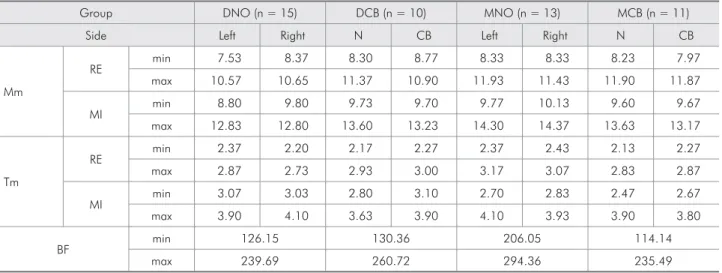
The descriptive statistics are shown on Tables 1 and 2. Muscle thickness and bite force mean values were earlier described.17
Age, gender and body variables had no effects on crossbite tendency in both dentition phases (Ta-ble 2). In the early mixed dentition, children with a higher AFH/FWB ratio were signiicantly more likely to have functional posterior crossbite, after controlling the mentioned variables.
The correlations of FWB and FWI with masseter thickness were signiicantly positive, while AFH/ FWB and AFH/FWI showed negative correlation with masseter and temporal muscle thickness in all groups (Table 3). Bite force was negatively corre-lated with AFH/FWB in the MCB group. AFH did not correlate with bite force or muscle thickness in any group. No signiicant correlations in the DNO group were observed.
Discussion
There is interaction between craniofacial dimen-sions and jaw muscle size in adults and growing in-dividuals.8,12,18,19 The temporal and masseter muscle
volumes exert inluence on the size of their adjacent skeletal sites – such as temporal fossa, zygomatic arch and mandibular ramus – and on which muscle force is exerted.18 Thus, the postural asymmetry that
exists in the presence of malocclusion20 may
contrib-ute to differences in muscle thickness,1 masticatory
function2,6 and skeletal growth and development.3,5 Figure 1 - Facial dimensions. AFH - anterior facial height,
FWB - bizygomatic facial width, FWI - intergonial width (A).
Gonion point (Go) determination. a - mandibular ramus
plane, b - mandibular plane (B).
Go a
b
AFH FWB
FWI
Positive correlations between masseter thickness and FWB and FWI were found, whereas AFH/FWB and AFH/FWI ratios determined negative correla-tions, indicating that children with strong or thick masseter had wider transverse head dimensions in proportion to their AFH. Adults and growing in-dividuals with larger faces8,12 and wider maxillary
dental arch1 presented thicker masseter than those
with a long-face pattern. However, in the current study the temporal thickness did not correlate with facial dimensions. Lateral cephalometry has shown that masseter thickness correlated negatively with mandibular inclination, and positively with mandib-ular ramus height in adults.21 The masseter
thick-ness and facial morphology measurements in grow-ing individuals demonstrated that the thickness was negatively related with AFH and mandibular length, and positively with FWB and FWI.8,12 In the
pres-ent research, AFH showed no signiicant correlation with thickness, agreeing with adult indings.19
Stud-ies with young children were not found for compari-sons.
There were no differences between boys and girls in group comparisons, and no gender inluence for crossbite tendency (Tables 1 and 2), probably because gender differences become signiicant at puberty.2,8,13 Otherwise, it has been considered that
bite force is inluenced by age and gender,13,14,22 de-Table 2 - Descriptive statistics and multivariable logistic regression significances (LoR).
Group Age (months) Gender (n) Weight (kg) Height (m) AFH/FWB AFH/FWI
Ƃ ƃ
DNO 58.67 ± 8.85 5 10 20.12 ± 4.20 1.09 ± 0.07 0.76 ± 0.03 0.99 ± 0.05 DCB 60.50 ± 8.00 4 6 20.39 ± 4.04 1.10 ± 0.07 0.76 ± 0.02 0.99 ± 0.06
LoR ns ns ns ns ns ns
MNO 72.85 ± 6.09 6 7 25.90 ± 4.44 1.20 ± 0.05 0.76 ± 0.03 1.00 ± 0.05 MCB 71.91 ± 4.70 8 3 23.72 ± 7.00 1.17 ± 0.06 0.78 ± 0.04 0.98 ± 0.04
LoR ns ns ns ns * ns
AFH: anterior facial height; FWB: bizygomatic facial width; FWI: intergonial width; DNO: deciduous-normal occlusion; DCB: deciduous-crossbite; MNO: mixed-normal occlusion; MCB: mixed-crossbite; *p < 0.05; ns: not significant.
Table 1 - Minimal (min) and maximal (max) values for masseter (Mm) and temporal (Tm) muscle thickness (mm) and bite force (BF) (N).
Group DNO (n = 15) DCB (n = 10) MNO (n = 13) MCB (n = 11) Side Left Right N CB Left Right N CB
Mm
RE min 7.53 8.37 8.30 8.77 8.33 8.33 8.23 7.97 max 10.57 10.65 11.37 10.90 11.93 11.43 11.90 11.87
MI min 8.80 9.80 9.73 9.70 9.77 10.13 9.60 9.67 max 12.83 12.80 13.60 13.23 14.30 14.37 13.63 13.17
Tm
RE min 2.37 2.20 2.17 2.27 2.37 2.43 2.13 2.27 max 2.87 2.73 2.93 3.00 3.17 3.07 2.83 2.87
MI min 3.07 3.03 2.80 3.10 2.70 2.83 2.47 2.67 max 3.90 4.10 3.63 3.90 4.10 3.93 3.90 3.80
BF min 126.15 130.36 206.05 114.14
creasing with dental and periodontal diseases, tem-poromandibular dysfunction, and malocclusion.2
Early studies have shown that bite force magnitude was related to vertical jaw relationship, face height, and mandibular inclination, form and length.10,22,23
In the present study, the MCB group showed a sig-niicant negative correlation between bite force and AFH/FWB ratio, i.e., children with longer faces tend to present lower bite forces. This agrees with adults23 and older children2,10,11,22 indings, as strong
masticatory muscle action was associated with a tendency to parallelism between the jaws bases, short lower face height, and small gonial angle, that is, good conditions for masticatory muscle strength development. But in deciduous dentition the facial dimensions did not correlate with muscle strength, corroborating the fact that masticatory muscle func-tion and facial form interacfunc-tion can occur later.4,8,24
This study did not ind association between fa-cial morphology and malocclusion in deciduous dentition, agreeing with the indings of Katz et al.7 (2004). However, in the early mixed dentition,
children with a higher AFH/FWB ratio were sig-niicantly more likely to have crossbite (Table 2). Craniofacial asymmetries may be the consequence of the malocclusion, and not only the cause. Lower face height and the maxillary-mandibular inter-molar width ratio were respectively positive and
negative related with crossbite in mixed dentition.3
Accordingly, the presence of a small effective maxil-lary to mandibular skeletal width ratio would sug-gest a skeletal crossbite component and it would be a reason for early intervention. Untreated crossbite in childhood might lead to progressive asymmetric compensation of the condyle-fossa relationship and results in a positional deviation of the mandible and a dentoalveolar asymmetry,20,25 which maintain the
crossbite occlusion in adults.25
A long-face pattern in early mixed dentition was signiicantly associated with a lower bite force and a higher probability for those children to develop crossbite. As bite force and jaw elevator muscles are some of the components of the chewing function, they can affect the face dimensions.22 The decrease
in bite force magnitude may relect on orofacial structure growth and development,2 and the
abnor-mal movement of the mandible (mandibular shift) may contribute to adverse effects as well.1,5
Furthermore, inadequate growth of craniofacial structures and dentofacial complex results from sev-eral genetic and environmental factors, for example oral breathing.4 However, the correct diagnosis of
oral breathing is controversial due to the deinition criteria used, which are often subjective. The lack of straightforwardness of the exams may result in in-correct diagnostics and consequently in inadequate Table 3 - Pearson’s coefficients (r) (p < 0.05) among facial dimensions, masseter (Mm) and temporal (Tm) muscle thickness, and bite force (BF).
Variables Group DCB Group MNO Group MCB
Side r Side r Side r
FWB x Mm RE CB 0.71 Right 0.57 – –
FWI x Mm MI CB 0.62 – – N 0.60
FWI x Mm RE CB 0.63 – – CB 0.60
AFH/FWB x Mm MI N / CB –0.65 / –0.67 Left –0.56 – –
AFH/FWI x Mm MI N –0.63 – – CB –0.68
AFH/FWB x Mm RE – – Left –0.66 – –
AFH/FWI x Mm RE – – – – N –0.70
AFH/FWI x Tm RE N 0.68 – – – –
AFH/FWB x Tm RE – – Left –0.60 – –
AFH/FWB x BF – – – – – –0.61
treatment.4 Thus, mild oral breathing was not taken
into consideration on sample selection, since cranio-facial morphology and dental patterns are affected by severe oral breathing sustained for long periods during high potential growth spurs.16 The children of
the studied sample did not have their full potential growth yet, due to their age, as considered by other studies.16,24
Despite the reliable results found, the sample size could be considered a limitation of this study, but the rationale of early treatment is to get the full ben-eit of the high plasticity of the facial skeletons; so the recognition of malocclusions should be consid-ered as soon as possible.5,6 Therefore, further
stud-ies in young children are required to evaluate cra-niofacial growth and development in the presence of
malocclusion, to assess early treatment beneits.
Conclusion
In the studied sample, masticatory muscle thick-ness was related to face width, and children in the early mixed dentition with a long-face tendency presented lower bite force and higher probability to present functional posterior crossbite. Age, gender, and body variables were not inluencing factors on predicting functional posterior crossbite in decidu-ous and early mixed dentition.
Acknowledgments
We are grateful to Mr. L. Ferrua for his help in statistical analysis. This study was supported by FAPESP-01/10442-3.
References
1. Kiliaridis S, Katsaros C, Raadsheer MC, Mahboubi PH. Bi-lateral masseter muscle thickness in growing individuals with unilateral crossbites [abstract]. J Dent Res. 2000;79:497. 2. Sonnesen L, Bakke M, Solow B. Bite force in
pre-ortho-dontic children with unilateral crossbite. Eur J Orthod. 2001;23(6):741-9.
3. Allen D, Rebellato J, Sheats R, Ceron AM. Skeletal and dental contributions to posterior crossbites. Angle Orthod. 2003;73(5):515-24.
4. Lessa FC, Enoki C, Feres MF, Valera FC, Lima WT, Matsu-moto MA. Breathing mode influence in craniofacial develop-ment. Rev Bras Otorrinolaringol. 2005;71(2):156-60. 5. Pinto AS, Buschang PH, Throckmorton GS, Chen P.
Mor-phological and positional asymmetries of young children with functional unilateral posterior crossbite. Am J Orthod Dentofacial Orthop. 2001;120(5):513-20.
6. Saitoh I, Hayasaki H, Iwase Y, Nakata M. Improvement in jaw motion following treatment of unilateral crossbite in a child with primary dentition: a case report. J Craniomandib Pract. 2002;20(2):129-34.
7. Katz CRT, Rosenblatt A, Gondim PPC. Nonnutritive sucking habits in Brazilian children: effects on deciduous dentition and relationship with facial morphology. Am J Orthod Dentofacial Orthop. 2004;126(1):53-7.
8. Raadsheer MC, Kiliaridis S, Van Eijden TM, Van Ginkel FC, Prahl-Andersen B. Masseter muscle thickness in growing individuals and its relation to facial morphology. Arch Oral Biol. 1996;41(4):323-32.
9. Raadsheer MC, van Eijden TM, van Ginkel FC, Prahl-An-dersen B. Contribution of jaw muscle size and craniofacial
morphology to human bite force magnitude. J Dent Res. 1999;78(1):31-42.
10. García-Morales P, Buschang PH, Throckmorton GS, English JD. Maximum bite force, muscle efficiency and mechanical advantage in children with vertical growth patterns. Eur J Orthod. 2003;25(3):265-72.
11. Ingervall B, Minder C. Correlation between maximum bite force and facial morphology in children. Angle Orthod. 1997;67(6):415-22.
12. Kiliaridis S, Kalebo P. Masseter muscle thickness measured by ultrasonography and its relation to facial morphology. J Dent Res. 1991;70(9):1262-5.
13. Kiliaridis S, Kjellberg H, Wenneberg B, Engstrom C. The relationship between maximal bite force, bite force endurance, and facial morphology during growth. A cross-sectional study. Acta Odontol Scand. 1993;51(5):323-31.
14. Kiliaridis S, Georgiakaki I, Katsaros C. Masseter muscle thickness and maxillary dental arch width. Eur J Orthod. 2003;25(3):259-63.
15. Oueis H, Ono Y, Takagi Y. Prediction of mandibular growth in Japanese children age 4 to 9 years. Pediatr Dent. 2002;24(3):264-8.
16. Lyle KC. Airway compromise and dentofacial abnormalities. J Gen Orthod. 2000;11(4):9-18.
17. Castelo PM, Gavião MB, Pereira LJ, Bonjardim LR. Mas-ticatory muscle thickness, bite force and occlusal contacts in young children with unilateral posterior crossbite. Eur J Orthod. 2007;29(2):149-56.
zygomatico-man-dibular form in adults with manzygomatico-man-dibular prognathism. J Dent Res. 2002;81(11):752-6.
19. van Spronsen PH, Weijs WA, Valk J, Prahl-Andersen B, van Ginkel FC. Relationships between jaw muscle cross-sections and craniofacial morphology in normal adults, studied with magnetic resonance imaging. Eur J Orthod. 1991;13(5):351-61.
20. Myers DR, Barenie JT, Bell RA, Williamson EH. Condylar po-sition in children with functional posterior crossbites: before and after crossbite correction. Pediatr Dent. 1980;2(3):190-4.
21. Kubota M, Nakano H, Sanjo I, Satoh K, Sanjo T, Kamegai T et al. Maxillofacial morphology and masseter muscle thick-ness in adults. Eur J Orthod. 1998;20(5):535-42.
22. Sonnesen L, Bakke M. Molar bite force in relation to occlu-sion, craniofacial dimensions, and head posture in pre-ortho-dontic children. Eur J Orthod. 2005;27(1):58-63.
23. Kovero O, Hurmerinta K, Zepa I, Huggare J, Nissinen M, Ko-nonen M. Maximal bite force and its association with spinal posture and craniofacial morphology in young adults. Acta Odontol Scand. 2002;60(6):365-9.
24. Defabjanis P. Impact of nasal airway obstruction on dentofa-cial development and sleep disturbances in children: prelimi-nary notes. J Clin Pediatr Dent. 2003;27(2):95-100. 25. Langberg BJ, Arai K, Miner RM. Transverse skeletal and