Effect of the delayed auditory feedback in stuttering
O efeito do feedback auditivo atrasado na gagueira
Eliane Regina Carrasco1, Ana Maria Schiefer2, Marisa Frasson de Azevedo2
ABSTRACT
Purpose: To verify the effect of delayed auditory feedback and altered frequency in the stuttering severity, by means of the SpeechEasy®
device. Methods: Sixteen 17 to 49 year-old men and women who stuttered were selected. Schooling ranged from High School to Undergraduate degree. Subjects were distributed in 2 groups: G1 with 8 people who stuttered and had speech therapy using the SpeechEasy®
device and G2 with 8 people who stuttered and had therapy without the device. All the subjects underwent conventional speech-language-hearing evaluation, specific stuttering evaluation, basic hearing evaluation and speech training with or without the device. Obtained data was submitted to appropriate statistical analysis. Results: There was a significant decrease in the stuttering severity level and in atypical disfluencies rate, in groups G1 and G2, in the final assessment when compared to the initial one. Conclusion: There was an improvement of stuttering level with speech training in both groups, with a tendency of G1, which made use of SpeechEasy® device to present higher reduction in the disfluencies rate and bigger gain in articulatory rate and information production rate.
Keywords: Speech, language and hearing sciences; Stuttering; Hearing; Equipment and supplies; Feedback
RESUMO
Objetivo: Verificar o efeito do feedback auditivo atrasado (delay auditory feedback) e da retroalimentação com a frequência alterada (frequency altered feedback) em indivíduos que manifestam gagueira.
Métodos: Foram selecionados 16 indivíduos adultos com diagnóstico de gagueira, de ambos os gêneros, faixa etária entre 17 e 49 anos e com, no mínimo, 8 anos de escolaridade. Os indivíduos foram distribuídos em dois grupos, sendo um grupo (G1) formado por oito indivíduos gagos submetidos à terapia de fala com o uso do aparelho SpeechEasy® e o outro (G2), formado por oito indivíduos gagos submetidos à terapia sem o uso do aparelho. Todos os indivíduos passaram por avaliação fonoaudiológica convencional, avaliação específica da fluência da fala, avaliação audiológica básica e treinamento de fala com ou sem o uso do aparelho.Os dados obtidos foram submetidos à análise estatística pertinente. Resultados: Nos grupos G1 e G2 houve diminuição signifi-cativa do grau de gagueira e das disfluências atípicas na avaliação final, quando comparada à inicial. Conclusão: Houve melhora do grau da gagueira com o treinamento de fala em ambos os grupos, com tendência do G1, que utilizou o dispositivo SpeechEasy®,para apresentar maior redução no índice de disfluências e maior ganho nas taxas de velocidade articulatória e de produção de informação.
Descritores: Fonoaudiologia; Gagueira; Audição; Equipamentos e provisões; Retroalimentação
Work accomplished in the Speech Therapy Department, PostGraduate Program in Human Communication Disorders, to obtain the title of Master of Science, Universidade Federal de São Paulo – UNIFESP – São Paulo (SP), Brazil.
(1) Speech Therapist, São Paulo (SP), Brazil.
(2) Speech Therapy Department, Universidade Federal de São Paulo – UNIFESP – São Paulo (SP), Brazil.
Funding: Coordenação de Aperfeiçoamento de Pessoal de Nível Superior (CAPES)
Conflict of interests: No
Authors’ contribution: ERC main researcher, research elaboration, schedule elaboration, literature review, collection and analysis of data, paper writing, submis-sion and procedures article; AMS co-advisor, research elaboration, schedule elaboration, analysis of data, paper writing review, approval of the final version; MFA
advisor, research elaboration, schedule elaboration, analysis of data, paper writing review, approval of the final version.
Correspondence address: Eliane Regina Carrasco. R. Professor Rubião Meira, 42, Sumaré, São Paulo (SP), Brazil, CEP: 05409-020. E-mail: [email protected]
INTRODUCTION
Stuttering is a speech disorder known since ancient times, but until today, there is no consensus on its definition and probable cause. Thus, the Stuttering Foundation of America published in 1995, numerous definitions that vary according to the authors.
Although it is consensus that the cause of stuttering is still unknown, there are a variety of etiologic factors have been considered, suggesting multiple causes, including genetic, neu-rophysiological, environmental, personality, learning, auditory processing, language and speech production.
In relation to hearing aspects, research conducted with individuals who stutter have shown important data that em-phasize its role in stuttering study. Research on the effect of delay auditory feedback (DAF) and frequency altered feedback (FAF) have shown that stutterers have improvement in their fluency when exposed to this type of stimulation, and even one of the techniques used in the treatment of stuttering(1-4).
There is controversy in the literature on the use of SpeechEasy® in stutterers. Some authors suggest that the use of this feature does not always have some positive change in stuttered speech, suggesting the influence of other factors(1).
Others consider the use of delayed auditory feedback as a therapeutic technique, which in addition to improving the flow of these individuals, presents results suggest that auditory processing and auditory feedback seem to have an important role in stuttering(5,6).
The objective of this research was to verify the effect of delayed auditory feedback and frequency altered feedback in individuals who manifest stuttering.
METHODS
This is a prospective, comparative study approved by the Research Ethics Committee of the Universidade Federal de São Paulo (UNIFESP) (nº. 0366/11). All participants were informed about the features and procedures of the study and signed the Informed Consent.
Data collection was performed at the Speech and Hearing Evaluation and Diagnostic Clinic of the São Paulo Hospital, Hearing Research Center for Speech and Fluency (NIFF).
The sample consisted of 16 adults diagnosed with stuttering, male and female, aged between 17 and 49 years, with education of at least eight years.
In the sample, the inclusion criteria were considered: to present the development stuttering history; between 17 and 59 years; have at least eight years of schooling; show 3% or more atypical speech disfluency and scoring at least 18 points in the Stuttering Severity Instrument(SSI-3)(7), which is equivalent
to a mild stuttering; unattended speech therapy at the time of evaluation.
Exclusion criteria were evidence of deafness; language disorder, neurological and/or psychiatric diseases and severity of stuttering classified as “very mild”.
Subjects were allocated into two groups: the G1 made up of eight stutterers undergoing therapy using the SpeechEasy® device during all sessions and the G2 group, made up of eight stutterers submitted to the same therapy, but without the use of SpeechEasy® device. The mean age of the G1 was 32.8 years, ranging 20-43 years and the G2 was 26 years, ranging from 19 to 43.
All subjects were submitted to speech and hearing assess-ment, pre- and post-therapy. The speech and hearing assessment consisted of anamnesis, speech and hearing screening and specific assessment of stuttering.
In the interview were collected relevant information about education, communication history, family history, hearing complaints and health in general. The speech screening was per-formed using the Neuropsychological Assessment Instrument-Brief NEUPSILIN(8).
For the evaluation specifies of the fluency of speech, spon-taneous speech recordings were made (Digital Camcorder DCR-SR85 Sony® model) with transcribed speech samples (200 syllables), mapping them in typical and atypical disfluen-cies(7,9). It was later estimated the severity of stuttering through
the SSI-3 protocol(7). For diagnosis of stuttering, we adopted the
criterion of the presence of at least 3% of atypical disfluencies and score from 18 points in the SSI-3 instrument, excluding the very mild stuttering.
To evaluate the speech rate, the analysis was made of the articulatory speed rates (syllables per minute) and production information (words per minute) in spontaneous speech recor-dings. It was used as normality criteria for adult individual values between 219-257 syl/min in speech rate and 117-140 word/min in the production information, according to the cri-terion described in the literature(10).
The audiological evaluation consisted of pure tone audiome-try and acoustic impedance. It was considered normal hearing when the mean of thresholds at 500 Hz, 1000 Hz and 2000 Hz was less than 25 dB HL. The tympanometric curve type A was considered normal.
Individuals of G1 group underwent with speech training based on the program Fluency Shaping (Fluency Shaping Therapy)(11,12), using digital electronic device - SpeechEasy®
allowing altered auditory feedback in two ways: by delayed auditory feedback (DAF) and by altering the frequency of the feedback (FAF). It was used a single device with individual generic molds, only during the training session.
most complex, i.e. the sound to syllable, word and sentence. Setting the device used for each participant was established according to the manufacturer’s protocol, which it regards as ideal personal preference regarding the signal quality associated with greater reduction of stuttering(5). Initially it was used the
default setting of 60 ms, 500 Hz and volume two. The default DAF was adjusted individually until reaching 100 ms, depen-ding on the performance of the patient. The choice of the ear to initial adaptation was made according to individual prefe-rence, starting with the ear that said use to talk on the phone, as recommended by the equipment representative.
Then, samples were made from recordings of spontaneous speech (conversation) with the use of the device previously adapted for the left ear and right separately.
With the device adapted, began a speech training period with the use of the device for one hour (30 minutes in each ear), through exercises to model the speech, for two consecutive we-eks, for a total of four days training. During the speech training, before each exercise, was recommended to the participant who should pay attention to the acoustic signal. The exercises were performed twice successively on each side of the ear, alternating every day of training, the ear to be stimulated initially.
After this training period, were recorded new speech samples with the device monaurally (right and left ears) and without the device.
All speech samples were transcribed and stuttering severity was verified by the SSI-3 Protocol(7).
The individuals of G2 group underwent the same speech training, but without the use of SpeechEasy® device, perfor-ming an initial recording and the other in the end to collect samples of speech and subsequent analysis of the level of severity of stuttering through SSI-3 Protocol.
In both groups, we performed the same speech training, making sure that all individuals receive exactly the same therapy. The author of the study that treated the patients. To maintain the reliability of the experiment, we opted for the transcription and analysis of samples by another speech the-rapist with experience in the area of fluency and without prior knowledge of the group to which the patient belonged (with or without SpeechEasy®) and in that situation (pre-therapy or post-therapy).
Statistics
For variables quantitative (numerical), were calculated some summary measures such as mean, median, minimum and ma-ximum values and standard deviation. The qualitative variables (categorized) were analyzed by calculating the absolute and relative frequencies (percentages). Inferential analyzes used in order to confirm or refute evidence found in the descriptive analysis were non-parametric analysis of ordinal data, com-paring the level of stuttering individuals by groups with and without equipment as pre- and post-therapy.
The analysis of variance (ANOVA) with repeated measu-res(13) was used for comparison of groups with and without the
device, in the early stages, according atypical disfluency (%), speed articulatory rate (syl/min) and information production rate (word/min).
RESULTS
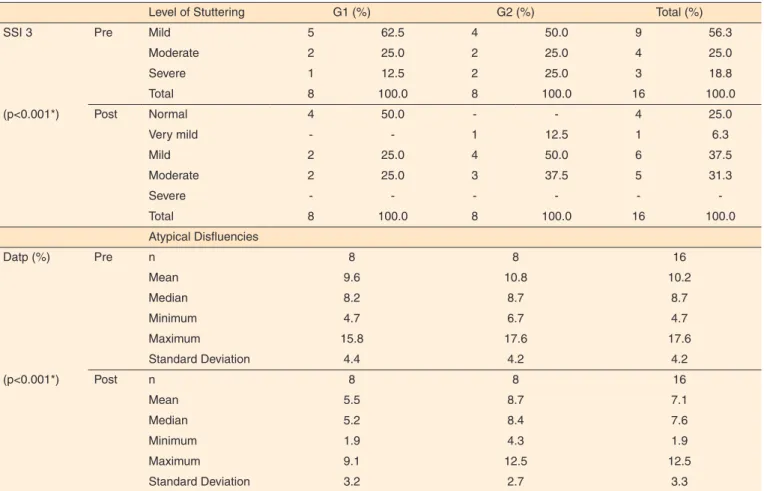
The distribution of level of stuttering and atypical disfluen-cies of individuals of G1 and G2 groups, in percentage, in the pre- and post-training is presented in Table 1 and Figure 1. There was a significant decrease in the level of stuttering and atypical disfluencies in the final evaluation when compared to baseline.
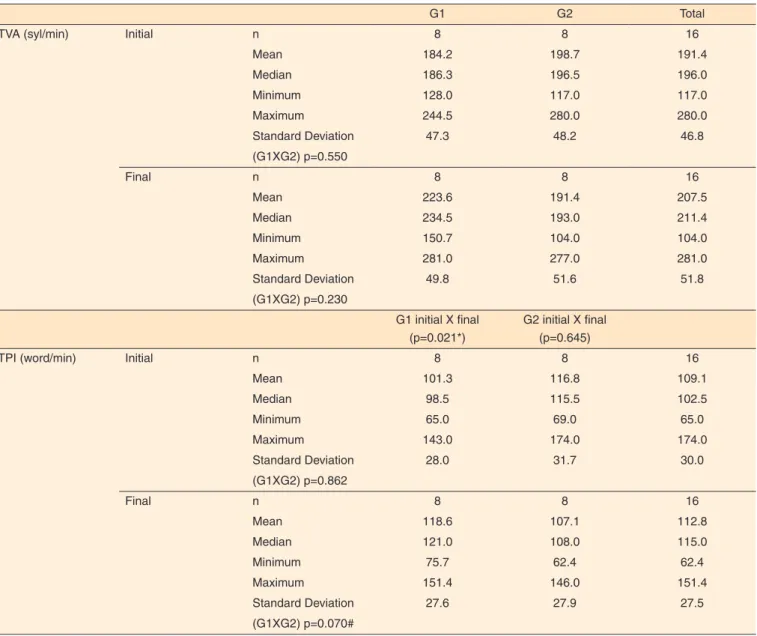
The distribution of rates of speed articulatory and pro-duction information of individuals in groups G1 and G2, the pre- and post-training, is presented in Table 2. In the G1, there was an increase of speech rate and reduce the production in-formation, the initial assessment to the final. In G2, there was a reduction in both assessments.
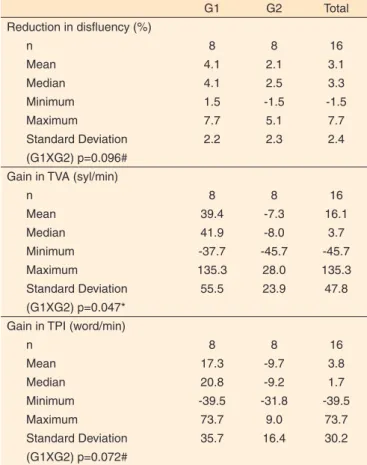
The mean values of the reduction of atypical disfluencies and earnings of speed articulatory rates and production information of individuals of G1 and G2, the pre- and post-training are presented in Table 3. It is observed that the G1 had a tendency to reduction in disfluencies index and higher gain in the articulatory speed rate and the rate of production information, compared to G2.
DISCUSSION
The results of the comparison between the groups in the pre and post-training time show an improvement with speech
Note: G1 = stutterers undergoing therapy using SpeechEasy® device; G2 = stut-terers submitted to the therapy, without the use of SpeechEasy® device
training in both groups. However, there was significant reduc-tion in the level of stuttering and atypical disfluencies in the final assessment when compared to the initial in G1 group, ie the group with the SpeechEasy®. According to Perkins (1984), Fluency Shaping Therapy brings good results by training the specific abilities of speech, whose main objective is to obtain a basal fluency. The line therapy used was effective for both groups.
The group using the SpeechEasy® (G1) showed a ten-dency to reduction in disfluencies index and higher gain in speed articulatory rate and the rate of production information, compared to G2. This shows that, although both had positive results with speech training, the group that used the device obtained greater benefits. In G1, there was reduced mean aty-pical disfluencies of pre-training evaluation for post-training compared to G2.
This reduction of disfluencies using the device agrees with the literature, since several studies demonstrated improved spe-ech stuttered under conditions of “auditory feedback”, ie using masking, DAF, FAF, or a combination of them, showing strong correlation between stuttering and auditory aspects(1,3,5,11,12,14-20).
Due to the reduction of disfluency, improvement was observed in the level of stuttering, especially in G1. Therefore, there
was significant reduction in the level of stuttering and atypical disfluencies in the post-training evaluation, compared to pre--training assessment of group using the SpeechEasy®.
Regarding the articulatory speed rates and production in-formation, it was observed that in G1, there was an increased speech rate and production information, pre- to post-training, while G2, there was a reduction in both.
Studies on the syllables speed rates and words in spee-ch stuttered indicate agreement concerning researspee-ch on the relationship between the severity of stuttering and rates of production information (words per minute) and articulatory (syllables per minute) through speech samples for analysis at least 200 fluent syllables. The results found that the more severe the level of stuttering, lower rates of production infor-mation and articulatory of stutterers, ie stutterers have minor speech rates when compared to fluent individuals. They also observed a significant difference in speech rates, taking into account the different levels of severity of stuttering. Individuals with mild and moderate stuttering have similar speech rates, whereas those with severe stuttering, have lower rates(21-23).
A study on the effect of auditory feedback in speed ra-tes found that all participants had a significant reduction in
Table 1. Level of stuttering and atypical disfluencies, pre- and post-treatment
Level of Stuttering G1 (%) G2 (%) Total (%)
SSI 3 Pre Mild 5 62.5 4 50.0 9 56.3
Moderate 2 25.0 2 25.0 4 25.0
Severe 1 12.5 2 25.0 3 18.8
Total 8 100.0 8 100.0 16 100.0
(p<0.001*) Post Normal 4 50.0 - - 4 25.0
Very mild - - 1 12.5 1 6.3
Mild 2 25.0 4 50.0 6 37.5
Moderate 2 25.0 3 37.5 5 31.3
Severe - - -
-Total 8 100.0 8 100.0 16 100.0
Atypical Disfluencies
Datp (%) Pre n 8 8 16
Mean 9.6 10.8 10.2
Median 8.2 8.7 8.7
Minimum 4.7 6.7 4.7
Maximum 15.8 17.6 17.6
Standard Deviation 4.4 4.2 4.2
(p<0.001*) Post n 8 8 16
Mean 5.5 8.7 7.1
Median 5.2 8.4 7.6
Minimum 1.9 4.3 1.9
Maximum 9.1 12.5 12.5
Standard Deviation 3.2 2.7 3.3
*Significant values (p<0.01) – Analysis of variance (ANOVA)
stuttering, speaking with the use of SpeechEasy®. However, speech rates vary minimally, increasing only 8% in the reading assignment and 15% in monologue task, remaining below normal. Low speech rate while using the device is probably due to the manufacturer’s instructions to encourage users to speak in chorus, with the sign of delayed auditory feedback(3).
For decades, several authors have used DAF for the reduc-tion of speech rate, including therapy cluttering, maintaining the hypothesis that the effect, both in the severity of stuttering, and in cluttering be due to a reduced speech rate(11,12,14).
Investigations into the immediate effect of auditory feedba-ck showed significant differences in the frequency of stuttering, but not in speech rate, indicating that stutterers showed no spe-ech rate slower when exposed to auditory feedback. However, studies show great variability in results, which illustrates clearly
the heterogeneity of the effects of these devices. There is strong evidence that the reduced speech rate is not essential for the improvement of stuttering when subjected to delayed auditory feedback conditions. This suggests that the auditory feedback actually plays an important role in improving the fluency and are not only subject to reduced speech rate(3,23,24).
The data in this study support the idea that the speech rate would not be responsible for the improvement of stuttering when underwent to delayed auditory feedback conditions, as was observed in G1, using the SpeechEasy®, the reduction index of atypical disfluencies and stuttering severity, associa-ted with increased rate of speech articulatory and production information.
The results observed in several experiments and in the pre-sent study demonstrated that these auditory nature strategies
Table 2. Rates of articulatory speed and the production information, pre- and post- treatment
G1 G2 Total
TVA (syl/min) Initial n 8 8 16
Mean 184.2 198.7 191.4
Median 186.3 196.5 196.0
Minimum 128.0 117.0 117.0
Maximum 244.5 280.0 280.0
Standard Deviation 47.3 48.2 46.8
(G1XG2) p=0.550
Final n 8 8 16
Mean 223.6 191.4 207.5
Median 234.5 193.0 211.4
Minimum 150.7 104.0 104.0
Maximum 281.0 277.0 281.0
Standard Deviation 49.8 51.6 51.8
(G1XG2) p=0.230
G1 initial X final (p=0.021*)
G2 initial X final (p=0.645)
TPI (word/min) Initial n 8 8 16
Mean 101.3 116.8 109.1
Median 98.5 115.5 102.5
Minimum 65.0 69.0 65.0
Maximum 143.0 174.0 174.0
Standard Deviation 28.0 31.7 30.0
(G1XG2) p=0.862
Final n 8 8 16
Mean 118.6 107.1 112.8
Median 121.0 108.0 115.0
Minimum 75.7 62.4 62.4
Maximum 151.4 146.0 151.4
Standard Deviation 27.6 27.9 27.5
(G1XG2) p=0.070#
*Significant values (p<0.05) – Analysis of variance (ANOVA) # Tendency
Table 3. Mean values reduction in atypical disfluency, the gains in speed articulatory rates and production information for G1 and G2
G1 G2 Total
Reduction in disfluency (%)
n 8 8 16
Mean 4.1 2.1 3.1
Median 4.1 2.5 3.3
Minimum 1.5 -1.5 -1.5
Maximum 7.7 5.1 7.7
Standard Deviation 2.2 2.3 2.4
(G1XG2) p=0.096# Gain in TVA (syl/min)
n 8 8 16
Mean 39.4 -7.3 16.1
Median 41.9 -8.0 3.7
Minimum -37.7 -45.7 -45.7
Maximum 135.3 28.0 135.3
Standard Deviation 55.5 23.9 47.8
(G1XG2) p=0.047* Gain in TPI (word/min)
n 8 8 16
Mean 17.3 -9.7 3.8
Median 20.8 -9.2 1.7
Minimum -39.5 -31.8 -39.5
Maximum 73.7 9.0 73.7
Standard Deviation 35.7 16.4 30.2
(G1XG2) p=0.072#
*Significant values (p<0.05) – t-Student Test #Tendency
Note: TVA = rates of articulatory speed; syl/min = syllables per minute; TPI = production information; word/min = words per minute; G1 = stutterers undergoing therapy using SpeechEasy® device; G2 = stutterers submitted to the therapy, without the use of SpeechEasy® device
cannot be used arbitrarily for all stutterers, because not all respond favorably, and should therefore be carefully tested in each individual(1,5,16,19,23-29).
CONCLUSION
There was an improvement of stuttering level with speech training in both groups, with a tendency of G1, which made use of SpeechEasy® device to present higher reduction in the disfluencies rate and bigger gain in articulatory rate and infor-mation production rate.
REFERENCES
1 Van Borsel J, Eeckhout H. The speech naturalness of people who stutter speaking under delayed auditory feedback as perceived by different groups of listeners. J Fluency Disord. 2008;33(3):241-51. http://dx.doi.org/10.1016/j.jfludis.2008.06.004
2 Lincoln M, Packman A, Onslow M. Altered auditory feedback and the treatment of stuttering: a review. J Fluency Disord. 2006;31(2):71-89. http://dx.doi.org/10.1016/j.jfludis.2006.04.001
3 Armson J, Kiefte M. The effect of SpeechEasy on stuttering frequency, speech rate, and speech naturalness. J Fluency Disord. 2008;33(2):120-34. http://dx.doi.org/10.1016/j.jfludis.2008.04.002 4 Ritto AP. Impacto do uso do SpeechEasy nos parâmetros acústicos e
motores da fala de indivíduos com gagueira [dissertação]. São Paulo: Faculdade de Medicina da Universidade de São Paulo; 2014. 5 Armson J, Kiefte M, Mason J, De Croos D. The effect of SpeechEasy
on stuttering frequency in laboratory conditions. J Fluency Disord. 2006;31(2):137-52. http://dx.doi.org/10.1016/j.jfludis.2006.04.004 6 O’Donnell JJ, Armson J, Kiefte J. The effectiveness of SpeechEasy
during situations of daily living. J Fluency Disord. 2008;33(2):99-119. http://dx.doi.org/10.1016/j.jfludis.2008.02.001
7 Riley GD. Stuttering severity instrument for children and adults. 3rd ed. Austin: Pro-Ed; 1994.
8 Fonseca RP; Salles JF; Parente MAMP. Neupsilin: instrumento de avaliação neuropsicológica breve. São Paulo: Vetor; 2009.
9 Juste F, Andrade CRF. Tipologia das rupturas de fala e classes gramaticais em crianças gagas e fluentes. Pró-Fono. 2006;18(2):129-40. http://dx.doi.org/10.1590/S0104-56872006000200002
10 Zackiewicz DV, Andrade CRF. Seis parâmetros da fluência. Rev Soc Bras Fonoaudiol. 2000;5(7):59-64.
11 Perkins WH, editor. Stuttering disorders. New York: Thieme-Stratton; 1984.
12 Ryan BP. Programmed therapy for stuttering in children and adults. 2nd ed. Springfield: CC Thomas; 2010.
13 Neter J, Kutner MH, Nachtsheim CJ, Wasserman W. Applied linear statistical models. 4th ed. Boston: Irwin; 1996.
14 Curlee RF. Stuttering and related disorders of fluency. New York: Thieme; 1993.
15 Bloodstein O. Some empirical observations about early stuttering: a possible link to language development. J Commun Disord. 2005;39(3):185-91. http://dx.doi.org/10.1016/j.jcomdis.2005.11.007 16 Stuart A, Kalinowski J, Saltuklaroglu T, Guntupalli VK.
Investigations of the impact of altered auditory feedback in-the-ear devices on the speech of people who stutter: one-year follow-up. Disabil Rehabil. 2006;28(12):757-65. http://dx.doi. org/10.1080/09638280500386635
17 Lincoln M, Walker C. A survey of Australian adult users of altered auditory feedback devices for stuttering: use patterns, perceived effectiveness and satisfaction. Disabil Rehabil. 2007;29(19):1510-7. http://dx.doi.org/10.1080/09638280601024739
18 Schiefer AM, Pereira LD, Gil D. Relação entre gagueira e os aspectos auditivos. In: Rocha EMN. Gagueira: um distúrbio da fluência. São Paulo: Santos; 2007. p. 205-18.
19 Antipova EA, Purdy SC, Blakeley M, Williams S. Effects of altered auditory feedback (AAF) on stuttering frequency during monologue speech production. J Fluency Disord. 2008;33(4):274-90. http:// dx.doi.org/10.1016/j.jfludis.2008.09.002
21 Andrade CRF, Cervone LM, Sassi FC. Relationship between the stuttering severity index and speech rate. Sao Paulo Med J. 2003;121(2):81-4. http://dx.doi.org/10.1590/S1516-31802003000200010
22 ArcuriCF, OsbornE, SchieferAM, ChiariBM. Taxa de elocução de fala segundo a gravidade da gagueira. Pró-Fono. 2009;21(1):45-50. http://dx.doi.org/10.1590/S0104-56872009000100008
23 Sparks G; Grant DE; Millay K; Walker-Batson D; Hynan LS. The effect of fast speech rate on stuttering frequency during delayed auditory feedback. J Fluency Disord. 2002;27(3):187-200. http:// dx.doi.org/10.1016/S0094-730X(02)00128-6
24 Unger JP, Glück CW, Cholewa J. Immediate effects of AAF devices on the characteristics of stuttering: a clinical analysis. J Fluency Disord. 2012;37(2):122-34. http://dx.doi.org/10.1016/j. jfludis.2012.02.001
25 Borsel JV; Sierens S; Pereira MMB. Realimentação auditiva atrasada e tratamento de gagueira: evidencias a serem consideradas. Pró-Fono. 2007;19(3):323-32. http://dx.doi.org/10.1590/S0104-56872007000300011
26 O’Donnell JJ, Armson J, Kiefte J. The effectiveness of SpeechEasy during situations of daily living. J Fluency Disord. 2008;33(2):99-119. http://dx.doi.org/10.1016/j.jfludis.2008.02.001
27 Andrade CRF, Juste FS. Análise sistemática da efetividade do uso da alteração do feedback auditivo para a redução da gagueira. J Soc Bras Fonoaudiol. 2011;23(2):187-91. http://dx.doi.org/10.1590/ S2179-64912011000200018
28 Gallop RF, Runyan CM. Long-term effectiveness of the SpeechEasy fluency enhancement device. J Fluency Disord. 2012;37(4):334-43. http://dx.doi.org/10.1016/j.jfludis.2012.07.001