Mo dulatio n o f staphylo kinase
-de pe n-de nt plasm ino ge n activatio n
by m o no - and divale nt io ns
1Laboratorio de Biologia y Medicina Experimental and
2Genetica y Q uimica Celular, Facultad de Ciencias, Universidad de Los Andes,
Merida, Venezuela A. Yarzábal1,
R.L. Serrano2
and J. Puig1
Abstract
The effect of several ions (Cl-, Na+, K+, Ca2+) on the rate of
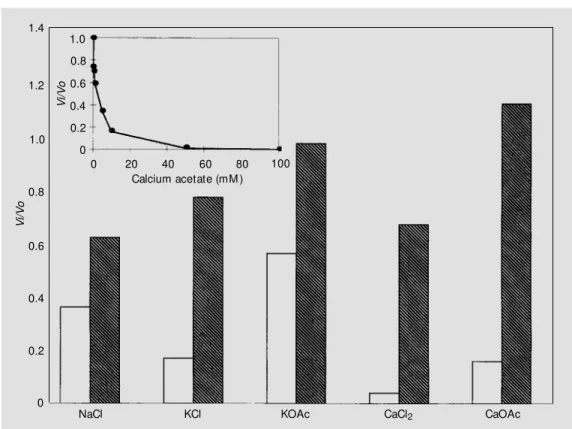
plasmino-gen (Pg) activation by recombinant staphylokinase (rSTA) is reported. Both monovalent and divalent ions affect the rate at which Pg is activated by rSTA, in a concentration-dependent manner (range 0-100 mM). In almost all cases, a decrease of the initial velocity of activation was observed. Cl- showed the most striking inhibitory effect at low concentrations (64% at 10 mM). However, in the presence of a fibrin surface, this inhibition was attenuated to 38%. Surprisingly, 10 mM Ca2+ enhanced the Pg activation rate 21% when a polymerized fibrin
matrix was present. These data support the idea that ions can modulate the rate of Pg activation through a mechanism that may be associated with changes in the molecular conformation of the zymogen. This effect is strongly dependent on the presence of a fibrin clot.
Co rre spo nde nce
A. Yarzábal
LABIO MEX, Facultad de Ciencias Universidad de Los Andes Apartado Postal 281 Mérida 5101 Venezuela Fax: + 58-74-63-4587 E-mail: [email protected]
Research supported by CDCHT/ ULA (No. C-678-94).
Received March 17, 1998
Accepted O ctober 7, 1998
Ke y wo rds
·Staphylokinase
·Plasminogen activation
·Fibrinolysis
Staphylokinase (STA), a bacterial plas-minogen activator produced by some strains
of Staphylococcus aureus, is considered at
present as the most promising fibrinolytic agent for the treatment of patients with acute myocardial infarction (1). Human plasmino-gen (Pg) activation by STA is being studied to elucidate the mechanism of activation since STA is not an enzyme. It has been established that STA forms a stoichiometric complex with Pg (STA.Pg) in which a plas-min (Pm) activity is rapidly detected. The STA.Pm complex is the active enzyme which specifically activates other Pg molecules on the surface of a fibrin clot (2,3). This prefer-ential activation of fibrin-bound Pg has been explained by the rapid inhibition of circulat-ing complexes by a-2-antiplasmin in plasma
but not on the fibrin surface, where the mo-lecular domains involved in the inhibition process closely associate with the clot (4).
Kinetic studies of Pg activation by STA have focused mainly upon the activation mechanism, fibrin specificity, the correlation among various inhibitors and the effect of STA concentration on plasminogen activa-tion (5). It is well known that ions could act as negative or positive effectors of Pg activation by streptokinase and urokinase, two well-known Pg activators currently in therapeutic use (6,7). However, to date no results con-cerning these effects on Pg activation by STA have been described. We report here, for the first time, the effect of Ca2+
rSTA and human Glu-Pg were purified and characterized as described elsewhere (8,9). Lys-Pg was produced by plasmin di-gestion of Glu-Pg at 37o
C in 40 mM L-lysine
for 1 h (10). rSTA.Pm complexes were ob-tained by incubation of Pg with rSTA (3 µM each, with a 5% molar excess of rSTA) at 37°C for 10 min in 50 mM HEPES, pH 7.4, containing 25% glycerol (11). Solid phase fibrin plates were prepared to activate plas-minogen in the presence of a polymerized fibrin surface. Briefly, after treatment of poly-vinyl chloride (PVC) plates with 2.5% glu-taraldehyde, purified human fibrinogen (0.1 mg/ml in 0.1 M sodium phosphate buffer, pH 7.4, containing 1 mM CaCl2) was
co-valently fixed and converted into a fibrin network by thrombin treatment (12). Activa-tion assays were performed in microtiter and fibrin plates and were based on the develop-ment of amidolytic activity of Pm generated by Pg activation, towards a chromogenic
substrate specific for plasmin, MM-Hyp-Arg-pNA (CBS 00.65, Diagnostica STAGO, Asnieres, France) (13). The assays were per-formed at 37o
C in a buffer containing 50 mM HEPES, pH 7.4, the substrate CBS 00.65 (1 mM), rSTA (50 nM) or rSTA.Pm complexes (10 nM) and different levels of ions ranging from 0 to 100 mM. Glu-Pg (1 µM) was added to start the reaction and the absorbance at 405 nm of the mixtures was continuously monitored. Initial reaction rates were deter-mined from the slopes of plots of A405 versus t2, according to the method of Wohl (14).
As expected, rSTA activated human Glu-Pg with a lag period of at least 5 min which almost disappeared when Lys-Pg was used (Figure 1A and B). Activation of Pg by rSTA obeyed Michaelis-Menten kinetics as re-vealed by linear double-reciprocal plots of the initial activation rates versus the Pg con-centration (Figure 1C). When preformed rSTA.Pm complexes were used as the acti-vator species, the lag period also diminished. This was also observed when activation as-says were performed in the presence of a fibrin surface on fibrin plates (results not shown).
Taken together, these results support the view that during the activation process of Glu-Pg by STA there is a rate-limiting step during which the activator must bind to the zymogen causing a molecular conversion of Glu-Pg to Lys-Pg to take place. It has been shown that Lys-Pg possesses a more open conformation and interacts more easily with activators (15). In fibrin plates, the binding of Glu-Pg to fibrin through kringle domains induces a similar conformational change, from a closed to an open form that ac-celerates the activation rate (16).
These observations were confirmed when the activation experiments were carried out in the presence of different ions (Figure 2). The effect of Cl-, which stabilizes the closed form of the zymogen (17), is mark-edly inhibitory even at 1/10 of its physiologi-cal concentration. SDS-PAGE analysis of
d
A
/d
t
1
/
b
(
2
x
D
A4
0
5
/m
in
2)
-1
0.20
0.15
0.10
0.05
0
0 5 10 15
0.20
0.15
0.10
0.05
0
0 5 10 15
Time (min)
80
60
40
20
-1 0 1 2 3
l/So(µM-1)
A
B
C
Pg activation products revealed that in the presence of 20 mM NaCl the one-chain Glu-Pg form did not undergo the molecular tran-sition to the enzymatically active two-chain Pm (not shown). Cl--induced inhibition has been reported previously in studies where Pg was activated with streptokinase and uroki-nase, two fibrinolytic agents used world-wide for the treatment of acute myocardial infarction (5). However, in the presence of a fibrin surface, a significant reduction of the inhibitory effect of Cl- was observed. Once again, Pg binding to fibrin appears to reverse the inhibition, probably due to Cl- exclusion from the domains involved in such interac-tion (17).
The inhibitory effect of other mono- and divalent ions has also been established. Their effect was not so striking as the Cl- inhibi-tion, but a concentration-dependent decrease of the Pg activation rate was observed in almost all cases (Figure 2, inset). The anion acetate does not inhibit Glu-Pg activation to the same extent as Cl-. As already stated,
acetate does not bind as strongly to the an-ion-binding sites on Glu-Pg kringles as does Cl- and therefore does not modulate as effec-tively the production of the closed state (17). Surprisingly, when calcium in the ac-etate salt form was added to activation mix-tures in fibrin plates, an enhancement of the rate of Pg activation by rSTA was observed. This effect attained its maximum at a con-centration of 5 mM, which is close to the physiological concentration.
The role of Ca2+
in fibrinolysis is un-known and has been investigated by several authors. Stack et al. (7) observed that diva-lent cations inhibited the activation of Glu-Pg but stimulated the activation of Lys-Glu-Pg, confirming that the molecular conformation of the substrate is critical for the inhibitory/ enhancer effect. Markus et al. (18) observed that casein, a Ca2+
-rich phosphoprotein, is a potent accelerator of the rate of Pg activation by both urokinase and tissue Pg-activator. Their findings showed that partial removal of Ca2+
by chelating agents such as EDTA or
1.4
1.2
1.0
0.8
0.6
0.4
0.2
0 1.0
0.8
0.6
0.4
0.2
0
0 20 40 60
V
i/
V
o
80 100
Calcium acetate (mM )
NaCl KCl KOAc CaCl2 CaOAc
V
i/
V
o
EGTA reduced the enhancing effect by an average of 38% of the control. Recently, Kojima et al. (19) reported that a physiologi-cal concentration of Ca2+
significantly short-ened the euglobulin clot lysis time, an assay used to assess systemic fibrinolytic activity. Furthermore, tetranectin, a plasminogen-binding protein which possesses intact cal-cium binding sites, has been shown to inter-act specifically with kringle 4. The function of tetranectin is unknown, but the protein has been reported to enhance Pg activation by t-PA, a mechanism that could be closely associated with calcium binding (20).
Our findings add to these results, show-ing that Ca2+
enhances the rate at which Pg is activated by rSTA in the presence of poly-merized fibrin. Even though the role of Ca2+
requires further investigation, it is clear that Ca2+ may modulate the rate at which Pg is
converted to Pm by physiological and thera-peutical activators. Such modulation of fi-brinolytic activity should be very important in determining the rate of activation in the microenvironment of this zymogen, particu-larly in the vicinity of a fibrin clot.
Nevertheless, since the mechanism of Pg activation is triggered and further amplified by specific interactions of fibrin with the Pg kringle domains, it is clear that these studies should be developed at least in the presence of a fibrin surface in order to obtain experi-mental conditions as close as possible to the physiological plasma/fibrin interphase. If not, some effects could be over- or underesti-mated, as shown in the present study.
Re fe re nce s
1. Lijnen HR & Collen D (1996). Staphyloki-nase, a fibrin-specific bacterial plasmino-gen activator. Fibrinolysis, 10: 119-126. 2. Collen D, Schlott B, Engelborghs Y, Van
Hoef B, Hartmann M , Lijnen HR & Behnke D (1993). On the mechanism of the acti-vation of human plasminogen by recom-binant staphylokinase. Journal of
Biologi-cal Chemistry, 268: 8284-8289.
3. Lijnen HR, Van Hoef B, De Cock F, Okada K, Ueshima S, M atsuo O & Collen D (1991). On the mechanism of fibrin-spe-cific plasminogen activation by staphylo-kinase. Journal of Biological Chemistry, 266: 11826-11832.
4. Silence K, Collen D & Lijnen HR (1993). Int eract ion bet w een st aphylokinase, plasmin(ogen) and a2-antiplasmin. Recy-cling of staphylokinase after neutralization of the plasmin-staphylokinase complex by
a2-ant iplasm in. Journal of Biological
Chemistry, 268: 9811-9816.
5. Shibata H, Nagaoka M , Sakai M , Saw ada H, Watanabe T & Yokokura T (1994). Ki-netic studies on the plasminogen activa-tion by the staphylokinase-plasmin com-plex. Journal of Biochemistry, 115:
738-742.
6. Urano T, Chibber BAK & Castellino FJ (1987). The reciprocal effects of e amino-hexanoic acid and chloride ion on the acti-vation of human (Glu1) plasminogen by human urokinase. Proceedings of the
Na-tional Academy of Sciences, USA, 84:
4031-4036.
7. Stack S, Gonzáles-Gronow M & Pizzo S (1991). The effect of divalent cations on the conformation and function of human plasminogen. Archives of Biochemistry
and Biophysics, 284: 58-62.
8. Yarzábal A, Bastidas M , Avilán L, Cruz J & Puig J (1997). Induction conditions for maximizing recombinant staphylokinase expression in Escherichia coli.
Biotech-nology Letters, 19: 633-637.
9. Castellino FJ & Pow ell JR (1981). Human plasminogen. M ethods in Enzymology, 80: 365-378.
10. Trieu T, Behnke D, Gerlach D & Tang J (1993). Activation of human plasminogen by recombinant staphylokinase. M ethods
in Enzymology, 223: 156-167.
11. Lijnen HR, Van Hoef B & Collen D (1993). Interaction of staphylokinase w ith
differ-ent molecular forms of plasminogen.
Eu-ropean Journal of Biochemistry, 211:
91-97.
12. Anglés-Cano E (1985). A spectrophoto-metric solid-phase fibrin-tissue plasmino-gen activator activity assay (SOFIA-tPA) for high-fibrin-affinity tissue plasminogen activators. Analytical Biochemistry, 153: 201-210.
13. Chibber BAK, M orris JP & Castellino FJ (1985). Effects of human fibrinogen and its cleavage products on activation of hu-man plasminogen by streptokinase.
Bio-chemistry, 24: 3429-3434.
14. Wohl RC, Summaria L & Robbins KC (1980). Kinetics of activation of human plasminogen by different activator spe-cies at pH 7.4 and 37oC. Journal of
Bio-logical Chemistry, 255: 2005-2013.
15. M angel W F, Lin B & Ram akrishan V (1990). Characterization of an extremely large, ligand-induced conf orm at ional change in plasminogen. Science, 248: 69-73.
Fi-brinolysis, 3: 605-614.
17. M cCance SG & Castellino FJ (1995). Con-tributions of individual kringle domains to-w ards maintenance of the chloride-in-duced tight conformation of human glu-tamic acid-1 plasminogen. Biochemistry, 34: 9581-9586.
18. M arkus G, Hitt S, Harvey SR & Tritsch GL
(1993). Casein, a pow erful enhancer of the rate of plasminogen activation.
Fibrin-olysis, 7: 229-236.
19. Kojima Y, Urano T, Kojima K, Serizaw a K, Takada Y & Takada A (1994). The signifi-cant enhancement of fibrinolysis by cal-cium ion in a cell free system: the short-ening of euglobulin clot lysis time by
cal-cium ion. Thrombosis and Haemostasis, 72: 113-118.
20. Clemmensen I, Petersen LC & Kluft C (1986). Purification and characterization of a novel, oligomeric, plasminogen kringle 4 binding protein from human plasma: tetranectin. European Journal of