C
ONVECTION
,
DIFFUSION AND REACTION
:
BRIDGING SCALES IN SCIENCE AND ENGINEERING
A Dissertation presented to the UNIVERSITY OF PORTO for the degree of Doctor in Chemical and Biological Engineering by
João Pedro Lopes
Supervisor: Prof. Alírio E. Rodrigues, University of Porto Co-Supervisor: Dr. Silvana S. Cardoso, University of Cambridge
Associate Laboratory LSRE-LCM, Department of Chemical Engineering Faculty of Engineering, University of Porto
João Pedro Lopes, 2011
Laboratory of Separation and Reaction, Associate Laboratory LSRE/LCM
Department of Chemical Engineering, Faculty of Engineering, University of Porto Rua Dr. Roberto Frias
4200-465 Porto Portugal
ABSTRACT
Microchannel reactors are a fundamental building block of chemical reaction engineering. One may find them in a permeable catalytic material as an idealized geometry for a single pore, in a fabricated microreactor, or as a cell in a monolith honeycomb. At different scales, all these structures materialize the concept of process intensification through mass/heat transfer enhancement and/or by miniaturization. The behavior of these systems is determined by the interplay of convection, diffusion and reaction in the open channel and surrounding catalyst domains. In this study, we propose an analysis of these interactions, using scaling and approximate analytical methods. First, we considered the determination of the conversion of reactant in the problem of mass transfer in channel flow with finite linear wall kinetics, for different degrees of the concentration profile development. Then, the analysis was extended to the case where a nonlinear reaction occurs, in the limits of kinetic and mass transfer control. These results were compared with numerical simulations and found to be in reasonable agreement.
A uniformly valid description concerning the degree of development of the concentration (or temperature) profile was also pursued. For this purpose, we developed the application of an asymptotic technique to the series which is the solution of the classical problem. The result can be written as a combination of the predictions from limiting theories and the intermediate region appears well characterized. The extension of this transition zone is bounded between the inlet regime length and the distance at which the profile can be considered fully developed, both given explicitly in terms of the parameters and of an appropriate criterion which can be set as desired.
Concerning the competition between mass transfer towards the catalyst and reaction at the wall, scaling analysis suggests that the correct scales for external and internal transport should be included in the criterion for diffusional limitation. This gives origin to the concept of a rescaled Damköhler number
Da*. These order-of-magnitude predictions are confirmed in more detail by correlations for the degree of mass transfer control θ. It is proposed that boundaries for kinetic and mass transfer control should be plotted for specified values of θ in a diagram, with the Damköhler and Graetz’s numbers as axes. At the scale of the catalyst coating, the internal reaction-diffusion processes were considered and boundaries between limits derived explicitly in terms of the operating temperature. The relationship with regimes defined by external phenomena was examined and the dimensionless group which establishes the overall picture in diffusional limitations at both channel and catalytic coating was identified. An improved calculation method for the effectiveness factor was proposed, based on a typical geometrical characteristic of thin coatings. This has found application in the description of nonlinear kinetics, non-uniform geometries and egg-shell catalyst particles.
The interaction between the same mechanisms appears in the analysis of perfusive catalyst particles and walls, where intraparticular convection is possible due to the existence of ‘large pores’. We have derived an expression for the effectiveness factor in a monolith with a permeable wall and shown that the conditions under which the performance enhancement is maximum correspond to strong convective transport, but only if this is ‘matched’ by a fast reaction. In a slab-shaped catalyst with a zeroth-order exothermic reaction, we estimated the effectiveness factor and maximum temperature in a number of regimes, represented in an operating diagram with axes defined by the intraparticular Peclet number, Thiele modulus and Lewis number.
RESUMO
Um microreactor é um elemento base em engenharia das reacções. Pode ser encontrado num material catalítico permeável como uma geometria idealizada para um poro, num microreactor fabricado, ou como uma célula de um monólito. Em escalas diferentes, todas estas estruturas materializam o conceito de intensificação de processos através da melhoria da transferência de massa/calor e/ou através de miniaturização. O comportamento deste sistemas é determinado pela interação entre convecção, difusão e reacção nos domínios do canal e do catalisador circundante. Neste estudo, proposemos uma investigação destas relações, utilizando análise de escalas e métodos analíticos aproximados. Em primeiro lugar, considerámos a determinação da conversão de reagente no problema de transferência de massa em escoamento num canal, com uma reacção de primeira-ordem na parede, para diferentes graus de desenvolvimento do perfil de concentração. Em seguida, a análise foi alargada ao caso em que uma reacção não-linear ocorre, nos limites de controlo cinético e difusional. Estes resultados foram comparados com simulações numéricas e a concordância entre ambos foi considerada razoável.
Uma descrição uniformemente válida no que diz respeito ao grau de desenvolvimento do perfil de concentração (ou temperatura) também foi procurada. Para atingir esse objectivo, desenvolvemos a aplicação de uma técnica assimptótica à série que é solução do problema. O resultado pode ser escrito como uma combinação das teorias clássicas formuladas em limites, e a região intermédia surge bem caracterizada. A extensão desta zona de transição está limitada entre o comprimento do regime de entrada e a distância à qual o perfil pode ser considerado perfeitamente desenvolvido, ambos formulados explicitamente nos parâmetros e num critério apropriado que pode ser estabelecido como desejado. No que diz respeito à competição entre transferência de massa para o catalisador e reacção na parede, a análise de escalas sugere que a escala correcta para transporte interno e externo deve ser incluída no critério para limitações difusionais. Isto dá origem ao conceito de número de Damköhler redimensionado
*
Da . Estas previsões são confirmadas por correlações para o grau de controlo diffusional θ. É sugerido que os limites para controlo cinético e difusional deverão ser representados para valores específicos de θ num diagrama, com os números de Damköhler e Graetz como eixos.
O processo de reacção-difusão foi considerado à escala da camada catalítica e derivaram-se fronteiras entre os limites em termos da temperatura de operação. A relação com fenómenos externos foi examinada e o grupo adimensional que estabele o quadro completo em termos de limitações difusionais foi identificado. Um método de cálculo melhorado para o factor de eficiência foi proposto, baseando-se na reduzida espessura dos revestimentos catalíticos. Este procedimento encontrou aplicação na descrição de cinéticas lineares e não-lineares, geometrias não-uniformes e partículas catalíticas peliculares.
A interação entre os mesmos mecanismos surge na análise de partículas e paredes com poros largos, onde é possível existir convecção intraparticular. Neste caso, derivámos uma expressão para o factor de eficiência num monólito com parede permeável e mostrámos que as condições em que o aumento do desempenho é máximo correspondem a um forte transporte convectivo, mas apenas se este for acompanhado por uma reacção suficientemente rápida. Num catalisador com geometria de placa plana e uma reacção exotérmica de ordem zero, estimámos o factor de eficiência e a temperatura máxima em vários regimes, representados num diagrama de operação que tem como eixos o número de Peclet intraparticular, o módulo de Thiele e o número de Lewis.
RÉSUMÉ
Un microréacteur est un élément essentiel en ingénierie des réactions. Il peut être trouvé dans un matériau catalytique perméable comme une géométrie idéalisée pour un pore, dans un microréacteur fabriqué, ou comme une cellule d'un monolithe. À des échelles différentes, toutes ces structures matérialisent le concept de l'intensification de procédés en améliorant le transfert de masse/chaleur et/ou grâce à la miniaturisation. Le comportement de ces systèmes est déterminé par l'interaction entre convection, diffusion et réaction dans les domaines du canal et du catalyseur avoisinant. Dans cette étude, nous proposons une analyse des ces interactions en utilisant l'analyse d'échelle et des méthodes analytiques approximées. Premièrement, nous avons considéré la détermination de la conversion du réactif dans le problème du transfert de masse en flux dans un canal, avec une réaction de premier ordre sur la paroi, pour différents degrés de développement du profil de concentration. Ensuite, l'analyse a été étendue au cas où une réaction non-linéaire se produit, dans les limites du contrôle de la cinétique et difusionnel. Une description uniformément valable en ce qui concerne le degré de développement du profil de concentration (ou température) a également été recherchée. Afin d'atteindre cet objectif, nous avons développé l'application d'une technique asymptotique à la série qui est la solution du problème. Le résultat peut être écrit comme une combinaison de théories classiques formulées en limites, et la région intermédiaire apparaît bien caractérisée. L'étendue de cette zone de transition est limitée entre la longueur du régime à l'entrée et la distance à laquelle le profil peut être considéré comme pleinement développé, ces deux termes sont explicitement formulés dans les paramètres et dans un critère approprié qui peuvent être défini comme désiré.
En ce qui concerne la compétition entre le transfert de masse pour le catalyseur et la réaction sur la paroi, l'analyse d'échelle suggère que l'échelle correcte pour le transport interne et externe doit être inclue dans le critère pour des limitations diffusionnelles. Cela donne lieu à la notion de nombre de Damkohler redimensionné Da*. Ces prévisions sont confirmées par corrélations pour le degré de contrôle
diffusionnel θ. Il est suggéré que les limites pour un contrôle cinétique et diffusionnel devront être
représentées pour des valeurs spécifiques de θ dans un diagramme, avec les numéros de Damkohler et
Graetz comme axes.
Le processus de réaction-diffusion a été considéré à l'échelle de la couche catalytique et des frontières entre les limites en termes de température de fonctionnement en ont dérivé. Une méthode de calcul amélioré du facteur d'efficacité a été proposée, basée sur l'épaisseur réduite des revêtements catalytiques. Cette procédure a trouvé une application dans la description de cinétiques linéaires et non linéaires, géométries non-uniformes et particules catalytiques pelliculaires.
L'interaction entre les mêmes mécanismes apparaît dans l'analyse de particules et parois avec de larges pores, où il peut y avoir une convection intraparticulaire. Dans ce cas, nous avons dérivé une expression pour le facteur d'efficacité d'un monolithe avec une paroi perméable et nous avons montré que les conditions dans lesquelles l'augmentation de performance est maximale correspondent à un fort transport convectif, mais seulement si celui-ci est accompagné par une réaction suffisamment rapide. Dans un catalyseur de géométrie de plaque plane et une réaction exothermique d'ordre zéro, nous avons estimé le facteur d'efficacité et la température maximale dans plusieurs régimes, représentés sur un diagramme d'opération avec les nombres de Péclet intraparticulaire, Thiele et Lewis comme axes.
ACKNOWLEDGEMENTS
I would like to acknowledge Prof. Alírio Rodrigues for sharing with me his time and ideas during the supervision of this thesis, but perhaps more importantly, for generously allowing me to build my own path. I am equally indebted to Dr. Silvana Cardoso for the valuable suggestions provided and for welcoming me into her research group during my visits to the Department of Chemical Engineering and Biotechnology in Cambridge.
Financial support from Fundação para a Ciência e Tecnologia (SFRH/BD/36833/2007) is also thankfully acknowledged.
Finally, I would like to express my gratitude to my family and friends for their understanding, encouragement and genuine affection.
CONTENTS
1 OVERVIEW AND RELEVANCE 1
1.1 Operation in the microspace 2
1.1.1 Reactor miniaturization under fixed efficiency 4
1.1.2 Fluid flow and pressure drop 5
1.1.3 Presence of wall-catalyzed reactions 8
1.1.4 Impact on mass transfer 10
1.1.5 Implications on heat transfer 11
1.2 Applications of microchannel reactors 13
1.2.1 Practical realizations of the microchannel reactor concept 14
1.2.2 Examples of applications 15
1.3 Characteristic regimes in microchannel reactors 20
1.3.1 Intrinsic kinetic measurements 21
1.3.2 ‘New’ operating regimes in microprocessing 24 1.4 Transport enhancement in catalytic structures due to intraparticular convection 27 1.4.1 Convection as an additional transport mechanism in ‘large-pore’ materials 27 1.4.2 Modeling of intraparticular convection coupled with reaction in catalyst
particles
29
1.5 Thesis objectives and outline 33
Notation 36
References 38
2 MASS TRANSFER IN A WALL-COATED MICROCHANNEL: FINITE REACTION RATES & KINETIC NORMALIZATION
49
2.1 Introduction 49
2.2 Graetz-Nusselt regime (dominant transverse diffusion and convection) 51
2.2.1 Theoretical background 55
2.2.2 Approximation to the eigenvalues 57
2.2.3 Approximation to wn coefficients 60 2.2.4 One-term approximation for the mixing-cup concentration 63
2.3 Lévêque’s regime (dominant convection) 68
2.3.1 Structure of the perturbation problem in Lévêque’s regime 69 2.3.2 Approximate solution to Lévêque’s problem under finite reaction rate
2.3.4 Effect of curvature in a circular channel with plug flow 74 2.3.5 Effect of nonlinear velocity profile in laminar flows 75 2.4 Kinetic normalization for ‘power-law’ reaction rates 77
2.4.1 Developing concentration profile 78
2.4.2 Fully developed concentration profile 85
2.5 Conclusions 89
Notation 90
References 92
3 BRIDGING THE GAP BETWEEN GRAETZ AND LÉVÊQUE’S THEORIES FOR MASS/HEAT TRANSFER
97
3.1 Introduction 97
3.2 Instantaneous concentration annulment at the wall (or uniform wall temperature) 102 3.2.1 Asymptotic dependence of eigenvalues and coefficients 102 3.2.2 Structure of the mixing-cup concentration/temperature profile 104
3.2.3 Lévêque’s regime limit 108
3.2.4 One-term Graetz regime limit 109
3.3 Uniform wall mass / heat flux 110
3.3.1 Asymptotic dependence of eigenvalues and coefficients 111 3.3.2 Uniformly valid approximation to Sherwood/Nusselt number 111
3.3.3 Limiting forms of Eq.(3.35) 115
3.4 Transition criteria between regimes and ranges of validity 115
3.4.1 Dirichlet boundary condition 116
3.4.2 Neumann boundary condition 119
3.4.3 Comparison with previous criteria 122
3.5 Finite linear wall kinetics 125
3.5.1 Assumptions on the dependence of eigenvalues and coefficients 125 3.5.2 Contributions to the mixing-cup concentration profile 127 3.5.3 Calculation procedure for the conversion profile 136 3.5.4 Developing length of the concentration profile 138 3.5.5 Other cross-sectional geometries 140
3.6 Conclusions 141
Notation 141
MICROREACTOR
4.1 Introduction 147
4.2 Scaling and operating regimes definition 149
4.2.1 Global scale regimes 149
4.2.2 Local scale regimes 151
4.2.3 Interphase mass transport - wall reaction regimes 152 4.3 Degree of external mass transport limitation 154 4.3.1 Fully developed concentration profile 154 4.3.2 Developing concentration profile 158 4.3.3 Iso-θ curves in the
m
Da−α Pe z diagram 160
4.4 Comparison with previous criteria in the literature 163
4.5 Inlet effects 169
4.5.1 Local (inner) scaling in the axial and radial directions 169 4.5.2 Rescaled Damköhler number for inlet effects 172
4.6 Conclusions 177
Notation 178
References 179
5 EFFECTIVENESS FACTOR FOR THIN CATALYTIC COATINGS 183
5.1 Introduction 183
5.2 Problem formulation 187
5.2.1 One-dimensional cylindrical model for a catalytic coating 187
5.2.2 Effectiveness factor 190
5.3 Perturbation solution for thin catalytic coatings 190
5.3.1 Linear kinetics 191
5.3.2 Nonlinear kinetics 192
5.3.3 Egg-shell catalysts 197
5.4 Uniform annular coating 199
5.4.1 Linear kinetics 201
5.4.2 Nonlinear kinetics 203
5.5 Nonuniform coatings 205
5.5.1 Circular channel in square geometry 205 5.5.2 Square channel with rounded corners 207
5.6.1 Kinetic regime 210
5.6.2 Diffusional regime 216
5.6.3 Mapping of operating regimes 219
5.7 Perfusive catalytic coatings and monoliths 222 5.7.1 Model equations for a perfusive hollow cylinder 225 5.7.2 Perturbation solution for specified surface concentration and pressure
profiles 227 5.7.3 Performance enhancement 231 5.8 Conclusions 234 Notation 236 References 237
6 NONISOTHERMAL EFFECTS IN PERFUSIVE CATALYST PARTICLES 245
6.1 Introduction 247
6.2 Operating regimes 247
6.2.1 Governing equations and model parameters 247
6.2.2 Scaling and regime diagram 250
6.3 Perturbation analysis 257
6.3.1 Regime I (Chemical regime) 258
6.3.2 Regime II (Diffusional regime) 262
6.3.3 Regime III (Strong intraparticular convection regime) 272
6.4 Maximum temperature estimate 278
6.5 Effectiveness factor approximation 280
6.6 Conclusions 281
Notation 283
References 285
OVERVIEW AND RELEVANCE
1
Convection, diffusion and reaction are simultaneously present in several chemical engineering phenomena. A well-defined interaction of these mechanisms at several scales is key for the development of strategies for process intensification. Microreaction technology has emerged as one of those strategies, or more generically as a new paradigm for the chemical industry aiming improved performance. One of the main objectives of this thesis is to provide an analysis of the transport-reaction problem in a wall-coated microchannel using approximate analytical techniques. In this chapter, we review the driving forces for miniaturization which can be explained in terms of the length scales governing each transfer mechanism (section 1.1). Then, the practical motivation behind microprocess engineering is briefly illustrated with examples of applications in different fields (section 1.2).
Our analysis also includes the definition of characteristic regimes, which is a topic of great interest in the design and operation of microdevices. Actually, conceptual development of a provess involves several stages in different regimes and a comprehensive description is required. Moreover, microreactors are known for opening new opportunities in parameter spaces which are unfamiliar to the conventional technologies. Some studies which are typically conducted in a widespread range of conditions are detailed in section 1.3.
Process intensification in the sense of enhancement of mass/heat transfer rates can also be accomplished by means of another concept: the promotion of convective transport, where conventionally only diffusion existed to assure transport. This can be implemented in both microreactors with permeable walls and catalyst particles. A review concerning the effect of this additional mechanism inside catalytic structures is presented in section 1.4. Finally, the outline of the thesis is described in detail, along with the specific objectives and methods employed in each chapter (section 1.5).
1.1 OPERATION IN THE MICROSPACE
The ‘microspace’ results from the reduction of the characteristic dimensions and its implications on flow, mass and heat transfer, coupled with eventual homogeneous and heterogeneous (wall-catalyzed) reactions. The terms ‘characteristic length’ or ‘length scale’ refer to the distance over which an appreciable change in a quantity of interest occurs (e.g. changes in velocity, temperature or concentration). In fact, microdevices are composed by structures whose dimensions are of the order of several tens to hundreds of micrometers. As a result they exhibit high surface to volume ratios. If the characteristic geometrical distance is a , then
1 ~
surf
S
V a. (1.1)
Values of this ratio have been reported to be around 10 000 to 50 000 m2/m3 (Ehrfeld et al. 2000), which are much larger than the ones for convectional technologies (1 – 10 m2/m3). The natural geometry to consider is a channel, and in particular the single channel design is attractive, either as a model for multichannel configurations or as a technology on its own for laboratory and small scale production, with manageable investment costs, safety concerns and control effort. However, apart from specific applications where a precise control of harsh conditions is expensive, parallelization or numbering up is always a possible strategy to increase the productivity.
A consequence of (1.1) is the decrease of the characteristic times for heat / mass transfer and mixing, i.e. enhancement of transport processes. Therefore, microtechnology offers opportunities for process intensification from several perspectives (Charpentier 2005; Becht et al. 2007; Becht et al. 2009; Van Gerven et al. 2009): pure reduction in plant size, increase in selectivity with reduction of waste by rigorous control of residence time and temperature gradients, and maximization of the interfacial area to which driving forces are applied. The timescales for several processes and their dependence on the geometrical characteristics of a microchannel are listed in Table 1.1. If these quantities are combined in the form of ratios, then several dimensionless parameters arise. It is possible to observe that different dependencies are present: second-order (diffusive) processes are more significantly affected from reduction in a . The process with the longest timescale will be controlling, and the design of the microgeometry should take this into consideration.
An analysis based on these time constants for transport phenomena and reactive processes allows one to identify the operations that benefit the most from miniaturization and to compare them with processes occurring at the conventional scale. Many reviews exist in the literature concerning the effect of scaling down. In particular, we highlight the case where a wall-catalyzed reaction occurs in a coated microchannel.
Table 1.1: List of characteristic times for transport-reaction processes Process X Timescale, τX Convection (flow) L u ~ L Viscous diffusion 2 a ν 2 ~ a Transverse mass diffusion / heat conduction a2
D; 2 a κ 2 ~ a
Axial fluid mass diffusion / heat conduction L2 D; 2 L κ 2 ~ L Interphase mass / heat transfer
(fully developed profile: Nu Sh =, constant)
2 ~ surf m V S a k Sh D; 2 ~ surf heat V S a k Nuκ 2 ~ a Interphase mass / heat transfer
(developing profile*: Nu Sh, ~δ−1 ) 2 ~ surf m V S a k D δ ; surf ~ 2 heat V S a k δ κ 2 ~ a δ
Reaction (ref. coating volume)
(
)
1 0 0 0 m c c c k − = R Homogeneous reaction(
)
1 0 0 0 m bulk bulk c c c k − = R Wall-catalyzed reaction(no internal diffusion limitations)
1 1
0 ~ 0
m m
surf surf surf
c V c a
k S k
− −
~ a Heterogeneous reaction in coating
(internal diffusion limitations**)
(
)
1 0 0 0 ~ m obs surf c a c c k η − R ~ a
Heat generation by chemical reaction 0
(
0)
(
,)
(
0)
0 0 P fluid ad R C T T c T c H c ρ = ∆ R −∆ R
Heat removal by wall conduction (transverse)
2 w wall t κ Reactor heat-up , ,
wall P wall wall P fluid
C V
m C
ρ
ɺ
Notes: a and L are the characteristic dimensions in the transverse and axial directions, respectively; for the remaining nomenclature please refer to the Notation section at the end of the chapter; *details on the scale for transport under developing profile conditions (~δ ) can be found in Chapters 2 and 4; **details concerning the use of the effectiveness factor (η) can be found in Chapters 4 and 5; R
(
c0)
is expressed as a power-law kinetics in some expressions ( 0m1.1.1 Reactor miniaturization under fixed efficiency
A simple methodology for the design of microreactors, comparison with conventional technologies and identification of the most interesting operations was developed by Commenge et al. (2005). Since in large part this is based on the analysis of the timescales given in Table 1.1, we now summarize the main aspects of this work.
These authors consider reduction of reactor volume (and of the characteristic distance for transfer processes), while keeping efficiency fixed for hydrodynamic and chemically equivalent systems. This naturally requires the definition of both process efficiency and equivalence criteria. According to Commenge et al. (2005), a microstructured reactor is ‘equivalent’ to a fixed bed packed with nonporous spherical catalyst particles if they present the same porosity, surface area to volume ratio and space time,
bed micro
ε =ε ,
surf bed surf micro
V V S S =
and τbed =τmicro. (1.2)
This implies that the cross-sections, heights, catalyst amounts and feed flowrates Qfeed of both
reactors are the same, and that the particle diameter in the fixed bed is related to the diameter of a cylindrical channel by 1 3 2 micro part channel micro d ε d ε − = . (1.3)
Since the spherical particles are only active at the surface, they observe that the two systems related by Eqs.(1.2) and (1.3) present the same conversion for a large range of parameters. In either case, the efficiency is defined as the ratio of two characteristic times, the space time of the process fluid in the system and the one for the operation being considered controlling,
conv X
NTU τ
τ
= , (1.4)
where τconv =L u and τX is given in Table 1.1 for some common processes. As long as the
number of transfer units (NTU) remains constant, the performance is fixed regardless of the
scale. Therefore, systems with different dimensions can be compared on the same basis.
For this discussion, the timescales for transport and reaction mechanisms can be grouped in terms of their dependence on the channel characteristic distance a . Then, the implications of reducing a on the reactor volume and pressure drop are examined (Hessel et al. 2004; Commenge et al. 2005; Renken et al. 2008). We write the microstructured reactor volume and pressure drop as
(
)
~reactor ch ch X feed X
2 2 4 4 2 ~ feed ~ ch ~ ch ch X ch X ch Q L A L L P N d τ d NTU τ d ∆ (1.5b)
since NTU and Qfeed ~Nch Ach L τX are constant (independent from channel dimensions).
Control by processes with high order dependences on a , leads to the most expressive reduction of reactor volume with the decrease of the length scale. On the other hand, pressure drop increases unless ~ 4
ch
N L a− , which according to Eq.(1.5a) leads to Vreactor ~a−2L2 (which decreases as τX with a if L~a τX ). For example, if mass transfer towards the coating phase
is controlling:
• the reactor volume decreases with a as Vreactor ~a2 • the dependence of pressure drop on a is
2 4 ~ L P a ∆
• miniaturization does not result in a pressure drop increase if L~a2 and Nch ~a−2.
Note that here the symbol ~ is used with the meaning “increases/decreases with decrease of a as”. Therefore, ~ 2
L a means that if a is reduced from 1 mm to 100 µm , L should be reduced from 1 m to 1 cm. This simplified analysis is only possible when there is a clearly controlling mechanism. In general, several effects may appear at leading-order behavior and further assumptions are required. However even for more idealized situations, the design equations need to be written with the correct coefficients and are more complicated than simple scaling rules. Thus, the analysis of regimes which consider the interplay e.g. between mass transfer and reaction are interesting to complement this approach (see Chapters 2 and 3 of this thesis). The definition of the areas where one mechanism is clearly controlling is also of interest (see Chapters 3 and 4 of this thesis). In the same line, Renken et al. (2008) proposed design rules obtained from comparison of the residence time in a microreactor with the time constants for several controlling processes. Note that the system’s conversion (and therefore specific productivity) is related with NTU. We now briefly review the implications of scale down in
fluid flow, energy consumption, heat and mass transfer, in the absence or presence of chemical reactions in microchannels.
1.1.2 Fluid flow and pressure drop
A major simplification in the modeling of microchannels is to assume a well-defined velocity profile, decoupling fluid mechanics from the problem. Namely, laminar flow is likely to be found since the timescale for viscous diffusion is much smaller than the one for convection, i.e. from Table 1.1:
2 1 a a u Re L α ν = << , (1.6)
where the two dimensionless parameters are the aspect ratio (α =a L), which is typically small; and the Reynolds number (Rea =a u ν), which is commonly in the laminar range for
channel flow. This allows the problem to be treated analytically and the solutions presented in this thesis will rely on this assumption. The effect of simultaneous development of the velocity profile compared with concentration/temperature fields requires numerical evaluation and the importance of this is measured by Prandtl’s number for heat transfer or by Schmidt’s number for mass transfer:
Pr ν κ = and Sc D ν = . (1.7)
When Pr → ∞ and Sc → ∞, the flow field develops much faster than the concentration or
temperature profiles. In the opposing limit (Pr →0 and Sc →0), ‘plug-flow’ can be used as an
idealized inlet profile. Solutions obtained for both cases will be presented in Chapters 2, 3 and 4, in the perspective of lower and upper bounds. The entrance length before which the velocity profile can be considered developed is often given by an expression of the type (Bird et al. 2002) ~ 0.14 e a L Re a , (1.8)
here written for flow in a circular channel. There is a similarity between the entrance length of velocity and concentration/temperature profiles. In Chapter 3, the thickness of this region is discussed for the mass/heat transfer problem.
The pressure drop is important to quantify the process energy requirements and sometimes even limiting of the design and performance of a microdevice. It is related to the friction factor by (Bird et al. 2002) 2 2 h u L P f d ρ ∆ = (1.9)
The (Darcy’s) friction factor f in a straight channel is inversely proportional to the Reynolds number ReD= u dh ν , according to Re f D C f = , (1.10)
where for fully developed velocity profile, the coefficient Cf can be found for several
cross-sectional shapes (Shah et al. 1978) (it equals 64 in a circular channel and 96 in a planar channel).
1.1.2.a Pressure drop reduction
A significant advantage in the adoption of microreaction technology would be the reduction in energy consumption. It is known that up to a certain extent, this is related to the pressure drop in the system. For ‘equivalent’ microstructured and packed bed configurations (in the sense detailed in section 1.1.1), the pressure drop from Poiseuille equation for the former is compared with Carman-Kozeney equation for the latter to yield (Commenge et al. 2005),
(
)
(
)
2 bed k ch P L h P L µ ∆ = ∆ . (1.11)Eq.(1.11) is the ratio between the mean length of passages between particles and the length of a straight capillary tube, given by hk 2. Since hk ~ 4.5 5− , the pressure drop can be reduced up to
2.5 times in a microreactor.
1.1.2.b Scaling effects
A question that always arises when discussing flow in microchannels, and particularly microflows, is the validity of the continuum theory. The extent of these deviations is assessed by the magnitude of the Knudsen number
mean charact
Kn = ℓ
ℓ , (1.12)
and their implications range from wall slip in gas flows to more unclear consequences in liquid flows. The literature presents contradictory conclusions concerning the need to account for these ‘new’ effects. Doubts related with the accuracy of experimental measurements at small scales with ‘large’ analysis equipment (Hessel et al. 2004) contribute to the assumption of continuum behavior for (Bruus 2008; Herwig 2008)
3
10
Kn< − (gas flows)
and liquid flows with ~ℓmean gas, 10. For mean free path for gases ℓmean ~ 50 nm, this implies
50 µm
charact =dch >
ℓ . Since the diameter of the channel at such small scales will be fixed by fabrication and cost limitations, if dch is between 100 µm and 500 µm , then the continuum
approach is valid (Mills et al. 2007). In tubes with diameters below 150 µm , some deviations of the product of the friction factor and Reynolds number from theoretical values were explained by the failure in accounting for surface roughness (Judy et al. 2002). Other sources of error have been identified (Pfund et al. 2000). A discussion on the importance of effects such as viscous dissipation and the appropriate simplifications of the Navier-Stokes equations at the microscale can be found elsewhere (Herwig 2008).
1.1.3 Presence of wall-catalyzed reactions
Heterogeneous reactions occurring at the microchannel wall or in a catalytic coating attached to this surface are of particular interest due to the large values of the surface to volume ratio, Eq.(1.1). This is in agreement with the generic statement that effects referred to the surface are privileged compared to the ones referred to volume. The dependence of the timescales for these reactions on the channel diameter compared with their homogeneous counterpart (Table 1.1), indicate that benefit from miniaturization does not occur if the controlling timescale is the one for bulk reaction. Actually, there may be a change in mechanism at the microscale and it is possible that a homogeneous reaction becomes heterogeneous. Moreover, uncoated walls (stainless steel, iron,…) can act as catalyst for partial or total combustion (Mills et al. 2007). Therefore, wall catalyzed reactions are of particular interest and their presence introduces additional design considerations which interact with pressure drop, heat and mass transfer.
1.1.3.a Reactor requirements at the microscale and criteria for miniaturization
The ideal set of conditions for an industrial reactor to be feasible is well-known (Wörz et al. 2001a; Wörz et al. 2001b). Our expectation is that by reducing the characteristic length scale, some of these requirements are achieved more efficiently or are simply made possible to attain. This is summarized in Table 1.2. It is commonly accepted that the potential of microdevices should be focused towards applications where dramatic improvements result, since the technology is not obviously free of disadvantages and has to compete with already well-established processes, which benefit from the economy of scale. Concerning the nature of the reaction, several authors propose that the main candidates to microprocessing should have the following characteristics:
• fast kinetics;
• exothermic (endothermic) with reasonable (large) reaction heats; • high temperature;
• complex; • multiphase; • hazardous;
• for which conventional technology does not exist or is limited.
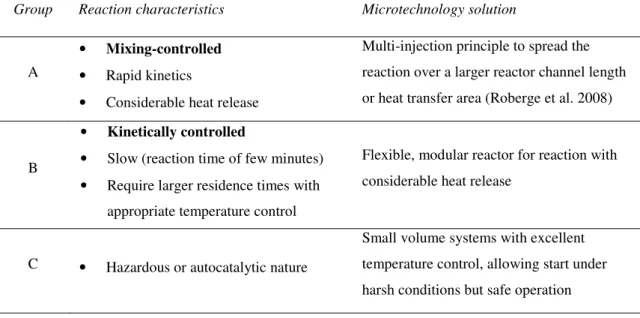
Actually, microreactor arrangements may constitute a solution for reactions with a wide range of characteristics. Roberge et al. (2005) classified reactions in three main types according to kinetics, and proposed some examples of how microtechnology can answer the challenges
raised by each one (we have collected this information in Table 1.3). Examples of microprocesses for applications fulfilling these requirements are presented in section 1.2.
Table 1.2: Fulfillment of ideal requirements by microstructured reactors.
Requirement Purpose Advantages offered by microspace operation Residence time
needed for reaction
• Attain desired levels of conversion
• Selectivity
• Exact control of residence time (minimum backmixing; uniform RTD);
• In particular, very short residence times can be achieved;
• Transport rates can be matched with kinetics Efficient heat
removal/supply
• Safety (thermal runaway, explosive); • Hot spots reduce
selectivity
• Simultaneous micro heat-exchangers;
• Large surface to volume ratio, enhanced heat transfer
• Selection of wall material and geometry (additional design parameter)
Sufficiently large interface (multiphase systems)
• Improve contact between phases and interphase transport
• large surface to volume ratio in wall-coated systems
Table 1.3: Reaction classification according to Roberge et al. (2005) and respective microreaction engineering approach.
Group Reaction characteristics Microtechnology solution
A
• Mixing-controlled • Rapid kinetics
• Considerable heat release
Multi-injection principle to spread the reaction over a larger reactor channel length or heat transfer area (Roberge et al. 2008)
B
• Kinetically controlled
• Slow (reaction time of few minutes) • Require larger residence times with
appropriate temperature control
Flexible, modular reactor for reaction with considerable heat release
C • Hazardous or autocatalytic nature
Small volume systems with excellent temperature control, allowing start under harsh conditions but safe operation
1.1.3.b Matching transfer rates with kinetics for design
It is commonly accepted that microreactors should be designed so that mass and heat transfer are fast enough compared to the reaction kinetics. A simple comparison of timescales allows the definition of regions of interest, although a more detailed analysis is required for rigorous design (see e.g. Chapter 2 of this thesis). Hessel et al. (2004) and Commenge et al. (2005) suggest that the dimensioning of the channel diameter should be ruled by these considerations. As can be seen from Table 1.1, heat and mass transfer depend on the channel’s diameter as
2
~dch, while the time constant for an heterogeneous reaction may be proportional to ~dch. For
selected values of dch, τmass transfer and τheat transfer <τreaction. However, it is recognized that other
factors may limit the possible designs, namely: pressure drop, occurrence of clogging/fouling, and uniform distribution of flow entering the microchannels. The first two factors suggest the use of larger diameters, which are also easier to clean (important for pharmaceutical production) and allow high flow rates. For higher throughputs, the ‘numbering up’ strategy can be used. Herwig (2008) presented a length-time scales plot comparing mixing by molecular diffusion in gases and liquids and the characteristic times for slow and fast homogeneous reactions.
We note that even though it appeared from section 1.1.1 that controlling homogeneous reactions would take no advantage from miniaturization, the fact that ‘new’ conditions can be applied allows the performance of these processes to be enhanced as well (see sections 1.2.2 and 1.3.2).
1.1.4 Impact on mass transfer
In the case of microdevices operating in laminar flow, transverse mixing is assured only by molecular diffusion, which as shown in Table 1.1 has a characteristic time proportional to the square of the channel’s radius or diameter. Jensen (2001) reports that studies with acid-base reactions show that complete mixing in a liquid-phase microreactor with channels 50-400 µm wide occurred in 10 ms. Thus, faster mixing implies channel diameter reduction. This also leads to the increase in pressure drop and a flowrate limitation may appear. This can be surpassed by numbering up, even though other issues such as uniform fluid distribution arise. Therefore, several strategies to improve mixing in microchannel apparatus and networks have been proposed (Hessel et al. 2005b; Falk et al. 2010). The objective is to overcome the limitations in conventional methods, regarding energy consumption, technical feasibility and detrimental effect in the process performance (due to backmixing and axial dispersion).
For the design of a single channel microreactor, the control of the residence time is important for selectivity issues. In preliminary design methods (Hessel et al. 2004; Commenge et al. 2005)
it is proposed that once the required residence time is fixed, the fluid velocity should selected so that minimum dispersion is obtained. It is possible however that excessive pressure drop results from this and a trade-off must be searched.
To highlight the benefits from microstructuring in reducing dispersion, ‘equivalent’ fixed bed and microreactor (as defined in section 1.1.1) are compared in terms of a dispersion ratio (ratio of the widths of initially delta-like concentration tracers at the reactor exit) (Hessel et al. 2004; Commenge et al. 2005; Renken et al. 2008). In terms of the Peclet number (with Dax as the
axial dispersion), an expression for fixed bed reactor of the type
(
,)
p ax u d Pe f Re Sc D = =is considered, while for the microchannel the classical Taylor-Aris theory applies (Taylor 1953; Taylor 1954; Aris 1956). For 3<u d D<100, Commenge et al. (2005) observed that the dispersion in a microchannel is smaller than that of a fixed bed reactor with porosity 0.4. These boundaries change for other values of porosity (the range gets broader for smaller porosities, and narrower for higher porosities). The minimum dispersion is attained at u dch D~ 14 and corresponds to a 40% reduction in dispersion in a microchannel reactor compared to a fixed-bed one.
1.1.5 Implications on heat transfer
Perhaps one of the most important consequences from miniaturization is the enhancement and control of heat transfer rates in both reactive and nonreactive cases. As in the case of mass transfer, higher heat transport rates are possible due to the high values predicted from Eq.(1.1). Very high values of heat transfer coefficient are commonly reported for microgeometries and this has been known for many years (e.g. in the field of electronic microdevices cooling). It is possible to achieve heat transfer coefficients one order of magnitude higher than in conventional heat exchangers (Ehrfeld et al. 2000; Mills et al. 2007).
Concerning the validity of macroscale theory in channels with reduced dimensions, Rosa et al. (2009) provided a critical review, evaluating the importance of scaling effects in single-phase heat transfer in microchannels. They concluded that even though inconsistencies in published results exist, the same theory and correlations are applicable as long as ‘scaling effects’ are explicitly accounted for or can be safely ignored. These ‘scaling effects’ included entrance effects, conjugate heat transfer, viscous heating, etc., and although they are likely to be ignored in macro-channels, they now may have a significant influence in heat transfer. They also stress the role of measurement and fabrication uncertainties and the need for reliable experimental
data. Results from single channel designs were found to agree with published correlations better than multichannel configurations and this was attributed to flow maldistribution, 3-dimensional conjugate heat transfer and measurements uncertainties. They expect sub-continuum models to become more important, however probably only relevant at the nano-scale. In particular, these authors review a number of experimental studies in the literature and conclude that in all of them entrance effects need to be accounted for. Conclusions in the same direction are taken in an experimental study from Lee et al. (2005). They assessed a number of classical correlations to describe thermally developing heat transfer in rectangular microchannels with hydraulic diameters ranging from 318 and 903 µm and concluded that these were in good agreement, as long as inlet and boundary conditions are correctly considered. In Chapter 3, we discuss the relevance and extent of inlet effects in the temperature profile.
A major improvement brought by microprocess technology results from combining superior heat transfer capabilities with highly exothermic (endothermic) reactions. Kockmann et al. (2009) discusses heat transfer in microstructures in terms of a volumetric heat transfer coefficient defined as ref V heat int int S Q U k V T V = = ∆ ɺ , (units of W/m3K)
where Vint is the internal volume, Sref the area of the reference surface and kheat the heat
transfer coefficient (per interface area). Kockmann et al. (2009) report a study from Kinzl which gives a threshold for UV in microreactors with residence time of 10 s and highly exothermic
reactions, so that a mean temperature difference of less than 10 K exists:
(
3)
1 MW m K
V
U ≥ .
Then, they estimate that under typical conditions for organic liquids,
( )
(
)
3 0.002 MW m K V ch U d m = ,which is greater than 1 for dch <2 mm. Therefore, microreactors are also heat exchangers and isothermal operation even for highly exothermic reactions is possible, due to efficient heat removal/supply. As discussed previously, this opens possibilities for dealing with reactions releasing large amounts of heat or with risk of explosion. It also improves selectivity of many processes, due to the reduction or even elimination of hot-spots. Consequently, more aggressive conditions may be employed (see section 1.3.2).
The fastest mechanism for heat removal is by conduction through the walls, as can be seen from the timescale in Table 1.1. Therefore, the channel walls can be designed so that due to its reduced thickness and high-conductivity construction material, no appreciable temperature gradients are registered. In fact, this provides an additional source for control of temperature and
heat supply/removal. Ehrfeld et al. (2000) and Hessel et al. (2004) report several examples of microsystems for carrying out reactions, which are integrated with heat exchangers. This can happen by adjacent heating/cooling gas channels placed in alternating layers with the process channels. Due to the low thermal mass of the thin wall, the thermal response is usually fast (Jensen 2001). Lomel et al. (2006) wrote the characteristic time in both semi-batch and continuous processes for Grignard reaction as a function of the limiting heat transfer timescale. They explained the drastic reduction in operation times as being due to the shorter dimensions of the continuous microprocess, leading to intensified heat transfer and therefore shorter process times. Hardt et al. (2003) explored microstructuring techniques to enhance heat transfer in microdevices by at least one order of magnitude (Nusselt numbers as high as 100 were observed). The performance of the system was also tested in the presence of an endothermic, heterogeneous, gas-phase reaction. When compared to a conventional fixed bed, reduction in the amount of catalyst required and overall equipment size was achieved.
Another direction which takes advantage from excellent thermal behavior is the safe realization of reactions which would result in explosion at the macroscale. Hessel et al. (2004) identified the key features in microchannel reactor which reduce the risk or prevent the occurrence of explosions due to chain reactions or to a large heat release. While molecule collisions with the channel walls may suppress the former, efficient heat transfer is capable of managing the latter. Two timescales that influence the increase in temperature due to a first-order homogeneous exothermic chemical reaction are (Table 1.1):
(
) (
)
,
~ wall P fluid wall generation rxn ad R wall C T T T H k T ρ τ τ = ∆ −∆ (1.13) ~ ch removal heat d k τ .
Eq.(1.13) is usually replaced simply by τrxn and is evaluated here at the wall temperature.
Insufficient heat removal or strong heat generation occurs whenever τremoval >>τgeneration, and the maximum temperature difference approaches the adiabatic limit. Nearly isothermal behavior is observed in the reverse case, which is favored by the use of smaller channels.
1.2 APPLICATIONS OF MICROCHANNEL REACTORS
The literature is abundant in applications and proofs of concept of technologies employing microchannel reactors. In fact, several patents have been filled (Hessel et al. 2008a) and some industrial applications were already reported (Hessel et al. 2005b). At the single channel level, several new laboratory or small production scale studies appear on a daily basis. As we will
discuss, the microchannel reactor concept also describes more consolidated technologies, such as monoliths. In this case, there are also many review articles (Hoebink et al. 1998; Nijhuis et al. 2001; Kreutzer et al. 2005; Moulijn et al. 2005; Kreutzer et al. 2006) and dedicated monographs (e.g. Cybulski et al. (1998)).
1.2.1 Practical realizations of the microchannel reactor concept
The description of a system including a channel with the ability to carry reactions due to catalytic activity at its walls is sufficiently general to encompass a series of technologies. In fact, this is an idealized portrait that can act as a fundamental model of several practical solutions in chemical reaction engineering. We however will focus on two approaches in the field of structured reactors: monoliths and microfabricated channels. Usually, both are distinguished by different ranges of characteristic dimensions, being monoliths associated with larger cell hydraulic diameters (dch~ 0.5 1 mm− ). Nevertheless, in terms of mass/heat transfer intensification with low pressure drops, both technologies claim the same advantages and sometimes the terms are used interchangeably. However, typically the term ‘monolith’ refers to a honeycomb arrangement composed by several repeating cells, divided by a ceramic or metallic material, e.g. Kolaczkowski (1999) and Chen et al. (2008b). It can be pictured as a catalyst block with a large number of parallel straight channels through which gas flows. On the other hand, microfabricated reactors are typically generated by precision techniques e.g. on a metallic plate. A number of fabrication methods (lithography, machining, micro milling, etc.) is available and details can be found e.g. in Mills et al. (2007) and Ehrfeld et al. (2000). This distinction may pose significant differences in terms of the channel-channel interaction.
The incorporation of catalyst in the walls of these channels also shares similar characteristics. This happens in the case where a high surface area washcoat (e.g. γ-alumina) containing the dispersed catalyst(s) is used, so that sufficient loading is achieved. There are currently a number of techniques available to coat a microchannel with a catalyst layer (wet impregnation, physical and chemical vapor deposition, anodic oxidation, sol-gel, slurry and aerosol techniques) and suitable reviews have been published on the subject (Wunsch et al. 2002; Hessel et al. 2005b). In the case of the monolith, the wall itself may already contain the catalyst as an integral part of its structure. In this case, the boundary conditions are more complex and channel interaction in specific arrangements has to be considered. Problems in microchannel coating are also common to both cases. Rebrov et al. (2009) identified the reproducible preparation of the catalytic coating as a crucial requirement in the fabrication of multi-phase microfluidic devices. Besides reproducibility, other requirements are: homogeneous distribution, mechanical and chemical stability, and sufficient activity to achieve the desired yield under given conditions. The
replacement of the catalyst can also become an arduous task. There is also the possibility of a micropacked bed or a packed monolith. This however typically leads to nonuniform temperature, concentration and flow profiles (leading to increased pressure drop, channeling and favoring the appearance of hot-spots), and are more prone to clog. The step of packing the microchannel also raises some technical issues that require additional study (van Herk et al. 2009). Finally, we refer to another distinction between the two technologies: fabricated microsystems may include other components, such as micromixers, micro-heat exchangers, sensors and controllers (Jensen 2001; McMullen et al. 2010).
1.2.2 Examples of applications
According to the characteristics listed above (section 1.1), we can expect a wide range of reactions to take significant advantages from scaling down. Actually, in the gas-phase, most of them fulfill all the desired features. For example, partial oxidations are typically highly exothermic reactions that required solid catalysts. Selectivity is a major issue, as strong exothermic total oxidation is undesirable. Implementation of more intense conditions is not feasible in conventional technologies due to difficulties in heat management (Becht et al. 2007). In this case, microstructured reactors offer the possibility of enhanced control of residence time and temperature, avoiding hot-spots that harm selectivity and catalyst lifetime.
Several reviews concerning chemicals production on microreactors are available. Srinivasan et al. (1997) discussed ammonia oxidation in an integrated microreactor. Ehrfeld et al. (2000) detailed several examples of studies in gas-phase microreactors. Mills et al. (2007) refer some integrated microreactors for pharmaceuticals manufacture, chemicals production and energy generation. Kockmann et al. (2009) presents some examples of nitrations and organometallic reactions, based on Lonza’s industrial experience. Kolb et al. (2007) presents a review of microreactor for gas-phase selective oxidations. Microreactors for preferential oxidation as a gas purification step for fuel cells were also addressed. Other examples can also be found in Kolb et al. (2004), Hessel et al. (2004) and Gokhale et al. (2005). Pennemann et al. (2004) provide a comparison between microreactor and batch reactor (also stirred vessels and fixed bed reactors in some cases) for a large number of industrially relevant organic reactions with data taken from the literature. Their review was divided in ‘small-scale applications’ (e.g. peptide synthesis, aldol reactions, hydrogenations, dehydrations) and ‘lab / pilot scale syntheses’ (e.g. nitrations, organomethalic reactions, oxidations, hydrogenations, chlorination and fluorination). This referred to fine chemicals applications with flow rates up to several milliliters per hour and from that to several tens of liters per hour, respectively. While the main concern at the small-scale appears to be conversion (which generally register improvements in microreactors), at larger
scales increase in the process yield and selectivity is also desired (and this is also visible in the results from microdevices). From these examples, it is possible to observe two other important facts: in some cases, the reaction conditions change dramatically (temperature increases from cryogenic to more reasonable values) and the residence times are drastically reduced (from several hours/days to seconds). Mae (2007) gives several examples of organic syntheses in microreactors highlighting the following advantages: shortening of reaction time, solvent-free operation, new synthesis routes, control of unstable intermediates, severe conditions, safe operation under explosive / thermal runaway conditions, and omission of catalysts and reagents. Other examples are given in McMullen et al. (2010). Each case presents particular challenges that microtechnology may solve completely or at least minor its adverse effects. Summary of some particular cases can be found in Table 1.4.
Application of microprocessing in the field of energy generation has gained particular interest and is nowadays a major line of research in the production of purified hydrogen for fuel cells and portable aplications (Kundu et al. 2008). Hessel et al. (2005b) and Kolb et al. (2005) review several examples of microdevices performing steam reforming of methanol, methane and propane. Examples of catalytic combustion and gas purification (CO clean up) are also given. The latter concerns mainly the water-gas shift reaction and preferential CO oxidation (Kim et al. 2008). Ethanol steam reforming has also been studied in the context of renewable fuels from biomass (Casanovas et al. 2008a; Casanovas et al. 2008b; Görke et al. 2009).
Another group of chemical transformations which may take advantage from microstructuring are the ones with biochemical nature (Miyazaki et al. 2006). This may sound as a contradiction when one considers the list of requirements presented in section 1.1.3.a. In fact, biotransformations are typically slow and release small amounts of heat. However, in multiphase systems or multistep synthetic processes the enhancement brought by miniaturization may be visible. Bolivar et al. (2011) presents several examples of liquid/liquid and gas/liquid contacting reactors with enzymatic transformations. In comparison with the reference batch technology, increase of conversion and reaction rate is generally observed and separation is also facilitated. Furthermore, as noted by Thomsen et al. (2009), microsystems become interesting because the biocatalytic step of the process is too slow for integration in conventional continuous flow processes. They performed hydrolysis of lactose and 2-nitrophenyl-beta-D-galactoside (catalyzed by β-glycosidase CelB) in washcoated stainless steel channels with γ-aluminum oxide (to which the enzymes were covalently immobilized). Very fast conversion in the coated microchannels was observed (~10 s to completion). Therefore, microdevices allow the integration of region- and stereoselectivity biocatalysts with continuous industrial production methods. Moreover, scale up is avoided from screening to production stages of the biochemical process. Nevertheless, major challenges in implementation remain such as: selective and reversible enzyme immobilization (with high volumetric activity) and the integration with analytical instruments.
Table 1.4: Role of microreactors in improving the production of some chemicals Reaction Features / Challenges Advantages from microscale
operation Refs. for details Partial oxidation of proprene to acrolein
• Prevent total oxidation
• Quench the reaction after synthesis of unstable desired intermediate
• Performed under kinetic control
• Fast heating of inlet gas up to the reaction temperature (enabling the use of short channels and low pressure losses)
• Preferred isolation of unstable intermediates Ehrfeld et al. (2000) Hessel et al. (2004) Selective partial hydrogena-tion of a cyclic triene
• Avoid consecutive full hydrogenation
• Unstable intermediate as target product
• Higher yields (45% increase) of desired product compared with coated granules, wire and foil pieces
• Uniform flow pattern, regular pore system, homogeneous catalyst distribution Ehrfeld et al. (2000) Kolb et al. (2004) H2/O2 reaction • High temperature • Danger of explosion
• Decrease of residence time to the sub-millisecond range
• Ignition only at about 100ºC • Simple and safe design
• Improved mass/heat transfer properties Ehrfeld et al. (2000) Maehara et al. (2008) Voloshin et al. (2009) Partial hydrogena-tion of benzene
• Avoid full hydrogenation • Very reactive intermediates
• Increase of selectivity (up to 38%) Ehrfeld et
al. (2000) Kolb et al. (2004) Oxidation of 1-butene to maleic anhydride • Exothermic reaction
• Combined with strongly exothermic total oxidation (hot-spots)
• Low selectivity
• Selectivity comparable to fixed bed
• Butane concentrations 10 times higher than explosion limit • Space-time yields 5 times higher
(shorter residence time)
Hessel et al. (2004) Kolb et al. (2007) Selective oxidation of ethylene to ethylene oxide
• Step in complex reaction scheme • Increase in selectivity desired • Total conversion to CO2 favored
by high temperatures
• Isothermal conditions (no hot spots)
• No inert gas (pure oxygen) with increase in selectivity
• Residence times of only a few seconds are required for 29% max. yield of ethylene oxide
Ehrfeld et al. (2000) Kesten-baum et al. (2002) Kolb et al. (2004; 2007)
Table 1.4 (cont.): Role of microreactors in improving the production of some chemicals Reaction Features / Challenges Advantages from microscale
operation Refs. for details Oxidative dehydroge-nation of alcohols
• Low selectivity in large scale pan reactor (45%)
• Appreciable temperature rise (150ºC)
• Side reactions due to long contact time
• Isothermal conditions
• Short residence times (one order of magnitude smaller than multi-tubular reactor)
• Conversions higher than 50% and selectivity higher than 90%
Ehrfeld et al. (2000) Hessel et al. (2004) Kolb et al. (2007) Synthesis of methyl isocyanate • High temperature • Hazardous gases
• Transport and storage risks • Intense cooling needed
• Modular devices including heat exchangers
• Smaller hold-up of hazardous chemicals Ehrfeld et al. (2000) Hessel et al. (2004) HCN synthesis • Fast kinetics • High temperature • Hazardous gases
• Fast side and consecutive reactions
• High temperatures attained (>1000ºC)
• Short contact times (between 0.1 and 1 ms)
• Uniform heat distribution (cooling times of 0.1 ms using air, resulting in less than 1.5ºC of difference)
Ehrfeld et al. (2000) Hessel et al. (2004) Kolb et al. (2007) Nitration of phenol • Fast kinetics
• Large heat release (∆T~ 50ºC)
• Autocatalytic (longer period required to start)
• Decomposition/explosion risk • Prolongated reactant dosing • Low yield (polymeric side
products)
• Small internal volumes
• High concentration of phenol (90%)
• Good temperature control • Almost solvent free
• Spontaneous start (controlled backmixing)
• Amount of side products reduced by a factor of 10 Kockmann et al. (2009) Halder et al. (2007) (nitration of toluene) Partial oxidation of methane (syngas generation)
• Very fast reaction (residence time in the order of milliseconds)
• Portable, small-scale systems required for on-site small natural gas deposits exploration
• High throughputs and space-time yields • Compactness Hessel et al. (2004) Phosgene formation
• Moderately fast and exothermic reaction
• Toxic products, storage and shipping difficulties
• Small hold-up • On-site production • High heat dissipation
• Kinetic studies in mini fixed-bed reactor
Hessel et al. (2004)