C
REATE
, P
ROTECT
, C
APTURE
Dissertation submitted in partial fulfillment of requirements for the degree of MSc in
Business Administration, at the Universidade Católica Portuguesa, December 2013
Joana Neves de Matos
T
HE IMPACT OF TRADE SECRETS AND NON
-
COMPETE
AGREEMENTS ON TECHNOLOGICAL ENTREPRENEURSHIP
2 Acknowledgements
First of all I wish to express my sincere gratefulness to my adviser, Professor Raffaele Conti, for his time and support throughout the development of this dissertation. His guidance, feedback and supervision were a precious help that allowed me to develop this thesis in a rightful way.
I take this opportunity to record my appreciation to all the faculty members at Católica-Lisbon with which I was fortunate to spend the last year and a half during my masters degree. Their learnings contributed to my present work and will also be incredibly useful in both my personal and professional life from now on.
Furthermore, I would like to thank the people who surrounded me during this important period - my friends and family. They have played an important role throughout the development of this thesis: the first by encouraging me and sharing the ups and downs of the process, while the latter provided me with the motivation and the tools which made it all possible.
Finally, I would like to express my gratitude to my grandfather, whom during his lifetime was one of the biggest influences of my life and who is no longer with us. He has been a great source of inspiration and I believe he is certainly overjoyed from seeing me graduate at Universidade Católica Portuguesa.
3 Table of Contents
Abstract ... 4
Introduction ... 5
Literature Review ... 8
The role of non-competes and trade secrets in stimulating entrepreneurship ... 8
Trade Secrets ... 9
Non-compete Agreements ... 11
Methodology ... 14
Sample and Data ... 14
Measures ... 15 Dependent Variable ... 16 Independent Variables ... 16 Control Variables ... 18 Empirical Strategy ... 19 Findings ... 21 Results ... 23
Discussion and Conclusions ... 25
REFERENCES ... 27
Appendix 1 ... 30
Trade secrets statutes in effect ... 30
Appendix 2 ... 32
Questions and Thresholds used in the elaboration of the non-competition enforcement index (Garmaise 2010) ... 32
Tables Table 1 – Description of Variables... 15
Table 2 - Descriptive Statistics ... 21
Table 3 - Correlations ... 22
4 Abstract
Title: Create, Protect, Capture – The Impact of Trade Secrets and Non-compete Agreements on Technological Entrepreneurship
Author: Joana Neves de Matos
Over the last years, firms have increasingly pursued ways to protect the knowledge they possess. The purpose of this thesis is to understand impact of two intellectual property rights tools – trade secrets and non-compete agreements – on technological entrepreneurship. I express technological entrepreneurship as the entry of firms, both new and established, in new technological domains. The aim of the study is to assess if a stronger enforcement of these tools is beneficial for entrepreneurial activity in technological markets. To achieve this goal, I have performed a Poisson panel estimation analysis on a sample comprising 4380 observations, each representing a state and technological category, in a specific year.
The main empirical findings point out that the use of trade secrets has a positive impact in the entry of firms in a new technological domain, while non-compete agreements do not. These results are of practical relevance and present both practitioners and policy makers with a possible approach to enhance entrepreneurial activity.
5 Introduction
“Entrepreneurs innovate. Innovation is the specific instrument of entrepreneurs.” - Drucker (1985)
The role of legal means protecting intellectual property (such as for instance trade secrets and non-competition agreements) in entrepreneurship has been widely debated. This debate is not merely theoretic, but has instead extremely important practical implications. Consider the case of Silicon Valley, one of the most famous entrepreneurial clusters in the world, which has in fact risen from one single company, Fairchild. More in detail, about 400 companies - including Intel - have been founded by a group of Fairchild former employees, the so called “Fairchild Eight”. If California had enforced non-compete agreements, which impede employees to leave their firm to found new companies in the same sector, the development of Silicon Valley would have been jeopardized.
On the other hand, companies such as Google would probably not exist without the possibility to protect trade secrets, which is information with commercial value to the company such that it chooses to keep it a secret. Google’s company roots date back to the 90’s. In those days Google was not the giant it is today. Rather, it was just a startup entering a technological market. In order for its search engine to be successful, its founders Larry Page and Sergey Brin decided to conceal the page rank algorithm. If Google could not protect its algorithm through a trade secret it would have probably not been able to gain a competitive advantage to outperform the established players in the industry, such as Yahoo.
From the previous two examples a preliminary insight seems to emerge: Non-competes harm entrepreneurship in knowledge intensive sectors, whereas trade secret promote it. This paper aims at going beyond such anecdotal evidence though. It aims instead at providing robust empirical evidence about the impact of these two legal tools on technological entrepreneurship, that is, the entry of companies in new technological domains (regardless whether such companies are new firms or are instead already established firms).
6 Past empirical studies have already focused on the enforceability of non-competes on the creation of new companies (Franco and Mitchel 2008, Stuart and Sorenson 2003, Samila and Sorenson 2008, Png 2011). However, previous literature has not studied the role of trade secrets and, moreover, has not focused on technological entrepreneurship. In this respect, I argue that trade secrets, differently from non-competes, have a positive effect on technological entrepreneurship.
Overall, there is a general trade-off in the protection of Intellectual Property Rights (IPR), between a greater protection of new knowledge, which promotes entrepreneurship, and lower knowledge inflows, which implies less entrepreneurial companies. Regarding trade secrets, the upside determined by the increase in protection which they provide, is larger than the downside determined by less knowledge spillovers. Trade secrets act as tool for companies to protect their most valuable assets and nevertheless still allow for that knowledge to be partially diffused, breaking the barriers of the company. Therefore, the first hypothesis of this study states that a greater enforcement of trade secrets induces more companies to enter in new technological domains. Concerning non-competes, the trade-off works in the opposite way. Since these agreements block employees from leaving the firm to found their own companies, it does not leave any room for knowledge spillovers, unlike trade secrets. For this reason, I hypothesize that non-competes affect negatively technological entrepreneurship.
To verify my hypotheses, I collected data from the NBER patent database from 1976 to 2006, measuring technological entrepreneurship by the number of patents introduced in a certain state by firms entering a technological category for the first time. The time frame of my analysis goes from 1980 to 1994. To explore the effect of both legal tools I used two different indexes concerning its application and strength in the US. Firstly, for trade secrets I relied on Png’s (2011) Uniform Trade Secret Act enactment index. For non-compete agreements I have used Bird’s (2009) non-compete enforceability index, based on Garmaise’s (2009) approach. The results of my work show that trade secrets foster entrepreneurship, while non-competes do not sort any kind of effect.
The structure of my dissertation is as follows. First of all, I gathered all previous literature encompassing relevant research in what concerns my research question, using
7 it to structure and further develop the hypotheses for the present study. Afterwards, I illustrate the empirical strategy and the main findings of my study. Hereafter, I discuss the results and describe the contributions for managers and policy makers, ending with the limitations of the study.
8 Literature Review
The role of non-competes and trade secrets in stimulating entrepreneurship
Entrepreneurship can be defined as an individual’s pursuit of opportunities without concerning about the resources he controls at the time (Stevenson and Jarillo 1990). The entrepreneurial process and outcomes are important for both individual firms and regions (or countries). At the firm level, especially in technologically intensive industries, an entrepreneurial approach represents a necessary condition for attaining and keeping a competitive advantage in the market (Newbert et al. 2008), due to the speed of technological progress and the velocity to which a technology becomes obsolete (Chapman 1986). At the regional and country level, entrepreneurial firms might be agents of chance – a source of innovative activity, which stimulates the entire industry and creates new jobs (e.g, Acs, 1992). Moreover, past studies have shown that countries that experience an increase in entrepreneurial activity have higher rates of economic growth (Audretsch et al.2002; Audretsch and Thurik, 2001).
As the economy is increasingly knowledge-based (Carree and Thurik 2002), all companies, including the entrepreneurial ones, want to protect the knowledge they held. Nonetheless, protecting knowledge might turn out to be a difficult task. Explicit knowledge can be codified through books or formulas, while tacit knowledge can only be transferred through conversations and experience-sharing. Thus, the latter is much harder to protect and can be easily transferred when a firms’ employees leave.
In general, any legal mean used to protect Intellectual Property Rights (IPR) implies the existence of a trade-off between a greater protection of new knowledge, which promotes entrepreneurship, and lower knowledge inflows, which implies less entrepreneurial companies. On the one hand, legal means for IPR protection provide greater appropriation of the value created by commercializing a new idea: as a result, entrepreneurs will be more willing to create their own business, knowing that they will be able to reap its rewards. On the other hand, by protecting information, IPR protection blocks knowledge inflows from other companies, for instance through informal knowledge exchange or employee mobility. Less knowledge spillovers can harm
9 entrepreneurship in the sense that, for example, if employees are unable to reuse the knowledge developed in their jobs, they will be less likely to found their own companies in the future. Also, by not being able to share protected information amongst employees of different companies, entrepreneurs cannot use knowledge from other firms to build-up their own products. In this way, by having IPR, companies are blocking the room for improvement that could be filled by other entrepreneurial firms.
In this study I will analyze how this trade-off works specifically for two legal tools: trade secrets, on one side, and non-competes, on the other. In particular, I will examine the impact of trade secret law and non-compete agreements on technological entrepreneurship, i.e., technological entry of firms (both new and existing) in domains where they have never been active before. Previous studies have only considered the impact of non-competes on entrepreneurship measured in terms of the number of new firms created. However, no study has considered the impact of non-competes on technological entrepreneurship. Moreover, there is also no literature aiming at the relationship between trade secrecy and its impact on entrepreneurship.
To fill this gap, the goal of this study is precisely to find if greater protection fosters or inhibits the entry of firms in a new technological domain.
Trade Secrets
A trade secret can be defined as any information that generates commercial value for the firm holding it, such that - in order to prevent the duplication from competitors - the company chooses to conceal it (Friedman, Landes and Posner, 1991). A trade secret can be assumed as misappropriated, and the owner able to take legal action, only if the trade secret has been acquired by improper means - including fraud, use of clandestine means and conspiracy (Chapman 1986). If the court verifies that the trade secret has been misappropriated, its owner may be entitled both to damages – representing the financial damages that were suffered from the misappropriation – and an injunctive relief – which prohibits the misappropriator from keeping using the protected information which was wrongly disclosed. Moreover, when the owner of a trade secret suspects that the secret in question can be easily disclosed by his employees, the doctrine of inevitable disclosure could provide him with the possibility
10 to impede an employee from moving to a competitor, on the ground that he would inevitably disclose the trade secret (Png and Samila, 2013).
In the United States, historically, trade secrets were ruled by principles of common law: trade secret misappropriation varied from state to state and the remedies for improper acquisition or disclosure would depend on the jurisdiction in which the suit was filed. Nowadays the protection of trade secrecy is established by a regulation, The Uniform Trade Secret Act, which has been adopted by many states, even if with some differences (Pooley, 1997). The Uniform Trade Secret Act dates back to 1979, having been created at the National Conference of Commissioners on Uniform States Law and represents a single uniform corrective framework for all US states. Unlike the common law trade secret protection, the Act clarifies and broadens the definition of a protectable trade secret, its misappropriation and also the remedial scheme, promoting uniformity among states (Lydon 1986).
As with any legal mean protecting IPRs, the effect of trade secrets on technological entrepreneurship is seemingly ambiguous due to the trade-off between more protection (which promotes technological entrepreneurship) and less knowledge spillovers (which instead harms entrepreneurship in general, and technological entrepreneurship in particular). However, it is possible to argue that in the case of trade secrets, the upside determined by more protection is larger than the downside determined by less knowledge spillovers, such that a greater enforcement of trade secrets induce more companies to enter in new technological domains. Trade secrets are quite effective in protecting knowledge but do not impede (with the exception of the inevitable disclosure doctrine) that former employees leave the firm to found their own companies, or to join other firms, conditional on the fact that they do not use their employer’s trade secrets.
This reasoning is consistent with Fosfuri and Roende (2003), arguing that trade secrets might in fact induce firms to cluster geographically. For this reason, I hypothesize:
11 Non-compete Agreements
Non-compete agreements protect company knowledge by blocking its transfer to other firms via employee mobility. Where enforceable, non-compete clauses effectively give the employer property rights over this tacit knowledge, i.e., knowledge hard to codify and so embodied in individual employees. When non-competes are enforced, the employee is forbidden from working for any other firm in the same industry and starting his own company, for a fixed length of time.
In the US, non-compete clauses were only established in the 18th century (Fisk 2001) and at the present time there is still not a uniform regulating act. Hence its enforcement varies from state to state: some forbid them (California) while others enforce them (Massachusetts) (Gilson 1999). The ones who enforce them do it by the “rule of reason”— considering an agreement valid if it does not prevent the individual from being a gainful employee and if it is not longer in duration or broader in scope than what is strictly necessary to protect the prior employer (Gilson 1999).
Both the time and geographic scope of non-competes vary from state to state. In some states like Missouri, an agreement will be enforced in a region even if the firm has no current business in that area, while in others like Virginia non-competes are restricted to the firm’s current markets. One can also see time scope differences when comparing states likes Pennsylvania and Florida. While the first will regularly enforce 3 year covenants, the latter assumes that covenants with more than 2 years in length are unreasonable.
Leonard (2001), Kaplan and Strömberg (2003) have found that this tool has become very common, particularly for technical workers and upper-level management. Moreover, the results of surveys done in the United States report that nearly 90% of these employees have engaged in non-competes. According to Kaplan and Stromberg (2003), about 70% of entrepreneurs receiving venture capital funding are required to sign a non-compete agreement. At the same time, almost 80% of new IT professionals are required to sign the clause as well (Holley 1998).
Similarly to trade secrets, non-competes also imply a trade-off between greater protection and less knowledge spillovers. On the one hand, Franco and Mitchel (2008) argue that, by providing entrepreneurs with intellectual property rights for their ideas,
12 non-compete clauses can foster regional innovation and growth. In particular, with sufficiently tough competition between spinouts and their parents, regions with higher enforceability can dominate, in the sense they spur more entrepreneurial companies and generate greater innovation.
On the other hand, a stronger non-competes law can reduce entrepreneurship (Png 2011) for several reasons, all related to less knowledge inflows for entrepreneurial companies. First, if skilled employees want to found their own companies but have signed non-compete agreements with their former employer, they will have to wait at least a certain period of time until they can do so, which implies the rise of less new companies (Graves and Diboise 2006). Second, non-competes decrease knowledge spillovers deriving from workers’ mobility among firms located in the same district (Samila and Sorenson 2008). Establishing a new business is more complicated if it is not possible to hire employees with experience in the industry due to the signing of competes (Stuart and Sorenson 2003). Third, and related to the previous point, non-compete agreements arrange for a loss of efficiency in the matching of employees to employers.
As a matter of fact, Stuart and Sorenson (2003) have shown that there is an increase in the number of new firms, when established firms experience liquidity events such as IPO’s or direct acquisitions, mainly in states where non-compete agreements are forbidden. Analogously, Samila and Sorenson (2011), found that the positive impact of venture capital on startup creation is significantly greater in regions that do not enforce non-competes. Similarly, Gilson (1998) and Hyde (2003) conclude the main reason for the success of Silicon Valley in California and the failure of Route 128 in Massachusetts was the different regulation concerning these clauses. Although both regions' clusters have sprung from similar roots – partnerships with local universities, the government-funded defense industry, and early venture capital funding sources – at some point in history Silicon Valley (located in California) has surpassed Route 128 (located in Massachusetts), precisely because in California non-compete agreements are not enforceable. By contrast, in Massachusetts non-competes are generally enforced, thereby blocking the critical mass of knowledge spillovers.
As we can see, most of past literature consistently shows non-compete agreements forbid employees to found new companies. We can thus argue that the
13 negative impact (in terms of less knowledge inflows) of using non-competes is much greater than the positive impact (in terms of more protection) they provide. Unlike trade secrets, which still allow for some knowledge spillovers and, most importantly, allow employees to leave their firms and pursue a new path as entrepreneurs, non-competes completely block employee mobility. For this reason, non-competes are likely to harm technological entrepreneurship. Therefore I hypothesize:
Hypotheses 2: Non-competes decrease technological entrepreneurship
In the next section, I will test the two hypotheses. To summarize, I expect the impact of trade secrets on technological entrepreneurship to be positive and significant. By contrast, as for non-competes, I expect its impact on technological entrepreneurship to be negative and significant.
14 Methodology
Sample and Data
To investigate how trade secrets and non-compete agreements affect the entry of firms in a technological market, I used the latest National Bureau of Economic Research (NBER) patent database, since I measure entry as the number of patents introduced by firms entering a technological market. This database provides information about all patents applied and granted in the US between 1976 and 2006.
Overall, I was able to gather all U.S patents that were applied for from 1980 to 1994. This selection of time period occurred mainly due to a practical reason: the non-compete enforceability index for the US which I applied in this study, elaborated by Bird (2009), refers only to the time frame of 1976 to 1994. Each patent was assigned to a technological category, based on a particular state, which is the residence of the patent’s first inventor.
In order to have more accurate results, I have also collected data for the control variables. One of the sources of such data is the Bureau of Economic Analysis (BEA), which is an agency in the United States Department of Commerce that provides relevant economic statistics. I gathered data about the gross domestic product of all states in the United States comprising the sample period. Moreover, I have also collected data from the Thomson Reuters VentureXpert database to assess the total amount of money invested by Venture Capital in each state between 1980 and 1994.
In total, my sample counts with 4380 observations, each representing a certain state and technological category, in a specific year.
15 Measures
In this segment I will provide the information about the variables used and its construction, to perform the analysis of the effect of trade secrets and non-competes on technological entrepreneurship. As a first approach, I have summed up all the variables used in the empirical analysis on Table 1, for an easier understanding.
Table 1 – Description of Variables
Variable Measure
Technological Entrepreneurship
Number of patents produced in a certain state by firms that entered in a technological domain for the first time.
Source: NBER Database
Trade Secrets Index of increase of Trade-secrecy
Source: Index of increase of Trade-secrecy (Png, 2012)
Non-compete Bird Index
Degree of enforceability of non-competes ranging from 0 to 12.
Source: Non-competition enforcement index (Bird, 2010)
TSNCB Interaction variable of Trade Secrets and NCBird
Equitytot Amount of US dollars invested by venture capital firms.
Source: Thomson Reuters VentureXpert
GDP
GDD in current prices for each state.
Source: U.S. Bureau of Economic Analysis
Number of Patents
Number of granted patents by application year.
Source: NBER patent database
Year Dummy Dummy variable coded as 1 for each year of the sample period
16 Dependent Variable
I measured technological entrepreneurship as the number of patents applied for, in a certain state and technological category, by “new” firms that entered for the first time in that technological domain.
To classify these technological domains I have used the constructed variable “technological category” by Hall et all (2001), which assigns patented inventions taking in consideration the technology it holds. There are 6 main categories: Chemical (excluding Drugs); Computers and Communications (C&C); Drugs and Medical (D&M); Electrical and Electronics (E&E); Mechanical; and Others.
Independent Variables
Trade Secrecy Index
I measured the increase in trade secrecy following Png (2012). In particular, he computes a measure based on the enactment of Uniform Trade Secret Act in US, encompassing three broad aspects of the law: the substantive law, the civil procedure and the remedies.
Specifically, the index comprises six items: (i) Whether a trade secret must be in continuous business use; (ii) Whether the owner must take reasonable efforts to protect the secret; (iii) Whether mere acquisition of the secret is misappropriation; (iv) The limitation on the time for the owner to take legal action for misappropriation; (v) Whether an injunction is limited to eliminating the advantage from misappropriation; and (vi) The multiple of actual damages available in punitive damages.
The index is the sum of the scores for each of the six items divided by six, so it is scaled between 0 and 1. A higher value of the index represents stronger protection of trade secrets in the sense of favoring the owner of trade secret in legal action against the misappropriator. Broadly speaking, over time, the law tended to increase the legal protection of trade secrets, either with cases deciding key legal issues or by the
17 enactment of statute. The trend was more gradual in states that depended completely on common law, such as New York and Massachusetts, and harsher in states, as California and Illinois, that enacted statutes.
A table summarizing the scores of each state as well as the year of the enactment of statute law is available in Appendix 1 for further reading.
An important concern is whether the UTSA enactment is exogenous, meaning that the decision behind it did not carry any “pro-business” agenda. My approach assumes that the decision of state-level governments to enact the UTSA was not done for enhancing entrepreneurship or innovation. In conformity with this reasoning, Png (2011) shows that the UTSA enactment was not significantly related with the state-level R&D tax credit and not related to state-level governmental decisions. Thus, it is possible to conclude that the UTSA was not enacted with the purpose to benefit any policy regarding the amount of R&D at a state-level. In conclusion, this variable can be considered as exogenous.
Bird Non- Competition Enforcement Index
To identify the impact of non-compete agreements, I used an index that measures its enforcement in U.S. states, elaborated by Bird (2010).
The enforceability index consists on a factor score considering the effects of changes in state regulations over time and cross-sectional differences in state laws based on the 12 questions formulated by Malsberger (2004), but applying it to a timeframe between 1976 and 1994. The score for each state was calculated by assigning one point to each question if the state’s CNC enforcement exceeded a given threshold, hence, the index range of zero to twelve.
Bird (2010) considered the twelve questions analyzed by Malsberger about each jurisdiction and assigned one point for each question of the jurisdiction enforcement of non-competes based on that question surpassed a certain threshold. For example, one question asks who has the burden of proving the unreasonableness or reasonableness of a covenant not to compete. If the state places the burden on the employee rather than the employer, a point to that jurisdiction is assigned. The more number of points a state receives, the more robustly non-competes may be enforced in that state.
18 A complete list of questions and thresholds used are available in Appendix 2.
It is possible to argue that the longitudinal variations of non-competes I use are exogenous. The enforcement of non-compete regulation in a certain state is mainly decided by the court. Assuming that courts decide to apply a stronger or weaker enforcement of non-compete agreements without taking in consideration any external factor, this variable can be considered to be an exogenous one. However, there are some exceptions to this rule. In some states, such as Michigan, the decision to enforce non-competes can be made by a legislator. In Michigan’s case, non-non-competes were prohibited until 1985, when the Michigan Antitrust Reform Act (MARA) was approved. With the passing of MARA the enforceability index regarding non-competes changed from 0 to 5. However, this major change was a side effect of the bill (Marx and Fleming 2009). Because this change in the non-compete agreements enforceability was not the main focus of MARA, but rather an antitrust reform, we can consider this decision to be exogenous as well.
Trade Secrecy*Non-compete agreements
To assess the relationship of Trade Secrecy and Non-compete Agreements, I made an interaction variable with the enforcement index and the trade secrecy variables. This variable is crucial to answer the research question of this study.
Control Variables
Although I believe my independent variables is exogenous, I will introduce control variables in order to reduce the risk of over or underestimation. The use of control variables both correlated with my dependent and independent variables should in fact to prevent any endogeneity problems that might still arise. Therefore I will control for the state GDP, the amount of venture capital investment and the overall number of patents.
The GDP is the gross state product variable, which controls for the possibility that states more strongly enforce non-competes when economic conditions deteriorate (Bird 2010). I also control for the amount of venture capital financing in each state. The
19 amount of financing is related to the amount of protection present in each state. If a state enforces non-competes and trade secrets, venture capitalists can be more willing to invest in firms located in such states, because they feel as if their investment is safer.
Finally, I also include as a control the total number of patents, since areas with higher enforcement of trade secrets and non-competes can have a higher number of patent applications and because it is correlated with patents by new firms (my dependent variable).
Empirical Strategy
Since the dependent variable is a count, using OLS regressions would yield bias estimates. Therefore, I performed Poisson regressions using a panel estimation. Also, I estimated robust standard errors clustered on states for all regressions:
log E(Patents by Entrantsist)= αTSist + Zist+ δy + βs+ βt (1)
log E(Patents by Entrantsist)= γNCbirdist + Zist+ δy + βs+ βt (2)
log E(Patents by Entrantsist)= αTSist + γNCbirdist + Zist+ δy +βs+ βt (3)
In the equations above, “patents by entrants” represents the number of patents introduced by a firm which is new in a technological domain, which, as explained, is my measure of technological entrepreneurship. “TS” stands for the trade secrecy index elaborated by Png (2011), representative of the enforcement of trade secret law in a certain state and year. “NCbird” stands for the non-compete agreements enforceability index elaborated by Bird (2009), which represents the enforcement of such agreements in a certain state and year.
20 Furthermore, factor Z is the vector of the control variables such as the GDP and factor δ represents the year dummy. Additionally, βs and βt represent the state and time fixed effects. I added the fixed effects to my regressions in order to control for unit-specific factors that do not vary overtime. βs is incorporated in the regressions so that it is possible to control for statistical estimation problems arising from time invariant differences among states (e.g., different cultures). On the other hand, βt is included because it is important to determine the impacts of year-to-year changes.
Regarding the coefficients, I expect α to be positive and significant. This anticipation is in concordance with my first hypothesis: a positive effect of trade secrets on the number of patents introduced by firms entering a technological category for the first time, i.e., technological entrepreneurship. Additionally, I expect γ to be negative and significant, which is consistent with my second hypothesis concerning the negative effect that non-competes will have on technological entrepreneurship.
21 Findings
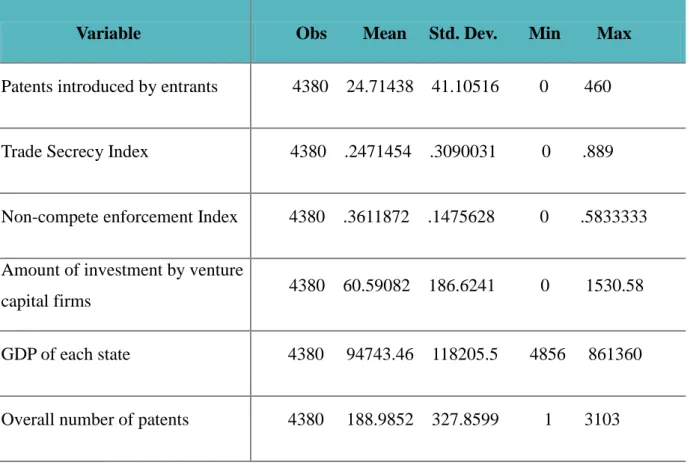
Before presenting the regressions I provide some descriptive statistics and the correlation matrix of the variables used.
Table 2 - Descriptive Statistics
Variable Obs Mean Std. Dev. Min Max
Patents introduced by entrants 4380 24.71438 41.10516 0 460
Trade Secrecy Index 4380 .2471454 .3090031 0 .889
Non-compete enforcement Index 4380 .3611872 .1475628 0 .5833333
Amount of investment by venture
capital firms 4380 60.59082 186.6241 0 1530.58
GDP of each state 4380 94743.46 118205.5 4856 861360
Overall number of patents 4380 188.9852 327.8599 1 3103
In table 2 we note that on average 25 patents were introduced by new firms in technological fields, whereas the maximum number of patents was 460. Moreover, these patents account for 13% of the overall number of patents introduced in a certain year, state and technological category. Additionally, the average enforcement of trade secrets in the United States, in the time period taken into consideration, is close to 0.25. Instead, the enforcement of non-competes is higher, being close to 0.36, both measured in a scale from 0 to 1.
22 Table 3 - Correlations
Patents by
entrants TSinew NCbird Equitytot GDP Numpat
Patents by entrants 1.0000 TSinew 0.0554 1.0000 Ncbird -0.1462 -0.1118 1.0000 TSNCB 0.0149 0.8815 0.2007 Equitytot 0.7081 0.0064 -0.2710 1.0000 GDP 0.5206 0.0775 -0.3150 0.6316 1.0000 Numpat 0.9351 0.0290 -0.1128 0.6011 0.4490 1.0000
By looking at the pairwise correlations we can see that there is a linear negative correlation between the enforceability of non-competes and the number of patents by “new firms”. Also worth mentioning is the high correlation between the control, such as the amount of venture capital investment and the GDP of a certain state, which enhances the chances of multicollinearity problems. However, since I am using a large sample in the study, these problems are less likely to occur.
23 Results
In the table below it is possible to see the results of the Poisson regressions to estimate equations (1), (2) and (3).
Table 4 - Results of Regressions
Variables (1) Patents by entrants (2) Patents by entrants (3) Patents by entrants (4) Patents by entrants TSinew 0.108*** 0.112*** 0.198*** (0.057) (0.039) (0.077) NCbird 0.032 0.111 0.132 (0.136) (0.139) (0.144) TSNCB -0.020 (0.017) Year Dummy Y Y Y Y Equitytot -0.000*** 0.000*** 0.000*** 0.000** (0.000) (0.000) (0.000) (0.000) GDP -0.000 -0.000 -0.000 -0.000 (0.000) (0.000) (0.000) (0.000) Numpat 0.000*** 0.000*** 0.000*** 0.000*** (0.000) (0.000) (0.000) (0.000) Observations 4,374 4,374 4,374 4,374 State & category ID’s 295 295 295 295 chi-square test 973.194 936.560 991.897 1021.144
24 Taking a closer look at the impact of trade secrets on the number of patents introduced by new firms (Table 4, column 1), one can see that this regression shows a significant positive coefficient of 0,108 (±0,057), which means that an increase in the trade secrecy index by approximately 0,3 (the standard deviation) in a certain state affects positively the number of patents introduced by new firms by 3,52%. This result holds even when I control for the enforcement of non-compete agreements (column 3): an increase of 0.3 in the trade secrecy index proves to increase the number of patents by 3,66%, since its coefficient is significant and positive – 0.112 (±0.039). In this regression, the coefficient of the trade secrecy index is significant and positive 0.198 (±0.077), which means that this particular index impacts and increases the number of patents introduced by new firms by 6.77%. This confirms hypothesis 1, according to which trade secrets have a positive effect on technological entrepreneurship.
By contrast, hypothesis 2 is not supported. In fact, we can see that non-competes do not have an effect on the number of patents introduced by firms entering a technological segment: is it neutral. This occurrence is possibly due to the fact that we have both new and established firms in the sample: for established firms non-competes are probably positive, inducing them to enter in new domains (Conti 2013). However, non-competes are probably negative for new firms, mainly due to the fact that they block employees from leaving the firms in which they work, impeding them from founding their own firms, as it is shown in previous literature. Thus, probably these two effects counterbalance each other.
Finally, it is worth noticing that the interaction between both indexes – trade secrecy and non-competes - is not significant, which means that the conjoint presence of these two legal tools does not affect the number of patents introduced by firms entering a technological category for the first time.
25 Discussion and Conclusions
I found that trade secrecy does play an important part in the development of entrepreneurship. The enforcement of trade secrets is confirmed to influence positively technological entrepreneurship, which was measured by the number of patents introduced by both new and established firms entering a technological category by the first time. Instead, non-competes have proven to be neutral in what regards technological entrepreneurship.
Accordingly, this work presents a relevant contribution to previous research. Although many studies have been made with the purpose to find out the impact of non-competes on entrepreneurship (Fosfuri and Roende 2003, Franco and Mitchel 2008, Sorenson and Samila 2011, Png 2011), none has focused on finding the effect of trade secrets on entrepreneurship. Moreover, none of previous literature is dedicated to studying the effect of legal tools on a specific category of entrepreneurship, such as technological entrepreneurship. Likewise, my findings reconcile the results of previous studies seemingly inconsistent with each other (See Sorenson and Samila 2011, and Conti 2013) concerning the effect of non-compete agreements. Although non-competes seem to encourage established firms to pursue corporate entrepreneurship, on the other side it has been shown that the founding of new firms is more likely to happen in states where the enforcement of those agreements is not allowed. By considering the patents of entrants (be them established company or new firms) on a new technological market as my measure of entrepreneurship, I was able to show that these two opposite effects counterbalance each other.
The present study has some limitations. Firstly, the time period I took into account (1980 to 1994) is quite far from today. The changes experienced in the technological environment in the last years have been significant. Also, I measured technological entrepreneurship by the number of patents applied for by firms entering a new technological domain. However, there might have been firms which have entered new market segments but that have not patented. By consequence, I might have omitted entrepreneurial firms in my study, which means I partially missed to capture what I wanted to study.
26 Despite these limitations, this study offers several relevant implications for both practitioners and policy makers. On the one hand, entrepreneurs might get a precise idea of the important of trade secret and non-compete protection. As said previously, Google may not have turn out to be one of the most valuable companies in the world if they did not have a trade secret on their page rank algorithm when they were a startup.
On the other hand, investing in technological entrepreneurship might be crucial for regional growth. In a world where technology plays more and more an important role, a region which entails more technological firms producing innovative products will be more prone to grow at the expense of other regions. My work is able to show to policy makers the importance of implementing trade secret law if their intention is to increase technological entrepreneurship.
By promoting the presence of more firms in the market, trade secret protection will bring more competition and consequentially convey more variety to the consumers to choose from. The economic impact of the entrance of new firms will, therefore, determine a higher social welfare, not only by enhancing competition among firms but also by reducing unemployment and generating economic growth. Further research on this topic would be essential in order to obtain conclusive findings on the impact of IPR enforcement on social welfare, for instance as measured by Gross Domestic Product growth.
27 REFERENCES
Acs Z. 1992. Small Business Economics: A Global Perspective. Challenge, Vol. 35 Issue 6, p38-44
Audretsch D., Carree M., Stel A., Thurik A. 2002. Impeded Industrial Restructuring: The Growth Penalty. Kyklos, Vol. 55 Issue 1: 81-98
Bird R., Knopf J. 2010. The impact of labor mobility on bank performance bird. Working Paper, University of Connecticut
Bone RG. 1998. A new look at trade secret law: Doctrine in Search of Justification. California Law Review Vol.86 No. 2: 241-314
Cava A. 1990. Trade Secrets and Covenants not to compete: Beware of winning the battle but losing the War. Journal of Small Business Management: October 1990
Chapman 1986. California Uniform Trade Secrets Act: A Comparative Analysis of the Act and the Common Law. Santa Clara Computer & High Technology Law Journal, Vol.2 No.2
Carree M.A, Thurik A.R. 2002. The Impact of Entrepreneurship on Economic Growth. Working Paper, Erasmus University Rotterdam
Conti R. 2013. Do non-competition agreements lead firms to pursue path-breaking inventions? Strategic Management Journal
Fallick et al 2006. Job-hopping in Silicon Valley: some evidence concerning the micro-foundations of a high technology cluster. The Review of Economics and Statistics 88(3): 472-481
Fisk CL. 2001. Working Knowledge: Trade Secrets, Restrictive Covenants in Employment and the Rise of Corporate Intellectual Property. Harvard Law Journal Vol. 52: 442-534
Fleming L., Sorenson O. 2004. Science as Map of Technological Search. Strategic Management Journal 25: 909-928
Fosfuri A., Rønde T. 2003. High-Tech Clusters, Technology Spillovers and Trade Secret Laws. Discussion Paper No. 4130, Centre for Economic Policy Research
28 Franco A., Mitchell MF. 2008. Covenants not to compete, labor mobility, and industry dynamics. Journal of Economics and Management Strategy 17(3):581-606
Friedman D., Landes W., Posner R. 1991. Journal of Economic Perspectives Vol.5: 61-72
Garmaise M. 2011. Ties that truly bind: Non-competition Agreements, Executive Compensation and Firm Investment. Journal of Law, Economics and Organization 27(2): 376-425
Gilson R.J. 1999. The legal infrastructure of high technology industrial districts: Silicon Valley, Route 128, and covenants not to compete. New York University Law Review 74: 575-629
Graves CT., Diboise JA. 2006. Do Strict and Non-Competition Laws Obstruct innovation? Entrepreneurial Business Law Journal Vol.1:2: 324-344
Hall B.H., Jaffe A.B., Trajtenberg M. 2001. The NBER patent citation data file: Lessons, insights and methodological tools. NBER working paper 8498
Hyde A. 2003. Working in Silicon Valley: Economic and Legal Analysis of a High-Velocity Labor. Armonk, N.Y: M.E. Sharpe
Kaplan SN, Stromberg P. 2003. Financial contracting theory meets real world: an empirical analysis of venture capital contracts. Review of Economic Studies 70: 281-315
Leonard B. 2001. Recruiting from the competition. HR Magazine Vol. 46 Issue 2
Lydon J.C. 1987. The Deterrent Effect of the Uniform Trade Secrets Act. Journal of Patent&Trademark Office Society Vol.69: 427-444
Malsberger B. 2004, Covenants Not to Compete: A State-by-State Survey. BNA Books: Washington D.C
Marx M., Strumsky D., Fleming L. 2009. Mobility, Skills, and the Michigan Non-Compete Experiment. Management Science Vol. 55, No. 6: 875–889
Motta M., Ronde T. 2002. Trade Secret Laws, labor mobility, and innovations. CEPR Discussion Paper No. 3615
29 Newbert S., Gopalakrishnan S., Kirchhoff B. 2008. Looking beyond resources: Exploring the importance of entrepreneurship to firm-level competitive advantage in technologically intensive industries. Technovation 28: 6-19
Png 2011. Law and Innovation: Evidence from the Uniform Trade Secrets Act. Working Paper, University of Singapore
Png, Samila S. 2013. Trade Secrets Law and Engineer/Scientist Mobility: Evidence from “Inevitable Disclosure”. Working Paper, University of Singapore
Pooley J. 1997. The Top Ten Issues in Trade Secret Law. Temple Law Review Vol.70
Samila S., Sorenson O. 2008. Venture Capital, Entrepreneurship and Economic Growth. The Review of Economics and Statistics
Samila S., Sorenson O. 2011. Non Compete Covenants: Incentives to Innovate or Impediments to Growth. Management Science Vol.57 No.3: 425-438
Saxenian A. 1994. Regional Advantage: Culture and Competition in Silicon Valley and Route 128. Harvard University Press: Cambridge, MA.
Stevenson H., Jarillo J. 1990. A Paradigm of Entrepreneurship: Entrepreneurial Management. Strategic Management Journal, Vol. 11: 17-27
Stuart T., Sorenson O. 2003. Liquidity Events and the Geographic Distribution of Entrepreneurial Activity. Administrative Science Quarterly, Vol. 48, No. 2: 175-201
30 Appendix 1
Trade Secrets Statutes in Effect
State Year of enactment
of statue law Score Alabama 1987 0.25 Alaska 1988 0.611 Arizona 1990 0.444 Arkansas 1981 0.167 California 1985 0.417 Colorado 1986 0.889 Connecticut 1983 0.611 Delaware 1982 0.611 Florida 1988 0.5 Georgia 1990 0.889 Hawaii 1989 0.611 Idaho 1981 0.611 Illinois 1988 0.889 Indiana 1982 0.611 Iowa 1990 0.611 Kansas 1981 0.611 Kentucky 1990 0.611 Louisiana 1981 0 Maine 1987 0.667 Maryland 1989 0.417 Michigan 1998 0.139 Minnesota 1981 0.444
31 Mississippi 1990 0.667 Missouri 1995 0.778 Montana 1985 0.667 Nebraska 1998 0 Nevada 1987 0.611 New Hampshire 1990 0.583 New Mexico 1989 0.611 North Carolina 1981 0.833 North Dakota 1983 0.611 Ohio 1994 0.556 Oklahoma 1986 0.583 Oregon 1988 0 Pennsylvania 2004 0 Rhode Island 1986 0.611 South Carolina 1992 0.611 South Dakota 1988 0.611 Tennessee 2000 0.778 Utah 1989 0.611 Vermont 1996 0.667 Virginia 1986 0.583 Washington 1982 0.611 West Virginia 1986 0.611 Wisconsin 1986 0.611 Wyoming 2006 0.667
32 Appendix 2
Questions and Thresholds used in the elaboration of the non-competition enforcement index (Garmaise 2010)
Question 1.Is there a state statute of general application that governs the enforceability
of covenants not to compete?
Threshold 1.States with statutes that enforce non-competition agreements outside a
sale-of-business context receive a score of one.
Question 2.What is an employer's protectable interest and how is it defined?
Threshold 2.States in which the employer can prevent the employee from future
independent dealings with all the firm's customers, not merely with the customers with whom the employee had direct contact, receive a score of one.
Question 3.What must the plaintiff be able to show to prove the existence of an
enforceable covenant not to compete?
Threshold 3.Laws that place greater weight on the interests ofthe firm relative to those
of the former employee are above the threshold. For example, a law that requires that the contract be reasonably protective of the firm's business interests and only meet the condition of not being unreasonably injurious to the employee's interests would receive ascore of one.
Question 4.Does the signing of a covenant not to compete at the inception of the
employment relationship provide sufficient consideration to support the covenant?
Threshold 4.States for which the answer to Question 4 is clearly "Yes" are above the
33 Question 5.Will a change in the terms and conditions of employment provide sufficient
consideration to support a covenant not to compete entered into after the employment relationship has begun?
Threshold 5.States for which the answer to Question 5 is clearly "Yes" are above the
threshold.
Question 6.Will continued employment provide sufficient consideration to support a
covenant not to compete entered into after the employment relationship has begun?
Threshold 6.States for which the answer to Question 6 is clearly "Yes" are above the
threshold.
Question 7.What factors will the court consider in determining whether time and geographic restrictions in the covenant are reasonable? Threshold 7.Jurisdictions in which courts are instructed not to consider economic or other hardships faced by the employee are above the threshold.
Question 8.Who has the burden of proving the reasonableness or unreasonableness of
the covenant not to compete?
Threshold8. States in which the burden of proof is clearly placed on the employee are above the threshold.
Question 9.What type of time or geographic restrictions has the court found to be reasonable? Unreasonable?
Threshold 9.Jurisdictions in which three-year statewide restrictions have been upheld receive a score of one.
Question 10.If the restrictions in the covenant not to compete are unenforceable because they are overbroad, are the courts permitted to modify the covenant to make the restrictions more narrow and to make the covenants enforceable?
34 Threshold 10.States for which the answer to Question 10 is clearly "Yes" are above the threshold.
Question 11.If the employer terminates the employment relationship, is the covenant enforceable?
Threshold 11.States for which the answer to Question 11 is clearly "Yes" are above the threshold.
Question 12.What damages may an employer recover and from whom for breach of a covenant not to compete?
Threshold 12.If, in addition to lost profits, there is a potential for punitive damages against the former employee, the state receives a score of one. States that explicitly exclude consideration of the reasonableness of the contract from the calculation of damages are also above the threshold.