University of Lisbon
The Incoherent Mind
Analysis of mind, brain and split-brain data in search of a countable
number of minds
Author:
Tiago Machado de Brito
Supervision:
Prof. Dr. David Yates
Co-Supervision:
Prof. Dr. Jim Hopkins
Dissertation for the obtainment of Master’s Degree in Cognitive Science
For my family,
Acknowledgements:
First and foremost, a heartful thank you to my kind supervisors, David Yates and Jim Hopkins, whose unyielding support kept me from sinking in this rather confusing and definitely vast area of investigation. For what work surfaced, I am ever grateful to you both.
My deep appreciation to the head of the master’s course as well, João Branquinho, for all his help revolving the troublesome bureaucracies and the little details associated with this thesis, ultimately returning to me much needed time.
I must also mention how important it was to have such great friends, in the academia and beyond, who would always be there for me, with a pint of beer in hand when in dire need. Those sweet moments made the worse ones all the less bitter.
For last but not least, I leave a word out to my brother, whose dedication and interest in impossibly baffling topics of the mind allowed me to keep mine open.
To all of you, I thank you.
Resumo Estendido
Pacientes Split-Brain são indivíduos cujo corpo caloso foi seccionado. O corpo caloso é a maior estrutura de massa branca do nosso cérebro, promovendo por excelência uma eficaz comunicação entre os seus dois hemisférios, ao nível do cortéx. Pacientes Split-Brain (daqui em diante SBP), cujo corpo caloso foi seccionado, revelam-se capazes de processar informações diferentes em cada hemisfério independentemente, desde que cada hemisfério tenha acesso exclusivo a informações segregadas. Estes indivíduos, nestas situações experimentais, agem como se fossem dois indivíduos, um associado a cada hemisfério. Por ausência de comunicação inter-hemisférica, cada hemisfério de um SBP não tem acesso ao que está a ser processado pelo outro, nem tem acesso a funções cognitivas localizadas no outro. Quando em isolamento informacional, cada hemisfério de um SBP tem a capacidade de trabalhar independentemente do outro, agindo perante estímulos, respondendo a questões, revelando personalidade e consciência de ocorrências referentes ao individuo.
Isto levou Thomas Nagel em 1971 a questionar quantas mentes podemos considerar nestes pacientes. Após ponderação e sucessiva rejeição de todos os casos possíveis, conclui que ou a nossa noção de mente está incorreta, ou estes indivíduos não têm um número contável de mentes. Não ficando satisfeito com a segunda alternativa, propus averiguar a plausibilidade da primeira. Uma das hipóteses defendidas por Nagel é a possibilidade de um SBP ter apenas uma mente, mas cujo conteúdo cognitivo deriva dos dois hemisférios de um modo algo dissociado. Nesta dissertação, tomo esta hipótese como a mais plausível resposta à questão de Nagel, pretendendo defende-la. Para este efeito, três objetivos foram propostos. Devidamente argumentados, o cumprimento destes objetivos levará o leitor a compreender a possibilidade desta hipótese. Uma mente com conteúdo dissociado traz consigo implicações à noção que temos da mente, pois perante esta hipótese, cada hemisfério será capaz de muito do que consideramos que uma mente apenas é capaz (processar informação, revelar emotividade, apresentar-se consciente, e.g.), sendo que para esta hipótese ser possível, é necessária a aceitação da nossa mente como algo passível de incoerência. Coerência é dada como um caracter necessário à atividade mental: de um individuo com uma mente é esperado que exista consecutivamente concordância mental. O que acontece com um SBP quando, por exemplo, ele vê um objeto através de um hemisfério e palavra através do outro, e se mostra independentemente consciente de ambos, é precisamente o oposto do que seria esperado de uma mente coerente. Assim , como primeiro objetivo , pretendo defender nesta dissertação que coerência
não é de caracter necessário à atribuição de uma mente, mas antes um caracter necessário à experiência de estados de consciência. Consideremos consciência como o conjunto de todos os estados mentais conscientes que possuímos. Nesta perspetiva, cada hemisfério destes indivíduos parece ser capaz de estados de consciência sobre coisas diferentes quando informações segregadas lhes são dadas, e em cada hemisfério parecem gerar-se estados conscientes independentes do outro. Se cada conjunto de estados conscientes gerados por cada hemisfério se mantiverem consecutivamente coerentes entre si, a mente de um SBP como um todo pode ser considerada incoerente, mas sem perda da sua singularidade. Para que esta hipótese possa ser considerável, será necessário que um indivíduo normal também possa revelar incoerências mentais, sendo nós admitidos possuidores de uma única mente. Foram então consideradas características de uma mente, onde ao detentor de todas elas garantidamente terá de ser atribuída uma mente. Estas características foram: capacidade de representação mental, deter um conjunto de crenças, capacidade de agir, apresentar (algum grau de) coerência e revelar consciência. Análise de fenómenos psicológicos de incoerência associados a estas características, como os de agir incoerentemente ou ser detentor de crenças incoerentes, revelaram que indivíduos normais têm de facto o potencial para revelar incoerências mentais, dadas pela existência de, numa mesma mente, estados mentais incoerentes. Isto é semelhante ao que acontece num SBP, onde numa mente ocorrem, simultaneamente, estados mentais que não deveriam poder ser atribuídos a uma única mente (sendo a diferença que exclusivamente nestes últimos, surgem estados mentais conscientes e incoerentes inter-hemisféricamente). A questão que se coloca é então a de um grau ou tipo de incoerência, onde uma mente pode ser mais ou menos incoerente. Consideração de graus de incoerência é o segundo objetivo do trabalho, onde quantos mais basais são os estados mentais que se revelam incoerentes, mais incoerência se encontra em estados mentais a eles associados; e onde quanto mais estados mentais se revelarem incoerentes numa mente, maior o seu grau de incoerência. Podendo uma mente ser incoerente, aquilo que diferencia um individuo normal de um SBP não é então o número de mentes, mas sim um grau de incoerência. Ficamos agora a ponderar sobre a plausibilidade de um cérebro poder gerar estas incoerências. Como terceiro objetivo, tenciono mostrar que qualquer cérebro potencialmente alberga incoerências mentais, tanto num indivíduo normal como num SBP. Para este efeito, analisaram-se teorias de funcionamento cerebral que expliquem como incoerências podem surgir; analisou-se lateralização e duplicação de funções no nosso cérebro; e teorias de consciência aplicáveis tanto a indivíduos normais como a SBP. A teoria de funcionamento cerebral abordada é a do Cérebro Bayesiano, que compreende o cérebro como uma “máquina de previsões”, captando informação sensorial e gerando representações conscientes daquilo que o cérebro prevê ser a causa da imposição sensorial. Perante esta teoria, e considerando que é possível a existência de modelos geradores de estados conscientes em conflito, incoerência pode ser vista como resultado deste conflito, e onde estados mentais incoerentes podem surgir numa mente singular. Num SBP, por
ausência de influência inter-hemisférica, surge o potencial para cada hemisfério gerar modelos independentes, levando á ocorrência de estados de consciência inter-hemisféricamente incoerentes. Por análise de lateralização e duplicação, vemos que cada hemisfério tem a capacidade de captar e analisar informação independentemente, e que cada hemisfério tem também processa essa mesma informação de formas distintas. No entanto, parece claro que o cérebro evoluiu para processar informações com contributo de ambos simultaneamente, e não em isolamento. Teorias de consciência, como o modelo de união parcial, defende que a experiência consciente de um SBP, dada a falta de comunicação hemisférica, se revela incoerente, mas não dividida. A consciência de um destes indivíduos é incoerente, visto que cada hemisfério tem modelos geradores de consciência independentes e incoerentes associados a informação segregada, mas possuindo também modelos geradores associados à informação que não é segregada. Esta informação leva a geração de modelos compartilhados pelos hemisférios, mantendo num SBP algum nível de coerência consciente (inclusive a que é revelada em situações normais). Considerando também que a construção mental de um indivíduo não depende apenas constituição cerebral dos hemisférios corticais, mas também do sub-cortéx e associados a um corpo singular, parece-me plausível aceitar que apenas uma mente é albergada no cérebro, independentemente da autonomia que cada hemisfério seja capaz de revelar.
Assim, a tese propõe que tanto indivíduos normais como SBP são possuidores de uma e apenas uma mente, sendo que esta não tem de ser necessariamente coerente em todos os momentos, e onde diferentes graus e tipos de incoerência podem ser considerados em cada individuo consoante a quantidade e quais os estados mentais que se revelarem incoerentes. Deste modo, creio ter construído nesta tese uma defesa sólida, ainda que preliminar, à plausibilidade de uma hipótese proposta por Thomas Nagel em 1971, que considera que um SBP tem uma e apenas uma mente, mas cujo conteúdo mental se encontra inter-hemisféricamente dissociado.
Abstract
Split-brains, patients who have undergone a corpus callosotomy – the severing of the corpus
callosum – have been targets of study for several decades, due to strange behavioral phenomena that they reveal. In experimental conditions, in which different information can be exclusively provided to each hemisphere of the brain, they appear to be able to act as if two distinct persons. This phenomena have left many investigators from various areas of research in awe, unable to explain how such strange occurrences could originate from a brain much like our own. However, here I argue that, not only can a normal brain account for the split-brain phenomena (given their structural changes), but that analyzing the problem from a different standpoint – that of considering mental incoherencies – we can start seeing mental coherence, not as a necessary property of a mind, but as a necessary property of a set of conscious states; and since split-brain patients seem to have a partially incoherent consciousness, where an incoherent conscious stream arises under experimental situations, no single or set of co-conscious conscious states in each hemisphere reveals incoherencies, but rather, the mind as a whole does. As such, and in accordance with the Bayesian Brain theory, I stand in the present work for an incoherent, single-mind hypothesis to the question of how many single-minds a split-brain patient has – a question that has closely followed the split-brain debate since its birth.
Keywords: Split-Brain; Consciousness; Mental Coherence; Lateralization of Function;
Bayesian Brain.
_____________________________________________________________________________
Resumo
Split-Brains, pacientes a quem foi efetuada uma calosotomia – o seccionamento do corpo caloso
– têm sido alvos de estudos há várias décadas devido a estranhos fenómenos comportamentais por eles revelados. Em condições experimentais, onde diferentes informações podem ser exclusivamente comunicadas a cada hemisfério do cérebro, estes pacientes aparentam ser capazes de agir como duas pessoas distintas. Este fenómeno deixou inúmeros investigadores de diversas áreas de estudo perplexos, incapazes de explicar em pleno como poderiam comportamentos tão curiosos surgir de um cérebro tão semelhante ao nosso. Nesta dissertação proponho que, não só um cérebro como o nosso tem o potencial para revelar os fenómenos manifestados por split-brains (dadas as devidas alterações estruturais), proponho também que ao analisar o problema por um outro prisma – através da consideração de incoerências mentais – podemos começar a considerar coerência mental, não como uma propriedade necessária à existência de uma mente, mas antes como uma propriedade necessária à existência de um conjunto de estados de consciência; e visto que split-brains parecem ter uma consciência parcialmente incoerente, onde experiencias conscientes incoerentes surgem ao serviço de um mesmo individuo em condições experimentais, nenhum conjunto de estados de consciência gerado por cada hemisfério revela incoerências, mas sim a mente enquanto um todo. Deste modo, e conforme a teoria do Cérebro Bayesiano, eu defendo na presente dissertação a hipótese da possibilidade de uma mente incoerente para a questão de quantas mentes podemos considerar um split-brain ter – questão esta que tem seguido o debate de fenómenos split-brain desde a sua origem.
Palavras-chave: Split-Brain; Consciência; Coerência Mental; Lateralização de Função; Cérebro
Index
Chapter 1: Brief Introduction to the Split-Brain Debate ... 1
1.1 The Brain and the Corpus Callosum ... 1
1.2 The Split-Brain Phenomena ... 3
1.3 Nagel’s Question ... 7
1.4 Points on the present study: ... 11
1.4.1 Approach and Relevancy... 11
1.4.2 Methods ... 12
Chapter 2: To Define a Mind ... 13
2.1 Mental Representations ... 14 2.2 Beliefs ... 15 2.3 Actions ... 17 2.4 Consciousness ... 19 2.5 Coherence ... 21 2.0.1 Why these 5? ... 22
2.6 The Mind can be Incoherent ... 23
Chapter 3: The Incoherent Mind ... 25
3.1 Types of Incoherence ... 26
3.1.1 Incoherent Action ... 26
3.1.2 Incoherent Beliefs ... 29
3.1.3 Incoherent Representations ... 33
3.1.4 Incoherent Consciousness ... 36
3.2 Degrees and Types of Coherence ... 37
Chapter 4: Incoherence in the Brain ... 40
4.1 The Bayesian Brain ... 41
4.1.1 Helmholtz and the Inference Machine ... 41
4.1.2 Friston and Free-Energy ... 43
4.1.3 When Predictions and Errors meet ... 44
4.1.4 Improving the Generative Model ... 45
4.2 The Conflicting Generative Models ... 47
4.2.1 In the Normal Brain: ... 48
4.2.2 In the Split-Brain ... 49
4.3 Lateralization of Function ... 50
4.3.1 Hemispheric duplication ... 51
4.3.2 Hemispheric lateralization ... 54
4.3.4 Split-Brain Data Reprised ... 59
4.4 Split-Brain Streams of Consciousness ... 61
4.4.1 The Conscious Duality Model ... 61
4.4.2 The Switch-Model of Consciousness ... 63
4.4.4 Disunity and Incoherence ... 66
4.5 The Mind of a Split-Brain ... 67
Chapter 5: Conclusions and Final Thoughts ... 69
5.1 Brief Overview ... 69
5.2 Conclusions ... 71
5.3 Final thoughts ... 74
5.3.1 On counting of Consciousness’, Models and Minds ... 74
5.3.2 On Impoverishment of Consciousness ... 77
5.3.3 On Evolutionary Perspectives ... 77
5.3.4 On what the Future holds ... 79
References: ... 81
“You keep looking but you can’t find the woods
While you’re hiding in the trees.”
- Trent Reznor
Chapter 1
Brief Introduction to the Split-Brain Debate
One particular topic that has eluded the scientific community for years is the Split-Brain
Phenomena. Split-brain studies, firstly led by Nobel-Prize winner Roger Sperry, and subsequently
by his student and apprentice, Michael Gazzaniga, revealed some of the most curious human behaviors ever reported, giving rise to a hot debate to this day. Few are those who are not intrigued by the strange capacities of a Split-Brain patient. But in order to fully grasp the subject at hand, we must first take a few steps back, covering the grounds on which the present work was based. For this purpose, this introductory chapter will focus on various experiments involving Split-Brain patients, what changes their brains have undergone, and what behaviors drew the attention of the scientific community.
1.1 The Brain and the Corpus Callosum
Communication in the cerebral hemispheres is in the center of the problem at hand, so to understand the split-brain phenomena, we must first overview how communication in the hemispheres is managed. It will be essential to understand (1) how the hemispheres communicate any information internally between them, and (2) how such perceived information is communicated to the hemispheres. Let us then start with how neural information is communicated internally between the hemispheres.
As it was briefly hinted, a human brain is composed of two cerebral hemispheres - a left-hemisphere (henceforth LH) and a right-left-hemisphere (henceforth RH) – which compose what we call the cerebral cortex, the largest region to be found in our brain (Kandel & Mack 2014). These hemispheres are mostly connected by a bundle of commissural fibers known as the Corpus
Callosum (hereafter CC), which allow for the communication of neural information across the
hemispheres 1 (Luders et al 2010). The integrity of this structure ensures that information reaching
each hemisphere has a way to be communicated to its counterpart, contributing to the integration
1 Though most information can be said to be communicated between the hemispheres through the corpus callosum,
of perceptual and cognitive information in the brain, coherent decision making, and overall accounts for the brain, with its two hemispheres, to function as a coordinated unit (Hofer & Frahm 2006; Sperry 1968). It is possible, however, to live with a sectioned corpus callosum. In cases of severe epilepsy, in which all other treatments have failed to prevent or treat the problem, a Corpus
Callosotomy – a surgery in which the corpus callosum is severed - is an efficient surgical
treatment that all but eliminates the occurrence of epileptic seizures by limiting the spread of epileptic activity between the hemispheres (Clarke et al, 2007; Mathews et al, 2008). But as we’ll come to see, it is not without a cost. An individual who has undergone this invasive procedure can lead a fairly normal life however, with no severe changes to one’s day to day routine (Sperry 1964; Gazzaniga 1967). These individuals have become known as Split-Brain Patients (hereafter
SBP), and they are the revealers of the split-brain phenomena. Most of the more curious behaviors
revealed by these patients can only be seen in experimental and controlled situations. Nonetheless, as we will see, this makes these behaviors no less peculiar.
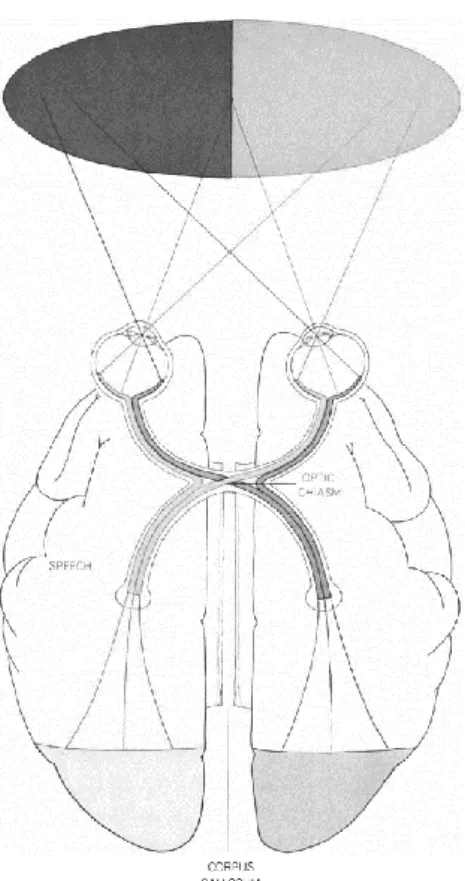
Secondly, a few words must be said regarding (2), on the way perceived information is communicated to the brain. Considering tactile and visual information, the left side of our bodies is managed by the RH of our brain, and right side of our bodies by the LH (Mutha et al 2012). This includes both what information is communicated to which hemisphere (such as sensory information), and which hemisphere communicates back to its respective body side (such as for producing movement) (Sperry 1977). Take vision for instance: in each eye, the retina – where visual information is perceived – can be divided in left and right sides, depending on what side the light is captured. Information perceived by the retinas travels to the brain via the optic nerves and through the Optic Chiasm, where these nerves partially cross (Llinás 2003). On this crossing, information perceived on the left side of both retinas (which correspond with what is seen on the right field of vision) is directly communicated to the LH, and information perceived on the right side of the retinas (corresponding to the left field of vision) to the RH. Together, these visual inputs make up our visual world, or visual field (Smythies 1996). As such, the division of visual information perceived is not considered by which eye, left or right, perceives what, but rather as on what side of your overall field of vision you are perceiving information. Consult Figure 1.01 in the appendix section for a very simplified illustration of said visual system. Similar mechanisms of communication to the brain apply to other sensory processes, though communication of said information may not be directed to the contralateral hemisphere, as with sight or tactile and motor control: auditory information is partially communicated to both hemispheres, though dominantly crossed as is visual and tactile information; olfactory information is an exception to this crossing, as it’s the ipsilateral hemisphere that receives perceived information from the nostrils; finally, muscle control of the face and neck is shared by
both hemispheres (Sperry 1973). Keeping these points in mind is key to understanding the split-brain phenomena, as we will see shortly.
1.2 The Split-Brain Phenomena
If the CC accounts for most of the communication of information across hemispheres, what can we expect to be the consequences of severing that channel of communication? This question haunted scientists and philosophers ever since this procedure became the main, last resort solution, for severe cases of epilepsy. More haunting still because, apparently, no change in these individuals’ behaviors was observable. Firstly conducted by Roger Sperry and his student, Ronald Meyers, back in 1955, split-brain studies were meant to take this lack of communication between the hemispheres to the test. Back in their early days, Meyers and Sperry tested the hypothesis that the CC was responsible for interhemispheric communication, preforming a corpus callosotomy in cats (Myers & Sperry 1953; Kean 2014) and proceeding to perform with them several tests. He discovered that he could actually teach different, contradictory things, to each of the hemisphere of the cats, depending on what hemisphere had access to the experiment through covering one of their eyes 2. As suspected, learned information was not communicated to the other hemisphere.
Human testing shortly followed, initially led by Sperry, and subsequently together with his student Michael Gazzaniga, who leads SBP studies today.
As mentioned before, SBP’s show no signs of any behavioral change in normal circumstances, which had left the scientific community in doubt as to how the severing of such a huge axonomic pathway could produce no change in their output behavior. Sperry, Gazzaniga and their colleagues enter the picture as explorers of the split-brain, dedicating years of research to the topic, providing the world with a massive amount of data on these individuals, and finally revealing what had been puzzling the scientific community throughout years before: the corpus
callosotomy does produce behavioral changes, though these might not have been so obvious at
first. The classic human split-brain study paradigm is as follows: the subject is presented a white screen, which he is told to fixate, but only at the dead center. This ensures the division of the visual field in left and right, which as we’ve seen, will guarantee that information on either side of the field will reach, exclusively, the contralateral hemisphere. On this screen, experimenters could now flash very brief stimuli, each lasting about 200 milliseconds, which is enough time to quickly identify a stimulus, but not for an ocular response (such as one that would lead the subject to focus the stimulus instead of the center of the screen) (Thorpe et al 1996). With this simple
2Unlike human callosotomy, in which the optic chiasm is kept intact (allowing for input from one retina to reach both
hemispheres), in cats’ callosotomy the optic chiasm is severed, allowing for left eye / right eye input to be lateralized in the hemispheres.
procedure, the left and right hemispheres can be stimulated separately, and responses from each of them can be studied.
Suppose a stimulus is presented in the left side of the screen. If an individual with a healthy brain were to be asked what he was seeing, he would promptly be able to describe whatever it is that was on the screen. But Sperry and Gazzaniga were working with SBP’s, and as bizarre as it seemed at first, the patient was not able to describe it. In fact, as far as the patient was able to verbalize, he did not claim to see anything at all. On the other hand, if the stimuli were to be shown on the right side of the screen, the patient would be able to both acknowledge seeing it, as well as describing it (Sperry 1968; Gazzaniga 2013). If this weren’t strange enough, if you were to give a SBP something to hold with his left hand, all the while not allowing them to see what they are grabbing, they could not describe what they were holding, and again, would even claim to not be holding anything at all. However, as you might suspect, should the object be held by the subject’ right hand, they would be able to claim to be holding something, and if possible, even identify it (Sperry 1968).
Now suppose a SBP was asked to pick up an object, through touch alone, which had been shown to the right side of the screen. The subject would readily find the object with his left, RH controlled hand (though claiming that he would prefer to do it with his right, LH controlled hand). But then, if the experimenter were to say something like “Good job on picking the right object!”, the subject would surely answer something like “The right object? How can I know which one is the right object if I don’t know what I saw?” (Sperry 1968). Should this experiment be repeated a time and time again, the subject would always get it right, and still claim not to know why. This result is beyond mere luck or chance. But then, why was the subject not able to verbalize that he had the information to get the right object, or even that he clearly knew he did have such information? These are the sort of strange behaviors that split-brain patients reveal, and these behaviors are what we call the curious Split-Brain Phenomena. It does get stranger however.
SBP’s can also act upon two different stimuli (each presented to each hemisphere)
simultaneously (Gazzaniga & Sperry 1966). Say then if two pictures of different objects were
flashed on both sides of the screen, the subject would be able to pick, through touch alone and at the same time, the correct object with the hand corresponding its respective hemisphere. Imagine also that a SBP was asked to draw a circle with his left hand, and a square with his right. A healthy brained individual would struggle to accomplish such a task, and probably get two shapes that are neither a square nor a circle. A SBP does this with little effort, and indeed, is able to draw a crude circle with a hand and a square with the other (Markmcdermott 2010). It seems so far that, upon separation of the hemispheres, a certain level of independence arises in each hemisphere, that leads the SBP’s to be able to act as if two different people.
Stepping away from experiments involving opposing stimulation in the hemispheres, let us see what happens when a SBP is faced with a task that can be completed with joint work from both hemispheres. J.W., one famous SBP who has worked with Gazzaniga, is a very good artist and a car aficionado. In an experiment in which he participated, the word “CAR” was flashed to the LH, and “1928” was flashed to the RH. He was then asked to draw what he had seen. What J.W. drew was a car from 1928. So even without interhemispheric communication, these individuals were still able to perform tasks which required hemispheric communication. This communication is considered to not be done internally however, but rather externally through some sort of cross-cueing of information – an unconscious form of external hemispheric communication – or maybe cooperative control over the drawing hand (Gazzaniga 2013).
Before bringing the SBP’s ability to cross-cue information externally to a close, consider the following experiment: a SBP was flashed numbers to the either hemisphere, numbered 1 through 9, and was told to count the numbers as they appear. As such, if the number “1” was flashed to the LH, the SBP would have to verbally report “One!”, and repeat the process with any other number (1 through 9) that would be flashed. When the LH was tested, as expected, the SBP could count the numbers perfectly, and took him approximately the same time to do so regardless of the number shown. Now, when the same test was applied to the RH, the SBP was actually able to count them as well, verbally reporting the numbers as they were shown. Against all the data that had before been collected, which suggested that anything shown to the RH would go unmentioned, the SBP was able to count what was flashed to the RH, just as the LH. The time it took the SBP to count each number, however, was different in each one (Gazzaniga & Hillyard 1971). As Gazzaniga and Hillyard report: “we were standing before a self-cueing mechanism”. As it would seem, the SBP, through his RH, had developed a method of slightly nodding his head a number of times correspondent to the number displayed, as to signal the LH of the number it had access to, allowing for the verbalization of the numbers through the LH. And again, all these self-cueing mechanisms occurred without the subject being able to verbalize the reason behind such curious self-cueing behavior. So the hemispheres can both function independently, to a point of one interfering with what the other one is up to, but also working together to achieve a cooperative goal, to a point where one communicates with the other externally.
Consider now what happens when a SBP is faced with a moral question. In several experiments, SBP’s were faced with short stories with moral decisions. In these experiments, there was no division of stimulus of any kind. The SBP’s were simply given a story regarding a moral decision, and were then asked to judge it accordingly. The stories were similar to the following:
The SBP was then asked to classify the waitress’ decision of bringing the sesame seed filled meal to the costumer as permissible or forbidden, depending on whether the decision was morally sound or not. The SBP classifies it as permissible, though checking before bringing a potentially harmful meal would be the morally acceptable thing to do. The SBP’s classification was based, not on the morality and beliefs he should know Kate to have, but on the outcome itself. In this case, as nothing bad happened, he would classify it as permissible, though we know well it wasn’t. Furthermore, if asked why he considered it permissible, he would answer “Sesame seeds? Such small things couldn’t harm anybody!” (Miller et al 2010). Should the tale have a negative outcome, the answer would have be forbidden. It would seem a SBP is not able to rightfully verbalize on the morality of situations. It is curious though, that when a SBP’s decision is not a morally sound one, that is when he feels the need to justify his decision, such as in the example given, almost as if trying to convince himself of his claim.
To finalize this short overview of the strange split-brain phenomena, let us consider what happens when a SBP is pointed out that he is acting strangely. Suppose that upon choosing a correct object, which had been flashed to the RH, the patient was asked “How did you know this was the right object”? Recall that SBP’s verbally claim to have no idea of what his RH controlled hand is doing. The patient would answer something similar to “I must be just guessing!” or “I must’ve done it unconsciously” (Sperry 1968), though we know that is not the case. Consider the following experiment: two pictures were shown on each half of the testing screen: on the left a snowed-in house; on the right a chicken claw. Then, several random pictures were shown to the SBP on the table, and he was asked to point out, with each hand, the picture that better related to the image he had just seen on the screen. With his RH controlled hand, he pointed to a snow shovel, and with his LH controlled hand he pointed out a chicken head. Yet, when asked why he had chosen those pictures, he answered “The chicken claw goes with the chicken, and you need a shovel to clean out the chicken shed” (Gazzaniga & LeDoux 1978). Consult Figure 1.02 in the appendix section for a depiction of said experiment. Again, the SBP was right in pointing out the pictures he did, but was not able to say the right reason for his decision. He knew that what he had seen through his RH was a snowed in house, and that is why he picked the shovel. But he wasn’t able to say so, and instead, his “speaking” LH creates a narrative 3 that somehow mixes
3Note that it is not the LH that creates a narrative, but rather us, holders of the mind. Attributing such concrete attributes
to structures that cannot hold them, as the hemispheres, is falling for the Fallacy of Misplaced Concreteness. It is useful to expose the argument however, so it will be done, mindfully, several times throughout the exposition.
“Kate is a waitress preparing to take a meal out to a customer's table. The customer is with his friends, and he orders a meal that calls for sesame seeds. The customer happens to love sesame seeds and that he will have no problem at all if he eats the sesame seeds in his meal. After overhearing part of the customer’s conversation with his friends, Kate believes that the customer is highly allergic to sesamelseeds. Kate puts the sesame seeds in. The customer enjoys his meal and is fine”.
what the left hand had picked out with what the LH had seen on the screen. This specific phenomena, in which the LH “creates” coherent narratives to justify the RH controlled actions, has been named the Left-Brain Interpreter. Through his interpreter, when the SBP is confronted with questions related to his RH controlled actions, the LH is able to maintain the individual’s personal story clear of contradiction, even if, as we can clearly see, the story is just an illusion. So, if it weren’t strange enough to imagine that a corpus callosotomy could have no real consequence at a behavioral level, realizing that it does indeed have consequences, and that those consequences could be so bizarre and yet so elusive, was scientifically amazing. Much so that it earned Roger Sperry his Nobel-Prize, and to this day, no one has been able to fully explain these phenomena without undermining, to some extent, what we have always believed to be true about the brain, the mind, and how they are related.
These studies have come to contribute greatly into what we now know about the brain, and indeed corroborated some of the theories that had already taken place in the scientific community. For instance, we knew that the linguistic center of the brain is (usually) located in the LH. It would then fit the picture that, as realized, a SBP would not be able to speak of anything related to the “unspeaking” RH. Not only language, we’ve come to learn that each hemisphere has its own cognitive proficiencies, in what we call Lateralization of Function in the brain (McGhilchrist 2012). Split-brain studies perfectly support this idea, for in them we see different proficiencies associated with each hemisphere. Tasks involving specific cognitive faculties are completed with greater ease by the hemisphere specialized in them, and though neural plasticity accounts for some variance and adaptation, it is still clear that each hemisphere has its own independent aptitudes, and also duplicated ones as well. Upon severing the CC, what seems to happen in these patients is that each hemisphere no longer “knows” what the other one is up to, and characteristics exclusively present in either hemisphere can no longer be shared with the other. This lack of interhemispheric communication leads to the strange split-brain phenomena, as the uncommunicating brain no longer seems to be able to operate as a unit in specific, experimental, situations.
1.3 Nagel’s Question
We can now sympathize with the attention that these phenomena have gotten from the scientific community. The debate surrounding the split-brain phenomena is immense, as numberless questions can be raised with relation to it. One major problem that arises with these phenomena is that it may come to undermine our idea of what a mind is. We know, even if only intuitively, that we have subjective mental experiences that make up what we call the mind. We’ve never had to considered that any one individual could have more than one mind, as this very
proposition seemed unintuitive and quite unnecessary; there was no reason for us to even consider this. SBP’s and their behavior came to change this, with the ground shaking fact that they do seem to act as if two different persons at times. So, at least with respect to SBP’s, we may ask how many minds we can consider such patients to have. Philosopher Thomas Nagel, renowned for his work on the philosophy of mind, asked this very question back in 1971 in his work “Brain
Bisection and Unity of Consciousness”, which to this day stands at the very heart of the split-brain
debate. In it, Nagel proposed an exhaustive number of possible answers to his question, considering what was known of the Split-Brain Phenomena. He considered five different possibilities, all of which might explain how a one brained individual could show such a strange duality of behavior:
1. Split-Brain Patients have one normal mind in the Left Hemisphere, and any response produced by the Right Hemisphere is the product of an automaton, and not of conscious mental processes;
2. Split-Brain Patients have one normal mind in the Left Hemisphere, and isolated conscious phenomena may occur on the Right Hemisphere, though not integrated into a mind; 3. Split-Brain Patients have two minds, one associated with each hemisphere;
4. Split-Brain Patients have one mind, whose contents arise from both hemispheres, which hold dissociated content;
5. Split-Brain Patients have one mind while hemispheric functioning is parallel, but when in experimental situations in which each hemisphere is given different tasks or information, the single mind splits into two (even if only temporarily).
Just as Nagel did in his work, let us start by analyzing the first two hypothesis, which share the common premise of considering that what goes on in the RH is not a product of a mind. On the matter of the first hypothesis, what evidence do we have supporting it? It is true that a SBP is unable to testify whatever happens in the RH, and by all means denies awareness of activities in that hemisphere. But we know well that the linguistic center of the brain is located in the LH. If the RH no longer has access to the LH, how can we expect anything that goes through it to even be mentionable? Or how can we expect the LH to know what’s going through the RH? We can’t. But that is hardly enough to jump to the conclusion that the RH holds no mental activity. Consider everything else the RH is capable of: it can clearly perceive information and act upon it; respond to complex stimuli; it can hold its own sets of beliefs on the world; it can rationalize; follow instructions and even raise unspoken objections. So it appears that the argument on the lack of testimony by the RH is not enough to permit the claim that it is not part of a mind, and thus, the first hypothesis is refuted. Discarded as well is the second hypothesis, which is based on the same premise. It fixes part of the problem of the first hypothesis, as it admits that whatever happens in the RH is conscious phenomena, but it denies integration of that activity into a mind. Immediately
this suggestion seems implausible. We’ve seen that all the RH does seems to fit the idea we have of a mind! Its mental activities are not fragmented – mental structure is present – and it’s a subject of experience and action; all in all, it can do most of what anyone with a mind can do (maybe with some hardships and the absence of speech). And again, in face of all the evidence pointing the other way, this hypothesis falls short, just as the first one does.
The remaining three hypothesis are definitely more sophisticated, as the main issue with them is to be able to choose one over the other. Starting with the third, it is possible that a SBP has two minds, one associated to each hemisphere. Note that both hemispheres, independently, are capable of things we ascribe to a mind; they have different functional proficiencies, different beliefs and actions that cohere with themselves; mental activity just does not cohere with what goes on in the other hemisphere. The split cortex may then be home to two separate minds, who share a common body, but whose higher functions are independent both physically and psychologically. They would work in parallel in the majority of situations, as both hemispheres would have access to the same information. This hypothesis loses its ground when we try and decide between it and the possibility of having only one mind. For in most situations, these individuals behave as one, and indeed people who relate to SBP’s consider them to be single individuals, as very little would make them suppose otherwise. We see little reason to deny that each hemisphere is home to independent mental activity. But it cannot be made clear in any situation that each hemisphere is absolutely distinct and independent. If they indeed have two minds, and we could make them be seen in them clear temporal dissociation, it would make this hypothesis a clear preferable choice. But as we stand, we hold no true reason not to believe that these individuals do not still hold a single mind with content derived from both hemispheres. This leads us to the fourth hypothesis, where a single mind dissociated could be the answer. But similar to what happened with the third hypothesis, what led us to think this may be the answer is not enough for us to understand the moments in which they appear to have two minds. Indeed, this hypothesis would provide insight into why in experimental situations, certain bits of information separately provided to each hemisphere would output different behaviors (as mental content would itself would be dissociated among both hemispheres), whilst keeping a single mind as seen in the majority of situations. In situations where no different stimulation was provided to each hemisphere, they would act as one; but in situations where different stimuli was provided, both
could act independently, but still under the same mind. Nagel proceeds to reject this hypothesis
as well however, as we would have to attribute some degree of incoherence to a single mind, and that is no easy feat:
“For in these patients there appear to be things happening simultaneously which cannot fit into a single mind: simultaneous attention to two incompatible tasks, for example, without interaction between the purposes of the left and right hands.”
It would require that the single conscious entity that these individuals are be product of two independent control systems, one associated with each hemisphere. This would make it hard to imagine what it would be like to be a SBP; to consciously hold something while consciously not holding something. To be a single person seems to be related to holding connected conscious experiences, such that when shown two different colors or two different shapes, one holds a single conscious experience that allows us to see if they are different colors or shapes. SBP do not hold such a unified consciousness, and indeed fail on this particular point we take to be characteristic in a single mind. Furthermore, while interhemispherically we cannot see this unity in experimental situations, we do see it intrahemispherically. This again points us towards a two-mind hypothesis, which as we’ve seen, does not give us strong evidence as to why individuals who act as a single person most of their time must be ascribed with two minds. These two hypothesis’ hold an interesting characteristic, where the strengths of one are the weaknesses of the other, and among deciding on one of them becomes a difficult problem.
Alternatively, the fifth hypothesis suggests that a SBP may have a single mind in normal situations, only to have it temporarily split in certain specific situations. This explanation would certainly fix the problem raised on the two-mind hypothesis, as in normality the individual could act as one, and experimentally act as two. It nonetheless fails to explain the phenomena, as it falls into fallacy. The structural change that these patients brains have undergone, in most cases, happened years before they were subjects to experiments, and no apparent physical changes can be considered between normality and the experimental moments. This ad hoc argument is hence faced with problems, as there is nothing in the experimental paradigms that may lead us to think or believe that any additional internal change has taken place that could account for this contrast in behaviors. But even if it were possible that the mind be divided upon segregation of information, though in experimental situations certain behaviors seem to be product of two minds, most behaviors do not. The subjects follow instructions as a single mind, their posture does not suggest any duality, and their interaction with the experimenter does not suggest it either. In exception for those single specific stimuli that reach each hemisphere separately, there are no indications of two minds in any other behavior, even in experimental situations.
These individuals, somehow, fall somewhere between us, normal and intact brain individuals, and a pair of individuals locked in independent cooperation, such as when playing a duet, as Nagel brilliantly put it. But if none of these hypothesis fit the phenomena, and, as it seems, we are left with no other options, then we stand before an impasse: either our idea of what is a mind is wrong, or split-brain patients have no countable number of minds. How can we accept these dualities as product of a brain much like our own? When considering these experiences, we cannot help but to compare our own subjective mental experience to that which only a SBP can imagine what it is to have; and we are not able to do it. Nagel suggests that maybe the problem
lies in holding our own, said normal mental experience, as the pillar that supports the idea that any organism with a mind must have our level of mental unity, and thus ignoring the possibility that our own unity is an abstraction, and a product of this complex neural control system of ours.
1.4 Points on the present study:
Though the debate has stretched of several decades, the split-brain phenomena remains a hot topic to this day, and naturally, new developments have risen, bringing with them new ideas, and clear room for expansion of thought. This thesis takes the opportunity from new evidence on the split-brain debate, philosophy, psychology and neuroscience, to try and revive Nagel’s question; only this time, hopefully, reaching a determined answer.
1.4.1 Approach and Relevancy
To this purpose, investigations on several topics were conducted, namely the properties that make up a mind; single-minded incoherencies; brain activity that might lead to said incoherencies and lateralization of function. All these topics were accordingly related to what we witness in split-brain phenomena.
Standing on evidence gathered from more modern perspectives in philosophy, psychology and neuroscience, I intend in this thesis to revise Nagel’s question, and to give it a determined answer: just as he hypothesized in his fourth possibility, the minds of SBP’s are home to one mind with dissociated contents derived from both hemisphere. Taking this as my hypothesis for the work, the objectives of this work are three-fold: (1) show that mental incoherence is not enough for the assertion of the loss of the single mind; (2) emphasize that not only does any mind (normal or a SBP's) reveal incoherence, it may come in varying form and nature, such that degrees of mental coherence can be considered; (3) understand how incoherence can be conceivable in any brain, be it normal or split. Having these objectives been fulfilled, and arguments in their defense proposed, I believe a solid base for considering the single mind to be incoherent will have been built, for both normal individuals and SBP’s. Regarding (1), we will see that normal minds reveal incoherent states in the mind, which amounts to having an incoherent mind – a mind whose states do not (always) cohere. As regards (2), witnessing that normal individuals may reveal incoherence in different depths (following a chain of mental processes from mental representing to taking action) with different resulting incoherent behaviors, and that SBP’s reveal incoherence according to what would be expectable if mental representations became consciously incoherent, mental coherence may be understood in degrees, and any mind must be found within the range of absolute coherence and no coherence at all. As for (3), considering the brain as a Helmholtzian predictive machine, generating models for conscious representation of predictions, and taken into account that more than one such model can be housed
in the brain, normal incoherence and SBP incoherence can both be explained in accordance to this Bayesian Brain theory, being this approach the first of its kind applied to the split-brain phenomena.
These answers require the integration of information from various areas of cognitive research, as the debate itself cannot be approached from any other perspective and hope to give it answer. To understand what goes on in a SBP’s mind, we must give way to new theories of the mind that can take in the strange split-brain phenomena. We must understand the brain mechanisms that give rise to these behaviors, and we such a physical brain, not very different from yours or mine, can produce different mental outputs given a change in hemispheric communication. As such, through investigation built from various standpoints of cognitive science – philosophy of mind, psychology and neuroscience – I intend to argue in a way that, as we will see in the following chapter, integrates knowledge from them all.
Thankfully, due to advances in medical science, invasive procedures such as the corpus
callosotomy are drastically decreasing. On the other hand, our window of opportunity for studying
the split-brain phenomena is coming to an end. Now, more than ever, is the time to approach this issue critically. Furthermore, the implications of said answers would be grand, for somewhere among them may lie the understanding of our minds, their structures and basis, knowledge of correlates of consciousness, and enlightenment on the very nature of the relation between our physical brain and our immaterial mind.
1.4.2 Methods
Given the multidisciplinary approach inherent to the problem under analysis, various branches of research had to be considered. Along with Sperry and Gazzaniga’s work on the split-brain phenomena (along with that of other researchers), investigations were conducted on properties of the mind, on phenomena of mental incoherence, on brain structure and information transferring mechanisms (such as through the CC) and on lateralized and duplicated functions in its hemispheres, on theories of brain functioning to generate consciousness and on the importance of structures, other than the cortex, in the maintenance of a mind. Research was conducted through various article search engines, such as PubMed, Phillpapers, Google Scholar and Semantics Scholar, along with search on specific books, provided their undeniable importance on the explored topics (as Iain McGilchrist’s “The Master and his Emissary” for lateralization of function, or Eric Kandel’s “Principles of Neuroscience” for general aspects of brain structure, for instance).
Chapter 2
To Define a Mind
Proceeding to the next step, we must now come to a sort of a consensus as to what we take a mind to be. Ask yourself: what is a mind? What is it to have a mind? All of us have an intuitive idea of what the answers to these questions are. Having a chain of thoughts must be related to having a mind, so would being conscious. Maybe being able to act on impulses, or even having emotions or feelings? With no doubt, all these and much more are said to be accessible, at least to some extent, through mental experience. The difficulty in defining a mind lies in finding an universally acceptable definition for it. Consider this: what if someone had all of the previous characteristics mentioned, but no emotions? Or inability to take action? Should we consider an individual without the ability to form memories to be without a mind, just because memory is clearly a characteristic of a mind? And what of a cat, whose mind is certainly different from ours? Surely differing mental qualities are not a suitable reason to assume the animal has no mind. A cat may not be able to form a complex chain of thoughts as we do, or even hold the elaborate concepts we are able to. But it will still know where to find his food, or how to provoke into his playful activities. They can perceive the world and hold a very basic understanding of it (arguably enough) so as to be able to act upon it accordingly. They can phenomenally experience it, feel angry, sad or happy; it would seem to me a cat shows clear evidence of having a mind, even if different from yours or mine. There must then exist certain mental properties that are necessary for having a mind, and a set of these that are sufficient for the same purpose. The question then is: which ones?
Given the difficulty in defining the mind, we will not attempt to come up with a definition for it per se, but rather propose a set of characteristics that we expect any one with a mind to have, such that one holding all these characteristics cannot be said to not have a mind. The proposed characteristics are: (1) forming representations; (2) holding beliefs; (3) taking action; (4) having consciousness; (5) having coherence. Note that these mental properties individually may not be necessary nor sufficient for having a mind, but having them all would certainly be sufficient for us to ascribe a mind to their holder. After treating these mental faculties, we’ll go over the reasons that led to the choice of these five. Finally, I shall disclose the argument behind the first objective of this work, to show that mental incoherence can be the product of any mind we deem singular.
2.1 Mental Representations
Starting with mental representations, we all have the ability to mentally perceive the world. Any given part of reality can become part of a mental experience that regards that reality. To be in any given state of mind is to have a mental state (Sehon 1994). A mental state is then any such mental activity that may occupy a state in the mind – if you think of a cat, you are having a mental state representing a cat; or if you feel angry and reflect upon that feeling, you’re having a mental state representing your anger. All mental states, in order to be represented, must be reflected upon. But one can represent the world without reflecting upon that representation. When you stare now at this document, you are not reflecting on the mental state of seeing this document; you are simply perceiving it, and indeed representing it. Mental representations are then mental states that represent reality or other mental states (Fodor 1981). These mental states are said to be intentional (refer to something, or are about something), and hence, are subjects to semantic and formal properties which characterize them, such as truth conditions, relevancy or accuracy, and so forth (Fodor 1981). If you were to say “the cat is a mammal”, your mental representation would be true; but if you were to say “the cat can fly”, it would not be true. Notice, however, that regardless of its semantic properties, there is a certain freedom associated with representing a mental state. As I write here “the pink cat dances upside down on the piano”, you are clearly able to imagine the said cat, even though you probably never had this thought or seen this happen. You are forming a new representation in your mind that is based on representations you already own (a cat, the color pink, a piano). In this sense, the capacity for the mind to represent content is vast, though ultimately may be limited by our mental representations themselves.
Through these mental representations, room for all kinds of mental activity can arise. When planning, rationalizing, visualizing, desiring; when tapping into any kind of mental activity, mental representations are their building blocks. The theory that stands by this idea has become known as the Representational Theory of the Mind (Sterelny 1990). If you imagine the most beautiful sunset on the beach, you are immediately presented with a series of mental representations of a reddish sun falling behind the horizon on a sandy shore. When you plan for a summer vacation, you create a series of mental representations of that which you are planning on doing throughout your vacations. All these mental representations – that of the sun, of the setting, of the beach or a series of plans – are fittingly related to form a single mental state that represents whatever it is supposed to represent.
Cognitive science finds its way to this issue, trying to find a way to naturalize this mental phenomenon. Any given mental activity must be associated with a corresponding brain activity. Alas, finding this association is the center of the mind-body problem. We have found, however, several brain regions associated to the formation of different representations: perceiving
horizontal lines is associated with the firing of specific neurons, and so is the perception of vertical lines (Fink et al, 2001); seeing faces (Kanwisher & Yovel 2006); words (Cohen et al 2000); and the list could go on. If we think about this however, it doesn’t seem like we make a conscious effort of representing these things. We simply perceive them, and indeed represent them. We, while awake and aware, are constantly perceiving information, and forming mental representations that make up this unified sense of who we are in the world. But we do not represent
everything (Mack & Rock 1998), as that would certainly be too overwhelming. We represent that
which is useful, that which has certainly been evolutionarily selected to be represented. When you stare at the white wall, you do not notice all the details, the little bumps or different shades of coloration. You see a wall, plain and simple (unless you make it your intention to look for detail, and even so, some details will surely be missed). The mental representation you become aware of is filtered, such that only some part of it is consciously represented. Nonetheless, the problem remains, as explaining how brain activity may be translated into mental states may be still out of our reach. Certainly within reach, however, is our ability to ponder on the very nature of mental representations, which has been a hot topic of debate in philosophy of mind.
Folk psychology is said to be the commonsense understanding of how the mind works
(Shroeder 2006). When we witness a behavior, we try to explain it according to what we know (i.e. of the person, of the situation), and justify it accordingly. In order for normal human beings to engage in social interaction, some presuppositions must be considered, such as the principle of
charity, through which we consider the best possible version of each other’s statements, allowing
us to make sense of each other (Blackburn 2016). We may understand the importance of these mental representations of ours through this scope: should the mental representations we all hold differ, then it would be extremely hard to have any type of discussion or conversation or even social interaction. As such, most philosophers and scientists agree on representational nature of the mind, which is ultimately reflected in our everyday mental experiences.
2.2 Beliefs
In tight relation with mental representations, we can now consider Beliefs. A belief is a
propositional attitude 4 (Fodor 1978) and a mental state that relates to certain mental
representations, and that refers to something truth-verifiable. A belief must be true, or it must not be true. Likewise, if we believe in something, we should not be able to honestly claim that we do not believe in that exact same proposition. If we think about our beliefs, we quickly realize that not all of them require long processes of thought or introspection: we all believe this document is
4A propositional attitude is an attitude one takes towards a proposition. If one believes in black cats, on has a belief
black in white; that time does not stop, or that the sun will rise each new day. Beliefs are, in a way, one of the most fundamental forms of mental representation, and certainly one of the central parts of mental activity, behavior and conscious thought.
To believe in something would then entail the existence of a mental state, such as a mental representations, whose representation must refer to something. Just as in mental representations, there is a certain freedom associated to what one may believe in. Beliefs can be contested, can change, and can even be unfounded. When established in a mind, they can easily be recalled at any time. It would then seem fitting to consider a belief to be the mental state of having a stored representation, whose propositional content will be the same as the belief itself (Sterelny 1994). One is left to wonder on the nature of such a mental state. A strongly established belief may be very hard to change. Indeed, there are even certain unconscious processes which seem to serve in defense of beliefs (unfounded or not), such as seen through a backfire effect, in which a challenge to our beliefs may lead to even stronger belief in them (Nyhan & Reifler 2010). Beliefs do seem to be very important for the mind, and furthermore, beliefs seem to be the roots of most behavioral phenomena, taking a core position in the causality of behavior (Leicester 2008).
Now that we understand the importance that the mental belief system holds, we may ask more difficult questions: how does a belief get to have content? Are there different types of beliefs? What are the properties of beliefs, and does the existence of beliefs in the mind entail the existence of structure for the mind? The content of a belief, as hinted previously, seems to be intimately related to the proposition associated with it, which is related to the representation it is based upon. Consider the belief that “the sun is bright”. This belief holds that an external object, the sun, possesses the property of being bright, which is its proposition. It is the storage of this representation and its propositions that allow for a minded individual to be able to take stances and attitudes towards such representations. As to different types of beliefs, two are generally considered by both philosophers and psychologists alike: occurent beliefs, which correspond to beliefs present in the conscious mind at any given time; and dispositional beliefs, which are beliefs that are stored in the mind, but not being consciously introspected at any given time (Rose & Schaffer 2013). Forming and storing beliefs has been widely studied along with memory, where a non-occurent belief may be recalled at any time, provided it is stored in memory (Schacter 2001).
The properties of beliefs are a more delicate matter, and one filled with diverging opinions. One that must be mentioned forehand is that which sets the prepositional attitude of believing apart from other prepositional attitudes: believing must relate to a norm of truth. A belief’s propositional representation must be subject to truth conditions (Burge 2010). Furthermore, an established belief in any mind must be true or must be false in that mind, such
that one may not believe in something while honestly claiming it not to be true. Another property of beliefs is the fact that they seem to be limitless, in what Jerry Fodor calls the productivity of
thought (Fodor 1975) – there seems to be no limit to the number of beliefs that one may have.
Another important property brought up by Fodor is considering the systematicity of our mental activity. If one is to believe that “cats dislike dogs”, one may also believe that “dogs dislike cats”. The way beliefs, and thought in general, can be rearranged in suggests the existence of internal mental organization, or a system they must abide to.
As such, it is considered that beliefs must have some kind of structure. Some believe that structure is intimately related with language (Davidson 1982); others consider the existence of a map-like structure of representational content, such that by repetition and rearranging of mapped representations, a limitless amount of mental states can be achieved without resort to language, and holding the properties suggested by Fodor (Blumson 2012).
2.3 Actions
Having an established belief system is, as mentioned, a pillar for the output of behavior. To act can be said to be to behave. Action, so long as it is willful, must be accompanied by intention (Davidson 1980). So, intentions can be said to be the main precursor of action, and definitely the precursor of willful action. Through having an intention may not be the same a holding the belief of willingness to act (Paul 2009), one and the other are related in the basis that intentions require beliefs to be acted upon. We can widely consider two kinds of actions, and to simplify, let us start by excluding right away a set of actions and behaviors that we are not interested in debating here. Suppose that a ball is coming straight for you. What do you do? Probably, you will at least attempt to dodge the ball. But you will do this unwillingly; this action holds no conscious intention (thought avoiding the ball could be an unconscious intention). This level of action will not subject of discussion here, as we do not intend to ask if a SBP can act unconsciously. This leaves us with willful action, which is, nonetheless, riddled with controversy. Donald Davidson, back in 1980 (Davidson, 1980), wrote the following premise:
(1) If a person F’s by G’ing, then the act of F’ing = the act of G’ing
This seems to be true to some extent. If a person breaks a glass by throwing said glass against the wall, then by all means, breaking the glass = throwing the glass against the wall. But what if we propose the same premise on the following thought: a person moves his hand by trying to move his hand. It would seem that willing to move allows for the movement itself (Wilson et al 2016).
If we take a look inside the brain, we know there is a region in each hemisphere dedicated to voluntary motor function – the motor cortex. Whenever we move, neuron firing in this region is certain. We generate this mental state of intending to act through activation of neurons in the motor cortex, which in turn leads to the physical command for movement. To further understand the possibility of this mechanic for agency, consider Benjamin Libet’s controversial experiments on willful movement. Libet noted that preparation for motor movement (as seen through neural firing in the motor cortex) preceded conscious awareness of the intention for said movement (Libet 1985). This left us to question the very nature of our free will, as admitting that neuronal firing for movement occurred prior to our conscious awareness of intention for that movement would entail that our movement and actions would not be determined by our intention to do so. Considering that free will is not something we can let go of so easily, theories behind what leads to conscious intent have been considered, such as Dennetts “Fame in the Brain” theory (Dennett, 2006), and through these theories, we may make sense of intention for movement producing said actions, where an unconscious mental process (such as the intention to act) may become conscious as the result of certain cerebral processes. It’s important to note that, independently of neuronal firing prior to conscious awareness of intention, this is a continuous process: neural firing leads to consciousness of intention which leads the movement – it’s a successive continuous process, as conscious awareness requires mental representation of phenomena, and thus only prior to said representation can it be consciously accessible. In this sense, what we may be willing to do, and becoming conscious of it, are not supposed to be simultaneous. Nonetheless, it should seem clear by now that actions entail the existence of mental states that ground said actions, and without these mental states, action as a product of a mind could not be considered.
One issue that should be briefly mentioned is that of simultaneous action. We see SBP’s taking simultaneous actions, without one task hindering the other. A normal mind struggles at this feat, and if asked to simultaneously act upon two different tasks consciously, reduction in the efficiency for both tasks is expected (Pashler 1994). Yet, a SBP can consciously focus on two different tasks simultaneously with a brain much like our own. A SBP can draw a circle with one hand and a square with the other with no difficulty. This is a whole other level of simultaneous action, and one we, normal individuals, cannot achieve easily. As mentioned, both hemispheres hold the needed neural basis for action. And as it would seem, both hemispheres hold the needed neural basis for the formation of representations and beliefs as well. If actions are based on beliefs, then it would be possible for both hemispheres to be able to take action simultaneously, provided that they would be allowed to act independently – which is exactly what a corpus callosotomy seems to enable – and that each hemisphere held a different set of relevant beliefs for the task, which they seem to do.