Riding as a Way of developing soft
skills in HigHeR education
Filipe Oliveira a1, Carlos Rouco a1 and Tatiana Gladkikh b1
a Department of Post-Graduate Studies, Military Academy, Lisbon, Portugal b Business School, University of Winchester, Winchester, United Kingdom
RESUMO
De uma forma geral é aceite que as “hard skills”, tal como as competências funcionais e cognitivas, são extremamente importantes para a execução das tarefas profissionais. Contudo, as “soft skills” fazem a diferença entre o “job
well done” e as capacidades para obter desempenhos superiores em equipa,
na integração em cada organização e na sociedade em geral. Recentemente, o Ensino Superior em todo o mundo começou a oferecer programas para o desen-volvimento de soft skills. No entanto, o caminho para desenvolver eficazmente as soft skills ainda está por definir.
Ao analisar os programas de treino para o desenvolvimento de soft skills no Ensino Superior verifica-se que as ofertas são bastante diversificadas. Neste sentido, para definir um modelo de soft skills e os métodos pedagógicos que as promovem, este estudo tem como objetivo verificar se a prática de equitação representa um excelente instrumento. Para materializar estes obje-tivos, a investigação usou o método quantitativo através da aplicação de um questionário com 23 Soft Skills. A amostra foi constituída por 180 indivíduos (90 estudantes praticantes e 90 não praticantes de equitação) provenientes de três Estabelecimentos Portugueses (Academia Militar, Universidade de Évora e Colégio Militar).
Da análise dos resultados, conclui-se que existem diferenças na média dos valores do nível de proficiência das Soft Skills entre os estudantes praticantes
1 Contato: Email – [email protected]
e os não praticantes da Academia Militar, Universidade de Évora e Colégio Militar. Os estudantes praticantes de equitação mostram elevados níveis de proficiência, nas seguintes Soft Skills: liderança participativa; liderança por delegação; consideração; autocontrolo; e promoção do desenvolvimento. Ainda, verifica-se que os estudantes praticantes de equitação desenvolvem significa-tivamente diferente dos não praticantes todas as Soft Skills em estudo, com exceção para a autoconfiança e tomada de decisão.
Palavras-Chave: Educação Superior; competências; montar a cavalo; atividades aprendizagem
ABSTRACT
It is generally agreed that hard skills, such as practical skills and theoretical knowledge, are extremely important for the execution of professional tasks. However, soft skills make a difference between the simple “job well done” and the ability to obtain superior performance in teams and the integration in each organization and society in general. In recent years higher education institutions throughout the world have started offering training programs for developing soft skills. However, the most effective ways to improve such skills are yet to be identified.
Examination of training programs of development of soft skills in Higher Education institutions demonstrates that such skills are very diverse. Therefore, in order to establish a framework of soft skills and a way to improve them, this study aims to verify if the practice of riding in educational establish-ments is a useful educational tool for developing soft skills. To achieve the objectives of the study, the research uses a quantitative method through the application of a questionnaire with 23 soft skills (Rouco, 2012). A sample of 180 individuals (90 riding students and 90 non-riders) from three Portuguese Institutions (Military Academy, Évora University and Military College) was used in the research.
The analysis concludes that there are differences in average values of the level of proficiency of soft skills between riding students and non-riders in the Military Academy, Évora University and Military College. Riding students show a higher level of proficiency in soft skills under study, demonstrated in the following: participative leadership, leadership by delegation, consideration, self-control and promoting development. The study concludes that the riding students develop soft skills proficiency levels significantly different from non--riders in all skills under study, except self-confidence and decision-making. Keywords: Higher Education; soft skills; horse riding; action learning.
1. INTRODUCTION
Higher Education is characterized by an advanced stage of learning where students acquire, value and guide their knowledge to the context of work and society in general. To achieve this, various learning theories and different pedagogical methods have been implemented in Higher Education. In the last decades, the action theory (Revan, 1982) proved to be very effective in developing a number of individual leadership and team problem solving skills (Leonard and Marquardt, 2010). The theory has also been used extensively in corporate and organizational leadership development programs. The action learning process includes (1) a real problem that is important, critical and usually complex; (2) a diverse problem-solving team or “set”; (3) a process that promotes curiosity, inquiry, and reflection; (4) a requirement that talk be converted into action and, ultimately, a solution; and (5) a commitment to learning.
Given the above assumptions, it is considered that horse riding represents an ex-cellent pedagogical tool for the action learning and the development of soft skills among students in Higher Education. Such skills are believed to be essential in various areas of life (e.g. social, emotional and professional). Horse riding as a pedagogical tool offers students multiple unstructured and complex situations in which students are required to use their knowledge acquired through: (1) inte-ractive dynamics between the student and the horse; (2) the relationship between the student and coach (facilitator); (3) the care of the horse; (4) the contact with the veterinary team; and (5) the contact with the support team.
Different theoretical approaches can be identified in researching human-horse inte-ractions, for example, symbolic interactionism (Brandt, 2004), social constructivism (Forsberg and Tebelius, 2011), figurational or process theory (Veliji and Flynn, 2010), and attachment theory (Bowlby, 1975). However, these theories are more focused on therapeutic riding, which presents obvious limitations to the current study given that it addresses the area of education. So, it is assumed that the research findings in the area of therapeutic riding are also applicable in the context of the current investigation. It is recognized that establishing a relationship between the learning theories and practical use of horse riding for the development of soft skills must be approached with a degree of caution given that scientific data are still scarce and that most researchers pointed out that this area of knowledge is still being developed. Similarly, caution must be taken in attempts to relate the human relationship theories with human-horse relationship.
Therefore it is considered that this paper acts a starting point in understanding the relationship between learning theories and the development of soft skills among stu-dents of Higher Education. Here horse riding is considered a pedagogical instrument between student riders and non-riders. The research addressed the following question: does horse riding improve the degree of proficiency of soft skills in Higher Education?
2. SOFT SKILLS AND HORSE RIDING IN HIGHER EDUCATION 2.1 Soft SkillS in HigHer education
In the context of the contemporary workplace each employee has become a fundamental asset of human and intellectual capital of his/her organization. Employees are expected to play a proactive role in their area of influence and thus contribute to organizational learning (knowledge management) through the experience of their organization (tacit knowledge). Hence, employees are part of their team bringing value to their collective performance. One of the challenges, therefore, is employees’ ability to interact with other members and contribute their knowledge to the intellectual capital of their organization. Additionally, employees must have the ability to adapt to constant internal and external changes influencing their organizational environment. Thus it can be concluded that individuals face many organizational challenges, among which the ability to assume the role of a leader; the ability to interact with the social and technological influences; the ability to utilize their talent for the benefit of their organization; and the ability to respond to change in its multiple manifestations. The field of education is under pressure as never before to prepare students to new ways for productive participation in the workforce (Greenberg and Nilssen, 2015). The dual forces of globalization and technological change are transforming the needs of employers who in recent years have begun making new calls for those entering the workforce to demonstrate soft skills – competencies that will make graduates more agile, better team members, and more adaptable (Greenberg and Nilssen, 2015). In response to this, the role of Higher Education is becoming more complex: it has to combine the traditional teaching (building students’ knowledge and developing their practical/technical skills) and the development of students’ soft skills, required in the workplace and in society in general.
Soft skills in the context of Higher Education can be defined as the combination of knowledge, skills and attitudes which can be understood as knowledge in action or in use promoting their integrated development (Ministry of Education, 2001). It enables the use of knowledge in diverse situations, familiar and unfamiliar to the student (Ministry of Education, 2001). Eurydice (2002) proposes that soft skills shape the ability to use an organized set of knowledge in order to answer the questions “what” and “how” and have the ability to use certain attitudes in an orderly manner to perform a specific number of tasks, while Sanchez-Ruiz, Edwards and Sarrias (2006) suggest that soft skills are the dynamic combination of knowledge, skills and capabilities.
Tremblay and Sire (1999) observed a strong correlation between functional com-petencies used in the United Kingdom and comcom-petencies “know-how” in France, as well as the soft skills used in the USA, and competencies “knowing how to
be” used in France. For Dejoux (1999) the notion of competencies is based on the concepts of knowledge (savoir e connaissance), and is a component based on experience (savoir faire ou savoir agir) and behavior (savoir être or ability to adapt). Cognitive, social and functional competencies are accepted in general and are evidently consistent within the French approach (know, know to do, know to be), for example KAA (knowledge, ability and attitudes) in training for a profession. Thus, knowledge and understanding are associated with cognitive competencies; the capabilities are related to functional competencies; and the personality traits, behaviors and attitudes are linked to social competencies. In the USA, soft skills are classified as three constructs: social, emotional and life competencies.
According to Ramos and Bento (2007), the social competencies represent a particular interest for researchers as they facilitate social integration in a com-munity, especially in such multicultural and multilingual environments as the European Union. One’s ability to develop and maintain personal relationships through effective communication, teamwork, language skills, awareness and respect for other cultures and traditions are among such competencies. A high level of social skills promotes the development of personal skills, such as self-esteem, motivation, perseverance and initiative. Citizenship is a competence that arouses particular interest at national and international level (Ramos and Bento, 2007).
The aforementioned competencies are considered cross-cutting given that they have two features: the transversality and the transferability. The soft skills which are common to various contexts, can be applied in any profession, situa-tion or hierarchical level (Ramos and Bento, 2007). Extra-curricular programs, including the practice of riding, have been developed for the development of transversal competencies of students in Higher Education. The practice of riding challenges the rider to overcome various obstacles and also helps developing their intellectual ability given the permanent search through rational thinking and intuition to find ways of managing an animal of considerable size and weight and with a mind of its own.
Having investigated the websites of top 30 universities of the world providing soft skills training, we could not easily determine a set template for such trai-ning. The existing programmes appear rather divergent. However, among the programmes consulted, we identified the following soft skills common to various programmes: critical thinking, problem solving, decision making, communication. For our study we adopted Rouco’s Soft Skills Model (2012) which is used in development of skills of the cadets of the Portuguese Military Academy. This is of particular interest as in the military context the soft skills are considered as functional competences. For example, the leadership, communication and decision-making are nuclear competencies of command.
2.2 HorSe riding and Soft SkillS
For thousands of years horses was have been at the service of a man in different functions, ranging from transportation to the symbol of power. Horses have also been used in education and training in sport, but also in the development of attitudes and behaviors of riders. Unfortunately not enough research interest has addressed the question of how riding schools develop their riders’ various skills through practice of horse riding. However, several research papers have analyzed the area of therapeutic riding in recent years. The current study will draw on such publications to identify the development of competences and will consider those that can be relevant to our research.
We begin with an assumption that riding is a factor of development of self-confidence and self-esteem. By developing a relationship with a horse the rider discovers his/ her capabilities to establish rapport, influence and manage. Therefore we believe that riding helps develop one’s capabilities and self-confidence, which is particu-larly helpful to leaders in their influencing their followers. According to Almeida (1997) the fact that the rider reads the mind of the horse, its actions and emotions influences development of sensitivity, control, ability to assess the circumstances, confidence, influence and, above all, management of his/her own emotions, as well as the horse’s. In this sense, it is considered that the practice of riding is an excellent activity for the development of empathy, which is perceived by Rouco (2012) as the ability to understand the feelings and expectations of the followers. Some investigations claim that the practice of riding can develop various com-petencies in riders. For example, Lloyd et al. (2007, 2008) identified six trait dimensions of dominance, anxiousness, excitability, protection, sociability and inquisitiveness. Burgeon (2011) described participation in equine assisted learning and therapy as altering participants’ perceptions of self-confidence, self-esteem, empathy and self-efficacy. Pendry et al. (2014) highlighted improvements in children’s personal responsibility, decision-making, goal-orientation, self-awareness, and self-management. Durlak and Weissberg (2007) study indicates that the promotion of personal and social skills in after-school settings are also known to improve youths’ feelings of self confidence and self-esteem, school bonding (positive feelings and attitudes toward school), positive social behaviors, school grades, and achievement in tests.
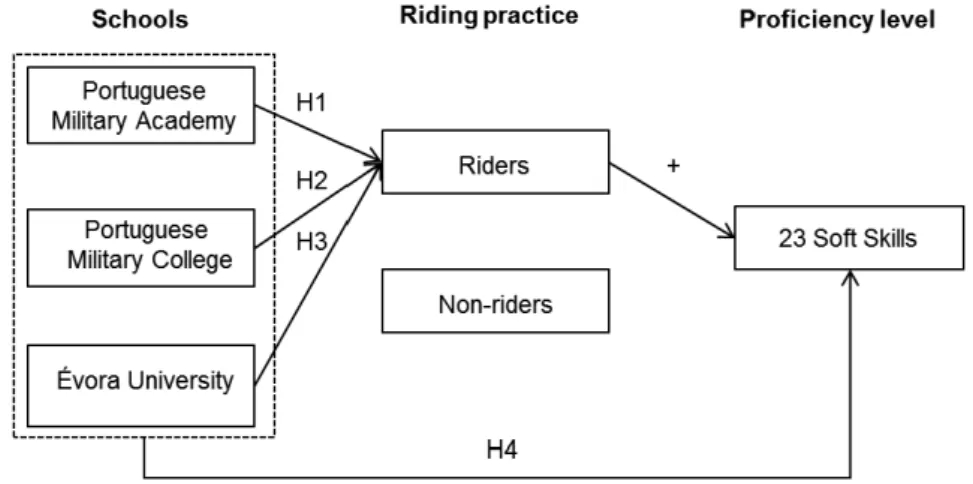
Stemming from the literature, our study aims to verify whether the proficiency levels of soft skills, according to Rouco’s Soft Skills Model (2012), are higher among young people who regularly practice horse riding versus those who do not. The following hypotheses were raised for research:
H1: The degree of proficiency of soft skills is higher among students who practice horse riding than among students who do not practice horse riding in the Portuguese Military Academy.
H2: The degree of proficiency of soft skills is higher among students who practice horse riding than among students who do not practice horse riding in the Portuguese Military College.
H3: The degree of proficiency of soft skills is higher among students who practice horse riding than among students who do not practice horse riding in the Évora University.
H4: There are significant differences between the degree of proficiency of soft skills of the student riders and non-riders.
Figure 1: Conceptual Model
3. METHODOLOGY AND METHODS
The investigation adopted a quantitative method through the application of a questionnaire with 23 soft skills (Rouco, 2012) during the months of April and May 2015. The questionnaire was applied to students (90 riders and 90 non-riders) in three Portuguese educational establishments. The questionnaire was applied in person by the investigators. Data collected formed a database, at first presented in the Microsoft Office Excel 2010. It was later transferred to the Statistical Package for Social Sciences (SPSS 15.0) for processing and statistical analysis.
3.1 Sample
This investigation was carried out in three educational establishments in Portugal, two of which are Higher Education Institutions (Portuguese Mi-litary Academy and Évora University) and the Portuguese MiMi-litary College,
which is a secondary school. At the Military Academy and the Military College students have a mandatory discipline of riding that is given during an academic year, in the remaining years it is only practiced by the students as an optional activity. At the Évora University riding is not offered as a discipline, but the University is located in a geographical area with strong tradition of riding practice. In this study 90 questionnaires were applied to students practicing riding and 90 to non-riders of each educational esta-blishment, making a total of 180 students. The age of students was between 16 and 25 years old. Out of the total sample 164 respondents were males and 16 females.
3.2 meaSureS
The Soft Skills questionnaire consists of two parts. The first part addresses the demographics of the sample, containing 11 questions about personal data and riding experiences. The second part consists of 69 close questions measuring 23 soft skills, seeking to determine the level of proficiency as perceived by the respondents. A adapted Likert range from 0 to 10 was used with 0 – extremely ineffective and 10 – extremely effective.
The following Cronbach’s Alpha values were obtained: consideration (0,79); technical and professional skills (0,77); self-confidence (0,78); self-control (0,76); problem solving (0,74); general communication (0,74); assertiveness commu-nication (0,58); courage (0,64); development of others (0,81); empathy (0,83); participative leadership (0,67); leadership by delegation (0,62); flexibility and adaptability (0,75); teamwork and cohesion (0,79); conflict management (0,76); influence by example (0,87); task orientation (0,77); recognition, evaluation and positive feedback (0,75); interpersonal relationship (0,74); decision making (0,67); transparency (0,85); vision (0,83); proactivity (0,85).
3.3 data analySiS
The sample was characterized using central tendency, the dispersion of the observations around the central tendency statistics and the form of distribu-tion. To check any statistically significant differences of the average values of the soft skills between the two subsamples (riders and non-riders) in the study, parametric tests were used. The use of these tests demonstrated if the dependent variable has normal distribution and if the population variances are homogeneous. The following tests were used: Kolmogorov – Smirnov (normal distribution) and Levene (homogeneity). The test post-hoc – Tukey was used for multiple comparisons of averages. To compare the averages of the two subsamples of riders and non-riders, we used the Independent-Sample T Test.
4. RESULTS AND DISCUSSION
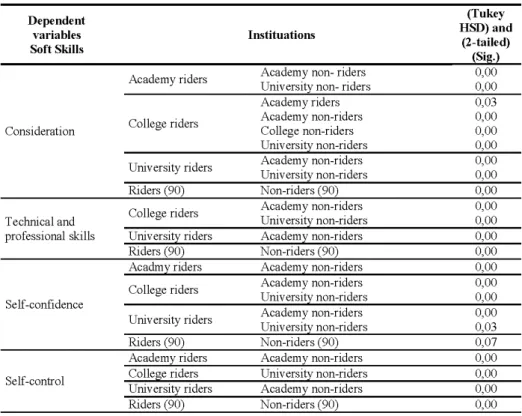
Owing to the word limit of the paper, this section presents and discusses only the most critical findings and results of the study. Table 1 shows that the College riders believe that they have significantly higher levels of proficiency of their soft skills than the other riders compared to non-riders. This is evident in the following skills: consideration; self-confidence; self-control; problem solving; assertiveness communication; development of others; empathy; leadership by delegation; flexibi-lity and adaptabiflexibi-lity; influence by example; task orientation; recognition, evaluation and positive feedback; transparency; and proactivity. These results confirm some findings discussed in the literature, for example, self-confidence (Burgeon, 2011; Durlak and Weissberg, 2007); empathy (Burgeon, 2011); task orientation (Pendry et al., 2014). These results show that riding practice is an excellent pedagogical tool to develop the soft skills among students and which meet some skills identified in the studies carried out in the area of therapeutic riding.
Table 1: Summary of significant differences between the riders and non-riders of riding of the three
* The mean difference is significant at the 0.05 level.
Lengend: the Military Academy - military riders and Military riders; the Military College - College riders and non--riders; the Évora Universaty - Universaty riders and non-riders
The Military riders perceive higher levels of proficiency of soft skills than Military non-riders, except for the following: general communication; assertiveness com-munication; courage; teamwork and cohesion; conflict management; interpersonal relationship; and vision. The young College riders only perceive higher levels of proficiency of soft skills than their peers College non-riders in the following: consideration; participative leadership; and leadership by delegation. University student riders perceive higher levels of proficiency in all soft skills than their peers university non-riders except the following: self-control; capacity to resolve problems; courage; participative leadership; leadership by delegation; teamwork and cohesion; conflict management; influence by example; interpersonal relationship; decision making (Pendry et al., 2014); vision; and proactivity.
The results demonstrate that riders of the Military College, who attend horse riding classes, perceive higher levels of proficiency of soft skills than students non-riders of the three educational establishments under study. This is evident in the following: participative leadership and leadership by delegation. The re-sults conclude that riding is a good practice to develop the behaviors associated with the leadership styles, which supports the studies of Durlak and Weissberg (2007). However, College riders perceive higher levels of proficiency of soft skills than Military non-riders, except in the following: self-control; courage; task orientation and interpersonal relationships.
The results obtained show that in general students of the three schools who regularly practice horse riding perceive higher proficiency levels than non-riders in all soft skills under study, except self-confidence and decision making. 5. LIMITATIONS, IMPLICATIONS AND FUTURE RESEARCH
The study of the practice of riding as a way of developing students’ soft skills did not permit establishing a comparative analysis with earlier results because the literature review was limited to only a small number of publications related to the practice of riding (e.g. for therapeutic purposes), which limited the discussion of the results obtained in this study.
From a practical point of view, this study allows enhancing the practice of riding as a way of developing soft skills among young people and preparing them for the challenges they will encounter in the workplace and society. It also highlights the importance of introducing horse riding activities in educa-tional establishments, schools and clubs as a pedagogical tool for developing soft skills in young people. Regarding our contribution to theory, this study identifies a variable (riding practice) moderator (predictive) that can be framed in action theory and the possibility of being used in development of models or educational programs in schools. The most significant contribution of this
study to theory is the identification of a framework with 23 soft skills that are related to the practice of riding. In order to enhance the effectiveness of the framework, a further multidisciplinary study addressing the link between riding practice and development of riders’ soft skills is encouraged.
Additionally, to better understand the relationship between the student and the horse in Higher Education it is necessary to carry out comparative studies between learning theories, teaching methods and results, and preferably in the workplace or in society in general. The authors are fully aware that the current study only represents a starting point of potential numerous lines of academic enquiry, such as:
• a longitudinal study with students riders and non-riders and the opportunity to study them in the workplace and society at large;
• a comparative approach to studying soft skills developed by the practice of riding versus other sports practiced in schools;
• a replicated study among managers and employees in a workplace. CONCLUSIONS
The practice of riding is an activity that enhances development of soft skills, particularly relevant to participative leadership and leadership by delegation. It has been demonstrated that horse riding is an excellent educational tool for developing soft skills, making young people more effective and efficient as a manager and leader in organizations.
Following the data analysis it can be concluded that there are differences in average values of the level of proficiency of soft skills between riding riders and non-riders in the Military Academy, the Évora University and the Military College, where riders showed a higher level of proficiency in skills under study, such as consideration, self-control and promoting development.
In general, we conclude that riders perceive proficiency levels significantly different from non-riders, and highlight the following skills: transparency, recog-nition and valorization, task orientation, flexibility and adaptability, leadership, empathy, promotion of development, self-confidence and consideration.
BIBLIOGRAPHY REFERENCES
ALMEIDA, N. (1997). Equitação: Como e Porquê (1.ª Ed). Lisboa: Edições Inapa.
BOWLBY, J. (1975). Attachment theory, separation anxiety and mourning. In David A. Hamburg and Keith H. Brodie (eds.), American Handbook of Psychiatry (2nd ed.), vol. 6, New Psychiatric Frontiers, Ch. 14, 292-309. BRANDT, K. (2004). A language of their own: An interactionist approach to
human–horse communication. Society & Animals, 12, 299–316.
BURGEON, H. L. (2011). ‘Queen of the world’: Experience of ‘at-risk’ young people participating in equine-assisted learn-ing/therapy. Journal of Social
Work Practice, 25(2), 165–183.
DURLAK, J. A., and Weissberg, R. P. (2007). The impact of after-school
pro-grams that promote personal and social skills. Chicago, IL: Collaborative
for Academic, Social, and Emotional Learning.
EURYDICE (2002). Key competencies: A developing concept in general com-pulsory education. Recuperado em 16 Fevereiro, 2010, em http:// eacea. ec.europa.eu/ ressources/eurydice/ pdf/031DN/031_BF_EN.pdf.
FORSBERG L., and Tebelius U. (2011).The riding school as a site for gender identity construction among Swedish teenage girls. World Leisure Journal, 53, 42–56.
GREENBERG, A.D., and Nilssen, A.H. (2015). The role of education in
buil-ding soft skills. Duxbury: Wainhouse Research.
LEONARD, L.S., and Marquardt, M.J. (2010). The evidence for the effectiveness of action learning. Action Learning: Research and Practice, 7 (2), 121-136. LLOYD, A.S., Martin, J.E., Bornett-Gauci, H.L.I., and Wilkinson, R.G., (2007).
Evaluation of a novel method of horse personality assessment: rater agree-ment and links to behaviour. Appl. Anim. Behav. Sci., 105, 205–222. Ministério da Educação (2001). Currículo Nacional do Ensino Básico:
Compe-tências Essenciais. Lisboa: Departamento de Educação Básica.
PENDRY, P., Carr, A., Smith, A. and Roeter, S. (2014). Improving Adolescent Social Competence and Behavior: A Randomized Trial of an 11-Week Equine Facilitated Learning Prevention Program. The Journal of Primary
Prevention, 35, 281–293
RAMOS, E., and Bento, S. (2007). As competências: Quando e como surgiram. In M. Ceitil (Ed.), Gestão e desenvolvimento de competências, 87-118. Lisboa: Edições Sílabo.
REVANS, R. (1982). What is Action Learning? Journal of Management
De-velopment, 1 ( 3), 64 - 75
ROUCO, J. C. (2012). Modelos de Gestão de Desenvolvimento de Competências
de Liderança em Contexto Militar. Lisboa: Universidade Lusíada de Lisboa.
SANCHEZ-RUIZ, L.M., Edwards, M., and Sarrias, E.B. (2006). Competence
learning challenges in engineering education in spain: From theory to practise. In proc. of the Internacional Conference on Engineering
educa-tion, San Juan, USA.
TREMBLAY, M., and Sire, B. (1999). Rémunérer les compétences plutôt que l’activité?. Revue Française de Gestion Paris, 126, 129-139.
VELIJA, P., and Flynn, L. (2010). Their bottoms are the wrong shape female jockeys and the theory of established outsider relations. Sociology of Sport