Repositório ISCTE-IUL
Deposited in Repositório ISCTE-IUL: 2019-05-07Deposited version: Publisher Version
Peer-review status of attached file: Peer-reviewed
Citation for published item:
Xing, J., Silva, J. M. V.-B. Da & Almeida, I. D. De (2017). Interest, design and assessment of eco-Industrial parks in China within a circular economy paradigm. 21rst Cambridge International Manufacturing Symposium – Globalisation 2.0. 12-25
Further information on publisher's website:
https://www.ifm.eng.cam.ac.uk/events/cimsymposium17/ Publisher's copyright statement:
This is the peer reviewed version of the following article: Xing, J., Silva, J. M. V.-B. Da & Almeida, I. D. De (2017). Interest, design and assessment of eco-Industrial parks in China within a circular economy paradigm. 21rst Cambridge International Manufacturing Symposium – Globalisation 2.0. 12-25. This article may be used for non-commercial purposes in accordance with the Publisher's Terms and Conditions for self-archiving.
Use policy
Creative Commons CC BY 4.0
The full-text may be used and/or reproduced, and given to third parties in any format or medium, without prior permission or charge, for personal research or study, educational, or not-for-profit purposes provided that:
• a full bibliographic reference is made to the original source • a link is made to the metadata record in the Repository • the full-text is not changed in any way
The full-text must not be sold in any format or medium without the formal permission of the copyright holders.
Interest, design and assessment of Eco-Industrial
Parks in China within a circular economy paradigm
Jicheng Xing ([email protected])Instituto Universitário de Lisboa (ISCTE-IUL), Business Research Unit (BRU-IUL), Lisboa, Portugal; Wuhan Qingquan University, Wuhan, Hubei province, P. R. of China
J. M. Vilas-Boas da Silva
Instituto Universitário de Lisboa (ISCTE-IUL), Business Research Unit (BRU-IUL), Lisboa, Portugal
Isabel Duarte de Almeida
Instituto Universitário de Lisboa (ISCTE-IUL), Universidade Lusíada, (CLISSIS-UL), Lisboa, Portugal
Abstract
This descriptive research addresses sustainability developments within circular economy (CE). Firstly, a 7R framework that provides an updated base to assess, develop and compare Eco-Industrial Parks (EIPs) was developed and preliminarily checked with secondary data from the Suzhou Industrial Park, which enables relevant benchmarking among EIPs all over the world. Secondly, different typologies of industrial parks in China provinces were analysed and related role changes were described. The 13th Five-Year Plan on National Economic and Social Development, called for the third generation of EIPs, as enablers of sustainability and balanced development of urbanization in an eco-city that combines industrial growth with city development. Therefore, Corporate, Consumer and Citizen Social Responsibility (coined as 3CSR) are attached to pursuing economic growth, social progress, and environmental sustainability. This research sets the scene for significant CE future developments, by leveraging the role of modern eco-cities through EIPs guided by a new conceptual model (7R).
Keywords: Sustainability; Circular Economy; Industrial Parks (EIP); Suzhou Industrial Park; Eco-City; Chinese Industrial Parks; 3R principles; 5R model; 7R framework; EIP Benchmarking; EIP design
1 Introduction
The world population have been suffering a very high cost of resource wastage and environmental deterioration due to excessive industrial production, such as depletion of water and energy, disruption of soil and plants, biodiversity reduction and greenhouse effect.
Economic-technological Development Zones, High-tech Industry Development Zones, National Demonstration Eco-Industrial Parks (EIPs), and New Development Zones have operationalised some of the actions pursued by central and regional governments of China to promote sustainable economic growth. In particular, EIPs have been emerging over the last decades based on both the industrial symbiosis and circular economy concepts. So, a first research question arises concerning the current interest for EIPs, i.e. if they still deserve a research effort in China, which has become the true “world plant”, in 2012. Therefore, this paper will help to set the scene concerning the current role of EIPs, since that all kinds of industrial parks have played a great role as “policy pioneers”(Shi & Yu, 2014). In fact, after the quick development of urbanization in China that has been taking place
over the past decade, it is getting more and more urgent to create a win-win relationship between economy and environment during urbanization process in an industrialized town (Yu et al., 2015a). So, one might be led to think if the EIPs still play a relevant role (vide also Xing et al., 2017b). Within this Past scenario, the Chinese Government initiated an ambitious national demonstration EIP programme in 2001 and some trial EIP programmes later on (Behera et al., 2012; Shi et al., 2012) to increase environment awareness in harmony with industrial growth. Therefore, there appears to be some successful experiences and, also, failure lessons to be learnt, because circular economy and sustainable development are increasingly getting of the public domain concern.
On the other hand, Circular Economy (CE) is the integration of activities of reduction, reuse and recycle during producing, exchange and consumption (Shen & Qi, 2012), which is essentially an ecological economy that requires human economic activities to be aligned with the 3R principle. It changes the traditional one-way linear economic model into the feedback closed loop mode of “resource – product – waste – renewable resource”, which conforms to the concept of sustainable development. Thus, resources usage and environmental protection are more effective, while maximal economic and social benefits are simultaneously targeted (Ying & Zhou, 2012).
Moreover, the United States Environmental Protection Agency (US EPA) has defined an Eco-Industrial Park as a community of manufacturing and service businesses aiming at enhanced environmental and economic performance by close collaboration in managing environmental and resource issues. Thus, these traditionally independent entities are brought together into a cooperative physical exchange of materials, energy, water, and by-products. This constitutes the named industrial symbiosis that happens within the scope of a green infrastructure of scavenger companies located on the common property of a EIP (Chertow, 2000; Popescu, 2008; Valenzuela-Venegas et al., 2016). To sum up, a EIP is a type of industrial park, which is designed and constructed according to Cleaner Production requirements, Circular Economy concept and Industrial Ecology Theory. It also obeys to the 3R principle of Circular Economy (Holländer et. al, 2009). However, the 3R principle has developed to include either the ecosystem maintenance or even the need to repair a destructed ecosystem (Shen & Qi, 2012; Li et al., 2015). This raises a second research question about the possibility to upgrade this cornerstone principle of the Circular Economy (3R) and so, of the EIPs support. In fact, if one is interested either in developing an EIP, in assessing it, or even in comparing it, there should be a reasonably updated and supported framework to provide some guidance to the above mentioned exercises. So, the role of the 3R principles might very well be a gap aiming at further discussion. In this paper, a conceptual proposal was developed from this background and motivations, and preliminarily tested in a descriptive study. The starting point of the literature review was the analysis of the connotation of 3R and 5R related to circular economy. Then, an attempt to propose an innovative conceptual framework coined as the7R principle was made (vide also Xing et al., 2017a).
2 Literature review
2.1 Concept of Eco-Industrial Park
China has witnessed a rapid economic growth from “Reform and Open door” policy, in 1978. In the transition of almost 40-year economic miracle, China government tried a serial of methods to promote the development of all walks of life, including agriculture, industry and service, some of which really work very well and fulfil some economic goals. In order to promote economic growth, some attempts have been tried by central and regional governments of China, such as the Economic-technological Development Zone, High-tech Industry Development Zone, National Demonstration Eco-Industrial Parks, and New the Development Zone. All kinds of industrial parks have played a great role as “policy pioneers” (Shi & Yu, 2014). Nowadays, an increasing number of researchers and practitioners both in China and foreign countries are interested in such themes as circular economy and Eco-Industrial Park (EIP).
The concept of Eco-Industrial Park (EIP) by the United Nations Environment Program was introduced to China in 1997 (Hashimoto et al., 2010; Shi et al., 2010). EIPs are a new form of industrial
organization based on industrial symbiosis and circular economies emerging from the extensive recognition of sustainable development proposed in the International Union for Conservation of Nature (IUCN). Industrial symbiosis concern the engagement of entities that are traditionally separated in a collective approach to gain competitive advantage by involving physical exchange of materials, energy, water, and by-products (Chertow, 2000). An Industrial Park can be classified as an Eco-Industrial Park (EIP) if the community of businesses cooperate with each other, sharing resources (Valenzuela-Venegas et al., 2016) and, leading to economic gains, gains in environmental quality and equitable enhancement of human resources for the business and local community” (Popescu, 2008). So, these businesses seek enhanced environmental, economic, and social performance through collaboration in managing environmental and resource issues, including energy, water, and materials. Moreover, hot topics like industrial symbiosis, industrial parks and Eco-Industry Parks (EIP) have drawn extensive attention rapidly as the route to promote Circular Economy (Chertow, 2000), which operationalises the concept of sustainable development.
EIP practices in developed countries, such as Denmark, USA, Germany, and Japan, have provided useful references for EIP development in China (Yu et al., 2015b). The State Environmental Protection Administration (SEPA) of China launched EIP pilot projects in Guangxi, Inner Mongolia, and Shandong provinces in 2001, and explored EIP planning and construction at the national level in 2003. In 2007, SEPA, the Ministry of Commerce, and the Ministry of Science and Technology jointly issued the Management Method for the National Demonstration EIP Program to facilitate the development of Chinese EIPs. Among these national demonstration of EIPs, the Tianjin Economic and Technology Development Area, the Suzhou Industrial Park, the Yantai Economic and Technology Development Area, and the Dalian Economic and Technology Development Area are popularly used as typical case studies for EIP construction in China (Yu et al., 2015). The research interest on China's EIP includes EIP management, material and energy integration, IS, planning methods, performance assessment, and low carbon development (Tian and Wei, 2012).
2.2 3R/5R Frameworks
The principle of reducing waste, reusing and recycling resources and products is often called the "3Rs". Dhaka (2010) argues that (i) reducing means choosing to use things with care to decrease the amount of waste generated; (ii) reusing involves the repeated use of items or parts of items, which still have potential for use; and, (iii) recycling means the use of waste itself as a resource. In addition, Ying & Zhou (2012) explains that (i) reduce means reducing the amount of substance in the process of production and consumption; (ii) reuse is involved in extending the time intensity of product and service; and, (iii) recycle focuses on the regeneration of renewable resources after use. The 3Rs is sometimes called the waste hierarchy (Dhaka, 2010), because it sets an approach to address waste in order of importance. The waste hierarchy classifies waste management strategies according to the desirability of each R. Waste minimization can be achieved in an efficient way by focusing primarily on the first of the 3Rs, "reduce," followed by "reuse" and then "recycle." The waste hierarchy has remained the cornerstone of most waste minimization strategies. The aim of the waste hierarchy is to extract the maximum practical benefits from products and to generate the minimum amount of waste (Global Environment Centre Foundation, 2006).
A basic connotation behind the first R (reduce) is to limit the amount of energy consumption, the number of purchases or the amount of waste generated. The core meaning of the second R (reuse) involves the repeated employment of items, or of usable parts of them, as much as possible, before replacing them, and the third R (recycle) means ensuring the circular utilization of products and components, or transferring waste into resources and energy by the adoption of new technology and techniques.
There are some methods to achieve the goals of 3R and fulfil circular economy, in order to decrease the amount of natural resources used and, to cut down the amount of waste generated and disposed. This kind of measures can be efficient. Examples are as follows: changing the design of the product or the production process, extending the product life cycle by improving repair and maintenance technologies, or decreasing the volume of waste discharge. Reuse can be achieved by
repeatedly using products with proper maintenance and storage. At the same time, Recycle can be fulfilled by appropriate share and also, by integrated industrial symbiosis. One product or parts of a manufactured component could be the resource or raw material of another one; this means to achieve recycle by exchanging physical materials, energy, water, and by-products among a serial of companies, as it happens, for instance, in the Kalunborg Eco-Industrial Park in Denmark, the first EIP in the world. The three keywords of 3R principle are correlated rather than separated. A simple illustration, in Figure 1, shows their circular and dynamic relationships.
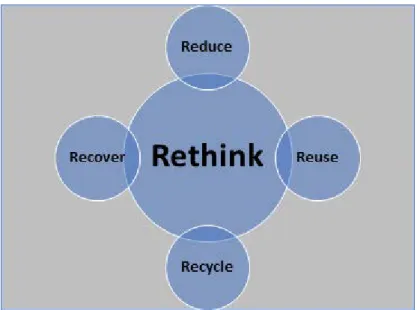
In addition to the basic 3R principle, there are some other keywords contributing to circular economy such as rethink, recover, rescue, or repair. Shen & Qi (2012) hold a view that 5R principle appears with the addition of "to rethink towards the maintenance of ecosystem" and "to repair the destructed ecosystem". Li et al. (2015) regard 5R spirit in the life-cycle of the production process, as “Recycling, Reducing, Reusing, Recovery of Energy, and Reclamation of Land”. Generally speaking, besides the 3R principle, the remaining two Rs in 5R refer to "recover" and "rethink". Recover refers to the practice of putting waste products to use. Rethink, which is the last R, is sometimes added to the front of the waste hierarchy, meaning that people should consider their options and think about their impact on the environment. For example, decomposing garbage produces methane gas (one of the greenhouse gases), which some landfill sites recover and burn for energy rather than letting it dissipate. Felicio & Amaral (2013) suggest that EIP have been seen as an opportunity for companies to reduce their waste, recover values and achieve economies of scale, in their production processes. Nevertheless, some researchers refer the fifth R as to rescue, and argue that the recycling-based technologies should be promoted and implemented in EIP (Li et al., 2015). Figure 2 is an illustration of 5R principle (reduce, reuse, recycle, recover and rethink). From an innovative perspective, rethink is not a parallel keyword with others, because rethink means not only being aware of the impact any human behaviour on the environment, anytime and anywhere, but also making sure to reconsider all other Rs. That is why the area of rethink in this figure is a little bit overlapped to each of other keywords. To be more specific, Reduce can imply decreasing any physical items and curtail inefficient production activities, as well as, high energy consumption; Reuse can imply utilizing products and sharing goods at their most; Recycle refers to material recycle, substance recycle, energy recycle, application recycle and data recycle, etc.; Recover alludes to the resilience that we will analyze in our innovative proposal. So, among the 5R principle, the most important is to rethink holistically in an all-around way.
2.3 Proposal of an Innovative Conceptual Proposal ‒ the7R Framework
Circular Economy is essentially an ecological economy, which requires human economic activities in line with 3R and 5R principles. It is Circular Economy that further strengthens the consciousness of both resources conservation and environmental protection, thus promoting the implementation of the strategy of green supply chain management and the popularization of EIP. EIP design is based
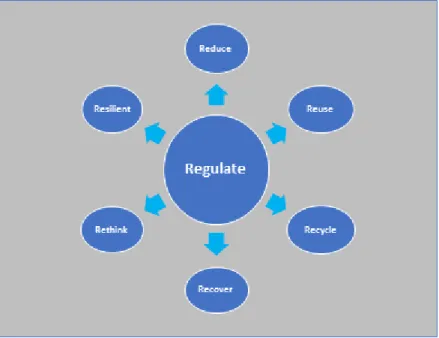
on the requirements of clean production, principles of circular economy and industrial ecology. It is composed of the enterprises inside the EIP, namely on the material and energy flows among the enterprises maintaining industrial symbiosis by means of shared resources and exchanged by-products. The goal of an EIP is to seek: (i) loop-closing circulation of material, (ii) multi-level energy utilization and (iii) waste minimization, by simulating the natural ecological system and establishing “producers-consumers-decomposers” circulation path in the industrial system (Li & Xiao, 2017). So, in this sense, 5R is still not enough. As is shown in Figure 3, the illustration of 7R principle proposal, two more Rs are introduced, i.e. Resilient and Regulate, respectively.
Resilience is the ability of a system to respond to change. Indeed, comprehensively analysing the possible perturbation process is crucial for developing adaptive capacity from both the topological structure and ecological feature in an EIP. To track the resilience progress in an EIP, not only snapshot analysis, but also time trend need to be followed, in order to develop novel mechanisms to avoid disruptions, improve the resilience of EIP and safeguard (Li & Xiao, 2017). As it is shown in “Transforming our world: 2030 Agenda for sustainable development” (Zachariah et al., 2016), the 9th of 17 sustainable development goals, addresses the development of a resilient infrastructure, the promotion of inclusive and sustainable industrialization and fostering innovation. The literal meaning of “resilient” is returning to the original form or position after being bent, compressed, or stretched. So, in the context of circular economy, “resilient” means the internal capacity of recovering from the depletion situation of resources and energy. On the other hand, “Regulate” refers to the necessary management, adjustment, control or enforcement from the government side, among others. For example, the following might be enumerated: some laws and regulations from the state and local governments, some conventions and proposals from trade associations, some suggestions and supports from non-profit sectors and some supervision and urges from mass media.
As it is shown in Figure 3, Regulate or Regulation is seating in the centre of the schematic diagram, and it causes an impact to all other Rs, because in our opinion, regulation is a pivotal driver to exert the efficiency of an EIP and circular economy, as well. Especially in developing countries, all other Rs can be a failure, if regulation is absent. EIP do work more efficiently under proper regulation and management from a holistic perspective. The proposed framework of 7R principle will be analyzed and demonstrated by the following case study on Suzhou Industrial Park, one of the most successful EIP, in China.
3 Research methodology
This paper follows a descriptive methodology. As regards the first research question (RQ 1), aiming at finding out if the EIPs still deserve a research interest and effort in China, secondary data from the data centres of EIPs administration departments in China, Ministry of Environmental Protection, Ministry of Commerce and Ministry of Science and Technology of People’s Republic of China were used. After being treated and refined in tables to facilitate the readers’ understanding about the initial EIPs interest and its current status quo, some lessons were learnt and suggestions for future sustainable development were made.
The second research question (RQ 2), is aiming at promoting the upgrade of the 3R principle of the Circular Economy to enable an updated base to assess, develop and compare EIPs. Thus, a 7R conceptual framework is deducted from a literature review. Then, a descriptive case study will conceptually apply and test the deducted framework within the scope of the Suzhou Industrial Park (SIP). Thus, the performance of SIP in applying ideas and methods of circular economy is preliminarily appreciated. Secondary data from the official website of SIP (www.sipac.gov.cn) are used to check if the SIP practices follow the principles established by the 7R framework that is being proposed. The scope was delimited to a very few representative organizations in SIP, for the convenience of this preliminary qualitative analysis.
4 Empirical research
4.1 Understanding the Progress of EIPs in China (RQ 1)
From 1984 to 1988, Chinese industrial parks were first built in the eastern coastal areas, such as Tianjin, Yantai, Shanghai, and Guangzhou. After several decades, the number of industrial parks was at least 1568 in 2011 (Yu et al., 2015b). In the same year, the gross domestic product (GDP) growth rate of industrial parks (30.3%) was significantly greater than that of the national average (9.2%) (Yu et al., 2015b). Thus, industrial parks became one of the major contributors to the economic growth in China. Despite early environmental pollution control actions and management measures (such as end-of-pipe pollution control approach and environmental impact assessment), they have been unable to ease the environmental pressure caused by the high economic development of industrial parks. Thus, some parks have paid severe resource and environmental costs (Yu et al., 2015). The Chinese government has adopted the EIP program in the hope of benefiting both the economy and the environment, in order to solve the contradiction between economic development and
environmental pollution. At the national level, the issue of Circular Economy (CE) was officially considered in the government decision-making agenda in 2003, and CE development was brought into the National 11th Five Year Plan in 2005. A series of policies about CE pilot city and parks establishment were published to promote CE development (Yu et al., 2015).
Kennedy & Johnson (2016) point out that The Draft Outline of China's 13th Five-Year Plan on National Economic and Social Development highlights that China should focus on improving environmental quality and solving prominent eco-environmental problems, devote greater efforts to eco-environmental protection, enhance the efficiency of resource utilization, provide more high-quality green products to consumers, and promote Chinese people’s well-being and prosperity in a beautiful China. The Draft Outline proposes: (i) to strengthen integrated environmental governance, to innovate in terms of concepts and methods of environmental governance, to carry out the most stringent environmental protection system, emphasize polluter's liability, to establish a co-governance system for government, enterprises and the public, and generally to improve environmental quality; (ii) to fully implement the action plans on pollution prevention and control, to mitigate against environmental risks, to strengthen the development of environmental infrastructure, and to reform the fundamental systems in environmental governance. The Draft Outline also proposes (i) to strengthen ecological protection and remediation, to give priority to the protection and restoration of nature, to facilitate the protection and remediation of natural ecosystems, to establish ecological corridors as well as biodiversity conservation networks, to comprehensively enhance the stability and the capacity of natural ecosystems to provide services, and to construct sound ecological security barriers; (ii) to comprehensively enhance ecosystem functions, to promote ecological remediation of key areas, to increase the supply of green products, and to preserve biodiversity. Finally, the Draft Outline proposes (i) to foster the green industry and the environmental protection industry, to support the development of service providers, to promote energy-saving and environment friendly products, to support innovation for technical equipment and services, to improve policies, to facilitate the development of the energy-saving and environmental protection industry; (ii) to increase the supply of environmental protection products and services, and to develop technical equipment for environmental protection, according to the Ministry of Environmental Protection of the People’s Republic of China (www.mep.gov.cn).
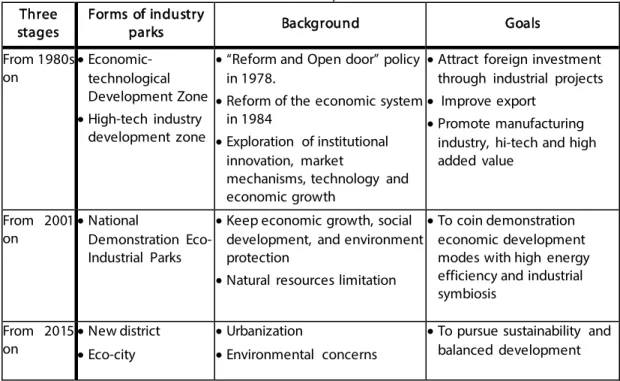
To sum up, the evolution of the EIPs in China can be divided into three stages: (i) stage one is about twenty years from 1980s to 2001; (ii) stage two is the period between 2001 to 2015; and, (iii) stage three, is from 2015 on (Table 1).
In the first Stage, Chinese government started to set up a serial of Economic- technological Development Zones and high-tech industry development zones under the background of Reform and Open door policy from 1978, Reform of the Economic System from 1984 and the exploration of institutional innovation, market mechanisms, technology and economic growth during those twenty years. The goals of these activities can be broadly summarized as attracting foreign investment through industrial projects, improving export, and promoting manufacturing industry, hi-tech and high added value. All these development zones are the sound background of EIPs in China, even though most of them are not called with a name of Eco-Industrial Parks. Almost all development zones kept the original names after they were approved as demonstration EIPs.
For the second stage, the symbol is the ambitious national demonstration of EIP programme initiated by Chinese government in 2001 and some trial EIP programmes, later on. People recognized the unsustainable limitation of natural resources and, also, the disruption of the ecosystem caused by industry development, so the goal of setting up EIPs is to explore and coin new economic development modes with keeping balance in economic growth, social development and environment protection.
With the release of China's 13th Five-Year Plan on National Economic and Social Development, it comes to the third stage of EIPs, in China, with the expansion of resources consumption and the aggravation of environmental decay, coupled with increasing urbanization, rising population size in almost all big and medium sized cities in China. It seems hard to focus on accelerating economic development only by considering EIPs themselves and neglecting environmental concerns. In order
to pursue sustainability and balanced development Chinese government had to combine industrial growth with city development, so the concepts such as new district and eco-city are put forward (third stage). A lot of EIPs are located in the new district of a city, for instance, the Huayuan Technology Park is located in Tianjin Binghai New District. Suzhou is called an eco-city, with the first and recognized most successful EIP of China, Suzhou Industrial Park and Suzhou High-tech Industrial Development Zone in Suzhou city. The policies of planning and designing new district and eco-city can impose a considerable impact on both the operation of EIP and the development of the city. As is shown in Table 1, the timeline of three stages, main characteristics of China’s industrial parks, backgrounds and goals are listed by and large.
4.2 Status quo of EIPs in China
According to the official website of the Ministry of Environmental Protection of the People’s Republic of China (www.sepa.gov.cn), the latest published list of eco-industrial parks in China shows a total of 48 National demonstration EIPs approved since their start in 2001 (Table 2), and of 45 National EIPs that are still under assessment and improvement (Table 3).
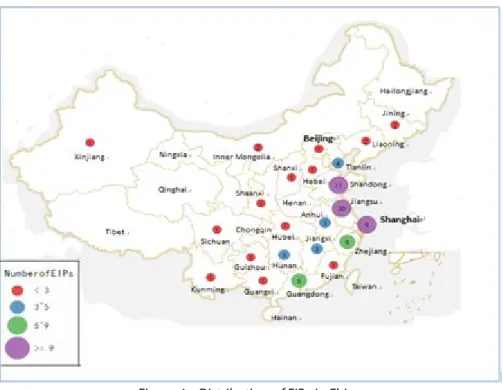
Based on the secondary data shown in Tables 2 and 3, some analysis is conducted and depicted in Figure 4. In order to facilitate the analysis, both approved and under assessment national demonstration EIPs are equally treated. So, the total amount of EIPs is 93. As a matter of fact, most of the EIPs under assessment were approved four or five years ago, even far back to 2001, e.g. the Guigang Sugar Industry National Eco-Industrial Park. From these two figures, it is obvious that : (i) only in Jiangsu province, there are 30 EIPs, which are almost one third of the total; (ii) most EIPs are located in the East of China; (iii) the total of Jiangsu, Shandong, Shanghai and Zhejiang together is 58, which accounts for 62.4%; (iv) by calculating all coastal provinces and cities of Eastern China, Tianjin, Shandong, Jiangsu, Shanghai, Zhejiang, Fujian, Guangdong respectively, the total amount reaches 68, which represents a proportion of 73.1%. This means the EIPs are highly concentrated in Eastern China. Among the four municipalities directly under the Central Government, i.e. Beijing, Shanghai, Tianjin, and Chongqing, there is no EIP in Chongqing so far, and only one EIP in Beijing. At the same time, there still are some other provinces without EIPs such as Heilongjiang, Henan, Ningxia, Qinghai, Tibet and Hainan. This means a very unbalanced situation; on the whole there are very few Eco-Industrial Parks in the Central and Western areas of China.
Table 1 – Timeline and characteristics of China’s industrial parks
Three
stages Forms of industry parks Background Goals
From 1980s on • Economic- technological Development Zone • High-tech industry development zone
• “Reform and Open door” policy in 1978.
• Reform of the economic system in 1984
• Exploration of institutional innovation, market
mechanisms, technology and economic growth
• Attract foreign investment through industrial projects • Improve export
• Promote manufacturing industry, hi-tech and high added value
From 2001
on • NationalDemonstration Eco-Industrial Parks
• Keep economic growth, social development, and environment protection
• Natural resources limitation
• To coin demonstration economic development modes with high energy efficiency and industrial symbiosis From 2015 on • New district • Eco-city • Urbanization • Environmental concerns
• To pursue sustainability and balanced development
4.3 Preliminary Descriptive Test conducted in the Suzhou Industrial Park (RQ 2)
The Suzhou Industrial Park (SIP) was established in 1994 and is a flagship of the economic cooperation project between Chinese and Singapore governments. It is located in the Eastern part of Suzhou, a city known as "the paradise on earth". Suzhou is also a traffic hub, about only 200 km of Nanjing, and around 100 km of Shanghai. It takes only 20 minutes to arrive in Shanghai and 45 minutes to Nanjing by high-speed train. With an advantageous transportation network, it appeals to more and more big enterprises and global talents. SIP covers a total jurisdiction area of 288 km2, among which, 80 km2 area belongs to China-Singapore Cooperative Zone. SIP is recognized as a pilot zone of reform and opening-up, a successful model of international cooperation, and one of China's fastest-growing development zones with the most international competitive edges. In SIP, the total number of permanent residents reached over 700,000 in 2012, including registered and non-registered population. Currently, approximately 25% of the land is industrial, and 30% is residential and commercial. The remainder is green space and water (Yu et al., 2015b). Nowadays, the development goals of SIP are to develop into a hi-tech industrial park with international competitiveness and, into an innovation eco-township of internationalized, modernized, information-based happy district of Suzhou (www.sipac.gov.cn).
4.4 Achievements of the Suzhou Industrial Park (SIP)
Concerning the performance in environment protection, SIP obtained the label of ISO 14000 National Demonstration Zone, in 2001. As the national EIP program was launched, SIP was approved as a pilot in 2004 and started to implement EIP planning in accordance with the national EIP development guideline. In 2008, SIP passed the evaluation and obtained the label as one of the first three National Demonstration EIPs. Currently, the energy consumption per GDP is 61% lower than the national level. The discharge amount of Chemical Oxygen Demand (COD) and SO2 are only one-eighteenth and one-fortieth of the national average, respectively. SIP is among the first national Integrated Resource Planning (IRP) demonstration parks, among the country's first demonstration
Table 2 – Extract of the list of approved National Demonstration EIPs in China
National Demonstration EIPs Approved date Province
1.Suzhou industrial park Mar 31 2008 Jiangsu
4.Yantai economic and technological development zone Apr 1 2010 Shandong
12.Shanghai Jinqiao export processing zone Apr 2 2011 Shanghai
15.Nanjing high-tech industry development zone Mar 19 2012 Jiangsu
19.Shandong Guxiangguang Eco-industrial park Feb 6 2013 Shandong
23.Shenyang economic and technological development zone Jan 10 2014 Liaoning
34.Ningbo economic and technological development zone Jul 31 2015 Zhejiang
48.Changchun Car industry economic and technological
development zone Nov 29 2016 Jilin
Table 3 – Extract of approved under assessment National Demonstration EIPs in China
National Demonstration EIPs Approved date Province
1.Guigang sugar industry national eco-industrial park Aug 14 2001 Guangxi
2.North Lu corporation group company Nov 18 2003 Shandong
3.Nanchang high-tech development zone Apr 1 2010 Jiangxi
8.Taiyuan economic and technological development zone Apr 2 2011 Shanxi
11.Guangzhou Nansha economic and technological development
zone May 30 2012 Guangdong
13.Qingdao economic &technological development zone Feb 5 2013 Shandong
24.Langfang economic and technological development zone Oct 14 2014 Hebei
eco-industrial parks, and among the first new-type industrial demonstration bases in China (www.sipac.gov.cn).
With respect to annual economic growth in SIP, 30% annual average growth occurs in key economic indicators, ranking second among national development zones in comprehensive development indexes. It accomplished four "Hundreds of Billions" of achievements, as follows: RMB 133 billion of GDP, RMB 165 billion of accumulated taxes, USD 18.9 billion of accumulated utilized foreign capital and RMB 197.2 billion of accumulated registered domestic capital. Besides that, there also are remarkable achievements in economic transformation and upgrading, as follows: RMB 147.2 billion of output value from new emerging industries, in 2010, accounting for 45.4% of scale industries ranking the first in Suzhou and, ranking the first, for years, in using foreign capital, among China's development zones (www.sipac.gov.cn).
As far as sustainable development is concerned, SIP achieved many awards. For example, it was recognized as China's only new-tech innovation & industrialization base, as China's only demonstration base of service trade innovation, as China's only national demonstration area of business tourism, no.1 among most competitive development zones, as China's first service outsourcing demonstration base and, as China's first experimental area on preferential policies for technologically advanced service enterprises (www.sipac.gov.cn).
4.5 7R principle application in SIP
When observing SIP, there is a large amount of exemplary enterprises, which conduct very good practices, in environmental protection and sustainable development, corresponding to each component of 7R principle, namely reduce, reuse, recycle, rethink, recover, resilient and regulate. Here we provide some supportive examples, analysis and beneficial implications, as follows.
Reduce: In SIP, it is obvious that there is a great amount of reduction on energy consumption. According to the official website of SIP, currently, the energy consumption per GDP is 61% lower than the national level. SIP learns from the experience of Singapore and adopts high standards in promoting energy-saving circular economy. In 2012, SIP recorded 0.28 ton of standard coal for producing 10,000-yuan GDP, with 0.149 kg COD, releasing 0.07, 0.008, and 0.151 kg of sulfur dioxide, ammonia, and nitrogen oxides, respectively. These are above national averages and made SIP the leader among national development zones, for four consecutive years, in the main indicators of environmental protection, energy conservation, and emission reduction (www.sipac.gov.cn).
Reuse: The SIP management has organized some representatives to learn from companies with outstanding performance in practicing Corporate Social Responsibility (CSR). For example, Fuji Xerox Eco-Manufacturing (Suzhou) shared with the participants the company's experience in recycling and reusing resources. From its establishment in January 2008, the company has been recycling the waste, copying machines, printers, and consumables as printing drums and powders from Chinese mainland, to make full use of resources and reduce their impacts on environment. The company, therefore, won the honorary title of SIP CSR Company 2013 (in the category of "Environment Responsibility") and was named "Model Company of Circular Economy" by Suzhou Economic and Information Technology Commission in 2014 (www.sipac.gov.cn).
Recycle: Green production has been part of corporate culture among most manufactures, in SIP. Nitto Denko (Suzhou), which is a member of Suzhou Industrial Park, since its founding in 2001, launched a clean production program, investing in energy-saving and emission-cutting projects. Their aim was bringing down energy consumption and waste water discharge. The company renovated the entire AC system and, as a result, saves 2.35 million kw annual use of electricity power and 8,000 tons of steam, which equals to 1,716.1 tons of standard coal. In order to save the water resource, the company recycles steam condensate and reclaimed water. Every year, the steam reused amounts to 420 tons (47 tons of standard coal) and the water recycled totaled 27,000 cubic meters (2.3 tons of standard coal) (www.sipac.gov.cn).
Recover: In order to optimize the regional environmental to build a beautiful SIP, for years, SIP has kept investing in environment-related infrastructure to improve the monitoring system and to use energies to their full potential. With 100% coverage of sewage pipe network, it manages to achieve Grade-1, a standard for all the waste water discharged. Moreover, the waste water treatment plant, the sludge drying plant, the thermal power plant, and the heating & cooling center create an integrated system maximizing the use of public amenities, resources, and energies as well as minimizing the discharge of pollutants. The efforts include the protection of the Yangcheng Lake, the source of potable water, 45.8% coverage of green grounds, surveys on biological diversity and ecological environment with 131 bird species being confirmed around the year, the river dredging projects, and the restocking of aquatic organisms in Jinji Lake (www.sipac.gov.cn).
Rethink: Taking Nitto Denko (Suzhou) as an example, the company introduced a lot of programs to stimulating rethink, among which "Green Design Action", which encourages employees to build up the belief that environment protection should become a part of its corporate culture. With the "Light Down" program, the employees are required to turn off their computers during lunch break. The company also regulates the AC (air-condition) temperature and arranges people to be in charge of lights and AC. The workshops should follow the plans and turn off the production equipment not in use. The company also participates in the "MOTTAINAI Campaign", a program aiming to promote environment awareness and to cultivate sense of responsibility among employees. The survey shows that the average awareness increased from 73.1% to 80.2%, which is transformed into a reduction of 11,557 kg of carbon dioxide emission (www.sipac.gov.cn).
Resilient: The Administrative Committee of the Suzhou Industrial Park has been calling on companies to work together to build SIP into a model of ecological civilization through Learning and Innovation. The committee often organizes all kind of forums. For example, there is a forum, which is part of the agenda for China International Green Innovative Products & Technologies Show (CIGIPTS). Enterprises are encouraged to contribute in building ecological industrial parks through international cooperation, and to demonstrate their achievements in exploring a new path of industrialization through technological innovation and low-carbon environment-friendly circular economy.
Regulate: Chinese Governments (both central and local) play an essential role in improving the performance of EIPs, especially when it comes to the integration and balanced development of industrialization and urbanization. In order to secure economic sustainability and optimize industrial structure to promote sustainable low-carbon economy, SIP authorities have vetoed down more than 400 projects totaling approximately 3-billion-dollar investment, which posed potential high hazards to surrounding environment. SIP government carried out energy auditing on 74
companies and set a record of 310 million RMB Yuan from local enterprises invested in technological renovation projects, cutting down energy consumption by 100,000 tons of standard coal. The enterprises are also encouraged to reuse water and wasted heat, to conform to standards on clean production, to invest in upgrading and renovating technologies and equipments, and to make a constant goal to reduce pollutant discharges. Meanwhile, SIP Eco-Science Hub and Suzhou Environmental Protection Sci-tech Industrial Park have contracted over 100 energy conservation and environmental protection companies, including Sujing and Great, with total output of 30 billion Yuan. SIP has three air monitoring stations and other two under construction, as well as three stations monitoring water quality and one under construction, which make possible to achieve real-time online monitoring and the releasing of PM2.5, PM1, and ozone, among 135 other atmospheric factors. 62 companies, including all key companies in the area, have installed 72 sets of automatic devices in total for online monitoring of pollution sources (www.sipac.gov.cn).
5 Expected results and contributions – setting the scene for the future
In this section the research questions are going to be revisited and the report will be closed on them. RQ 2: Does the upgrade of the 3R principle of the Circular Economy to the 7R Framework enable an updated base to assess, develop and compare EIPs?
Holistic balance and sustainable development are getting more and more critical, in order to maintain the three bottom-line pillars, namely economic, social and environmental. When retrospecting the evolvement of these principles from 3R (reduce, reuse and recycle) to 5R (reduce, reuse, recycle, recover and rethink) and then, to the innovative conceptual framework of 7R principle (reduce, reuse, recycle, recover, rethink, resilient and regulate), it is safe to conclude that the 7R principle is essentially pivotal to practice circular economy and sustainable development. That is to say, all participants including enterprises in the supply chain, governments from different levels, local trade associations and consumers can get involved and shoulder responsibility by applying the 7R principle. Both Corporate Social Responsibility, Consumer Social Responsibility and Citizen Social Responsibility ‒ coined in this paper as 3CSR ‒ should be attached to pursuing economic growth, social progress, and environmental sustainability, as well. As a matter of fact, individuals can vastly contribute to protect the Earth by consistently practising 7R in many aspects and in a variety of ways. To sum up, this preliminary confirmatory study tries to be inspiring to current research in the area of circular economy. In fact, the conceptual 7R principle proposal can be an adventurous attempt for pursuing theoretical efforts in the nR domain (e.g. 3R and 5R). For researchers, this is also a nice attempt to stimulate more systematic and systemic thinking. Finally, for practice, Suzhou Industrial Park is just an exemplary model to set a relevant benchmark among hundreds of EIP all over the world. Moreover, it will be significantly desirable if there is an increasingly number of industrial parks to introduce the 7R principle as an assessment framework.
RQ 1: Do EIPs still deserve a research interest and effort in China?
Chinese government had recently to combine industrial growth with city development, in order to pursue sustainability and balanced development, so the concepts such as new district and eco-city have been put forward, lately. Thus, the policies of planning and designing a new district and an eco-city can impose a considerable impact on both the operation of EIP and the development of the city. Although the performance of EIPs in China is highly recognized, there are still some obvious shortcomings, namely: (i) the failures regarding employee participation, (ii) the support from ordinary citizens, and (iii) the deficiency of overall planning from the different levels of government. In addition, EIPs are highly concentrated in Eastern China. For example, the total amount of EIPs in Jiangsu, Shandong, Shanghai and Zhejiang is 58, which accounts for 62.4%. At the same time, there still are some other provinces without EIPs, such as Heilongjiang, Henan, Ningxia, Qinghai,
Tibet and Hainan. This means a very unbalanced situation, as follows: on the whole there are very few Eco-Industrial Parks in the central and western areas of China.
As a consequence, there still is room for development, as regards EIP improvement and spread. Nevertheless, EIP performances also result from government policy guidance and advertising. Therefore, Chinese Governments (both central and local) play an essential role in improving EIPs’ development, especially when it comes to the integration and balanced development of industrialization and urbanization. Thus, a new concept of EIP linked with the concept of eco-city is emerging, which reinforces the interest on EIPs.
On the other hand, the requirements to learn from other mature circular economy modes from developed countries (i), to enact more feasible laws and legislation (ii), to enhance the advertising of some concepts related to circular economy and sustainable development (iii), to encourage more engagement from all kinds of enterprises and companies (iv), to arouse vast environmental and circular economy awareness from urban citizens (v), to introduce more advanced technology & methods (vi) and, to conduct more scientific urban planning and construction (vii) call for an extended conceptual framework, i.e. the 7R model. This will enable the positioning of the problematic in a more systematic, systemic and organised way, in order to describe, analyse, assess, benchmark and discuss it to find out paths of future development.
Indeed, future research on the theme of EIP and in-depth theoretical exploration is worthy of much more effort by following the novel approach reported on this paper ‒ i.e. the 7R framework ‒ which informs organisations, society and state owned institutions to best configure circular supply chain networks to achieve viability under the umbrella of the 'triple bottom line' of sustainability. Therefore, despite some obvious limitations during this study are identified, such as the lack of primary data and the need for a more detailed and structured field study, the scene for future developments concerning circular economy was set in a significant way.
References
Behera, S. K., Kim, J. H., Lee, S. Y., Suh, S. and Park, H. S., 2012. Evolution of ‘designed’industrial symbiosis networks in the Ulsan Eco-industrial Park:‘research and development into business’ as the enabling framework. Journal of Cleaner Production, 29, 103-112.
Cassel, S., 2016. The Circular Economy : From Concept to Business Reality. Product Stewardship Institute, Wharton initiative for global environmental leadership (IGEL). Accessed March 01, 2017, from https://igel.wharton.upenn.edu/wp-content/uploads/2016/05/Scott-Cassel-2016-04-27-PSI-Presentation-to-Wharton-IGEL_Circular-Economy_FNL.pdf.
Chertow, M., 2000. Industrial symbiosis: literature and taxonomy. Annual review of energy and the environment, 25(1), 313-337.
Dhaka, 2010. National 3R Strategy for Waste Management. Accessed March 01, 2017, from http://globalrec.org/wp-content/uploads/2014/03/, Draft-National-3R-Strategy.pdf
Global Environment Centre Foundation, 2006. 3Rs Technologies and Techniques in Japan. Accessed March 01, 2017, from http://www2.gec.jp/gec/EN/publications/ecotown-3R.pdf.
Felicio, M. and Amaral, D., 2013. Environmental indicators applied to reality of Eco-Industrial Park (EIP). 11th Global Conference on Sustainable Manufacturing, 85–90.
Kennedy, S. and Johnson, C., 2016. Perfecting China, Inc.: China's 13th Five-Year Plan. Rowman & Littlefield. Li, J., Pan, S. Y., Kim, H., Linn, J. H. and Chiang, P. C., 2015. Building green supply chains in eco-industrial parks
towards a green economy: Barriers and strategies. Journal of Environmental Management, 162, 158–170. Li, X. and Xiao, R., 2017. Analyzing network topological characteristics of eco-industrial parks from the
perspective of resilience: A case study. Ecological Indicators, 74, 403–413.
Holländer, R., Wu, C. and Duan, N., 2009. Sustainable Development of Industrial Parks. University of Leipzig. Popescu, R., 2008. Industrial Ecology and Eco-Industrial Parks: Principles and Practice. Accessed March 01,
2017, from http://dx.doi.org/10.2139/ssrn.1317231.
Shen, X., and Qi, C., 2012. Countermeasures towards circular economy development in west regions. Energy
Procedia, 16, 927-932.
Shi, H., Tian, J. and Chen, L., 2012. China's Quest for Eco‐industrial Parks, Part I. Journal of Industrial Ecology, 16(1), pp.8-10.
Shi, L. and Yu, B., 2014. Eco-industrial parks from strategic niches to development mainstream: the cases of China. Sustainability, 6(9), pp.6325-6331.
Valenzuela-Venegas, G., Salgado, J. C. and Díaz-Alvarado, F. A., 2016. Sustainability indicators for the assessment of eco-industrial parks: classification and criteria for selection. Journal of Cleaner Production, 133, 99-116.
Xing, J., Vilas-Boas, J. and Almeida, I., 2017a. "A New Conceptual Perspective on Circular Economy: preliminarily confirmation of the 7R Principle by a descriptive Case Study in Eastern China ", In: Proceedings of 23rd Annual International Sustainable Development Research Society (ISDRS) Conference, Universidad de los Andes School of Management, Bogotá, Colombia, 14th ‒ 1 6th June.
Xing, J., Vilas-Boas, J. and Almeida, I., 2017b. "Eco-industrial parks in China: current situation, problems and development suggestions", In: Proceedings of 24th EurOMA – Inspiring Operations Management, Heriot Watt University, Edinburgh, Scotland, 1rst ‒ 5th July.
Ying, J. and Li-jun, Z., 2012. Study on green supply chain management based on circular economy. Physics
Procedia, 25, pp.1682-1688.
Yu, C., Dijkema, G. P., de Jong, M. and Shi, H., 2015a. From an eco-industrial park towards an eco-city: a case study in Suzhou, China. Journal of Cleaner Production, 102, 264-274.
Yu, F., Han, F. and Cui, Z., 2015b. Evolution of industrial symbiosis in an eco-industrial park in China. Journal of
Cleaner Production, 87, 339-347.
Yu, Z., 2008. Theory and Case Study of Ecological Industry Based on Circular Economy in China. MSc Thesis. Royal Institute of Technology, Stockholm, Sweden.