ii
DIREITOS DE AUTOR E CONDIÇÕES DE UTILIZAÇÃO DO TRABALHO POR TERCEIROS
Nome: Ana Isabel da Costa Sousa
Endereço eletrónico: [email protected] Telefone: +351 913293739
Número do Cartão de Cidadão: 14697648
Título da dissertação: An analysis of Intransitive and Pantomime Gestures in Autism Spectrum Disorder
Orientadoras: Professora Doutora Adriana Sampaio e Professora Doutora Angela Bartolo Ano de conclusão: 2019
Designação do Mestrado: Mestrado Integrado em Psicologia
Este é um trabalho académico que pode ser utilizado por terceiros desde que respeitadas as regras e boas práticas internacionalmente aceites, no que concerne aos direitos de autor e direitos conexos.
Assim, o presente trabalho pode ser utilizado nos termos previstos na licença abaixo indicada. Caso o utilizador necessite de permissão para poder fazer um uso do trabalho em condições não previstas no licenciamento indicado, deverá contactar o autor, através do RepositóriUM da Universidade do Minho. Atribuição-NãoComercial-SemDerivações CC BY-NC-ND https://creativecommons.org/licenses/by-nc-nd/4.0/ Universidade do Minho, ___/___/______ Assinatura: _______________________________________________________________
iii ACKNOWLEDGEMENTS
To my supervisors, close friends and family.
“In the midst of chaos, there is also opportunity” ―SUN-TZU
iv DECLARAÇÃO DE INTEGRIDADE
Declaro ter atuado com integridade na elaboração do presente trabalho académico e confirmo que não recorri à prática de plágio nem a qualquer forma de utilização indevida ou falsificação de informações ou resultados em nenhuma das etapas conducente à sua elaboração. Mais declaro que conheço e que respeitei o Código de Conduta Ética da Universidade do Minho.
Universidade do Minho, ___/___/______
Assinatura: ________________________________________________________________ Uma Análise de Gestos Intransitivos e Pantomímicos na Perturbação do Espetro do Autismo
v RESUMO
Apesar de algumas descobertas acerca dos processos de identificação e produção de gestos, é pouco claro como os gestos com significado (intransitivo e pantomímico) são processados. No presente estudo, o objetivo é o de compreender o que separa (ou assemelha) gestos intransitivos e pantomímicos, explorando uma subdivisão de cada gesto em “em direção ao corpo” (e.g.: coçar a cabeça, pôr perfume), e “em direção ao outro” (e.g.: acenar, mexer a sopa). Para tal, 18 participantes de desenvolvimento típico e 11 com Perturbação do Espetro do Autismo (conhecidos por terem dificuldades na identificação e produção de gestos) produziram gestos intransitivos e pantomímicos, tendo também visto vídeos de uma atriz a produzir gestos com ou sem significado. Nesta última tarefa, os participantes tinham de decidir se o gesto que estavam a ver tinha significado. Foram encontradas diferenças, tanto na produção como na identificação de gestos intransitivos e pantomímicos – resultado consistente com o facto de cada tipo de gesto tirar partido de caminhos cerebrais distintos. Neste sentido, o caminho para intransitivos parece ser o mais afetado nos participantes com Perturbação do Espetro do Autismo. Em relação à distinção entre “em direção ao corpo” vs. “em direção ao outro”, os resultados foram inconclusivos.
Palavras-Chave: gestos intransitivos, gestos pantomímicos, identificação de gestos, produção de gestos, Perturbação do Espetro do Autismo
vi
An Analysis of Intransitive and Pantomime Gestures in Autism Spectrum Disorder ABSTRACT
Even though some light has been shed on the processes underlying the identification and production of gestures, to this day it is still unclear how meaningful gestures (intransitive and pantomime) are processed. In this study, we aim to further assess what sets apart (or brings together) intransitive and pantomime gestures, while also exploring a subdivision of each gesture in “towards the body” (e.g. scratching head, putting perfume on), and “away from the body” (e.g. beckoning, stirring soup). To that end, 18 typical-development and 11 Autism Spectrum Disorder participants (known for having considerable difficulties identifying and producing gestures) were asked to perform intransitive and pantomime gestures and also watched videos of an actress performing meaningful and meaningless gestures while deciding if said gesture was meaningful. Differences were found in both the performance and identification of intransitive and pantomime gestures, a result consistent with each type of gesture taking advantage of distinct pathways in the brain, the pathway for intransitives appearing to be most affected by the deficits that characterize Autism Spectrum Disorder. Regarding the towards vs. away distinction, the results were mostly inconclusive, thus warranting further research.
Key Words: Autism Spectrum Disorder, gesture identification, gesture production, intransitive gestures, pantomime gestures
vii TABLE OF CONTENTS
ABBREVIATIONS AND ACRONYMS ... viii
LIST OF FIGURES ... viii
LIST OF TABLES ... viii
INTRODUCTION ... 1 METHOD ... 4 Participants ... 4 Measures ... 5 Procedure ... 6 RESULTS ... 7 DISCUSSION ... 12 REFERENCES ... 16 APPENDIX ... 18
viii ABBREVIATIONS AND ACRONYMS
ANOVA – Analysis of Variance ASD -- Autism Spectrum Disorder M – Mean
SD – Standard Deviation
SEM – Standard Error of the Mean TD – Typical Development
LIST OF FIGURES
Figure 1. Schema of stimuli timeline. The numbers besides each stimulus represent their duration. Figure 2. Mean proportion (with SEM) of correct production of pantomime and intransitive gestures. The filled dots refer to typical-development (TD) participants and the empty dots refer to Autism Spectrum Disorder participants (ASD).
Figure 3. Mean proportion (with SEM) of correct identification of meaningless and meaningful (pantomime and intransitive) gestures. The filled dots refer to typical-development (TD) participants and the empty dots refer to Autism Spectrum Disorder participants (ASD).
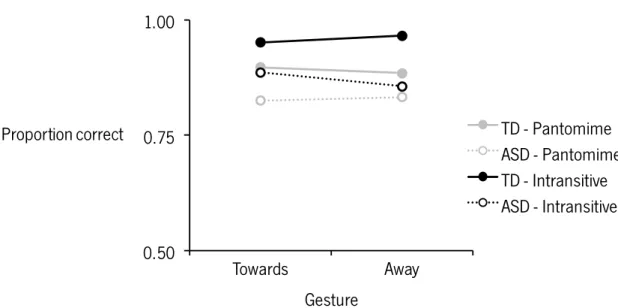
Figure 4. Mean proportion of correct identification of pantomime (grey dots) and intransitive (black dots) gestures. Data points on the left refer to towards gestures and data points on the right refer to away gestures. The filled dots refer to typical-development (TD) participants and the empty dots refer to Autism Spectrum Disorder participants (ASD).
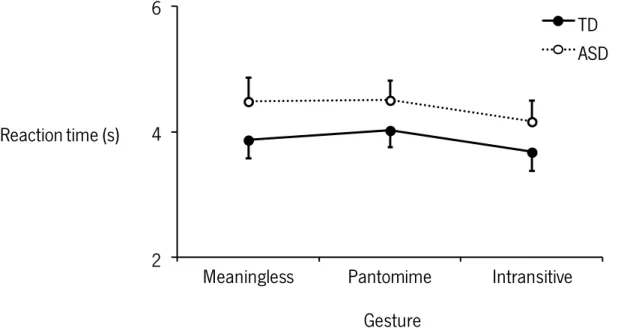
Figure 5. Mean reaction times (in seconds, with SEM) in the identification of meaningless and meaningful (pantomime and intransitive) gestures. The filled dots refer to typical-development (TD) participants and the empty dots refer to Autism Spectrum Disorder participants (ASD).
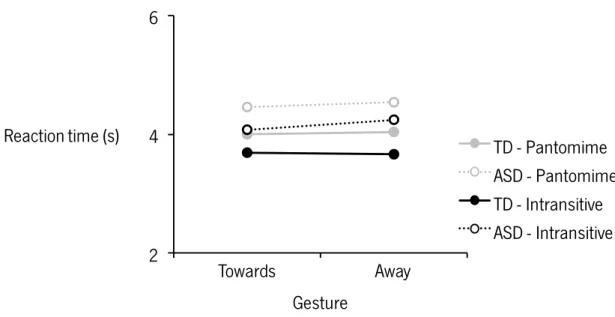
Figure 6. Mean reaction times (in seconds) in the correct identification of pantomime (grey dots) and intransitive (black dots) gestures. Data points on the left refer to towards gestures and data points on the right refer to away gestures. The filled dots refer to typical-development (TD) participants and the empty dots refer to Autism Spectrum Disorder participants (ASD).
LIST OF TABLES
Table 1. List of meaningful gestures used, categorized by type (intransitive and pantomime) and direction (towards and away)
INTRODUCTION
1
An analysis of Intransitive and Pantomime Gestures in Autism Spectrum Disorder
Communication underlies what it means to be human. So much so, that we use its channels – verbal and nonverbal – on a daily basis, with any and everyone around us. A skilled individual will be aware of a sizeable amount of the information the other person conveys, either through their words (verbal communication) and/or their overall body movements – eye gaze, facial expressions, posture, and gestures (nonverbal communication).
Gestures, broadly speaking, share a lot of commonalities. Specifically, most of them are performed with intent – “meaningful gestures”. Yet, some gestures either carry no meaning, per se, or simply do not have any relevance for the population at hand – “meaningless gestures” (Bartolo & Stieglitz Ham, 2016). How meaningful and meaningless gestures are handled within the brain is still an open question. One possibility, advanced by Bartolo and Stieglitz Ham (2016) in their dual route model, is that meaningful and meaningless gestures are processed through different routes. Meaningful gestures are processed via the dorsal lexical route - an automatic, fast pathway. This happens because, once a gesture becomes familiar, this automatic route can be used to retrieve its motor representation, with no need for intermediate steps. For processing meaningless gestures, however, it is necessary to transform the received visual input, which has no meaning whatsoever, into a motor output. This process happens in the ventral sublexical route, a slower and more effortful pathway.
The dual route model further differentiates meaningful gestures, since not all of them have the same purpose. Thus, meaningful gestures can be transitive (i.e., actual object manipulation), intransitive (i.e., related to communication and social interaction) (Carmo & Rumiati, 2009) or pantomime (i.e., gestures that describe the usage of an object) (Stieglitz Ham, Bartolo, Corley, Swanson, & Rajendran, 2010). Whereas the purpose of transitive gestures is the functional manipulation of objects, both intransitive and pantomime gestures may have a communicational intent: they can be performed when an individual aims to convey information to someone else. Henceforth, our focus will be on intransitive and pantomime gestures.
Attempts to ascertain whether intransitive and pantomime gestures are processed differently in the brain have not been conclusive. On the one hand, there seems to be a brain network responsible for the recognition of both intransitive and pantomime gestures (cf. Villarreal et al., 2008). This network involves the pre-supplementary motor area (related with response selection and/or attention), the superior temporal sulcus (which seems to be particularly important when gathering biological and motion-related cues), the precuneous (associated with the execution of
INTRODUCTION
2
reaching-like movements), visual cortices, the left inferior posterior parietal cortex and bilateral superior posterior parietal cortices (related with planned movements, spatial reasoning, and attention). Króliczak and Frey (2009) also found no clear evidence of dissociation between the identification of intransitive and pantomime gestures. Both recruit, largely, the same brain areas, within the same network – Praxis Representation Network: left parietal (supramarginal gyrus – area also known as an integration center –, superior parietal lobe – responsible for representations of the limbs and its movements –, and premotor cortices), frontal and posterior temporal cortices.
On the other hand, there seem to be areas specific to the recognition of either intransitives or pantomimes. For intransitive gestures, there is a significant activation of the left dorsolateral prefrontal cortex (Villarreal et al., 2008). According to the authors, this area appears to be responsible for the management of the accurate goal of an action. Additionally, the left posterior inferior frontal gyrus appeared to also be highly engaged. This specific area is triggered whenever the subject attributes meaning to a gesture performed by another person (Villarreal et al., 2008). In sum, it appears as if there is a pronounced left lateralization in the recognition of intransitive gestures (Bohlhalter et al., 2009). Regarding the recognition of pantomimes, it looks as though the right occipitotemporal region and left middle frontal gyrus (related with lexical processing) are specially recruited, which is consistent with a slightly more bilateral representation of these gestures (Villarreal et al., 2008).
In summary, even though intransitive and pantomime gestures do not seem to be processed in exactly the same way, there appears to be considerable overlap in the brain areas each calls forth. But perhaps “intransitive vs. pantomime” is too broad a categorization. Gallagher and Frith (2004) divided intransitive gestures in two categories: instrumental gestures – aimed at influencing others’ behavior (e.g., “Come here”) – and expressive gestures – aimed at expressing one’s emotional state (e.g., “I am cold”), and found differences in how they are processed. Seeing that most instrumental gestures Gallagher and Frith (2004) used were performed away from the body and most expressive gestures were performed towards the body, henceforth we will refer to “instrumental” gestures as “away” gestures and “expressive” gestures as “towards” gestures.
Gallagher and Frith (2004) found that, identification of away gestures engaged the left inferior frontal cortex and the left middle frontal cortex, which implies that these gestures are treated like linguistic signs. It is worth noting that the stimuli used by Villarreal and collaborators (2008) and Króliczak and Frey (2009) were, in their vast majority, away gestures, which could explain the strong left-lateralized representation within the brain they found. On the other hand, the identification of
INTRODUCTION
3
towards gestures was intimately associated with the anterior paracingulate cortex (linked to perception of expressive gestures), the right superior temporal sulcus (related with the signaling of others’ mental states), the temporal poles bilaterally (connected with object and face recognition) and, sometimes, the amygdala (associated with the automatic processing of expressions of emotional states). These are also involved in the mentalization capacity (“social brain”), commonly called Theory of Mind (or, at least, its cognitive facet). Said capacity consists in the identification of mental states (e.g. beliefs and desires) in others, which allows the explanation and prediction of their behavior (Happé, Brownwell, & Winner, 1999).
As aforementioned, the stimuli used in Villarreal et al. (2008) and Króliczak and Frey (2009) were, predominantly, away gestures. Therefore, the overlap found in left-hemisphere brain activity may be, perhaps, due not to a similarity in processing intransitive and pantomime gestures, but to a similarity in processing away gestures in general. Therefore, their evidence does not tell us, conclusively, whether intransitive and pantomimes are processed differently. There have been, at least, two studies that have employed away and towards gestures for both pantomime and intransitive gestures. In addition to away gestures, the inclusion of towards gestures (which as we saw, have a more social, right-hemispherical, component, at least for intransitive gestures) may allow for a better comparison of what (potentially) distinguishes intransitive and pantomime gestures. These studies were strictly behavioral (neuroimaging was not employed), focused on the production of intransitive and pantomime gestures, not their identification, and, most importantly, included clinical populations that showed deficits/lesions on the right hemisphere.
The first of these studies compared the performance of pantomimes and intransitive gestures in stroke patients with right hemisphere damage (Stamenova, Roy, & Black, 2010), and found that performance of intransitive gestures was more affected than pantomimes. The second study (Stieglitz Ham et al., 2010) reported the case of an 11-year-old boy diagnosed with Autism Spectrum Disorder (ASD). His production of intransitive gestures was found to be significantly worse than the production of pantomimes, once again showing a difference between both types of gestures. As one of the foci of the present study will be on individuals with ASD, let us look into more detail at this disorder.
ASD tends to be considered a neurodevelopmental condition fundamentally characterized by pervasive impairments in social interaction and communication (American Psychological Association (APA), 2013). Interestingly enough, two literature reviews suggest that individuals with ASD display higher deficiencies (than controls with other developmental disorders) in imitating gestures (Rogers
INTRODUCTION
4
& Williams, 2006; Williams, Whiten, & Singh, 2004), as well as recognizing them (Smith & Bryson, 2007). Other than those core impairments, ASD individuals show a demarked deficit related to Theory of Mind (Happé, Brownwell, & Winner, 1999). In summary, ASD individuals may have considerable impairment with tasks that demand the usage of the right side of the brain.
In conclusion, individuals with right hemisphere damage (ASD and stroke patients) show biggest impairment for intransitive gestures than for pantomimes (Stieglitz Ham et al., 2010; Stamenova, Roy, & Black, 2010), which suggests that may be, in fact, a difference in the processing of these gestures.
Regarding intransitive gestures, there seems to be both a demarked left lateralization (likely related to away gestures) and also a more social/Theory of Mind-related component (likely related to towards gestures). If this is the case, in patients with right-hemisphere deficits, we should see the most pronounced impairment for towards gestures. However, in Stieglitz Ham et al. (2010) and Stamenova, Roy, and Black (2010), performance for towards and away was not described separately, so this distinction cannot be made. For pantomimes, there may be a similar breakdown: we know that pantomimes away also have a left lateralization (Króliczak & Frey, 2009), but there may be a difference regarding towards gestures – and that may be the reason behind the differences between intransitive and pantomime gestures found by Stieglitz Ham et al. (2010) and Stamenova, Roy, and Black (2010).
Thus, the present study aims to distinguish between intransitive and pantomime gestures (while also exploring whether the distinction towards vs. away is helpful in this endeavor) and test our hypothesis of whether gestures assumed to have right lateralization (Intransitive Towards) show a deficit in ASD individuals (when in comparison with TD participants).
METHOD
Participants
25 typical-development Portuguese participants voluntarily took part in the study. Of these, due too poor performance (cuttof point: 50% accuracy or above), only 18 typical-development participants were included (MAGE = 14.4 years, SD = 1,95, range: 12-18). 13 were female (72.2%),
and one was left-handed (5.6%).
12 Spanish participants with a diagnosis of Autism Spectrum Disorder also voluntarily took part in the study. Of these, due too poor performance (cuttof point: 50% accuracy or above), only 11
METHOD
5
participants diagnosed with Autism Spectrum Disorder were included (MAGE = 13.1 years, SD = 1,98,
range: 10-16). Two were females (18.2%) and only two participants were left handed (15.4%).
Measures
Cognitive assessment
Phonemic fluency skills were evaluated by the Phonemic fluency subtest from the Verbal Fluency Tests (Cavaco et al., 2013). This instrument consists of three trials, each taking one minute to execute. The participant must produce, orally, as many words as possible beginning with a specific letter (m, r and p). However, any word that starts with said capital letter (ex.: names of people or places) or has the root (e.g.: “mar” and “marinheiro”) are excluded.
Motor imagery was assessed through an adaptation of a mental chronometry paradigm proposed by Decety and Michel (1989). According to this model, visual imagery and visual perception activate the same cognitive processes; both visual perception and visual imagery may involve similar processes within the brain. In this task, the stimuli includes the following sentences: “Eu sou português” (tr. “I am Portuguese”), “Eu sou português e vivo em Portugal” (tr. “I am Portuguese and I live in Portugal”) and “Eu sou português e vivo em Portugal com a minha família” (tr. “I am Portuguese and I live in Portugal with my family”). The researcher reads each sentence out loud, one at a time and, the participant must write said sentences down on a piece of paper (provided by the researcher). In the end of this “writing” part of the exercise, the researcher re-reads each sentence, one at a time, and the participant, while placing the pen on the previously provided piece of paper, must only imagine writing each sentence. The time taken in the execution of the task was recorded.
Gesture assessment
To assess the production of gestures, an adaptation of a gesture protocol adapted to the Portuguese population was used. This assessment consisted of a list of items formulated to evaluate the performance in intransitive gestures and pantomimes (Viana, 2015). First, pantomimes were measured in a visual condition: drawings representing different situations were presented and participants had to mime using the object needed in each situation. Secondly, also in a visual condition, intransitive gestures were assessed. Participants were presented with drawings of different scenarios and, were then asked to perform the gesture that a person in the picture would do. For each type of gesture, there were one training item and five test items.
METHOD
6 Procedure
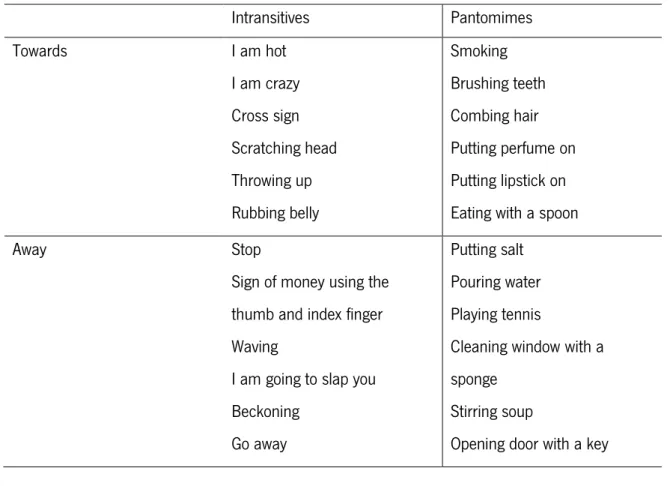
Stimuli. The stimuli were 96 silent videos of an actress performing meaningful and meaningless gestures (there were 48 gestures, each performed twice, once with each hand, leading to the total 96 videos). From those 96 videos, 48 depicted meaningless gestures, further divided in away from the body (24 stimuli) and towards the body (24 stimuli). The remaining 48 videos portrayed meaningful gestures: 24 stimuli were pantomimes (12 directed away from the body and 12 performed towards the body) and 24 were intransitive gestures (12 performed away from the body and 12 performed towards the body) (Pereira, 2018). Table 1 lists all meaningful gestures.
Table 1. List of meaningful gestures used, categorized by type (intransitive and pantomime) and direction (towards and away).
Intransitives Pantomimes Towards I am hot I am crazy Cross sign Scratching head Throwing up Rubbing belly Smoking Brushing teeth Combing hair Putting perfume on Putting lipstick on Eating with a spoon
Away Stop
Sign of money using the thumb and index finger Waving
I am going to slap you Beckoning
Go away
Putting salt Pouring water Playing tennis
Cleaning window with a sponge
Stirring soup
Opening door with a key
Task and experimental procedure
All stimuli were presented on a portable computer, that was placed in a desk in front of the participant, who was sitting on an office chair. The stimuli were presented using the software Psychopy 1.85.4, which allowed the recording of participants’ responses and response time.
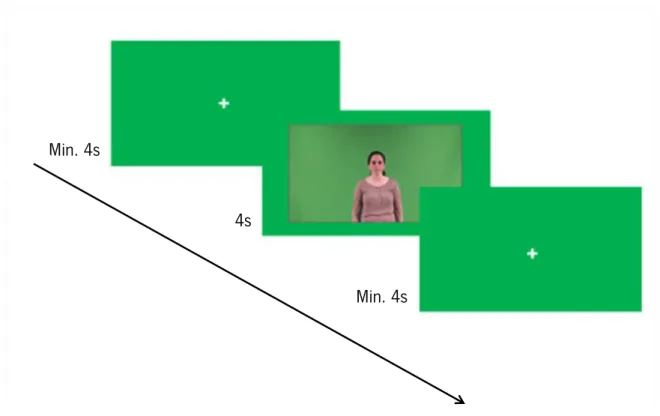
The trial timeline (Figure 1) was as follows: a trial began with the presentation of a white fixation cross for a minimum of 4 seconds to a maximum of 16 seconds (randomized durations).
METHOD
7
Immediately after, a video of an actress performing a gesture (without any facial emotional expression) came up and the participant had to evaluate whether the gesture was meaningful. To do so, there were previously-assigned keys for “yes” and for “no”. Said keys were counterbalanced across participants. Following the response, the previously mentioned white fixation cross reappeared and, again, lasted for a minimum of 4 seconds (ending when a participant’s response was recorded) (jittered design). All stimuli were displayed against a green background.
Figure 1. Schema of stimuli timeline. The numbers besides each stimulus represent their duration.
All data were collected in a single session. A session began with the researcher briefly presenting the study and delivering the informed consent. Participants then provided their sociodemographic details and responded to the Edinburgh Handedness Inventory (Oldfield, 1971). The cognitive and gesture assessment and the experimental task followed. The order in which the assessments and the task were presented was counterbalanced across participants.
RESULTS
Regarding the cognitive assessment measures, and starting with Phonemic Fluency Skills, both populations scored above the cutting point of 10±3 words, with an average score of 24.0 (SD = 7.1) for typical-development participants (TD) and 25.4 (SD = 5.7) for Autism Spectrum Disorder participants (ASD). There was no significant difference between populations, t(24.78) = 0.57, p =
Min. 4s
4s
RESULTS
8
.574, dS = 0.21 – given the difference in number of participants between populations (18 TD and 11
ASD), Welch's t-test was employed for population comparisons (Moser & Stevens, 1992; Ruxton, 2006). In the Motor Imagery task, the difference between writing and imagining writing the sentences was, on average, 1.31s (SD = 1.23) for TD participants and 5.35s (SD = 6.13) for ASD participants. Despite the apparent disparity between populations, the difference was not significant, t(10.50) = 2.16, p =.055, dS = 1.05.
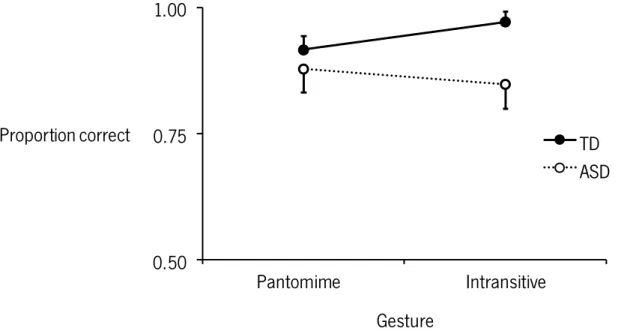
As far as production of gestures are concerned (Figure 2), TD participants showed an overall higher proportion of correct responses (filled dots; M = 0.94, SD = 0.11) than ASD participants (empty dots; M = 0.86, SD = 0.15), t(33.56) = 2.20, p = .035, dS = 0.65. The difference between
populations was mostly due to intransitive gestures: Whereas there was a significant difference between TD and ASD participants for intransitive gestures t(13.70) = 2.40, p = .031, dS = 1.05, no
such difference was found for pantomime gestures, t(17.43) = 0.71, p = .486, dS = 0.29. For TD
participants (filled dots), proportion correct for pantomime gestures (M = 0.92, SD = 0.12) was not significantly different from intransitive gestures (M = 0.97, SD = 0.09), t(17) = 1.84, p = .083, dZ =
0.43. ASD participants (empty dots) also showed no difference between pantomime (M = 0.88, SD = 0.15) and intransitive (M = 0.85, SD = 0.16) gestures, t(10) = 0.48, p = .640, dZ = 0.14.
Figure 2. Mean proportion (with SEM) of correct production of pantomime and intransitive gestures. The filled dots refer to typical-development (TD) participants and the empty dots refer to Autism Spectrum Disorder participants (ASD).
0.50
0.75
1.00
1 2Pantomime Intransitive
TD
ASD
Proportion correct
Gesture
RESULTS
9
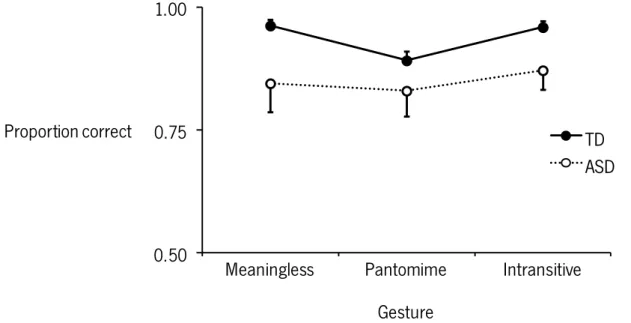
Concerning the experimental task, and first comparing performance for meaningless and meaningful (pantomime + intransitive) gestures (Figure 3), for ASD participants (empty dots) proportion correct for meaningful (M = 0.85, SD = 0.15) was not significantly different than for meaningless (M = 0.84, SD = 0.19), t(10) = 0.07, p = .946, dZ = 0.02. For TD participants (filled
dots), there was also no difference in accuracy between meaningful (M = 0.93, SD = 0.06) and meaningless (M = 0.96, SD = 0.06) gestures, t(17) = 1.69, p =.109, dZ = 0.40.
Figure 3. Mean proportion (with SEM) of correct identification of meaningless and meaningful (pantomime and intransitive) gestures. The filled dots refer to typical-development (TD) participants and the empty dots refer to Autism Spectrum Disorder participants (ASD).
Focusing now on meaningful gestures, that is, pantomime and intransitive gestures – that could be away or towards – (Figure 4), there was no difference in global accuracy between ASD (empty dots) and TD (filled dots) participants, t(12.07) = 1.68, p = .118, dS = 0.77. For TD
participants, a repeated-measures ANOVA, with category (pantomime vs. intransitive) and direction (away vs. towards) as factors, showed that accuracy for pantomimes (grey data points) was significantly lower than for intransitive gestures (black data points), F(1,17) = 11.82, p = .003, ηp² =
0.41. There was no difference between away and towards (F(1,17) = 0.001, p = .978, ηp² = 0.00),
nor interaction between the factors, F(1,17) = 0.46, p = .508, ηp² = 0.26. An equivalent test for the
ASD participants showed no main effects (category: F(1,10) = 1.65, p = .228, ηp² = 0.14; direction:
F(1,10) = 0.08, p = .783, ηp² = 0.01) nor interaction (F(1,10) = 1.21, p = .297, ηp² = 0.11). One
stimulus of particular interest was intransitive towards; so we performed a direct comparison 0.50 0.75 1.00 1 2 3 TD ASD
Meaningless Pantomime Intransitive Proportion correct
RESULTS
10
between populations in its performance, and found no significant differences: t(15.66) = 1.54, p = .144, dS = 0.65.
Figure 4. Mean proportion of correct identification of pantomime (grey dots) and intransitive (black dots) gestures. Data points on the left refer to towards gestures and data points on the right refer to away gestures. The filled dots refer to typical-development (TD) participants and the empty dots refer to Autism Spectrum Disorder participants (ASD).
If we contrast accuracy with performance on the Motor Imagery task, for ASD participants there was a significant negative correlation for pantomimes (r = - .70, p = .016). This was probably due to a significant negative correlation between motor imagery and accuracy for pantomimes towards (r = - .68, p = .022). For intransitive gestures, a similar pattern was apparent, but the negative correlation failed to attain significance (r = - .57, p = .066). However, when we break the gestures down to Intransitives Away and Towards, there was a significant negative correlation between motor imagery and accuracy for intransitive towards (r = -.71, p = .014). Since both towards showed a significant negative correlation with Motor Imagery task, we compared pantomimes towards and intransitives towards and found there was no difference between them, t(10) = 1.34, p = .208, dZ = 0.41. For TD participants, no significant correlation between accuracy
and motor imagery surfaced; neither for pantomime (r = .03, p = .895) or intransitive (r = .04, p = .871) gestures. No significant correlations were found between accuracy and performance on the Phonemic Fluency Skills task.
0.50 0.75 1.00 1 2 TD - Pantomime ASD - Pantomime TD - Intransitive ASD - Intransitive Towards Away Gesture Proportion correct
RESULTS
11
In addition to accuracy, another measure of interest is reaction time: the time it takes a participant to correctly classify a gesture. Figure 5 shows the average reaction times for each type of gesture for TD (filled dots) and ASD (empty dots) participants. Neither population showed different reaction times for meaningless and pantomime gestures (TD: t(17) = 1.99, p = .063, dZ = 0.47;
ASD: t(10) = 0.22, p = .830, dZ = 0.07). However, when comparing reaction times for meaningless
and intransitive gestures, both populations showed a significant difference (TD: t(17) = 2.57, p = .020, dZ = 0.61; ASD: t(10) = 2.61, p = .026, dZ = 0.79).
Figure 5. Mean reaction times (in seconds, with SEM) in the identification of meaningless and meaningful (pantomime and intransitive) gestures. The filled dots refer to typical-development (TD) participants and the empty dots refer to Autism Spectrum Disorder participants (ASD).
For meaningful gestures (Figure 6), even though ASD participants (empty dots; M = 4.33s, SD = 1.07s) tended to take longer to respond than TD participants (filled dots; M = 3.85s, SD = 1.18s), the difference was not significant: t(22.81) = 1.13, p = .273, dS = 0.42. For TD participants,
a repeated-measures ANOVA, with category (pantomime vs. intransitive) and direction (away vs. towards) as factors, showed that reaction time was significantly shorter for intransitives, F(1,17) = 22.47, p < .001, ηp² = 0.57. There was no main effect for direction, F(1,17) = 0.20, p = .889, ηp² =
0.01, nor interaction between the factors, F(1,17) = 0.29, p = .600, ηp² = 0.17. ASD participants
showed a similar pattern: they were also faster to respond to intransitive gestures, F(1,10) = 14.68,
2
4
6
1 2 3TD
ASD
Meaningless
Pantomime
Intransitive
Reaction time (s)
RESULTS
12
p = .003, ηp² = 0.60, and no main effect of direction (F(1,10) = 3.63, p = .086, ηp² = 0.27), or
interaction (F(1,10) = 1.51, p = .247, ηp² = 0.13) were found.
Figure 6. Mean reaction times (in seconds) in the correct identification of pantomime (grey dots) and intransitive (black dots) gestures. Data points on the left refer to towards gestures and data points on the right refer to away gestures. The filled dots refer to typical-development (TD) participants and the empty dots refer to Autism Spectrum Disorder participants (ASD).
DISCUSSION
The aim of the present study was to better understand how intransitive and pantomime gestures are processed. To that end, aside from two cognitive measures (Phonemic Fluency and Motor Imagery), production and performance of such gestures in two populations – typical development (TD) and Autism Spectrum Disorder (ASD) – were analyzed and compared. The analysis further distinguished the gestures between gestures performed towards or away from the body.
When comparing identification accuracy for pantomime and intransitive gestures, even though there was no overall difference between populations, a within-group analysis showed a difference between the groups: whereas for TD participants accuracy for intransitives was higher than for pantomimes (see also Carmo, & Rumiati, 2008; Mozaz, Rothi, Anderson, Crucian, & Heilman, 2002), for ASD participants no such difference was found. If intransitive and pantomime gestures were processed in the exact same way, and if ASD participants were to show a deficit in identification, we would expect that deficit to apply equivalently to both types of gestures, so the superiority of intransitive over pantomimes that TD participants displayed should also be present in
2 4 6 1 2 TD - Pantomime ASD - Pantomime TD - Intransitive ASD - Intransitive Towards Away Gesture Reaction time (s)
DISCUSSION
13
ASD participants. However, since there was no difference between intransitive and pantomime gestures for ASD participants, we can surmise that, for these participants, there was a decrease in accuracy for intransitive gestures (Stieglitz Ham et al., 2010). That is, as we saw for production, the identification of gestures also suggests that intransitive and pantomime gestures are processed in different ways.
Concerning the directionality of gestures, the absence, for both populations, of a difference between towards and away gestures does not allow us to state whether they are processed differently. Related with this, a specific prediction we proposed to test in this work was whether gestures assumed to have right lateralization (intransitive towards) would show a deficit in ASD individuals – we did not find this specific deficit in our ASD group; the overall performance for intransitive gestures was equivalent for both away and towards, that is, no marked deficit was found for intransitive towards specifically.
Regarding the Phonemic Fluency Skills and Motor Imagery measures, there was no difference between TD participants and ASD participants. These measures tend to be correlated with the production and interpretation of pantomimes, specifically: Phonemic Fluency requires brain areas related with language and linguistic signs (left middle and inferior frontal gyrus) which seem to also be specially required for pantomimes understanding (Villarreal et al., 2008); Motor Imagery tasks take advantage of motor areas even when only imagining performing the task (Decety & Michel, 1989), which, in and of itself, is also similar to how pantomimes are processed within the brain. Therefore, and given that both populations had similar scores in measures correlated with pantomimes, it is fair to assume that, if differences between participants (TD and ASD) are found, these may mostly be found in the processing of intransitive gestures. The prediction that ASD participants could show an impairment in the processing of intransitive gestures was confirmed by the production task: while for pantomimes there was no difference between TD and ASD participants, for intransitive gestures TD participants were better than ASD participants. From this, and since TD participants showed no difference between pantomime and intransitive gestures, ASD participants’ performance should be significantly worse for intransitive gestures. However, this was not the case. Yet, in Figure 2 we can see that, for TD participants (filled dots), performance for intransitive gestures tended to be above than that for pantomimes (which replicates Carmo and Rumiati, 2008). Conversely, for ASD participants (empty dots), performance for intransitive gestures tended to be below than that for pantomimes (cf. Stieglitz Ham et al., 2010 found a similar difference). That is, albeit non-significant within each population, these opposite tendencies explain
DISCUSSION
14
the difference found between pantomime and intransitive gestures and point to the possibility that these gestures are processed differently.
The comparison of identification accuracy with performance on the Motor Imagery task may shed some light on whether towards and away gestures are processed similarly. For ASD participants, a negative correlation was found between performance in this task and the identification of both intransitive and pantomimes towards (for away gestures, neither intransitive nor pantomime gestures correlated significantly with performance on the Motor Imagery task). For TD participants no correlation was found. These results suggest that TD and ASD populations differ in how they process towards gestures, but not necessarily away gestures. A similar result was found by Bartolo et al. (submitted), suggesting that both intransitive and pantomimes gestures towards the body may have a lot in common; perhaps both share a strong social emotional component (Gizzonio et al., 2015), which is particularly impaired in ASD participants. This goes along with what Gallagher and Frith (2004) proposed for intransitive gestures towards the body – a more social, Theory of Mind-dependent pathway, weakened in ASD participants. Maybe, all gestures towards the body share this pathway which is somehow less adapted in ASD participants. However, this result did not appear in our other measures, so this conclusion may be tentative but does need to be explored further.
In summary, the analyses focused on performance (in both production and identification of gestures) are consistent with the notion that intransitive and pantomime gestures are processed differently. Shifting focus from performance to reaction time, identification of intransitive gestures was faster than pantomimes for both populations, which is also consistent with them being processed differently.
First comparing reaction times of meaningless gestures with one of the meaningful gestures, intransitives, both groups were faster to identify intransitive gestures. This goes along with what the Dual Route Model (Bartolo & Stieglitz Ham, 2016) proposes – a sublexical, rather slower, route for processing meaningless gestures and a lexical, automated route for processing meaningful gestures, namely intransitives. However, the same was not true for pantomime gestures (another type of meaningful gestures): there was no significant difference in reaction times between meaningless and pantomime gestures, for neither ASD nor TD participants. Hence, it appears as if, for both populations, the time required to identify a pantomime gesture was fairly the same needed to identify a meaningless gesture. This is also congruent with the Dual Route model since, even though pantomimes are an example of a meaningful gesture, they are particularly difficult to identify
DISCUSSION
15
because, most times, they are regarded as “new” (Bartolo and Stieglitz Ham (2016). The reaction times also suggest that pantomimes and intransitive gestures, though both meaningful, are somehow, different.
Focusing now on the reaction times for meaningful (pantomime and intransitive) gestures alone, average times for both gestures tended to be longer for ASD than TD participants, though non-significant. A within-group analysis showed that, for both TD and ASD participants, reaction time for intransitives was shorter than for pantomimes. Regarding directionality of gestures (towards and away), the absence, for both populations, of a significant main effect of direction (and interaction with category of gesture) does not tell us much about how these subcategories (towards and away) may differ.
In conclusion, our results suggest a difference between intransitive and pantomime gestures. If we assume that this difference is a reflection of the processing of intransitive and pantomimes following different pathways, the results of the present thesis would be consistent with:
a) The deficits that characterize ASD participants appear to interfere more with the pathway for processing intransitive gestures (between TD and ASD, we found that, when ASD participants showed a decrement in performance, this was usually for intransitive gestures);
b) The pathway for processing intransitives seems to be faster than the pathway for processing pantomimes (reaction times for intransitives were shorter for both populations).
Hence, our results suggest that intransitive and pantomime gestures may be processed differently. Perhaps, the brain correlates identified for processing intransitive gestures need not apply to the processing of pantomime gestures. However, within each category, the results of direction (towards and away) are still inconclusive. This may have happened due to small non-homogenous samples and little number of each type of stimuli. To, potentially, solve these problems, future research should include more participants of each group and increase the number of stimuli. Furthermore, to confirm different neuronal pathways, it would be interesting to conduct this study using a neuroimaging technique.
REFERENCES
16 REFERENCES
American Psychiatric Association. (2013). Diagnostic and statistical manual of mental disorders (5th ed.). Washington, DC: Author.
Bartolo, A., & Stieglitz Ham, H. S. (2016). A cognitive overview of limb apraxia. Current neurology and neuroscience reports, 16(8), 75.
Bartolo, A., Claisse, C, Gallo, F., Ott, L., Sampaio, A., & Nandrino, J. (2019). Gestures convey different physiological responses when performed toward and away from the body. Manuscript submitted for publication.
Bohlhalter, S., Hattori, N., Wheaton, L., Fridman, E., Shamim, E. A., Garraux, G., & Hallett, M. (2008). Gesture subtype–dependent left lateralization of praxis planning: An event-related fMRI study. Cerebral Cortex, 19(6), 1256-1262.
Carmo, J. C., & Rumiati, R. I. (2009). Imitation of transitive and intransitive actions in healthy individuals. Brain and cognition, 69(3), 460-464.
Carmo, J. C., & Rumiati, R. I. (2009). Imitation of transitive and intransitive actions in healthy individuals. Brain and cognition, 69(3), 460-464.
Cavaco, S., Gonçalves, A., Pinto, C., Almeida, E., Gomes, F., Moreira, I., ... & Teixeira-Pinto, A. (2013). Semantic fluency and phonemic fluency: regression-based norms for the Portuguese population. Archives of Clinical Neuropsychology, 28(3), 262-271.
Decety, J., & Michel, F. (1989). Comparative analysis of actual and mental movement times in two graphic tasks. Brain and cognition, 11(1), 87-97.
Gallagher, H. L., & Frith, C. D. (2004). Dissociable neural pathways for the perception and recognition of expressive and instrumental gestures. Neuropsychologia, 42(13), 1725-1736. Gizzonio, V., Avanzini, P., Campi, C., Orivoli, S., Piccolo, B., Cantalupo, G., ... & Fabbri-Destro, M.
(2015). Failure in pantomime action execution correlates with the severity of social behavior deficits in children with autism: a praxis study. Journal of autism and developmental disorders, 45(10), 3085-3097.
Stieglitz Ham, H.., Bartolo, A., Corley, M., Swanson, S., & Rajendran, G. (2010). Case report: Selective deficit in the production of intransitive gestures in an individual with autism. Cortex, 46(3), 407-409.
Happé, F., Brownell, H., & Winner, E. (1999). Acquired ‘theory of mind' impairments following stroke. Cognition, 70(3), 211-240.
REFERENCES
17
Króliczak, G., & Frey, S. H. (2009). A common network in the left cerebral hemisphere represents planning of tool use pantomimes and familiar intransitive gestures at the hand-independent level. Cerebral Cortex, 19(10), 2396-2410.
Moser, B. K., & Stevens, G. R. (1992). Homogeneity of variance in the two-sample means test. The American Statistician, 46(1), 19-21.
Mozaz, M., ROTHI, L. J. G., Anderson, J. M., Crucian, G. P., & Heilman, K. M. (2002). Postural knowledge of transitive pantomimes and intransitive gestures. Journal of the International Neuropsychological Society, 8(7), 958-962.
Oldfield, R. C. (1971). The assessment and analysis of handedness: the Edinburgh inventory. Neuropsychologia, 9(1), 97-113.
Pereira, R. (2018). Neural Basis of Pantomime and Intransitive Gestures: an fMRI Study (Unpublished master's thesis). University of Minho, Braga, Portugal.
Rogers, S. J., & Williams, J. H. (Eds.). (2006). Imitation and the social mind: Autism and typical development. Guilford Press.
Ruxton, G. D. (2006). The unequal variance t-test is an underused alternative to Student's t-test and the Mann–Whitney U test. Behavioral Ecology, 17(4), 688-690.
Smith, I. M., & Bryson, S. E. (2007). Gesture imitation in autism: II. Symbolic gestures and pantomimed object use. Cognitive Neuropsychology, 24(7), 679-700.
Stamenova, V., Roy, E. A., & Black, S. E. (2010). Associations and dissociations of transitive and intransitive gestures in left and right hemisphere stroke patients. Brain and cognition, 72(3), 483-490.
Viana, J. A. R. (2015). The role of social cognition and motor imagery in gesture processing: a patients' study (Doctoral dissertation).
Villarreal, M., Fridman, E. A., Amengual, A., Falasco, G., Gerscovich, E. R., Ulloa, E. R., & Leiguarda, R. C. (2008). The neural substrate of gesture recognition. Neuropsychologia, 46(9), 2371-2382.
Williams, J. H., Whiten, A., & Singh, T. (2004). A systematic review of action imitation in autistic spectrum disorder. Journal of autism and developmental disorders, 34(3), 285-29
APPENDIX
18 APPENDIX – ETHICAL APPROVAL
APPENDIX