ECOLOGY AND FUTURE, VOL. X, No 4
Bulgarian Journal of Ecological Science Sofia. 2011Abstract
Droughts are natural but temporary imbalances of wa-ter availability, consisting of a persistent lower-than-aver-age precipitation, of uncertain frequency, duration and severity, of unpredictable or difficult to predict occur-rence, resulting in diminished water resources availability and impacts on natural and man-made ecosystems.
To successfully cope with drought there is a need to understand the characteristics and consequences of re-lated phenomena; however, differences in the percep-tion of drought lead to difficulties in adopting risk man-agement.
The effectiveness of drought risk management de-pends upon drought monitoring, drought prediction and warning capabilities, and means to provide information to users, as well as on related awareness of populations.
For drought monitoring and warning, drought indices are useful. The SPI has been extensively used in Portugal and stochastic methods have been developed for pre-diction of drought class transitions to be used for early warning. For agricultural purposes, the PDSI was modi-fied and successfully referred to the rainfed olive crop, thus originating the MedPDSI. Its evaluation against the SPI and PDSI shows the appropriateness of this index.
Relative to information systems, a variety of approach-es were used to support deficit irrigation. However, its economic feasibility is questionable and more studies are required to assess ways to improve irrigation under drought.
Key words: drought concepts and perception; drought indices, drought risk management; economic impacts, deficit irrigation
Introduction
Droughts are natural but temporary imbalances of water availability, consisting of a persistent lower-than-average precipitation, of uncertain frequency, duration and severity, of unpredictable or difficult to predict occurrence, resulting in diminished water
L. S. PEREIRA
CEER – Biosystems Engineering, Institute of Agronomy, Technical University of Lisbon, Portugal E-mail: [email protected]
Drought Challenges in a Context of Soil Use Sustainability
resources availability, and reduced carrying capacity of the ecosystems (Pereira et al., 2009). Many other definitions of drought exist; generally, these defini-tions clearly state that drought is mainly due to the break down of the rainfall regime, which causes a series of consequences, including agricultural and hydrological hazards which result from the severity and duration of droughts. It is important to recog-nise the less predictable characteristics of droughts, mainly their initiation and termination, as well as their severity.Drought impacts in agriculture need to be ap-proached through managing the risk associated with the occurrence of droughts and with the re-spective impacts. Drought impacts are higher when the demand is close to, or even higher than the long term average availability of water. Drought ef-fects are especially severe when the water resource development is limited and there is not sufficient water storage capacity to have stored water from high flow periods to supplement the low flows dur-ing drought. Drought impacts are also greater when pollution and poor water management negatively impact the access to water sources. In other words, drought impacts are higher when associated with natural aridity of the climate and with man induced water scarcity (Pereira et al., 2009).
It is important to recognise the less predictable characteristics of droughts, with respect to their initi-ation and termininiti-ation, as well as their severity. These characteristics make drought both a hazard and a disaster. Drought is a hazard because it is an accident of unpredictable occurrence, part of the naturally variable climate system and that it occurs with some known or recognised frequency. Drought can be a disaster because it corresponds to the failure of the precipitation regime, causing the disruption of the water supply to the natural and agricultural ecosys-tems as well as to other human activities.
Water scarcity due to drought needs appropri-ate approaches. To successfully cope with drought there is a need to understand the characteristics and consequences of those phenomena which make water scarcity due to drought very different from that caused by aridity. Dealing with water scarcity situations resulting from aridity usually re-quires the establishment of engineering and man-agement measures that produce conservation and perhaps the seasonal augmentation of the available resource. On the other hand, droughts require the development and implementation of preparedness and emergency measures, in other words, risk
man-agement strategies. Differences in the perception of drought (Figure 1) lead to difficulties in adopting those strategies.
As shown in Figure 1, precipitation deficits are first detected and cause meteorological droughts. Next detected are soil water deficits due to lack of rainfall to refill the soil water storage, thus produc-ing the so-called agricultural droughts. When pre-cipitation deficits continue the river flow regimes are affected and hydrological droughts occur. Con-tinuing this situation, surface water storage is af-fected causing a water supply drought. Last to be perceived are the ground-water deficits usually as-sociated with long periods of below average pre-cipitation. The time to perceive those deficits relates to the hydrologic processes involved, which require different time durations, less to deplete soil water storage, much more to impact storage in large aqui-fer systems. A farmer quickly perceives the onset of a drought while an urban citizen may not perceive it until water is not available at home.
The peculiar characteristics of droughts require use of specific measures (Figure 2). The complex-ity and hazardousness of droughts make their management particularly difficult and challeng-ing. Adopting risk management is a must, together with clearly defined preparedness measures. Since droughts have pervasive long term effects and their severity may be very high, they also require appro-priate evaluation of impacts.
Time
Precipitation deficit Soil water deficit
River flow deficit
Surface storage deficit
Groundwater Storage deficit
Meteorological drought Agricultural drought Hydrological drought Water supply drought Graundwater drought Fig. 1. Differences in perception of drought that lead to different concepts and definitions of drought and to differences in the adoption of risk management strategies
Droughts are unpredictable or
difficult to predict Droughts have pervasive long termeffects and may be highly severe Mitigation
measures
• early warning and information to users
• changes in water allocation and delivery operation of water systems • using non conventional sources, including waste and low quality • reduced demand, water saving practices, especially in irrigation
• developing public awareness • technical support to users
• finantial support to highly affected users • water pricing policies
Preparadness measures
Drought Risk Management
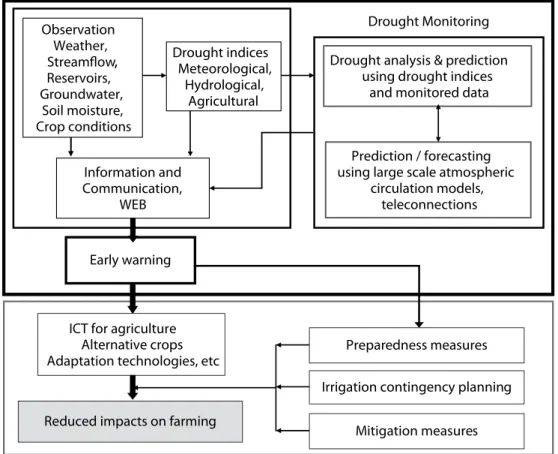
The effectiveness of drought risk management depends upon the drought monitoring facilities, drought prediction capabilities, and means to pro-vide information to users, as well as on the aware-ness of populations of drought water scarcity. This is exemplified in Figure 3 for agriculture.
Drought monitoring and Drought Watch Systems are often discussed but action is rarely taken. At-tempts have been made in several places but sus-taining interest between droughts has proved dif-ficult. Monitoring means keeping an ongoing watch and attempting to alert interested parties when a drought appears to be developing. Maintaining a historical record is part of drought monitoring.
For drought monitoring and warning, meteor-ologists and hydrmeteor-ologists have developed drought indices, which depend on hydro-meteorological parameters or rely on probabilities of drought oc-currence. Adopting different indices at the regional level with support of mapping probably has the best potential.
Drought monitoring may use: a variety of vari-ables relative to weather, surface hydrology,
reser-voirs, groundwater, water quality, soil moisture and vegetation, diverse observation tools land or satel-lite based; modelling tools for computing drought indices, exploring teleconnections, developing pre-dictions, produce public information and desirably information management tools to support best users practices to cope with drought, e.g., Figure 3 relative to agriculture.
The controversy over perceptions of drought (Figure 1), and the consequent difficulties in defin-ing them and their characteristics, does not help decision and policy makers to plan for droughts. Lack of clearly agreed definitions makes it difficult to implement preparedness measures, to apply timely mitigation measures when a drought occurs, or to adequately evaluate drought impacts. There-fore, despite the logic behind monitoring and warn-ing, these are often not applied even when drought variables are observed and indices are computed.
Drought indices have been one of most useful tools for understanding and deal with droughts be-cause enabling analyses of their temporal and spatial variability and supporting drought monitoring and information. Drought indices categorize the
sever-Drought indices Meteorological, Hydrological, Agricultural Information and Communication, WEB
Drought analysis & prediction using drought indices
and monitored data
Prediction / forecasting using large scale atmospheric
circulation models, teleconnections
Preparedness measures ICT for agriculture
Alternative crops Adaptation technologies, etc Observation Weather, Streamflow, Reservoirs, Groundwater, Soil moisture, Crop conditions Early warning
Reduced impacts on farming
Irrigation contingency planning Mitigation measures
Drought Monitoring ,
Fig. 3. Drought monitoring, prediction, and information, warning system and information technologies in the framework of drought risk management in agriculture
ity of droughts and help to follow-up their variability in time and space. However, the complexity of the drought phenomenon, involving several physical factors, e.g., meteorological, hydrological and hydro-geological, as well as a wide variety of environmen-tal and socio-economic impacts, makes it impossible to develop indices that relate with all these issues. Therefore, drought indices have been developed to respond to specific perspectives such as meteorolog-ical, agricultural, hydrologmeteorolog-ical, and managerial. Per-haps the most known is the Palmer Drought Severity Index (PDSI), developed by Palmer (1965), that takes into consideration precipitation, evapotranspiration and soil moisture conditions, thus it is of interest for meteorological, agricultural, hydrological, and managerial purposes. At present, the most popular is probably the Standard Precipitation Index (SPI) that uses only precipitation and may be computed with various time scales (McKee et al. 1993). To consider both the effects of precipitation and evapotranspira-tion related to known vegetaevapotranspira-tion, we developed the MedPDSI that refers to the olive crop and may be useful for agricultural purposes (Pereira et al., 2007).
Confident forecasts of drought are still only a hope, primarily among researchers, but short time drought predictions are important for warning farmers about the probable initiation or establish-ment of a drought, about its continuation or its probable termination in a few months. This
infor-mation may help them to make decisions to cope with that predicted situation. Short time drought predictions may also be used to alert water manag-ers and decision or policy makmanag-ers about the need to enforce appropriate preparedness measures before a drought is effectively installed, or to prepare for a post-drought period. To support early warning, an al-ternative is to predict the drought classes transitions with one up to three months lead time.
To cope with droughts requires preparatory measures, contingency plans that support the time-ly implementation of mitigation measures and that forecast impacts which are likely to be experienced once the drought becomes established and evolves. Associating agricultural vulnerability to drought (Popova et al., 2011) with an early warning system may lead to improve monitoring and information to agricultural users and, mainly, to the adequate and timely implementation of mitigation measures and to control drought impacts This implies risk-based drought policies and effective monitoring and early warning systems. However this is only possible for a society that has strong institutions and where public participation forces policy-makers to adopt drought risk policies and make the society resilient to drought (Wilhite and Buchanan-Smith 2005). When technological and political capabilities are lacking and public participation is poor, the society is vulnerable to the full effects of drought (Figure 4).
Lack of risk -based drought management policies
Society exposed to drought
Risk -based drought policies, plans developed Lack of early warning system Early warning system effective
Society vulnerable to drought Society resilient to drought Crisis management
Potential disaster Impacts reduced
Mitigation actions implemented
Strong institutions an d public participation Weak institutions an d dependent population Conflicts Poverty Poor resources Low awareness Social adaptative capacity High awareness Political capital -
Challenges to cope with drought are evidently not only of technological nature but refer to the society, the policies and the politics. A democratic society is then more able to cope with drought than a society where public participation is poor or non existing.
Recognition that drought is inevitable and that its frequency of occurrence and even its intensity can be known provides opportunity to prepare for most of its effects. Drought is not an unexpected catastrophic occurrence. Careful study of available weather data allows understanding the normal vari-ability of climate, particularly very wet and very dry periods (droughts). Education programs are needed to make sure no-one is surprised when the next drought occurs.
Drought Indices and Predicting
Drought Class Transitions
Considering the objectives of drought indices, these must provide appropriate information on the characteristics of drought and wetness peri-ods at any location, i.e., must be able to represent the respective climate anomalies. When the objec-tive is meteorological or relaobjec-tive to water supply it is enough to consider the precipitation anomalies such as with the SPI. When impacts on vegetation and crops are considered, then it is appropriate to identify the anomalies with help of the respective soil water balance. This is the approach with the PDSI, often considered an appropriate agricultural drought index (Szép et al., 2005). However, not the
potential evapotranspiration (ETp) but the actual ET (ETa) as influenced by drought must be considered. This is the approach with the MedPDSI (Figure 5).
ETa for the MedPDSI is computed as the actual evapotranspiration of a rainfed olive crop while with PDSI is computed from the Thornthwaite equation and an old fashion soil water balance (Alley, 1984). The soil water balance with MedPDSI is performed with the ISAREG model (Pereira et al., 2003) when knowing the soil depth and water holding charac-teristics and crop parameters, mainly the crop co-efficient, Kc. The dual Kc approach is applied. The basal Kcb is monthly dependent and the evapora-tion coefficient Ke is both depending on the month rainfall and the previous rain (Pereira and Rosa, 2010). ETo with MedPDSI is computed with the PM equation with temperature only (see Popova et al., 2006) ETa with the MedPDSI is larger than with PDSI in winter, spring and late autumn and is smaller in summer and early autumn when rainfall is lower. ETa peaks are detected first with MedPDSI as correspond-ing with the Sprcorrespond-ing season while peaks for PDSI oc-cur later, however when actually there is no soil water that could justify such behaviour. This is a reason for adopting MedPDSI.
The procedures for computing the Z anomaly, including for parameters calibration, as well as for computing the index from the anomaly with MedP-DSI are not changed relative to the original Palmer index. It results a similar behaviour of indices (Fig-ure 6). 0 20 40 60 80 100 120 1965 1966 1967 1968 1969 1970 1971 1972 1973 1974 1975 1976 1977 1978 1979 1980 1981 1982 1983 1984 1985 ET a (m m) 0 20 40 60 80 100 120 1986 1987 1988 1989 1990 1991 1992 1993 1994 1995 1996 1997 1998 1999 2000 2001 2002 2003 2004 2005 2006 ET a (m m)
However, it is apparent that MedPDSI tends to detect droughts before than using the original ín-dex, which is beneficial in monitoring and for early warning. In addition, the MedPDSI relates well with the SPI computed for a time scale of 9 or 12 months (Rosa et al., 2010). For the period 1941-2006 and the entire country, it was observed that the MedP-DSI identified more times, earlier and more severe droughts than SPI or PDSI (Paulo et al., 2010).
Moreira et al. (2008) developed a methodology for SPI-based drought category prediction using loglinear models. Paulo and Pereira (2008) used the Markov chains for the stochastic prediction of drought class transitions. Both approaches allow a lead time of 2 to 3 months for early warning of droughts in Southern Portugal. More recently, the Markovian approach was extended to the full coun-try and adopted for both the SPI and MedPDSI (Paulo and Pereira, 2008). A Markovian approach was also developed to the processes governing at-mospheric regime transitions between positive and negative phases of the North Atlantic Oscillation or Arctic Oscillation, which were associated with de-terministic forecasts of the monthly-SPI at 1, 2 and 3 months of forecast lag. Further research along these lines is continuing.
Irrigation to Cope with Droughts.
Economic Impacts of Water Deficits
When a drought occurs, the demand for water increases despite water availability is then limited. Therefore, deficit irrigation is often adopted. To build appropriate irrigation schedules under deficit irrigation it is required to understand well, through experimentation, the relationships between water use and crop yields. Good examples are the studies developed in Bulgaria, which could be recently ana-lysed through modelling and used to build-up ap-propriate irrigation schedules (Popova et al., 2006b; Popova and Pereira, 2011). However, the economic results of deficit irrigation may be very different.
Studies for cereals in southern Portugal (Rod-rigues and Pereira, 2009; Rod(Rod-rigues et al., 2010) show that deficit irrigation results depend upon: a) soil fertility associated with farmer husbandry; b) climate demand and crop water requirements; c) irrigation technology and performance; d) water price; e) irrigation production costs; f) yield value. As shown in Figure 7, deficit irrigation may not be a profitable solution but just the way farmers may find to loose less in drought years.
The example in Figure 7 shows that profitability with deficit irrigation may not be achieved. It also
Fig. 6. Time series of MedPDSI (——) and original PDSI (...) for Beja
-8 -6 -4 -2 0 2 4 6 8 1941 1943 1945 1947 1949 1951 1953 1955 1957 1959 1961 1963 1965 1967 1969 1971 1973 PDSI -8 -6 -4 -2 0 2 4 6 8 1974 1976 1978 1980 1982 1984 1986 1988 1990 1992 1994 1996 1998 2000 2002 2004 2006 PDSI
shows that the ratio YPCR decreases when water costs increase, decreases when the demand for water increases (particularly for the drought years), and decreases when the irrigation performance is lower. In reality, with current maize prices, it is dif-ficult with fully irrigated crops: farmers need to at-tain a land productivity threshold of 12 ton per ha. With drought farmers have to valour all sub-prod-ucts, e.g., for animal feeding. Under drought water is insufficient for fully irrigate the cropped area and the option may be to adopt a reduced deficit in as much as possible of the area. Water managers often refer the need to increase then the water produc-tivity instead of maximizing land producproduc-tivity. But this is only possible with a limited deficit. There is a strong need to understand better the economic relations of irrigation, including those on costs and benefits of adopting a better performing irrigation system and relative to irrigation water costs.
References
Alley, W. M. 1984. The Palmer Drought Severity Index: limitations and assumptions. J. Climate and Applied Me-teorology, 23: 1100-1109
McKee, T. B., Doesken, N. J., Kleist, J. 1993. The re-lationship of drought frequency and duration to time scales. -In: 8th Conference on Applied Climatology. Am. Meteor. Soc., Boston, p. 179-184
Moreira, E. E., Coelho, C. A., Paulo, A. A., Pereira, L. S., Mexia, J. T. 2008. SPI-based drought category predic-tion using loglinear models. J. Hydrology, 354, 116-130
Palmer, W. 1965. Meteorological Drought. U.S. Weath-er Bureau, Res. PapWeath-er No 45, Washington.
Paulo, A. A., Pereira, L. S. 2008. Stochastic prediction of drought class transitions. Water Resour. Manage, 22: 1277-1296
Paulo, A. A., Pereira, L. S. 2010. Análise estocástica das transições entre classes de seca através de modelos de Markov. -In: Pereira, L. S, Mexia, J. T., Pires, C. A. L. (Eds) Gestão do Risco em Secas. Métodos, tecnologias e desa-fios. Ed. Colibri & CEER, Lisboa, 171-188
Paulo, A. A., Rosa, R. D., Martins, D. 2010. Variabili-dade temporal e espacial dos índices de seca. Comparação entre o SPI, o PDSI e o MedPDSI. -In: Pereira, L. S., Mexia, J. T., Pires, C. A. L. (Eds) Gestão do Risco em Secas. Métodos, tecnologias e desafios Ed. Colibri & CEER, Lisboa, 59-72
Pereira, L. S., P. R. Teodoro, P. N. Rodrigues, J. L. Tei-xeira. 2003. Irrigation scheduling simulation: the model ISAREG. -In: G. Rossi, A. Cancelliere, L. S. Pereira, T. Oweis, M. Shatanawi, A. Zairi (Eds.) Tools for Drought Mitigation in Mediterranean Regions. Kluwer, Dordrecht, p. 161-180
Pereira, L. S., Rosa, R. D., Paulo, A. A. 2007. Testing a modification of the Palmer Drought Severity Index for Mediterranean environments. In: Rossi, G., Vega, T., Bo-naccorso, B. (eds.) Methods and Tools for Drought Analy-sis and Management. Springer, Dordrecht, pp. 149-167.
Pereira, L. S., Cordery, I., Iacovides, I. 2009. Coping with Water Scarcity. Addressing the Challenges. Springer, Dordrecht, 382 p.
Pereira, L. S., Rosa, R. D. 2010. O MedPDSI, uma mod-ificação do índice de Palmer para clima mediterrânico. 1. Desenvolvimento. -In: Pereira, L. S., Mexia, J. T., Pires, C. A. L. (Eds) 2010. Gestão do Risco em Secas. Métodos, tecno-logias e desafios. Ed. Colibri & CEER, Lisboa, 15-34
Pires, C., Sousa, J. 2010. Previsão de classes de seca por cadeias de Markov condicionadas por regimes da Oscilação do Atlântico Norte e da Oscilação Ártica. -In: Pereira, L. S., Mexia, J. T., Pires, C. A. L. (Eds) Gestão do Risco em Secas. Métodos, tecnologias e desafios. Ed Co-libri & CEER, 209-224
Popova, Z., Pereira, L. S. 2011. Modeling for maize irrigation scheduling using long term experimental data from Plovdiv region, Bulgaria. Agric Water Manage, Vol. 98 (4): 675-683
Popova, Z., M. Kercheva, L. S. Pereira. 2006a. Valida-tion of the FAO methodology for computing ETo with limited data. Application to South Bulgaria. Irrig and Drain., 55(1): 201-215
Popova, Z., Eneva, S., Pereira, L. S. 2006b. Model validation, crop coefficients and yield response factors for maize irrigation scheduling based on long-term ex-periments. Biosystems Eng., 95 (1), 139-149
Legend:
PELQ = potential (application) efficiency referred to the low quarter; Av, VH and Ext = water requirements in average, very high and extremely high climate demand; Present, OM&M, and Costs Tot = irrigation water costs with present subsidizing, to cover operation, maintenance and management, and to cover all costs, including investment costs, as for the European Water Framework Directive.
Fig. 7. Yield value to production costs ratio (YPCR) for sprinkler irrigated maize, southern Portugal
0.80 0.70 0.60 0.50 0.40 0.30 Av VH Ext Ext Av VH Ext Av VH PELQ = 61.5% PELQ = 70% PELQ = 85% Presente OM&M Custos Totais
Popova, Z., Ivanova, М., Alexandrova, P., Done-va, K., Alexandrov, V., Pereira, L. S. 2011. Impact of drought on maize irrigation and productivity in Plovdiv region.
Rodrigues, G. C., Pereira, L. S. 2009. Assessing eco-nomic impacts of deficit irrigation as related to water pro-ductivity and water costs. Biosystems Eng.,103: 536-551
Rodrigues, G. C., Silva, F. G., Pereira, L. S. 2010. As-sessing the feasibility of deficit irrigation under drought conditions. –In: A López-Francos (ed) Options Méditerra-néennes Séries A95, 285-291
Rodrigues, G. C., Silva, F. G., Pereira, L. S. 2010. Análise económica e da produtividade da água em rega em condições de seca: aplicação às culturas de milho
e trigo no regadio da Vigia. – In: Pereira, L. S., Mexia, J. T., Pires, C. A. L. (Eds) 2010. Gestão do Risco em Secas. Métodos, tecnologias e desafios. Edições Colibri e CEER, Lisboa, pp. 321-344
Rosa, R. D., Pereira, L. S., Paulo, A. A. 2010. O Med-PDSI, uma modificação do índice de Palmer para clima mediterrânico. 2. Aplicação a país. – In: Pereira, L. S., Mex-ia, J. T., Pires, C. A. L. (Eds) 2010. Gestão do Risco em Se-cas. Métodos, tecnologias e desafios. Ed. Colibri & CEER, Lisboa, 15-34
Szép, I. J., Mika, J., Dunkel, Z. 2005. Palmer drought severity index as soil moisture indicator: physical inter-pretation, statistical behaviour and relation to global cli-mate. Physics and Chemistry of the Earth, 30: 231-243