AMCIS 2012 Proceedings
Proceedings
Executives and Smartphones: Friend or Foe?
Ana Borges
Brazilian School of Public and Business Administration, Getulio Vargas Foundation, Rio de Janeiro, Rio de Janeiro, Brazil.,
Luiz Joia
Brazilian School of Public and Business Administration, Getulio Vargas Foundation, Rio de Janeiro, Rio de Janeiro, Brazil.,
Follow this and additional works at:
http://aisel.aisnet.org/amcis2012
This material is brought to you by the Americas Conference on Information Systems (AMCIS) at AIS Electronic Library (AISeL). It has been accepted for inclusion in AMCIS 2012 Proceedings by an authorized administrator of AIS Electronic Library (AISeL). For more information, please contact [email protected].
Recommended Citation
Borges, Ana and Joia, Luiz, "Executives and Smartphones: Friend or Foe?" (2012). AMCIS 2012 Proceedings. 2.
Proceedings of the Eighteenth Americas Conference on Information Systems, Seattle, Washington, August 9-12, 2012. 1
Executives and Smartphones: Friend or Foe?
Ana Paula Borges
Getulio Vargas Foundation
[email protected]
Luiz Antonio Joia
Getulio Vargas Foundation
[email protected]
ABSTRACT
This article seeks to identify the existence of ambiguities in the day-to-day use of smartphones by Brazilian executives. In this manner, fourteen technological paradoxes were identified from the theoretical reference base adopted. The single representative case study method was then applied, by analysing a Brazilian company in the pharmaceutical sector, which has a policy of providing smartphones to its senior executives. After consolidation and analysis of the data collected, it was seen that of the fourteen paradoxes obtained, two generated strong ambiguity regarding the use of smartphones by the executives in question, namely: continuity vs. asynchronicity and autonomy vs. addiction. Furthermore, three other paradoxes were moderately associated with the use of smartphones by the executives in question, namely freedom vs. enslavement, dependence vs. independence, and planning vs. improvisation. Lastly, the implications and limitations of the research are presented, as well as recommendations for future work associated with this theme.
Keywords
Paradoxes; smartphones; mobile technology
INTRODUCTION
Nowadays, smartphones are used by over 100 million users worldwide. As with any innovation that swiftly alters the way people relate to each other, the aggressive growth of the smartphone has also elicited discussion about its benefits and drawbacks. The same occurs in relation to the cell phone and other technologies in regular use, such as the Internet, electronic games, digital music appliances and other instruments.
Studies grounded in technological paradoxes show that the adoption of certain technologies can impart positive as well as negative aspects to those who adopt them (Tyler, 2002; Winner, 1994; Goodman, 1988; and Boorstin, 1978). Thus, while smartphones help the population to speed up communications, they can also cause dependence, anxiety, and a reduction in time free from their sway.
In this way, cognizant of the fact that technology has changed the way individuals work, live and relate to each other, this paper seeks to answer the following research question, in light of the prevailing theory on technological paradoxes: Can the technological paradoxes identified and prevalent in a series of technologies also be identified in the relationship between executives and smartphones? If the answer is in the affirmative, which of these paradoxes is most strongly detected in this relationship?
BIBLIOGRAPHICAL REVIEW Technological Paradoxes
Proceedings of the Eighteenth Americas Conference on Information Systems, Seattle, Washington, August 9-12, 2012. 2 Every paradox is a statement which is in itself a contradiction, albeit possibly well-grounded and valid (Lewis, 2000). The contradiction is presented on the basis of the opposition between two propositions in which the truth of one necessarily implies the falsity of the other and vice versa (Adekola & Sergi, 2007).
With respect to the implications of the paradoxes associated with the technological field, Winner (1994), for example, asserts that the same technology that creates feelings of intelligence and efficiency can also generate feelings of stupidity and paralysis. Goodman (1988) and Pai et al. (2004) mentioned that the technological tools acquired to minimize time in performing tasks often resulted in an increase in the time taken in executing them. For his part, Boorstin (1978) noted that, whereas technology brought people closer together, it also isolated them.
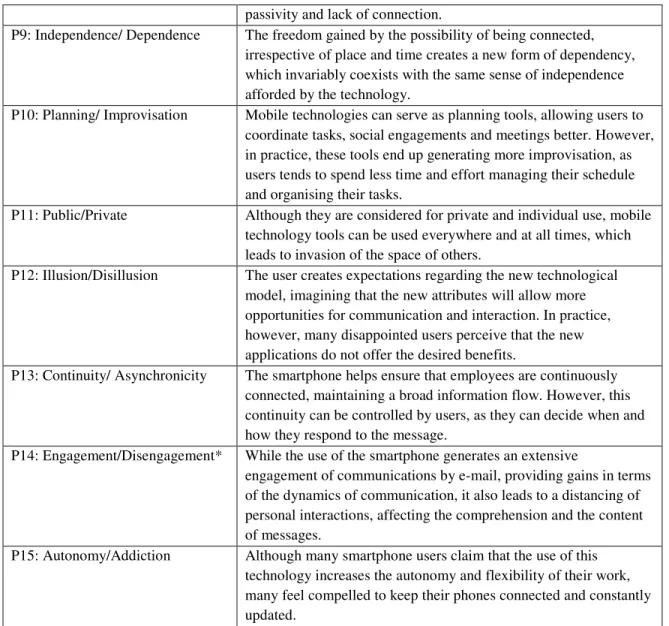
Mick & Fournier (1998) made their contribution to the discussion about the technological paradoxes, when they decided to assess them employing a qualitative approach based on content analysis of interviews, a study which had not yet been performed until that time in the academic field. The research conducted in the U.S. assessed the sentiments and behaviours of consumers of technological products like computers, printers, DVDs and televisions, by means of interviews, group discussions, and questionnaires. The scope of that research was to synthesise the concepts of paradoxes, emotions and behavioural strategies within the field of applied technology in consumer products. During that research eight paradoxes (P1 to P8) were revealed, as shown in Table 1.
Jarvenpaa & Lang (2005) also studied the concept of technological paradoxes, more specifically in the universe of mobile technology. In 2001, the authors conducted a survey with 33 discussion groups composed of 222 users recruited in Finland, Japan, China and the U.S. At the end of the study, they identified 23 paradoxes that after methodological revalidation were reduced to eight, which can be specifically applied to mobile technology tools. In addition to four paradoxes revealed in the study of Mick & Fournier (1998) – P2; P4; P6; P8 – Jarvenpaa & Lang (2005) pinpointed four more technological paradoxes (P9 to P12), as shown in Table 1.
Mazmanian, Orlikowski, & Yates (2006), when studying the social implications of using wireless email devices (Blackberrys) also identified three types of conflicting dualities arising from use of this technology (P13 to P15): continuity/asynchronicity, engagement/disengagement and autonomy/addiction (see Table 1).
Understanding that organisations and humankind adopt technologies because they believe they contribute to increasing their performance (John, Weiss, & Dutta, 1999), it is relevant to understand the effective role of these technologies in the day-to-day reality of these units of analysis. Ambiguities or anomalies arising from this use need to be studied and analysed in order to seek solutions that can minimise the conflicting aspects associated with the use of these technologies.
Paradox Concept
P1: Control/Chaos Technology can facilitate the order and control of tasks and
situations, but it can also cause disorder, disarray and revolt. P2: Freedom/Enslavement Technology can facilitate independence and reduce restrictions, but
it can also cause dependency and more restrictions.
P3: New/Obsolete Technology can bring new benefits arising from advances in
knowledge, but it can also be outdated by the time it becomes accessible to the consumer.
P4: Competence/In-competence Technology can elicit a sense of efficiency and intelligence, but it can also cause feelings of incompetence and ignorance, due to the complexity and difficulty of use.
P5: Efficiency/Inefficiency Technology permits greater speed and less effort in performing certain tasks, but it may also require more time and effort in others. P6: Satisfaction/Creation of Needs Technology can facilitate the satisfaction of desires and needs, but
it can also make us aware of as yet unrecognised desires and needs. P7: Integration/Isolation Technology can facilitate interaction between people, but it can also
cause their separation.
P8: Engagement/Disengagement Technology can facilitate the involvement, the flow and the activation of persons, though it may also cause accommodation,
Proceedings of the Eighteenth Americas Conference on Information Systems, Seattle, Washington, August 9-12, 2012. 3 passivity and lack of connection.
P9: Independence/ Dependence The freedom gained by the possibility of being connected, irrespective of place and time creates a new form of dependency, which invariably coexists with the same sense of independence afforded by the technology.
P10: Planning/ Improvisation Mobile technologies can serve as planning tools, allowing users to coordinate tasks, social engagements and meetings better. However, in practice, these tools end up generating more improvisation, as users tends to spend less time and effort managing their schedule and organising their tasks.
P11: Public/Private Although they are considered for private and individual use, mobile
technology tools can be used everywhere and at all times, which leads to invasion of the space of others.
P12: Illusion/Disillusion The user creates expectations regarding the new technological model, imagining that the new attributes will allow more opportunities for communication and interaction. In practice, however, many disappointed users perceive that the new applications do not offer the desired benefits.
P13: Continuity/ Asynchronicity The smartphone helps ensure that employees are continuously connected, maintaining a broad information flow. However, this continuity can be controlled by users, as they can decide when and how they respond to the message.
P14: Engagement/Disengagement* While the use of the smartphone generates an extensive
engagement of communications by e-mail, providing gains in terms of the dynamics of communication, it also leads to a distancing of personal interactions, affecting the comprehension and the content of messages.
P15: Autonomy/Addiction Although many smartphone users claim that the use of this technology increases the autonomy and flexibility of their work, many feel compelled to keep their phones connected and constantly updated.
*The engagement/disengagement paradox (P8), identified by Mick & Fournier (1998), was also identified by Mazmanian et al. (2006) (P14). Therefore, the 15 paradoxes listed were reduced to 14.
Table 1 – Technological Paradoxes
METHODOLOGICAL PROCEDURES
In this study, it was decided to use the simple case study method, in which the individual is the unit of analysis. The choice of this method stems from the belief that case studies are particularly suitable for research topics which are recent, with little literature on the subject, as well as in research where the experiences of the actors are critical to understanding the research question (Benbasat et al., 1987; Eisenhardt, 1989, and Lee, 1989). This choice can further be justified, as this topic is relatively recent as compared to other classic areas, in addition to the fact that this study requires a strong proximity to reality, in which the understanding and perception of the individual play a preponderant role in understanding the research question. Yin (2005) argues that there is no formula for deciding when to use the case study method, but he affirms that the more the research problem seeks to explain a current circumstance, the more the use of this method may prove useful.
As the intention is to test the paradoxes raised earlier, the study will have an eminently positivist flavour, in spite of using a hybrid system of data collection that also demands an interpretative analysis of the depositions of the respondents (Lee, 1991).
Proceedings of the Eighteenth Americas Conference on Information Systems, Seattle, Washington, August 9-12, 2012. 4
The Choice of the Case Study
Despite the belief that the choice of multiple cases assists in the generalisation of the results of a positivist case study, this study adopted the analysis of only one company to achieve the research objective in question. The ideas of Stake (1988) are espoused, namely that generalisation is not the emphasis in all research and that the case study can contribute incrementally toward greater generalisation. In this sense, as the scope of this paper is to conduct more in-depth research on prior studies into technological paradoxes, the choice of a simple and intrinsic case (Stake, 1988) is justified by the aim of this study to conduct further analysis of a specific research interest.
As a criterion for the choice of case, the recommendation of Paré (2004) was heeded, which states that the reason behind the choice of object to be studied has the purpose of maximising the learning curve in the research. Thus, the criteria used for case selection were based on the following aspects: a) a medium or large company operating in a competitive market in which the flow of information and commitment to operational results is strongly required of its employees; b) a company with managers who regularly use smartphone appliances provided by the company in their day-to-day activities.
Based on these criteria, the company Pharma Co. was chosen as it complied with the points previously defined in the initial research design. As Pharma Co. adopts a structure of business units, the OTC (Over the Counter) division was chosen as it accounts for 75% of the revenue of this organisation. Pharma Co. is a medium-sized company that operates in the Brazilian pharmaceutical market. The pharmaceutical market is highly competitive, with billion-dollar turnovers worldwide. In Brazil, the market boasted figures of over US$14 billion in 2010 and the ongoing process of mergers and acquisitions that have occurred in recent years reflects the dynamism and competitiveness of this industry.
As in many medium and large national companies, the majority of its senior executives uses the smartphone as a tool in their day-to-day work. Since it therefore adopts this technology as standard issue, this is the reason why Pharma Co. is a significant choice for conducting in-depth investigation into technological paradoxes, thereby fulfilling the criteria related to the research question.
Research Design
According to Benbasat et al. (1987), before starting work on data collection, the researcher must define the unit of analysis within the site chosen. In the case of this article, the units of analysis relate to the individuals represented here by the chosen company's executives who use smartphones.
The data collection process sought to use a multiple approach so as to permit triangulation of data in order to increase the chain of evidences and consequently the reliability of the study (Lee, 1991; Yin, 2005).
For this article, individual questionnaires, in-depth interviews and documentary analysis, relating to the use of smartphones by the selected sample, were used.
In the first phase of the research, which took place in March 2010, 14 executives of the OTC division of Pharma Co, representing 75% of medium-level and senior executives of the company, filled out the questionnaire. The remaining 25% of the executives were not included in the sample, as they do not use smartphones as a work tool since they are not provided by the organisation. The profile of the sample was 71% men and 29% women, with ages varying between 30 and 54 years. All respondents had no less than a managerial position and had been with the organisation for an average of about 4.5 years. The questionnaires that represented the first phase of data collection were prepared from the consolidation of 14 technological paradoxes singled out by Mick & Fournier (1998), Jarvenpaa & Lang (2005) and Mazmanian et al. (2006), as of the total of 15 listed paradoxes, two (P8 and P14) are similar (see Table 1). Each of the 14 paradoxes was broken down into two questions that represented the antagonism associated with that paradox. Thus, the questionnaire consisted of 28 interspersed questions, such that the conflicting issues relating to a certain paradox would not be together or in close proximity, aiming to minimise the perception of respondents regarding the purpose of the research.
The questionnaire used a semantic differential 5-point Likert scale, the intention of which was to evaluate the agreement of the executives in relation to the sentences presented. The scale ranged from 1 (totally disagree) to 5 (totally agree).
Proceedings of the Eighteenth Americas Conference on Information Systems, Seattle, Washington, August 9-12, 2012. 5 In order to investigate the presence of paradoxes associated with the use of smartphones by the executives, a test was conducted to see whether the means accrued from the two antagonic questions associated with the corresponding paradox might be considered statistically different. If it was not rejected, the presence of a paradox was discarded. Conversely, if it could be rejected as being statistically different, a paradox was created.
As a small sample was used, the nonparametric two-tailed Wilcoxon test for comparison of means with normal approximation (n>10 respondents) was used with 1% and 5% significance levels (Siegel & Castellan Jr., 2006).
In the second phase of data collection, which involved in-depth interviews, a group of five people was selected from the initial sample of respondents. These five individuals were selected in a probabilistic way, by means of simple random selection.
The in-depth interviews were developed from a semi-structured script based on the technological paradoxes presented in this study, in order to establish the existence or otherwise of same (Malhotra, 2001). The interviews lasted an average of 1 hour and 10 minutes and were conducted at Pharma Co. offices.
Finally, a third phase, which occurred throughout the entire data collection process, dealt with the analysis of e-mails sent by the respondent executives using their smartphones.
RESULTS
Based on the consolidated analysis of results, it was revealed that the sentences associated with the positive aspects of smartphone technology received a higher average rating (3.98) than the sentences associated with the negative aspects (2.99) of this same technology. This result suggests that the perception of the benefits perceived by the executives is greater than the perception of potential harmful effects relating to this appliance.
The two-tailed Wilcoxon test with normal approximation was then applied for each of the paradoxes set forth. There are two paradoxes that cannot be rejected at a 1% significance level, namely Continuity/Asynchronicity and Autonomy/Addiction and three paradoxes that cannot be rejected at a 5% significance level, namely Freedom/Enslavement, Independence/Dependence and Planning/Improvisation. Therefore, for the sake of simplicity and ease of comprehension by the readers, the two former paradoxes were ascribed with a strong ambiguity, whereas a moderate ambiguity was ascribed to the latter three paradoxes. With respect to the other paradoxes accrued from the literature review, one cannot support any ambiguity associated with them at both a 1% and 5% significance level. In the subsections below, these findings are better analysed.
Results Associated with the Technological Paradoxes of Mick & Fournier (1998)
As stated above, the eight technological paradoxes identified by Mick & Fournier (1998) were broken down into 16 sentences – eight of which represent the positive aspects regarding the use of a smartphone and eight relate to negative aspects of the same relationship. The concepts with higher averages and, consequently, with a high degree of compliance with the theoretical references were: the perception of increased ease in ordering and controlling tasks (4.3); feeling of freedom due to the reduction of restrictions (4.4); and the possibility of reaping new benefits from the evolution of technology and knowledge (4.2). The positive aspects regarding the possibility of control, freedom and sense of novelty, identified by Mick & Fournier (1998) for several technological products and also identified in the usage relationship between the executive and the smartphone, can therefore be inferred.
The concepts outlined above were also perceived to a significant extent in the depositions of the executives surveyed. M. (female, 42 years old) affirmed: "The fact that the staff in the office can locate me wherever I am gives me peace of mind. Nowadays, I can take the liberty of leaving work early and going to the gym without any qualms, as I know that if anything important arises, the staff can find me." Despite making this statement to illustrate how her smartphone gave her freedom, in the deposition of M. (Female, 42 years), there are also elements hinting at the negative side of the appliance, as she suggests that it must always remain switched on. This ambiguous aspect of the technology comes under the freedom/enslavement paradox.
To a more moderate extent, the study also identified the presence of feelings of competence (3.9), efficiency (3.5), satisfaction (3.5) and integration (3.7), resulting from use of a smartphone, as highlighted by Mick & Fournier (1998).
Proceedings of the Eighteenth Americas Conference on Information Systems, Seattle, Washington, August 9-12, 2012. 6 The identification of perceived competence could also be identified in the deposition of A. (male, 38 years old): "When I was a trainee here 20 years ago, we had to stay in the office waiting for reports from abroad, which often arrived very early in the morning, due to the time zone differences. Now, I can access them from home and work on them more comfortably." The example given by A. to describe how the smartphone made him feel efficient and competent can also be interpreted from the standpoint of freedom, as it ensures greater work flexibility.
As for the negative aspects detected in the study by Mick & Fournier (1998), only the question relating to enslavement (3.7) was reported in a moderate way with the use of the smartphone. The concept of enslavement mentioned relates to the feeling of dependence resulting from the need to be available and on call at all times. Thus, only the freedom/enslavement paradox associated with the use of smartphones was identified at a 5% level of significance (medium ambiguity).
Despite the fact that the sentence relating to enslavement only appeared in the questionnaires in a moderate manner (3.7), in the depositions of the respondents during the second phase of research, this concept was widely emphasized. Although the executives do not state explicitly that they feel enslaved by the technology, all of them without exception said that they are obliged to keep the appliance switched on in order to be located, both by co-workers and in their private lives. This obligation to keep the appliance connected was identified in the deposition of J. (male, 51 years old): "Even when I have a shower, I take my phone with me. It has become a kind of inseparable friend. Indeed, it is sometimes a rather inconvenient friend (sic)...." In other words, being able to be contacted and receive or send e-mails at any time or in any place is seen as a benefit by the executives. However, they do not seem to see clearly that even this "benefit" also becomes an "obligation" to remain on call at all times. Despite declaring that the appliance is always switched on, they do not associate this statement with a negative aspect; they simply see it as being a characteristic feature related to the use of this technology.
Results Associated with the Technological Paradoxes of Jarvenppa & Lang (2005)
The four paradoxes singled out by Jarvenpaa & Lang (2005) were broken down into eight sentences. With regard to the positive aspects associated with the technology, this study showed that items relating to independence, planning and illusion also appear strongly associated with the use of the smartphone. The feeling of independence is related to the possibility of being connected anytime and anywhere; the feeling of the perception of planning refers to the contribution envisioned by the executives regarding the planning and controlling of tasks; and, lastly, the feeling of illusion is aligned with the perspective that the smartphone can offer new possibilities for interaction and communication among its users.
As for the negative aspects of the technological paradoxes proposed by the authors for mobile phones, personal digital assistants and wireless integrated solutions, no individual sentence attained an average above 4.0 when applied to smartphones. However, aspects relating to dependence and improvisation obtained averages of 3.0, 4.0 and 3.1, respectively, revealing paradoxes at a 5% level of significance (moderate ambiguity).
The concept of dependence could be seen by means of the analysis of e-mails sent by the executives from their smartphones. In other words, the common practice of sending and/or answering e-mails of a professional nature during the weekend was detected. To obtain this material, the researchers asked the executives to print their respective pages of items sent over 15 days. Based on the report of e-mails sent by 8 executives over the course of 15 days it was possible to identify an average of 2.4 e-mails sent and/or answered per weekend (between Friday night after work hours and Sunday evening). The researchers had no access to the content of e-mails, but having the list of items sent, they asked the executives to single out those e-mails of a professional nature that were sent during the weekend. F. (female, 38 years old), for example, sent an e-mail about a financial budget at 11:24 p.m. on a Friday, and 10:15 a.m. on a Sunday regarding a request for quotation, from her residence on the same weekend. Asked about the reason for sending e-mails outside work hours, F. explained that "it was impossible to read an e-mail with an item pending without answering it."
This deposition shows that despite the smartphone affords independence to users, as it allows them to access the appliance freely, it also paradoxically leads to certain dependence.
Results Related to the Technological Paradoxes of Mazmanian et al. (2006)
The three paradoxes identified by Mazmanian et al. (2006) were broken down into 6 sentences. All the sentences representing the positive aspects of the technology attained a high level of theoretical goodness-of-fit (averages above 4.0). Aspects related to the capacity of continuity, commitment, and autonomy were considered by respondents to be significant in relation to the use of smartphones (see Table 1). Pharma Co. executives believe that smartphones contribute to them feeling continuously connected, maintaining a broad flow of information. These same executives also believe that the smartphone
Proceedings of the Eighteenth Americas Conference on Information Systems, Seattle, Washington, August 9-12, 2012. 7 affords a significant engagement in communications by e-mail, enabling an enhancement in the dynamics of communication. And, lastly, they agree that the use of this technology can increase the autonomy and flexibility of their tasks.
With regard to sentences associated with negative aspects, only one of three sentences failed to achieve a high degree of goodness-of-fit with the theory (see Table 1). The perception of disengagement, which signifies the distancing of personal interactions, was assessed as having a moderate theoretical goodness-of-fit in relation to the use of the smartphone.
Although the average for disengagement was only 3.0, which shows that executives from Pharma Co maintain a neutral position on the question of whether the smartphone causes the distancing of interpersonal relationships, the depositions and e-mail listings reveal a different reality. Both the listings of e-e-mails sent by the executives using the appliance, and the depositions of executives during the interviews provide evidence that the smartphone has invaded the private space of users, bringing about a reduction in personal contacts. When commenting that the smartphone is part of her daily life, F. (female, 38 years old) says: "I usually feed Matheus, with my smartphone at my side. As he is tiny, he takes forever (sic) to eat ... I give him a spoonful and then take a look at my smart (sic) ... and that way he eats everything." Upon analysis of F’s answers to the questionnaire, she stated that she disagreed with the sentence that said the smartphone causes disengagement.
This apparent contradiction between the answer to the questionnaire and the deposition may be an indication of the difficulty of the smartphone user in visualising the negative or not so positive aspects of the appliance.
The aspects related to the concept of asynchronicity and addiction achieved higher indices of goodness-of-fit in relation to the 14 negative sentences assessed (see Table 1). The first demonstrates that the use of smartphones can be controlled by users with respect to the choice of when and how they will respond to the message. Regarding the aspect of addiction, there is a strong feeling that this appliance induces in the user the obligation to remain switched on and constantly updated.
As for the feeling of addiction, J. (male, 51 years old) declares "My wife said she will throw out my Blackberry. Indeed, she has a point ... The other day I caught myself answering an e-mail in the middle of a film at the cinema ..." Asked by the researchers as to the reason for such behaviour, J. said he did not know. "Beats me (sic). When I realised what I was doing, I was already typing. I agree that it really is the last straw."
Thus, in this set, two paradoxes were detected at a 1% significance level (high degree of ambiguity), namely continuity/asynchronicity and autonomy/addiction).
CONCLUSIONS
As already stated, with regard to the paradoxes themselves, it was found that of the 14 paradoxes associated with various types of technology only five were also effectively associated with the use of smartphones. They are: freedom vs. enslavement, independence vs. dependence, planning vs. improvisation, with a moderately ambiguous relationship between the sentences. In addition, there is continuity vs. asynchronicity and autonomy vs. addiction, with a strongly ambiguous relationship between the sentences.
The identification of technological paradoxes in the corporate world denotes the presence of contradictions, which, according to Smith & Berg (1987) and Kelbaugh (2005), are sources of paralysis in organisations, resulting in the emergence of tensions and anxieties in their employees. Consequently, studies of this nature are relevant because they contribute to the advancement of the identification of ambiguities and provide input for the development of strategies aimed at minimising these contradictions on the part of executives and managers.
However, further studies in this area should be conducted, as more executives take part in the research, more organisations are investigated, as well as other theoretical frameworks are added to those already applied.
This research agenda above sets forth the limitations of this article; limitations that can and should be superseded in further studies.
REFERENCES
1. Adekola A. & Sergi B.S. (2007). The significance and paradox of globalization in the 21st century: the role of three major global institutions in selected areas. Int. J. Management and Enterprise Development, 4(3), 354-371.
Proceedings of the Eighteenth Americas Conference on Information Systems, Seattle, Washington, August 9-12, 2012. 8 2. Benbasat, I., Goldstein, D., & Mead, M. (1987). The Case Research Strategy in Studies of Information Systems. MIS
Quarterly, 77(3), 369-386.
3. Boorstin, D. (1978). The Republic of Technology. New York: Harper & Row.
4. Goodman, E. (1988). Time Bandits in the Machine Age. Chicago Tribune, Tempo Section, January 10th.
5. Jarvenpaa, S. & Lang, K. (2005). Managing the Paradoxes of Mobile Technology. Information Systems Management, 22(4), 7-23.
6. John, G., Weiss, A., & Dutta, S. (1999). Marketing in Technology-Intensive Markets: Toward a Conceptual Framework. Journal of Marketing, 63, 78-91.
7. Kelbaugh, D. (2005) The Paradox of Progress. Retrieved October 13 2008 from:
www.tcaup.umich.edu/portico/paradoxoofprogress.html.
8. Lee, A. (1989). A Scientific Methodology for MIS Case Studies. MIS Quarterly, 13(1), 33-50.
9. Lee, A. (1991). Integrating Positivist and Interpretive Approaches to Organizational Research, Organization Science, 2(4), 342-365.
10. Lewis, M. (2000). Exploring paradox: Toward a more comprehensive guide. Academy of Management Review, 25(4), 760 – 776.
11. Malhotra, N. (2001). Pesquisa de marketing: uma orientação aplicada. Porto Alegre: Bookman.
12. Mazmanian, M., Orlikowski, W., & Yates, J. (2006). Crackberrys: exploring the social implications of ubiquitous wireless email devices. In Proceedings of the EGOS 2006.
13. Mick, D. & Fournier, S. (1998). Paradoxes of Technology: consumer cognizance, emotions and coping strategies. Journal of Consumer Research, 25(20), 123-143.
14. Pai, V.S., Wang, L., Park, K.S., Pang, R., & Peterson, L. (2004). The dark side of the Web: an open proxy's view. ACM SIGCOMM Computer Communication, 24(1), 57-62.
15. Paré, G. (2004). Investigating Information Systems with Positivist Case Study Research. Communications of the Association of the Information Systems, 13, article 18. Retrieved October 15 2008 from:
http://aisel.aisnet.org/cais/vol13/iss1/18.
16. Siegel, S. & Castellan Jr., J. (2006). Estatística Não-Paramétrica para Ciências do Comportamento. Porto Alegre: Artmed.
17. Smith, K. & Berg, D. (1987). Paradoxes of Group Life, San Francisco, CA: Jossey-Bass.
18. Stake, R. (1988). Case Studies. In Denzin, N.K. & Lincoln, I.S. (Eds.) Strategies of Qualitative Inquiry (pp. 86-109). Thousand Oaks/London: Sage Publications.
19. Tyler T.R. (2002). Is the Internet Changing Social Life? It Seems the More Things Change, the More They Stay the Same. Journal of Social Issues, 58(1), 195-205.
20. Winner, L. (1994). Three Paradoxes of the Information Age. In Gretchen B. and Timothy D.(Eds.) Culture on the brink: Ideologies of technology (pp. 191-197). Bay, Seattle.