ISSN 1516-8913 Printed in Brazil
BRAZILIAN ARCHIVES OF
BIOLOGY AND TECHNOLOGY
A N I N T E R N A T I O N A L J O U R N A L
A Biological Treatment Technique for Wool Textile
Xiao-Wei Yu, Wen-Jun Guan, Yong-Quan Li
*, Ting-Jing Guo and Ji-Dong Zhou
College of Life Science, Zhejiang University; Hangzhou310027; P. R. China
ABSTRACT
A biological treatment technique for wool textile was carried out by enzymes degradation coupled with H2O2
oxidation. The results demonstrated that the technique had ideal effects on wool textile such as better softness, plump and less loss of bursting stress. Because of mild reaction conditions, less textile damage and less environmental pollution, this technique for wool textile treatment could have promising prospect.
Key words: Wool textiledecrement, oxidation pretreatment, enzyme degradation, L86 enzymes
*
Author for correspondence
INTRODUCTION
It is necessary for the wool industry to use more environmentally friendly finishing processes due to the pollutant in the process of chemical treatment. Wool mainly consists of scaly layer and cortex layer, both adhering to each other through cellular matrix carboxymethyl cellulose (CMC). Scaly layer is composed of surface layer, outer layer and inner layer, which is approximately 10% of total wool weight(Word et al., 1993; Messinger et al., 1994). During the processing the scaly layer of wool is peeled off partly or completely by digestion in order to raise the wool fineness shine, softness and elasticity. Surface layer and outer layer of wool contain abundant keratin protein, which are too tight to be degraded; whereas inner layer contains non-keratin protein, which are easy to be digested by protease; cellular matrix CMC is similarly easy to be degraded by cellulase (Leeder et al., 1968). Traditional oxidizers such as NaClO and KMnO4 are used to break the surface layer and outer layer of the scaly layer by oxidizing the disulfide bond in
C O
C CH2S
N H
SCC H2
C O
NH
[O ]
CC H2SO3H
C O
NH
L86 enzyme
CHC H2SO3H
C O
NH
Scheme 1 - The mechanism of oxidation by H2O2 and enzymes.
MATERIALS AND METHODS
Experimental Materials
Knitted fabric was made from 100% Australia wool, whose size was 22cm*16cm, transverse 54 needles/cm and longitudinal 78 lines/10cm.
Process of treatment
After H2O2 oxidation pretreatment, the wool textile was degraded with L86 enzymes, followed by neutralization with alkali, washing and aminosilicone oil Umd softening treatment (18g/L of Umd, pH5-6, 20-30ºC for 10min), and finally, the treated wool textile was washed and dried at
80ºC.
H2O2 oxidation
All experiments were carried out under the conditions of the dissolvent proportion of 1:30 and 2.0g/L of penetrate reagent. For observing influence of H2O2 oxidation on wool textile, reaction
temperature and pH were at 20ºC, pH 4.0 for 40 min; H2O2 concentration 40g/L, pH 4.0 for 40 min, and at 20ºC, H2O2 concentration 40g /L and ratio at 6.0%.
Biological treatment with respectively enzymes Under the conditions of dissolvent proportion of 1:30, reaction temperature 40ºC and pH 4.0 according to the enzymatic characteristics of acid protease and CMCase (Xinghua,Wen, 1999), the L86 enzymes containing acid protease and CMCase were added to degrade the inner layer, and add NaHSO3 at the same time.
Acid protease measurement
Folin method was applied in the enzyme activity assay (Yongquan Li, 1999). Under the conditions
of pH3.0 and 40ºC, one unit of acid protease was ✁✂✄
☎
✁ ✆ ✝ ✞ ✟✠ ✡ ☛ ☞✌
✝✄ ☎
✁ ✍ ☞✌ ✎ ✏
✁ ✑
☛ ✒☛ ☞✌✓☛ ✝✄ ✝
✌ ✂
casein per minute.
CMCase measurement
CMC saccharimetry was applied in the enzyme activity assay (Shuzheng Zhang, 1984). Under the conditions of pH5.0 and 50ºC, one unit of CMCase ✔
✆ ✝ ✁✂✄ ☎
✁ ✆ ✝ ✞ ✟✠✕
✖
✕✒☛ ☞✌✓☛ ✗ ✁ ✍ ✁
☞✘ ✄
☎✎✡ ✁✙
Bending stiffness
Bending stiffness was measured with Instron 1122 Strength Electronic Instrument.
Bursting Strength
The strength of wool textile (measure unit N/cm2) was determined with Textile Bursting Strength Instrument.
Decrement ratio
Untreated wool textile was dried at 105ºC. Then, it was treated with decrement and dried. The decrement ratio was calculated:
Each test was conducted at least three times. Data are the means of three replications. Significantly different from replications was at p<0.05.
Dry weight before treatment-dry weight after treatment
Dry weight before treatment
×100% Decrement
Technique of oxidation pretreatment
The relationships between the concentration of H2O2 and bursting strength loss ratio, decrement ratio are illustrated in Fig. 1. The results indicated that when the concentration of H2O2 was between 40 and 50g/L, the decrement ratio arrived was
within 10% and the wool textile was soft, plump and smooth.
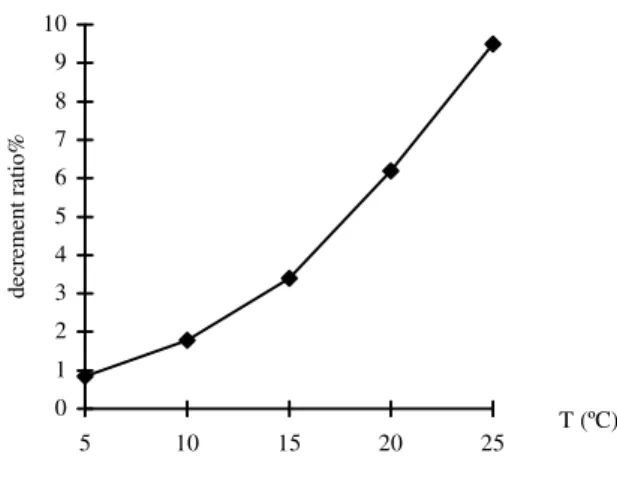
The experiment about effect of reaction temperature on decrement ratio showed (Fig 2) that the speed of H2O2 oxidation was slow below 20ºC.
0 2 4 6 8 10 12 14
1 2 3 4 5 6 7
H2O2(*10g/L)
decrement ratio(%)
strength loss ratio(%)
decrement ratio% strength loss ratio%
Figure 1 - Effects of H2O2 concentration on the pretreatment of wool textile. The reaction conditions were at 20ºC, pH 4.0 for 40 min.
0 1 2 3 4 5 6 7 8 9 10
5 10 15 20 25
T (ºC)
decrement ratio%
Figure 2 - Effects of reaction temperature on decrement ratio. The reaction conditions were at H2O2 concentration 40g/L, pH 4.0 for 40 min.
However, the reaction speed was increased above 20ºC, but it damaged the strength of wool textile intensively and made the wool textile fragile and
Fig. 3 showed the pH effect on pretreatment reaction. The results revealed that the H2O2 oxidation reaction was hardly processed at pH>6.5. While at pH<2.0, H2O2 reaction finished completely within 20 min (decrement ratio at 6.0%); and if the reaction time was beyond 30 min, the effects of the treatment were not fairly
proportioned (decrement ratio>10%, bursting strength loss ratio>12%). However, controlling pH 4.0 and reaction time 45min, the decrement ratio also could reach at 6.0%. Thus, the pretreatment condition was selected as 40g/L of H2O2 concentration, reaction time 45 min and pH 4.0.
0 20 40 60 80 100 120 140
0 2 4 6 8
pH
reaction time(min)
Figure 3 - Effects of pH on time of H2O2 oxidation reaction. The reaction conditions were at H2O2 concentration 40g/L, 20ºC, and ratio at 6.0%.
Enzymatic degradation
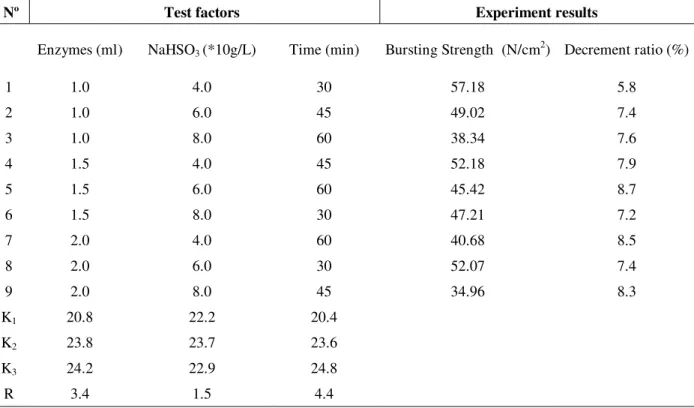
The supernatant from Aspergillums usamii L86’s fermentation broth containing acid protease (10000U/ml) and CMCase (3600U/ml) was used as treating reagent. After the oxidation pretreatment at the conditions of 40g/L of H2O2, pH 4.0, 20ºC and 45min of reaction time, the L86 enzymes containing acid protease and CMCase were added to degrade the inner layer. CMCase acted on the cellular matrix between scaly layer and cortex layer, which could help peeling off the scaly layer, so as to reinforce the effect of acid protease degradation. In order to optimize the enzyme degradation process, an L9 (34) orthogonal test was carried out, in which the amount of enzyme solution, the concentration of NaHSO3 and the reaction time were taken as experimental parameters.
The results are shown in Table 1, which showed that reaction time influenced the results most significantly and the enzyme concentration
followed. The reaction time represented the influence of enzyme degradation on the decrement ratio, the longer the treatment time, the stronger the degradation reaction.
into solution, the reaction speed could not be increased. Considering the reaction effect and the material cost, the suitable amount of enzymes was selected as 1.5 ml of per liter solution.
process were 1.5ml of enzymes of per liter solution and its final concentration arrived at 15U/ml of acid protease and 5U/ml of CMCase, 60g/L of NaHSO3, the reaction time 45min, dissolvent proportion 1:30, 40ºC, pH 4.0.
Table 1 - Orthogonal Test of enzyme degradation and extreme value analyses
Nº Test factors Experiment results
Enzymes (ml) NaHSO3 (*10g/L) Time (min) Bursting Strength (N/cm2) Decrement ratio (%)
1 1.0 4.0 30 57.18 5.8
2 1.0 6.0 45 49.02 7.4
3 1.0 8.0 60 38.34 7.6
4 1.5 4.0 45 52.18 7.9
5 1.5 6.0 60 45.42 8.7
6 1.5 8.0 30 47.21 7.2
7 2.0 4.0 60 40.68 8.5
8 2.0 6.0 30 52.07 7.4
9 2.0 8.0 45 34.96 8.3
K1 20.8 22.2 20.4
K2 23.8 23.7 23.6
K3 24.2 22.9 24.8
R 3.4 1.5 4.4
Table 2 - The conditions and results of contrast experiment
Experiment Results
Nº Test Method Decrement ratio
(%)
Bending stiffness (N/cm)
Bursting strength (N/cm2)
10 Enzyme degradationa 4.5 0.305 63.68
11 H2O2 oxidationb 7.2 0.274 50.97
12 Coupling treatment processc
8.8 0.213 46.52
Experimental conditions : a1.5ml/L of enzymes per liter solution, NaHSO3 60g/L, pH 4.0, 40 ºC, dissolvent proportion 1:30 for
90min;
b H
2O2 40g/L, penetrate agent 2.0g/L, 20ºC, pH=4.0; dissolvent proportion 1:30 for 90min.; c
H2O2 oxidation conditions were like No11, for 45min;enzyme degradation conditions were like No10, for 45min
Contrast experiment
In order to show the characteristics of enzyme degradation coupled with H2O2 oxidation, the contrast experiment about enzyme degradation, H2O2 oxidation pretreatment and enzyme
Apparently the coupled treatment process provided better decrement effect with satisfying decrement ratio, bursting strength and softness than that of H2O2 oxidation or enzyme degradation alone. Furthermore, after coupling treatment, washing and drying, the treated wool textile showed good strength and softness, and clear printing pattern. While treated with H2O2 oxidation or enzyme degradation alone, the textile showed relatively bad strength, softness and feel of handle.
After the treatment by enzyme degradation coupled with H2O2 oxidation, the wool textile should be washed, avoiding the peptides and carbonaceous matters adhering to textile, which were produced by enzyme degradation. Then, temperature should be raised to 80ºC so as to deactivate enzyme and dry wool textile. When the scaly layer of wool was peeled off, the wool textile showed plump and softness but bad elasticity, and the cortex layer would be influenced easily by many chemistry reagents and weather conditions, therefore softener with affinity to wool, amino-silicone oil Umd, had to use to form a protective membrane covering the wool surface.
The technique of biological treatment was studied according to the subtle structure of wool. The enzyme degradation had mild reaction conditions and could be controlled easily. The enzymes from strain Aspergillums L86, whose components (two enzymes) interrelated with the structure of wool closely and had the same pH of decrement process, improved the effects of treatment remarkably (Yongquan Li, 2001). Hence the effect of coupling treatment process was better than that of traditional chemistry treatment. For example, it greatly improved the quality of treated textile, and produced less environment pollution.
Since H2O2 oxidation and enzyme degradation required the same pH, when these two processes were combined, the solution needed not be changed during process. Thus, using this technique could cut down the material cost and manpower.
ACKNOWLEDGEMENTS
This work was supported by Science Research Plan of Zhejiang Province in China (No.99-3-031).
REFERENCES
Bishop, D.; Shen, J.; Heine; E. and Hollfelder, B. (1998), The use of proteolytic enzymes to reduce wool-fibre stiffness and prickle. J. Text Inst., 89, 546-553.
Breier, R. and Eugen, P. (1999), Felt-free finishing of wool using proteolytic enzyme, useful for flocks, slubbing, yarn and fabric. DE19807456.
Cortez, J.; Bonner, P. L. R. and Griffin, M. (2002), A method for enzymatic treatment of textiles. WO0204739.
Heine, E.; Hartwig, H. and Lone, D. (2001), Method for enzymatic treatment of wool. US2001003220. Jose, C. (1996), The state of the art in textile
biotechnology. J. Soc. Dyers and Colorists, 112, 326-329.
Leeder, J. D. and Bradbury, J. H. (1968), Conformation of epicuticle on keratin fibres. Nature, 218, 694-695. Manjrekar, S. G. (1995), Application of enzymes in
wet process an overview. J. Textile Assn.,60, 79-87. Messinger, H.; Hocker, H. and Zahn, H. (1994),
Covalently linked fatty acids at the surface of wool: part of the cuticle cell envelope. Textile Res. J., 64, 554-555.
Shridhar, V. C.; Samina, K. and Mehta, R. D. (1995), Effect of bio-finishing on cotton/wool blended fabrics. Textile Res. J., 65, 564-569.
Shuzheng Zhang (1984), Enzyme preparation industry, Beijing: Science Press. pp. 387-413.
Word, R. J.; Willis, H. A.; George, G. A.; Guise, G. B.; Denning, R.; Evans, D. J. and Short, R. (1993), Surface analysis of wool by x-ray photoelectron spectroscopy and static secondary mass spectrometry. Textile Res. J., 63, 362-368.
Xinghua Wen; Yongquan Li and Chenming Xu (1999), Studies on the kinetic property of acid protease from Aspergillus usamii mutant. Mycosystem, 18, 66-71.
Yongquan Li (2001), Screening of compound enzymes high productive strain L86 for wool textile decrement by laser irradiation Mycosystema, 20, 196-200. Yongquan Li; Xinghua Wen and Xiaolong He (1999),
Studies on the screening high yield acid protease producing strain L336 by combining microwave irradiation with chemical inducing. Acta Microbio. Sinica, 39, 181-184.