Long-term nitrogen fertilization in native pasture with Italian ryegrass
introduction - Effects on soil health attribute indicators
Fertilização nitrogenada de longo prazo em campo nativo com introdução de azevém anual – Efeitos sobre atributos indicadores da saúde do solo Diego Cecagno1* Ibanor Anghinoni1 Sérgio Ely Valadão Gigante de Andrade Costa1 Daniel Martins Brambilla2 Amanda Posselt Martins1 Emanuelle Cavazini Magiero1 Tatiane Bagatini1 Joice Mari Assmann1 Carlos Nabinger2
ISSNe 1678-4596
INTRODUCTION
Pampa’s biome native pasture is the main nutritional source used to feed sheep and beef cattle in the Rio Grande do Sul State (SEBRAE/SENAR/FAR-SUL, 2005). However, incorrect anthropogenic actions have been degrading native pastoral ecosystems from this region, by decreasing the occurrence of desirable forage species and animal load bearing capacity of the native pasture. Excessive stocking rates and improper fertilization used in pastoral environments has caused reduction in plant biomass production and soil organic matter (SOM) content and lability as well as soil micro-bial biomass (SOUZA et al., 2010; CONTE et al, 2011).
The use of nitrogen (N) fertilizer is required for intensifying the meat production on pasture since N is an essential nutrient required in large amounts by grass species (SARMENTO et al., 2008). In addition, summer species predominate in the Pampas biome, becoming necessary the introduction during winter season of species with high yields such as Italian ryegrass (Lolium
multiflorum Lam.) (CONTERATO et al., 2016). Both nitrogen fertilization and Italian ryegrass introduction in native grassland can be an alternative for sustainable Pampa biome exploration. However, these factors affect the carbon (C) dynamics in soil due to their effects on chemical, physical and biological properties (CARTER, 2002). Considering the existing coupling between C and
1Departamento de Solos, Universidade Federal do Rio Grande do Sul (UFRGS), Av. Bento Gonçalves, 7712, 91540-000, Porto Alegre, RS,
Brasil. E-mail: [email protected]. *Corresponding author.
2Departamento de Plantas Forrageiras e Agrometeorologia, Universidade Federal do Rio Grande do Sul (UFRGS), Porto Alegre, RS, Brasil.
ABSTRACT: Native pastures are of great importance for cattle and sheep nutrition in the Pampa biome. However, due to its low productivity, the Italian
ryegrass introduction and the nitrogen (N) fertilization are alternatives proposed to intensify livestock production in a sustainable manner. The objective of this study was to evaluate the effects of long-term N application on soil health indicators in a native pasture with Italian ryegrass introduction in southern Brazil.The experiment consists of a secondary native pasture under continuous grazing and constant herbage allowance. In 1996 experimental area was broadcast limed and the experiment was initiated, testing three N topdressing rates (0, 100 and 200kg N ha-1 year-1). In 2010 soil of experimental and reference area of non grazed native grassland was sampled in the soil layers of 0-20 and 20-40cm. Total, particulate and mineral associated carbon (C) and N stocks were evaluated. Soil microbiological attributes were evaluated in 0-5 and 5-10cm soil layers. The long-term N fertilization in soils with native pasture and Italian ryegrass introduction did not affect total C and N stocks. However, increases in N particulate fraction were seen with 100kg ha-1 year-1 of N rate of fertilization. Furthermore, the increase in N rates increased N microbial biomass and respiration.
Key words: carbon and nitrogen stocks, microbial biomass, natural pasture.
RESUMO: A pastagem nativa é uma importante fonte de forragem para produção de bovinos e ovinos no bioma Pampa. A introdução do
azevém e a fertilização nitrogenada são alternativas que visam intensificar a exploração pecuária de forma mais sustentável, podendo causar alterações em vários atributos do solo. Este trabalho teve por objetivo avaliar os efeitos de longo prazo de fertilização nitrogenada sobre atributos indicadores da saúde do solo em pastagem nativa com introdução de azevém anual. O experimento consistiu de uma sucessão secundária da pastagem natural submetida ao pastejo contínuo por bovinos e ovinos, com oferta de forragem constante. Em 1996, anteriormente ao inicio do experimento, a área experimental foi calcareada para correção da acidez do solo. O experimento foi então iniciado, sendo constituído da aplicação de três doses de N em cobertura, correspondendo a 0, 100 e 200kg ha-1 ano-1 de N. Em 2010, amostras de solo foram coletadas nas camadas de 0-20 e 20-40cm para análise de C e N total, particulado e associado aos minerais, além de uma área de referência (campo nativo sem pastejo). Análises microbiológicas foram conduzidas nas camadas de 0-5 e 5-10cm. A adubação nitrogenada de longo prazo em solos de campo nativo com introdução de azevém não altera os estoques totais de C e N, mas aumenta a fração particulada de N na dose de 100kg ha-1 ano-1. Em relação à atividade microbiana, o aumento na dose do fertilizante aumenta a respiração dos microrganismos, assim como o N da sua biomassa.
Palavras-chave: estoques de carbono e nitrogênio, biomassa microbiana, pastagem natural.
N in the soil system, monitoring C dynamics in these conditions is necessary to monitor the environmental impacts over time.
According to SOUSSANA & LEMAIRE (2014), plants coupling atmospheric C and mineral N in the photosynthesis process are an ongoing process. Thus, these compounds are added to the soil in a coupled form, accumulating both simultaneously. However, since plants normally have a higher C:N ratio compared to the soil, constant N inputs in the soil can increase C sequestration (FORNARA & TILMAN, 2012).
Both microbial biomass and soil organic fraction are indicators of soil quality and sustainability of production systems, being affected by soil management (NANNIPIERI et al., 2003; BODDEY et al., 2010). Thus, over time, N fertilization can increase crop production and soil C stocks (COSTA et al., 2008). However, OLSON et al. (2005) observed a decrease in C stocks with N fertilization, due to its potential to increase soil microbial activity. There may be both positive (MAJUMDER et al., 2007) and negative effects (YU et al., 2016) in microbial biomass by nitrogen fertilization.
Thus, looking for a strategy to manage native grasslands and avoid pasture and environmental degradation, this study aimed to evaluate the long-term N fertilization impacts in an Ultisol under native grassland with Italian ryegrass introduction, by measuring some soil attributes that are considered as soil health indicators.
MATERIALS AND METHODS
The experiment was carried out since 1996 at the Agronomic Experimental Station of the Federal University of Rio Grande do Sul, in Eldorado do Sul, Brazil, on a Rhodic Paleudult clay loam soil. In the 0-20 and 20-40cm soil layers clay contents were 130 and 200g kg-1, respectively. The climate is subtropical with
warm summer weather (Cfa), according to the Köppen
classification. The historical annual average from
1970 to 2009 for air temperature, rainfall and reference evapotranspiration (ETo) are 18.8°C, 1455 and 1161mm, respectively (BERGAMASCHI et al., 2013).
In 1996, the soil was fertilized with 500kg ha-1 of 05-20-20 fertilizer and limed to reach pH 6.0
with 3.0Mg ha-1 of lime broadcast applied. In this
year, grazing began with beef cattle and sheep. The stocking rate was controlled to keep the forage supply at the level of 12% (12kg dry mass offered / 100kg live weight / day). Some years had beef cattle grazing, while others sheep. Treatments consisted of topdressed N annual rates of 0, 100 and 200kg ha-1 yr-1 (called in
the current study as “without N”, “moderate N” and “high N”, respectively) conducted since 1996. The N source was always urea and the rates were splitted in two applications (50% in May and 50% in July). The experiment is characterized by a secondary succession of native grassland spanning an area of 3.11 hectares, and was carried out in a randomized block design with two replicates. Experimental plots size ranged from 0.3961 to 0.6587ha. The Italian ryegrass introduction occurred in 2007, when soil was again limed and fertilized with 300kg ha-1 of 12-52-00 fertilizer. During
winter and summer, Italian ryegrass and Paspalum
notatum and Cynodon dactylon were the predominant species. In 2010, N was applied July 30th and November
2nd, with rainfall around 15mm (nine and seven days
after application). The average forage accumulation rate in 2010 was 7918, 9657 and 14144kg ha-1 of dry
matter, and grazing pressures of 757, 895 and 1167kg ha-1 of live weight were recorded for N rates of 0,
100 and 200kg ha-1, respectively. To estimate the dry
matter accumulation rate (kg ha-1) three exclusion
cages per plot using the double-pairing technique were used. The accumulation rate was obtained by the difference between the forage mass outside the cage at measurement i-1 and the forage mass from within the
cage at measurement i, after approximately 28 days.
The average soil chemical attributes in the 0-20cm layer from shovel sampling in August 28th of 2010 were, for SOM, available phosphorus
(P Mehlich 1) and potassium (K Mehlich 1), exchangeable calcium and magnesium (KCl 1mol L-1): 18.2g kg-1, 18.6mg dm-3, 0.31cmol
c kg -1,
1.45cmolc kg-1 and 0.83cmol c kg
-1, respectively.
Total (TOC, TN), particulate (POC, PN) and mineral-associated carbon and nitrogen stocks (MAC, MAN) were determined for combined soil samples (ten subsamples) of the 0-20 and 20-40cm soil layers sampled during August of 2010. A native grassland area without grazing located about 500m from the experiment was also sampled. This area was grazed with traditional cattle management until approximately 1980 when grazing has been suspended. SOM fractionation was performed ac-cording to CAMBARDELLA & ELLIOT (1992). Total organic carbon and POC were analyzed by dry combus-tion using a Shimadzu TOC-V CSH analyzer. TN and PN were determined by Kjeldahl method. MAC and MAN were calculated by the difference between total and par-ticulate stocks. Carbon and N stocks were calculated using the soil equivalent mass according to ELLERT & BETTANY (1995). For stock calculations, soil bulk den-sity was estimated using volumetric rings (270 cm3); soil
density values were 1.50 and 1.56kg dm-3 for the 0-20 and
Combined soil samples from five subsamples
per plot sampled from the 0-5 and 5-10cm soil layers were used to determine soil microbial biomass. Soil microbial biomass carbon (SMBC), soil microbial biomass nitrogen (SMBN), microbial respiration and metabolic quotient were determined according to VANCE et al. (1987), BROOKES et al. (1985), ALEF & NANNIPIERI (1995) and ANDERSON & DOMSH (1993), respectively.
Results were submitted to analysis of
variance (ANOVA) and, when significant (P<0.10), averages were compared by Tukey test (P<0.10) using
the SISVAR software. The following statistical model was used for the ANOVA:
Yijk = μ + Bi + Nj + Error a (ij) + Lk + Error b (ik) + NjLk + Error c (ijk)
where μ = the overall experiment average; B = the blocks
(i = 1, 2); N = the nitrogen rates (j = 1, 2, 3); L = the soil layer (k = 1, 2); and Error = the experimental error.
RESULTS AND DISCUSSION
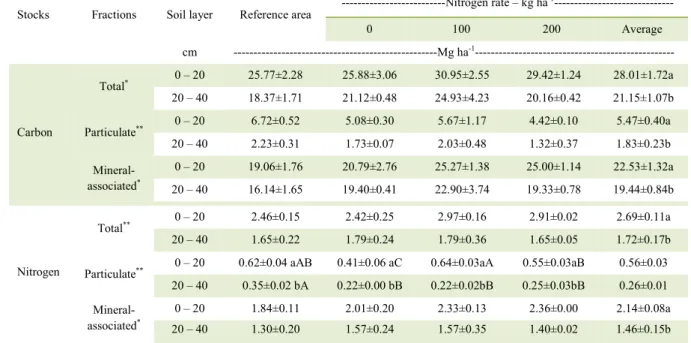
C stocks and C fractions were not affected by topdressed nitrogen fertilization over time, being similar to those observed in the reference area (Table 1). TOC stocks in 0-20cm were around 25% lower than those reported by CONTE et al. (2011) in similar climate, soil and herbage conditions. Conversely, POC stocks
were similar, demonstrating the role of Italian ryegrass introduction to maintain soil quality.
Similar C stocks under different N rates can be explained by increased microbial respiration with increasing availability of this nutrient (Table 2). Even with an increase in dry matter production with increasing nitrogen fertilization (2.39 to 4.68Mg ha-1 yr-1),
there was a higher CO2 emission by microorganisms (Table 2) leading to organic compounds oxidation, as described by KHAN et al. (2007).
The climate is another factor that explains the similarity in C stocks, regardless of N fertilizer rate. The average temperatures observed on this trial (18.8°C) are moderates based on the growth curve of plants, which is not low or high enough to be a limiting factor for growth/development. This factor associated with high annual rainfall distributed throughout the year contributes to soil organic matter oxidation. Under such environmental conditions microbial activity is intense (Table 2), decomposing faster the soil organic residues. Despite the increase in dry matter production with increasing N rate, there is a balance between matter and energy outputs and inputs in the system, keeping the C stocks under treatments and the reference area at similar levels.
Table 1 - Carbon and nitrogen stocks and fractions in an Ultisol with continuous grazing in native pasture with Italian ryegrass introduction, under different nitrogen topdressing rates.
Stocks Fractions Soil layer Reference area
---Nitrogen rate – kg ha-1---
0 100 200 Average
cm ---Mg ha-1---
Carbon
Total* 0 – 20 25.77±2.28 25.88±3.06 30.95±2.55 29.42±1.24 28.01±1.72a
20 – 40 18.37±1.71 21.12±0.48 24.93±4.23 20.16±0.42 21.15±1.07b
Particulate** 0 – 20 6.72±0.52 5.08±0.30 5.67±1.17 4.42±0.10 5.47±0.40a
20 – 40 2.23±0.31 1.73±0.07 2.03±0.48 1.32±0.37 1.83±0.23b
Mineral-associated*
0 – 20 19.06±1.76 20.79±2.76 25.27±1.38 25.00±1.14 22.53±1.32a
20 – 40 16.14±1.65 19.40±0.41 22.90±3.74 19.33±0.78 19.44±0.84b
Nitrogen
Total** 0 – 20 2.46±0.15 2.42±0.25 2.97±0.16 2.91±0.02 2.69±0.11a
20 – 40 1.65±0.22 1.79±0.24 1.79±0.36 1.65±0.05 1.72±0.17b
Particulate** 0 – 20 0.62±0.04 aAB 0.41±0.06 aC 0.64±0.03aA 0.55±0.03aB 0.56±0.03
20 – 40 0.35±0.02 bA 0.22±0.00 bB 0.22±0.02bB 0.25±0.03bB 0.26±0.01
Mineral-associated*
0 – 20 1.84±0.11 2.01±0.20 2.33±0.13 2.36±0.00 2.14±0.08a
20 – 40 1.30±0.20 1.57±0.24 1.57±0.35 1.40±0.02 1.46±0.15b
Total nitrogen stocks also were not affected by N fertilization (Table 1). Grazing recycles (as manure, urine and plant senescent material) a large soil N fraction of soil or fertilizer-N. Residue decomposition increases N inorganic availability becoming available
to leaching, denitrification and ammonia volatilization
processes (PARDON et al., 2016).
Rainfall events with at least 5mm within two days after urea application led N volatilization losses of less than 20% of the applied N (WHITEHEAD, 1995). Nitrogen applications under this trial were always carried under low soil moisture conditions. In the evaluated year (2010), rainfall
only occurred nine and seven days after the first and
second application, respectively, leading to potential NH3 losses. Therefore, a fraction of the applied N rates was potentially lost even before soil absorption.
Cation exchange capacity (CEC), pH, buffering capacity and SOM content are important
factors that influence ammonia losses by volatilization
(KNOBLAUCH et al., 2012). The surrounding urea granule region may rise up to 3 pH units, creating favorable conditions for NH3 volatilization even in acidic soils (WHITEHEAD, 1995). In low buffering capacity soils and low CECpH 7.0, as in the present trial, volatilization may have occurred a long time after fertilization (FRENEY et al., 1983).
The N losses by nitrate leaching occurs from 10 to 30% of the fertilized N (MEISINGER et al., 2008) and may differ according to the soil texture,
N rates and the water percolation in the soil profile.
In average, historically, there is an annual water surplus of 300mm (BERGAMASCHI et al., 2013),
that can be leached into the soil profile. As a result,
the lack of increase in N stocks even after long-term N fertilization may occur for two main reasons: 1) ammonia volatilization; and 2) soil texture and climate of the area favoring leaching losses (WHITEHEAD, 1995; MEISINGER et al., 2008).
The TN as well as the TOC stock was higher in the 0-20cm layer (Table 1). Such pattern results from surface residue deposition, higher biological activity due to higher root growth and exudates production (HAFNER et al., 2014). Despite N rates not affecting POC, the PN at 0-20cm layer
was higher (P<0.10) under moderate rate, being
similar to the reference area (Table 1). Such behavior can be explained by the higher microbial activity under high N rates. GAJDA (2010) also observed particulate organic matter losses in soils under high microbial activity.
Microbial activity responds faster to different grazing management processes than the TOC and TN, being more intense in the 0-5cm layer (Table 2). Despite the evaluated soil layer, the N rate
effects only affected (P<0.10) the microbial respiration
and, in the 0 to 5cm layer, the SMBN. SMBN was higher under the highest N rates and higher microbial respiration occurred under all N rates (Table 2). Similar N fertilization impacts in the long-term conditions were observed by HATCH et al. (2000), which can be explained by the increase in available N fraction Table 2 - Microbial activity in an Ultisol, with continuous grazing in native pasture with Italian ryegrass introduction, under different
nitrogen topdressing rates.
Soil attribute Soil layer (cm) ---Nitrogen rate – kg ha
-1---
Average
0 100 200
Soil microbial biomass carbon*(μg g-1)
0 – 5 255±8.1 285±0.6 305±11.5 281±0.9 a
5 – 10 171±24.3 169±13.7 224±1.9 188±13.3 b
Average 213±8.1 227±6.5 264±6.7
Soil microbial biomass nitrogen***(μg g-1)
0 – 5 35±1.3 aC 44±1.4 aB 49±3.0 aA 43±1.9
5 – 10 24±0.4 b 25±1.4 b 24±0.6 b 24±0.1
Average 29±0.5 34±1.4 37±1.2
Microbial respiration**(μg C-CO2 g-1 soil h-1)
0 – 5 1630±50 2090±78 2490±355 2070±161 a
5 – 10 740±223 800±100 870±93 800±139 b
Average 1190±137 B 1450±89 AB 1680±224 A
Metabolic quotient**(μgC-CO2 μg Cmic g-1 soil h-1)
0 – 5 6.40±0.02 7.35±0.20 8.18±1.07 7.31±0.42 a
5 – 10 4.32±0.60 4.72±0.06 3.89±0.26 4.31±0.27 b
Average 5.36±0.29 6.04±0.07 6.04±0.66
and microbial protein synthesis as well as increasing TOC and microbial biomass. As observed in this trial, PEREZ et al. (2005) reported no N addition effect in the SMBN in the 5-10cm layer. This occurs due to residues accumulation on the soil surface leading to an increase in microbial respiration (PEÑA et al., 2005). However, microbial respiration is high in all treatments compared with the results of SILVA et al. (2010). Even under conventional tillage and in a clayey soil, these authors reported lower values due to the higher organic matter physical protection resulted from clay-organic matter interactions.
CONCLUSION
The long-term nitrogen fertilization in a native pasture with Italian ryegrass does not change total soil carbon and nitrogen stocks. Yet, rates of 100kg N ha-1 yr-1 increase soil nitrogen in its particulate
fraction. The increase in N fertilization rates up to 200kg N ha-1 yr-1 led to increases in the soil microbial
biomass nitrogen as well as microbial respiration. Thus, the rate of 100kg ha-1 yr-1 increases in soil health,
increasing N in the more labile organic matter fraction and enhancing N cycling in the soil system.
REFERENCES
ALEF, K.; NANNIPIERI, P. Methods in applied soil microbiology
and biochemistry. London: Academic, 1995. 576p.
ANDERSON, J.P.E.; DOMSCH, K.H. The metabolic quotient (qCO2) as a specific activity parameter to assess the effects of
environmental conditions, such as pH, on the microbial biomass of forest soils. Soil Biology and Biochemistry, v.25, p.393-395, 1993. Available from: <http://www.sciencedirect.com/science/ article/pii/0038071793901407>. Accessed: Feb. 19, 2017.
BERGAMASCHI, H. et al. Boletins agrometeorológicos da
Estação Experimental Agronômica da UFRGS: série histórica
1970 - 2012. Porto Alegre, RS, 2013. Available from: <www.ufrgs. br/agronomia/joomla/files/EEA/Srie_Meteorolgica_da_EEA-UFRGS.pdf>. Accessed: Feb. 19, 2017.
BODDEY, R.M. et al. Carbon accumulation at depth in Ferralsols under zero-till subtropical agriculture. Global Change Biology,
v.16, p.784-795, 2010. Available from: <http://onlinelibrary.wiley. com/doi/10.1111/j.1365-2486.2009.02020.x/abstract>. Accessed: Feb. 19, 2017.
BROOKES, P.C. et al. Chloroform fumigation and the release of soil nitrogen: a rapid direct extraction method to measure microbial biomass nitrogen in soil. Soil Biology and Biochemistry, v.17,
p.837-842, 1985. Available from: <http://www.sciencedirect.com/ science/article/pii/0038071785901440>. Accessed: Feb. 19, 2017.
CAMBARDELLA, C.A.; ELLIOT, E.T. Particulate soil organic-matter changes across a grassland cultivation sequence. Soil
Science Society of America Journal, v.56, p.777-783, 1992.
Available from: <https://dl.sciencesocieties.org/publications/sssaj/ abstracts/56/3/SS0560030777>. Accessed: Feb. 19, 2017.
CARTER, M.R. Soil quality for sustainable land management: organic matter and aggregation interactions that maintain soil functions. Agronomy Journal, v.94, p.38-47, 2002. Available from:
<https://dl.sciencesocieties.org/publications/aj/abstracts/94/1/38>. Accessed: Feb. 19, 2017.
CONTE, O. et al. Soil density, aggregation and carbon fractions of
an Alfisol under natural pasture and different herbage allowance.
Revista Brasileira de Ciência do Solo, v.35, p.579-587, 2011.
Available from: <www.scielo.br/pdf/rbcs/v35n2/v35n2a27.pdf>. Accessed: Feb. 19, 2017.
CONTERATO, I.F. et al. Agronomic behavior of annual ryegrass (Lolium multiflorumL.) in Rio Grande do Sul state. Boletim de
Indústria Animal, v.73, p.198-205, 2016. Available from: <www.
iz.sp.gov.br/pdfsbia/1475172230.pdf>. Accessed: Feb. 19, 2017.
COSTA, K.A.P. et al. Nitrogen doses and sources in Marandu pasture. I - Changes in soil chemical properties. Revista Brasileira de Ciência
do Solo, v.32, p.1591-1599, 2008. Available from: <http://www.
scielo.br/pdf/rbcs/v32n4/a23v32n4.pdf>. Accessed: Feb. 19, 2017.
ELLERT, B.H.; BETTANY, J.R. Calculation of organic matter and nutrients stored in soils under contrasting management regimes. Canadian
Journal of Soil Science, v.75, p.529-538, 1995. Available from: <http://
pubs.aic.ca/doi/pdf/10.4141/cjss95-075>. Accessed: Feb. 19, 2017.
FORNARA, D.A.; TILMAN, D. Soil carbon sequestration in prairie grasslands increased by chronic nitrogen addition. Ecology,
v.93, p.2030-2036, 2012. Available from: <https://www.ncbi.nlm. nih.gov/pubmed/23094375>. Accessed: Feb. 19, 2017.
FRENEY, J.R. et al. Volatilization of ammonia. In: FRENEY, J.R.; SIMPSON, J.R. Gaseous loss of nitrogen from plant-soil
systems. The Hague: Martinus Nijhoff, 1983. p.1-32.
GAJDA, A.M. Microbial activity and particulate organic matter content in soils with different tillage system use. International
Agrophysics, v.24, p.129-137, 2010. Available from: <www.old.
international-agrophysics.org/artykuly/international_agrophysics/ IntAgr_2010_24_2_129.pdf>. Accessed: Feb. 19, 2017.
HAFNER, S. et al. Spatial distribution and turnover of root-derived carbon in alfalfa rhizosphere depending on top- and subsoil properties and mycorrhization. Plant and Soil, v.380,
p.101-115, 2014. Available from: <http://link.springer.com/ article/10.1007%2Fs11104-014-2059-z>. Accessed: Feb. 19, 2017.
HATCH, D.J. et al. Nitrogen mineralization and microbial activity in permanent pastures amended with nitrogen fertilizer or dung. Biology
and Fertility of Soils, v.30, p.288-293, 2000. Available from:
<http://link.springer.com/article/10.1007%2Fs003740050005>. Accessed: Feb. 19, 2017.
KHAN, S.A. et al. The myth of nitrogen fertilization for soil carbon sequestration. Journal of Environmental Quality, v.36, p.1821-1832,
2007. Available from: <https://dl.sciencesocieties.org/publications/ jeq/abstracts/36/6/1821>. Accessed: Feb. 19, 2017.
KNOBLAUCH, R. et al. Volatilização de amônia em solos alagados
influenciada pela forma de aplicação de ureia. Revista Brasileira
de Ciência do Solo, v.36, p.813-821, 2012. Available from: <www.
MAJUMDER, B. et al. Soil organic carbon pools and productivity relationships for a 34-year-old rice–wheat–jute agroecosystem. Plant and Soil, v.297, p.53-67. 2007. Available from: <http://link.springer.com/articl e/10.1007%2Fs11104-007-9319-0>. Accessed: Feb. 19, 2017.
MEISINGER, J.J. et al. Soil nitrogen budgets. In: SCHEPERS, J.S.; RAUN, W.R. Nitrogen in agricultural systems. Madison: American Society of Agronomy, 2008. p.505-562.
NANNIPIERI, P. et al. Microbial diversity and soil functions.
European Journal of Soil Science, v.54, p.655-670, 2003.
Available from: < http://onlinelibrary.wiley.com/doi/10.1046/j.1351-0754.2003.0556.x/abstract>. Accessed: Feb. 19, 2017.
OLSON, K.R. et al. Soil organic carbon changes after 12 years of no-tillage and no-tillage of Grantsburg soils in southern Illinois. Soil and
Tillage Research, v.81, p.217-225, 2005. Available from: <http://
www.sciencedirect.com/science/article/pii/S0167198704001977>. Accessed: Feb. 19, 2017.
PARDON, L. et al. Quantifying nitrogen losses in oil palm plantations: models and challenges. Biogeosciences, v.13, p.5433-5452, 2016.
Available from: < www.biogeosciences.net/13/5433/2016/bg-13-5433-2016.pdf>. Accessed: Feb. 19, 2017.
PEÑA, M.L.P. et al. Respiração microbiana como indicador da
qualidade do solo em ecossistema florestal. Floresta, v.35, p.117-127, 2005. Available from: <http://ojs.c3sl.ufpr.br/ojs/index.php/
floresta/article/viewArticle/2435>. Accessed: Feb. 19, 2017.
PEREZ, K.S.S. et al. Nitrogênio da biomassa microbiana em solo cultivado com soja, sob diferentes sistemas de manejo, nos cerrados.
Pesquisa Agropecuária Brasileira, v.40, p.137-144, 2005.
Available from: <http://www.scielo.br/pdf/pab/v40n2/23820.pdf>. Accessed: Feb. 19, 2017.
SARMENTO, P. et al. Atributos químicos e físicos de um argissolo cultivado com Panicum maxicum Jacq. cv. IPR-36 Milênio, sob lotação rotacionada e adubado com nitrogênio. Revista Brasileira
de Ciência do Solo, v.32, p.183-193, 2008. Available from: <http://
www.scielo.br/pdf/rbcs/v32n1/18.pdf>. Accessed: Feb. 19, 2017.
SEBRAE/SENAR/FARSUL. Diagnóstico de sistemas de
produ-ção de bovinocultura de corte no estado do Rio Grande do Sul.
Porto Alegre: SENAR, 2005. 265p.
SILVA, R.R. et al. Biomassa e atividade microbiana em solo sob
diferentes sistemas de manejo na região fisiográfica Campos das
Vertentes – MG. Revista Brasileira de Ciência do Solo, v.34, p.1585-1592, 2010. Available fom: <www.scielo.br/pdf/rbcs/v34n5/11.pdf>. Accessed: Feb. 19, 2017.
SOUSSANA, J.F.; LEMAIRE, G. Coupling carbon and nitrogen
cy-cles for environmentally sustainable intensification of grasslands and
crop-livestock systems. Agriculture, Ecosystems and Environment, v.190, p.9-17, 2014. Available from: <http://www.sciencedirect.com/ science/article/pii/S0167880913003526>. Accessed: Feb. 19, 2017.
SOUZA, E.D. et al. Biomassa microbiana do solo em sistema de
integração lavoura-pecuária em plantio direto, submetido a inten -sidades de pastejo. Revista Brasileira de Ciência do Solo, v.34, p.79-88, 2010. Available from: <http://www.scielo.br/pdf/rbcs/ v34n1/a08v34n1.pdf>. Accessed: Feb. 19, 2017.
VANCE, E.D. et al. An extraction method for measuring microbial biomass C. Soil Biology and Biochemistry, v.19, p.703-707,
1987. Available from: <http://www.sciencedirect.com/science/ article/pii/0038071787900526>. Accessed: Feb. 19, 2017.
WHITEHEAD, D.C. Volatilization of ammonia. In: WHITEHEAD, D.C. Grassland nitrogen. Wallingford: CAB International, 1995. p.152-179.