0
A Work Project, presented as part of the requirements for the Award of a Master’s Degree in Management from the Nova School of Business and Economics
ANALYSIS OF THE CONCEPT OF INDUSTRIAL FOUNDATIONS IN THE SOUTH OF EUROPE:
Insights from Portugal and Spain
ANA MARGARIDA MATIAS OLIVEIRA MARTINS, 25959
Work project carried out under the supervision of:
Miguel Alves Martins
1 Analysis of the concept of Industrial Foundations in the South of Europe: Insights from
Portugal and Spain
Abstract
Industrial Foundations are foundations which own business companies (Thomsen, 2012), and these are very common in the Northern Europe. Foundations are perceived as long-term shareholders, thus, this model arises as a sustainable and rational solution to avoid short-termism. This thesis contributes to the existing literature by exploring the application of this type of ownership in the Southern Europe, namely in Portugal and Spain. In Portugal, there are some examples of charitable industrial foundations with small dimension, whereas in Spain the model and its benefits have been, recently, recognized and adopted by large corporates, nonetheless, still exist in a small amount.
Keywords: Corporate Governance, Industrial Foundations, Long-termism, Southern Europe1
This work used infrastructure and resources funded by Fundação para a Ciência e a Tecnologia (UID/ECO/00124/2013, UID/ECO/00124/2019 and Social Sciences DataLab, Project 22209), POR Lisboa (LISBOA-01-0145-FEDER-007722 and Social Sciences DataLab, Project 22209) and POR Norte (Social Sciences DataLab, Project 22209).
1 Acknowledgments: This thesis is the consummation of a journey of four and a half years at Nova SBE, which
would not have been possible without the contribution and support of very important people in my life, thus, I want to acknowledge my parents who allow me to integrate this Master’s degree and who always encouraged me. I also thank my brother, my childhood friends, who still support me at a distance, the friends I made at Nova, and a special thanks to Afonso. I also express my sincere gratitude to my advisor, Professor Miguel Alves Martins, for his valuable advice and guidance and co-advisor Professor Ricardo Zózimo, and to all privileged observers (foundations, institutions, scholars and people) who participated in this work project, and that, generously, provided the necessary data used in the research. Finally, to everyone that crossed my path in these twenty-two years of life and who supported me in one way or another, this is your accomplishment as well.
2
Table of Contents
Abstract ... 1 1.Introduction... 2 2. Literature Review ... 5 3. Methodology ... 113.1 Motivations of research design:... 11
3.2 Sample Selection: ... 11
3.3 Data Collection and Analysis processes: ... 12
4. Findings ... 12
4.1 Foundational Context: Portugal and Spain ... 13
4.2 Portugal: sample analysis and characterization: ... 13
4.2.1 Analysis on the interview with an expert from F5-C5 ... 15
4.3 Spain: sample analysis and characterization: ... 16
4.3.1 Analysis on the interview with an expert from F7-C7 ... 18
5. Discussion ... 21
5.1 Theoretical and practical implications: ... 21
5.3 Limitations and Directions for future research... 24
6. Conclusion ... 24
7. References... 25
8. Appendix ... 28
1.Introduction
Bansal and DesJardine (2014) said that “sustainability is fast becoming fashionable in strategic management, yet its meaning can be elusive” as it is often confined to environmental issues or referring to corporate social responsibility measures. However, it should not be seen as acts of kindness, but as a creation of long-term business value (Bansal and DesJardine, 2014). In the business world, this concept is crucial to avoid short-termism. The concept of short-termism is defined by “decisions and outcomes that pursue a course of action that is best for the short term but suboptimal over the long run” (Laverty, 1996). So, firms must make trade-offs across time to safeguard intergenerational equity (Bansal and DesJardine, 2014).
3
Hence, as concerning short‐termism seems to be for corporate governance, many scholars were inspired to search for institutional arrangements to promote long‐term decision‐making (Thomsen et al, 2018). In this thesis, I call attention to long‐term ownership by industrial foundations, which are common in the Northern Europe, but little known and studied in the rest of the world.
The term “industrial foundation” is described by Steen Thomsen 2 (2017) as foundations
that own business companies and whose long‐term owners allow for practice of long‐term governance. Despite the fact that this concept appears to be quite exotic, in part due to ignorance and also due to hostile regulation (Thomsen, 2017), it is possible to name a number of highly successful and worldwide-known corporations under foundation ownership, for instance: Bertelsmann, Heineken, Ikea, Robert Bosch, Rolex, A.P. Møller-Maersk, Novo Nordisk, the Tata Group and Carlsberg. In fact, most of these are located in the Northern Europe, where foundation-owned companies account for a non-trivial share of the business sector (Thomsen, 2012). For example, experts estimate the value of listed companies controlled by Danish foundations at about 68% of the total market capitalisation quoted on Copenhagen Stock Exchange (Mcculloch, 2018).
Overall, the foundations that own the companies are non-profit entities, they have no owners and are under the control of a self-elective board of directors (Thomsen and Rose, 2004), whose compensation is completely divorced from the profitability of the company and who cannot be removed or replaced by anyone except themselves (Hansmann and Thomsen 2018). The most important purpose is, typically, to exercise responsible ownership of a business company. Secondly, industrial foundations, often, perform philanthropic activities funded by dividends from the company and portfolio investments (charitable industrial foundations). But there are
2 Steen Thomsen is Professor at the Center for Corporate Governance at Copenhagen Business School and
principal investigator on the topic. The author of the current thesis acknowledges his contribution on the research with his useful insights and the offer of his book “The Danish Industrial Foundations” (2017).
4
also examples of foundations, which aim to benefit the founding family through donations (family foundations) or whose only purpose is to own a business company and, therefore, do not donate at all (business foundations) (Thomsen, 2017). However, the majority of industrial foundations combine both business ownership and philanthropy, which means that part of the company's profits distributed to shareholders are devoted to philanthropic means rather than paid out to the investors (Thomsen, 2018).
The triggering enigma of industrial foundations emerges, then, when bearing an immense body of literature supporting that dispersed ownership and economic incentives play a key role in the efficient operation of business companies (e.g. Jensen and Meckling, 1976; Putterman, 1993; Hart, 1995; Hansmann, 1996; Williamson, 1996; Shleifer and Vishny, 1997), we realize that several are the companies owned in its majority by foundations, whose directors do not benefit from substantial material incentives, other than losing their jobs in case the foundation bankrupts and needs to be liquidated (Thomsen, 2018), and which still allow for the companies to be top-performers and live longer. Such evidence makes one question if this particular type of non-profit organization, the industrial foundation, can be, as a matter of fact, a viable and competitive business structure and, to a greater extent, a more sustainable one. One may also place the question in a different way, that is, whether profit-seeking ownership is a necessary condition for competitive enterprise (Thomsen and Rose, 2004).
It is precisely this relationship between foundation-ownership and governance with long-term perspective that this project focusses the scope of research on, however, it does so over a specific location: Southern Europe, namely in Portugal and Spain, where, according to the main expert on the topic, Steen Thomsen, literature is still in its research phase, few examples are known and there is interest for investigation in this region to take place. Hence, this thesis aims to close the addressed gap by 1) mapping out organisations under the defined type of ownership existing in the Southern Europe reality, 2) understand the set of key characteristics that defined
5
them and, by intersecting with existent literature, 3) do a comparative analysis with the corresponding characteristics of the Nordic Industrial Foundations. With the resulting findings, the underlying study wishes at responding to the following guiding research questions:
Research question 1: How do we understand industrial foundations in the context of Portugal and Spain?
Research question 2: In which ways is the understanding of Industrial Foundations similar across different European countries?
The remainder of the thesis is structured as follows: after the introduction, section 2 reviews current literature to gain a comprehensive understanding of the industrial foundations concept and factors that influence its emergence; section 3 regards the methodology used, including the motivations for the method and the data collection and analysis processes, section 4 exposes the two levels of findings, which are then discussed and confronted with literature in section 5 along with limitations of the study and potential areas for further research and, finally, the section 6 provides overall conclusions encompassing all outcomes. Sources used are scrutinized in section 7 and appendix in section 8.
2. Literature Review
On a first hand, the concept of industrial foundations can be named differently across different geographies, which, however, transmit different meanings. For instance, while the term corporate foundation denotes a foundation established by a company for CSR purposes, a commercial foundation indicates a more commercial purpose, which is not usually the case of the foundations we meant to describe in this thesis. Broader, the term enterprise foundations, widely used in Germany, for instance, (Hopt and von Hipppel, 2010) covers all foundations with any business activity, even if it is rather small, such as a museum, which sells tickets and runs a cafeteria and a museum shop. Nonetheless, and not intending to neglect the important role these organizations play in society and their philanthropic purposes, this thesis aims to
6
solely focus on the study of real, competitive business companies with significant economic activity, which are owned in its majority by foundations and that do not depend on government funding for their existence (Thomsen, 2017). Therefore, for the sake of consistency, and bearing the actual definition we are aiming to convey, the term industrial foundations is primarily used to invoke organizations that reflect all following legal characteristics (Kronke, 1988):
1. Creation by donation: The industrial foundation is created through an irreversible3
donation of its ownership stake in the company, by the company’s founder at the end of his active life. Transfer of ownership to the foundation, according to Thomsen and Rose (2004), may serve as an alternative to passing ownership to heirs or to outside investors, and is uniquely suited for business owners who want to preserve core values and business principles, which are easily diluted by profit incentives (Thomsen, 2018). The foundation establishment may also be motivated by inheritance and wealth taxes saving while maintaining control of the business, as well as, wish to keep a stable ownership of the company or, simply, due to a philanthropic desire to “give back to society”.
2. Independence: Prewitt (2006) said that independence unites foundations apart from their variety in terms of their legal and organizational forms, as well as, their differences in how they operate, essentially, they have no owners nor members, thus, can be referred to as “self-owning institutions”. Industrial foundations are also private (i.e. non-governmental), non-profit entities which economic affairs are completely separated from those of the founder and founder’s family (Thomsen, 2017).
3. A non-selfish purpose: While the company is responsible for the business part, the foundation itself must serve a non-selfish purpose that goes beyond benefiting the employees or concerning for the future generations of the founder’s family. For instance, it may contribute
7
to charity, education, research, art or social projects, and as such, industrial foundations are socially responsible by design.
4. Foundation Endowment: The foundation must own shares/voting rights in a company that represents access to a source of future income and, in most cases, a pool of liquid financial assets.
5. Foundation Organization: Since foundations have no ownership, their boards of directors (or trustees) play a very important role. Usually, they are self-elective (Thomsen and Rose, 2004) and, possibly, part of this board is constituted by managing directors and employees from the company.
6. Foundation Charter: Tantamount to other foundations, industrial foundations are ruled by a charter in which the founders enshrine the core values and business principles they want to preserve (Thomsen, 2018). Additionally, it often stipulates that the foundation should serve some broadly defined social purpose, includes specific rules on the election and composition of the foundation’s board, as well as, guidelines about governance and ownership of the company. Such constraints are always subject to government approval and supervision, and the board must act at its own discretion (Thomsen and Rose, 2004).
7. Outside supervision: Industrial foundations cannot be monitored by owners or members, and hence, must be regulated and supervised by a government authority, like a foundation regulator, charity commissions, courts or the local tax authorities (Thomsen, 2017), to ensure that foundations comply with the law and with their foundation charter (Kronke, 1988). They are also responsible to control audited annual reports submitted by the foundations. Thus, the regulator usually does not intervene in business decisions, but can, for instance, replace the board in case of neglect or abuse through donation policies or board member overcompensation (Thomsen, 2017).
8
8. Majority control / voting majority of a business company: Having a controlling ownership stake in a private business company, with significant sales of goods and services to the public on a commercial basis (i.e. in a competitive market), is what separates “industrial” from purely charitable foundations. Ownership could be full (100%), and foundation board members may be identical and even (in a few cases) use the foundation structure to conduct business without incorporating a separate company, or just a controlling influence, i.e. more than 50%, and so, the company will, in principle, act like any other joint stock company and it will have fiduciary duty to all its shareholders (Thomsen, 2012).
Overall, the above described set of key characteristics defines most of the Nordic Industrial Foundations. Nonetheless, literature review also allowed to grasp the determinants for the existence of industrial foundations and how this unique governance structure influences the behaviour and performance of companies.
First off, by observing the clustered location of most industrial foundations, mainly in the Northern European countries, presumably indicates significant influence of country effects,
namely, their legal recognition, which clearly determines their establishment 4. Additionally,
governments can also make it more attractive for industrial foundations to set in by imposing lighter taxation in comparison to other alternative ownership arrangements. It may be no accident that in Northern Europe wealth tax rates are high (Thomsen, 1999), which reduces the effectiveness of monetary rewards and encourages business owners to seek non-standard ownership structures (Thomsen, 2018). Yet, Nordic countries offer more than just wealth preservation benefits, culturally, these are small and homogenous countries with strong social norms. For instance, they score high on indices of governance, trust, and corruption control
4 For instance, in 1969, the US reformed its tax laws to effectively prevent private foundations from having
control of businesses (Fleishman, 2001, Thomsen, 2006). It sought to remedy perceived abuses that private foundations’ charitable organizations served the interests of the rich rather their charities (Mcculloch, 2018).
9
(Thomsen, 2016a, 2016b), and that plays a role in keeping directors honest and maintaining a responsible business behaviour.
Investigators have also studied the possibility for specific industries to be more prone to this kind of ownership (Kuhn and Thomsen, 2015a). The empirical evidence demonstrates, however, examples of industrial foundations spread across all the industry spectrum, and, ergo, it cannot be taken as a fundamental factor.
On the other hand, the same cannot be said regarding firm effects, as the advantages of long-termism, characteristic of industrial foundations, only take place with companies that are rather successful and well-consolidated (Børsting et al. ,2014a), i.e. large and mature companies that have been in existence for at least two or more decades (Thomsen, 2017). Such firms are less likely to be capital-constrained and can autonomously finance their investments without infusions of outside equity. Indeed, it would seem to make little sense that founders would donate a start-up, which highly depends on profit incentives, or a failing company that is urging for outside capital, to a foundation.
Ultimately, previous research studied possible founder effects that can influence the origin of industrial foundations. The founder, when taking the choice of ownership succession for her company, usually, has in mind, along with other factors, the economic incentives respective to each option, which are specifically: selling the company to an industry buyer, taking it public, leaving the company bequeathed to descendants or setting up an industrial foundation. The findings (Thomsen, 2017) indicate that founders with no descendants willing and able to take over the company, have greater chances to settle industrial foundations.
Therefore, these determinants, unique to industrial foundations, unquestionably, play a role in how these organizations emerge and behave. Legally, they are perpetuities with an obligation to preserve their endowment (i.e. the company), and in fact, they may be regarded (Schelling, 1960, 2005) as commitment devices, since, the survival of the company, irrevocably, becomes
10
the primary objective. Consequently, this presupposes a more patient governance style with longer time horizons compared to family or investor ownership. In practice, these companies engage more in long-run investments, like R&D and education, and are less likely to fire loss-making managers, which, in turn, can mean higher labour costs. On the other hand, they are also intrinsically more risk averse and have constrained access to outside capital, so, foundation-owned companies do not compromise their future by getting into high leverage or risky investments and neither are willing to dilute their control/ownership. Ultimately, this translates into fewer mergers and acquisitions and slower growth (Thomsen, 2017).
In addition, managers of foundation-owned companies tend to commit to a more ethical behaviour, with greater preoccupation for their reputation. Moreover, the absence of monetary incentives entails less breach of contracts with the stakeholders and greater commitment to the charter’s values and principles (Mayer, 2013, Thomsen, 2017).
Altogether, theoretical and empirical research does not provide, however, a clear prediction on how foundation-owned companies financially perform. On one hand, their lack of personal profit motive to monitor managers and their inability to attract capital from outside investors are strong weaknesses that, theoretically, anticipate a performance - in terms of profitability, growth and cost efficiency - to be below average (Casper and Rose, 2004). Sceptics would claim that these weaknesses cast doubt on the financial viability of foundation ownership (Thomsen, 2018). On the other hand, previous studies (Thomsen, 1996, 1999, Hermann and Franke, 2002, Rose and Thomsen, 2004) found the economic performance of foundation owned companies to be no worse or even slightly better than that of companies with more common ownership structures. Thus, the balance of the weaknesses and strengths will depend on several determinants that characterize the context in which each firm is. The literature (Kuhn and Thomsen, 2015) concludes that advantages associated with long-termism will be enhanced by larger firm size and greater prosperity levels, as well as, firms with intensive R&D activity.
11
3. Methodology
3.1 Motivations of research design:
Bearing the guiding research questions of the present study, the choice was to employ a qualitative research approach, which focuses on obtaining data through open-ended and conversational communication. Such methodological approach is very convenient in the corporate governance context (Yasin and Sulaiman, 2014), as it provides a great opportunity to gather precise and relevant data about motivations and beliefs of the people behind the analysed organizations.
3.2 Sample Selection:
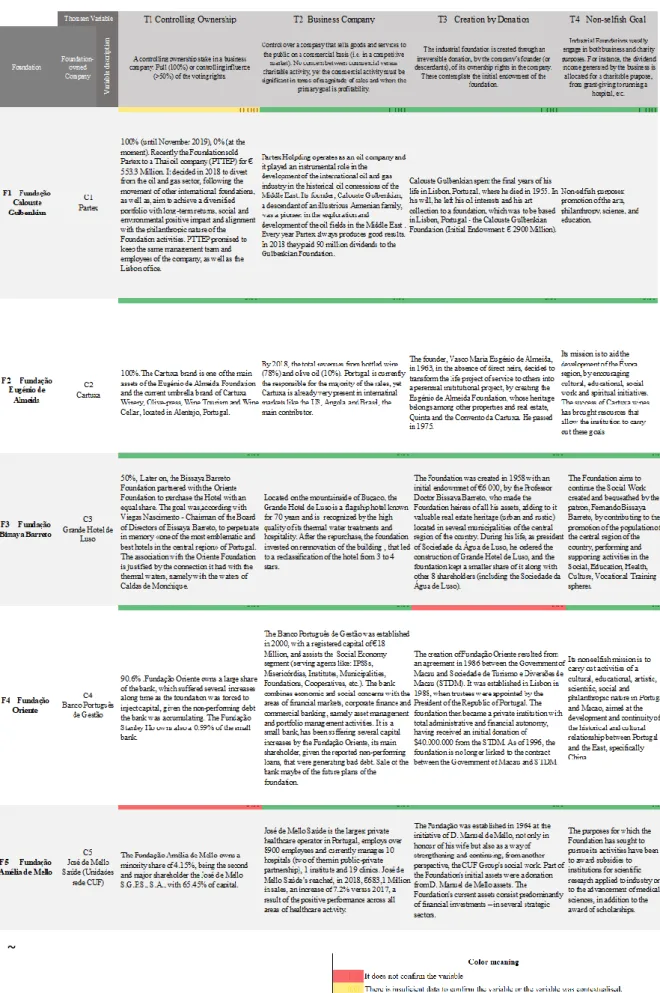
Within the aforementioned geographical context, followed an investigation for organizations that fit the majority of characteristics that describe most of northern industrial foundations studied by Steen Thomsen (2017). In order to facilitate this search, a set of 4 variables (T1-T4) (see Appendix: Table 1) was selected to use as a filter for finding the most interesting and significant cases. The objective was to adopt in this investigation a theoretical “Thomsen lens” and use it as a reference for the type of organizations we were looking for in Portugal and Spain.
The initial pre-samples of foundations explored were provided by privileged observers who are experts in the community of foundations both in Portugal, namely, Mário Curveira Santos, General Secretary from Centro de Fundações Portuguesas, and in Spain, Rosa Gallego García, International Relations Director from the Asociación Española de Fundaciones, to whom the
author expresses sincere gratitude for their collaboration. The final samples drawn5
5 The foundations, and respective companies, selected verify at least three of the four variables T1-T4. The level
to which they were kept or not in the sample encompasses an evaluation case by case and contextualization of the variables for both countries.
12
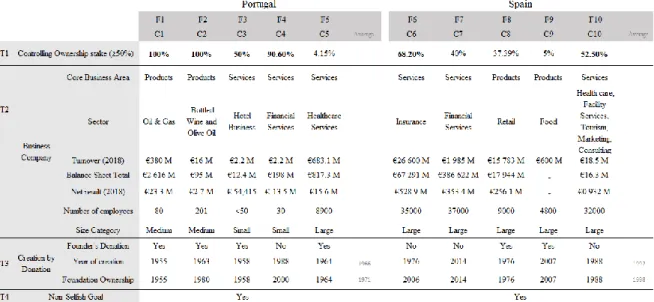
contemplate 5 foundations in Portugal (labelled F1-F5) and 5 foundations in Spain (F6-F10), which details are described in the Tables 2 and 3 (in the Appendix)6.
3.3 Data Collection and Analysis processes:
To better understand the context in which the selected cases emerged in, the next section starts with a brief review of the foundational environment in Portugal and Spain (Table 2). Thereafter, a concise analysis variable by variable was performed (Table 3), based only on secondary sources, similar to the analysis pursued in Chapter 5 of Steen Thomsen’s book (2017). The goal was to find common patterns of attributes and do a cross-country comparative analysis. When doing so, there were intriguing aspects found in the samples studied, which motivated a more comprehensive investigation, through collection of primary data from experts. Thus, to enrich the framework of the study and gain new insights for the literature, two
individual semi-structured interviews 7were conducted: 1) with an expert from F5 in Portugal,
and 2) with an expert from F7 in Spain.
4. Findings
The current study encompasses two levels of findings: 1) first, based on secondary sources, a review on foundational context in each country (Table 4) and a characterization of the industrial foundations analysed (using Tables 2, 3 and 5); and 2) on a second level, primary data was used to provide robustness to the first analysis, to clarify intriguing aspects, and preview future prospects of the development of the Foundation-Company relationship (difficult to obtain from secondary data).
6 All information about the companies and foundations was retrieved from secondary online sources, namely
company websites, annual financial and non-financial reports, previous interviews, news and opinion articles.
7 The semi-structured interview framework provided a certain flexibility, preventing a narrow exchange of
thoughts and allowing follow-up and probing questions (Gillham 2005). The interviews lasted about 45 minutes, were conducted via videoconference and phone call, recorded and transcribed in verbatim form.
13
4.1 Foundational Context: Portugal and Spain
Table 4 Summary review of the foundational context in Portugal and Spain
Portugal's Foundational Environment Spain's Foundational Environment
Definition of foundation:
A foundation is a non-profit organization created on the initiative of one or more individuals or legal entities (founders) for the management of a property irrevocably donated to them by the founders and which must be substantially preserved, for the fulfilment of certain purposes of social interest.
A foundation is a non-profit organization that pursues purposes of general interest and benefits generic groups of people. Its initial assets, the heritage, must be an unrecoverable contribution from the founder(s), with a minimum €30 000 of worth, and along with future assets will permanently be affected by those social purposes.
Furthermore, the revenues generated by the foundation cannot directly or indirectly benefit the founder or the employers, who are those who govern it, or to singular persons who do not pursue purposes of general interest.
Source: Portuguese Center of Foundations (2019) Source: Spanish Association of Foundations (2019)
Regulatory Authority:
General Secretariat of the Presidency of the Council of Ministers
(Secretaria-Geral da Presidência do Conselho de Ministros)
Protectorates
Distinction factor:
In Spain, foundations are not subject to a single basic Law, but instead, have to follow specific rules imposed by the Protectorate of the Spanish Autonomous Community they are inserted in, as some have their own laws on the subject. Currently, about 71% are attached to these autonomous protectorates.
Source: INAEF et al. (2011)
Main responsibilities:
- Recognition, modification of the bylaws - Extinction of foundations - Recognition of its public utility status, which has as its primary objective the attainment of tax benefits. - Definition of legal obligations based on the pillars of transparency (e.g. Code of Good Practices, compliance with the objectives and management rules, constant reporting, control on money laundering, etc).
- Annual accountability - Budget supervision and action plan and - Processing of authorizations and communications for certain acts of property disposition.
Number of foundations:
Census 2011: 817 foundations Census 2011: 12 921 foundations
Source: ECO.Sapo (2019) Of these, 9 050 are estimated to be active, that is, 70% of the total.
Updated counting (2019): 884 foundations Source: INAEF et al. (2011)
Largest
Foundation:
Calouste Gulbenkian Foundation (F2) Total assets: €2 616 Million
(Portuguese foundations' total assets: €9 000 M)
Largest
Foundation:
"la Caixa" Foundation (F7) Total assets: €22 700 Million
Source: Forbes (2019)
Observations: - In 2012, Portuguese legislation for foundations suffered a profound reform which led to the extinction of numerous foundations, the reduction of benefits and public support grants and even the cancelation of public utility status granted. During the reform, it was also created a much more detailed foundations' legal regime through the Foundations Framework Law
(Lei-Quadro das Fundações) and entitled a government authority to control them. - Overall, there is a stable legal regime relating to Portuguese Foundations.
- Spain is, after Germany, the country with the highest number of foundations, however, these do not enjoy great tax incentives to perform more philanthropic activities and be more active, reason why many demand for change in the Patronage Law.
Source: Funds People (2018) Source:Vozpópuli (2018)
4.2 Portugal: sample analysis and characterization:
By observing the industrial foundations selected in Portugal it can be seen that there is an apparent pattern of very high ownership stakes (≥50%) held by the foundations in Portugal (T1). However, two cases require further attention:
14
F1-C18: In recent November 2019, the foundation sold the totality of the company, which
core business was no longer in line with the objectives of the foundation. The foundation guaranteed, nonetheless, that the future holder would be reliable, respectful of the company’s unique history, its high-quality portfolio, and the strength of its management and employees (Fundação Calouste Gulbenkian, 2019).
F5-C5: This case is the exception in the Portuguese sample, as the foundation only holds a minority share of 4.15% (José de Mello Saúde, 2019).
Moreover, all foundations, except one (F4), were created through an irreversible donation by the company’s founder or relatives (T3) with the main objective of perpetuating founders’ companies and social projects. Distinctive cases:
F4-C4 - The foundation started as a public foundation and with a partnership with a foreign government, which granted the foundation the proceeds from gambling business in that foreign country. (Fundação Oriente, 2019) Later on, that link was broken, and the Foundation became private and fully autonomous, in the country of its origin (Portugal), creating then a small bank (C4) which aimed at assisting the Social Economy segment with financial and banking services. It is, therefore, not a donation, but a majority holding of the foundation, which is, however, at risk of being sold bearing the ongoing bad performance of the bank over the years (Alves, 2019).
F2-C2 - The development of the agricultural and industrial exploitation, that led to the emergence of wine and olive oil business and brand, only took place after the death of the founder. In fact, they were developed in the estate assets donated by him, with the primary goal of guaranteeing the self-sustainability of the institution and the pursuit of its mission, as
8 The consideration of this case for the sample had in mind the fact that it is a great example in Portugal of
creation of an industrial foundation through donation of assets by its founder. Moreover, it is relevant as it is by far the largest foundation in the country and is within the 40 largest foundations in the world (ECO, 2019).
15
a consequence, it also contributed to the promotion of the economic and social development of the region. (FEA, 2019)
Finally, one last point about the Portuguese foundations: they all have a clear public utility, as they develop actions with philanthropic purposes (T4), namely, contribute to the promotion of the arts, culture, education and science, in a broad sense, but some, for instance, give greater preference to deploy such promotional activities in specific regions (F2, F3 and F4).
The companies held by the foundations (T2), on the other hand, reveal dispersion across different sectors of activity, deliver both products and services and also embrace different size categories, being mostly small-medium enterprises, according to European Commission (2003) standards.
Overall, we can say that we have found in Portugal examples of family industrial foundations, which are used as an instrument to honour, reinforce and continue the social work of its founder (F1, F2, F3 and F5), and which developed (C2 and C4) or continue on exploring (C1, C3 and C5) economic activity under normal conditions of the competitive market, to guarantee the subsistence of the philanthropic activities of the foundations. Nonetheless, companies’ industrial size is considerably small, and foundation-ownership is at risk in some cases given misalignment from foundation’s core values (F1) or company’s financial instability (F4).
4.2.1 Analysis on the interview with an expert from F5-C5
There was an opportunity to interview an expert from Fundação Amélia de Mello (F5), where we 1) clarified some questions about this foundation ownership example and 2) explored the experts’ opinion on the application of the concept of industrial foundations in Portugal (see Table 6, in the Appendix, for complete transcript of the interview).
First off, the expert did not recognize the concept and term industrial foundations, and instead, distinguished two categories of foundations: a) the corporate foundations or business foundations, which he relates with foundations that are associated with a brand (i.e. those which
16
have the brand’s name as the name of the foundation) and that may have a marketing motive, besides the philanthropic purpose implicit in them all - within this category, he identified a sub-type of foundations, the territorial foundations, which have special criteria for the territory where they intervene, one example is the Gulbenkian Foundation; b) There is also the category of family foundations, in which the expert included the Amélia de Mello Foundation (F5), and that he identified as those who are not associated with a brand directly and have a family project. In the end, he does not consider F5 as an Industrial Foundation, neither it has any impact in the CUF Group’s (C5) management, this is because the share they hold, and which aim to maintain for the moment, is very small (4.15%). It is just another asset part of the large and diversified portfolio that the foundation has.
Moreover, besides identifying several examples of foundations owning businesses in Portugal, the expert does not believe that this concept applies significantly in the country, because, back in 1975, after the Carnation Revolution, there was an impactful process of nationalization of very big companies in Portugal by the newly created state, that destroyed the corporate entrepreneurial structure and that never recovered completely up until today. Therefore, without the “old money” of these capitalists and without a consolidated “private economy”, the expert said that it is difficult for large industrial foundations to set in. There is no space for philanthropy to develop through foundations and proceed to the redistribution of the accumulated capital to the society. Nonetheless, the expert believes that if there is economic development and businesses growth, there will be more capacity and conditions for industrial foundations to emerge, perhaps through the “new money” that was created after the nationalization of companies’ phase.
4.3 Spain: sample analysis and characterization:
Within the Spanish sample, contrary to the Portuguese trend, we observe lower controlling ownership stakes (T1), never achieving the totality, and three of the cases (F7, F8 and F9) are,
17
in fact, below 50%. Nonetheless, in all cases, except F9-C9, foundations are the largest shareholder. On the exception mentioned, foundation ownership is recent (2017). According to the Grupo Siro Foundation (F9), the Cereal to Siro Foods (C9) started as a “family business and dreams of its legacy lasting more than 500 years. That’s why its owners have decided to hand down their company to the Grupo Siro Foundation” which “will therefore become the next owner of the company and already holds a 5% stake in the group”. In the words of the founder González Serna (2017), the goal is that the “business model has to endure, go beyond us, transcend”.
Additionally, establishment of the foundation through an irreversible donation of assets by the founders with the aim of securing more independence and long-term future of their business projects (T3) is visible in two of the five cases (F8 and F9). Exceptions:
F6-C6: The foundation was primarily created to channel the socially responsible performance of the parent institution. Later, majority of control of the group was transferred to the foundation to ensure a greater independency and business sustainability (elEconomista, 2006). F7-C7: The banking foundation resulted from a transformation of a savings bank in order to comply with Savings Banks and Banking Foundations Law of 2013. The foundation became the largest shareholder of the bank (C7), with the holding limit imposed (40%) through an unlisted investment holding company that manages the remaining F7’s portfolio of assets (Obra Social la Caixa, 2019).
F10-C10: The foundation was established to complement the activity of its founding organization (ONCE, which provides social services to blind people) by extending the employment, training, accessibility and other initiatives to the rest of people with disabilities (ONCE Foundation, 2019). The business itself (C10) emerged a few years later with the aim of diversifying the income sources of the founding entities and generating employment opportunities for people with disabilities (Ilunion, 2017).
18
Moreover, in accordance with what was found in the sample of Portugal, they all pursue non-selfish purposes (T4), which range from promoting and supporting health, education, scientific and social research to contributing to social inclusion for disabled people and recovery and preservation of historical heritage, mainly inside the Spain’s national regions and Spanish speaking communities (F7). On the other side, the business companies in question do also commercialize across a variety of sectors with both products and services, but in contrast with Portugal, all companies are large, more consolidated and employ, on average, more people.
Generally speaking, it seems that the foundation ownership is more recent in Spain (on average since 1998) compared to Portugal ( on average since 1971), encompassing larger and more consolidated firms, including a banking foundation established by law (F7), a social institution that originated a foundation to broaden the target of its social purpose (F10), and three cases where part of the ownership was donated to a foundation with the clear purpose of perpetuating the company’s activity (F6, F8 and F9).
4.3.1 Analysis on the interview with an expert from F7-C7
Within the Spanish sample, it was possible to interview an expert from “la Caixa” Foundation (F7), where we had the opportunity to 1) review the historical evolution of the bank and creation of the foundation, 2) discuss intriguing aspects 3) understand the behaviour of the foundation as an investor, 4) explore future prospects regarding foundation-ownership, 5) quest expert’s opinion on the other foundation-owned companies included in the sample, and finally, 6) what he resonates about this type of ownership structure, particularly, in Spain and Portugal (see Table 7, in the Appendix, for complete transcript of the interview).
In that line of thought, it is paramount to remember that La Caixa Foundation (F7) is a particular case of industrial foundation, as it is a banking foundation established to comply with Savings Banks and Banking Foundations Law of 2013 imposed in Spain, when “the Spanish banking sector had to be rescued” as a way of avoiding the rescue of the whole country.
19
According to the expert, CaixaBank was not problematic, but many other “savings banks had problems during the crisis, because they were influenced by politicians and were not so professional”.
Regarding the use of CriteriaCaixa (the Group’s unlisted holding company) as an intermediary holder of the assets of the foundation (i.e. industrial and financial investments amounting up to €20 Billion), versus holding them directly like it happens in the remaining cases in Spain and Portugal, the justification given bares the great size of the assets that the foundation holds and the fact that “CriteriaCaixa has specialized staff in risk management, as well as, people representing the foundation´s interests and individual experts.” Thus, “it is convenient that these holdings are under CriteriaCaixa, because as a big business, it is very important to be a solid group. So, La Caixa Foundation controls what CriteriaCaixa is doing, but runs directly all the welfare projects.”
Another puzzling aspect had to do with the stake of CaixaBank held by the foundation (40%), to which the respondent walked us through the bank’s history. Succinctly, when CaixaBank, the group’s company responsible for all financial activity was, created in 2011, it was also listed on the market for trade. At some point, the foundation had 60%-70% of
CaixaBank, yet, when the exchange rates got too low, the ECB9 and the Bank of Spain found
necessary to impose a limit to foundation-ownership of 40%. This was a precautionary measure to protect the rest of the “la Caixa” investments, as if there is a new banking crisis, the foundation will only be responsible for the 40% stock they have in their holdings, versus having to save the whole bank and risking the remaining assets, in case they hold more than that. On the other hand, the foundation-ownership is kept at the limit imposed since “the foundation is pretty comfortable with 40% of CaixaBank, as half of their investments are in banking (mainly in Caixa Bank, but also Bank of East Asia and in Inbursa in Mexico) and the other half in the
20
industry, services and real estate portfolio. The future prospects are that they will keep the holding of CaixaBank forever, not because it is required in the charter, but because “the foundation has a very long history with CaixaBank and a name to respect”, so in other words, “la Caixa” Foundation is seen as long-term shareholder of CaixaBank.Moreover, when asked about the influence of the foundation in the management of CaixaBank and in the other assets, he responded that, nowadays10, the aim is “not to control every company, but to control several strategic and also historical investments where the “la Caixa” is relevant. The goal is to be seated with one, two or more members at the board of the company, to participate in the decision-making.” In small companies that can mean owning a big share or even totally but is more difficult to do so in very large multinational companies, where 20% can sometimes guarantee the presence in the vote. Nevertheless, the foundation has also several minor holdings that behave like an investment fund.
Regarding his opinion on advantages of foundation-ownership, he highlighted the foundation’s investment behaviour which is similar throughout most foundations, i.e. foundations “are very conservative” when doing investments, they “have medium-long term vision”, and “do not want to get a lot of profit quickly”, but instead “stable investments that pay out investments every year, in order to be able to cover foundation’s welfare projects’ costs”. In practice, that “does not mean only invest in big and very profitable corporates”, but instead, “la Caixa”, through CriteriaCaixa, manages risk, controls and invests in different geographic markets and economy sectors, as well as, it invests in cyclical and non-cyclical
companies, so that all investments complement each other.
The expert demonstrated, however, short knowledge about industrial foundations existing in Spain (apart from the banking foundations). Nonetheless, he recognized some after hearing
10 The responded did a comparison with the with the vision "la Caixa" had 10-15 years ago, when it preferred to
"only invest in business that (they) understand and that (they) control. So, (they) only wanted to be in few companies where (they) can be dominant in the vote or/and have an agreement with other shareholders."
21
about the other cases analysed in this study, and further explained its establishment through founder’s donations of assets. By the end of the conversation, the respondent clarified the “la Caixa”’s long-term mission regarding the size of the foundation’s assets, explicitly, “in one century, the goal is to have the equivalent or more than the €20 Billion in assets and a steady, yet slow, growth of the €500 Million foundation’s budget to invest in its medium- to long-term welfare projects.”
5. Discussion
5.1 Theoretical and practical implications:
The outline of the present thesis is motivated by two research questions; 1) how is the concept of Industrial Foundation understood in the Southern Europe, particularly in Portugal and Spain, and 2) how does it differentiate from other European countries. Thus, one first insight is that the concept of Industrial Foundation does apply, to some extent, in these countries, yet, it is not recognized by this nomenclature, but instead, by corporate foundation or enterprise foundation (“Fundação de empresa” or “Fundação corporativa” in Portugal, or “Fundación-empresa” in Spain), terminology which Steen Thomsen (2017)
associates with a foundation established to prosecute the CSR11 purposes of a company. This
theory was also confirmed by one of the experts interviewed from the Portuguese foundations, to which he added that one of the motives was also marketing, or in other words, brand promotion. To what comes to business ownership by foundations, there is no legal barrier that prevents foundations to develop or hold business companies, it is in fact, “natural”, according to one of the interviewees, that foundations develop or invest in several business companies, in order to generate dividends that pay for the philanthropic activities developed by them. Nonetheless, the level to which industrial foundations, or foundations with business-ownership, is developed in Portugal and Spain, is relatively small, with greater insignificance
22
in Portugal, when compared to other European countries (Couto, 2018). One reason appointed by one of the experts interviewed, for the Portuguese context, has to do with the nationalization process that happened in 1975 and which extinguished the majority of the capitalists and large companies existing at the time. On the Spanish situation this movement did not take place, which explains the existence of larger, yet still few, industrial foundations. As a matter of fact, they have been emerging in more recent times, as foundation ownership has been perceived as advantageous and a successful model of ownership. One example is Grupo Siro Foundation (F9), which aims for perpetuity of its business and that was inspired by the “successful precedent model of Mapfre” Foundation (F6) (ESADE, 2017) to establish one too, and donate some ownership. Specifically, in the latter case (F6), the foundation, established in 1976, only became owner of the majority of the voting rights in 2006, when Mapfre executives decided this transition, because “first, it sounds very nice and social the idea of Foundation (versus private investors ownership) and, second, by maintaining control of the company within the Foundation, it will protect it from financial sharks that may try to buy it. In other words, when someone wants to buy the company, the decision makers will be the managers, who control it through the Foundation, and not the shareholders.” (Alvaréz-Moro, 2006). Thus, this goes in line with previous literature that supports foundation-ownership contributes to long-term
governance and long-termism of the business (Børsting et al., 2014a).
Moreover, the samples in this study confirm that, first, industrial foundations can be found across all different industries, as Kuhn and Thomsen also concluded in a study in 2015, second, industrial foundations will have more success with already large and consolidated enterprises (Børsting et al., 2014a), this is clear in F6-C6, F8-C8 and F9-C9 cases of the Spanish sample. An additional proof on the latter conclusion is the F4-C4 case, where the on-going bad financial performance and small size of the bank (C4) are putting at risk foundation-ownership in the near future. Notwithstanding, the experts’ insights collected through this research reveal that,
23
despite that they wish to keep their stakes in C5 and C7 today, as a matter of respect for its history, nothing forbids them of selling it in the future, if they believe the money will be better invested somewhere else, therefore, foundation is not, necessarily, as a “commitment mechanism” that guarantees the existence of the business in perpetuity as Scheling (1960) proposed. Their paramount objective is to manage the assets in order to guarantee return to pay the projects. As a matter of fact, the largest foundation in Portugal (F1) and the best example of industrial ownership in the country, sold recently its company (C1) bequeathed by the founder, after previewing its decline in the future.
Additionally, the size of ownership held by the foundations also depicts different insights in both countries. In Portugal, the stakes of ownership are higher but companies are small-medium enterprises, and in the case of minority ownership (F5-C5) the expert affirms it not to be an example of industrial foundation, but only a financial asset donated by the founder. On the other side of the border, in Spain, the stakes are necessarily smaller but with large and consolidated companies, and influence on management seems to have greater impact, as foundations managed to have some seats in the board and participate in the decision-making. Regarding the foundation behaviour as an investor, and which is in consonance with the literature, that foundations managed their assets in a conservative way, by investing in risk-free (or reduced risk) projects, giving preference to companies that provide constant and stable dividends and investing in diversified industries and locations to avoid idiosyncratic risk.
Lastly, this study also contributes with interesting insights about the enablers for emergence of foundation-ownership, theory suggests that tax-saving is one of the explanations, and in fact both in Portugal and Spain, companies owned by foundations are exempt from paying corporate taxes, yet tax incentives are not big enough to be one of the main motivations to foundation creation or company-ownership by foundations in the Iberian countries.
24
Overall, this thesis might be purposeful to policymakers, corporates and foundations aiming at finding a sustainable and rational solution to promote long-term governance.
5.3 Limitations and Directions for future research:
This study involves a number of limitations that shall be taken into consideration. First, given constraints in time, proper access to data and limited size of the working project, it is not possible to guarantee the existence of more cases of foundation-ownership, in Portugal and Spain, of interest for the research, as well as a more complete investigation of each of the cases. On the other hand, the small size of the sample does not allow generalization of the conclusions inferred.
Hence, future research should, then, exploit more substantially these cases by including, for instance, an overview of the financial performance of the foundation-owned companies, a deeper investigation of the legal structure of each country or an analysis of the governance behaviour of the foundation-owned companies. Investing more resources into finding more cases of foundation-owned companies is also recommended. Finally, to better close the addressed gap in the literature, more countries in the South of Europe should be scrutinized, as foundation ownership seems to be a reasonable solution to guarantee companies’ long-term stability. The author hopes the current project inspires others to contribute to this discussion, as both qualitative and quantitative studies are important and necessary to enhance the understanding of this concept.
6. Conclusion
The current thesis contributes to the literature by offering here a first effort to analyse qualitatively the role of foundation-ownership in the Iberian countries. The study finds that, besides that there exist no legal constraints, this concept is, yet, very unexplored in both countries. On one hand in Spain, it starts to exist some recognition of the benefits of this structure for the long-term performance and some large companies are modifying their
25
organization towards this concept, nevertheless, insignificant tax incentives and overall unfamiliarity with the concept may justify that there are not many important examples of industrial foundations. In Portugal, on the other hand, there are several examples of historical industrial “family-foundations”, where recognized capitalists in the past have donated their assets to a foundation, with the goal of foundations looking after them and continue the social projects of the founders, however, the sizes of the assets are considerably small and the drastic extinction of influential capitalists in the previous century did not allow, yet, for great capital accumulation and consequent foundation establishment. Furthermore, in conformity with Spain there is little knowledge about the model of industrial foundations. One last rationale has to do with cultural context of both countries, they both score worse than Nordic countries on governance and corruption indicators (Kaufmann, Et al., 2010) which may create reluctance to this model and lack of trust that companies’ returns will be redistributed to society through foundations’ philanthropic activities.
Overall, there is space and legal conditions for this concept to proliferate in both countries.
7. References
Alvaréz-Moro, O. (2006). "Los directivos de Mapfre se blindan." El Bolg Salmón, June 20. https://www.elblogsalmon.com/empresas/los-directivos-de-mapfre-se-blindan.
Alves, M.T. (2019). "Fundação Oriente injetou no BPG mais de 30 milhões desde 2015." Jornal Económico, January 8. https://jornaleconomico.sapo.pt/noticias/fundacao-oriente-injetou-no-bpg-mais-de-30-milhoes-desde-2015-395587
Associación Española de Fundaciones (2019). “Crear una fundación”. Accessed October 20. https://abc.fundaciones.org/crear-una-fundacion/
Bansal, P., and M. R. DesJardine (2014). “Business sustainability: It is about time”. SAGE Journals 12 (1),70– 78.
Borgo, K. (2018). “España es, tras Alemania, el país con mayor número de fundaciones: 9.500.” August 1.
https://www.vozpopuli.com/altavoz/cultura/xx-Ley_de_Mecenazgo-Micromecenazgo-Desgravaciones_0_560343964.html
Børsting, C., J. Kuhn, T. Poulsen, S. Thomsen (2014a). “The Performance of Danish Foundation Owned Companies.” Unpublished Working Paper. The Research Project on Industrial Foundations.
Centro Português de Fundações (2019). “O que é uma Fundação.” Accessed October 12. http://www.cpf.org.pt/paginas/8/o-que-e-uma-fundacao/8/.
Couto, M. (2018). "Fundações de empresa – Agentes de mudança", Link to Leaders, November 5. https://linktoleaders.com/fundacoes-empresa-agentes-mudanca-margarida-couto/
26
Draghi, M. (2013). “Opinion of the European Central Bank of 23 July 2013 on savings banks and banking
foundations.” European Central Bank, July 23.
https://www.ecb.europa.eu/ecb/legal/pdf/en_con_2013_52_f_sign.pdf.
ESADE, (2017). "Juan Manuel González Serna, chairman of Grupo Siro, at ESADE: ‘Our strategy is to grow our client’s business’." Esade Ramon Llull University (italic), June 7. https://www.esade.edu/en/news/juan-manuel-gonzalez-serna-chairman-grupo-siro-esade-our-strategy-grow-our-clients-business/15636
European Commission (2003). “What is an SME?” Accessed November 28.
https://ec.europa.eu/growth/smes/business-friendly-environment/sme-definition_en
Ferreira, J. N. (2019). “Estas são as dez maiores fundações do país. Gulbenkian é das maiores do mundo.” ECO. Accessed October 14. https://eco.sapo.pt/2019/02/28/estas-sao-as-dez-maiores-fundacoes-do-pais-gulbenkian-e-das-maiores-do-mundo/
Fleishmann, J. (2001). “Public policy and philanthropic purpose - foundation ownership and control of corporations in Germany and the United States. In A. Schlüter, V. Then and P. Walkenhorst (Bertelsmann Foundation) (eds.) Foundations in Europe: Society, Management and Law (pp. 372-4089. London: Directory
for Social Change.
Fundação Calouste Gulbenkian (2019). “Gulbenkian assina acordo para venda da Partex”. Accessed October 11. https://gulbenkian.pt/noticias/gulbenkian-assina-acordo-para-venda-da-partex/
Fundação Eugénio de Almeida (2019). “Fundador e História.” Accessed October 11. https://www.fea.pt/10-fundador
Fundação Oriente (2019). “The Fundação Oriente.” Accessed October 12. http://www.foriente.pt/109/the-fundacao-oriente.htm#.XeqcMuj7Q2x
Gillham, Bill. 2005. Research Interviewing: The Range of Techniques. Maidenhead; New York: Open University Press.
Grupo Siro Foundation (2019). Accessed October 15. https://www.fundaciongruposiro.com/en/grupo-siro-foundation/
Hansmann, H. (1996). “The Ownership of Enterprise.” Cambridge, MA: The Belknap Press of Harvard University Press.
Hansmann, H. and S., Thomsen (2013). “Managerial Distance and Virtual Ownership: The Governance of Industrial Foundations.” Working Paper. The Research Project on the Governance of Industrial Foundations.
Hansmann, H. and Thomsen, S. (2018). “The Governance of Foundation-Owned Firms.” Working Paper. The Research Project on Industrial Foundations.
Hart, O. (1995). “Firms, Contracts and Financial Structure.” New York: Oxford University Press.
Hermann, M. and G. Franke (2002). “Performance and Policy of Foundation-Owned Companies in Germany.” In
European Financial Management, Vol. 8 (3).
Hopt, K. J. and von Hippel, T. (2010). “International Corporate Law and Financial Market Regulation.” In
Corporative Corporate Governance of Non-Profit Organizations. Cambridge University
Press. http://nosotros.ilunionhotels.com/sites/default/files/ilunion-valorcompartido2017_baja_en.pdf Ilunion (2017). “Shared Value Report 2017”, p.9.
Instituto de Análisis Estratégico de Fundaciones (INAEF), M. García, M. and L. González (2011). “El sector
fundacional español - datos básicos.” Asociación Española de Fundaciones, 19-21.
http://www.fundaciones.org/EPORTAL_DOCS/GENERAL/AEF/DOC-cw4e1d396869ffb/Elsectorfundacionalespaol-Datosbsicos.pdf
Jensen, M. and Meckling, W. (1976). “Managerial Behaviour, Agency Costs and Ownership Structure.” Journal of Financial Economics. ed.3, 305–360.
José de Mello Saúde (2019). “Information on the Shareholding Structure, Organization and Corporate
Organization.” Financial Statements Report 2018, 165. Accessed November 12.
https://www.josedemellosaude.pt/sites/josedemellosaude/files/inline-files/vers%C3%A3o%20inglesa_Relat%C3%B3rio%20de%20Demonstra%C3%A7%C3%B5es%20Financeir as.pdf.
27
Kaufmann D., A. Kraay, and M. Mastruzzi (2010). "The Worldwide Governance Indicators: Methodology and Analytical Issues” - https://papers.ssrn.com/sol3/papers.cfm?abstract_id=1682130.
Kronke, H. (1988). “Stiftungstypus und Unternehmensträgerstiftung.”, Tübigen: J.C.B. Mohr.
Kuhn, J. and S. Thomsen (2015). “Performance Drivers in Foundation Owned Companies.” Working Paper. The Research Project on Industrial Foundations.
Laverty, K. J. (1996). “Economic ‘Short-Termism’: The Debate, the Unresolved Issues, and the Implications for Management Practice and Research,” Academy of Management Review 21(3): 825–60.
Leardini, C., G. Rossi and S. Moggi (2014). “Board Governance in Bank Foundations.” Berlin: Springer. Mayer, C. (2013). “Firm Commitment: Why the corporation is failing us and how to restore trust in it.” Oxford:
Oxford University Press.
Mcculloch, S. (2018). “Industrial Foundations: The Imperfect Solutions to Long-term Prosperity?” Campden FB (73) May 28. http://www.campdenfb.com/article/industrial-foundations-imperfect-solution-long-term-prosperity.
Obra Social la Caixa (2019). ”la Caixa Foundation - Our Beginnings”. Accessed November 12. https://obrasociallacaixa.org/en/quienes-somos/quienes-somos/nuestros-inicios.
ONCE Foundation (2019). Accessed 18 November. https://www.fundaciononce.es/es/pagina/presentacion
Prewitt, K. et al. (2006), “Legitimacy of Philanthropic Foundations: United States and European Perspectives.” Russell Sage Foundation.
Putterman,L. (1993). “Ownership and the Nature of the Firm.” Journal of Comparative Economics. 17, 243–263. Rita, L.S. (2018). "Fundações como meio de conservação e gestão de património." (Funds People-italico). December 13. https://pt.fundspeople.com/news/fundacoes-como-meio-de-conservacao-e-gestao-de-patrimonio Rita, L.S. (2018). "Fundações como meio de conservação e gestão de património." Funds People. December 13.
https://pt.fundspeople.com/news/fundacoes-como-meio-de-conservacao-e-gestao-de-patrimonio
Schelling, T.C. (1960). “The Strategy of Conflict”. Harvard University Press.
Schelling, T.C. (2005). “Strategies of Commitment and other essays.” Harvard University Press.
Shleifer, A. and Vishny, R. W. (1997).“A Survey of Corporate Governance.”Journal of Finance. 52 (2),737–783. Thomsen, S, (2018). “Foundation Ownership and Firm Performance: A Review of the International Evidence.” In Corporate Governance in Contention, eds. Ciaran Driver and Grahame Thompson, Chapter 4. Oxford University Press. https://blogs.lse.ac.uk/netuf/2018/09/06/the-performance-of-foundation-owned-firms/ Thomsen, S. (1996). “Foundation ownership and economic performance.” In Corporate Governance: An
International Review, Vol.4 (4).
Thomsen, S. (1999). “Corporate ownership by industrial foundations.” The European Journal of Law and
Economics 7 (2).
Thomsen, S. (2006). “Industrial Foundations - foundation ownership of business companies.” In K.Prewitt, M. Dogan, S. Heyedmann and S. Toepler (eds.) The Legitimacy of Philanthropic Foundations, pp. 236-251. Russel
Sage Foundation.
Thomsen, S. (2012). “What Do We Know (and Not Know) about Industrial Foundations?”. Working Paper.Center for Corporate Governance Copenhagen Business School.
Thomsen, S. (2017). “What are “Industrial Foundations”?”, In The Danish Industrial Foundations, ed. 1, 11-23. Copenhagen: Djøf Publishing.
Thomsen, S. and Rose, C. (2004). “Foundation Ownership and Financial Performance: Do Companies Need Owners?”. European Journal of Law and Economics, 2004, 18(3), 343-364.
Thomsen, S., Poulsen, T., Børsting, C. and Kuhn, J. (2018). “Industrial Foundations as Long-Term Owners”. Working Paper.
Williamson, O. E. (1996). “The Mechanisms of Governance.” New York: Oxford University Press.
Yasin, F.M. and N.A. Sulaiman (2014). “Corporate Governance Research: A Review of Qualitative Literature.”
28
8. Appendix
Table 1 "Thomsen lens" variables
“Thomsen lens”’ variables to filter “Industrial Foundations” in Portugal and Spain
T1. Controlling ownership - A controlling ownership stake in a business company: Full (100%) or controlling influence (>50%) of the voting rights.
T2. Business Company - Control over a company that sells goods and services to the public on a commercial basis (i.e. in a competitive market). No concern between commercial versus charitable activity, yet the commercial activity must be significant in terms of magnitude of sales and where the primary goal is profitability. (For example, income generated from museum tickets, small food establishments, etc. is taken in consideration).
T3. Creation by Donation - The industrial foundation is created through an irreversible donation, by the company’s founder (or descendants), of its ownership rights in the company. These contemplate the initial endowment of the foundation.
T4. Non-selfish Goal - Industrial Foundations usually engage in both business and charitable purposes. For instance, the part of the dividend income generated by the business is earmarked to a non-selfish purpose (e.g.: art, education, charity, research, etc.).
29 ~
30 Table 3 Spanish Sample of Industrial Foundations using "Thomsen lens"
31 Table 5 Consolidated data of each individual of Portuguese and Spanish samples
Table 6 Interview with Jorge Quintas from Amélia de Mello Foundation (F5)
Foundation: Fundação
Amélia de Mello Company: Grupo CUF
Interviewee: Jorge Quintas Position(s): General secretary of Fundação Amélia de Mello
Contact level: Phone call Date: December 12, 2019
Note: The following interview transcript includes the main structural questions and insightful answers, thus, initial presentation of the project, related talk and final acknowledgments are not comprised. Part of the conversational text may have suffered minor alterations in the interconnection of ideas in order to facilitate the flow of reading. The interview was done in Portuguese and it was translated for the purpose and format of the current thesis. Lastly, as mentioned in the methodology, the interview was realised in a semi-structured way allowing a more focused, open and fluid conversation.
Q1: Have you ever about the concept of Industrial Foundations?
A1: No. In the categories of foundations I only know two, which are the corporative/business foundations
and the family foundations, that is the distinction I make. Yet, there may be more, for instance, there is a sub-type, the territorial foundations, which have special criteria for the territory where they intervene, one example, is the Gulbenkian Foundation, which is a family foundation with territorial intervention criteria, too. That is, it intervenes at the national level (Portugal), but it also develops projects only in Armenia, where the foundation's founder is originated from. In his legacy, he created the foundation where he said the foundation does this and that, but also imposed the foundation to develop something specific in the territory where he was born, Armenia. In addition, the Gulbenkian Foundation, until very recently owned a company, named Partex, a company that operates in the field of oil products. Overall, in Portugal, as far as I know, foundations that own businesses, we have, for example, two more: the foundation of Berardo, which owns the Bacalhôa Wines, and the Eugénio de Almeida Foundation that owns Cartuxa and Pêra Manca wines. Then, it is natural that there are more foundations ownings businesses, for example, in the area of education, there is a foundation that is CEBI that owns a large college in Alverca, which even has secondary education, inclusive. Moreover, there are, nowadays, many foundations that have a different business essence, which are the Foundations of Universities, some universities are currently migrating to the foundation model, Universidade Nova de Lisboa as well as the University of Lisbon are two of these cases. The Catholic University has a foundation, as well, but is a different case, since it is a catholic university, it depends on the Cardinal Patriarch of Lisbon, so in that sense, let's say the owner is the Patriarchate of Lisbon. In the world, there are many, however, in the United States, in Germany, in Belgium there are many foundations that are business owners, the Henkel Foundation, for example, the Prosegur Foundation, the Ramón Areces Foundation which is the owner of El Corte Ingles, with a great participation, the La Caixa Foundation which has 40% of La Caixa bank, among others.
Q2: What is the size of the business that is you perceive, in order to be consider it to be an Industrial
Foundation?
A2: It is important to contextualize each case and perceive then its size at a scale. For example, in the case
of CEBI Foundation, the foundation and its college are very large in Alverca, they have a large dimension given the specific context of the region in which it operates.
Q3: What are the tax incentives for foundations that own businesses?
A3: Foundations with public utility are exempt from Corporate income tax (IRC) that is, in fact, a relevant