Working Paper Series
Do Migrants Send Remittances as a Way of
Self-Insurance?
Cátia Batista
Nova School of Business and Economics and NOVAFRICA, Nova University of Lisbon
Janis Umblijs
Ragnar Frisch Centre for Economic Research
ISSN 2183-0843
NOVAFRICA Working Paper Series
Any opinions expressed here are those of the author(s) and not those of NOVAFRICA.
Research published in this series may include views on policy, but the center itself
takes no institutional policy positions.
NOVAFRICA is a knowledge center created by the Nova School of Business and
Economics of the Nova University of Lisbon. Its mission is to produce distinctive
expertise on business and economic development in Africa. A particular focus is on
Portuguese-speaking Africa, i.e., Angola, Cape Verde, Guinea-Bissau, Mozambique,
and Sao Tome and Principe. The Center aims to produce knowledge and disseminate
it through research projects, publications, policy advice, seminars, conferences and
other events.
NOVAFRICA Working Papers often represent preliminary work and are circulated to
encourage discussion. Citation of such a paper should account for its provisional
Do Migrants Send Remittances as a Way of Self-Insurance?
✩Catia Batista*, Janis Umblijs±
November 2014
Abstract
How do risk preferences affect migrant remittance behaviour? Examination of this relationship has only begun to be explored. Using a tailored representative survey of 1500 immigrants in the Greater Dublin Area, Ireland, we find a positive and significant relationship between risk aversion and migrant remittances. Risk-averse individuals are more likely to send remittances home and are, on average, likely to remit a higher amount, after controlling for a broad range of individual and group characteristics. The evidence we obtain is consistent with a “purchase of self-insurance” motive to remit in that we also find support for more remittances being sent by risk-averse immigrants who face higher wage risks and to individuals with more financial resources.
Keywords: Migration, Risk Aversion, Remittances, Self-Insurance
JEL: D81, F22, F24, J15, J61
✩
The authors gratefully acknowledge support from the Irish Research Council (IRC), Trinity College Dublin, and Nova Forum at the Nova School of Business and Economics. This paper is based on a representative immigrant survey generously funded by the EU NORFACE Programme on International Migration. We thank the editor, two anonymous referees, Pedro Pita Barros, Gaia Narciso, Pedro Vicente and participants in several seminars and international conferences for helpful comments.
1. Introduction
The scale and growth of global remittance flows over the last decade has been
unprecedented. Officially recorded remittances to developing countries have quadrupled over the
last decade from US$ 85 billion in 2000 to US$ 372 billion in 2011 (World Bank, 2011), a value
three times greater than total official development assistance.
While this substantial global flow of money has motivated a great deal of research, the
reasons behind why people remit are still an object of investigation. An already long debate has
indeed been taking place over whether remittances are sent as a result of broadly defined altruistic
or self-interested motivations.1 Becker (1974) proposed the seminal model of altruism as the main determinant of inter-household transfers. This model was first tested by Cox (1987), who found
that inter-vivos transfers in the United States were more consistent with exchange-related motives
than with pure altruism. Several ensuing studies, including field evidence from a variety of
developed and developing countries at different points in time, have also failed to support altruism
as a motivation for remittances – or, at least, as the single motivation for remittances.2 A more
recent strand of research has conducted behavioural experiments to examine the altruistic
motivations behind giving. They found an important role for selfish or reciprocal motives – desires
on the part of givers to reward recipients for past behavior or to influence future behavior – in
addition to altruism and social pressure as determinants of giving behavior.3 Overall, the evidence in the literature is consistent with mixed motives for remittance behavior, as discussed by Brown
and Jimenez (2011): in line with the findings of Cox (1987), Cox, Eser and Jimenez (1998, Cox,
Hansen and Jimenez (2004), and Kazianga (2006), they observe that altruistic remittance motives
dominate below a certain threshold for the income of remittance recipients, whereas exchange
motives seem to take the lead above that threshold.
1
Arrondel and Masson (2006), Rapoport and Docquier (2006), and Cox and Fafchamps (2008) are good sources reviewing the literature on private giving.
2
See, for instance, Lucas and Stark (1985) on evidence for Botswana; Altonji et al. (1992, 1997) for the United States; Cox, Eser and Jimenez (1998) for Peru; Cox, Hansen and Jimenez (2004) for the Philippines; Kazianga (2006) for Burkina Faso; Osili (2007) for Nigeria; Brown and Jimenez (2011) for Tonga; and DeWeerdt, Genicot, and Mesnard (2014) for Tanzania.
3
Restricting our analysis to non-altruistically motivated remittances outside the household,4 we can further distinguish between three main different self-interest or exchange incentives to
remit. First, the absent remittance sender may be motivated by a wish to guarantee the provision of
services to his/her family left behind by the remittance recipients outside the household (purchase
of current and future goods and services for the benefit of others). Second, the remitter may be
investing in his/hers good reputation in the home community (which may mean that remittances are
the result of social pressure as in Chort et al., 2012; or of reciprocation to the network who covered
the initial migration costs as in Ilahi and Jafarey, 1999). Finally, the migrant may remit as a way to
self-insure in the event of an unexpected negative shock that he/she experiences in the host country
(purchase of future goods and services for self in specific states of nature), as in Amuedo-Dorantes
and Pozo (2006).
In this paper we investigate the extent to which the desire of migrants to self-insure against
future risks faced in the host country constitutes a motive to send remittances – this is our
definition of self-insurance purchased from the migrant’s network at home and what we call the
self-insurance motive to remit. There is evidence that networks at home often provide financial
assistance to migrants in case of negative income shocks in the receiving country and that home
networks are able to monitor the financial situation of the migrant through contacts with network
members in the receiving country (Agarwal and Horowitz, 2002; De la Briere et al., 2002). In this
setting, because the willingness of network members at home to provide financial assistance in
difficult times is likely to depend on past remittances from the migrant, the decision to remit can be
viewed as insurance against future negative shocks.
While this self-insurance motive is sometimes mentioned in the literature, there are few
studies that test this motive empirically - notable exceptions being Lucas and Stark (1985);
Agarwal and Horowitz (2002); and Amuedo-Dorantes and Pozo (2006). The existing literature has
mostly used two approaches to empirically test the self-insurance motive to remit. The first strand
of literature proposes that a positive relationship between income of migrant networks at home and
4
migrant remittances is indicative of a self-insurance motive to remit, while a negative relationship
indicates altruism as the relevant remittance determinant. This would happen because migrants
remitting with an insurance motive will increase the amount remitted when networks at home have
larger income values and hence offer a larger insurance payoff – the underlying assumption being
that the willingness of network members at home to provide financial assistance in difficult times is
likely to depend on past remittances from the migrant and on the magnitude of their income flows.
Alternatively, migrants will increase remittances in response to worsening economic situations in
the home country when altruism is the dominant factor. Testing this theory empirically Lucas and
Stark (1985) found that the ‘insurance motive’ dominated, while Agarwal and Horowitz (2002)
concluded that altruism was the main motive for remitting. The main drawback of this approach is
that it labels a set of possible reciprocal remittance motives (including any desire on the part of
givers to reward recipients for past behavior or to influence their current and future behavior) as
self-insurance, which is presented as the single (mutually exclusive) alternative to altruistic
remittance motives. Moreover, this testing approach focuses entirely on the remittance recipients
and misses the variation in risk faced by the migrants themselves, which must have a strong impact
on the demand for this type of self-insurance through the remittance channel.
An alternative, more direct way of testing for the self-insurance mechanism is to look at the
wage risks that migrants face in the host country and how these relate to remittances. If migrants
respond to increases in wage risk in the receiving country by remitting more, this may be
interpreted as evidence of remittances as a way of purchasing self-insurance (against more likely
future negative shocks affecting the migrant). Note that if remittances were motivated by altruism,
one would not be able to predict an obvious change in remittances - although altruistic motives
may still be at play simultaneously with insurance motives. Amuedo-Dorantes and Pozo (2006)
find evidence that Mexican migrants remit more when faced with higher wage risk, and seem
therefore driven, at least in part, by insurance motives. This approach has the advantages of being
able to account for the wage risk faced by migrants in the host country using a number of proxy
variables, and also of allowing simultaneously for the possibility of both altruistic and insurance
motives for remittances. One limitation of the approach taken by Amuedo-Dorantes and Pozo
(2006) is, however, the difficulty in ensuring that the proxy variables used for wage risk (such as
employment) are not conflated with differences in migrant unobservable characteristics, such as
risk attitudes, which can influence the demand for insurance.
Our paper uses a unique representative data-set of 1500 immigrants in the Greater Dublin
area, in Ireland, which includes detailed information not only on the characteristics of individual
migrants and their networks both in the home and in the host countries, but also on migrant
remittances, wage risks and risk preferences. With this information in hand, we build on the work
of Amuedo-Dorantes and Pozo (2006) and use the established positive relationship between
individual risk preferences and the purchase of insurance to investigate the existence of an
insurance motive for sending remittances.
Our identification strategy rests first of all on the hypothesis that more risk-averse individuals
have a preference for purchasing more insurance than less risk-averse individuals. In the
migration context, this would translate into more risk-averse migrants remitting more with the
aim of self-insuring against potential negative outcomes. Therefore, a statistically significant
positive link between risk aversion and money sent home would provide supportive evidence for
the insurance motive.
This hypothesis that more risk-averse individuals have a preference for purchasing more
insurance than less risk-averse individuals is well grounded both in theoretical and empirical
terms. To illustrate this fact, we start by proposing a simple theoretical model where migrants
may remit for altruistic, self-insurance purchase or other exchange motives. In this well-defined
context, we derive the results that the purchase of self-insurance by a migrant wishing to insure
against future bad states of nature indeed increases with risk aversion. This relationship is also
supported by recent experimental field evidence offering actual insurance to real-life subjects in
risky contexts - as opposed to the line of behavioural experimentation using university students as
experimental subjects. Empirical studies in domains as different as health insurance, agricultural
weather insurance, and flood insurance – respectively the works by Galarza and Carter (2011),
Hill et al. (2013) and Petrolia et al. (2013). All of these studies find positive significant
relationships between risk aversion and insurance take-up.
To complement this novel empirical strategy that uses risk preferences as a source of
evidence to support this motive, one needs to also account for other correlates with the
self-insurance motive for remittances that were introduced in the past literature. Namely, we need to
control for the income risk faced by the migrant in the host country (which will likely determine
insurance demand), and also for the income variation faced by the migrant’s network in the home
country (which is a determinant of the expected insurance payoff). For this purpose, our empirical
analysis uses proxies for the income risk that the individual migrant faces in the host country, and
also for the income variation in his network at home. We expect the relationship between risk
aversion and remittances to be stronger for individuals facing higher wage risk and remitting for
self-insurance motives, and not meaningful for those not facing wage risk and remitting for
altruistic motives. The inclusion of information on individual risk preferences to the empirical
strategy followed by Amuedo-Dorantes and Pozo (2006) should help to control for some of the
unobserved heterogeneity potentially present in previous work, in addition to also providing a
direct test of the self-insurance motive for migrant remittances.
Overall, we find that there is a statistically significant positive relationship between being
risk averse and both the probability to remit and the amount remitted by migrants. This result
remains statistically significant after including a wide range of controls suggested by the existing
literature. Furthermore, we find that the relationship between risk aversion and remittances is
especially strong for individuals with temporary contracts, those expressing an intention to return
and those with working network members in the sending country – a variety of robustness checks
that strengthens the support for the self-insurance motive of remittances. While we cannot
definitely exclude other motives to remit, our results do suggest that migrants remit with the
purpose of self-insuring against uncertainty faced in the host country.
The rest of the article is organized in the following way: Section 2 proposes a theoretical
framework for our analysis and describes the empirical strategy to be used; Section 3 describes the
survey design and presents descriptive statistics, while Sections 4 and 5 present and discuss the
2. Theoretical Framework and Empirical Strategy
2.1. Theoretical framework
We aim at examining the question of whether risk averse individuals send more remittances
with the purpose of purchasing self-insurance from their networks outside of the household in the
home country. For this purpose, it is useful to provide a theoretical framework to our analysis.
The model we propose is a simple, tractable model that illustrates different motivations to
remit (namely altruism towards own family left behind in the origin country, and purchase of
self-insurance outside of the family in the origin country), while allowing for the possibility
mixed motives – i.e. that all of the remittance motives in the model are non-exclusive and
simultaneously at play. This model is more general than the mixed motive models proposed by
Cox (1987), Cox et al. (1998, 2004) and Brown and Jimenez (2011), in the sense that it does not
provide any threshold that determines the prevalence of each of the different remittance motives.
Instead, we here allow for altruistic, self-insurance and exchange transfers all to possible happen
simultaneously provided their net marginal benefits are equalized.
Our model, which we now turn to describe, is an extension of the theoretical model proposed
by Amuedo-Dorantes and Pozo (2006). However, we use a CRRA utility function that allows us
to do comparative statics on amounts remitted as a function of the relative risk aversion
parameter, 𝜂. Also, we reinterpret the asset accumulation mechanism originally proposed by Amuedo-Dorantes and Pozo (2006) as any
Let us consider a two-period model. In the first period, individuals earn a sure amount YH,
while there is income uncertainty in period 2. The two possible outcomes for income in period 2
are YH and YL, such that YH > YL.
The intertemporal utility function for each migrant is given by:
𝑈= 𝐶1
𝜔
𝑎1−𝜔 1−𝜂−1
1−𝜂
+
𝛿
𝐶
21−𝜂−1
1−𝜂 (1)
where 𝜂 >0 is the (constant) relative risk aversion parameter; 𝛿<1 is the discount factor
parameter denoting the utility contribution of the migrant’s consumption at time 1, 𝐶
!, relative to
his/her altruistic payments to family members left behind, a.
Migrants may choose to self-insure themselves against the bad state of nature in period 2. In
order to do so, they can make a payment x at time 1 to their network at home, which results in a
linear payoff 𝑘.𝑥, with 𝑘> 0, to be received in period 2 in the event that the bad state of nature
realizes. We assume insurance is not complete, 𝑘.𝑥<𝑌
! −𝑌!. This assumption seems reasonable in the context of migrants self-insuring against possible negative shocks occurring in
the host country, but who do not otherwise choose to return in face of this risk.
The important distinction between altruistic and self-insurance payments is that the migrant
expects nothing in return for the altruistic payment, whereas there is an exchange between the
migrant and the self-insurance payment recipient in the event that the bad state of nature realizes
in period 2.
In addition to purchasing self-insurance from their network in the origin country, migrants
can choose to make an alternative type of investment. In this case, migrants save an amount z out
of their period 1 income, YH, which pays interest at the rate of return r in period 2, regardless of
the state of nature. Note that this investment and its rate of return may be interpreted broadly: z
may be simply interpreted as migrant savings, earning an interest rate r; but one may also think of
z as an exchange-motivated transfer from the migrant to his/her network at home, which pays
back 𝑧.(1+𝑟) .
Purchasing self-insurance from the migrant’s network in the origin country differs from the
migrant’s asset accumulation in the sense that migrant savings (and their return) are available to
the migrant in period 2, regardless of economic conditions, whereas network-provided
self-insurance will only work if the bad state of nature is realized in period 2.
The migrant budget constraints for periods t = 1 and t = 2 will therefore be given,
respectively, by:
𝐶
! ≤ 𝑌!−𝑥−𝑧−𝑎! (2)
𝐶
! ≤ 𝜋 𝑌!+𝑔 𝑥 +𝑧 1+𝑟 + 1−𝜋 𝑌! +𝑧(1+𝑟) (3)
The migrant therefore needs to solve the problem of maximizing expected intertemporal
utility (1), subject to (2) and (3), in order to choose consumption at time t = 1 and t = 2, the level
of altruistic payments, 𝑎, the amount of self-insurance purchased from the network abroad, x, and
the investment amount, z.
Optimality conditions imply that altruistic payments must be such that verify the
intratemporal optimality condition equalizing the altruistic payments to period 1 consumption
ratio to a function of the migrant’s altruistic preference parameter, 𝜔:
! !
!
=
!
!!!
(4)
In terms of intertemporal equilibrium, two conditions arise, one relative to each intertemporal
transfer mechanism: 𝐶 ! ! =𝐶 !
!"!!!!
𝑎(!!!)(!!!)!"!
! (5) 𝐶 ! ! =𝐶 !
!"!!!!
𝑎(!!!)(!!!)!(!!!)
! (6)
Note that these two intertemporal equilibrium conditions imply that the expected return on
self-insurance is the same than that on investment, 𝜋𝑘= 1+𝑟.
It is clear to see that equations (4)-(6), together with the budget constraints (2)-(3), form a
system of equations that jointly determines the optimal choices of 𝐶
! and 𝐶!, 𝑎, x, and z. We can
use this system of equations to derive comparative statics. In particular, we wish to examine the
response of the three types of remittances (altruistic, self-insurance or exchange motivated) to
different degrees of risk aversion. Using the implicit function theorem, we obtain:
𝛿𝑎
𝛿𝜂 =
0 (7)
This result implies that altruistic remittances do not depend on a migrant’s degree of risk
aversion, which seems a sensible property.
!"
!"
=
!" !!!!!!! ! ! !"# ! !
!!"!!!!
!!
> 0since !!
!!!!!
!! = 𝜋.𝑘
!
!" !"
=
!" !! ! !!!! ! ! !(!!!) ! !
!!"!!!!
!
!
> 0 since !!
! !!!!
!! = 𝜋.𝑘 !
= 1+𝑟 ! > 0 (9)
Expressions (8) and (9) imply that both self-insurance and savings/investment should increase
in the presence of higher levels of (relative) risk aversion. This finding is sensible in light of the
theoretical definition of risk aversion as demanding additional insurance, and also if we think of
the exchange-motivated remittances as a type of precautionary savings that increase in an
uncertain environment in the presence of increased risk aversion.
2.2. Econometric model and empirical strategy
To introduce empirical content to our theoretical model, we depart from our finding that more
risk-averse migrants should remit more with the aim of self-insuring against potential negative
outcomes. Therefore, identification of a statistically significant positive link between risk
aversion and money sent home would suggest support for the self-insurance motive – although
not excluding the possibility of other remittance exchange motives by the migrant, who may be
using remittances to transfer goods or services broadly defined into the future.
In this context, the relevant empirical relationship between risk aversion and remittances can
be summarized as follows:
Remittancesi = β1 Risk Aversioni + β2 Individual Controlsi + εi (10)
This expression describes how migrant remittances vary with risk aversion, while controlling
for an array of individual characteristics that are correlated with a migrant’s willingness and
capacity to remit. These controls include basic demographics, such as gender, age, years of
schooling, religion, marital status, having children, industry of occupation, income, financial
distress indicators, and world region of origin. In addition, our specification includes controls for
likely determinants of the willingness to purchase self-insurance through remittances: namely
income risk faced by the migrant in the host country (proxied by employment contract duration)
and proxies for the likelihood to return home (such as the reported intention to return, number of
years in Ireland, partner living in Ireland and Irish partner), which are both correlated with the
demand. We also include as a control income variation faced by the migrant’s network in the
home country (proxied by employment status of the network member, an indicator of financial
resource availability), which may be interpreted as a determinant of the expected insurance payoff.
Finally, we also control for the presence of migrant savings, which are an additional (or alternative)
way of transferring income into the future, which may also be used in case of bad risks taking
place, as described in our model.
We estimate different specifications of this econometric model. In additional specifications,
we also add interaction terms for risk preferences and contract duration, intention to return and
employment status of network members in order to provide a stricter test of the “self-insurance
purchase” motive for remittances. This is because one would expect that risk-averse migrants
would seek additional insurance when they face a larger likelihood of needing to request financial
assistance from their networks and also when they perceive greater financial availability in their
networks at home.
We are interested in examining whether migrants decide to remit (the extensive margin of
remittances), and the amount of remittances sent (the intensive margin of remittances). However,
remittance data suffer from two main problems: censoring (i.e. individuals who do not remit
because their circumstances do not allow them to, e.g. they do not have enough disposable income)
and sample selection (i.e. individuals who could remit, but choose not to do so). In order to deal
with these econometric problems, we estimate the double hurdle model proposed by Cragg (1971),
and also used by Sinning (2011), Bettin et al. (2012) and Brown et al. (2014). In this model, the
first hurdle follows a probit model of participation, given by equation (11), where the dependent
variable is a binary variable taking the value of 1 when the individual migrant sent any form of
remittances in the year before the survey; and the second hurdle of the model, given by equation
(12), is represented by a standard linear regression model of the amount remitted. More specifically
our econometric specification is:
𝑃𝑟𝑜𝑏 𝑌! >0|𝑿𝒊 = Φ (𝛽
𝐸 𝑌!|𝑌! > 0,𝑿𝒊 = 𝛽!𝑥!!+ 𝛽!𝑥!!+𝛽!"𝑥!!𝑥!!+𝑿𝒊𝛽+𝜎
!((!!!!
!! !!!!!!!!"!!!!!!!𝑿𝒊!)/!) ! ((!!!!
!! !!!!!!!!"!!!!!!!𝑿𝒊!)/!)
(12)
where Yi is the value of any remittances sent by individual i to anyone in his network in the home
country in the last year; β1 is the coefficient on the variable summarizing risk aversion xi1; xi2 is a
dummy variable for the type of contract, intention to return or employment status of network
member; and β12 captures the interaction effect between xi1 and xi2. Xi is the vector of control
variables described previously, which are likely correlated with remittance behaviour.
3. Data and Descriptive Statistics
3.1. Background on Survey
This paper uses a tailored representative household survey of the immigrant population in the
Greater Dublin Area. The survey was conducted among 1500 immigrants aged 18 years or older,
residing in the Greater Dublin Area, who arrived in Ireland between ten years and six months prior
to the interview date, and who were not Irish or British citizens. Eligibility requirements were set to
maximize the probability that migrants still kept contacts outside of Ireland but were already
minimally established in Ireland so that contacts with their networks abroad could provide useful
information.
The survey was conducted between February 2010 and December 2011 by Amarach
Research, a reputable survey company with prior experience in conducting research surveys in
Ireland, under close supervision of the research team.
The sample of immigrants in our survey is representative of the total immigrant population,
both registered and non-registered, in the Greater Dublin Area. In order to per- form random
sampling, 100 Electoral Districts (EDs) were randomly selected out of the 323 EDs in the Greater
Dublin Area. This selection was performed according to probability- proportional-to-size sampling,
in which size is defined as the total number of non-Irish and non-British individuals residing in
Ireland, according to the 2006 Census of Ireland. After the first randomization level of ED
selection, 15 households were selected within each ED using a random route approach, starting at
initial addresses within each ED that were also selected randomly. Furthermore, in the presence of
household was selected randomly based on a next-birthday rule. In the absence of the designated
respondent, an appointment was set up for a later date.
All enumerators were initially trained by the research team and were subsequently supervised
by the survey company and, randomly, by members of the research team. Each enumerator had to
complete an enumeration report, listing each address approached, the number of callbacks and the
outcome of each visit.5 The enumeration reports were closely inspected and verified by the research team. If the randomization instructions were not followed, interviews had to be replaced.
When selected respondents declined to be interviewed, their characteristics (namely gender,
approximate age, nationality and type of dwelling) were recorded to allow for the adjustment of
sampling weights. The final data was weighted by nationality, age and gender of non-respondents.
The design of the survey questions and the data collection strategy were carefully developed
in order to ensure that our sample is representative of all migrants, including illegal and
non-registered migrants. The randomized procedure for selecting addresses within an ED was useful in
capturing a representative selection of migrants, including those that were not registered in official
data. The legal status of respondents was not asked and this was made clear to the respondents
before the survey was administered. In addition, it was made clear to respondents that the data
would be anonymized and not used for any purposes other than academic research. In order to
maximize trust, interviewers were chosen from a broad range of backgrounds and received detailed
classroom and in-the-field training, followed up by randomized quality checks.
Obtaining a representative sample of migrants is important in the context of our research as it
avoids sample selection problems which are present in related work where data collection
methodologies include surveys conducted in the border regions of sending countries
(Amuedo-Dorantes and Pozo, 2006), or generally limited to return migrants and family members left in the
home country (Agarwal and Horowitz, 2002; Lucas and Stark, 1985).
5
In order to measure risk preferences in the domain of money, we use a hypothetical lottery
question. This measure has been used by a number of studies in the literature,6 and has been validated using real monetary payments by Dohmen et al. (2011).
The survey also includes a number of questions regarding remittances to encompass all
channels that could be used to transfer money or gifts to individuals in the sending country. The
survey allowed for the possibility of money transfers, money handed over in person (in Ireland or
in the sending country) and gifts sent or given in person. The survey also included questions on the
frequency and amount remitted and the cost of sending money and gifts home. Data on the
characteristics of individuals that receive remittances, including age, gender, country of residence
and relationship to the respondent were also collected.7 In addition, survey respondents were asked a range of questions on their five closest social connections outside of Ireland, defined as the five
individuals the migrant had the most regular contact with. In addition to basic demographic
characteristics of social contacts, we also collected data on country of residence, and the
relationship to the respondent. We use this information to construct our network variables.
In defining a respondent’s main network contact, we considered the person who has received
the largest share of remittances in case there is more than one recipient of remittances - which
happens to only 35% of respondents. If the respondent has not sent any remittances in the year
prior to the interview, the network variable is based on the characteristics of the main social contact
(the person listed first when asked with whom the respondent has most contact with). Note that for
those that did remit, the recipient of the remittances was also the main social contact in 91 % of
cases.
Batista and Narciso (2013) and Batista and Umblijs (2014) present complementary analysis
of the same migrant survey focusing on questions related to the importance of asymmetric
6
See for example, Van Praag and Cramer (2001); Ahn (2010); Bonin et al. (2007); Zimmermann et al. (2009); Caliendo et al. (2010).
7
information in transnational networks in determining remittance flows, and the role of risk attitudes
in migrant entrepreneurship.
3.2. Descriptive Statistics
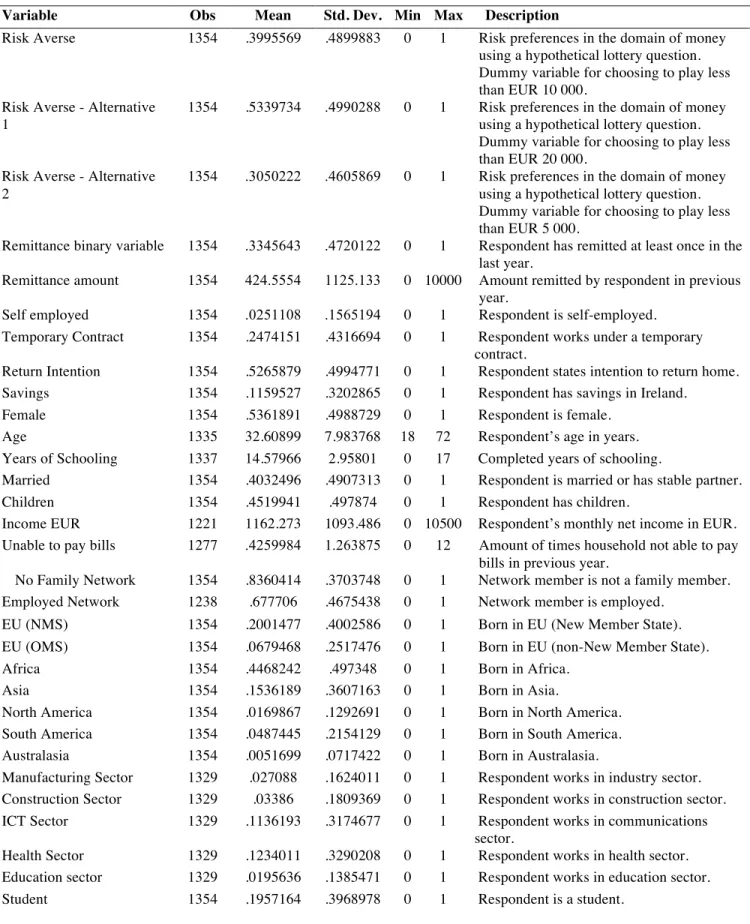
Table 1 presents a brief description of each variable used in our empirical analysis, together
with descriptive statistics. Our sample includes 1354 immigrants from a broad range of countries.
The three most popular origin countries are Nigeria, Poland and India. All other country groups
consist of less than 5% of the sample. Other European Union ‘New Member States’ are also
represented, with the largest groups being Romanians, Lithuanians, and Latvians. The two largest
migrant groups in Greater Dublin by World Region of Birth are Africa and Asia.
Still according to Table 1, a little over than half of immigrants in our sample are female.
They average 33 years of age and nearly 15 years of schooling. 40% of the respondents are married
or in a stable relationship, and 45% have children. They average a net monthly wage of 1162 EUR,
and close to 25% work under a temporary contract. One fifth of the respondents reports being a
student, while 12% works in the health sector and 11% in ICT. Nearly 9% of respondents report
being unemployed. In terms or religion, 68% of the respondents in our sample followed a Christian
religion, whereas 10% were Muslim and 11% followed no religion.
Finally, immigrants in our sample were reportedly living in Ireland for an average of 7 years
and 53% of them reported their wish to eventually return to their home country. 31% of our
respondents were married to or in a stable relationship with someone with the same nationality as
themselves, and 4% to an Irish partner.
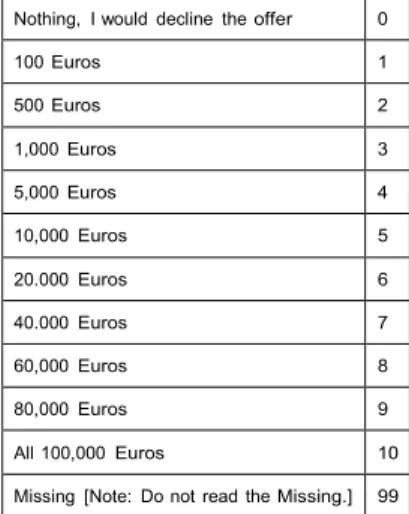
Our measure of willingness to take risks is based on a hypothetical lottery question as shown
in Figure 1. The results from the question range from 0 (corresponding to no lottery purchase) to 10
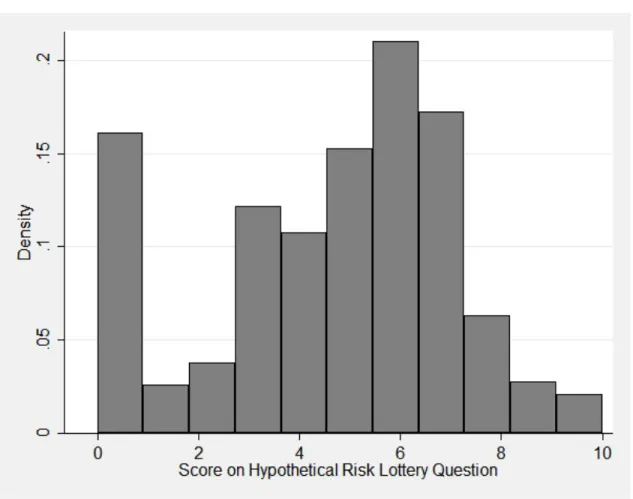
(corresponding to spending all available 100,000 Euros in a risky lottery). Figure 2 shows the
distribution of responses to the hypothetical lottery question. According to Figure 2, the most
common answer to the hypothetical lottery question was not to gamble any of the money, while the
other responses approximate a normal distribution with mean at gambling 60% of the available
As shown in Table 1, 36% of immigrants in our sample report having sent money at least
once in the year preceding the interview, while less than 12% report having savings in Ireland.
From those that did send money home, the amount varied significantly as shown in Figure 3,
ranging from EUR 3 to EUR 10,000. The main remittance recipient is not a family member in 84%
of the interviews, and this main remittance recipient was working at the time of the interview in
64% of the cases.
There is a substantial variety in the probability of remitting across world regions of birth. As
shown in Table 2, migrants from Africa are the most likely to remit with 40% sending some
money home, migrants from Asia are the second most likely to remit (36% do so in our sample).
While 31% of the EU New Member State migrants remit money home, only 7% of pre-2004
enlargement EU states send remittances home.
Regarding the relationship between risk aversion and the probability of remitting, a simple
comparison of averages for the total sample shows that a larger proportion of risk averse
individuals send remittances compared to risk loving individuals. Table 3 shows that, while only
27% of risk-loving individuals sent remittances, 40% of risk-averse migrants sent money to their
networks abroad.
Table 4 describes the covariates of risk aversion. Overall, and most importantly, the results
are consistent with the existing literature, namely with a (weak) negative relation between income
and risk aversion. Interestingly, students are very strongly negatively correlated with risk
aversion. The marital situation of migrants also seems to be strongly correlated with risk
aversion: those whose partner also lives in the host country seems to be significantly more risk
averse, although sharing the same nationality of the partner is associated with lower risk aversion.
Finally, those migrants who remit to non-family members seem to be particularly more risk
4. Empirical Results
Risk Aversion and Remittances
Table 5 presents estimates for the relationship between risk aversion and remittances both at
the extensive and intensive margin. Column (1) of Table 5 suggests that there is a statistically
significant positive relationship between risk aversion and the probability of remitting, as well as
the amount remitted: being risk averse (according to our empirical definition) corresponds to a 52
percentage point increase in the probability of remitting and 30 percentage point increase in the
amount remitted.
These controls include short contract duration (as a proxy for wage risk in the host country)
and the intention to return (as a proxy for the likelihood of needing to use insurance upon return).
According to the existing literature, both these variables should correlate positively with the
demand for self-insurance via remittances. We indeed obtain positive coefficients but they are
not precisely estimated when we account for individual risk aversion. We also control for
savings, which could be regarded as an alternative way for migrants to obtain self-insurance
against adverse shocks in the host country. This coefficient shows, however, positively in our
estimation, although not very precisely estimated, which may indicate that savings are a
complementary to remittances as a way for migrants to obtain self-insurance.
Note that the dummy variable ‘Risk Averse’, as used in columns (1) of Table 5, is defined as
investing less than EUR 10,000 in the hypothetical lottery and corresponds to approximately 50%
of the responses in our sample of migrants. Columns (2) and (3) of Table 3 shows that the
relationship between risk aversion and remittances keeps holding positive and significantly when
risk version is defined as investing less than EUR 20,000 (Risk Aversion alternative 1) or EUR
5,000 (Risk Aversion alternative 2) in the hypothetical lottery.
Income Risk and Remittances
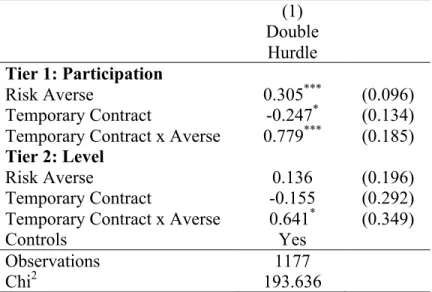
Table 6 shows how the probability of remitting correlates with temporary employment
contracts, with duration of less than one year – a proxy for wage risk faced by migrants. The
reference group is given by individuals with permanent employment contracts. Results are shown
the relationship between having a temporary contract and the probability of sending remittances is
especially significant for risk-averse individuals. The results suggest that while having a temporary
contract is associated with a lower probability of remitting and with remitting less relative to the
control group, being risk averse and having a temporary contract is associated with a higher
probability of remitting and sending more remittances.
This evidence strengthens our hypothesis that, when facing additional income risk in the host
country, risk averse individuals will remit more in an attempt to purchase additional
self-insurance from their network members at the origin.
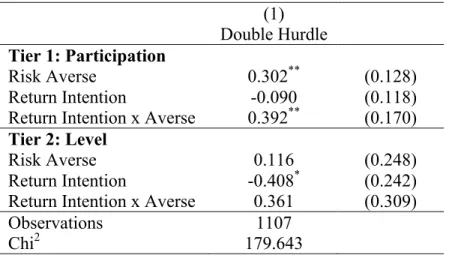
Table 7 investigates the relationship between intention to return and remittances, including
risk aversion interaction terms. The results shows that expressing an intention to return while
being risk averse is associated with an increased probability of remitting.
These results show that remittances sent by risk averse migrants are increasing with the
likelihood of returning to the origin country and benefiting from any “insurance” the migrant has
purchased with remittances
Status of Network Members and Remittances
As well as the relationship of the remittance recipient to the migrant, the financial situation of
the home network also may play a role in the decision to send money home as a method of
self-insurance. Migrants wanting to insure themselves via remittances do so with the expectation of
receiving financial assistance from home network members in case of a negative outcome in the
future, making the financial situation of contacts at home an important consideration. Sending
remittances will only function as an insurance mechanism if the migrant believes that the network
member at home is in a position to provide financial assistance when required. Therefore, the
insurance motive is likely to dominate when home network members have more resources, while
altruism usually dominates when networks are less financially stable. We test this hypothesis by
utilizing information on the employment status of network members. In our sample 67% of
network members are currently employed and we would expect the insurance motive to be stronger
for migrants sending remittances to this group compared to those with network members not
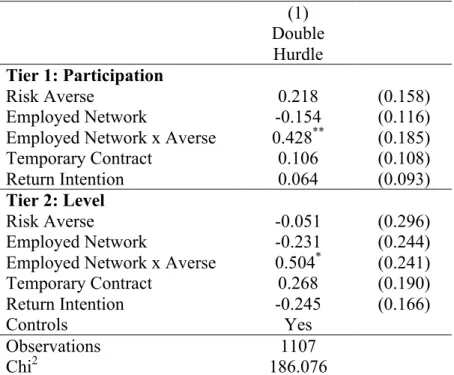
Table 8 shows the results of the intensive and extensive margin for the employment situation
of the remittance recipient. The results in Table 8 suggest that there is a positive link between
having an employed network member and being risk averse. Similar results can be seen for the
intensive margin, where there is a (marginally) significant positive link between having an
employed network member and being risk averse.
This evidence lends some support to the hypothesis that migrants target network members
with good economic status to purchase self-insurance by sending remittances to these “well-off”
network members.
Outside Family Networks and Remittances
It is likely that altruistic motives dominate for remittances to immediate family (such as
parents, children or spouses). This proposition would imply that remitting to a network contact
outside the immediate family is therefore relatively more likely to follow the self-insurance
motive for remittances. We test this implication, by examining the remittance impact of having a
main network contact outside of the immediate family.
The results confirm that having a main network contact outside of the immediate family is
associated with a lower probability of sending remittances as well as remitting a lower amount in
the year prior to the survey, as shown by Table 9 Columns (1) and (2). However, when we
investigate the interaction term for being risk averse and remitting outside of the immediate
family, the results support our hypothesis that more self-insurance motivated remittances are sent
to the network members outside of the immediate family.
5. Discussion of Results
Our results suggest that there is a positive relationship between risk aversion and remittances.
Given that we control for individual key characteristics, this measure is a good proxy for the
inherent risk preference of individuals in the domain of money. In addition, this type of risk
measure has been validated using real monetary incentives for the German Socioeconomic Panel
study by Dohmen et al. (2011), which lends confidence that this hypothetical question is able to
We are also able to test the relationship between wage risk and remittances. As in
Amuedo-Dorantes and Pozo (2006) we also found evidence that migrants on temporary contracts are more
likely to remit than those with permanent contracts. However we include an additional test to
support the suggestion that the link between wage risk and remittances is due to the insurance
motive by interacting the contract type variables with our risk preference variable. As suggested
by our hypothesis, we find that having a non-permanent contract is only significantly related to
remittances for the risk-averse individuals in our sample.
Given that migrants who intend to return are more likely to benefit from the support of
network members after return, we also investigated the link between intention to return and the
probability of remitting. While we find no strong significant link between the intention to return
and remittances in general, we do find a significant positive link for this relationship for risk-averse
individuals. This corresponds to the insurance motive for remittances as risk-averse individuals
have a stronger preference to purchase insurance, and these risk-averse individuals with an
intention to return have a higher incentive to remit for insurance purposes as they are most likely to
benefit from this insurance.
We also look at the relationship between the employment status of the network member and
remittances. We expect that employed network members are more likely to have the resources to
assist migrants in case of difficulty and are therefore more likely targets of remittances sent with
the purpose of self-insurance. We find that while risk loving migrants are less likely to send
remittances if network members are employed, risk averse migrants are more likely to send
remittances if network members are employed. This supports the hypothesis that risk-averse
migrants have a higher preference for insurance and therefore remit more when networks have a
more stable situation. Risk loving individuals have a lower preference for insurance and are
more likely to remit for other motives such as altruism, in which case we would expect a negative
link between the financial resources of the network and remittances.
6. Conclusions
The relationship between risk aversion and remittance behaviour was tested using a
Ireland. We find a statistically significant positive relationship between immigrant risk aversion
and both the probability to remit and the amount remitted by individuals in our sample.
The results suggest that being risk averse is associated with an increase in the probability of
remitting of around 40 percentage points, and an increase in the amount remitted of around 30
percentage points. Examining specific groups in our sample we find that migrants on temporary
contracts, those expressing an intention to return and those with employed network members are
more likely to remit, the more risk averse they are. This relationship is robust to different
specifications.
Our results support the hypothesis of a self-insurance motive for remittances. The use of an
individual risk aversion variable allowed us to investigate this hypothesis in a novel way,
accounting for relevant unobservable characteristics of immigrants, while strengthening the case
already made in support of this hypothesis in previous literature. This is an important suggestive
finding for policy-making in a world where the magnitude and importance of remittance flows
References
Agarwal, R., Horowitz, A., 2002. Are international remittances altruism or insurance? Evidence from Guyana using multiple-migrant households. World Development 30 (11), 2033–2044.
Ahn, T., 2010. Attitudes toward risk and self-employment of young workers. Labour Economics 17 (2), 434–442.
Altonji, J., Hayashi, F., Kotlikoff, L., 1992. Is the extended family altruistically linked? Direct tests using micro data. American Economic Review 82, 1177–1198.
Altonji, J., Hayashi, F., Kotlikoff, L., 1997. Parental Altruism and Inter Vivos Transfers: Theory and Evidence. Journal of Political Economy 105 (6), 1121-1166.
Amuedo-Dorantes, C., Pozo, S., 2006. Remittances as insurance: Evidence from Mexican immigrants. Journal of Population Economics 19 (2), 227–254.
Amuedo-Dorantes, C., Pozo, S., 2011. Remittances and income smoothing. American Economic Review 101 (3).
Arrondel, L., Masson, A., 2006. Altruism, exchange or indirect reciprocity: what do the data on family transfers show? In S. Kolm & J.M. Ythier (eds.), Handbook on the Economics of Giving, Reciprocity and Altruism, Elsevier, Chapter 14.
Ashraf, N., Aycinena, D., Martinez, C., and Yang, D., 2014. Savings in Transnational Households: A Field Experiment Among Migrants from El Salvador. Review of Economics and Statistics, forthcoming.
Batista, C., Narciso, G., 2013. Migrant remittances and information flows: Evidence from a field experiment. IZA Discussion Paper 7839.
Batista, C., Umblijs, J., 2014. Migration, risk attitudes, and entrepreneurship: Evidence from a representative immigrant survey. IZA Journal of Migration, 3(1): 1-25.
Batista, C., Silverman, D., Yang, D., 2014. Directed Giving: Evidence from an Inter-Household Transfer Experiment. NBER Working Paper 20605.
Becker, G. S., 1974. A Theory of Social Interactions. Journal of Political Economy 82(4), 1063-1094.
Bonin, H., Dohmen, T., Falk, A., Huffman, D., Sunde, U., 2007. Cross-sectional earnings risk and occupational sorting: The role of risk attitudes. Labour Economics 14 (6), 926 –937.
Brown, R., Jimenez, E., 2011. Subjectively-Assessed Welfare and International Remittances: Evidence from Tonga. Journal of Development Studies 47(6), 829-845.
Brown, R., Leeves, G., Prayaga, P., 2014. Sharing Norm Pressures and Community Remittances: Evidence from a Natural Disaster in the Pacific Islands. Journal of Development Studies 50(3), 383-398.
Caliendo, M., Fossen, F., Kritikos, A., 2010. The impact of risk attitudes on entrepreneurial survival. Journal of Economic Behavior and Organization 76 (1), 45–63.
Chort, I., Gubert, F., and Senne, J., 2012. Migrant networks as a basis for social control: Remittance incentives among Senegalese in France and Italy. Regional Science and Urban Economics 42(5), 858-874.
Cox, D., 1987. Motives for Private Income Transfers. Journal of Political Economy 95(3), 508-46.
Cox, D., Eser, Z., Jimenez, E., 1998. Motives for private transfers over the life cycle: An analytical framework and evidence for Peru. Journal of Development Economics 55(1), 57-80.
Cox, D., Fafchamps, M., 2008. Extended Family and Kinship Networks: Economic Insights and Evolutionary Directions. Handbook of Development Economics, Elsevier.
Cox, D., Hansen, B., and Jimenez, E., 2004. How Responsive are Private Transfers to Income? Evidence from a Laissez-Faire Economy. Journal of Public Economics 88 (9-10), 2193–2219.
Cox, D., Jimenez, E., 1992. Social Security and Private Transfers in Developing Countries: The Case of Peru. World Bank Economic Review 6 (1), 155–169.
Cragg, J. 1971. Some statistical models for limited dependent variables with application to the demand for durable goods. Econometrica 39, 829–844.
De la Briere, B., Sadoulet, E., De Janvry, A., Lambert, S., 2002. The roles of destination, gender, and household composition in explaining remittances: An analysis for the Dominican Sierra. Journal of Development Economics 68 (2), 309–328.
DellaVigna, S., List, J., and Malmendier, U., 2012. Testing for Altruism and Social Pressure in Charitable Giving. Quarterly Journal of Economics 127 (1), pp. 1-56.
Dohmen, T., Falk, A., Huffman, D., Schupp, J., Sunde, U., Wagner, G., 2011. Individual Risk Attitudes: Measurement, Determinants, and Behavioral Consequences. Journal of the European Economic Association 9(3), 522–550.
Galarza, F., Carter, M., 2011. Risk Preferences and Demand for Insurance in Peru: A Field Experiment. Working Paper 11-08, Universidad del Pacífico.
Gubert, F., 2002. Do migrants insure those who stay behind? Evidence from the Kayes area (Western Mali). Oxford Development Studies 30(3), 267–287.
Hill, R., Robles, M., Ceballos, F., 2013. Demand for weather hedges in India: An empirical exploration of theoretical predictions. IFPRI discussion papers 1280.
Ilahi, N., Jafarey, S., 1999. Guestworker migration, remittances and the extended family: evidence from Pakistan. Journal of Development Economics 58 (2), 485–512.
Jensen, R., 2004. Do private transfers 'displace' the benefits of public transfers? Evidence from South Africa. Journal of Public Economics 88(1-2), 89-112.
Kazianga, H., 2006. Motives for household private transfers in Burkina Faso. Journal of Development Economics 79(1), 73-117.
Leider, S., Mobius, M., Rosenblat, T., Do, Q., 2009. Directed Altruism and Enforced Reciprocity in Social Networks. Quarterly Journal of Economics 124 (4), 1815-1851.
Ligon, E., Schechter, L., 2012. Motives for Sharing in Social Networks. Journal of Development Economics 99, 13-26.
Lucas, R., Stark, O., 1985. Motivations to remit: Evidence from Botswana. Journal of Political Economy 93(5), 901–918.
Petrolia, D., Landry, C., Coble, K., 2013. Risk Preferences, Risk Perceptions, and Flood Insurance. Land Economics 89(2), 227-245.
Rapoport, H., Docquier, F., 2006. The Economics of migrants’ remittances. In J. Mercier-Ythier and S. C. Kolm (eds.), Handbook on the economics of giving, altruism and reciprocity, Elsevier, Chapter 17.
Sinning, M., 2011. Determinants of savings and remittances: empirical evidence from immigrants to Germany. Review of Economics of the Household 9(1), 45-67.
Van Praag, C., Cramer, J., 2001. The roots of entrepreneurship and labour demand: Individual ability and low risk aversion. Economica 68 (269), 45–62.
Yang, D., Choi, H., 2007. Are remittances insurance? Evidence from rainfall shocks in the Philippines. World Bank Economic Review 21 (2), 219–248.
Tables and Figures
Figure 1: Survey Question
LOTTERY QUESTION
Finally, please consider what you would do in the following situation.
Imagine that you had won 100,000 Euros in the lottery.
Almost immediately after you collect the winnings, you receive the following financial offer from a reputable bank, the conditions of which are as follows: - There is the chance to double the money within two years.
- It is equally possible that you could lose half of the amount invested within two years.
You have the opportunity to invest the full amount, part of the amount or reject the offer.
L014: What share of your lottery winnings would you be prepared to invest in this financially risky, yet lucrative investment?
Nothing, I would decline the offer 0
100 Euros 1
500 Euros 2
1,000 Euros 3
5,000 Euros 4
10,000 Euros 5
20.000 Euros 6
40.000 Euros 7
60,000 Euros 8
80,000 Euros 9
All 100,000 Euros 10
Figure 2: Risk Preferences in Migrant Sample
Figure 3: Amount of Remittances Sent Home in the Previous Year (EUR)
Table 1: Variable Description and Descriptive Statistics
Variable Obs Mean Std. Dev. Min Max Description
Risk Averse 1354 .3995569 .4899883 0 1 Risk preferences in the domain of money using a hypothetical lottery question. Dummy variable for choosing to play less than EUR 10 000.
Risk Averse - Alternative 1
1354 .5339734 .4990288 0 1 Risk preferences in the domain of money using a hypothetical lottery question. Dummy variable for choosing to play less than EUR 20 000.
Risk Averse - Alternative 2
1354 .3050222 .4605869 0 1 Risk preferences in the domain of money using a hypothetical lottery question. Dummy variable for choosing to play less than EUR 5 000.
Remittance binary variable 1354 .3345643 .4720122 0 1 Respondent has remitted at least once in the last year.
Remittance amount 1354 424.5554 1125.133 0 10000 Amount remitted by respondent in previous year.
Self employed 1354 .0251108 .1565194 0 1 Respondent is self-employed. Temporary Contract 1354 .2474151 .4316694 0 1 Respondent works under a temporary
contract.
Return Intention 1354 .5265879 .4994771 0 1 Respondent states intention to return home. Savings 1354 .1159527 .3202865 0 1 Respondent has savings in Ireland.
Female 1354 .5361891 .4988729 0 1 Respondent is female.
Age 1335 32.60899 7.983768 18 72 Respondent’s age in years.
Years of Schooling 1337 14.57966 2.95801 0 17 Completed years of schooling.
Married 1354 .4032496 .4907313 0 1 Respondent is married or has stable partner. Children 1354 .4519941 .497874 0 1 Respondent has children.
Income EUR 1221 1162.273 1093.486 0 10500 Respondent’s monthly net income in EUR.
Unable to pay bills 1277 .4259984 1.263875 0 12 Amount of times household not able to pay bills in previous year.
No Family Network 1354 .8360414 .3703748 0 1 Network member is not a family member. Employed Network 1238 .677706 .4675438 0 1 Network member is employed.
EU (NMS) 1354 .2001477 .4002586 0 1 Born in EU (New Member State).
EU (OMS) 1354 .0679468 .2517476 0 1 Born in EU (non-New Member State).
Africa 1354 .4468242 .497348 0 1 Born in Africa.
Asia 1354 .1536189 .3607163 0 1 Born in Asia.
North America 1354 .0169867 .1292691 0 1 Born in North America. South America 1354 .0487445 .2154129 0 1 Born in South America.
Australasia 1354 .0051699 .0717422 0 1 Born in Australasia.
Manufacturing Sector 1329 .027088 .1624011 0 1 Respondent works in industry sector. Construction Sector 1329 .03386 .1809369 0 1 Respondent works in construction sector.
ICT Sector 1329 .1136193 .3174677 0 1 Respondent works in communications sector.
Health Sector 1329 .1234011 .3290208 0 1 Respondent works in health sector.
Education sector 1329 .0195636 .1385471 0 1 Respondent works in education sector.
Unemployed 1354 .0886263 .2843086 0 1 Respondent is unemployed.
Christian 1354 .6779911 .467419 0 1 Respondent is Christian. Muslim 1354 .0974889 .296732 0 1 Respondent is Muslim.
No Religion 1354 .1107829 .313979 0 1 Respondent follows no religion.
Partner lives in Ireland 1354 .359675 .1652196 0 1 Respondent’s partner lives in Ireland. Same Nationality Partner 1354 .3146233 .4645373 0 1 Respondent’s partner has same nationality.
Irish Partner 1354 .0406204 .1974821 0 1 Respondent’s partner is Irish.
Table 2: Percentage of Migrants Remitting by Region of Birth
Region Percent remit (%)
Africa 40
Asia 36
EU (NMS) 31
South America 19
North America 12
EU (OMS) 7
All - Average 33
Note: The Table shows the percentage of individuals from each world region of birth that have remitted money or sent goods home at least once in the last year. EU (NMS) refers to countries which joined the European Union after 2004, EU (OMS) refers to countries that where in the EU prior to 2004.
Table 3: Risk Aversion and Probability of Remitting
Percentage remitting (%) Risk Averse 40
Risk Loving 27
Table 4: Risk Aversion and Covariates used in Empirical Analysis
Probit S.E.
Female 0.014 (0.095)
Age -0.005 (0.006)
Years of Schooling -0.015 (0.020)
Married -0.224 (0.344)
Having Children -0.169 (0.182)
Income -0.000* (0.000)
Savings 0.101 (0.136)
Financial Distress Indicator 0.071* (0.038)
Temporary Contract 0.137 (0.134)
Employed Network 0.072 (0.092)
Non-Family Network 0.249*** (0.095)
Self Employed -0.046 (0.234)
Manufacturing Sector -0.084 (0.212)
Construction Sector -0.027 (0.301)
ICT Sector 0.194 (0.139)
Health Sector 0.249* (0.147)
Education Sector 0.264 (0.285)
Student -0.357*** (0.129)
Unemployed -0.349 (0.223)
Christian 0.242 (0.201)
Muslim -0.101 (0.172)
No Religion -0.166 (0.174)
Africa 0.195 (0.132)
Asia 0.103 (0.180)
EU (NMS) -0.059 (0.186)
Rest of the World -0.005 (0.180)
Same Nationality Partner -0.424** (0.176)
Irish Partner 0.171 (0.239)
Partner Lives in Ireland 0.602* (0.324)
Partner Lives in Same House 0.560 (0.367)
Year of Arrival 0.013 (0.016)
Observations 1107
Pseudo R2 0.116
Marginal effects; Standard errors in parentheses, clustered by country of birth.
*
p < 0.10, **p < 0.05, ***p < 0.01
Table 5: Probability of Remitting and Risk Preferences
Marginal effects; Standard errors in parentheses, clustered by country of birth.
*
p < 0.10, **p < 0.05, ***p < 0.01
Note: The Table reports marginal effects of Double Hurdle estimates. Control variables include basic demographics, such as gender, age, years of schooling, religion, marital status, having children, industry of occupation, income, financial distress indicators, and world region of origin. We also include employment contract duration, reported intention to return, number of years in Ireland, partner living in Ireland and Irish partner, as well as employment status of the network member, and the presence of migrant savings.
(1) (2) (3)
Double Hurdle
Double Hurdle
Double Hurdle
Tier 1: Participation
Risk Averse 0.515*** (0.086)
Risk Aversion - Alt.1 0.340*** (0.086)
Risk Aversion - Alt.2 0.442*** (0.088)
Temporary Contract 0.119 (0.107) 0.109 (0.108) 0.146 (0.107) Return Intention 0.076 (0.092) 0.096 (0.092) 0.107 (0.092) Savings 0.175 (0.126) 0.167 (0.125) 0.183 (0.125)
Tier 2: Level
Risk Averse 0.306* (0.166)
Risk Aversion - Alt.1 0.346* (0.180)
Risk Aversion - Alt.2 0.242* (0.145)
Temporary Contract 0.286 (0.192) 0.260 (0.190) 0.295 (0.193) Return Intention -0.227 (0.167) -0.228 (0.166) -0.201 (0.168) Savings 0.581*** (0.195) 0.571*** (0.193) 0.585*** (0.195)
Controls Yes Yes Yes
Observations 1107 1107 1107
Table 6: Remittances and Type of Contract: Extensive and Intensive Margins
Marginal effects; Standard errors in parentheses, clustered by country of birth.
*
p < 0.10, **p < 0.05, ***p < 0.01
Note: The Table reports marginal effects of Double Hurdle estimates. Control variables include basic demographics, such as gender, age, years of schooling, religion, marital status, having children, industry of occupation, income, financial distress indicators, and world region of origin. We also include employment contract duration, reported intention to return, number of years in Ireland, partner living in Ireland and Irish partner, as well as employment status of the network member, and the presence of migrant savings.
(1) Double Hurdle
Tier 1: Participation
Risk Averse 0.305*** (0.096) Temporary Contract -0.247* (0.134) Temporary Contract x Averse 0.779*** (0.185)
Tier 2: Level
Risk Averse 0.136 (0.196)
Temporary Contract -0.155 (0.292) Temporary Contract x Averse 0.641* (0.349)
Controls Yes
Observations 1177
Table 7: Remittances and Intention to Return: Intensive and Extensive Margins
Marginal effects; Standard errors in parentheses, clustered by country of birth.
*
p < 0.10, **p < 0.05, ***p < 0.01
Note: The Table reports marginal effects of Double Hurdle estimates. ‘Return Intention’ is a dummy variable for intending to return in the next ten years. Control variables include basic demographics, such as gender, age, years of schooling, religion, marital status, having children, industry of occupation, income, financial distress indicators, and world region of origin. We also include employment contract duration, reported intention to return, number of years in Ireland, partner living in Ireland and Irish partner, as well as employment status of the network member, and the presence of migrant savings.
(1) Double Hurdle
Tier 1: Participation
Risk Averse 0.302** (0.128) Return Intention -0.090 (0.118) Return Intention x Averse 0.392** (0.170)
Tier 2: Level
Risk Averse 0.116 (0.248)
Return Intention -0.408* (0.242) Return Intention x Averse 0.361 (0.309)
Observations 1107