A Dynamical System for the Algebraic Approach
to the Genetic Code
M. Magini
1∗and J.E.M. Hornos
2 1Instituto de Pesquisa e Desenvolvimento, UNIVAP,
Av. Shishima Hifumi, 2911, 12244-000 S˜ao Jos´e dos Campos, S.P., Brazil 2
Instituto de F´ısica de S˜ao Carlos, USP,
Caixa Postal 369, 13560-970 S˜ao Carlos, S.P., Brazil
Received on 22 May, 2003. Revised version received on 23 September, 2003.
Explaining codon evolution in the standard genetic code is a remarkable subject in Molecular Biology. There are many works which try to develop a model to represent this evolution, sometimes using a certain amount of mathematical tools. The present work has as its main objective to explain one possible dynamical evolution model, which is based in the algebraic approach proposed in1993by Hornos and Hornos. This model made an analogy between the evolution of elementary particles and evolution of codons. As a result, the symmetry group that better adjusts degeneracy of the genetic code is the simplectic groupSp(6). The dynamical model present here is based in the3dimensional weight space ofSp(6), calledCodon Space. This space is invariant under the action of theOctahedral Group. A map,ℜ3
→ ℜ3
, was constructed using an equivariance principle and its action in the Codon Space was observed. The results were based in the analysis of the attractors and their preserved symmetries. The dynamical system action reproduces the main aspects of the labeling proposed in the algebraic approach. Moreover, the map separates the codons in distinguished sets, coupling codons from the same aminoacid in the same attractor. These dynamical results indicate that the algebraic model proposed in
1993may be an important contribution to explain codon evolution, both in the algebraic and in the dynamical aspects.
1
Introduction
An evolving code is a widely accepted idea after the dis-covery of non-standard mithocondrial codes[1, 2]. The de-viations from the universal code which characterize mitho-condrial and some nuclear species are testimonies of the large scale time evolution from a simpler ancestor code to the present form. Examples of such ideas are the primor-dial code proposed by Osawa and Jukes[1, 2], the theory of Landweber[3], and Gray et. al.[4].
A code containing only a reduced number of aminoacids ruling the protein synthesis in the beginning of life forma-tion is also a very common assumpforma-tion. Recently Trifonov [5] listed and compared a family of models designed to se-lect the amino-acid ancestors [6-9].
The algebraic approach to the genetic code [10-13] con-siders the experimental degeneracy of the standard code as a starting point, and searches for a symmetry group able to generate this degeneracy by a process of symmetry-breaking called the Higgs-Crick mechanism. The best, or unique un-der some restrictions, symmetry found among Lie groups was the symplectic group Sp(6). From an evolutionary point of view, we can say that the symplectic symmetry have
been selected by evolution in the same sense that icosahedral symmetry was advantageous in the formation of virus cap-sule. However, the analogy is vague: in the case of viruses one deals with the symmetry of an object while in the case of the genetic code it is a dynamical symmetry, manifested in the process of protein translation. This approach is simi-lar to symmetry-based models used in physics, mathematics and recently in biology [14-19]. However, in those theories some kind of dynamical system is naturally associated with the model. The most popular example is Maxwell’s the-ory for electromagnetism or the similar theories for strong and weak interactions. Space-time symmetries and gauge invariance appear as properties of partial differential equa-tions, leading immediately to the possibility of quantitative predictions.
In the case of the algebraic model only the degeneracy is used as an input, and the symmetry-breaking pattern is the main result coming from the theory. A number of predic-tions about the primordial amino acids, the existence of a freezing process, and some hints about the timing of incor-poration of amino acids can be obtained from this approach. However, the absence of a dynamical model limits the quan-titative power of that approach.
The definition of a class of dynamical systems appro-priate to a given symmetry is a well-defined mathematical problem. One can, for example, look for general first-order differential equations equivariant under the given symme-try, and use that to model the codon evolution and the re-lation with the amino acids. Indeed, the idea to investigate the properties of codons in some 64th-dimensional structure is older than the algebraic model. It has been used to in-vestigate physical-chemist correlations between codons and amino acids by Giulio [8].
The main point in the algebraic approach is the action of a Lie group on the space of codons. The main goal of this article is to propose a dynamical system for the evolution of codons. The high dimensionality of the codon space and the complexity of the symplectic group turn this problem into a formidable task. Dynamical systems for finite groups have been extensively studied [20, 21, 22], but few examples are available in the literature for continuous groups as complex asSp(6).
A less ambitious program can be implemented focusing our attention in the weight space of the group [23, 24]. This space, to be defined below, is a tridimensional space instead of a 64th dimensional space as the codon space. They are not equivalent: going down to the weigh space we
neces-sarily loose information. But what is important is that the fundamental features of the dynamical system will appear in this simple model.
2
The algebraic model codon
assign-ment
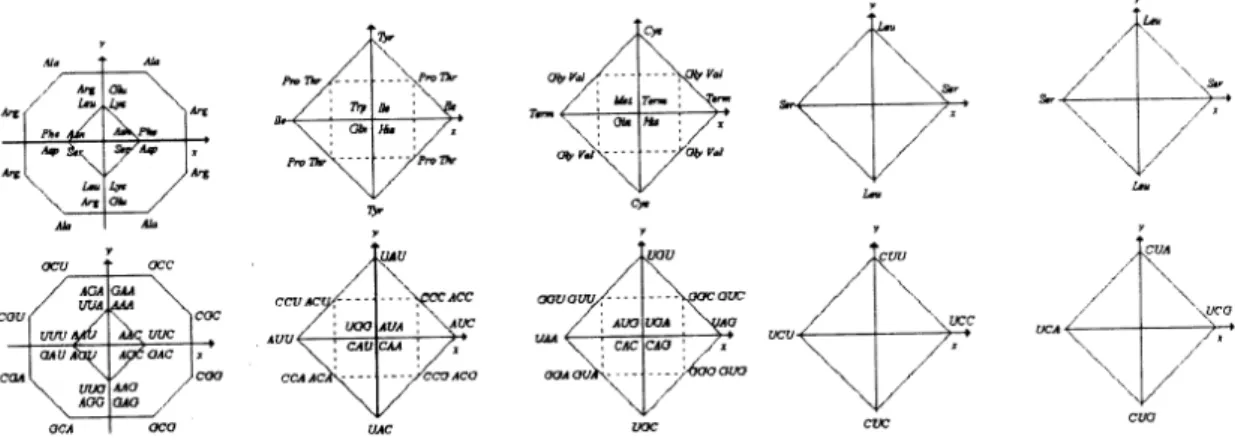
One important step to understand the present approach is the codon assignment proposed by the algebraic model. The decomposition of the codon space [13] occurs in this way: in the first step six independent groups of codons are gen-erated, corresponding to primitive amino acids. The codon space in this stage has six different codons labeled, and as a result the octahedral symmetry decrease to a symmetry Z2×D4. In the next steps, degeneracy decreases until the standard code is reached, where the symmetry preserved is the Klein symmetry. In the final step we have all codons represented by vectors in theWeight Space. The assignment of the codons in the Weight Space is showed, separated by their degeneracies, in tab.(1), tab.(2), tab.(3), tab.(4), tab.(5). In the algebraic model for the genetic code aminoacids with degeneracy six can be found in the weight space of the symplectic group in the plans called bosonic plans, which arez= 0,±2.
Table 1. The codons and their positions in the Weyl space, degeneracy =6.
Codons - Aminoacid Positions
CGU,CGC,CGA,CGG,AGA,AGG - Arg (−2,1,0),(2,1,0),(−2,−1,0),(2,−1,0),(0,1,0),(0,−1,0)
UUA,UUG,CUU,CUC,CUA,CUG - Leu (0,1,0),(0,−1,0),(0,1,2),(0,−1,2),(0,1,−2),(0,−1,−2)
AGU,AGC,UCU,UCC,UCA,UCG - Ser (−1,0,0),(1,0,0),(−1,0,2),(1,0,2),(−1,0,−2),(1,0,−2)
Table 2. The codons and their positions in the Weyl space, degeneracy =4.
Codons Aminoacid Positions
GCU,GCC,GCA,GCG Ala (−1,2,0),(1,2,0),(−1,−2,0),(1,−2,0)
CCU,CCC,CCG,CCA Pro (−1,1,1),(1,1,1),(1,−1,1),(−1,−1,1)
GGU,GGC,GGA,GGG Gly (−1,1,−1),(1,1,−1),(−1,−1,−1),(1,−1,−1)
ACU,ACC,ACG,ACA Thr (−1,1,1),(1,1,1),(1,−1,1),(−1,−1,1)
GUU,GUC,GUG,GUA Val (−1,1,−1),(1,1,−1),(1,−1,−1),(−1,−1,−1)
Table 3. The codons and their positions in the Weyl space, degeneracy =3.
Codons Aminoacid Positions
AUU,AUA,AUC Ile (−2,0,1),(0,0,1),(2,0,1)
Table 4. The codons and their positions in the Weyl space, degeneracy =2.
Codons Aminoacid Positions
UUU,UUC Phe (−1,0,0),(1,0,0)
GAU,GAC Asp (−1,0,0),(1,0,0)
GAA,GAG Glu (0,1,0),(0,−1,0)
AAU,AAC Asn (0,1,0),(0,−1,0)
AAA,AAG Lys (0,1,0),(0,−1,0)
CAA,CAG Gln (0,0,1),(0,0,−1)
CAU,CAC His (0,0,1),(0,0,−1)
UGU,UGC Cys (0,2,−1),(0,−2,−1)
UAU,UAC Tyr (0,2,1),(0,−2,1)
Table 5. The codons and their positions in the Weyl space, degeneracy = 1.
Codons Aminoacid Positions AUG Met (0,0,−1)
UGG Trp (0,0,1)
The plan names were defined by the last coordinate in the weight vector. For example a codon with assignment vector type (a, b,±1)has to be in a fermionic plan other-wise it will be in abosonic plan.
All aminoacids with degeneracy three are in the fermionic plan1
. In tab. (4) is showed the aminoacids with degeneracy two.
There are nine aminoacids with degeneracy two. Some of them can be found in a fermionic plan and some in the bosonic plan. There are two aminoacids with degeneracy one. The representation of the codons in a three dimensional space leads to a problem: the64 codons, that were repre-sented in theSp(6)model by independent vectors, have to fit in a3dspace, and thus some information is lost. The arrangement of the codons in the weight space by plans is showed in Fig. 1. The codons position is a fundamen-tal characteristic for a dynamical discrete system behavior, since from these positions was defined the dynamical system action; in other words, they are initial conditions to iterate the discrete map.
Figure 1. Amino acid and codon assignments for the standard genetic code,according to [13]. From left to right: planez= 0; planez= 1; planez=−1; planez= 2; planez=−2.
3
The octahedral equivariant map
The octahedral equivariant map can be constructed using the generators of the groupOhwith dimension three[25]. These generators are matrices3×3, in total of three. All different combinations of the generators produce the rest of the45 el-ements of theOhgroup. Each symmetry operation has the corresponding matrix representation. For example: a rota-tion of900
around thezaxis is represented by the matrix
M1=
0 1 0
−1 0 0 0 0 1
. (1)
This matrix correspond to the permutation element
(1234)or a rotation by900
degrees around thez- axis. The other two3-dimensional generators ofOhare
M2=
0 0 1 0 −1 0 1 0 0
, (2)
1
and
M3=
−1 0 0
0 −1 0 0 0 −1
, (3)
corresponding to the permutation elements (16)(35)(24)
and (13)(24)(56), respectively. The last one is the com-plete reflection. Multiplying these matrices among them-selves we generate more45matrices, including the identity, which represents the octahedral group.
The dynamical system which has this symmetry as equivariant symmetry can be represented by a set of func-tions. The equivariance principle is given by: The function f(r;λ) : M → N is said to be equivariant under the ac-tion of the elementγ ∈Γ, whereΓis a symmetry group if, f(γr;λ) =γf(r;λ),where the constantλis thebifurcation parameter[20]. Through the map iteration it is possible to see the isotropic subgroups when the bifurcation parameter has increased or decreased, depending on the system con-structed [25]. The isotropic subgroups are represented by the attractors generated by the iteration process [22]. In our case the map is an application f(x) : ℜ3
→ ℜ3
, and the attractors are in the same space, but drawing in a plane by perspective.
The first step in the construction of the dynamical sys-tem is to apply the equivariance in a generic function f(x, y, z;λ) = Σ ∆τ,θ,ρxτyθzρ, where τ, θ, ρ are vari-ant parameters. Through the equivariance properties by the matrices action it is possible to construct the map. The equivariant map can be reduced in the final step of its con-struction using the invariant function. The invariance prin-ciple is given byThe function f(r;λ) : M → N is said to invariant under the action of the symmetry group Γ if; f(γr;λ) = γf(r;λ) = f(r;λ)whereγ ∈ Γ. Using the invariance principle was construct the three invariant func-tions for the octahedral symmetry, as follow.
u = x2y2z2
v = x2+y2+z2 (4)
s = x2y2+z2y2+x2z2.
There are an infinite number of possibilities to produce a dynamical system which preserves the octahedral symme-try. One of these possibilities of dynamics, based in stability concepts and analyzing the fixed points for each value of the bifurcation parameter, is given as follow.
⌋
F=
fx=x[δs+σv+λ+ϕ{(x 2
−y2
−z2
) + (y2 z2
−x2 y2
−z2 x2
)}]
fy=y[δs+σv+λ+ϕ{(y 2
−x2
−z2
) + (x2 z2
−x2 y2
−z2 y2
)}]
fz=z[δs+σv+λ+ϕ{(z2−x2−y2) + (x2y2−z2y2−z2x2)}]
. (5)
⌈
The parameters δ, σ, ϕ were determined from parity relations between the matrices and the old general param-eters τ, θ, ρ. Their values are determined observing the fixed points possibilities. The role of the parameters is de-termine the shape of the attractors. Different attractors with Ohcan be produced by different values of the fixed param-etersδ, σ, ϕ. This characteristic can be observed in some works were the bidimensional maps withDmsymmetry are analyzed [21]. A fixed point is defined by:
f(x0, y0, z0;λ) = (x0, y0, z0). (6) The map is an applicationℜ3
→ ℜ3
so the fixed points
(x0, y0, z0)can be obtained by mathematical relations that preserves the real space. In other words, the fixed points are responsible to define the dynamics behavior in the real space and they have a directly relation (x0, y0, z0) =
p
f(δ, σ, ϕ; λ). Imposed that this square root is a real number for a range ofλvalues it was achieve the fixed pa-rameters values.
Starting our dynamics with δ = 1, σ = −0.7, ϕ =
−0.8and the bifurcation parameter inλ=−1.440produces
an attractor withOhsymmetry. This result is well known in many aspects. However, the interest here is in how this map can change the evolution aspects(labeling) proposed by the algebraic approach. Besides, the map can produce a totally different evolution path when acting in the codon space.
Using the labeling proposed by the algebraic approach described in Fig. 1 it is possible to define what initial condi-tions are in our perspectives. Theλvariation promotes a set of different attractors, where the preserved symmetries are related by the invariant subgroups. Forλ =−1.400aD4 symmetry is generated. Through the computational behav-ior the symmetry relations can be easily determined. Appli-cation of the generator matrices in the points resulted by the map iteration leave all points invariant. This fact leads to the D4symmetry as invariance group for this value ofλ.
4
Results and conclusions
sym-metries that are preserved by different values ofλare: oc-tahedral symmetry in −1,440, D4 symmetry in −1,400, Klein symmetry in−1,354andZ2or Chiralsymmetry in
−1,332, which are the isotropic subgroups ofOh. To pro-duce the dynamics attractors the initial condition was fixed in just one value. As an example it is possible to see the octahedral subgroups represented by their attractors in Fig. 2, Fig. 3 acting in the codon space when the values of λ are−1,440and−1,400. In this specific case the dynamics does not produce the octahedral symmetry, theD4 symme-try is preserved. This happens because the aminoacids are in plans which reduce the space in one dimension. In other words, there is no dynamics in a three dimensional space when one is considering the map action in codon space even ifλ=−1,440.
Figure 2. Attractor withD4symmetry preserved.
Different initial conditions could produce completely differ-ent aspects of our dynamics. For our surprise, the points fixed as codons in the algebraic model weight space gave us one important information: codons that represent the same aminoacid remains in the same attractor until the final step of symmetry breaking in the dynamical model, when the sym-metryZ2appear as main symmetry, pairing the codons two by two.
The symmetry breaking or codon evolution represented by a dynamical system is unique. As an example of the present approach it will be considered some aminoacids — a complete study is unnecessary because the symmetry is valid for all aminoacid — so the dynamical system acts in the same way when the same position is used as initial con-dition. Let us present a brief discussion about the action of the discrete map in the aminoacids position labeled repre-sented in the codons space.
When the dynamical system starts in the codon posi-tion that represents the aminoacid Gly, it promotes a split
of attractors corresponding to the codons GGC and GGA in a two-points attractor and the other two codons of Gly in another two-points attractor, which are distinct. The same pattern can be viewed when the aminoacid Val is used. A notable fact is this: no codon is mixed with codons from different aminoacids because the different assignment will mix different codons from distinguishable aminoacids. The unexpected pairing GGC and GGA besides GGC and GGU depends on assignment proposed, exclusively, and can be re-paired in the algebraic model to make the dynamical model more precise.
Figure 3. Distinct attractors (divide by traceable lines) withKlein symmetry preserved.
The codons of Ala are in a attractor withD4symmetry whenλ ≤ −1.400Fig. 2. Together with them, forming in the same orbit, are the Arg codons CGU, CGC, CGA and CGG, see tab.(1). These codons are in the same irreducible representation in the algebraic model, which is an impor-tant result. For−1.400 < λ ≤ −1.354the codons of Ala are separated of the Arg codons in two distinct attractors Fig. 3. Each one has as a setwise group of symmetry, the Kleingroup. The assignment done by the algebraic model and the dynamical system action guarantee a correct sepa-ration of codons during their evolution. An undesired situ-ation that not occurred, in this case, will be the mixing of different codons from distinct aminoacids in the same orbit. For lower values ofλthere occurs a shift of codons from the same aminoacids forming two attractors for the same aminoacid. Similar result occurred with the Gly.
The codons of Arg, Ser and Leu with degeneracy6were separated by the action of the dynamical system in two be-haviour families: one family is a set of4 codons and the another is a set with2codons2
while in the algebraic model 2
they are in the same representation. The Weyl Group action in the weight space does not connect the six codons of each aminoacid. In this way they evolved to distinct attractors, as discussed.
Figure 4. Distinct attractors (divide by traceable lines) withQuiral symmetry preserved.
The dynamical system differs the termination codons UAA and UAG, see tab.(3), from the codon UGA. This dis-tinction can be observed in non-standard codes when UGA starts to codify Ile. Surprisingly these two codons are in the same orbit in Fig. 4. The same pattern occurs with Met and Trp.
The algebraic approach [10] was proposed to explain codon degeneracy in the standard genetic code. After some time a series of works and tools were created to produce stronger conclusions about evolution. Most of them were a success in the sense that they prove that ideas suggested by the model are correct, in biological and mathematical con-text. Here was presented one important approach, which only uses as a starting point the Weyl Group of Sp(6). Note that the possibilities of distinction using the dynami-cal model are more than 1. In other words, from the action of the map in the Codon Space it could be expected a set of symmetry breaking chains. Actually the possible number of chains are bigger than 20. More than this, the points in the map are unstable and hyperbolics so the behavior of the map in unpredictable. However, it was observed that even in the dynamical system the codon evolution produces prac-tically the same path proposed by the algebraic approach, with one difference: the aminoacids with degeneracy 6 are not well represented by the dynamics, this is a weak point in this approach. Nevertheless, aminoacids with degener-acy 6 were a doubt problem when the algebraic approach was constructed, and are considered by many researchers as “problematic” aminoacids when the evolution context is an-alyzed. In a general context the dynamics action in Codon
Space is responsible to shift different aminoacids leaving codons from a same aminoacids in a same dynamic symme-try. These results generate families of codons in a evolution sense provided by variation ofλ.
References
[1] S. Osawa, T.H. Jukes, K. Watanabe, and A. Muto, Microb. Rev.56229 (1992).
[2] S. Osawa,Evolution of the Genetic Code, (Oxford University Press, Oxford, 1995).
[3] R.D. Knight and L.F. Landweber, Cell vol.101, 569 (2000).
[4] M.W. Gray, G. Burger, and B. F. Lang, Science vol.283, 1476 (1999).
[5] E.N. Trifonov, Gene261, 139 (2000).
[6] M. Eigen and R. Winkler- Oswatitsch, Die Naturwis-senshaften68, 217 (1981).
[7] M. Eigen and R. Winkler- Oswatitsch, Die Naturwis-senshaften68, 282 (1981).
[8] M. Di-Giulio, Orig. Life Evol. Biosph.26, 589 (1996).
[9] K. Nieselt-Struwe and P.R. Wills, J. Theor. Biol. 187, 1 (1997).
[10] J.E.M. Hornos and Y.M.M. Hornos, Phys. Rev. Lett.71, 4401 (1993).
[11] J.E.M. Hornos and Y.M.M. Hornos, J. Biol. Phys.20, 289 (1994).
[12] M. Forger, J.E.M. Hornos, and Y.M.M. Hornos, Phys. Rev. E
56, 7078 (1997).
[13] J.E.M. Hornos, Y.M.M. Hornos, and M. Forger, Int. J. Mod. Phys. B13, 2795 (1999).
[14] A. Arima and F. Iachello, The Interact-ing Boson Model, Cambridge Monographs on Mathematical Physics,(Cambridge University Press, Cambridge, 1987).
[15] M. Eigen, B.F. Lindermann, M. Tietze, R. Winkler-Oswatitsch, A. Dress, and A. von Haeseler, Science244, 673 (1989).
[16] J. Chela-Flores, Acta Biotheretica37, 267 (1988).
[17] J. Maddox, Nature,367, 111 (1994).
[18] I. Stewart, New Scientist141, 16 (1994).
[19] M.A. Jim´enez-Monta˜no, Biosyst.64, 47 (1999).
[20] P. Chossat and M. Golubitsky, Siam J. Math. Anal.19n.6, 1259 (1988).
[21] P. Chossat and M. Golubitsky, Phys. D32, 423 (1998).
[22] E. Barany, M. Dellnitz, and M. Golubitsky, Phys. D67, 66 (1993).
[23] M. Hammermesh, Group Theory and It is Application to Physical Problems, (Dover Books, New York, 1989).
[24] A.O. Barut and R. Raczka,Theory of Group Representations and Applications, (World Scientific Publishing, Singapore, 1986).