Frame Dependence of the Pair Contribution to the
Pion Electromagnetic Form Factor in a Light-Front Approach
J. P. B. C. de Melo
a, T. Frederico
b, E. Pace
c, and G. Salm`e
da
Instituto de F´ısica Te´orica,
Universidade Estadual Paulista, 01405-900, S ˜ao Paulo, SP, Brazil b
Dep. de F´ısica, Instituto Tecnol´ogico da Aeron´autica,
Centro T´ecnico Aeroespacial, 12.228-900, S˜ao Jos´e dos Campos, S˜ao Paulo, Brazil c
Dipartimento di Fisica,
Universit`a di Roma “Tor Vergata” and Istituto Nazionale di Fisica Nucleare, Sezione Tor Vergata, Via della Ricerca Scientifica 1, I-00133 Roma, Italy
d
Istituto Nazionale di Fisica Nucleare,
Sezione Roma I, P.le A. Moro 2,I-00185 Roma, Italy
Received on 30 October, 2002
The frame dependence of the pair-term contribution to the electromagnetic form factor of the pion is studied within the Light Front approach. A symmetric ansatz for the pion Bethe-Salpeter amplitude with a pseudo scalar coupling of the constituent to the pion field is used. In this model, the pair term vanishes for the Drell-Yan condition, while it is dominant for momentum transfer along the light-front direction.
I
Introduction
Within the Front Form dynamics[1], where the state of the system is defined atx+ = t+z = 0, if one uses the im-pulse approximation of the plus component of the electro-magnetic current (j+) in the Drell-Yan frame to calculate the form factors, the pair production from the incoming photon (pair-term contribution) is in general suppressed by light-front momentum conservation (see, e.g., [2]). This was seen in schematic covariant models for spin-zero composite sys-tems [3, 4, 5]. However, even in the Drell-Yan frame the pair term is present inj+ for spin-one systems and is necessary to keep the rotational properties of the matrix element of the current[6, 7].
To avoid the difficulties associated with the rotational properties of the impulse approximation some physically motivated schemes to extract form factors from the cur-rent were used[8, 9, 10]. In another approach, free of these ambiguities[11], the plus component of the momen-tum transfer is non zero while the transverse momenmomen-tum transfer vanishes in the Breit frame. This can be achieved by departing from the Drell-Yan condition by rotating the system around they-direction, i.e, a non-kinematical trans-formation, and thus changing the direction of the momentum transfer in thez−xplane.
However, by relaxing the Drell-Yan condition, a light-front pair term can contribute to the plus component of the current, which can be studied in the pion example, as a
pro-totype of a relativistic system of bound constituents. In this work, the composite system of a constituent quark and anti-quark, is described by an ansatz for the Bethe-Salpeter am-plitude which is nonconstant and symmetric with a pseudo scalar coupling of the constituent to the pion field. Our aim here is to discuss, within that model, the magnitude of the pair contribution to the pion electromagnetic form factor for momentum transfers in thez−xplane in the Breit-frame, as has been done in Ref.[5].
The work is organized as follows. In Sec. II, we present the model of the pion Bethe-Salpeter amplitude and its eletromagnetic current in impulse approximation. In Sec. III, we discuss the numerical results for the pion electromag-netic form factor where the separate contribution of the pair term is given. We also present our summary in Sec. III.
II
Pion Model and Electromagnetic
Current
The electromagnetic current of the pion is calculated in impulse approximation, using a pseudoscalar coupling be-tween pion and quark fields, given by the effective La-grangian (see, e.g. [12]):
LI =−ıg~Φ·qγ5~τq , (1)
where g = m/fπ is the coupling constant from the
mass of the constituents andfπthe pion decay constant.
The electromagnetic current of π+in impulse approxi-mation is build from the covariant expression, which corre-spond to the Feynman triangle diagram (see, e.g., [13]):
jµ = −ı2em
2
f2
π
Nc
Z d4k
(2π)4Λ(k, P′)Λ(k, P)
× T r[S(k)γ5S(k−P′)γµS(k−P)γ5], (2)
whereS(p) = 1 /
p−m+ıǫ,Nc= 3is the number of colors, PµandP′µ=Pµ+qµare the initial and final momenta of
the system, qµ is the momentum transfer andkµ the
spec-tator quark momentum. The factor 2 stems from isospin algebra.
Our ansatz for the analytical form of the vertex function describing the momentum part of the coupling between the constituents and pion is:
Λ(k, P) = C (k2−m2
R+ıǫ)
+ C
((P−k)2−m2
R+ıǫ)
,
(3) where mR is the regulator parameter. By imposing the
charge normalization conditionFπ(q2 = 0) = 1, the
con-stantC is fixed. This model satisfies current conservation
q·j= 0[5].
We consider Breit frames, with the momentum trans-ferq+ 6= 0and using the light-front variables, i.e. k+ =
k0+k3, k−=k0−k3, ~k
⊥≡(k1, k2), one has
q+=−q−=p
−q2sinα, q
x=
p
−q2cosα, q
y= 0, (4)
andq2=q+q−−(~q
⊥)2. The Drell-Yan frame withq+= 0
is recovered forα = 0, while theq+ = p
−q2 condition [11] comes withα = 90o. (The angleθof Ref.[14]
corre-sponds toα+ 90o).
The pion electromagnetic form factor is extracted from the general covariant expression:
jµ=e(Pµ+P′µ)F
π(q2), (5)
evaluating the plus component of the current in Eq.(2), which has two non vanishing contributions: [3, 5, 14, 15]:
Fπ(q2) =Fπ(I)(q2, α) +Fπ(II)(q2, α). (6)
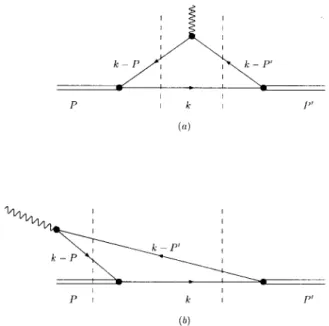
The integration over the interval of0 ≤ k+ < P+ de-finesFπ(I)(q2, α)(see Fig. 1(a)). Fork+ in the integration
intervalP+
≤ k+
≤ P′+ (see Fig. 1(b)) one defines
Fπ(II)(q2, α). In this model the contribution of the valence
component of the wave function is part ofFπ(I)(q2, α). The
pair term contribution to the form factor, withq+ > 0, is
Fπ(II)(q2, α).
Figure 1. Light-front time-ordered diagrams for the current: (a) Fπ(I)(Eq.(7)) and (b)F(
I I)
π (Eq. (8)).
The two contributions to the form factor are given by:
F(I)
π (q
2, α) =
−ı m
2
(P++P′+)f2
π
Nc
(2π)4 Z
d2k⊥dk+dk−
× θ(k
+)θ(P+
−k+)
k+(P+−k+)(P′+−k+)Π(k, P, P′)(7) and
Fπ(II)(q2, α) = −ı
m2 (P++P′+)f2
π
Nc
(2π)4 Z
d2k⊥dk+dk−
× θ(k
+−P+)θ(P′+−k+)
k+(P+−k+)(P′+−k+)Π(k, P, P
′)(8)
where
Π(k, P, P′) = T r[O+]Λ(k, P)Λ(k, P′)
(P−−k−−(P−k)−
on+P+ıǫ−k+)
× 1
(k−−k−
on+ıǫ)(P′−−k−−(P′−k)−on+ıǫ)
,
(9) with,
O+= (/k+m)γ5(/k−/P′+m)γ+(/k
−/P+m)γ5. (10) The suffixonindicates particles on-k−-shell. In particular,
for the Drell-Yan condition (q+ = 0)F(II)
π (q2, α)vanishes.
The Dirac propagator written in terms of light-front mo-menta has two parts [16]:
/
k+m k2−m2+ıǫ =
/
kon+m
k+(k−−k−
on+kıǫ+)
+ γ +
2k+ , (11) where k−
on = (k⊥2 +m2)/k+. In the right-hand side of
Eq.(11), the first term is propagating in the light-front time and the second one is instantaneous. This second term con-tributes to bothFπ(I)(q2)andFπ(II)(q2), due to the analytic
The pion Bethe-Salpeter amplitude within the model is given by:
Ψ(k, P) =
m fπ
/
k+m k2−m2+ıǫγ
5Λ(k, P) /k−/P+m (k−P)2−m2+ıǫ(12), from which the momentum component of the valence light-front wave function, Φ(k+, ~k
⊥;P+, ~P⊥)[5], is
de-rived eliminating the relative time between the quarks af-ter dropping the instantaneous af-terms of the exaf-ternal Dirac propagators[17]. Also, the factors containing gamma ma-trices in the numerator and the phase space factorsk+ and (P+−k+)appearing in the denominator are left out[5], and then one gets:
Φ(k+, ~k⊥;P+, ~P⊥) =
·
N
(1−x)(m2
π− M2(m2, m2R))
+ N
x(m2
π− M2(m2R, m2))
¸ P+
m2
π−M02
. (13) whereN = √Nc C m/fπ, is a normalization factor and
x = k+/P+, with 0
≤ x ≤ 1; M2(m2
a, m2b) = k2
⊥+m
2 a
x +
(P−k)2
⊥+m
2 b
1−x −P
2
⊥ ; and the square of the free
mass is M2
0 = M2(m2, m2). The light-front wave func-tion, Eq.(13), is symmetric by the interchange of quark and antiquark momenta, therefore it is not plagued by the con-ceptual difficulties associated with the use of the nonsym-metric regulator [14].
The electromagnetic form factor evaluated in the Breit frame using only the valence component is given by:
F(W F)
π (q
2, α) = 1 2π3(P′++P+)
Z
d2k⊥
Z P+
0
dk+
×
·
k−
onP+P′++
1
2~k⊥·~q⊥(P
′+
−P+)−1 4k
+q2
⊥
¸
× Φ(k
+, ~k
⊥;P′+,~q2⊥)Φ(k+, ~k⊥;P+,−~q2⊥)
k+(P+−k+)(P′+−k+) , (14) where normalization constantCis determined from the con-ditionFπ(0) = 1in Eq. (6). The probability of the valence
component in the pion,η, is identified toFπ(W F)(0,0)
The pion decay constant is one constraint to fix the free parameters of the model:
Pµ<0|Aµi|πj>=ı m2πfπδij, (15)
whereAµi = ¯qγµγ5τi
2qis the isovector axial current. With our ansatz for the pion-qq¯ vertex function, one gets
fπ = −ı
m fπ
Nc
m2
π
Z d4k (2π)4
× T r[/P γ5S(k)γ5S(k−P)]Λ(k, P), (16) and integrating onk−, one arrives at
fπ=
m√Nc
4π3
Z d2k
⊥dk+
k+(m
π−k+)
Φ(k+, ~k⊥;mπ,~0), (17)
expressed in terms of the valence component of the wave function [12].
III
Numerical Results and Summary
In this model, we have two free parameters: the constituent quark massm, which is chosen as 0.220 GeV [12, 18, 19] and the regulator mass, mR, found to be 0.6 GeV from
the fit of the experimental valuefexp
π = 92.4 MeV. The
pion mass used is 0.140 GeV. With these parameters, the charge radius fromhr2
i = 6 ∂
∂q2Fπ, comes out to be 0.74
fm, which is about10%larger than the experimental value (rexp = 0.67±0.02fm [20]). The probability of theqq
Fock-state component in the pion in the model is calculated to beη= 0.77, differently from the nonsymmetric regulator model of Ref. [4], whereη= 1. We note that, in a previous work[12] it was necessary a probability around 0.5 - 0.75 of the valence wave function to fit the data on deep inelastic scattering.
[
]
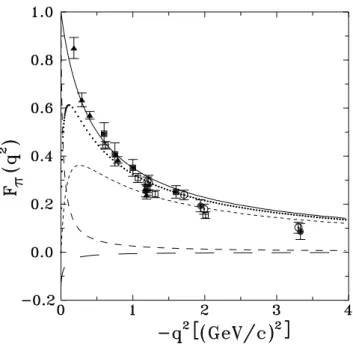
Figure 2. Pion form factor as a function of −q2 for α =
90o
. Theoretical results:Fπ(q2)(solid line);F( I)
π (q2, α)(dashed
line); Fπ(I I)(q2, α) (dotted line); F( I)
π inst(q
2
, α) (long-dashed line); Fπ inst(I I) (q
2) (short-dashed line). Experimental data: Ref. [21] (full squares), Ref. [22] (full triangles), Ref. [23] (empty squares), Ref. [24] (empty circles) and Ref. [25] (full circles).
In Fig. 2, the results for the pion form factor are shown and compared to the experimental data. The full-model calculations, Eq. (6), nicely agree with the new data for the pion form factor [21]. Therefore, our symmetric ver-tex model can reproduce the form factor data consistently with the experimental value offπ, while for the
nonsymmet-ric regulator this was not achieved[4]. We observe that the model reproduces simultaneouslyfπ and the experimental
The separate contributions to the pion form factor,Fπ(I)
andFπ(II) for α = 90o, are shown in Fig. 2. Differently
from the caseα= 0o, the form factor is dominated by the
pair production process forα= 90o, except nearq2 = 0. Also, we observe that the form factor is completely dom-inated by the pair-term contribution at high values of the momentum transfer, which appears to be fairly model inde-pendent as well[5, 14].
The contributions of the instantaneous part of the Dirac propagator to Fπ(I)(q2, α) and Fπ(II)(q2, α), called
Fπ inst(I) (q2, α) and F(II)
π inst(q2, α), respectively, are also
shown in Fig. 2 forα= 90o. The value ofF(I)
π inst(q2, α)is
nonzero because of the specific analytic structure of the ver-tex function[5]. We also observe thatFπ inst(II) (q2, α)
domi-natesFπ(q2)at higher momentum transfers. One can
under-stand this by looking at the diagram of Fig. 1(b), where in principle the spectator quark can be exchanged between the incoming and outgoing pion at a given instantx+, while the quark-antiquark pair has been produced by the virtual pho-ton at an earlier stage. As the magnitude of the momentum
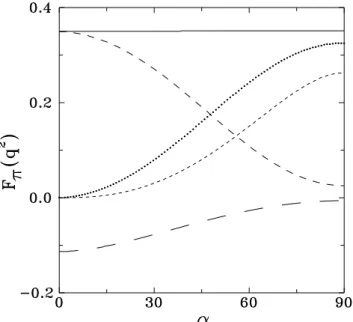
q−(= −q+)increases, the time fluctuation for the virtual process decreases and favors the instantaneous exchange of the spectator quark between the initial and final pion, which finally explains the dominance ofFπ inst(II) (q2, α)in the pion form factor. In Fig. 3, the results for the various contribu-tions to the pion form factor for −q2 = 1(GeV/c)2 as a function of the angle αare shown. For increasing angles, the form factor changes smoothly from valence to pair-term or nonvalence dominance.
Figure 3. Contributions to the pion form factor vsαfor−q2 =
1 (GeV/c)2. Theoretical results: Fπ(q2)(solid line);F( I) π (q2, α)
(dashed line) ; Fπ(I I)(q2, α)(dotted line); F( I)
π inst(q
2
, α) (long-dashed line);Fπ inst(I I) (q
2, α)(short-dashed line).
In summary, we verified that the new data for the pion electromagnetic form factor[21] is satisfactory described by our symmetric ansatz of the vertex function when the experi-mental value offexp
π is fitted and the constituent quark mass
is chosen in the range between 0.2 and 0.3 GeV. We per-formed a detailed analysis of the contribution of the light-front pair-term to the form factor for different momentum transfer directions in the Breit frame. Such contribution is unique and does not depend on the particular choice of Bethe-Salpeter vertex, as long as the four-dimensional im-pulse approximation is used to calculate the electromag-netic current. Another interesting outcome of our symmetric model is that the probability of the pion valence component,
η, is about 0.77), at variance with previous covariant calcu-lations whereη = 1[4, 14].
We thank the funding agencies FAPESP (Fundac¸˜ao de Amparo a Pesquisa do Estado de S˜ao Paulo), and CNPq (Conselho Nacional de Pesquisa e Desenvolvimento), and Ministero della Ricerca Scientifica e Tecnologica for partial support.
References
[1] P. A. M. Dirac, Rev. Mod. Phys.21, 392 (1949).
[2] L.L. Frankfurt and M.I. Strikman, Nucl. Phys. B148, 107 (1979).
[3] M. Sawicki, Phys. Rev. D44, 433 (1991); Phys. Rev. D46, 474 (1992).
[4] J. P. B. C. de Melo, H. W. Naus and T. Frederico, Phys. Rev. C59, 2278 (1999).
[5] J. P. B. C. de Melo, T. Frederico, E. Pace and G. Salm`e, Nucl. Phys. A707, 399 (2002).
[6] J. P. B. C. de Melo, J. H. O. Sales, T. Frederico and P. U. Sauer, Nucl. Phys. A631, 574c (1998); J. P. B. C. de Melo, T. Frederico, H. W. L. Naus and P. U. Sauer, Nucl. Phys. A660, 219 (1999).
[7] B.L.G. Bakker, H.-M. Choi and C.-R. Ji, Phys. Rev. D65, 116001 (2002).
[8] I. L. Grach and L. A. Kondratyuk, Sov. J. Nucl. Phys.39, 198 (1984).
[9] L. L. Frankfurt, T. Frederico and M. I. Strikman, Phys. Rev. C48, 2182 (1993).
[10] J. Carbonell, B. Deplanques, V. A. Karmanov and J.-F. Math-iot, Phys. Rep.300, 215 (1998).
[11] F. M. Lev, E. Pace and G. Salm`e, Nucl. Phys. A641, 229 (1998); Few-Body Syst. Suppl.10, 135 (1998); Phys. Rev. Lett.83, 5250 (1999); Phys. Rev. C62, 064004 (2000); Nucl. Phys. A663, 365 (2000); E. Pace and G. Salm`e, Nucl. Phys. A684, 487 (2001); A689, 411 (2001).
[12] T. Frederico and G. A. Miller, Phys. Rev. D45, 4207 (1992); Phys. Rev. D50, 210 (1994).
[13] S.J. Brodsky and J. R. Primack, Ann. Phys.52, 315 (1969), and references therein quoted; F. Coester and D.O. Riska, Ann. Phys.234, 141 (1994).
[14] B. L. G. Bakker, H.-M. Choi and C.-R. Ji, Phys. Rev. D63, 074014 (2001).
[16] S. J. Brodsky, H. C. Pauli, and S. S. Pinsky, Phys. Rep.301, 299 (1998).
[17] J. H. O. Sales, T. Frederico, B. V. Carlson and P. U. Sauer, Phys. Rev. C63, 064003 (2001).
[18] S. Godfrey and N. Isgur, Phys. Rev. D32, 185 (1985).
[19] F. Cardarelli, I.L. Grach, I.M. Narodetskii, E. Pace, G. Salm`e and S. Simula, Phys. Lett. B332, 1 (1994).
[20] S. R. Amendolia, G. Batignani, G. A. Beck, E.H. Bellamy, E. Bertolucci, G. Bologna, L. Bosito, C. Bradaschia, M. Bu-dinich, M. Dell’Orso, B. D’Ettore Piazzoli, F.L. Fabbri, F. Fidecaro, L. Foa, E. Focardi, S.G.F. Frank, P. Gianetti, A. Gi-azzotto, M.A. Giorgi, M.G. Green, G.P. Heath, M.P.J. Lan-don, P. Laurelli, F. Liello, G. Mannocchi, P.V. March, P.S. Marrocchesi, A. Menzione, E. Meroni, P. Picchi, F. Ragusa, L. Ristori, L. Rolandi, A. Scribano, A. Stefani, D. Storey, J.A. Strong, R. Tenchini, G. Tonelli, G. Triggiani, W. Von Schlippe and A. Zallo, Phys. Lett. B178, 116 (1986).
[21] J. Volmer, D. Abbott, H. Anklin, C. Armstrong, J. arrington, K. Assamagan, S. Avery, O. K. Baker, H.P. Blok, C. Bochna, E.J. Brash, H. Breuer, N. Chant, J. Dunne, T. Eden, R. Ent, D. Gaskell, R. Gilman, K. Gustafsson, W. Hinton, G.M.
Hu-ber, H. Jackson, M.K. Jones, C. Keppel, P.H. Kim, W. kim, A. Klein, D. Koltenuk, M. Liang, G.J. Lolos, A. Lung, D.J. Mack, D. MacKee, D. Meekins, J. Mitchel, H. Mkrcthyan, B. Muller, G. Niculescu, I. Niculescu, D. Pitz, D. Potterveld, L.M. Qin, J. Reinhold, I.K. Shin, S. Spepanyan, V. Tade-vosyan, L.G. Tang, R.L.J. van der Meer, K. Vansyoc, D. Van Westrum, W. Vulcam, S. Wood, C. Yan, W.-X. Zhao and B. Zihlmann, Phys. Rev. Lett.86, 1713 (2001).
[22] C. N. Brown, C.R. Canizares, W.E. Cooper, A.M. Eisner, G.J. Feldman, C.A. Lichtenstein, L. Litt, W. Lockeretz, V.B. Mon-tana and F.M. Pipkin, Phys. Rev. D8, 92 (1973).
[23] C. J. Bebek, C.N. Brown, M. Herzlinger, S. Holmes, C.A. Lichtenstein, F.M. Pipkin and L.K. Sisterson, Phys. Rev. D9, 1229 (1974).
[24] C. J. Bebek, C.N. Brown, M. Herzlinger, S.D. Holmes, F.M. Pipkin, S. Raither and L.K. Sisterson, Phys. Rev. D13, 25 (1976).