EVALUATION OF EFFICACY, RELIABILITY, AND TOLERABILITY OF SIBUTRAMINE IN OBESE PATIENTS, WITH AN
ECHOCARDIOGRAPHIC STUDY
From the Department of Endocrinology and Metabolic Disorders, Hospital das Clínicas, Faculty of Medicine, University of São Paulo.
Alfredo Halpern, Claudia Cozer Leite, Nathan Herszkowicz, Alfonso Barbato and Ana Paula Arruda Costa
RHCFAP/3077 HALPERN A et al. - Evaluation of efficacy, reliability, and tolerability of sibutramine in obese patients, with an
echocardiographic study. Rev. Hosp. Clín. Fac. Med. S. Paulo 57(3): 2002.
This is a double-blind, placebo-controlled study of the efficacy, safety, and tolerability of sibutramine in the management of obese patients for a 6-month period.
METHOD: Sixty-one obese patients (BMI >30, <40 kg/m2), aged 18-65 years were evaluated. In the first phase of the study (30 days), the patients were given a placebo. We monitored compliance with a low-calorie diet (1200 kcal/day) and to the placebo. In the next stage, the double-blind phase (6 months), we compared placebo and sibutramine (10 mg/day). The criteria for evaluating efficacy were weight loss, reduction in body mass index (BMI), and abdominal and hip circumferences. Tolerability was assessed based on reported side effects, variation in arterial blood pressure and heart rate, metabolic profile (fasting glucose, total cholesterol and its fractions, and triglycerides), laboratory tests (renal and hepatic functions), and flow Doppler echocardiogram.
RESULTS: We observed a greater weight loss (7.3 kg, 8% vs 2.6 kg, 2.8%) and a reduction in body mass index (7.4% vs
2.1%) in the sibutramine group than in the placebo group. Classifying the patients into 4 subgroups according to weight loss (weight gain, loss <5%, loss of 5% to 9.9%, and loss >10%), we observed a weight loss of >5% in 40% of the patients on sibutramine compared with 12.9% in the placebo group. We also detected weight gain in 45.2% of the placebo group compared to 20% in the sibutramine group. The sibutramine group showed improvement in HDL- cholesterol values (increased by 17%) and triglyceride values (decreased by 12.8%). This group also showed an increase in systolic blood pressure (6.7%, 5 mmHg). There were no changes in echocardiograms comparing the beginning and end of follow-up, and side effects did not lead to discontinuation of treatment.
DISCUSSION: Sibutramine proved to be effective for weight loss providing an 8% loss of the initial weight. Compliance to prolonged treatment was good, and side effects did not result in discontinuation of treatment. These data confirmed the good efficacy, tolerability, and safety profiles of sibutramine for treatment of obesity.
DESCRIPTORS: Obesity. Weight loss. Sibutramine.
Prevalence of obesity and its comorbidities has increased all over the world1-3. Abdominal or visceral obesity is closely related to hypertension, glu-cose intolerance, hypertriglyceridemia with low HDL levels, and hyperinsuline-mia, resulting in the so-called “metabolic syndrome” with an increased risk of car-diovascular disease4-7. Obesity is also a risk factor for sleep apnea, orthope-dic, dermatological and
thromboembo-lic conditions, and some types of can-cer8-9. In addition, excessive weight is a discriminating factor in the workplace and in society as a whole.
Today there is strong evidence that weight loss in overweight and obese
Sibutramine is a tertiary amine ini-tially developed as an antidepressant medication. Subsequent studies showed a significant effect of the drug on weight loss due to its satietogenic and calorigenic effects13-15.
The objective of the present study was to evaluate the efficacy, safety, and tolerability of sibutramine in obese pa-tients over a 6-month period and to check the influence of the drug on the echocardiographic patterns of the pa-tients. We considered effective weight loss to be a reduction by a minimum of 5% of the initial weight.
PATIENTS AND METHODS
From May 1998 to September 1999, we recruited 61 patients (60 female and 1 male), aged 18-65 years and with a body mass index (BMI) >30 kg/m2. The study was divided into 2 phases: the first phase (30 days) with the placebo, and the second phase (6 months) evalu-ating sibutramine vs placebo.
The inclusion criteria were fasting glucose values <130 mg/dL, total cho-lesterol <300 mg/dL, triglycerides <500 mg/dL, uric acid <8.0 mg/dL, trans-amines <40 mg/dL, bilirubin <2.0 mg/ dL, urea <40 mg/dL, and creatine < 1.5 mg/dL. Echocardiographic studies were also performed in this phase by means of a System Five, Ving Med, with color flow mapping able to generate and re-ceive second harmonic echoes and syn-chronized firing of EKG. All echocardiographs were performed by the same observer (NH).
The exclusion criteria were weight loss in the previous 3 months, chronic diseases, such as renal or hepatic fail-ure, endocrinopathy, cardiopathy, se-vere hypertension (systolic blood sure >150 mmHg, diastolic blood pres-sure >110 mmHg), severe dyslipidemia (total cholesterol >300 mg/dL and trig-lycerides >500 mg/dL), rheumatic, gas-trointestinal, respiratory, neurological, and psychiatric disorders. Patients with an altered echocardiogram or taking beta-blockers, dopaminergic agonists, antidepressant agents, or thyroid
hor-mones were also excluded. Women of childbearing age were instructed on how to use the appropriate contracep-tive method.
In the first phase, the patients were clinically assessed and weighed (scale brand, Filizola) without shoes and wear-ing light clothes. Height was deter-mined using a wooden stadiometer. BMI was calculated dividing weight (kg) by height (m2). Systolic and diastolic blood pressure levels were measured with patients in the seated position, on the left arm, and after a 5-minute rest pe-riod.16 The parameter used to measure the abdominal circumference was the shortest diameter between the lowest rib and the iliac crest of the subject in orthostatic position. In order to mea-sure the hip circumference, the greater trochanter region was used17. During the first 30 days, the patients received placebo once a day(only the physi-cians had this information) at breakfast and were told to follow a low-calorie diet (1200 kcal/day) composed of 55% carbohydrates, 30% fat, and 15% pro-tein. They were also encouraged to prac-tice 30-60 minutes of physical activity every day.
Thirty days later, the patients were randomized into 2 groups: one group received sibutramine 10 mg/day and the other group received the placebo, to be taken at breakfast. The placebo tablets were obtained from Knoll Pharmaceuti-cal Industries and were rigorously iden-tical to the sibutramine tablets.
The patients were followed up for 6 months. During the monthly appoint-ments, the efficacy criteria were re-viewed: weight and height, abdominal and hip circumference, tolerability (variations in arterial blood pressure, and heart rate), and safety (possible adverse effects of the drug). Labora-tory tests were repeated at months 4 and 6, and an echocardiogram was re-peated at the end of the study.
All patients signed the informed consent statement after being in-structed about the study details, the Ethics Committee of the University Hospital approved the protocol.
The Student’s t test was used to
compare means in the statistical analy-sis. To compare results from the initial and final phases, as well as different weight loss percentiles, we used the chi-square test. The significance level was P < 0.0518.
RESULTS
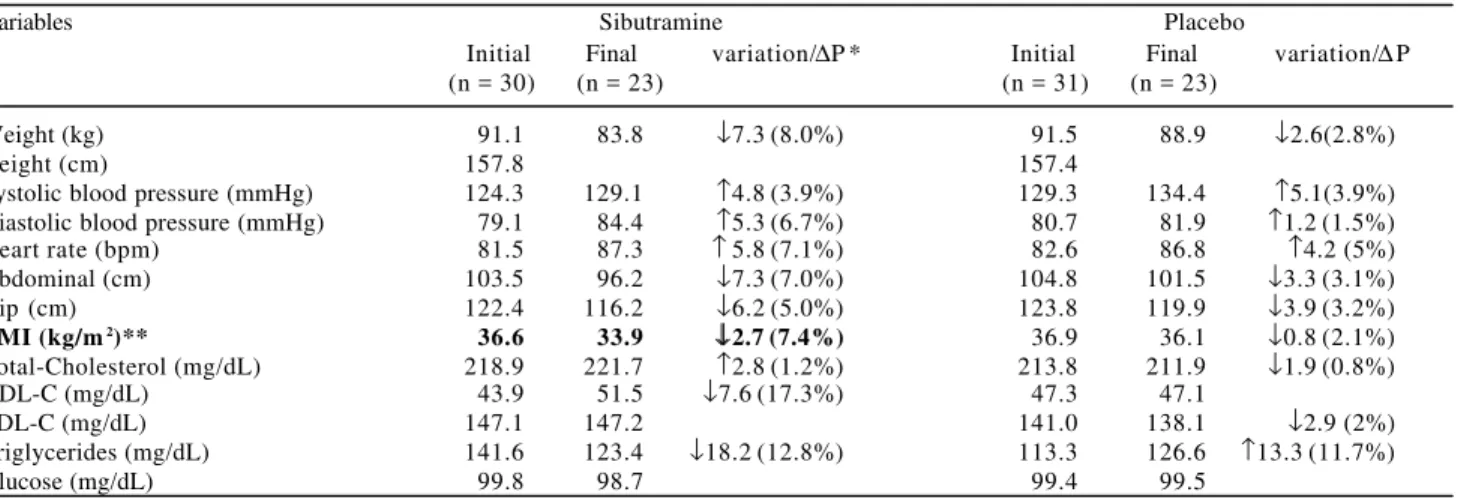
Out of 61 patients selected, 46 con-cluded the study. The mean age was 38.3 years for the sibutramine and pla-cebo groups. The data for patients as-sessed during the first and last visits (height, weight, waist, and hip mea-sures, BMI, systolic and diastolic blood pressure, heart rate, and laboratory tests) are presented in table 1. The sibutramine and placebo groups had similar initial clinical and laboratory pro-files.
Fifteen patients (24.6%) withdrew treatment; 7 were in the sibutramine group (7/30 - 23.3%), and 8 in the pla-cebo group (8/31 - 25.8%). Dropout from study was not a result of side effects of the drug.
In the analysis of efficacy, the per-centage reduction in weight (8%) and BMI (7.4%) was greater in the sibutramine group than in the placebo group (2.8% and 2.1%, respectively). The sibutramine group lost an average of 7.3 kg vs 2.6 kg in the placebo group.
Reduction in BMI was the only statis-tically significant variable (P < 0.002).
Classifying weight loss into 4 sub-groups (weight gain, loss <5%, loss of 5% to 9.9%, and loss >10%), we ob-served a weight loss of >5% in 40% of the patients from the sibutramine group as compared to 12.9% in the placebo group. On the other hand, 45.2% of the patients gained weight in the placebo group as compared with 20% in the sibutramine group (Table 2). Although the sibutramine group had better results than placebo group, these differences were not statistically significant, except in the weight gain group.
in the sibutramine group, and there was a reduction of 3% (3.5 cm) in both val-ues in the placebo group (Table 1). These differences in both groups were not statistically significant.
Regarding blood pressure, we ob-served increased systolic pressure val-ues in both groups and with the same variation (5 mmHg). Diastolic pressure, however, increased only in the sibutramine group (5 mmHg). Concern-ing the lipid profile (total cholesterol
and LDL-cholesterol) and glucose lev-els, the values remained unaltered in both groups. There was an improve-ment in HDL-cholesterol (increase of 17%) and triglyceride levels (decrease of 12.8%) in the group treated with sibutramine (Table 1). There was no sta-tistically significant difference between these variables between sibutramine and placebo groups.
Tolerability and safety results re-vealed that 5 patients in the
sibutramine group and 10 patients in the placebo group reported side ef-fects. None of them discontinued treat-ment because of side effects. The most common side effects were intestinal constipation and dry mouth. Despite the higher incidence of side effects in the placebo group, there was no sta-tistically significant difference be-tween the groups (P > 0.05) table 3.
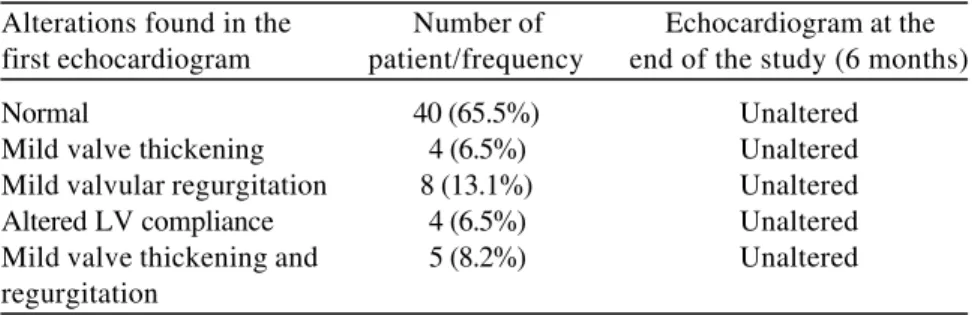
In the initial assessment of 61 pa-tients, 40 (65.5%) of them had a normal echocardiogram, and 21 patients showed slight alterations with no he-modynamic impact (Table 4). Six months later, there was no alteration in the echocardiographic patterns in either group.
DISCUSSION
Obesity is an important risk factor for morbidity and mortality. There is evidence that weight loss leads to re-duced risk of morbidity and mortality.
In the obese patients assessed in this study, the administration of sibutramine resulted in better results than administration of placebo in pa-tients undergoing diet restriction and exercise programs (weight loss: 8% vs
2.8%; reduction in BMI: 7.4% vs 2.1%;
reduction in waist measure: 7% vs 3.1%).
However, only the difference in BMI Table 1- Distribution of main variable means at the beginning and end of the study and variation observed during 6 months.
Variables Sibutramine Placebo
Initial Final variation/∆P * Initial Final variation/∆P
(n = 30) (n = 23) (n = 31) (n = 23)
Weight (kg) 91.1 83.8 ↓7.3 (8.0%) 91.5 88.9 ↓2.6(2.8%)
Height (cm) 157.8 157.4
Systolic blood pressure (mmHg) 124.3 129.1 ↑4.8 (3.9%) 129.3 134.4 ↑5.1(3.9%) Diastolic blood pressure (mmHg) 79.1 84.4 ↑5.3 (6.7%) 80.7 81.9 ↑1.2 (1.5%)
Heart rate (bpm) 81.5 87.3 ↑ 5.8 (7.1%) 82.6 86.8 ↑4.2 (5%)
Abdominal (cm) 103.5 96.2 ↓7.3 (7.0%) 104.8 101.5 ↓3.3 (3.1%)
Hip (cm) 122.4 116.2 ↓6.2 (5.0%) 123.8 119.9 ↓3.9 (3.2%)
BMI (kg/m2)** 36.6 33.9 ↓↓2.7 (7.4%) 36.9 36.1 ↓0.8 (2.1%)
Total-Cholesterol (mg/dL) 218.9 221.7 ↑2.8 (1.2%) 213.8 211.9 ↓1.9 (0.8%)
HDL-C (mg/dL) 43.9 51.5 ↓7.6 (17.3%) 47.3 47.1
LDL-C (mg/dL) 147.1 147.2 141.0 138.1 ↓2.9 (2%)
Triglycerides (mg/dL) 141.6 123.4 ↓18.2 (12.8%) 113.3 126.6 ↑13.3 (11.7%)
Glucose (mg/dL) 99.8 98.7 99.4 99.5
*∆P – percentage difference.
**The initial and final BMI was the only variable that the difference was statistically significant (P < 0.002).
Table 2 - Comparative analysis of sibutramine and placebo by weight loss Subgroups.
Sibutramine Placebo
Number of patients/% Number of patients/%
Weight gain 6 (20%)* 14 (45.2%)
Loss <5% 12 (40%) 13 (41.9%)
Loss>5% - <10% 4 (13.3%) 3 (9.7%)
Loss >10% 8 (26.7%) 1 (3.2%)
*The chi-square test showed statistically significant difference in weight gain subgroups (P <0.03).
Table 3 - Proportion of patients who experienced adverse effects during the 6-month follow-up.
Adverse effects Sibutramine group (30) Placebo group (31)
Intestinal constipation 2 (6.6%) 5 (16.1%)
Dry mouth 2 (6.6%) 4 (12.9%)
Epigastralgia 0 1 (3.2%)
Somnolence 1 (3.3%) 0
was statistically significant. In addition, the percentage of subjects who lost >5% of their initial weight was mark-edly higher in the sibutramine group (40% vs 12.9% in the placebo group).
It should be emphasized that weight loss ³5% results in evident reduction in cardiovascular risks. In the patients who did not have a marked metabolic risk profile, we observed increased HDL lev-els and reduced triglyceride levlev-els with the use of sibutramine.
Regarding tolerability, there was no statistically significant difference be-tween the two groups; side effects were not severe, and no patient discontinued treatment because of adverse effects.
Table 4- Analysis of echocardiographic results of patients before the study and at the end of the 6-month test period.
Alterations found in the Number of Echocardiogram at the first echocardiogram patient/frequency end of the study (6 months)
Normal 40 (65.5%) Unaltered
Mild valve thickening 4 (6.5%) Unaltered Mild valvular regurgitation 8 (13.1%) Unaltered Altered LV compliance 4 (6.5%) Unaltered Mild valve thickening and 5 (8.2%) Unaltered regurgitation
The slight increase in systolic blood pressure (5 mmHg) and in diastolic blood pressure (5 mmHg) in the sibutramine group was corroborated by the literature13-15. The slight increase in blood pressure seems to be compen-sated by drug-induced weight loss15. It is also important to mention that in-creased systolic blood pressure was observed in the placebo group, but there was no explanation for this fact.
We were particularly interested in checking whether sibutramine would cause valvular echocardiographic alter-ations, as described in studies with fenfluramine and D-fenfluramine21. The echocardiographic study was very
de-tailed and was carried out with sophis-ticated equipment. The analysis of find-ings was made by the same observer. Out of 61 patients, 21 had some previ-ous echocardiographic alteration, showing that heart disease may be dem-onstrated in a significant percentage of apparently healthy obese patients. However, in the final assessment, we did not identify any alterations in the echocardiogram in either group. These data were similar to those found in an-other study22, demonstrating that sibutramine does not have a dilation effect on the heart.
Therefore, our results enabled us to conclude that sibutramine is an effec-tive drug for inducing reduction of the body mass index and for preventing weight gain in obese patients undergo-ing low-calorie diet and exercise pro-grams, and it has good safety and tol-erability profiles.
ACKNOWLEDGEMENTS
1.HODGE AM & ZIMMET PZ - The epidemiology of obesity. Clin Endocrinol Metab 1994; 8:577-99.
2.SEIDELL JC - The worldwide epidemic of obesity. In: GUY-GRAND B; AILHAUD G. eds. - Progress in obesity research, 8th ed,
London, John Libbey, 1999. p. 661-68.
3.WHO- Obesity: preventing and managing the global epidemic. Report of a WHO consultation on obesity. Geneva, June 3-5, 1997. Geneva: WHO, 1998.
4.KISSEBACH AH, VYDELINGUM N, MURRAY RW et al. - Relation of body fat distribution to metabolic complications of obesity. J Clin Endocrinol Metab 1982; 54:254-60.
5.LAPIDUS L, BENGTSSON C, LARSSON B et al. - Distribution of adipose tissue and risk of cardiovascular disease and death: a 12-year follow-up of participants in the population study of women in Gothenburg, Sweden. Br Med J 1984; 289:1261-3. 6.HUBERT H B, FEINLIEB M, MCNAMARA PM et al. - Obesity as
an independent risk factor for cardiovascular disease: a 26-year follow-up of participants in the Framingham Heart Study. Circulation 1983; 67:5-14.
7.LARSSON B, SVARSUDD K, WELIN L et al. - Abdominal adipose tissue distribution, obesity and risk of cardiovascular disease and death: 13-year follow-up participants in the study of men born in 1913. Br Med J 1984; 288:1401-4.
8.MANCINI M C, ALOE F & TAVARES S - Apnéia do sono em obesos. Arq Bras Metab 2000; 4(1):81-90.
9.HALPERN A, MAT OS AFG, SUPLICY HL et al. - Obesidade. São Paulo, Lemos Ed, 1998. p. 191-197.
10.GOLDSTEIN DJ - Beneficial health effects of modest weight loss. Int J Obes Relat Met Dis 1992; 16:397-415.
11.NATIONAL Task Force on the Prevention and Treatment of Obesity. Long term pharmacotherapy in the management of obesity. JAMA 1996; 276:1907-5.
REFERENCES
12.REPORT of a WHO Consultation on Obesity - Preventing and managing the global epidemic. Geneva: World Health Organization, 1997.
13.HANSEN DL ,TOUBRO S, STOCK MJ et al. - The effect of sibutramine on energy expenditure and appetite during chronic treatment without dietary restriction. Int J Obesity 1999; 23:1016-24.
14.BRAY GA, BLACKBURN GL, FERGUSON JM et al. - Sibutramine produces dose-related weight loss. Obesity Res1999; 7:189-98. 15.JAMES WPT, ASTRUP A, FINER N et al. - Effect of sibutramine on weight maintenance after weight loss: a randomized trial. Lancet 2000; 356:2119-2125.
16.PERLOFF D, GRIM C & FLACK J - Human blood pressure determination by sphygmomanometry. Circulation 1993; 88:2460-7.
17.LOHMAN TG, ROCHE AF & MART ORELLI R -Anthropometric Standardization Reference Manual. Champaign, IL, Human Kinetics 1998. p. 90.
18.ARMITAGE P & BERRY G - Statistical methods in medical research, 2nd ed. Oxford, Blackwell, 1987. p. 282-95.
19.LAVIE CJ & MESSERLI F H - Cardiovascular adaptation to obesity and hypertension. Chest 1986; 90(2):275-9.
20.KU C S, LIN S L, WANG D J et al. - Left ventricular filling in young normotensive obese adults. Am J Cardiol 1994; 73:613-5. 21.CONNOLLY H M, CRARY J L, MC GOON M D et al. - Valvular
heart disease associated with fenfluramine - phentermine. N Engl J Med 1997; 337:581-8.
22.BACH DS, RISSAMEN AM & MENDEL CM - Absence of cardiac valve dysfunction in obese patients treated with sibutramine. Obes Res 1999; 7:363-9.
Received for publication on August 21, 2001.
RESUMO RHCFAP/3077
HALPERN A e col. - Avaliação da eficácia, segurança e tolerabilidade da sibutramina em obesos - estudo randomizado duplo-cego. Rev. Hosp. Clín. Fac. Med. S. Paulo 57(3): 2002.
O presente estudo objetivou com-parar a eficácia, segurança e tolerabilidade da sibutramina em paci-entes obesos.
MÉTODO: Selecionamos 61 pacien-tes obesos (30<IMC<40kg/m2) entre 18-65 anos. Na primeira fase do estudo (30 dias), os pacientes usaram medicação placebo e realizaram os exames de in-clusão, enquanto acompanhamos a adesão à dieta hipocalórica prescrita (1200cal/dia) e à medicação. A seguir, na fase duplo-cega (6 meses), compara-mos placebo vs sibutramina (10mg/dia). Os critérios para a avaliação da eficácia foram: perda de peso, diminuição do
ín-dice de massa corpórea (IMC), circunfe-rência abdominal e de quadril. A avalia-ção da tolerabilidade foi feita pelo relato dos efeitos adversos, variações da pres-são arterial, freqüência cardíaca, perfil metabólico (glicemia de jejum, colesterol total e frações e triglicerídeos), altera-ções laboratoriais (função hepática e re-nal) e pelo ecocardiograma com Doppler fluxo realizado em todos os pacientes no início e fim do tratamento.
RESULTADOS: Houve uma diminui-ção maior de peso (7,3kg—8% vs 2,6kg—
2,8%) e IMC (7,4% vs 2,1%) no grupo
sibutramina do que no grupo placebo. Quando dividimos a perda de peso em quatro subgrupos (aumento de peso, perda<5%, perda entre 5-9,9%, perda >10%) ocorreu perda de peso>5% em 40% dos pacientes em uso da sibutramina vs 12,9% no grupo placebo e ganho de peso em 45,2% dos pacientes em uso de placebo vs 20% no grupo sibutramina.
No grupo sibutramina notamos melhora dos níveis de HDL-colesterol (aumento de 17%) e triglicerídeos (diminuição de 12,8%), neste grupo ocorreu também um aumento da pressão arterial sistólica (6,7%-5mmHg). Não houve alteração en-tre os ecocardiogramas do início e final do acompanhamento e os efeitos adver-sos não levaram à descontinuação do tra-tamento.
DISCUSSÃO: A sibutramina mos-trou-se eficaz na redução de peso, pro-porcionando um perda de 8% em rela-ção ao peso inicial. Houve boa adesão do paciente ao tratamento prolongado, sem haver descontinuações pelos efei-tos adversos. Estes dados confirmam o bom perfil de eficácia, tolerabilidade, e segurança da sibutramina no tratamen-to da obesidade.