&!
From the Department of Dermatology,Hospital das Clínicas, Faculty of Medicine, University of São Paulo.
NECROLYTIC MIGRATORY ERYTHEMA ASSOCIATED
WITH GLUCAGONOMA SYNDROME: A CASE
REPORT
Cassio C. Dal Coleto, Ana Paula F. de Mello, Jaime Piquero-Casals, Fábio R. Lima, Maria Aparecida Constantino Vilela, Cyro Festa-Neto and José Antonio Sanches Jr.
RHCFAP/3059 DAL COLETO CC et al. - Necrolytic migratory erythema associated with glucagonoma syndrome: a case report. Rev. Hosp. Clín.
Fac. Med. S. Paulo 56(6):183-188, 2001.
Necrolytic migratory erythema is a rare skin condition that consists of migrating areas of erythema with blisters that heal with hyperpigmentation. It usually occurs in patients with an alpha islet cell tumor of the pancreas—or glucagonoma—and when associated with glucose intolerance, anemia, hyperglucagonemia, and weight loss defines the glucagonoma syndrome.
We describe a 52-year-old female patient with necrolytic migratory erythema associated with glucagonoma syndrome who had metastatic disease at presentation and passed away one week after her admission. The autopsy showed a tumor in the body of the pancreas, which was diagnosed as a neuroendocrine tumor and confirmed by immunohistochemistry.
The diagnosis of necrolytic migratory erythema is a matter of great importance, since it might be an auxiliary tool for the early detection of glucagonoma.
DESCRIPTORS: Necrolytic migratory erythema. Glucagonoma syndrome. Glucagonoma.
Necrolytic migratory erythema (NME) is a rare skin condition charac-teristically presented as an irregular annular eruption with a serpiginous advancing border. Bullae may be seen at the centre of the lesions that subse-quently erode and become crusted. The lesions occur most commonly on the perineum, distal extremities, lower ab-domen, and face1-4.
NME usually appears as a para-neoplastic process in patients with al-pha cell tumor of the pancreas, i.e., glucagonoma. Glucagonoma, in asso-ciation with hyperglucagonemia, glu-cose intolerance, anemia, and weight loss, defines the glucagonoma syn-drome3,4.
Less often, NME may have no cor-relation with glucagonoma and be
re-lated to celiac disease, malabsorption, chronic pancreatitis, infection and he-patic cirrhosis, or extrapancreatic glu-cagon-secreting tumor ( renal, duode-nal, or pulmonary)5-12. We describe a
woman with NME associated with glucagonoma syndrome.
CASE REPORT
A 52-year-old white woman with an 8-month history of pruritic and burning skin eruption that rapidly progressed to involve the entire body was referred for
evaluation. The patient presented marked fatigue, anorexia, weakness, confusion, and a 20-pound weight loss over the previous 8 months.
She was treated with topical and systemic steroids (prednisone 20 mg/ day) for 2 months without clinical im-provement. There was no history of al-cohol intake or diabetes mellitus.
angu-&"
lar stomatitis were also noted. The clinical differential diagnosis included zinc deficiency, pellagra, pemphigus vulgaris, and NME.
Examination of biopsy specimens showed an intraepidermal cleft, pres-ence of vacuolated pale epidermal cells with pyknotic nuclei, and neutrophils in the upper epidermis (Fig. 2)—all changes consistent with NME.
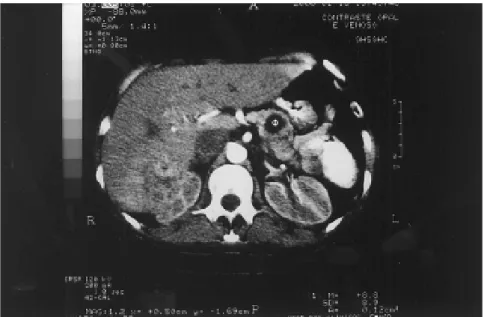
A computed tomography scan of the abdomen revealed a 3-cm
pancre-atic mass (Fig. 3) and multiple meta-static nodules in both lobes of the liver. The serum glucagon level was markedly increased to 4517.1 pg/mL (normal 50 to 150 pg/mL). Glycemia was increased to 204 mg/100 mL (nor-mal 70 to 100 mg/mL), hematocrit value was 22.1 (normal 35-45), and all serum amino acid levels were de-creased. The serum zinc level was within normal limits. With the support of these findings, the diagnosis of
NME associated with glucagonoma syndrome was made.
The patient developed acute respi-ratory distress syndrome and died of acute respiratory failure a week after the admission. No specific treatment was performed.
The autopsy showed 4 pale, hard masses in the body of the pancreas and multiple pale metastatic nodules in both lobules of the liver ranging from 0.5 to 5.0 cm. On microscopic exami-nation, the tumor was composed of small, relatively uniform cuboidal cells with centrally located nuclei and finely granular acidophilic cytoplasm, result-ing in defined nests, separated by highly vascularized stroma (solid pat-tern) (Fig. 4). There was no evidence of glandular or trabecular differentia-tion. Mitotic figures were scarce. Im-munohistochemical staining for chromogranin was strongly positive, while synaptophysin, insulin, gluca-gon, and somatostatin were negative.
DISCUSSION
Becker et al.13 described in 1942 a
“diffuse progressive epidermal necrotic rash” associated with pancreatic neo-plasm. In 1966, McGravan et al.14
re-ported hyperglucagonemia in a patient with an eczematoid, erythematous rash, mild diabetes mellitus, anemia, and a glucagon-secreting alpha cell tumor of the pancreas.
Mallinson et al.2 in 1974 defined
the glucagonoma syndrome as pre-sented in 9 patients with diabetes mellitus, anemia, weight loss, a distinc-tive rash referred as “necrolytic migra-tory erythema” (NME), and tumor of the islet cells of the pancreas. Glossi-tis, stomatiGlossi-tis, cheiliGlossi-tis, diffuse alo-pecia, diarrhea, hypoaminoacidemia, increased incidence of thromboembo-lism, and psychiatric disturbances com-plete the glucagonoma syndrome15.
Our patient had this rare and
com-Fig. 1 - Scaling annular lesions around perineum.
&#
plete syndrome, with metastatic diseaseat presentation, similar to what is re-ported in literature16.
Immunocytochemical findings show that glucagonoma has two dis-tinct types: One associated with the glucagonoma syndrome, presented as a solitary and large tumor, with a solid microscopic pattern, low or lack of im-munoreactivity for glucagon and high incidence of malignancy (60% of pa-tients); the other one, not associated
with glucagonoma syndrome, has tumors that are often multiple and small, have a gyriform microscopic pattern of growth, are strongly immu-noreactive for glucagon, and are al-ways benign17-20 .
The macroscopic and microscopic patterns of our patient’s tumor were those of a neuroendocrine neoplasm of pancreatic islet cells. The positive im-munohistochemistry for chromogranin confirmed this diagnosis. The negative
immunohistochemistry for glucagon does not exclude the possibility of glucagonoma, since the majority of glucagonoma cases associated with this syndrome present low levels or lack immunohistochemical reactivity to glu-cagon.
There are many theories about the pathogenesis of NME. The effects on the skin of the glucagonoma syndrome that result in NME may be due directly to glucagon itself or to other factors.
The increased level of glucagon as a direct cause of NME is supported by some evidence: the demonstration in vitro that an increased level of gluca-gon yields greater amounts of epider-mal arachidonic acid, which causes the inflammatory changes in the skin21; the
cure of NME after surgical removal of the tumor, with consequent normaliza-tion of serum glucagon levels22-25; and
the remission of the rash after therapy with somatostatin analogue (octreo-tide), which is a potent inhibitor of glu-cagon release26,27.
However, other evidence fails to link NME with hyperglucagonemia, e.g., the report that only 52% of pa-tients with non-glucagonoma-associ-ated NME had an increased glucagon level12.
Other theories that could explain the genesis of NME are based on the secondary effects of glucagon. Gluca-gon stimulates glycogenolysis, gluco-neogenesis, ketogenesis, and conse-quently a systemic catabolic state28.
The hypoaminoacidemia secondary to increased gluconeogenesis is suggested by some reports as a cause of NME29,30.
However, several patients cleared the cutaneous lesions after amino acid in-fusions29, and some patients with
necrolytic migratory erythema had a normal amino acid level7,31, or did not
improve after the supplementation22.
Delaney and Uff 32 controlled NME
using omega-3 triglycerides in a patient with a surgically unresectable gluca-gonoma. Also, improvement of the
Fig. 3 - Pancreatic mass and metastatic nodules in the liver in computed tomography scan.
&$
rash has been observed after zinc sup-plementation in patients who have a low 8,33 or normal serum zinc level9,34.
The clinical and histologic similari-ties between NME, hereditary acroder-matitis, enteropathica secondary to zinc deficiency, pellagra, and fatty acid de-ficiency have been noted35-36. The
re-semblance may be explained by this catabolic state.
Unfortunately, in the present case, the diagnosis was confirmed at a late stage of the disease, and the ideal treat-ment was not instituted. This case il-lustrates the importance of early recog-nition of NME, with its distinctive
clinical and histopathologic features, as well as signs and symptoms that com-pose the glucagonoma syndrome.
These data suggest that the cause for the NME associated with gluca-gonoma is multifactorial, and it is likely that the postulated theories are not mutually exclusive.
RESUMO RHCFAP/3059
DAL COLETO CC e col. - Eritema Necrolítico Migratório associado à Síndrome Glucagonoma: descrição de um caso. Rev. Hosp. Clín. Fac.
Med. S. Paulo 55(6):183-188, 2001.
O eritema necrolítico migratório é uma rara condição cutânea que se apre-senta como lesões eritematosas, migra-tórias, com vesículas e bolhas na super-fície, evoluindo para cura com hiper-pigmentação. É freqüentemente
obser-vado em doentes com tumor de célu-las alfa do pâncreas, ou glucagonoma, e quando associado com intolerância a glicose, anemia, hiperglucagonemia, e perda de peso definem a síndrome do glucagonoma.
É descrito o caso de uma paciente do sexo feminino, 52 anos, branca, com eritema necrolítico migratório as-sociado à síndrome do glucagonoma com doença metastática na apresenta-ção, vindo a falecer uma semana após
sua admissão. A autópsia mostrou um tumor no corpo do pâncreas diagnos-ticado como tumor neuroendócrino e confirmado pela imuno-histoquímica. O reconhecimento do eritema necro-lítico migratório é de grande importân-cia para a possibilidade de diagnóstico precoce do glucagonoma.
&%
REFERENCES
1. SWEET RD - A dermatosis specifically associated with tumours of pancreatic alpha cells. Br JDermatol 1974;90:301-308. 2. MALLINSON CN, BLOOM SR, WARIN AP et al. - A glucagonoma
syndrome. Lancet 1974;2:1-5.
3. CHURCH RE & CRANE WJ - A cutaneous syndrome associated with islet-cell carcinoma of the pancreas. Br J Dermatol1967;79
:284-286.
4. WILKINSON DS - Necrolytic migratory erythema with pancreatic carcinoma. Proc R Soc Med 1971;64:1197-1198.
5. MARINKOVICH MP, BOTELLA R, DATLOFF J et al. - Necrolytic migratory erythema without glucagonoma in patients with liver disease. J Am Acad Dermatol 1995;32:605-609.
6. SIBRACK LA & GOUTERMAN JH - Cutaneous manifestations of pancreatic diseases. Cutis 1978;125:460-462.
7. BLACFORD S, WRIGHT S & ROBERTS DL - Necrolytic migratory erythema without glucagonoma: the role of dietary essencial fathy acids. Br J Dermatol 1991;125:460-462.
8. KELLY CP, JOHNSTON CF, NOLAN N et al. - Necrolytic migratory erythema with elevated plasma enteroglucagon in celiac disease.
Gastroenterology 1989;96:1350-1353.
9. GOODENBERG DM, LAWLEY TJ, STROBER Wet al. - Necrolytic migratory eruthema without glucagonoma. Report of two cases. Arch dermatol 1979;115:1429-1432.
10. TRUE L, CHARLES A, LEWI H et al. - A pseudoglucagonoma syndrome. Clin Res1979;27:51A.
11. SCHWARTZ RA - Glucagonoma and pseudoglucagonoma syndromes.Review. Int J Dermatol 1997;36:81-99.
12. MULLANS EA & COHEN PR - Iatrogenic necrolytic migratory erythema: A case report and review of nonglucagonoma-associated necrolytic migratory erythema. J Am Acad Dermatol 1998;38
:866-873.
13. BECKER SW, KAHN D & ROTHMAN S - Cutaneous manifestations of internal malignant tumors. Arch Dermatol Syphilol
1942;45:1069-1080.
14. MCGRAVAN MH, UNGER RH, RECANT L et al. - A
glucagon-secreting alpha-cell carcinoma of the pancreas. N Engl J Med 1966;274:1408-1413.
15. WERMERS RA, VAHAB F, WYNE AG et al. - The glucagonoma syndrome. Medicine 1996;75:53-63.
16. MONTENEGRO-RODAS F & SAMAAN NA - Glucagonoma tumors and syndrome.Curr ProblCancer 1981;6:3-54.
17. ROSAI J - Pancreas and ampullary region. In: ROSAI J - Ackerman’s Surgical Pathology. 8th ed. St. Louis, Mosby, 1996. p. 990-999.
18. HAMID QA, BISHOP AE, SIKRI KL et al. - Immunecytochemical characterization of 10 pancreatic tumours, associated with the glucagonoma syndrome, using antibodies to separate regions of the proglucagon molecule and other neuroendocrine markers. Histopathology 1986:10:119-133.
19. NEVES JM, MARTINS JUNIOR EV, GABURRI AK et al. -Glucagonoma: relato de caso e revisão de literatura. Arq Gastroenterol 1996;33:167-172.
20. KHEIR SM, OMURA EF, GRIZZLE WE et al. - Histologic variation
in the skin lesions of the glucagonoma syndrome. Am J Surg Pathol
1986;10(7):445-453.
21. PETERSON LL, SHAW JC, ACOTT KM et al. - Glucagonoma
syndrome: in vitro evidence that glucagon increases epidermal arachidonic acid. J Am Acad Dermatol 1984;2:468-473.
22. ABRAIRA C, DEBARTOLO M, KATZEN R et al. - Disappearance of glucagonoma rash after surgical resection, but not during dietary normalization of serum amino acids. Am J Clin Nutr 1984;39 :351-355.
23. MONTENEGRO F, LAWRENCE GD, MACON W et al. - Metastatic glucagonoma. Improvement after surgical debulking. Am J Surg
1980;139:424-427.
24. REYES-GOVEA J, HOLM A & ALDRETE JS - Response of glucagonomas to surgical excision and chemoterapy. Report of two cases and review of the literature. Am Surg 1989;35:523-527. 25. SMITH AP, DOOLAS A & STAREN ED - Rapid resolution of
necrolytic migratory erythema after glucagonoma resection. J Surg Oncol 1996;61:306-309.
26. ALTIMARI AF, BHOOPALAM N, O’DORSIO T et al. - Use of
somatostatin analog (SMS 201-995 ) in the glucagonoma syndrome.
Surgery 1986;100:989-996.
27. CH’ING JL, ANDERSON JV, WILLIANS SJ et al. - Remission of symptoms during long term treatment of metastatic pancreatic endocrine tumours with long acting somatostatin analogue. Br Med
J 1986;292:981-982.
28. MARLISS EB, AOKI TT, ONGER RH et al. - Glucagon levels and
metabolic effects in fasting man. JClin Invest 1970;49:2256-2270.
29. NORTON JA, KAHN CR, SCHIEBINGER R et al. - Amino acid
deficiency and the skin rash associated with glucagonoma. Ann Intern Med 1979;91:213-215.
&&
31. MARRI-FRIDLING GD & TURNER MLC - Necrolytic migratory erythema without glucagonoma. J Am Acad Dermatol 1992;27:486.
32. DELANEY TJ & UFF JS - Necrolytic migratory erythema: Apparent response to oral omega-3 ( marine ) essential fatty acids. Br J
Dermatol 1990;123(suppl. 37):107-109.
33. SINCLAIR AS & REYNOLDS N - Necrolytic migratory erythema and zinc deficiency. Br J Dermatol1997;136:783-785.
34. MALLINSON CN, HANLEY J, ALLISON DJet al. - Treatment of malignant pancreatic glucagonoma: effect of zinc on the rash an hepatic arterial embolization on liver metastases. Gut 1978;19:A448.
35. MILLER SJ - Nutritional deficiency and the skin. J Am Acad Dermatol
1989;21:1-30.
36. COHEN PR & PRYSTOWSKY JH - Metabolic and nutritional desorders. In: SAMS JRWM & LYNCH PJ - Principles and practice of dermatology. 2nd ed. New York, Livingstone, 1996. c.
61, p.693-712.