Smo king in flu en ces on the thick ness of mar gi nal gin gi val epit he li um
Influências do fumo sobre a espessura do epitélio oral da
gengiva mar ginal
Cristina Cunha Villar*
An to nio Fernando Martorelli de Lima**
AB STRACT: Smoking pa tients show re duc tion of in flam ma tory clin i cal signs that might be as so ci ated with lo cal vasoconstriction and an in creased gingival ep i the lial thick ness. The pur pose of this work was to eval u ate the thick ness of the mar ginal gingival oral ep i the lium in smok ers and nonsmok ers, with clin i cally healthy gingivae or with gin gi vi -tis. Twenty bi op sies were ob tained from four dif fer ent groups. Group I: non-smok ers with clin i cally healthy gingivae (n = 5). Group II: non-smok ers with gin gi vi tis (n = 5). Group III: smok ers with clin i cally healthy gingivae (n = 5). Group IV: smok ers with gin gi vi tis (n = 5). These bi op sies were histologically pro cessed, se ri ally sec tioned at 5 µm, stained with H. E., and ex am ined by im age anal y sis soft ware (KS400), which was used to per form the morphometric eval u a tion and the quan ti fi ca tion of the ma jor ep i the lial thick ness, the ep i the lial base thick ness and the ex ter nal and in ter nal ep i the lial per im e ters. Dif fer ences be tween the four groups were an a lyzed us ing ANOVA test and Tukey’s test. The cri te ria for sta tis ti cal sig nif i cance were ac cepted at the prob a bil ity level p < 0.05. A greater ep i the lial thick ness was ob served in smok ers in de pend ent of the gingival health sit u a tion.
DESCRIPTORS: Gingiva; Ep i the lium; To bacco.
RESUMO: Pa ci en tes fu man tes fre qüen te men te apre sen tam re du ção dos si na is clí ni cos in fla ma tó ri os da gen gi vi te, as so -ci a da, em gran de par te, a va so cons tri ção lo cal e au men to da es pes su ra epi te li al. O ob je ti vo des te tra ba lho foi ava li ar a es pes su ra do epi té lio oral da gen gi va mar gi nal de pa ci en tes fu man tes e não fu man tes, nos es ta dos de sa ú de gen gi val e gen gi vi te. Fo ram ob ti dos vin te frag men tos de te ci do gen gi val de qua tro gru pos de pa ci en tes. Gru po I: não fu man tes com sa ú de gen gi val (n = 5). Gru po II: não fu man tes com gen gi vi te (n = 5). Gru po III: fu man tes com sa ú de gen gi val (n = 5). Gru po IV: fu man tes com gen gi vi te (n = 5). As bióp si as re ce be ram pro ces sa men to his to ló gi co de ro ti na, e os cor -tes semi-se ri a dos com 5 µm de es pes su ra fo ram co ra dos com H. E. Com au xí lio do sis te ma de ima gens KS400 fo ram quan ti fi ca das a es pes su ra epi te li al ma i or e a es pes su ra da base epi te li al e de ter mi na dos os va lo res dos pe rí me tros epi te li a is ex ter no e in ter no. Os da dos fo ram ava li a dos pelo ANOVA e pelo tes te de Tu key, con si de ran do sig ni fi ca ti vo o va -lor de α = 0,05. Os re sul ta dos mos tra ram va lo res da es pes su ra da base epi te li al ma i or (p < 0,05) nos pa ci en tes fu man -tes, in de pen den te men te do es ta do de sa ú de gen gi val.
DESCRITORES: Gengiva; Epitélio; Tabaco.
IN TRO DUC TION
The as so ci a tion be tween to bacco smok ing and periodontal health has been stud ied in sev eral clin i -cal and ep i de mi o log i -cal investigations1,2,3,4,5,7,8,12,13
. Those stud ies sug gest that by-prod ucts orig i nated from to bacco ox i da tion mod ify the clin i cal char ac ter is tics and the pro gres sion of periodontal dis -eases, and de scribed smok ing habit as a risk fac tor for periodontal diseases7,8,13
.
Some early stud ies in di cated that smok ing pa -tients showed more in tense in flam ma tory gingival signs than non-smok ing ones13
. This find ing was gen er ally in ter preted as re lated to a less ef fi cient oral hy giene and its con se quent in tense plaque ac -cu mu la tion in smok ers. Con versely, high to bacco
con sump tion seemed to re duce gingival bleeding2 . Later stud ies con firmed the re duc tion of in flam -ma tory signs in smok ers, sug gest ing that smok ing could mod ify the in flam ma tory re sponse to den tal plaque accumulation3,4,5,7
.
The gin gi vi tis ex per i men tal model in smok ing and non-smok ing pa tients showed that the plaque for ma tion rate was sim i lar in both groups3
. How -ever, smok ers dis played a less pro nounced gingival in flam ma tory re ac tion as com pared with nonsmok ers. The re duc tion of clin i cal in flam ma -tory signs1,2,3,5,7
is con firmed by the de crease in gingival bleed ing and sup pu ra tion on probing1,3,5,7, tis sue red ness, edema1,3,5
, and the amount of blood ves sels in the mar ginal gingival tissue3
.
The re duc ti on of cli ni cal in flam ma tory signs in smo kers, par ti cu larly re gar ding gin gi val ble e ding upon pro bing and tis sue red ness, can be at tri bu -ted to the cotinine5
, a ni co ti ne me ta bo lic bypro -duct, which has a pe rip he ral cons tric ti ve ac ti on on gin gi val ves sels. Although the li te ra tu re in di ca tes an in cre a se in oral mu co sa epit he li um thick ness in smo kers6, the re is no morp ho me tric study as -ses sing the oral gin gi val epit he li al thick ness in tho se pa ti ents.
The ob jec ti ve of this work was to in ves ti ga te the re la ti on bet we en the thick ness of the mar gi nal gin -gi val oral epit he li um in smo kers and non-smo kers, with cli ni cally he althy gin gi vae or with gin gi vi tis.
MA TE RIALS AND METHODS
Study pop u la tion
Twenty young adult pa tients (20 to 35 years old) were se lected, with clin i cal signs of gingival health (grade 0, Löe & Silness gingival in dex, 1964) or gin -gi vi tis (grade 2, Löe & Silness -gin-gival in dex), and a clin i cal in di ca tion for periodontal sur gery (crown length en ing or api cally po si tioned flap) at one intraoral site per pa tient. Among the pa tients, 10 were smok ers and 10 nonsmok ers (Ta ble 1). In di -vid uals that had smoked an av er age of 10 or more cig a rettes per day for at least 5 years were con sid -ered smok ers.
For mer smo kers, preg nant wo men, pa ti ents with pe ri o don tal poc ket or bone loss iden ti fi ed by cli ni cal exam with a se cond ge ne ra ti on pe ri o don tal elec tro nic pro be (Flo ri da Pro be®
* system) or by di -gi tal ra di o grap hic ima ges, ob ta i ned by the ima ge system Acu-Ray®
**, in di vi du als with syste mic and/or im mu no lo gic ab nor ma li ti es, de tec ted in physi cal or la bo ra to ri al exams, or tho se who had used any drug on the 4 we eks be fo re the ex pe ri -ment were ex clu ded from the sam ple.
Tis sue prep a ra tion and morphometric anal y sis
All mar ginal gingival bi op sies (0.4 cm by 0.2 cm) from dif fer ent parts of the oral cav ity were ob tained dur ing periodontal sur gery as part of a rou tine periodontal treat ment in de pend ent of this study. Only one bi opsy was taken per pa tient. The intra-buccal antisepsis was per formed us ing chlorhexidine 0.2%, and the ex tra-buccal antisepsis was car ried out with a povidone-io dine so lu tion. The an es thetic tech nique was per formed
on the sur gi cal site lo ca tion, avoid ing any lo cal an -es thetic in fil tra tion.
The mar ginal gingival bi op sies were di vided into four groups, ac cord ing to the do nor’s gingival health and smok ing habit. Group I (n = 5): non-smok ers with clin i cally healthy gingivae; Group II (n = 5): non-smok ers with gin gi vi tis; Group III (n = 5): smok ers with clin i cally healthy gingivae; Group IV (n = 5): smok ers with gin gi vi tis.
The study was sub mit ted to and ap pro ved by the Ethics Com mit tee in Re se arch, Scho ol of Den -tistry of Pi ra ci ca ba, Sta te Uni ver sity of Cam pi nas (UNICAMP), un der the pro to col # 076/2001, sub jec ted to the 196/96 re so lu ti on of the Bra zi li an Na -ti o nal He alth Coun cil (10/10/96). All pa -ti ents
*Flo ri da Pro be, Ga i nes vil le, FL, USA.
**New Ima ge do Bra sil Imp. Exp. Ltda., São Pa u lo, SP, Bra zil.
TABLE 1 - Pa ti ent cli ni cal in for ma ti on.
Group Patient Age Gender Location
I
1 32 M 13 palatal
2 23 F 36 buccal
3 26 F 26 palatal
4 22 F 26 palatal
5 26 F 25 palatal
II
1 29 M 25 palatal
2 22 F 14 palatal
3 20 F 37 lingual
4 32 F 26 palatal
5 35 F 26 palatal
III
1 35 M 44 buccal
2 28 F 16 palatal
3 27 M 25 palatal
4 32 M 26 palatal
5 21 F 16 palatal
IV
1 30 M 25 palatal
2 35 F 25 palatal
3 34 F 46 lingual
4 22 F 16 palatal
5 28 F 17 palatal
gave a writ ten in for med con sent for all pha ses of the re se arch.
The sam ples were im me di a tely fi xed in 10% phosp ha te-buf fe red for ma lin, pH 7.4, and la ter em bed ded in pa raf fin and se ri ally sec ti o ned at 5 µm. The sam ples were cut at right an gles to the oral ves ti bu lar epit he li um, re sul ting in a sec ti on ex hi bi ting both sul cu lar and oral epit he li um. The sli des were sta i ned with he ma toxy lin and eo sin (H. E.) and were ob ser ved in a light mi cros co pe at 10 X (ob jec ti ve) mag ni fi ca ti on equip ped with a vi deo ca -me ra. The ima ges ge ne ra ted by the vi deo were trans fer red to a mi cro com pu ter with ima ge analy -sis soft wa re***, which was also used to per form the morp ho me tric analy sis. Under a blind pro to col the sli des were num ber co ded and sub se quently all the analy ses were car ri ed out by the same in ves ti -ga tor. The morp ho me tric analy sis was per for med con si de ring the oral epit he li um.
The ex ter nal (EEP) and in ter nal (IEP) epit he li al pe ri me ters, the ma jor epit he li al thick ness (MET = dis tan ce bet we en the ex ter nal epit he li al sur fa ce and the epit he li al cris ta tip) and the epit -he li al base thick ness (EBT = dis tan ce bet we en t-he ex ter nal epit he li al sur fa ce and ba sal mem bra ne lo -ca ted bet we en two cris tae) were eva lu a ted. EEP and IEP were eva lu a ted in du pli ca te in three dif fe -rent fi elds per sli de. MET and EBT were eva lu a ted in 5 dif fe rent are as in each of the three dif fe rent fi -elds, to ta ling 15 me a su res per sli de. The fi nal data for each pa ra me ter re pre sent the mean for the quan ti fi ca ti on in the analy zed fi elds.
Sta tis tics anal y sis
The morphometric re sults were ex pressed as arith me tic mean ± stan dard de vi a tion for each group. The data showed ho mo ge ne ity and the dif fer ences be tween the four groups were an a lyzed us -ing the ANOVA test (ANOVA – Tukey’s mul ti ple com par i son test). The cri te rion for sta tis ti cal sig nif i -cance was ac cepted at the prob a bil ity level p < 0.05. The dif fer ence in cig a rette con sump tion be tween Groups III and IV was an a lyzed us ing the Stu dent’s
t-test. The cri te rion for sta tis ti cal sig nif i cance was
ac cepted at the prob a bil ity level p < 0.05.
RE SULTS
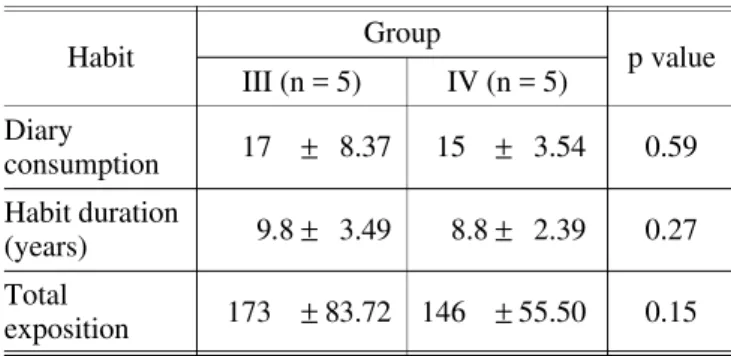
Smo kers with cli ni cally he althy gin gi vae (Group III) had con su med an ave ra ge of 17 ± 8.37 ci ga ret tes per day du ring 9.8 ± 3.49 ye ars, whi le smo kers with gin gi vi tis (Group IV) had con su med
15 ± 3.54 ci ga ret tes per day du ring 8.8 ± 2.39 ye -ars, wit hout any sig ni fi cant sta tis ti cal dif fe ren ce bet we en both groups (p = 0.15) (Ta ble 2).
The mar gi nal gin gi val epit he li um was clas si fi ed as ke ra ti ni zed stra ti fi ed squa mous epit he li um with small in ter cel lu lar spa ces. The spi nous stra tum oc -cu pi ed about 50% of the to tal epit he li al thick ness and the stra tum cor ne um was more exu be rant in
smo king pa ti ent sam ples (Fi gu re 1). The pre sen ce of glyco gen in the ke ra ti nocy tes was ob ser ved in some sam ples of both Group II and Group IV.
The re was no sta tis ti cal sig ni fi cant dif fe ren ce in MET bet we en smo kers and nonsmo kers, re gard -less of the cli ni cal gin gi val con di ti on. Ho we ver, EBT was lar ger in smo king pa ti ents. (p < 0.05) ( Ta -bles 3 and 4)
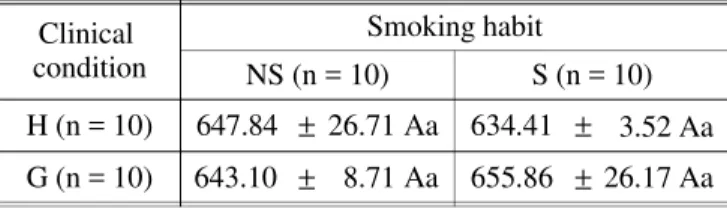
The re was no sig ni fi cant sta tis ti cal dif fe ren ce in both EEP and IEP bet we en smo ker and nonsmo ker pa ti ents, re gard less of the cli ni cal gin gi val con -di ti on (Ta bles 5 and 6).
DIS CUS SION
The in flam ma tory res pon se in du ced by den tal pla que ac cu mu la ti on can be mo di fi ed by to bac co by-pro ducts5
, such as co ti ni ne, a bypro duct of ni co ti ne that has a pe rip he ral va so cons tric ti on ac ti -on that re du ces gin gi val cli ni cal signs of ble e ding, red ness, and ede ma3,5.
The in crease in lo cal tem per a ture and the byprod ucts from to bacco ox i da tion in duce an in crease in the oral mu cosa and in the oral gingival ep -i the l-ial th-ickness6. The ep i the lium of such mucosae is strat i fied and keratinized; how ever, the buccal and la bial ep i the lial mucosae do not pres ent pro -nounced pro jec tions. The ep i the lial ar chi tec ture is de ter mined by lo ca tion and func tional demand14.
TABLE 2 - Smo king ha bits cha rac te ris tics.
Habit Group p value
III (n = 5) IV (n = 5)
Diary
consumption 17 ± 8.37 15 ± 3.54 0.59
Habit duration
(years) 9.8± 3.49 8.8± 2.39 0.27
Total
exposition 173 ±83.72 146 ±55.50 0.15
III = smok ers with clin i cally healthy gingivae; IV = smok ers with gin gi vi tis. Stu dent’s t-test (p < 0.05).
In the sam ples eva lu a ted throug hout this study, the spi nous stra tum oc cu pi ed about 50% of the to tal epit he li um thick ness and the ke ra ti nocy -tes were apart by small in ter cel lu lar spa ces. In the smo kers’ sam ples, the stra tum cor ne um was more
pro noun ced (Fi gu re 1). The se events were si mi lar to the ones al re ady des cri bed in the li te ra tu re6
. Pre sen ce of ma te ri al si mi lar to glyco gen was no -ted in some sam ples from cli ni cal in fla med are as (Fi gu re 2). The in flam ma ti on can in ter fe re in the epit he li al ma tu ra ti on pro cess and in the ori gi nal con for ma ti on of to no fi la ments, com pro mi sing the com ple te ke ra ti ni za ti on10
. The se aut hors ve ri fi ed the pre sen ce of a glyco gen-like ma te ri al in si de the epit he li um cells, in di ca ting a dis tur ban ce in the cel lu lar dif fe ren ti a ti on pro cess.
The morphometric anal y sis showed an in crease in the MET in clin i cally healthy gingival sam ples when com pared to in flamed sam ples, in both smok
-ing and non-smok -ing pa tients, but this dif fer ence did not achieve sta tis ti cal sig nif i cance (Ta ble 3). The gingival in flam ma tion re duces the ep i the lial thick -ness and can po ten tially cause clin i cal ulceration9,11
. In our sam ples, we found an in crease in the gin -gi val EBT in smok ing pa tients (Ta ble 4). The re sults in Ta bles 5 and 6 show that there was no sig nif i cant sta tis ti cal dif fer ence (p > 0.05) in both EEP and IEP, re gard less of the clin i cal con di tion. How ever, IEP was larger in gin gi vi tis’ cases. The ep i the lium is a non-vas cu lar tis sue that de pends on the subjacent con nec tive tis sue. The in flam ma tion causes con -nec tive tis sue dis or ga ni za tion, mod i fy ing the blood avail abil ity and im ped ing the elim i na tion of me tab -o lites fr-om the ep i the lium. Ep i the lium pr-o jec ti-ons are more fre quent and pro tu ber ant dur ing gingival inflammation9.
Our re sults sug gest that among all the neg a tive con se quences of to bacco on the periodontium, the to bacco in flu ence on signs and symp toms of
TABLE 3 - Mean ± stan dard de vi a ti on of ma jor epit he li al
thick ness (MET) in non-smo kers (NS) and smo kers (S), with cli ni cally he althy gin gi vae (H) and gin gi vi tis (G). Va -lu es ex pres sed in µm.
Clinical condition
Smoking habit
NS (n = 10) S (n = 10)
H (n = 10) 460.86 ± 38.26 Aa 534.38 ± 54.61 Aa
G (n = 10) 434.77 ± 53.84 Aa 506.05 ± 84.61 Aa
ANOVA (p < 0.05). In the rows, means fol lowed by the same cap i tal let ter are not dif fer ent. In the col umns, means fol lowed by the same low er case let ter are not dif fer ent.
FIGURE 1 - Exu be rant stra tum cor ne um pre sen ce in oral gin gi val epit he li um in a smo king pa ti ent (H. E., 40 X).
FIGURE 2 - Keratinization process disturbance and glycogen-like cytoplasmic accumulation noted in the gingival pocket epithelium in a sample from a clinical inflamed area (H. E., 10 X).
TABLE 4 - Mean ± and stan dard de vi a ti on of epit he li al
base thick ness (EBT) in non-smo kers (NS) and smo kers (S), with cli ni cally he althy gin gi vae (H) and gin gi vi tis (G). Va lu es ex pres sed in µm.
Clinical condition
Smoking habit
NS (n = 10) S (n = 10)
H (n = 10) 250.91 ± 37.58 Ba 259.88 ± 59.22 Aa
G (n = 10) 174.86 ± 59.22 Ba 274.68 ± 47.26 Aa
are more fre quent and pro tu ber ant dur ing gingival inflammation9.
Our re sults sug gest that among all the neg a tive con se quences of to bacco on the periodontium, the to bacco in flu ence on signs and symp toms of gingival in flam ma tion in duced by plaque ac cu mu -la tion must be con sid ered. Al though the ex act mech a nism of its in flu ence is still un clear, smok -ing must be con sid ered a high risk fac tor for chronic periodontal dis ease.
CON CLU SION
Re gard less of the health con di tion, smok ing pa tients showed in creased ep i the lial base and
stra tum corneum thick ness. The in creased ep i
-the lial thick ness can con trib ute to -the re duc tion of in flam ma tory clin i cal signs in the gingival tis -sue.
AC KNOWL EDG MENTS
The au thors are grate ful to Oslei Paes de Almeida and Ana Cristina do Amaral Godoy (Pa -thol ogy Area, Oral Di ag no sis De part ment, School of Den tistry of Piracicaba, State Uni ver sity of Campinas) for their tech ni cal sup port, and to Glaucia Maria Bovi Ambrosano (School of Den -tistry of Piracicaba, State Uni ver sity of Campinas) for her sta tis ti cal as sis tance.
TABLE 5 - Mean ± stan dard de vi a ti on of ex ter nal epit he
-li al pe ri me ter (EEP) in non-smo kers (NS) and smo kers (S), with cli ni cally he althy gin gi vae (H) and gin gi vi tis (G). Va lu es ex pres sed in µm.
Clinical condition
Smoking habit
NS (n = 10) S (n = 10)
H (n = 10) 647.84 ± 26.71 Aa 634.41 ± 3.52Aa
G (n = 10) 643.10 ± 8.71 Aa 655.86 ± 26.17 Aa
ANOVA (p < 0.05). In the rows, means fol lowed by dif fer ent cap i tal let ters are dif fer ent. In the col umns, means fol lowed by dif fer ent low er case let ters are dif fer ent.
TABLE 6 - Mean ± stan dard de vi a ti on of in ter nal epit he
-li al pe ri me ter (IEP) in non-smo kers (NS) and smo kers (S), with cli ni cally he althy gin gi vae (H) and gin gi vi tis (G). Va lu es ex pres sed in µm.
Clinical condition
Smoking habit
NS (n = 10) S (n = 10)
H (n = 10) 2257.46 ± 326.86 Aa 2004.15 ± 577.38 Aa
G (n = 10) 2342.60 ± 527.03 Aa 2537.00 ±712.40 Aa
ANOVA (p < 0.05). In the rows, me ans fol lo wed by the same ca pi tal let ter are not dif fe rent. In the co lumns, me ans fol lo wed by the same lo wer ca se let ter are not dif fe rent.
REF ER ENCES
1. Bergström J. Oral hygi e ne com pli an ce and gin gi vi tis ex -pres si on in ci ga ret te smo kers. Scand J Dent Res 1990;98:497-503.
2. Bergström J, Flo de rus-Myrhed B. Co-twin con trol study of the re la ti ons hip bet we en smo king and some pe ri o don tal di se a se fac tors. Com mu nity Dent Oral Epi de mi ol 1983; 11:113-6.
3. Bergström J, Pre ber H. The in flu en ce of ci ga ret te smo king on the de ve lop ment of ex pe ri men tal gin gi vi tis. J Pe ri o don -tal Res 1986;21:668-76.
4. Bergström J, Pre ber H. To bac co use as a risk fac tor. J Pe -riodontol 1994;65:545-50.
5. Bergström J, Pers son L, Pre ber H. Influ en ce of ci ga ret te smo king on vas cu lar re ac ti on du ring ex pe ri men tal gin gi vi -tis. Scand J Dent Res 1988;96:34-9.
6. Da ni els TE, Chou L, Gre ens pan JS, Grady DG, Ha uck WW, Gre e ne JC, et al. Re duc ti on of Lan ger hans cells in smo ke -less to bac co-as so ci a ted oral mu co sal le si ons. J Oral Pat hol Med 1992;21:100-4.
7. Da ni el sen B, Man ji F, Na gel ker ke N, Fe jers kov O, Ba e lum V. Effect of ci ga ret te smo king on the tran si ti on dyna mics in ex -pe ri men tal gin gi vi tis. J Clin Pe ri o don tol 1990;17:159-64.
8. Ha ber J, Wat tles J, Crow ley M, Man dell R, Jos hi pu ra K, Kent RL. Evi den ce for ci ga ret te smo king as a ma jor risk fac tor for pe ri o don ti tis. J Pe ri o don tol 1993;64:16-23. 9. Hara K, Ta ka has hi T, No a ra H, Ko ba yas hi S. A cor re la ti on
bet we en mi cros co pic nu me ri cal eva lu a ti on, cli ni cal sco ring and to tal col la gen con tent in in fla med gin gi vae. J Pe ri o don -tol 1975;46:459-64.
10. Kat chbu ri an E, Ara na V. His to lo gia e Embri o lo gia Oral. Tex to – Atlas – Cor re la ções clí ni cas. São Pa u lo: Pa na me ri -ca na, 1999.
11. Pol son AM, Gre ens te in G, Ca ton J. Re la ti ons hips bet we en epit he li um and con nec ti ve tis sue in in fla med gin gi va. J Pe -ri o don tol 1981;52:743-6.
12. Pre ber H, Bergström J. Ci ga ret te smo king in pa ti ents re fer -red for pe ri o don tal tre at ment. Scand J Dent Res 1986;94:102-8.
13. Pre ber H, Kant T, Bergström J. Ci ga ret te smo king, oral hygi e ne and pe ri o don tal he alth in Swe dish army cons -cripts. J Clin Pe ri o don tol 1980;7:106-13.
14. Ten Cate AR. Oral his to logy – deve lop ment, struc tu re and func ti on. 5th ed. St Lou is: Mosby, 1998.