Rev Bras Cir Plást. 2013;28(1):55-8 55 Adhesion stitches in rhytidoplasty: a comparative study
Adhesion stitches in rhytidoplasty: a comparative study
Pontos de adesão nas ritidoplastias: estudo comparativo
ABSTRACT
Background: Hematomas are one of the most frequent complications in the immediate postoperative period following rhytidoplasty. In the present study, we aimed to assess the
eficacy of using adhesion stitches to prevent the development of hematomas following
rhytidoplasty. Methods: We performed a retrospective assessment of 2 groups of 88 patients who underwent rhytidoplasty. Adhesion stitches were applied to all patients in group 2, but not to those in group 1. Results: Five patients (5.7%) in group 1 developed massive hematomas that were treated surgically and 12 patients (13.6%) developed small hematomas that were resolved by local puncture. The patients in group 2 did not develop any hematoma that required surgical evacuation. Five patients (5.68%) developed small hematomas that were resolved by local puncture and 4 patients (4.54%) developed seromas. Conclusions: During rhytidoplasty, the bilateral application of 12-15 adhesion stitches in the dissected areas prevented the development of hematomas that required surgical evacuation, thus improving postoperative recovery.
Keywords: Rhytidoplasty/methods. Face/surgery. Hematoma/prevention & control.
RESUMO
Introdução: Os hematomas constituem uma das complicações mais frequentes no
pós-ope-ratório imediato de ritidoplastias. O objetivo deste estudo é avaliar a eicácia do emprego de
pontos de adesão na prevenção de hematomas em ritidoplastias. Método: Foram avaliados, retrospectivamente, 2 grupos constituídos por 88 pacientes submetidos a ritidoplastia. Os pacientes do grupo 1 não receberam pontos de adesão, que foram aplicados em todos os pacientes do grupo 2. Resultados: No grupo 1, foram observados 5 (5,7%) hematomas extensos, que foram tratados cirurgicamente, e 12 (13,6%) hematomas de pequeno porte,
solucionados com punção local. No grupo 2, não foi veriicado nenhum hematoma que
ne cessitasse limpeza cirúrgica. Foram observados 5 (5,68%) casos com pequenas coleções
hemáticas, solucionados com punção local, e 4 (4,54%) seromas. Conclusões: Durante ri
-tidoplastias, a aplicação de 12 a 15 pontos de adesão nas áreas dissecadas, bilateralmente,
proporcionou melhor recuperação no período pós-operatório, com ausência de hematomas que exigissem limpeza cirúrgica.
Descritores: Ritidoplastia/métodos. Face/cirurgia. Hematoma/prevenção & controle.
This study was performed at the Hospital Regional do Vale do Paraíba, Taubaté, SP, Brazil.
Submitted to SGP (Sistema de Gestão de Publicações/Manager Publications System) of RBCP (Revista Brasileira de Cirurgia Plástica/Brazilian Journal of Plastic Surgery).
Article received: July 5, 2012 Article accepted: September 29, 2012
1. Plastic Surgeon, Doctor in Surgery, Full Member of the Sociedade Brasileira de Cirurgia Plástica (Brazilian Society of Plastic Surgery – SBCP), Head of the Plastic Surgery Department at the Hospital Regional do Vale do Paraíba, Taubaté, SP, Brazil.
2. Plastic Surgeon, Associate Member of the SBCP, Member of the Clinical Staff at the Hospital Regional de Taubaté, Taubaté, SP, Brazil. 3. Plastic Surgeon, Full Member of the SBCP, Editor-in-chief of the Revista Brasileira de Cirurgia Plástica, Campinas, SP, Brazil.
Marco Willians Baena
Destro1
cristina Destro2
ricarDo BarouDi3
Franco T et al.
Rev Bras Cir Plást. 2013;28(1):55-8
56
Destro MWB et al.
INTRODUCTION
Hematomas are one of the most frequent complica-tions in the immediate postoperative period following rhy tidoplasty and are caused by a variety of conditions, such as hypertensive crisis, vomiting, agitation, pain, and vesical distention. The surgeon’s approach and technical pre cautions, with regard to hemostasis and extension of the dis sected areas, are also important.
The use of medication during the days preceding the pro cedure, including certain vitamins, Ginkgo biloba, and as pirin can also interfere with the coagulation mechanism.1,2
Vacuum or Penrose drains have been routinely used by sur geons in order to prevent the formation of hematomas;
however, this is not always suficient to avoid these problems.
The use of adhesion stitches applied to the pre and re -troauricular regions has completely reduced the incidence of hematomas requiring urgent surgical drainage.3,4 The number of adhesion stitches applied and the distance between them
vary according to the surgeon. Moreover, the use of ibrin
glue is also not frequent due to a variety of factors, including its cost.
In the present study, we aimed to assess the eficacy of
using adhesion stitches to prevent the development of hema-tomas following rhytidoplasty.
METHODS
The present study was approved by the Ethics Commit tee of the Hospital Regional de Taubaté (Taubaté, SP, Brazil).
A retrospective assessment of 2 groups of 88 patients who underwent rhytidoplasty was performed.
Adhesion stitches were not applied to the patients in group 1 because the surgical team was not familiar with adhe -sion stitches routinely used in abdominoplasty procedures; however, adhesion stitches were applied to all patients in group 2.
The procedures were performed according to the specii -cations outlined for each case.
Surgical Technique
Patients in groups 1 and 2 underwent the surgical proce-dure under intravenous sedation and local anesthesia using
0.25% lidocaine and epinephrine (1: 200,000).
Skin dissection was performed according to previously marked limits, and hemostasis was achieved through ther-mocautery. Thereafter, platysma plication,5,6 excess skin re -section, and suturing were performed.
The patients in group 2 underwent the same dissection steps, hemostasis, and excess skin resection. However, unlike
in group 1, the skin lap was adjusted around the ear in group
2 patients and sutured at 2 reference points: an anterior point at the root of the helix and a second point at the apex of the
retroauricular incision (Figure 1). To mark both the skin and the dissected tissue underneath, the skin was marked and
trans-ixed at 12-15 points in the pre- and retroauricular regions
using a needle with methylene blue applied at the distal end
(Figure 2). The lap was reopened and adhesion stitches were applied using 3-0 or 4-0 monocryl absorbable thread at each
marking (Figure 3). Thereafter, the edges were sutured with
isolated stitches using 6-0 nylon thread in the preauricular region and 4-0 nylon thread in the retroauricular region.
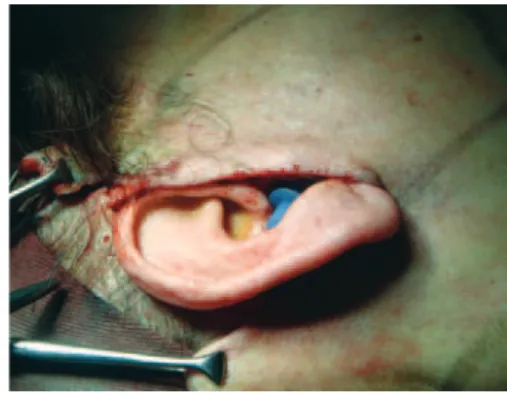
Figure 1 – Detailed view of the cervicofacial skin lap dissected
according to the marked limits and pulled with 1 temporary ixing stitch at the root of the helix and 1 ixing stitch at the apex of the
retroauricular incision.
Figure 2 – In A, a needle with methylene blue applied at the distal end externally transixes and marks the skin 12 to 15 times.
In B, dissected tissue exhibiting the markings made
with methylene blue.
A B
A B
Figure 3 – In A and B, isolated adhesion stitches using 4-0 monocryl thread are applied for better adjustment of the skin lap
Rev Bras Cir Plást. 2013;28(1):55-8 57 Adhesion stitches in rhytidoplasty: a comparative study
A B
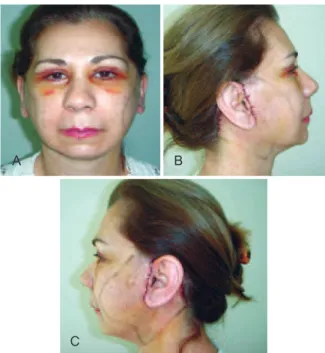
Figure 4 – In A and B, inal appearance
(absence of ecchymoses or hematomas).
Figure 5 – Postoperative image of the sutured skin lap.
Small skin depressions, if present, disappear within a few days postoperatively.
Figure 6 – Appearance on the irst postoperative day
(absence of ecchymoses and hematomas).
In both groups, occlusive dressings and Penrose drains were used and maintained for 24 hours.
RESULTS
In group 1, 5 patients (5.7%) had massive hematomas that were treated surgically. One of the patients was taking
Ginkgo biloba and was not excluded from the sample. Twelve patients (13.6%) had small hematomas that were resolved by puncture (6 in the retroauricular region, 5 in the preauricular region, and 1 in the cervical region). Two patients (2.3%) who were smokers developed minimal skin necrosis in the retroau-ricular region, with a necrotic area of approximately 2 cm².
The patients in group 2 did not develop any hematoma that required surgical evacuation. Five patients (5.68%) deve-loped small hematomas and 4 patients (4.54%) devedeve-loped seromas (3 were located in the pre- and retroauricular regions and 1 in the zygomatic region) that were treated by puncture.
DISCUSSION
Vasoconstrictor administration combined with extensi ve dissections are routinely performed by plastic surgeons du ring rhytidoplasty procedures, despite the associated com -plications such as hematoma formation.5-7
Skin markings performed using a hypodermic needle applied with methylene blue following skin dissection, excess skin resection, and temporary repositioning of the skin at 2 reference points (1 at the root of the helix and 1 at the apex of the retroauricular incision) are simple proce-dures that can be used to guide the application of adhesion stitches. Moreover, the application of these stitches is guided
by 12-15 perforations in order to better adjust the skin lap
suture around the ear with a high degree of adhesion, thereby reducing the risk of hematoma development to a great extent (Figures 4 to 7).
In the present study, the beneit of using adhesion stitches was conirmed by the absence of hematoma development
and minimal ecchymosis in the patients in group 2. Prior
A B
C
Rev Bras Cir Plást. 2013;28(1):55-8
58
Destro MWB et al.
transfixion of skin using a needle applied with methylene blue facilitates the easy application of adhesion stitches.
In addition to the use of adhesion stitches, less-extensive dissections combined with selective tunneling using dou ble-sided underminers8-10 can reduce the incidence of hematoma formation.
CONCLUSIONS
During rhytidoplasty, the bilateral application of 12-15 adhesion stitches in the dissected areas prevented the deve-lopment of hematomas that required surgical evacuation, thus improving postoperative recovery.
REFERENCES
1. Baroudi R, Ferreira CA. Contouring the hip and the abdomen. Clin Plast Surg. 1996;23(4):551-72.
2. Baroudi R, Ferreira CA. Seroma: how to avoid it and how to treat it. Aesthet Surg J. 1998;18(6):439-41.
3. Destro MW, Speranzini MB, Cavalheiro Filho C, Destro T, Destro C. Bilateral haematoma after rhytidoplasty and blepharoplasty follo-wing chronic use of Ginkgo biloba. Brit J Plast Surg. 2005;58(1): 100-1.
4. Destro MWB, Speranzini MB, Destro C, Guerra C, Recco GC, Romag-nolo LGC. Estudo da utilização no pré-operatório de medicamentos ou drogas itoterápicas que alteram a coagulação sanguínea. Rev Col Bras Cir. 2006;33(2):107-11.
5. Baker DC. Complications of cervicofacial rhytidectomy. Clin Plast Surg. 1983;10(3):543-62.
6. Baker CD, Stefani WA, Chiu ES. Reducing the incidence of hematoma requiring surgical evacuation following male rhytidectomy: a 30-year review of 985 cases. Plast Reconstr Surg. 2005;116(7):1973-85. 7. Barton EF Jr. Aesthetic surgery of the face and neck. Aesthet Surg J.
2009;29(6):449-63.
8. Luz DF, Wolfenson M, Figueiredo J, Didier JC. Full-face undermining using progressive dilators. Aesthetic Plast Surg. 2005;29(2):95-9. 9. Menezes MVA, Abla LEF, Dutra LB, Junqueira AE, Ferreira LM. Ava
-liação dos resultados do mini-lifting modiicado: estudo prospectivo. Rev Bras Cir Plást. 2010;25(2):285-90.
10. Saldanha OR. Ritidoplastia com descolamento seletivo. In: Luz D, ed. Técnica Dílson Luz. Tunelizações progressivas: princípios, aplicações e procedimentos complementares. Rio de Janeiro: Dilivros; 2010. p. 99-108.
Correspondence to: Marco Willians Baena Destro