J. Braz. Chem. Soc., Vol. 15, No. 4, 487-490, 2004. Printed in Brazil - ©2004 Sociedade Brasileira de Química 0103 - 5053 $6.00+0.00
Article
* e-mail: [email protected]
Determination of Lead in Bone by Electrothermal Atomic Absorption Spectrometry with
Zeeman Effect Background Correction
Hugo B. Pereira
a, Aderval S. Luna
a, Friedrich W. Herms
band Reinaldo C. de Campos*
,ca
Instituto de Química and bInstituto de Geociências, Universidade do Estado do Rio de Janeiro, Rua São Francisco Xavier, 524, Maracanã, 20550-013 Rio de Janeiro - RJ, Brazil
c
Departamento de Química, Pontifícia Universidade Católica do Rio de Janeiro, Rua Marquês de São Vicente, 225, Gávea, 22453-900 Rio de Janeiro - RJ, Brazil
Um método para a determinação de traços de Pb em ossos por espectrometria de absorção atômica é descrito. Boas precisão e exatidão foram obtidas utilizando-se calibração externa com pa-drões aquosos e NH4H2PO4 como modificador. O limite de detecção alcançado foi de 0,07 ng mL
-1
na solução de leitura, correspondendo a 0,022 Pg g-1 na amostra original. Conseqüentemente, o
limite de quantificação encontrado foi de 0,23 ng mL-1. Uma precisão de 3,5% foi obtida na leitura de
400 ng de Pb na presença da matriz. A exatidão do procedimento foi confirmada pela boa concordância entre os valores certificado e encontrado na análise de um material certificado de referência (NIST SRM 1846, bone meal).
A simple method for measuring trace levels of Pb in bone by electrothermal atomic absorption spectrometry is described. It is shown that Pb can be accurately measured with good precision and accuracy using external calibration with aqueous Pb analytical solutions containing NH4H2PO4 as modifier. The detection limit was found to be 0.07 ng mL-1, corresponding to 0.022 Pg g-1 in the
original sample. Consequently, the limit of quantification was found to be 0.23 ng mL-1. The precision
of the procedure, expressed by the relative standard deviation, was 3.5% for 400 ng Pb in sample measurements. The accuracy of the procedure was confirmed by the good concordance between found and certified values in the analysis of a bone meal certified reference material, NIST SRM 1846.
Keywords: ETAAS lead determination, NH4H2PO4 modifier, bone meal
Introduction
Lead has been one of the most extensively studied toxic elements. Lead in the body comprises 2% in the blood and 95% in bone and dentine. Blood lead may remain elevated for years after cessation of long exposure,
due to remobilization from bone.1It appears that bone-Pb
may be a more accurate and appropriate index of
long-term cumulative exposure compared with blood-Pb.2 This
has led to the development of in vivo measurements of Pb
in bone by X-ray fluorescence (XRF) including K-XRF3
and L-XRF.4,5 However, before these methods become a
valuable screening tool for clinical studies, there are still questions that need to be addressed, such as the absence of an adequate certified reference materials for instrumental
calibration and method validation. Nowadays, for
validation purposes6-8most studies of in vivo XRF
bone-Pb measurements rely on the analysis of bone materials by electrothermal atomic absorption spectrometry (ETAAS) following acid digestion.
The most common and successful technique for
measuring Pb in clinical samples is ETAAS9-11 because of
its high sensitivity and favorable detection limits. Moreover, in general, just a simple pre-treatment is required due to the matrix simplification in the pyrolysis step inherent to the method. However, the analysis of bone still
poses a challenge due to the complexity of the bone matrix.2
In order to minimize matrix interferences, modifiers have been used to stabilize the analyte at higher pyrolysis temperatures, permitting a more efficient volatilization of
the matrix. For instance, Acar12 showed that a Ni + Pd +
NH4H2PO4 modifier mixture was preferred for
488 Pereira et al. J. Braz. Chem. Soc.
et al.,13 in contrast to Parsons14 used a Pd/Mg(NO
3)2 mixture
as modifier. The authors claimed that it enables a significant reduction of the spectral interferences observed if modifiers
based on NH4H2PO4 with either Ca or Mg are used for
Ca3(PO4)2 rich samples. Recently permanent modifiers
have also been proposed in the determination of Pb by
ETAAS.15,16 Due to this literature controversy, the present
work evaluates the use of NH4H2PO4 as modifier for the
determination of lead in bone by ETAAS.
Experimental
Instrumentation
A Perkin-Elmer Model 3030 atomic absorption spectrometer equipped with transverse Zeeman background corrector, a Massmann type longitudinally heated HGA-600 graphite furnace and an AS-60 autosampler was used for the atomic absorption measurements. Perkin-Elmer pyrolytically coated grooved graphite tubes (PN B0109322) containing a L’vov platform (PN B0109324) were used. An Intensitron (Perkin Elmer) hollow cathode lamp was used as line source. Argon (99.99%, Aga, Rio de Janeiro, Brazil) was used as shielding gas, and the stop flow mode used during the atomization step. Injection
volume was always 20 PL. Other instrumental parameters
are summarized in Table 1.
Reagents and solutions
All chemicals used were of analytical-reagent grade.
The lead stock solution (1000 mg L-1) were prepared from
a Titrisol concentrate (Merck, Darmsdadt, Germany). Working solutions were prepared by two consecutive adequate dilutions of the lead stock solution. Nitric acid
489 Determination of Lead in Bone by Electrothermal Atomic Absorption Spectrometry
Vol. 15, No. 4, 2004
Results and Discussion
Method optimization and characterization
In order to optimize the temperature program, pyrolysis and atomization temperatures curves were performed. In
this case, an aqueous Pb (40 ng mL-1) analytical solution
already containing the 1% m/v NH4H2PO4 modifier was
first used. Figure 1 shows the results, indicating optimum pyrolysis and atomization temperatures of 1000 and 1500 °C respectively. It was also observed that the addition of the modifier solution to the sample was also necessary to reach the same performance in spite of the large endogenous phosphate concentration of its matrix. Taking this into account, similar curves were obtained for a sample solution.
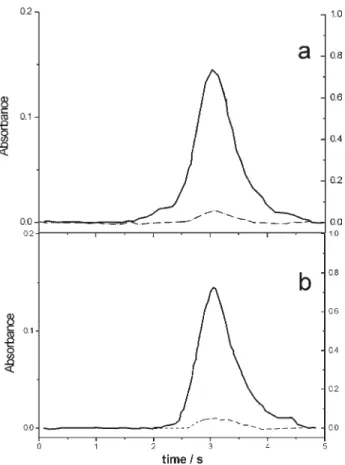
Comparison of the absorbance profiles (Figures 2a and 2b) reveals a close match between the profile related to the bone matrix and that related to the aqueous Pb analytical
solution both containing the NH4H2PO4 modifier. This
match encompasses not only the peak shape but also similar appearance and maximum absorbance times. This behaviour indicates the feasability of using aqueous analytical solutions for calibration. Moreover, the low background absorbance observed is an indicative of the absence of spectral interferences.
The limit of detection was calculated from 3s/m where
s is the estimated standard deviation of 10 consecutive
measurements of the blank solution and m is the slope of
the analytical curve. A value of 0.07 ng mL-1 was obtained,
corresponding to 0.022 Pg g-1 in the original sample. This
also corresponds to a 0.23 ng mL-1 limit of quantification
in the sample solution, well below the range indicated by
Pais and Benton Jones17 (4 – 30 Pg g-1) for Pb in human
bone. The precision of the procedure, expressed by the relative standard deviation, was 3.5%, taken in the measurement of 400 ng Pb in a sample solution.
Validation and application of the method
The method was validated by the analysis of a certified reference material (NIST SRM 1846 Bone Meal). This analysis (in triplicate) showed a good concordance between
the obtained experimental value (1.36 ± 0.03 Pg g-1) and
the certified value (1.335 ± 0.014 Pg g-1), confirming the
accuracy of the proposed procedure. The procedure was used in the analysis of dolphin bone samples, aiming the assessment of anthropogenic environmental impact on
marine mammals. The results ranged from 3 to 6 Pg g-1,
and will be discussed in detail in a further work.
Conclusion
A phosphate (NH4H2PO4) based compound was
confirmed as a good modifier for the determination of Pb
Figure 2. Atomization pulse profiles (— atomic, ···· background)
for (a) an aqueous analytical solution and (b) a bone matrix contain-ing solution, uscontain-ing NH4H2PO4 as modifier. Left scale: atomic absorp-tion values and right scale: background values.
Figure 1. Pyrolysis (z) and atomization ({) temperature curves
for Pb (800 pg) in 5% v/v HNO3 in the presence 0.2 mg of NH4H2PO4 as modifier. Atomization temperature, 16000C for the pyrolysis study;
490 Pereira et al. J. Braz. Chem. Soc.
in bone by ETAAS. External calibration with aqueous analytical solutions was possible, provided the presence of the same modifier concentration in all solutions. No additional Ca or Mg compound was necessary for a good modification action, confirmed by the high pyrolysis temperature and similarity of the peak profiles for sample and aqueous analytical solutions. The whole analytical procedure is extremely simple, providing accuracy and an adequate limit of detection for Pb-bone studies. The procedure could be made even simpler by avoiding the solution transfer to the second plastic tube. However, this would lead to less accuracy in the final volume adjustment, once the volume of the first tube is irreversibly affected due to the heating.
References
1. Gordon, J. N.; Taylor, A.; Bennett, P. N.; Br. J. Clin. Pharmacol. 2002,53, 451.
2. Zong, Y. Y.; Parsons, P. J.; Slavin, W.; J. Anal. At. Spectrom. 1996,11, 25.
3. Todd, A. C.; Parsons, P. J.; Carroll, S.; Geraghty, C.; Khan, F. A.; Tang, S. D. ; Moshier, E. L.; Phys. Med. Biol.2002,47, 673.
4. Todd, A.C.; Phys. Med. Biol.2002,47, 491. 5. Todd, A.C.; Phys. Med. Biol.2002,47, 507.
6. Todd, A. C.; Carroll, S.; Geraghty, C.; Khan, F. A.; Moshier, E. L.; Tang, S. D. ; Parsons, P. J.; Phys. Med. Biol.2002,47, 1399.
7. Todd, A. C.; Moshier, E. L.; Caroll, S.; Casteel, S. W.; Environ. Health Perspect. 2001,109, 1115.
8. Todd, A. C.; Parsons, P. J.; Tang, S. D.; Moshier, E. L.; Environ. Health Perspect. 2001,109, 1139.
9. Tahán, J. E.; Granadillo, V. A.; Romero, R. A.; Anal. Chim. Acta 1994,295, 187.
10. Keating, A. D.; Keating, J. L.; Halls, D. J.; Fell, G. S.; Analyst 1987, 112, 1381.
11. Spevackova, V.; Smíd, J.; Spectrochim. Acta Part B1999,54, 865.
12. Acar, O.; Talanta2001,55, 613.
13. Iavocoli, I.; Carelli, G.; Castellino, N.; Schlemmer, G.; Fresenius’ J. Anal. Chem.2001,370, 1100.
14. Zong, Y. Y.; Parsons, P. J.; Slavin, W.; Spectrochim. Acta Part B1998,53, 1031.
15. Pereira Filho, E. R.; Poppi, R. J.; Arruda, M. A. Z.; Quim. Nova 2002,25, 246.
16. Grinberg, P.; Campos, R. C.; Spectrochim. Acta Part B2001, 56, 1831.
17. Pais, I.; Benton Jones Jr, J.; The Handbook of Trace Elements, St. Lucie Press: Boca Raton, 1997.
Received: March 21, 2003