Significant Reduction of Antibiotic
Consumption and Patients
’
Costs after an
Action Plan in China, 2010
–
2014
Lidao Bao1☯, Rui Peng1☯, Yi Wang1, Ruilian Ma1, Xianhua Ren1, Wenbin Meng2, Fusheng Sun3, Junxia Fang4, Ping Chen5, Yang Wang6, Qiuhong Chen7, Jian Cai8, Jian Jin9, Jinhui Guo10, Shucheng Yang11, Xiaomei Mo12, Enjing Zhang13,
Yuerong Zhang14, Zhaoxin Lu15, Binbin Chen16, Xiujuan Yue17, Meijun Zhu18, Yingying Wang19, Xinchao Li20, Yuan Bian21, Shaoshan Kong22, Wenfei Pan23, Qian Ding24, Jun Cao25, Rupin Liu26, Nan Chen27, Xuelian Huang28, Agula B29*, Haijun Lyu30*
1Department of Pharmacy, Affiliated Hospital of Inner Mongolia Medical University, Hohhot, Inner Mongolia, China,2Department of Obstetrics, Affiliated Hospital of Inner Mongolia Medical University, Hohhot, Inner Mongolia, China,3Department of Pharmacy, People’s Hospital, Qingdao, Shandong, China,4Department of Pharmacy, The Third People’s Hospital, Fuyang, Zhejiang, China,5Department of Pharmacy, Central Hospital, Zibo, Shandong, China,6Department of Pharmacy, Women and Children’s Hospital, Maanshan, Henan, China,7Department of Pharmacy, The 175th Military Hospital of the People’s Liberation Army, Zhangzhou, Fujian, China,8Department of Pharmacy, Fengxian District Psychiatric Center, Shanghai, China,9Department of Pharmacy, The Ninth Affiliated People’s Hospital of Shanghai Transport University, Shanghai, China,10 Department of Pharmacy, Tuberculosis Hospital, Zhengzhou, Henan, China, 11Department of Pharmacy, Women and Children’s Hospital, Taiyuan, Shanxi, China,12 Department of Pharmacy, Women and Children’s Hospital, Qingdao, Shandong, China,13 Department of Pharmacy, The Third Hospital, Wuhan, Hubei, China,14Department of Pharmacy, Huli District Women and Children’s Hospital, Xiamen, Fujian, China,15Department of Emergency, Haici Medical Group, Qingdao, Shandong, China,16Department of Pharmacy, Psychiatric Center, Xiamen, Fujian, China,17 Department of Pharmacy, Beijing Youan Hospital of Capital Medical University, Beijing, China,18 Department of Pharmacy, Minhang District Psychiatric Center, Shanghai, China,19Department of Pharmacy, Dongchangfu District Women and Children’s Hospital, Liaocheng, Shandong, China,20Department of Pharmacy, Lintong District Chinese Medicine Hospital, Xian, Shanxi, China,21Department of Pharmacy, People’s Hospital, Chengdu, Sichuan, China,22Department of Pharmacy, Women and Children’s Hospital, Zhuhai, Guangdong, China,23 Department of Pharmacy, Buwai Cardiology Hospital, Beijing, China, 24Department of Pharmacy, Affiliated Children’s Hospital of Capital Pediatrics Research Center, Beijing, China,25Department of Pharmacy, The Fifth People’s Hospital, Suzhou, Zhejiang, China,26Department of Pharmacy, Central Hospital, Xinyang, Henan, China,27Department of Pharmacy, People’s Hospital Affiliated to Southern China Medical University, Zhengzhou, Henan, China,28 Department of Pharmacy, People’s Hospital, Luo County, Guangdong, China,29Department of Mongolian Medicine, Inner Mongolia Medical University, Hohhot, Inner Mongolia, China,30 Scientific Research Center, Affiliated Hospital of Inner Mongolia Medical University, Hohhot, Inner Mongolia, China
☯These authors contributed equally to this work.
*[email protected](HL); [email protected](AB)
Abstract
Introduction
On July 1, 2011, the Chinese government launched a national Action Plan for antibiotic stewardship targeting antibiotic misuse in public hospitals. The aim of this study was to eval-uate the impacts of the Action Plan in terms of frequency and intensity of antibiotic utilization and patients costs in public general hospitals.
OPEN ACCESS
Citation:Bao L, Peng R, Wang Y, Ma R, Ren X,
Meng W, et al. (2015) Significant Reduction of Antibiotic Consumption and Patients’Costs after an Action Plan in China, 2010–2014. PLoS ONE 10(3): e0118868. doi:10.1371/journal.pone.0118868
Academic Editor:Andrew C Singer, NERC Centre
for Ecology & Hydrology, UNITED KINGDOM
Received:September 8, 2014
Accepted:January 7, 2015
Published:March 13, 2015
Copyright:© 2015 Bao et al. This is an open access
article distributed under the terms of theCreative Commons Attribution License, which permits unrestricted use, distribution, and reproduction in any medium, provided the original author and source are credited.
Data Availability Statement:All relevant data are
within the paper and its Supporting Information files.
Funding:This study was financially supported by
Methods
Administrative pharmacy data from July 2010 to June 2014 were sampled from 65 public general hospitals and divided into three segments: (1) July 2010 to June 2011 as the prepa-ration period; (2) July 2011 to June 2012 as the intervention period; and (3) July 2012 to June 2014 as the assessment period. The outcome measures included (1) antibiotic pre-scribing rates; (2) intensity of antibiotic consumption; (3) patients costs; and (4) duration of peri-operative antibiotic treatment in clean surgeries of thyroidectomy, breast, hernia, and orthopedic procedures. Longitudinal and cross-sectional analyses were conducted.
Results
Longitudinal analyses showed significant trend changes in the frequency and intensity of antibiotic consumption, the patients’costs on antibiotics, and the duration of antibiotic treat-ment received by surgical patients undergoing the 4 clean procedures during the interven-tion period. Cross-secinterven-tional analyses showed that the antibiotic prescribing rates were reduced to 35.3% and 12.9% in inpatient and outpatient settings, that the intensity of antibi-otic consumption was reduced to 35.9 DDD/100 bed-days, that patients’costs on antibiotics were reduced significantly, and that the duration of peri-operative antibiotic treatment re-ceived by surgical patients undergoing the 4 types of clean procedures decreased to less than 24 hour during the assessment period.
Conclusion
The Action Plan, as a combination of managerial and professional strategies, was effective in reducing the frequency and intensity of antibiotic consumption, patients’costs on antibiot-ics, and the duration of peri-operative antibiotic treatment in the 4 clean surgeries.
Introduction
The increasing prevalence of antibiotic resistance has been recognized as a public health threat worldwide, especially in China [1]. The prevalence of methicillin-resistantStaphylococcus aure-us(MRSA), extended-spectrumβ-lactamase-producingEscherichia coli, imipenem-resistant Pseudomonas aeruginosa, and imipenem-resistantAcinetobacter baumanniiaccounted for 50% to 70% of nosocomial infections in China in 2010 [2]. Antibiotic overuse and misuse are major contributing factors for antibiotic resistance [3,4]. An epidemiological research found that antibiotics were prescribed for 68.9% of hospitalized patients, among whom 37.0% of the patients were subject to a combination of multiple antibiotics treatment, and that the average intensity of antibiotic consumption was 80.1 Defined Daily Doses/per 100 patient-days (more than twice of the average value worldwide) in China in 2010 [5].
According to recommendations from the World Health Organization (WHO), healthcare authorities should put emphasis on four aspects to contain antibiotic resistance, including (1) establishment of a national system to address antibiotic resistance; (2) legislation followed by enforcement to prevent illegal sales or marketing of prescription drugs targeting microbial in-fections; (3) education and stewardship on rational antibiotic use; and (4) strict adherence to guidelines aiming to prevent infections in the entire healthcare facilities [6]. Collectively, WHO suggests that antibiotic resistance should be addressed by administrative strategies and analysis, decision to publish, or preparation of
the manuscript.
Competing Interests:The authors of this study
together with professional strategies at national, regional, and institutional levels. Implementa-tion and enforcement of a holistic antibiotic stewardship program have shown positive effects in combating antibiotic resistant pathogens, as was reported in a recent meta-analysis of 89 studies [7]. On July 1, 2011, the Chinese government initiated a national public health cam-paign targeting antibiotic resistance [8]. The campaign was a national antibiotic stewardship action plan (hereafter referred to as the Action Plan) in a series of government regulations over the past decade by incorporating administrative and professional strategies into an overall anti-biotic stewardship program. Since its inception, the rampant antianti-biotic consumption driven by multifaceted factors have been reduced as a result of enforced antibiotic management and opti-mized antibiotic prescribing in China [1,9]. However, there are few researches evaluating the overall impact of the Action Plan due to practical and methodological challenges.
The aim of this Research Article was to bridge the gap by examining the pharmacoeconomic impacts of the Action Plan. Administrative pharmacy data and electronic medical records were extracted from the hospital information systems in 65 public general hospitals across China. The impacts of the Action Plan on antibiotic consumption and economic costs were analyzed using segmented regression analysis of interrupted time series (ITS).
Methods
Policy interventions by the Action Plan
The Action Plan for combating antibiotic resistance officially took into effect on July 1, 2011 [8]. Since compulsory participations from secondary and tertiary public hospitals (correspond-ing to Class II and III hospitals accord(correspond-ing to China’s hospital classification system) were dictat-ed by the Ministry of Health, a separate control group characterizdictat-ed by a randomizdictat-ed control trial was not feasible. Therefore, we decided to evaluate the impact of the Action Plan using segmented regression analysis of ITS as well as cross-sectional analyses to provide a whole pic-ture. Before the initiation of the Action Plan, 3 guidelines that had effects on antibiotic pre-scribing had been enacted by the Ministry of Health: (1)Regulations on Prescription Managementissued on February 10, 2010, which highlights pharmacy validation by clinical pharmacists on medication use, especially on antibiotic prescribing [10]; (2)Regulations on pharmacy administration in medical institutionsissued on January 30, 2011, which underscores the key roles of Drug and Therapeutics Committees (DTCs) and clinical pharmacists in formu-lary control, concurrent prescribing monitoring, and pharmacy validation [11]; and (3)Action Plan for Antibiotic Stewardship in Clinical Applicationissued on April 25, 2011, which outlines the key elements in developing and implementing a framework for antibiotic stewardship in public hospitals [8]. In our study, the 3 major policy changes mentioned above were considered as a preparation phase prior to the official initiation of the Action Plan started on July 1, 2011.
and a tendency to cause antibiotic resistance. As a managerial tool, specific goals were set by the Action Plan: (1) the proportion of patients receiving antibiotic prescription (hereafter re-ferred to as antibiotic prescribing rates) should be less than 60% for hospitalized patients or less than 20% for outpatients; (2) the intensity of antibiotic consumption should be less than 40 DDD/100 bed-days; (3) the proportion of patients receiving antibiotic prophylaxis for clean surgeries should be less than 30%; and (4) antibiotic prophylaxis should be administered 30 to 120 minute prior to surgical incision and the duration of the prophylaxis should not extend be-yond 24 hour.
Apart from regular dissemination sessions through routine DTC meetings in respective hos-pitals, the Ministry of Health regularly held national education programs for physicians and managerial personnel. Supervision on the compliance with the Action Plan was conducted twice a year by the healthcare authorities. These measures are an ongoing process, so is the re-finement of the guidelines for prescribing antibiotics. On May 8, 2012, the Chinese MoH issued a revised version of antibiotic guidelines entitledRegulations on Clinical Applications of Antibi-otics[12], aiming to improve rational antibiotic utilization in all medical units with detailed listings of indications, contraindications, dose, form, route, frequency and duration of adminis-tration on antibiotics in the formulary of public hospitals.
Study design
Conceived by the first author in May 2014, a research on the pharmacoeconomic impacts of the Action Plan was discussed by peers on a professional clinical pharmacist community
(http://www.clinphar.cn/). The inclusion criteria required the completeness and availability of
administrative pharmacy data and electronic medical records from all medical units, excluding the departments of pediatrics and hematology, over the past 4 years (July 2010 to June 2014). By stratified sampling based on classification (i.e., secondary or tertiary) of public general pitals, the research protocols were sent to the pharmacy departments of 300 public general hos-pitals. Among the 152 hospitals that responded, 65 hospitals (30 tertiary hospitals and 35 secondary hospitals) were selected depending on the inclusion criteria. The stratification of sampling was based on the ratio of the total number of medical encounters in tertiary hospitals to the number in secondary hospitals in 2011 (898 million in tertiary hospitals vs. 992 million in secondary hospitals) [13]. This research was approved by the Ethics Committee of the Affili-ated Hospital of Inner Mongolia Medical University. The Ethics Committees of the 65 hospitals approved this research on condition of not being identified.
Since 3 major policy changes mentioned above had occurred before the initiation of the Ac-tion Plan on July 1, 2011, we chose data points of 12 months prior to the initiaAc-tion. The coau-thors of our study agreed to identify this time period as a preparation period. Further, it was reasonable to postulate that there were lagged effects of the Action Plan as disseminating and implementing the Action Plan occurred during an extended period of time. After preliminary data analysis on the collected data, the study period was divided into 3 segments characteristic of the segmented regression analysis, including Segment 1: the preparation period (July 2010 to June 2011); Segment 2: the policy intervention period (July 2011 to June 2012); and Segment 3: the assessment period (July 2012 to June 2014).
Outcome measures and data collection
DDD system (WHO, version 2013) [14]. Antibiotic prescribing rates were calculated for inpa-tient, outpainpa-tient, and emergency settings in the 65 hospitals. The data of the antibiotic con-sumption were normalized to DDD/100 bed-days for inpatients, and to DDD/1000 outpatient-days for outpatients. Inpatients’costs (including the costs on hospital study, medication, anti-biotics, and very-restricted antibiotics) were extracted from inpatients’discharge records. Out-patients’costs on medication, antibiotics, and very-restricted antibiotics were collected from hospital information systems. The patients’costs were then converted into U.S. dollars (1 U.S. dollar = 6.15 CNY). The average duration of hospital stay as well as peri-operative antibiotic treatment received by patients undergoing 4 types of clean surgeries (thyroidectomy, breast surgery, hernia, or orthopedic procedures) were extracted. Finally, the collected data were ag-gregated as evenly-spaced average monthly data characteristic of time series data points.
Statistical analysis
Segmented regression analysis of ITS was conducted to analyze the aggregated monthly data of interest from indicated hospitals. The data points were then divided into 3 segments corre-sponding to the preparation period, policy intervention period, and assessment period. Two parameters define each segment of a time series: (1) level, which is the value of a time series at a beginning of a given times series (e.g., they-intercept); and (2) trend, which is the rate of change of an outcome measure of interest (e.g., the slope). Segmented regression analysis of in-terrupted time series allows us to assess, in statistical terms, how much an intervention changed an outcome of interest, immediately and over time; instantly or with delay; transiently or long-term [15].Model 1below can be used to evaluate the changes in level and trend caused by a single intervention.Model 2below can be used to evaluate the changes in time series with more than one change points which are characterized by lagged effects and/or interventions that occur over an extended period of time [15]. Given the lagged effects revealed by prelimi-nary analysis and multiple interventions occurred during the policy intervention period,Model 2was the statistical model used in this study:
Yt¼ b0þ b1timetþb2interventiontþb3time after interventiontþet ðModel 1Þ
Yt¼ b0þb1timetþb2interventiontþ b3time after interventiont
þb4assessmenttþb5time after assessmenttþet
ðModel 2Þ
InModel 2,β0estimates the level of the outcome during the preparation period;β1estimates
assessment or 1–24 after the assessment. The last term inModel 2is the error termet, repre-senting variation unexplained by the segmented regression model. The error termetis assumed to be comprised of a Gaussian random error (white noise) and an potential error term at timet that may be correlated to errors (the autoregressive component) or shocks (the moving-average component) at preceding or subsequent time points [15]. To avoid overestimating the signifi -cance of effect of the policy intervention, the error termetis reduced to a white noise byfitting an ARMA model to the error termet[15].
Statistics were analyzed using Statistics Analysis System (SAS; version 9.2). The effects of policy intervention are expressed as changes in level and trend and their corresponding stan-dard errors. Segmented Regression analysis of ITS was conducted using PROC ARIMA of SAS. In addition, the impacts of the Action Plan were evaluated by whether the managerial goals on antibiotic consumption had been achieved during the assessment period; therefore, cross-sectional analyses were conducted on the average yearly values of outcome measures during the 3 periods using PROC MIXED of SAS. Bar charts were plotted for data visualization, with error bars representing standard deviations. Normality was checked by Shapiro-Wilk test, and homoscedasticity was checked using plots of residuals against the predicted values. The signifi-cance level was 0.05.
Results
Changes in antibiotic prescribing rates and intensity of antibiotic
consumption
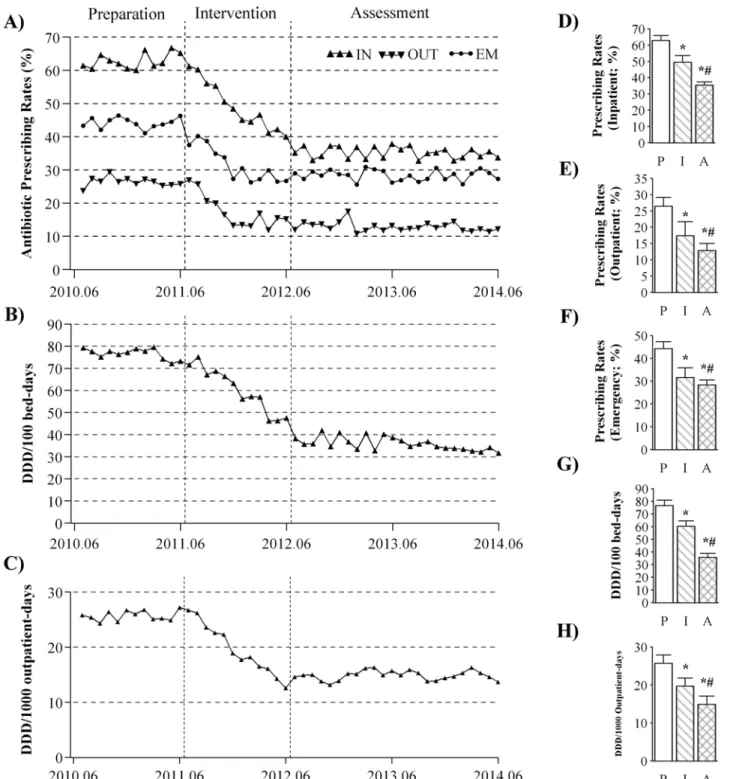
The impacts of the Action Plan on antibiotic consumption in the 65 general hospitals are shown inFig. 1. The changes of level and trend with respects to antibiotic prescribing rates dur-ing the preparation, intervention, and assessment periods are summarized inTable 1.Fig. 1A
shows that the average antibiotic prescribing rates declined by 2.27% (se= 0.22;p<0.001), by
1.07% (se= 0.37;p= 0.004), and by 1.31% (se= 0.19;p<0.001) per month in the inpatient,
outpatient and emergency settings during the intervention period, respectively (Table 1). Cross-sectional analyses showed that the average prescribing rate was reduced significantly from 62.9% during the preparation period to 35.3% during the assessment period in the inpa-tient settings (p<0.001;Fig. 1D). Similar reductions in prescribing rates were observed in
both outpatient (26.4% vs. 12.9%;p<0.001) and emergency (44.2% vs. 28.4%;p<0.001)
set-tings during the assessment period compared with the preparation period (Fig. 1E and 1F).
Fig. 1B and 1Cshow that the average intensity of antibiotic consumption decreased per
month by 2.23 DDD/100 bed-days (se= 0.30;p<0.001) in the inpatient settings, and by 1.31
DDD/1000 outpatient-days (se= 0.14;p<0.001) in the outpatient settings during the
inter-vention period (Table 1). Cross-sectional analyses showed that the average intensity of inpa-tients’antibiotic consumption dropped from 76.6 DDD/100 bed-days during the preparation period to 35.9 DDD/100 bed-days during the assessment period (p<0.001;Fig. 1G), and that
the intensity of outpatients’antibiotic consumption declined from 25.7 DDD/1000 outpatient-days during the preparation period to 14.9 DDD/1000 outpatient-outpatient-days during the assessment period (p<0.001;Fig. 1H).
Changes in patients
’
costs on hospital stay, medication, antibiotics
including the very-restricted antibiotics
Fig 1. Changes in antibiotic prescribing rates and intensity of antibiotic consumption.Time series of average monthly value of the antibiotic prescribing rates (A) were plotted for inpatient (IN), outpatient (OUT), and emergency (EM) settings. The data on intensity of antibiotic consumption were plotted for the inpatient (B) and outpatient settings (C). Cross-sectional analyses were conducted by comparing the average yearly data on antibiotic prescribing rates in inpatient (D), outpatient (E) and emergency (F) settings as well as the intensity of consumption in the inpatient (G) and outpatient (H) settings. P: preparation; I: intervention; A: assessment;*significant difference in intervention/assessment vs. preparation;#significant difference in
assessment vs. intervention.
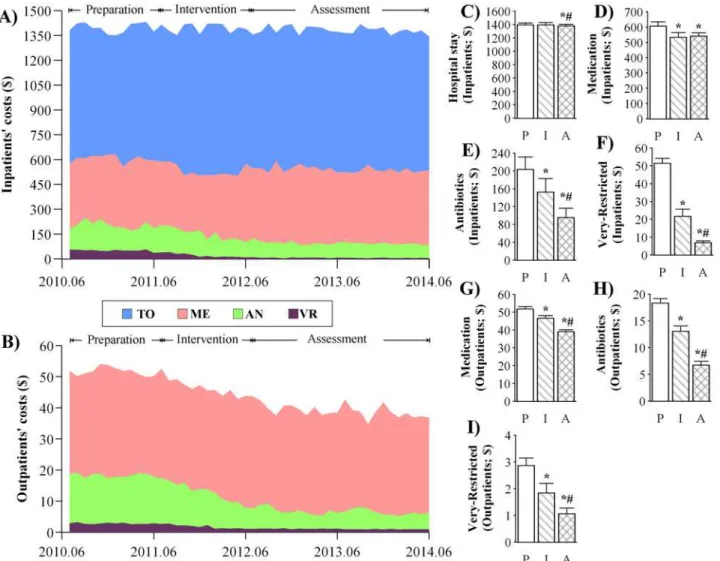
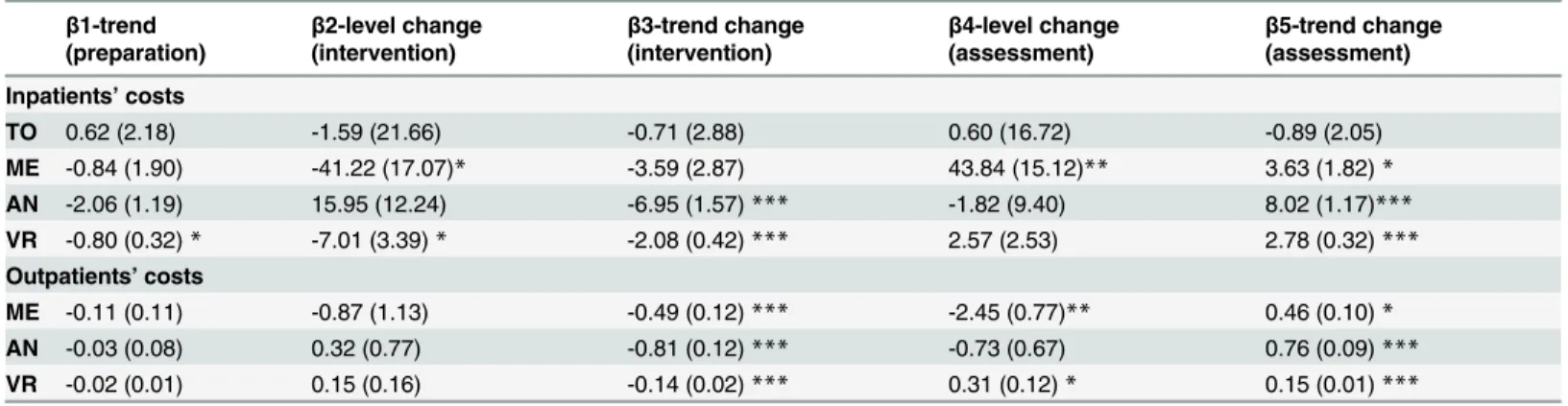
significant decrease (level= -41.2;se= 17.7;p<0.05) at the start of the intervention period
(Table 2). The average costs on antibiotics decreased by $6.95 (se= 1.57;p<0.001) per month
during the intervention period for hospitalized patients (Table 2). Similarly, the costs for hospi-talized patients on the very-restricted antibiotics showed a significant reduction (slope= -2.08; se= 0.42;p<0.001) per month during the intervention period (Table 2). Cross-sectional
anal-yses showed significant decreases in the average costs on hospital stay ($1396.2 vs. $1382.2; p= 0.041), medication ($606.7 vs. $541.8;p<0.001), antibiotics ($203.7 vs. $95.4; a reduction
of 53%;p<0.001), and on the very-restricted antibiotics ($51.3 vs. $6.9; a reduction of 87%;
p<0.001) for hospitalized patients during the assessment period compared with the
prepara-tion period (Fig. 2C–2F).
In the outpatient settings (Fig. 2B), the average patients’costs on medication, antibiotics, and on the very-restricted antibiotics decreased significantly by $0.49 (se= 0.12;p<0.001),
$0.81 (se= 0.12;p<0.001), and $0.14 (se= 0.02;p<0.001) per month during the intervention
period, respectively (Table 2). Cross-sectional analyses showed significant decreases in the av-erage outpatients’costs on medication ($51.7 vs. $39.1;p<0.001), antibiotics ($18.3 vs. $6.7; a
reduction of 63%;p<0.001), and on the very-restricted antibiotics ($2.9 vs. $1.1; a reduction
of 62%;p<0.001) during the assessment period compared with the preparation period
(Fig. 2G–2I).
Changes in hospital stay as well as duration of peri-operative antibiotic
treatment in the 4 types of clean surgeries
The average duration of hospital stay as well as peri-operative antibiotic treatment for patients receiving the 4 types of clean surgeries of thyroidectomy, breast surgery, hernia, or orthopedic procedures in the 65 general hospitals are shown inFig. 3. The average duration of hospital stay decreased by 0.16 day (se =0.03;p<0.001) per month during the intervention period; the
duration of peri-operative antibiotic treatment received by the surgical patients decreased by 0.19 day (se =0.02;p<0.001) per month during the intervention period (Table 3).
Cross-sec-tional analyses showed significant decreases in the duration of hospital stay (6.41 vs. 5.27 day;p
<0.001) and the duration of peri-operative antibiotic treatment (3.97 vs. 0.96 day;p<0.001)
during the assessment period compared with the preparation period (Fig. 3B and 3C). Table 1. Regression analyses of ITS on the changes in antibiotic consumption.
β1-trend (preparation)
β2-level change (intervention)
β3-trend change (intervention)
β4-level change (assessment)
β5-trend change (assessment)
RATE_I 0.30 (0.16) -2.32 (1.55) -2.27 (0.22)*** -2.67 (1.30)* 1.93 (0.17)*** RATE_O -0.08 (0.24) 0.43 (1.99) -1.07 (0.37)** 1.16 (1.79) 1.13 (0.27)*** RATE_E 0.10 (0.15) -5.58 (1.60)*** -1.31 (0.19)*** 4.25 (1.17)*** 1.17 (0.14)*** DDD_I -0.39 (0.21) 2.84 (2.13) -2.23 (0.30)*** -7.06 (1.74)*** 2.39 (0.22)*** DDD_O 0.06 (0.10) 1.67 (0.88) -1.31 (0.14)*** 2.03 (0.75)** 1.25 (0.10)***
Changes in level and slope in antibiotic prescribing rates in inpatient (RATE_I), outpatient (RATE_O) and emergency (RATE_E) settings in the 65 general hospitals were analyzed using segmented regression analysis of ITS. The intensity of antibiotic consumption was expressed as DDD/100 bed-days for inpatient settings (DDD_I) or DDD/1000 outpatient-days for outpatient settings (DDD_O). The parameters ofβ1 toβ5, expressed as Mean (SE), were described in the Methods.
*p<0.05;
**p<0.01;
***p<0.001.
Discussion
In summary, the impacts of a national action plan for antibiotic stewardship in China were evaluated with reference to the goals set by the Action Plan, including the frequency and inten-sity of antibiotic consumption as well as the duration of antibiotic prophylaxis in clean surger-ies of thyroidectomy, breast, hernia, and orthopedic procedures. A total of 65 public general hospitals were included, and data were extracted from pharmacy modules of respective hospital information systems. Longitudinal analyses were conducted on the average monthly data by re-gression analysis of ITS; cross-sectional analyses were conducted on the average yearly data using the mixed model. Regression analyses of ITS revealed consistent and significant trend changes (β3) in the frequency and intensity of antibiotic consumption, the patients’costs on antibiotics, and the duration of antibiotic treatment received by surgical patients undergoing the 4 clean procedures during the intervention period (Tables1,2, and3). Cross-sectional Fig 2. Changes in patients’costs.The stack plots represent the average monthly data of costs for inpatients (A) and outpatients (B) during the preparation, intervention, and assessment periods. The costs are summarized as the costs on hospital stay (TO), medication (ME), antibiotics (AN), and very-restricted antibiotics (VR). Cross-sectional analyses were conducted by comparing the average yearly data on patents’costs on hospital stay, medication, antibiotics, and very-restricted antibiotics (Very-Restricted) for both inpatients (C—F) and outpatients (G—I). P: preparation; I: intervention; A: assessment;*significant difference in intervention/assessment vs. preparation;#significant difference in assessment vs. intervention.
analyses show that the antibiotic prescribing rates during the assessment period were reduced to 35.3% and 12.9% (Fig. 1D and 1E) in inpatient and outpatient settings respectively, indicat-ing that the goals set by the Action Plan were achieved (60% for inpatients and 20% for outpa-tients as described in the Methods). During the preparation period, the average yearly intensity of antibiotic consumption was 76.6 DDD/100 bed-days (Fig. 1G) in inpatient settings, which was comparable to the previously reported data (80.1 DDD/100 bed-days) [5]. In contrast, the intensity was reduced to 35.9 DDD/100 bed-days (Fig. 1G) during the assessment period, which was lower than the goal set by the Action Plan (40 DDD/100 bed-days). Meanwhile, pa-tients’costs on antibiotics were reduced significantly by 53% (Fig. 2E) and 62% (Fig. 2H) in Table 2. Regression analyses of ITS on the changes in patients’costs.
β1-trend (preparation)
β2-level change (intervention)
β3-trend change (intervention)
β4-level change (assessment)
β5-trend change (assessment)
Inpatients’costs
TO 0.62 (2.18) -1.59 (21.66) -0.71 (2.88) 0.60 (16.72) -0.89 (2.05)
ME -0.84 (1.90) -41.22 (17.07)* -3.59 (2.87) 43.84 (15.12)** 3.63 (1.82)*
AN -2.06 (1.19) 15.95 (12.24) -6.95 (1.57)*** -1.82 (9.40) 8.02 (1.17)***
VR -0.80 (0.32)* -7.01 (3.39)* -2.08 (0.42)*** 2.57 (2.53) 2.78 (0.32)***
Outpatients’costs
ME -0.11 (0.11) -0.87 (1.13) -0.49 (0.12)*** -2.45 (0.77)** 0.46 (0.10)*
AN -0.03 (0.08) 0.32 (0.77) -0.81 (0.12)*** -0.73 (0.67) 0.76 (0.09)***
VR -0.02 (0.01) 0.15 (0.16) -0.14 (0.02)*** 0.31 (0.12)* 0.15 (0.01)***
Changes in level and slope in patients’costs on medications (ME), antibiotics (AN), and on the very-restricted (VR) antibiotics were analyzed for both inpatients and outpatients in the 65 general hospitals. Patients’total costs during hospital stay (TO) were analyzed for inpatients. The parameters ofβ1 to
β5, expressed as Mean (SE), were described in the Methods.
*p<0.05;
**p<0.01;
***p<0.001.
doi:10.1371/journal.pone.0118868.t002
Fig 3. Changes in hospital, duration of peri-operative antibiotic treatment.Time series of duration of hospital stay (dHS) and peri-operative antibiotic treatment (dAT) for patients undergoing 4 types of clean procedures of thyroidectomy, breast, hernia, and orthopedic procedures were plotted (A). Cross-sectional analyses were conducted by comparing the duration of patients’hospital stay (B) and the duration of peri-operative antibiotic treatment (C) received by the surgical patients during the 3 study periods. P: preparation; I: intervention; A: assessment;*significant difference in intervention/assessment vs. preparation;#significant difference in assessment vs. intervention.
inpatient and outpatient settings during the assessment period compared with the preparation period, respectively. In effect, the duration of hospital stay were analyzed for all hospitalized patients as well, showing that there were no significant differences during the 3 periods investi-gated (data not shown); therefore, we selected a homogeneous subset of clean surgeries to eval-uate the impacts of the Action Plan. The duration of peri-operative antibiotic treatment received by surgical patients undergoing the 4 types of clean procedures decreased to less than 24 hour (<24 hour set by the Action Plan) during the assessment period, which was
concomi-tant with a slight yet significant decrease in the duration of hospital stay (Fig. 3B and 3C). The purpose of the Action Plan as a combination of professional and administrative strate-gies was to promote rational antibiotic utilization to contain the prevalence of antibiotic resis-tance and patients’costs. The Action Plan focused on the managerial strategies. The
effectiveness and efficiency of the managerial strategies can be attributed, at least partially, to the organizational structure in China’s public hospitals. The chief administrators are appointed jointly by higher healthcare administrations and cadre authorities, taking full responsibilities of day-to-day performance, including procurement of medicines and employment decisions [16]. Healthcare professionals working in public hospitals are subject to civil service rules as well as the supervision from cadre authorities [16], meaning that disciplinary actions caused by in-fringement on the antibiotic guidelines lead to the cessation of the prescribers’medical career. In implementing the strategies initiated by the Action Plan, members of DTC and directors of all relevant departments hold weekly meetings, by which issues in antibiotic administration were identified and discussed and prescribers in question are interviewed. In routine practice, clinical pharmacists are conferred with more power to participate in daily ward-rounds and concurrent pharmacy validation. Furthermore, as a managerial tool, healthcare authorities conduct two supervision sessions each year, during which the hospitals’performances relating to antibiotics are inspected. All the members of our research team agree that prescribers and clinical pharmacists are working under more pressure from the management and peers.
Since China’s private hospitals, which handled about 5% of total outpatient and inpatient services [13], are privately funded and operated for profit with more autonomy, the Action Plan of antibiotic stewardship concentrated on public hospitals, which are roughly divided into national, provincial, municipal, and county-level hospitals. Our pilot study on the national and county-level public hospitals showed larger variation in the collected data; therefore, they were excluded from this study to achieve statistical homogeneity. Though statistical analyses showed slight yet significant differences between secondary and tertiary hospitals, separate data analy-ses using hospital category as a factor reached the same conclusions as they were analyzed as a Table 3. Regression analyses of ITS on the changes in duration of hospital stay and peri-operative antibiotic treatment in the 4 types of clean surgeries.
β1-trend (preparation)
β2-level change (intervention)
β3-trend change (intervention)
β4-level change (assessment)
β5-trend change (assessment)
dHS -0.04 (0.03) 1.50 (0.34) -0.16 (0.03)*** 0.11 (0.22) 0.19 (0.03)***
dAT -0.09 (0.02)*** 0.30 (0.21) -0.19 (0.02)*** 0.71 (0.14)*** 0.27 (0.02)***
Changes in level and slope in the days of hospital stay (dHS), as well as the duration of peri-operative antibiotic treatment (dAT) received by patients undergoing 4 clean surgeries of thyroidectomy, breast surgery, hernia, or orthopedic procedures in the 65 hospitals were analyzed. The parameters ofβ1 toβ5, expressed as Mean (SE), were described in the Methods.
*p<0.05;
**p<0.01;
***p<0.001.
whole (data not shown). Besides, only 65 out of 300 hospitals were admitted in this study, which was mainly due to three reasons: (1) the lack of a fully-functional pharmacy manage-ment system in certain hospitals that were excluded from this study; (2) the concern for release of sensitive medical data; and (3) the stratified sampling method, which required a ratio of the number of tertiary hospitals to the number of secondary hospitals equaling about 9/10. A com-puterized pharmacy management system plays important roles in pharmacy validation and concurrent prescription monitoring with improved patient outcomes [17]. However, more than 50 hospitals that could not participate in this study lacked a functional pharmacy module in their hospital information systems during the study periods, especially in 2010. Although the avoidance of acquiring sensitive data, such as standardized mortality rates, was manifested in our research protocols, more than 100 of hospitals that refused to participate concerned the release of medical information on patients’costs, resulting in the relatively lower response rate (152/300), which was confirmed in our follow-up calls. In addition, the impacts of the Action Plan on the duration of antibiotic treatment in clean surgeries were evaluated in only 4 types of clean surgeries of thyroidectomy, breast, hernia, and orthopedic procedures, since these 4 sur-geries could be identified as clean procedures from the available data. We examined the dura-tion of antibiotic treatment other than the duradura-tion of antibiotic prophylaxis, since whether the antibiotic treatment was for prophylactic purpose or for therapeutic purpose could not be iden-tified from the collected data in the year of 2010. The compliance of administering antibiotic prophylaxis 30 to 120 minute prior to surgical incision was not evaluated quantitatively in this study, since recording the timing of prophylactic antibiotic administration electronically re-quired technical issues of modifying the pharmacy management systems, which occurred dif-ferentially in the investigated hospitals.
Along with the antibiotic stewardship program in public hospitals, the Chinese government began to strengthen antibiotic utilization policy specific to primary healthcare institutions in the community and in rural clinics, which will be evaluated in our future studies. We hope that the fundamental changes prompted by the Action Plan can gradually turn into institutionalized and standardized clinical practice in all healthcare institutions so as to effectively address the global threat—antibiotic resistance.
Conclusions
In conclusion, the antibiotic stewardship in China was effective in reducing the frequency and intensity of antibiotic use in public hospitals. Furthermore, segmented regression analysis of ITS reveals how these changes in antibiotic prescriptions changed in different settings in vari-ous types of hospitals, which will provide evidence for healthcare policy makers when for future policy interventions on antibiotic stewardship.
Author Contributions
References
1. Yezli S, Li H. Antibiotic resistance amongst healthcare-associated pathogens in China. Int J Antimicrob Agents. 2012; 40: 389–397. doi:10.1016/j.ijantimicag.2012.07.009PMID:22999767
2. Xiao YH, Giske CG, Wei ZQ, Shen P, Heddini A, Li LJ. Epidemiology and characteristics of antimicrobi-al resistance in China. Drug Resist Updat. 2011; 14: 236–250. doi:10.1016/j.drup.2011.07.001PMID:
21807550
3. Costelloe C, Metcalfe C, Lovering A, Mant D, Hay AD. Effect of antibiotic prescribing in primary care on antimicrobial resistance in individual patients: systematic review and meta-analysis. BMJ. 2010;340. 4. Goossens H, Ferech M, Vander Stichele R, Elseviers M. Outpatient antibiotic use in Europe and
associ-ation with resistance: a cross-nassoci-ational database study. Lancet. 2005; 365: 579–587. PMID:15708101 5. Wang JF, Chou KC. Metallo-beta-lactamases: structural features, antibiotic recognition, inhibition, and
inhibitor design. Curr Top Med Chem. 2013; 13: 1242–1253. PMID:23647546
6. Knobler SL, Lemon SM, Najafi M, Burroughs T. WHO Global Strategy for Containment of Antimicrobial Resistance: Executive Summary. 2003.
7. Davey P, Brown E, Charani E, Fenelon L, Gould IM, Holmes A, et al. Interventions to improve antibiotic prescribing practices for hospital inpatients. Cochrane Database Syst Rev. 2013;4.
8. Chinese Ministry of Health. Action Plan for Antimicrobial Stewardship in Clinical Application. April 25, 2011.
9. Li F, Wu L, Cao B, Zhang Y, Li X, Liu Y. Surveillance of the prevalence, antibiotic susceptibility, and ge-notypic characterization of invasive candidiasis in a teaching hospital in China between 2006 to 2011. BMC Infect Dis. 2013; 13: 353. doi:10.1186/1471-2334-13-353PMID:23899244
10. Chinese Ministry of Health. Regulations on Prescription Management. 2010.
11. Chinese Ministry of Health. Regulations on pharmacy administration in medical institutions. 2011. 12. Chinese Ministry of Heath. Regulations on Clinical Applications of Antimicrobials. 2012.
13. Chinese Ministry of Health. China’s Healthcare Almanac. Beijing: People’s Healthcare Press; 2012. 14. World Health Organization. Collaborating center for drug statistics methodology: guidelines for ATC
classification and DDD assignment 2013.
15. Wagner AK, Soumerai SB, Zhang F, Ross-Degnan D. Segmented regression analysis of interrupted time series studies in medication use research. J Clin Pharm Ther. 2002; 27: 299–309. PMID:
12174032
16. Tao D, Hawkins L, Wang H, Langenbrunner J, Zhang S, Dredge R. Fixing the public hospital system in China. Volume. 2010; 2: 8–20.