Rethinking the neurological
examination I
Static balance assessment
Péricles A. Maranhão-Filho1,4, Eliana Teixeira Maranhão2, Marcos Martins da Silva3, Marco Antônio Lima4
ABSTRACT
The authors advocate a modernization of the neurologic exam with regard to the evaluation of static equilibrium through the application of some easily performed and interpreted bedside maneuvers like the Clinical Test of Sensory Integration and Balance - modified and the Functional Reach Test. The authors also believe that these and other assessments, such as that of the risk of falling for elderly patients, should be incorporated into the routine neurological examination.
Key words: neurological examination, static balance, Romberg sign, clinical test for sensory integration in balance - modified, functional reach test, risk of falling.
Repensando o exame neurológico I: avaliação do equilíbrio estático
RESUMO
Os autores advogam a modernização do exame neurológico no que diz respeito à pesquisa do equilíbrio estático, por meio da aplicação de algumas manobras de beira-de-leito fáceis de serem executadas e interpretadas, tais como o Teste Clínico de Integração Sensorial e Equilíbrio-modificado e o Teste do Alcance Funcional. Os autores também acreditam que estes e outros testes visando avaliação de risco de queda em pacientes idosos devem fazer parte do exame neurológico de rotina.
Palavras-Chave: exame neurológico, equilíbrio estático, sinal de Romberg, teste clínico de integração sensorial e equilíbrio - modificado, teste do alcance funcional, risco de queda.
Correspondence
Péricles Maranhão-Filho
Av. Canal de Marapendi 1680 / 1802 22631-050 Rio de Janeiro RJ - Brasil E-mail: [email protected]
Received 15 April 2011 Received in final form 12 July 2011 Accepted 19 July 2011
1MD, PhD, Department of Neurology, Federal University of Rio de Janeiro, Rio de Janeiro RJ, Brazil; 2PT, MSc,Department
of Physiotherapy Brazilian National Cancer Institute, Rio de Janeiro RJ, Brazil; 3MD, MSc, Department of Neurology, Hospital
Universitário Clementino Fraga Filho, Federal University of Rio de Janeiro, Rio de Janeiro RJ, Brazil; 4MD, PhD, Department
of Neurosurgery, Brazilian National Cancer Institute, Rio de Janeiro RJ, Brazil.
he neurological examination (NE) is the main instrument for diagnosing cen-tral and peripheral nervous systems dis-eases1 and is a science that remains in
con-stant evolution2. Its practice continues to
grow using simple and creative maneuvers such as: clapping hands3, rolling a coin
be-tween ingers4, tapping foot5, walking foot
- forefoot6, or simply extending the hands
forward, or rolling ingers7. Currently the
great advance in imaging and other di-agnostic techniques have revolution-ized all areas of medical knowledge but the NE is still critical because of its accu-racy and ability to locate neuro-anatomic dysfunctions. Over time some old tricks
and signs are no longer used because they are devoid of practical importance8,
but new tests and signs with proven sen-sitivity and specificity replace them7.
In a regular neurological consultation, after the interview the examinees are usu-ally submitted to general clinical and NE and, depending on the examinee’s com-plaint, to a more speciic focal evaluation. For practical and didactic purposes the NE is subdivided in several parts, which limits are not precise, that can provide the neurologist with 94 diferent aspects9.
complex, and impractical. In fact, the NE needs always be adapted to a speciic circumstance1.
Regarding the static balance examination, we believe that based on current knowledge, one cannot justify the use of the same semiotic resources employed by Charcot and his disciples in the XIX century11,12. In addition to
looking for the Romberg sign we can also use several tests often used in neuro-otology, neuro-geriatrics and vestibular rehabilitation ields, which enrich the neuro-logical assessment and should be part of a routine NE.
he aim of this article is to propose modernize the practice and teaching of NE introducing some already validated maneuvers in relation to static balance evalu-ation, stressing a more suitable approach to the vestib-ular system, and emphasizing the need for the neurolo-gist to routinely assess the risk of fall in older examinees.
Romberg sign
he German neurologist Moritz Heinrich Romberg (1795-1873) maybe worried about losing the merit of pi-oneering the description of his sign – loss of postural control in darkness of a patient with severely compro-mised proprioception was already been described by Marshall Hall (1836) and possibly by Bernardus Brach (1840) but, without highlight a clinical practical signii-cance13-15 – noted in the second edition of his book
Leh-rbook Nervenkrankheiten der den Menschen (1851): “... be arranged that (the patient) close your eyes in the upright position, he begins swaying and rocking from side to side; the insecurity of his gait is exhibited more in the dark. It is now ten years since I called atten-tion to this pathognomonic sign ...” (ie, c1840. Author’s note)14. Only thirty-seven years later, William Gowers
(1845-1915) in his classic book, Handbook of Disease of the Nervous System (1888) provided a clear contribution to research on the Romberg Sign, suggesting that the ex-aminee should take a narrower base, putting his feet to-gether as part of the test13,14. his is how the test is
per-formed nowadays.
he original description of this test was opportune as a reliable way to determine the healthiness of the poste-rior column spinal pathways since tabes dorsalis was very common in Europe at that time14.
Good balance depends on good motor control abilities but also on feedback inputs regarding body position and velocity at any time. hese inputs come from three sys-tems: vision, proprioception, and vestibular sensation16.
In normal individuals, these systems share the task of maintaining standing on a irm surface as follows: pro-prioceptive system (70%), vestibular system (20%), and visual system (10%)17. It can be concluded that the
re-search of traditional Romberg sign better discerns pro-prioceptive problems than vestibular afections.
As surface becomes unstable, balance control shifts to: 70% vestibular system, 20% visual system and only 10% proprioceptive system18. Interestingly, some authors
consider that upon closing the eyes, normal individuals sufer severe loss of postural control, with a reduction of up to 50-65% compared to previous status with eyes open19. By other way, Black et al. recordings of Romberg
tests performed by 132 normal subjects demonstrated no statistically signiicant sex or age efect on adults aged 20 through 49 years, and there was a strong stabilizing in-luence of vision upon postural control in most, but not all normal subjects20.
Over time, some questions arose about how to elicit the Romberg sign and interpret their responses. For ex-ample, should the examinee remove his shoes? What should be considered a positive test? Just swinging or taking a step sideways, or down? How should the ex-aminee position his arms? Forward along the body or keeping them crossed on the chest? What kind of ma-neuver can the examiner use as an adjuvant? Pulling or pushing the examinee slightly forward, backward, or sideways? Is placing the examinee’s feet in a straight line an appropriate technique?13,14.
he Romberg sign is supposed to be observed while the examinee is standing, without shoes, with his feet place together and crossed arms on the chest. Initially the examinee should have his eyes open (EO), and the examiner should set the vision at a point far away 1 meter, thus remaining at 30 seconds. Next, the same po-sition, with eyes closed (EC) for 30s. Observe the exam-inee’s ability to maintain this position, with no falls, little oscillations at most, and what resources are used to cir-cumvent any diiculties21. Normal individuals over the
age of 79 may stand with their EC and without falling, at least for 30 seconds.
If, for some reason the examinee can’t stand by him to be examined, the test should be performed by ob-serving his ability to remain seated at the bedside, sup-ported with hanging legs22.
he Romberg sign is present if the examinee moves his feet away from the initial position, uncrosses his arms, or opens his eyes with the intention to remain in balance. In such cases, it is indicative of the loss the as-cending proprioceptive function of the lower limbs. he sign may be observed in patients with peripheral neurop-athy and proprioceptive changes as well in acute vestib-ular disorders23.
Using values obtained in the stabilometry platform the Romberg sign can be quantiied by Romberg index (RI) which is the proportion or balance (sway) rate with EC to the balance rate with EO (RI=EC sway/EO sway)24.
Significant imbalance with EO and EC (in other words, RI=1), or a predominant characteristic sway in the anteroposterior direction indicate cerebellar sign24.
When the examinee sways exaggerated and stereo-typically, this points to a somatization or conversive dis-order. In this case, distracting the examinee with another task, for example, recognition of a coin by touch (stere-ognosis) or asking him to do the inger-nose test (coor-dination) will abolish the excessive swing and eliminate the false response25.
Although some authors8,26 consider the existence of
the “vestibular Romberg sign”, the conventional method to elicit is not best suited to assess the vestibular system, especially in cases of examinee with unilateral vestibular dysfunction compensated.
Uncompensated unilateral vestibular lesions can pro-mote the body’s tendency to shift and fall to the side of the slower phase of nystagmus (to the same side of the le-sion). However, examinees with true peripheral unilateral vestibular dysfunction (compensated or not) and bilateral lesions do not necessarily present the Romberg sign24.
Clinical Test for Sensory Integration in Balance - modiied (CTSIB-m)
he CTSIB was developed by Anne Shumway-Cook27,
Horak and Nashner28 in 1986, and was introduced as a
tool for clinical evaluation by the irst author in 1987. In the original description the examinee was tested in six positions, two of them with visual conlict24. he
CTSIB-m suppressed the visual conlict without losing the test sensitivity and speciicity23. he situations 1 and
2 are the same used to elicit Romberg’s sign. Soon after, in situations 3 and 4, the examinee repeats the same po-sitions, but now on foam with proper density (Fig 1).
he examiner needs to protect the examinee from falling whereas the foam prevents the perception of the deep sensation that ascends through the lower limbs.
We believe that CTSIB-m should be part of the static balance assessment (Table 1), because, besides consid-ering proprioception, it also measures the contribution of vestibular aference to static balance/posture.
he result must take into consideration the period standing in each position for 30 seconds, and also quan-tify the balance, which can be graded as follows: 1=min-imum imbalance; 2=mild imbalance; 3=moderate imbal-ance; and 4=loss of balance. he test should be repeated three times23.
Previous studies have shown that inability to remain standing on the foam with eyes closed indicate a vestib-ular dysfunction with 90% sensitivity and 95% speciicity29.
In a national survey involving US adults (n=5086) aged 40 years and older, Agrawal et al.30 demonstrated that
pa-tients with vestibular dysfunction (ie, reported of dizzi-ness) and failed to be examined on the foam with their eyes closed, had a 12-fold increase in the odds of falling. The CTSIB-m exhibited a high degree of concor-dance (90%) with the Sensory Organization Test (SOT) of Computerized Dynamic Posturography (CDP)29.
he CDP, a method created from a series of studies of basic research regarding the control of human move-ment developed by the National Institutes of Health and NASA in 60’ and 70’ years, was deined by the Amer-ican Academy of Otolaryngology-Head and Neck Sur-gery and the American Academy of Neurology as a tool that quantiies the contribution of sensory and motor control of balance in people with sensory-motor skills during normal and abnormal31. In 1982, Nasher et al.32
were the irst to describe the CDP system as a clinical tool, and four years later, the technique became com-mercially available33.
Fig 1. CTSIB position 4.
Table 1. Clinical Test For Sensory Integration in Balance-modiied. • Place the foam near a wall (preferably angled walls)
• Examinee standing with feet together, without shoes, and arms crossed in front of the chest • In the hard surface: irst with eyes open (looking away) and then with eyes closed
• Thirty seconds in each position
• In the foam: staying in the same positions during the same time • Repeat each test three times and consider the lowest score
Romberg tandem
he Romberg tandem also called the Romberg sharp-ened, is performed as follows: the examinee should be barefoot, arms crossed in front of the chest, stare at a point approximately one meter away, stand with heel to toe (the foot that is behind most regulates the balance in this position). His feet should be perfectly aligned so to not form an angle. he test time is the same as the Rom-berg test; thirty seconds of EO and another 30 seconds of EC. This test will exacerbate any subtle changes in static balance and showed diferent according to exam-inee’s age. he test unveils the same conditions as con-ventional Romberg test and is 49-60% sensitive and 95% speciic for static imbalance21,23.
Single leg stance
his test rarely is employed during NE. It is diicult for older adults to perform, but provides information on the possibility to walk in relative safety when climbing stairs or in the dark23,34.
Method – he examinee should be barefoot, arms
crossed in front of the chest. He should then ix his eye-sight on a point about one meter away, standing on one foot for 30 seconds only, irst EO and then EC. Standard data from this event has been established according to age. hose aged between 20 and 39 can stay on only one foot for 30 seconds. Individuals between 60-69 years re-maining 22.5±8.6 seconds with EO, and 10.2±8.6 sec-onds with EC with no signiicant diference between the dominant or non dominant leg. In the age group of 70-79 years the values are: with EO=14.2±9.3, and 4.3±3.0 sec-onds with EC34,35.
The test should be stopped if one leg touches the other, the foot moves excessively on the loor, or arms leave their initial positions.
Functional Reach Test
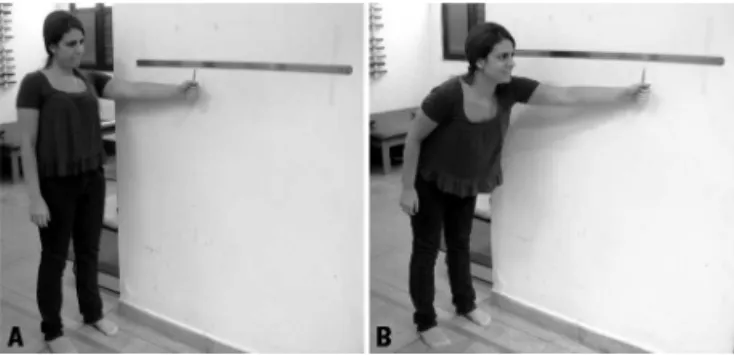
The Functional Reach Test (FRT) is a clinical test which was devised by Duncan, Studenski et al. in 1990. he test assesses the voluntary limits of stability in the anterior direction by gauging the balance and functional reach considering the maximum distance that the arm can reach when leaning forward, maintaining a fixed base of support in the standing position36,37. he test is
simple to perform and normalized, measures the stability margin at the beginning of the activity and predicts the relative fall risk in older adults34. he necessary material
requires only one meter ruler ixed to the wall.
The examinee is placed standing parallel to a wall where a horizontal rule is ixed (by velcro) at shoulder height. he examinee elevates the upper limb nearest the wall to the horizontal position, with a ist holding a stylus (pen or pencil), which acts as a marker for the
po-sition, and bending the trunk forward trying to reach the greatest possible distance, without touching the arm or body to the wall. he distance reached is measured in centimeters. he subject could lift feet of the ground as long as they did not lose balance (Fig 2 A and B).
he FRT assesses the risk of falling and can be scored (Table 2). It can also be useful in the development of pro-spective elderly examinees23,37. It correlates well with the
centers of pressure measured on a stabilometry platform and the simplicity with which it is performed, should be part of routine assessment of NE.
The examinee’s age and height influences the re-sponse36 and the test should be discontinued if the
ex-aminee touches the wall or give a step. Range test multi-directional (back and sides) has been developed, but still needs standardization23.
Pull test
he Pull Test (PT) also called the Postural Stress Test (PST)34, has long been used in clinical movement
disor-ders. It should be part of neurologic semiotic resources in the routine evaluation of examinees older than 65 years16.
he test is done with both – the examinee and the examiner – standing. he examiner stands behind the
Fig 2. Functional Reach Test . Gauging, in centimeters , the scope forward reaching as far as possible without losing the balance.
Table 2. Graduation of the Functional Reach Test.
Range ≥ 25 cm = Normal (no risk of falling)
15 to 25 cm = 2-fold IOF*
<15 cm = 4-fold IOF
≤2 cm = 8-fold IOF
*IOF: increase in the odds of falling.
Table 3. Pull test.
0 No observable attempt to step; requires assist 1 Takes ≥ 2 steps and requires assist
examinee from a distance, gives a sudden pull backward by shoulders (or waist), with the force needed to cause imbalance. The examinee is told to maintain balance. he test invalid if the examinee is leaning forward, an-ticipating that he will be pulled back. A variation of this method is to start from the same position, with the ex-aminee anchoring his back in the examiner’s hands. If the examiner notices that the center of mass of the ex-aminee is behind the heels, quickly removes his hands and observes whether the examinee is able to regain the equilibrium. he maximum level of ability is deal with the perturbation using body movements without moving his feet. One compensatory step backward is considered normal16,25,34. he abnormal response is characterized by
the inability to recover the balance and can be scored (Table 3). Grade zero corresponds to a functional depen-dence and assumes the need for assistance and supervi-sion for walking. Whatever the technique, the examiner should always have a wall behind him, in case the exam-inee falls back into his arms38.
In conclusion, some simple-to-perform semiotic techniques must be part the routine of neurological ex-amination turning it into a more sensitive, functional, dynamic, and even prospective assessment instrument.
he Clinical Test for Sensory Integration in Balance - modiied, for instance, is a bedside method for evalu-ating the static contribution of proprioceptive and ves-tibular input for static balance.
We believe that the NE for examinees over 65 years should routinely include the Functional Reach Test and the Pull Test that, in addition of providing us with infor-mation about the static balance, it also assesses the risk of falling, a common cause of morbidity and mortality in this age group.
ACKNOWLEDGMENTS – he authors are in debit with Dr. Michael C Schubert, PhD, PT, Associate Professor Johns Hopkins University School of Medicine for reviewing and suggesting improvements to the manu-script, and with Mr. Péricles Maranhão Neto for his technical support.
REFERENCES
1. Campbell WW. The neurological exam. Course 7PC-001. AAN Syllabi CD ROM; 2006.
2. Maranhão-Filho PA, Maranhão ET. A evolução do exame neurológico e alguns sinais descritos a partir do século XX: semiologia neurológica. Rev Bras Neurol 2007;43:5-11.
3. Dubois B, Slachevsky A, Pillon B, et al. “Applause sign” helps to discrimi-nate PSP from FTD and PD. Neurology 2005;64:2132-2133.
4. Hill BD, Barkermeyer CA, Jones GN, et al. Validation of Coin Rotation Test. The Neurologist 2010;16:249-253.
5. Miller TM, Johnston SC. Should the Babinski sign be part of the routine neurologic examination? Neurology 2005;65:1165-1168.
6. Abdo WF, Borm GF, Munneke M, et al. Ten steps to identify atypical par-kinsonism. J Neurol Neurosurg Psychiatry 2006;77:1367-1369. 7. Maranhão ET, Maranhão-Filho PA, Lima MA, Vincent MB. Can clinical tests
detect early signs of monohemispheric brain tumors? J Neurol Phys Ther 2010;34:145-149.
8. DeJong R N. The neurologic examination. 4th Edition. Harper & Row Pub-lishers. Mariland, USA; 1978:482.
9. Moore FGA, Chalk C. The essential neurologic examination. What should medical students be taught? Neurology 2009;72:2020-2023.
10. Chalk C. How should we teatch the neurological examination to medical students? Course 1EP-001. AAN Syllabi CD ROM; 2010.
11. Bogousslavsky J, Moulin T. Birth of modern psychiatry and the death of alienism: the legacy of Jean-Martin Charcot. In: Bogousslavsky J (Ed). Fol-lowing Charcot: A Forgotten History of Neurology and Psychiatry. Front Neurol Neurosci 2011;29:1-8.
12. Philippon J, Poirier J. Joseph Babinski. A biography. Oxford University Press Inc. New York; 2009.
13. Lanska DJ, Goetz CG. Romberg’s sign: development, adoption, and adap-tation in the 19th century. Neurology 2000;55:1201-1206.
14. Lanska DJ. The Romberg sign and early instruments for measuring pos-tural sway. Sem Neurol 2002;22:409-418.
15. Pearce JMS. Marshall Hall and ‘‘Romberg’s sign’’. J Neurol Neurosurg Psychiatry 2005;76:1241.
16. Fahn S, Jankovic J. Principles and practice of movement disorders. Churchill Livingstone, Philadelphia; 2007.
17. Peterka RJ. Sensorimotor integration in human postural control. J Neuro-physiol 2001;88:1118-2002.
18. Herdman SJ. Vestibular rehabilitation. 3rd Ed. Contemporary Perspectives in Rehabilitation. E.A. Davis Company, Philadelphia; 2007.
19. Kattah JC. Posture and balance. Course 2BS-008. AAN Syllabi CD ROM; 2007.
20. Black FO, Wall C, Rockette Jr HR. Normal subject postural sway during the Romberg test. Am J Otolaryngol 1982;3:309-318.
21. Desmond AL. Vestibular function: evaluation and treatment. Thieme, NY; 2004.
22. Kattah JC. Balance disorders. Course 3BS-003. AAN Syllabi CD ROM; 2009. 23. Herdman SJ, Clendaniel RA. Vestibular rehabilitation: a competency-based course. department of rehabilitation medicine. Emory Physical Therapy Association. Atlanta, EUA; May 2010.
24. Jacobson GP, Shepard NT. Balance function assessment and management. San Diego, Plural Publishing; 2008.
25. Nutt JG, Lang AE. Balance and gait disorders. Course 8BS-003. AAN Syl-labi CD ROM; 2010.
26. DeJong’s the neurologic examination, 6th Edition. In: Campbell WW (Ed). J.B. Lippincott, Philadelphia; 2005.
27. Shumway-Cook A, Horak F. Assessing the influence of sensory interation on balance. Phys Ther 1986;66:1548-1550.
28. Horak F, Nashner L. Central programming of postural movements: Adaptation to altered support-surface configurations. J Neurophysiol 1986;55:1369-1381.
29. Weber PC, Cass SP. Clinical-assessment of postural stability. Am J Otol 1993;14:566-569.
30. Agrawal Y, Carey JP, Della Santina CC, Schubert MC, Minor LB. Disorders of balance and vestibular function in US adults. Data from the National Health and Nutrition Examination Survey, 2001-2004. Arch Intern Med 2009;169:938-944.
31. Black FO. Clinical status of computerized dynamic posturography in neu-rotology. Curr Opini Otolarynogol Head Neck Surg 2001;9:314-318. 32. Nashner LM, Black FO, Wall C. “Adaptation to altered support and visual
conditions during stance: patients with vestibular deficits”. J Neurosci 1982;5:117-124.
33. Monsell EM, Furman JM, Herdman SJ, et al. “Technology assessment: com-puterized dynamic platform posturography”. Otolarynogol Head Neck Surg 1997;117:394-398.
34. Hall CD. Assessment of gait and balance. In: Herdman SJ, Clendaniel RA (Eds). Vestibular rehabilitation. A competency-based course. Department of Rehabilitation Medicine. Emory Physical Therapy Association. Atlanta, EUA; May 2010.
35. Bohnnon R, Larkin P, Cook A, et al. Decrease in time balance test scores with aging. Phys Ther 1984;64:1067-1070.
36. Duncan PW, Weiner DK, Chandler J, Studenski S. Functional reach: a new clinical measure of balance. J Gerontol 1990;45:192-197.
37. Duncan PW, Studenski S, Chandler J, Prescott B. Functional reach: pre-dictive validity in a sample of elderly male veterans. J Gerontol 1992;47: M93-M98.