AR
TIGO ORIGINAL / ORIGINAL AR
TICLE
INTRODUCTION
The 1991 Conference for the Development of Consensus of the National Institute of Health of the United States, decided thatbariatric surgery is an option for weight loss in patients with body mass index higher than 40 Kg/m2 or higher than 35 Kg/m2
with additional weight-related morbidity and in which there was no success in weight loss programs(1).
Obesity is linked to hypertension, diabetes, degen-erative joint diseases, gastro-esophageal relux, sleep apnea syndrome, venous insuficiency, hypoventilation syndrome, hernias of the abdominal wall and cere-bral pseudotumor(1). Chronic venous insuficiency
can manifest itself by edema of the legs, varicose veins, venous ulcers and ochre dermatitis, refractory to treatment(6). Weight loss provided by restriction/
mal-absorption surgery may result in improvement of these comorbidities(7).
Patients who are candidates for bariatric surgery
VENOUS INSUFFICIENCY AND
THROMBOEMBOLIC DISEASE IN
BARIATRIC SURGERY PATIENTS
Bonno van BELLEN
1, Ivan de Barros GODOY
1, Andrea Almeida REIS
1and
Pedro BERTEVELLO
2ABSTRACT – Context - Morbid obesity is associated with various co-morbidities, including chronic venous insuficiency. Bariatric surgery is the only effective treatment for morbid obesity, but with potential risks and possible complications, including venous thromboembolism. Objective - To determine the prevalence of clinical and ultrasonographic signs of chronic venous insuficiency in morbid obese patients in preparation for bariatric surgery and the incidence of post-operative venous thromboembolic disease.
Methods - Patients on work-up for bariatric surgery of Centro Terapêutico Especializado em Fígado (CETEFI) and Pro-Gastro surgical teams of the Hospital Beneicência Portuguesa de São Paulo were included. The analysed data were pre-operative indings for venous insuficiency (CEAP - clinical, etiological, anatomical, physiopathologic - classiication and venous ultrassonographic indings), type of surgery (open or laparoscopic), abdominal circumference, body mass index (BMI) and post-operative ultrassonog-raphy search for venous insuficiency and deep venous thrombosis. Results - Between March 2007 and December 2009, 95 patients candidates for bariatric surgery had clinical and duplex scan evaluation of the lower limbs venous system. Of the 95 patients, 53 were submitted to the surgical procedure. There was a predominance of women (77.9%), the average age was 38.5 years, average preoperative weight 124.6 kg and average BMI of 45.5 kg/m2. Regarding obesity, 16.8% were obese, and 83.1% were morbidly obese.
In relation to the venous indings, 86.3% of the patients did it CEAP classiication less than 3 and 13.7% greater than or equal to 3. Among the post-operative complications, there were four cases of wound infection. Three patients developed post-operative distal venous thrombosis (7.5%), but no one had clinically manifested pulmonary embolism. Conclusion - No relation between BMI, CEAP classiication and venous ultrassonographic indings were found. Although prophylaxis was used in all patients, the incidence of post-operative distal venous thrombosis was considerably high.
HEADINGS - Venous insuficiency. Venous thromboembolism. Bariatric surgery. Morbid obesity.
1 Serviço de Cirurgia Vascular Integrada of the Hospital da Beneficencia Portuguesa, São Paulo; 2 Progastro, Hospital da Beneficência Portuguesa, São Paulo, Brasil.
Corresponcence: Bonno van Bellen. Rua Maestro Cardim 925 - 01323-001, São Paulo, SP, Brasil. E-mail [email protected]
are at high-risk mainly because of the associated co-morbidities and the procedure can result in various types of complications(1).
In conventional surgery (open gastroplasty), the most common complications are deep venous throm-bosis, pulmonary embolism, pulmonary atelectasis, technical problems of anastomosis, hernias and wound infection(1). For laparoscopic surgery, the most
frequent complications are primarily those related to peritoneal distention, such as metabolic acidosis, cardiac arrhythmias, deep venous thrombosis and pulmonary embolism(1).
The incidence of venous thrombosis of the lower limbs after bariatric surgery is considered to be low even in laparoscopic approach although in this type of procedure, increased venous stasis is an important component(4, 9). Increased intra-abdominal pressure
causes decrease in venous low in the legs, increasing venous stasis.
venous stasis in morbid obese patients, and its relations to the degree of obesity and check its correlation with postop-erative thromboembolic events and with other risk factors such as age, sex, body mass index, abdominal circumference.
METHODS
This is a prospective, observational, epidemiological, longitudinal study, for the determination of the prevalence of clinical and ultrasonographic signs of chronic venous insuficiency in morbid obese patients and its correlation with the incidence of postoperative deep vein thrombosis and pulmonary embolism.
The study was approved by the Committee for Medical Ethics of the Beneicencia Portuguesa Hospital of São Paulo.
The patients selected for this study were on work-up for bariatric surgery by two different services: Centro Terapêu-tico Especializado em Fígado (CETEFI) and Pro-Gastro during the period from March 2007 to December 2009. All agreed to participate, having signed the informed consent.
The assessment of the lower limb venous system was done pre-operatively by eco color Doppler and again between 25 and 35 days after surgery. This evaluation was performed by the same operator and with the same instrument.
The standardization of prophylaxis for deep vein throm-bosis consisted of 40 mg subcutaneous enoxaparin every 12 hours during the whole postoperative in-hospital period, associated with elastic stockings and early deambulation(3, 5).
The events of primary interest were the clinical indings, CEAP (clinical, etiological, anatomical, physiopathologic) classiication for chronic venous disease(2) and
ultrassono-graphic indings, by which post-operative possible clinical improvement of chronic venous insuficiency up to 35 days after surgery could be assessed, as could the presence of deep venous thrombosis. The occurrence of pulmonary embolism was evaluated only on the basis of clinical symptoms. We con-sidered secondary interest events: the type of surgery (open or laparoscopic), the abdominal circumference, body mass index.
The data were evaluated to determine independent factors related to the development of venous stasis.
For statistical analysis the Fischer’s test was used, the Chi-square for independent equality of two ratios and the Mann-Whitney test. For complementation of quantitative descriptive analysis, the technique of conidence interval for the mean was used. The considered signiicance level was 0.05 (5%) and conidence intervals constructed with 95% statistical conidence.
The CEAP classiication for venous insuficiency accord-ing to the consensus established in 1994 at the American Venous Forum and revised in 2004(2), was used only for the
clinical classiication (C):
C0 – no visible nor palpable signs of venous disease; C1- presence of reticular veins or teleangectasis; C2 - presence of varicose veins;
C3 - presence of edema;
C4 - presence of skin changes such as hyperpigmentation, eczema or dermatoesclerosis;
C5 – presence of healed venous ulcer; C6 – presence of active venous ulcer.
Patients were considered in two groups: CEAP classiica-tion less than C3 and equal or higher than C3.
Regarding obesity, patients were divided into groups according to the body mass index:
- Severe obese (with index between 30 and 40); - Morbidly obese (index equal to or greater than 40)(1).
Regarding the echo color Doppler indings, patients were grouped as normal or abnormal. The result was deined as abnormal when there was signiicant relux in the internal saphenous veins, perforating veins and deep veins and, if there were signs of previous deep venous thrombosis.
About the abdominal circumference, the grouping of patients was set when greater than or lesser than 100 cm.
RESULTS
Ninety-ive patients were included in this study, of which 53 were effectively operated. The others gave up the procedure or were excluded on the basis of some clinical contra-indi-cation for surgery.
Among the patients, 74 were female (77.9%), the median age was 38.5 years, the average preoperative weight 124.6 kg and the average BMI was 45.5 kg/m2)(Table 1).
In relation to clinical classiication of obesity, 16.8% (16 patients) were severely obese and 83.2% (79 patients) were morbidly obese (Table 1).
TABLE 1. Demographic data of the patients
N %
Total of patients 95 Number of operated patients 53
Females 74 77.9
Males 21 22.1
Average age in years 38.5 Average weight in kg 124.6 Average BMI in kg/m2 45.5
Severely obese 16 16.8
Morbid obese patients 79 83.2
CEAP 0 12 12.6
CEAP 1 41 43.2
CEAP 2 29 30.5
CEAP <3 82 86.3
CEAP 3 8 8.4
CEAP 4 3 3.2
CEAP 5 1 1.1
CEAP 6 1 1.1
CEAP ≥3 13 13.8
Normal ultrasound 69 72.6 Abnormal ultrasound 17 17.9 Ultrasound with no consistent results 9 9.5
As regarding to venous insuficiency, 12 (12.6%) patients had a CEAP classiication of zero, 41 (43.2%) had CEAP equal to 1, 29 (30.5%) CEAP equal to 2, 8 (8.4%) CEAP equal 3, 3 (3.2%) CEAP equal to 4, 1 (1.1%) CEAP equal to 5 and 1 (1.1%) CEAP equal to 6. Considering the CEAP grouping, 82 (86.3%) patients were classiied below 3 and 13 (13.7%) patients were equal or above 3 (Table 1).
With regard to the ultrasound examination, 69 (72.6%) patients had a normal exam, 17 (17.9%) had an abnormal examination, and 9 (9.5%) were not examined for various reasons. Among the ultrasound examinations that showed abnormalities, 14 patients had valve insuficiency of the greater saphenous vein and the remaining had varicosities or insuficient perfurators. In no case there were signs of previous venous thrombosis. (Table 1)
Among the 53 patients operated, the average length of stay was 4.75 days. Conventional open surgery was performed in 39 patients (73.6%) and in the remaining 14 (26.4%) lap-aroscopic surgery was performed.
Regarding the surgical complications, there were four cas-es of wound infection, accounting for 7.5% of the operated cases. There were three (5.7%) cases of postoperative venous thrombosis detected by ultrasound. In all cases thrombosis occurred distally to the popliteal vein. No patient presented clinical signs of pulmonary embolism.
Association between BMI and CEAP
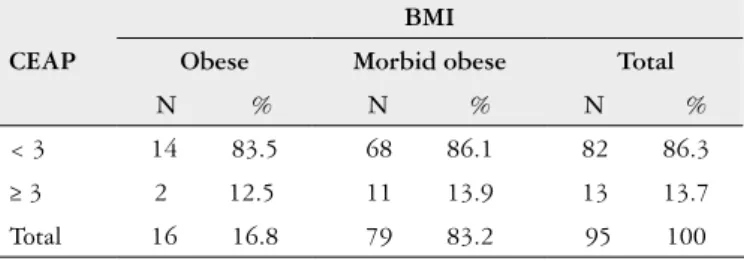
Among the 16 obese patients, 14 (87%) had venous disease classiied as CEAP below 3 and the other 2 (12.5%), CEAP equal or above 3.
Of the 79 patients with morbid obesity, 68 (86.1%) had venous disease classiied as CEAP below 3 and 11 (13.9%) had CEAP classiication equal or above 3.
There was no statistical difference between the two groups (P = 1.000) (Table 2).
Association between CEAP and abdominal circumference
The average abdominal circumference of the 82 patients with CEAP below 3 was 129.32 cm whereas in the 13 patients with CEAP equal or above 3 the circumference was 140.23 cm. This difference was statistically signiicant (P = 0.028).
Association between abdominal circumference and ultrasonographic findings
Normal ultrasound results occurred in patients with 131.5 cm average abdominal circumference whereas abnor-mal results occured in patients with an average of 131.0 cm abdominal circumference. These results are statistically similar (P = 0.392).
Association between BMI and deep venous thrombosis
The three cases of deep vein thrombosis occurred in mor-bidly obese patients. Although there have been no case among the obese, there was no statistical signiicance (P = 1.00). Similarly, there was no signiicance regarding the occurrence of thrombosis in relation to the abdominal circumference.
Association between type of surgery and deep venous thrombosis
The three cases of deep venous thrombosis occurred in patients submitted to open surgery. Although there were no cases among the patients who had laparoscopic surgery, there was no statistical difference between the occurrence of this complication.
DISCUSSION
Among the co-morbidities of morbid obesity is chronic venous insuficiency, which in turn is a risk factor for deep vein thrombosis, notably when the patient undergoes surgery. One of the factors that favors venous stasis in the obese is probably high intra-abdominal pressure due to the obesity itself. This high abdominal pressure results in increased pressure upon the inferior vena cava, iliac and femoral veins, which in turn diminishes venous low and therefore result in venous valve insuficiency, leading to chronic venous stasis causing swelling, dermatitis, eczema, and inally venous ulcer. The occurrence of chronic venous insuficiency syndrome was observed in 3.6% of 1976 patients reported by Sugerman HJ(8) and occurred in individuals with a BMI of 61 ± 12 kg/m2
or weight of 179 ± 39 kg, therefore within the group of
mor-TABLE 2. Association between obesity expressed in body mass index (BMI) and CEAP classiication of venous insuficiency
CEAP
BMI
Obese Morbid obese Total
N % N % N %
< 3 14 83.5 68 86.1 82 86.3
≥ 3 2 12.5 11 13.9 13 13.7
Total 16 16.8 79 83.2 95 100
P<0.001
Association between BMI and ultrasound
Of the 15 obese patients in who venous ultrasonography was done, 4 (26.7%) had an abnormal examination and 11 (73.3%) had a normal scan.
Among the 70 morbidly obese patients in which the exam was done, 12 (17.1%) had an abnormal examination and 58 (82.9%) had a normal scan.
There was no statistically signiicant difference between these indings (P = 0.467) (Table 3).
TABLE 3. Association between CEAP classiication and ultrasonographic indings
US Obese Morbid obese Total N % N % N % Normal 11 73.3 58 82.9 69 72.6 Abnormal 4 26.7 12 17.1 16 16.8 Total 15 15.7 80 84.2 95 100
bidly obese. In the population here presented, comparing the CEAP classiication among the two groups of obesity (obese vs morbid obese) no correlation was observed between the degree of obesity and the clinical classiication of venous disease. Also there was no statistically signiicant difference between the degree of obesity and the changes observed in the ultrasonographic examination. It can be assumed that the older the patient, the greater should be the impact of obesity upon the venous stasis. Although it is not possible to compare from the statistical point of view, the group analysed by Sugerman had an average age of 44 +/- 10 years, while the average age of our group was 38.5 years.
On the other hand, analyzing the relationship between abdominal circumference and venous disease, we observed statistically signiicant difference regarding the CEAP, i.e. patients classiied as CEAP lower than 3, had an average abdominal circumference of 129.32 +/- 3.09, statistically different from 140,23+/- 11.52 for those who had a CEAP classiication of ≥3. However, no correlation could be ob-served between abdominal circumference and the ultrasso-nographic examination.
The ultrasound examination performed 25 to 35 days after surgery, did not show any modiication regarding the pre-operative indings. Sugerman showed improvement in venous stasis in his patients followed for 5 years after bar-iatric intervention(3). Surely these data cannot be compared
with those of our patients since our follow up was too short. Regarding thromboembolic disease, bariatric surgery is considered as being of moderate risk, and pharmaco-logical prophylaxis is recommended(11). Despite the fact
that this recommendation is not new, some authors do not see the need for prophylaxis considering the low incidence of thromboembolic disease found in their operated pop-ulations. Westling(10) found distal vein thrombosis in only
two patients of the 116 operated, without prophylaxis. In 1978, Printen asserted that he did not recommend prophy-laxis, because the risks would be greater than the beneits. He based his afirmation on a retrospective study of 564 patients undergoing bariatric surgery without prophylaxis. There were four deadly pulmonary embolisms and three others without complications.
On the other hand, Stern, in 2005, in a systematic review found that the relative risk for pulmonary embolism of patients undergoing bariatric surgery is 2.21, being females below 40 years of age at higher risk.
If there is no consensus among surgeons about the need to perform prophylaxis, there is neither consensus regarding the dosage to be used. Schelten compared two groups of patients: 30 mg enoxaparin twice a day in 92 patients and 40 mg enoxaparin twice a day in 380 patients. Patients had also intermittent pneumatic compression or used elastic stockings. In the irst group, with the lower dose, ive cases of
venous thrombosis were detected (5.4%). In the other group, with higher dose, there were two cases of venous thrombo-sis, corresponding to 0.6%. This difference was statistically signiicant. There was one case in each group with bleeding complications.
Hamad analysed 668 patients in a retrospective study of ive different centers in which 40 mg of enoxaparin was used for 10 days postoperatively. There were six (0.9%) cases of pulmonary embolism and one (0.1%) case of deep venous thrombosis. In six (0.9%) patients occurred bleeding complications.
A survey carried out by Wu in 2000 among the members of the American Society of Bariatric Surgery, shows that 86% of surgeons feel that patients submitted to bariatric surgery, are at risk of developing thromboembolic disease. They reported an incidence of venous thrombosis of 2.63% and 0.95% of pulmonary embolism. The most important is that 95% of the surgeons claimed they use prophylaxis: 50% with mini-dosis heparin, 33% by intermittent compression by, 13% by low molecular weight heparin and 4% by other methods.
Thus, it seems that most surgeons use prophylactic pro-tection for their patients. As regarding the dose, it usually is higher than used in conventional prophylaxis: 60 to 80 mg of enoxaparin per day.
In the group under study, prophylaxis was done with 80 mg enoxaparin per day, as well as additional measures have been used, such as elastic stockings and early ambulation.
Even so, a high index of venous thrombosis occurred (5.7%) as compared to the literature. It should be noted that the 5.4% occurrence reported by Schelten happened in pa-tients in whom prophylaxis was done with 60 mg enoxaparin per day, while in those in which the incidence was 0.6% the used dose was 80 mg enoxaparin.
It is possible that this difference is due to the fact that the ultrassonographic examination was done between 25 and 35 days after surgery. The before mentioned data were obtained in still hospitalized patients. In these circumstances venous thrombosis may not be detectable since early thrombus has an acoustic interface very similar to the normal blood.
CONCLUSION
Obesity is linked to numerous co-morbidities and bar-iatric surgery is a viable option for treatment. The surgical procedure has a risk for thromboembolic events due to changes of venous low.
REFERENCES
1. Buchwald H; Consensus Conference Panel. Consensus conference statement bariatric surgery for morbid obesity: health implications for patients, health professionals, and third-party payers. Surg Obes Relar Dis. 2005;1:371-81. 2. Eklöf B, Rutherford RB, Bergan JJ, Carpentier PH, Gloviczki P, Kistner RL,
Meissner MH, Moneta GL, Myers K, Padberg FT, Perrin M, Ruckley CV, Smith PC, Wakeield TW; American Venous Forum International Ad Hoc Committee for Revision of the CEAP Classiication. Revision of the CEAP classiication for chronic venous disorders: consensus statement. J Vasc Surg. 2004;40;1248-52. 3. Hamad GG, Choban PS. Enoxaparin for thromboprophylaxis in morbidly obese
patients undergoing bariatric surgery: indings of the prophylaxis against VTE outcomes in bariatric surgery patients receiving enoxaparin (PROBE) study. Obes Surg. 2005;15:1368-74.
4. Kearon C, Akl EA, Comerota AJ, Prandoni P, Bounameaux H, Goldhaber SZ, Nelson ME, Wells PS, Gould MK, Dentali F, Crowther M, Kahn SR; American College of Chest Physicians. Antithrombotic therapy for VTE dis-ease : antithrombotic therapy and prevention of thrombosis, 9th ed: American College of Chest Physicians Evidence-Based Clinical Practice Guidelines. Chest. 2012;141:e419S-94S.
5. Printen KJ, Miller EV, Mason EE, Barnes RW. Venous thromboembolism in the morbidly obese. Surg Gynecol Obstet. 1978;147:63-4.
6. Scholten DJ, Hoedema RM, Scholten SE. A comparison of two different prophy-lactic dose regimens of low molecular weight heparin in bariatric surgery. Obes Surg. 2002;12:19-24.
7. Stein PD, Beemath A, Olson RE. Obesity as a risk factor in venous thromboem-bolism. Am J Med. 2005;118:978-80.
8. Sugerman HJ. Effects of increased intra-abdominal pressure in severe obesity. Surg Clin North Am. 2001;81:1063-75.
9. Sugerman HJ, Sugerman EL, Wolfe L, Kellum JM Jr, Schweitzer MA, DeMaria EJ. Risks and beneits of gastric bypass in morbidly obese patients with severe venous stasis disease. Ann Surg. 2001;234:41-6.
10. Westling A, Bergqvist D, Boström A, Karacagil S, Gustavsson S. Incidence of deep venous thrombosis Incidence in patients undergoing obesity surgery. World J Surg. 2002;26:470-3.
11. Wu EC, Barba CA. Current practices in the prophylaxis of venous thromboem-bolism in bariatric surgery. Obes Surg. 2000;10:7-14.
Received 18/12/2012. Accepted 8/5/2013.
van Bellen B, Godoy IB, Reis AA, Bertevello P. Insuiciência venosa e doença tromboembólica em pacientes submetidos a cirurgia bariátrica. Arq Gastroenterol. 2013,50(3):191-5.
RESUMO - Contexto - A obesidade mórbida está associada a várias comorbidades, dentre elas a estase venosa crônica. A cirurgia bariátrica é a única modalidade efetiva de tratamento, porém com riscos e possibilidade de complicações, inclusive o tromboembolismo venoso.Objetivos - Determinar a prevalência de sinais clínicos e ultrassonográicos de insuiciência venosa crônica no paciente obeso mórbido candidato a cirurgia bariátrica e a incidência de trombose venosa profunda.Métodos - Foram selecionados para este estudoos pacientes candidatos a cirurgia bariátrica das equipes Centro Terapêutico Especializado em Fígado (CETEFI) e Pró-Gastro do Hospital Real e Benemérita Sociedade Portuguesa de Beneicência de São Paulo no período de março de 2007 a dezembro de 2009. Os dados analisados foram os achados clínicos (classiicação CEAP - clínica, etiologia, anatomia e patoisiologia - classiicação da estase venosa crônica) e sinais ultrassonográicos, o tipo de cirurgia (aberta ou laparoscópica), a circun-ferência abdominal, o índice de massa corpórea (IMC), o tempo de internação hospitalar e presença de comorbidades. A avaliação foi realizada para encontrar fatores independentes relacionados com a estase venosa.Resultados - Entre março de 2007 e dezembro de 2009, 95 pacientes candidatos a cirurgia bariátrica foram avaliados clinicamente e por ultrassonograia duplex scan de sistema venoso de membros inferiores. Dos 95 pacientes, 53 acabaram sendo submetidos à cirurgia. Houve predominância de mulheres (77,9%), a idade média foi de 38,5 anos, a média de peso pré-operatório 124,6 kg e IMC médio de 45,5 kg/m2. Quanto à obesidade, 16,8% eram obesos graves, 78,9% obesos mórbidos e 4,2% mega-obesos. Em relação à
avaliação venosa clínica, 86,3% dos pacientes se enquadravam na classiicação CEAP menor que 3 e 13,7% maior ou igual a 3. Dentre as complicações pós-operatórias, houveram quatro casos de infecção de ferida. Não houve nenhum caso de trombose venosa e embolia pulmonar no pós-operatório.
Conclusão - Não foi encontrada correlação entre IMC, classiicação CEAP e achados ultrassonográicos. Apesar de ter sido feita proilaxia para trombose venosa distal pós-operatória em todos os pacientes, a incidência foi consideravelmente elevada.