Primary progressive aphasia
Classification of variants in 100 consecutive Brazilian cases
Mirna Lie Hosogi Senaha1, Paulo Caramelli2, Sonia M.D. Brucki3, Jerusa Smid3, Leonel T. Takada4, Claudia S. Porto1, Karolina G. César4,
Maria Niures P. Matioli4, Roger T. Soares4, Letícia L. Mansur1, Ricardo Nitrini5
ABSTRACT. Primary progressive aphasia (PPA) is a neurodegenerative clinical syndrome characterized primarily by progressive language impairment. Recently, consensus diagnostic criteria were published for the diagnosis and classification of variants of PPA. The currently recognized variants are nonfluent/agrammatic (PPA-G), logopenic (PPA-L) and semantic (PPA-S). Objective: To analyze the demographic data and the clinical classification of 100 PPA cases. Methods: Data from 100 PPA patients who were consecutively evaluated between 1999 and 2012 were analyzed. The patients underwent neurological, cognitive and language evaluation. The cases were classified according to the proposed variants, using predominantly the guidelines proposed in the consensus diagnostic criteria from 2011. Results: The sample consisted of 57 women and 43 men, aged at onset 67.2±8.1 years (range of between 53 and 83 years). Thirty-five patients presented PPA-S, 29 PPA-G and 16 PPA-L. It was not possible to classify 20% of the cases into any one of the proposed variants. Conclusion: It was possible to classify 80% of the sample into one of the three PPA variants proposed. Perhaps the consensus classification requires some adjustments to accommodate cases that do not fit into any of the variants and to avoid overlap where cases fit more than one variant. Nonetheless, the established current guidelines are a useful tool to address the classification and diagnosis of PPA and are also of great value in standardizing terminologies to improve consistency across studies from different research centers.
Key words: primary progressive aphasia, clinical consensus, variants, agrammatic, logopenic, semantic, semantic dementia.
AFASIA PROGRESSIVA PRIMÁRIA: CLASSIFICAÇÃO DAS VARIANTES EM 100 CASOS CONSECUTIVOS BRASILEIROS
RESUMO. A afasia progressiva primária (APP) é uma síndrome clínica neurodegenerativa caracterizada pelo comprometimento predominante e progressivo da linguagem. Recentemente, foi publicado um consenso clínico para o diagnóstico e classificação das variantes da APP. As variantes reconhecidas atualmente são: não-fluente/agramática (APP-G), logopênica (APP-L) e semântica (APP-S). Objetivo: Analisar os dados demográficos e classificar as variantes de uma amostra de 100 casos de APP. Métodos: Foram analisados os achados de 100 pacientes de APP que foram encaminhados consecutivamente para avaliação fonoaudiológica entre 1999 e 2012. Os pacientes foram submetidos à avaliação neurológica, cognitiva e de linguagem. A partir, principalmente, dos critérios elaborados pelo consenso clinico de APP, os casos foram classificados em uma das variantes. Resultados: Cem casos, 43 homens e 57 mulheres, foram avaliados. A idade de início variou entre 53 e 83 anos (x=67.2 (±8.1). Foram identificados 35 casos de APP-S, 29 de APP-G e 16 de APP-L. Vinte casos não se enquadraram em nenhumas das três variantes. Conclusão: Foi possível classificar distúrbio de linguagem em 80% da amostra em uma das três variantes de APP. A recomendação atual estabelecida pelo consenso clínico é uma ferramenta útil para direcionar a classificação e diagnóstico da APP e também é de grande valor para uniformidade das terminologias entre os diferentes centros de pesquisa. Porém, alguns ajustes seriam interessantes para contemplar os casos que não se encaixam em nenhuma das variantes e para evitar a sobreposição de casos que poderiam se encaixar em mais de uma variante. Palavras-chave: afasia progressiva primária, consenso clínico, variantes, agramática, logopênica, semântica, demência semântica.
1PhD, Member of Behavioral and Cognitive Neurology Unit of Department of Neurology, University of São Paulo School of Medicine, São Paulo SP, Brazil. 2MD, PhD,
Professor, Department of Internal Medicine, Faculty of Medicine, Federal University of Minas Gerais, Belo Horizonte, Minas Gerais MG, Brazil. 3MD, PhD, Member of
Behavioral and Cognitive Neurology Unit of Department of Neurology, University of São Paulo School of Medicine, São Paulo SP, Brazil. 4MD, Member of Behavioral
and Cognitive Neurology Unit of Department of Neurology, University of São Paulo School of Medicine, São Paulo SP, Brazil. 5MD, PhD, Professor, Department of
Neurology, University of São Paulo School of Medicine, São Paulo SP, Brazil.
Mirna Lie Hosogi Senaha. Rua Montesquieu, 371 / 62 – 04116-190 São Paulo SP – Brazil . E-mail: [email protected] Disclosure: The authors report no conflicts of interest.
INTRODUCTION
P
rimary progressive aphasia (PPA) is a neurodegen-erative clinical syndrome characterized primarily by progressive language impairment. Systematic stud-ies on PPA started after Mesulam1 published hissemi-nal paper entitled “Slowly progressive aphasia without generalized dementia” in 1982. Indeed, cases reported over the past 100 years by Pick, Déjerine, Sérieux and Rosenfeld, which presented degenerative diseases with language disturbances in the initial phase, would possi-bly it current criteria for the condition now recognized as PPA.2
Intensive research on PPA has been carried out to-ward gaining a better understanding of several aspects of this syndrome, such as neuroimaging, genetics, neu-ropathology, clinical and cognitive features.
Regarding the clinical characteristics of PPA, nu-merous investigations have explored the heterogene-ity of the linguistic forms of this syndrome. For some years, there have been diferent visions and controver-sies about the classiication and diagnosis of this syn-drome.3-6 However, more recently, consensus diagnostic
criteria were published with the objective of providing a standard approach to the diagnosis of PPA and its classi-ication across multicenter studies, by a group of experi-enced clinicians and researchers from diferent centers.7
he consensus establishes that the classiication of PPA variants must be based primarily on the clinical features. Besides the clinical diagnosis (irst level), the consensus criteria also establish other two levels for the diagnosis: imaging-supported and deinite pathologic diagnosis.
he irst level is clinical classiication, done in two steps. In the irst step, it is determined whether the patient has PPA according to inclusion and exclusion criteria based on Mesulam’s guidelines8-9 (Table 1). he
second step involves the classiication of language dis-turbance into one of the currently recognized variants: nonluent/agrammatic (PPA-G), logopenic (PPA-L) and semantic (PPA-S), based on language and speech char-acteristics. For each variant, there are core and ancillary features for the diagnosis (Table 2).
he second level of classiication, besides the clinical indings of the characteristics of each subtype, includes imaging-supported diagnosis, where the following fea-tures must be present on structural or functional neu-roimaging: [1] nonluent/agrammatic variant (PPA-G), predominant left fronto-insular area abnormalities on neuroimaging assessment; [2] semantic variant, pre-dominant anterior temporal lobe atrophy, hypoperfu-sion or hypometabolism; and [3] logopenic variant,
imaging abnormalities predominantly in left posterior perisylvian or parietal areas are necessary.
For the third classiication level, deinite pathologic diagnosis, the consensus establishes that, besides the typical clinical characteristics of each variant, the pa-tient must present pathologic or genetic mutations deinitely associated with the frontotemporal lobar de-generation (FTLD) spectrum, Alzheimer’s disease (AD), or another speciic etiology.
Studies have shown that PPA-G is more frequently associated with deposits of hyperphosphorylated tau protein, whereas PPA-S is associated with deposits of ubiquitinated TDP-43 protein, whereas PPA-L is more frequently caused by AD, with beta-amyloid and tau protein parenchymal aggregation and deposition.10-15
Due to the lack of biological markers, PPA clini-cal classiication into one of the variants may help the clinician in identifying the possible pathologic basis and may also assist in the choice of pharmacological intervention.
he aim of the present study was to analyze the demographic data and the clinical classiication of 100 consecutive PPA patients evaluated in Brazil.
METHODS
Demographic data from a series of 100 PPA patients consecutively evaluated between 1999 and 2012 were analyzed.
All patients underwent neurological examination, neuroimaging assessment and comprehensive cogni-tive, language and semantic memory evaluation. All pa-tients were submitted to structural (MRI/CT)
neuroim-Table 1. Inclusion and exclusion criteria for PPA diagnosis: based on criteria by Mesulam8,9 (Gorno-Tempini et al., 2011).7
Inclusion: all above criteria must be answered positively
1. Most prominent clinical feature is a language disturbance;
2. The language disturbance is the principal cause of impaired daily living activities;
3. Aphasia should be the most prominent deficit at symptom onset, for the initial phases of the disease.
Exclusion: all above criteria must be answered negatively
1. Pattern of deficits is better accounted for by other nondegenerative nervous system or medical disorders;
2. Cognitive disturbance is a better accounted for by psychiatric diagnosis;
3. Prominent initial episodic memory loss, visual memory and visuospa-tial impairments;
Table 2. Guidelines to classify PPA variants according to recommendations in consensus diagnosis criteria (Gorno-Tempini et al., 2011).7
PPA-G - Nonfluent/agrammatic variant (also known as progres-sive nonfluent aphasia)
A. One of the following core features must be present: 1. Agrammatism in language production;
2. Effortful, halting speech with inconsistent speech sound errors and distortions (apraxia of speech).
B. At least 2 of 3 of the following ancillary features must be present: 1. Impaired comprehension of syntactically complex (non-canonical)
sentences;
2. Spared single-word comprehension; 3. Spared object knowledge.
PPA-S - Semantic variant (also known as semantic dementia) A. Both of the following core features must be present: 1. Impaired object naming;
2. Impaired single-word comprehension.
B. At least 3 of 4 of the following ancillary features must be present:
1. Impaired object knowledge, particularly for frequency or low-familiarity items;
2. Surface dyslexia or dysgraphia; 3. Spared repetition;
4. Spared grammaticality and motor aspects of speech.
PPA-L - Logopenic variant (also known as logopenic progressive aphasia)
A. Both of the following core features must be present: 1. Impaired single-word retrieval in spontaneous speech and naming; 2. Impaired repetition of phrases and sentences.
B. At least 3 of 4 of the following ancillary features must be present:
1. Phonological errors (phonemic paraphasias) in spontaneous speech or naming;
2. Spared single-word comprehension and object knowledge; 3. Spared motor speech;
4. Absence of frank agrammatism.
aging assessment and/or functional (SPECT/PET scan) neuroimaging assessment.
All patients were also submitted to language evalu-ation by the same speech pathologist (MLHS), which included application of the following tools: communica-tion funccommunica-tional evaluacommunica-tion, aphasia battery tests (Beta MT-86,16 Boston Diagnostic Aphasia Exam-BDAE,17
Boston Naming Test,18 Human Frontier Science Program
(HFSP) reading and writing protocols19 and in some cases
additional evaluation (example: tasks of semantic mem-ory battery previously described in other papers).20-21
To evaluate the core and ancillary criteria for diag-nosis of the PPA variants, a number of diferent tasks were used. he analyses of oral production in spontane-ous speech and on the Boston Cookie theft picture de-scription task17 were employed for syntax assessment.
In some cases, there was an additional task of order-ing sorder-ingle written words, printed on a separated card, to constitute a correct sentence. Syntactic comprehen-sion was evaluated through matching tasks (sentences-pictures) from the Beta MT-86 protocol.16 Speech
mo-tor disturbances were evaluated from the assessment proposed by Darley et al.22 Semantic comprehension
was evaluated through word-picture matching and word deinition tasks from the semantic memory battery.20-21
he BDAE17 stimulus were used to assess sentence
repe-tition. Object knowledge (visual semantic memory) was assessed through qualitative analysis of responses on the Boston Naming Test18 and in some cases the Peno
protocol,23 Pyramids and Palm Tree (PPT)24 and famous
face recognition tests were used.20,21 Written language
abilities were examined through reading aloud and dic-tation tasks from the HFSP protocol19 or Beta MT-86
aphasia protocol”.16
From the data obtained in the language evaluation, cases were classiied according to the proposed variants, using predominantly the criteria proposed by the con-sensus7 (Table 1), but also with support of other
stud-ies.25-28 Besides the 100 consecutive PPA cases included
in this study over the 13-year study period, two patients evaluated were diagnosed with progressive apraxia of speech based on current criteria.
RESULTS
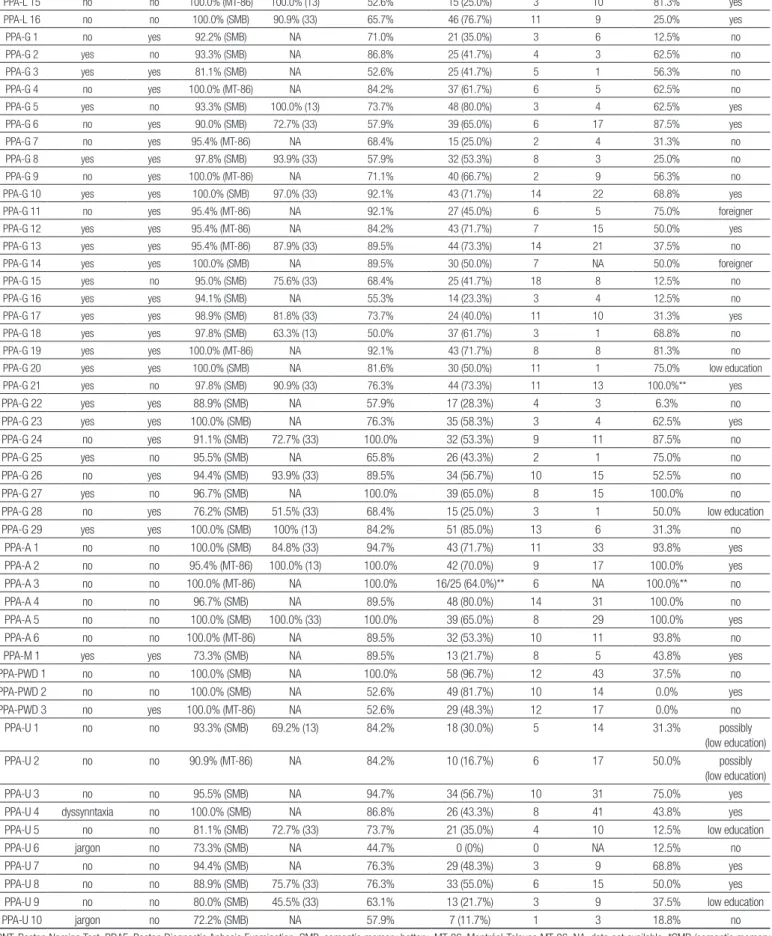
he evaluated sample comprised 57 women and 43 men. he main demographic data and Mini-Mental State Examination (MMSE) scores29,30 are shown in Table 3.
Ninety-eight patients were right-handed, one case had a history of developmental dyslexia and two cases had a history of transient global amnesia episodes before the emergence of language disturbance.
Figure 1 shows age distribution at time of diagnosis for the overall sample and for the three main variants. Age at diagnosis ranged from 54 to 90 years. hirty-four patients had disease onset before 65 years of age.
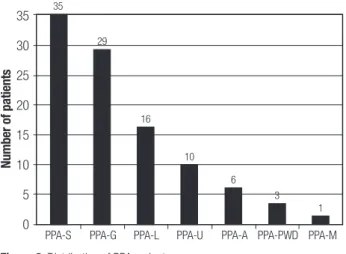
Classiication into the PPA variants of the 100 cases can be seen in Figure 2. It was possible to classify 80% of the sample into one of the three PPA variants proposed by the International consensus:7 35 presented PPA-S, 29
PPA-G, and 16 PPA-L. hus, it was not possible to classify 20% of the cases into any one of the proposed variants. Among these 20 unclassiiable cases, there were six cases of anomic aphasia (PPA-A), three of pure word deafness PWD), one case of mixed PPA (PPA-M)31,32 and ten unclassiiable cases (PPA-U).
Table 3. Demographic data of PPA patients studied.
Mean (SD) Median Minimum/maximum values
All PPA patients (n=100; 57 women and 43 men) Age 69.8 (8.3) 69.5 54-90
Age at onset 67.2 (8.1) 67.0 53-83
Educational level 12.5 (4.7) 15 2-20*
Mini-Mental State Exam 22.1 (4.8) 23 11-29**
PPA-S (n=35; 18 women and 17 men) Age 69.1 (8.0) 68.0 55-88
Age at onset 64.1 (13.6) 67.0 53-82
Educational level 13.5 (4.5) 15 3-20
Mini-Mental State Exam 21.6 (5.5) 23 11-29***
PPA-G (n=29; 18 women and 11 men) Age 70.1 (8.6) 70.0 57-85
Age at onset 68.2 (8.5) 68.0 54-83
Educational level 11.4 (4.9) 11 2-20
Mini-Mental State Exam 22.2 (5.0) 23.5 11-20****
PPA-L (n=16; 10 women and 6 men) Age 67.4 (8.3) 68.5 54-79
Age at onset 65.3 (8.5) 66.5 51-77
Educational level 13.7 (3.6) 15 5-20
Mini-Mental State Exam 20.6 (4.5) 24 13-29*****
SD, standard deviation; *one case of informal education; **data from 88 cases; ***29 cases; ****26 cases; *****15 cases.
25
20
15
10
5
0
51-55 56-60 61-65 66-70 71-75 76-80 81-85 86-90 9
8
7
6
5
4
3
2
1
0
51-55 56-60 61-65 66-70 71-75 76-80 81-85 86-90
9
8
7
6
5
4
3
2
1
0
51-55 56-60 61-65 66-70 71-75 76-80 81-85 86-90 9
8
7
6
5
4
3
2
1
0
51-55 56-60 61-65 66-70 71-75 76-80 81-85 86-90
Figure 1. [A] Distribution of age at diagnosis for all PPA cases. [B] Distribution of age at diagnosis for PPA-S cases. [C] Distribution of age at diagnosis for PPA-G cases. [D] Distribution of age at diagnosis for PPA-L cases.
A B
35
30
25
20
15
10
5
0
Number of patients
PPA-S PPA-G PPA-L PPA-U PPA-A PPA-PWD PPA-M 35
29
16
10 6
3 1
Figure 2. Distribution of PPA variants.
PPA: primary progressive aphasia; PPA-S: semantic variant; PPA-G: nonfluent/agrammatic vari-ant; PPA-L: logopenic varivari-ant; PPA-U: unclassifiable; PPA-A: anomic varivari-ant; PPA-PWD: pure word deafness variant; PPA-M: mixed variant.28,29
structural and/or functional neuroimaging indings for all PPA cases.
DISCUSSION
he data reported in this study included a large number of consecutive PPA cases submitted to language evalua-tion by the same speech pathologist over a period of 13 years. Our sample had higher mean age at onset than that reported in previous studies10,33-36 and also
con-tained more women.33,34
Rogalsky et al.37 suggested that learning disabilities
(LD) may constitute a risk factor for PPA. heir results showed that patients with PPA and their irst degree rel-atives had a higher frequency of LD, especially dyslexia, when compared to patients with AD, with behavioral variant of FTLD and to healthy older adults.
During history taking, we systematically asked the patient and informant whether the patient had a his-tory of LD, or diiculty with reading or writing during the irst years of school. he informant was in most cases the patient’s spouse or son/daughter, who clearly had not lived with the patient during this period. We did not investigate whether any of the patients’ irst-degree relatives had LD. A history of developmental dyslexia was found in only one case.
Recently, a possible association between transient global amnesia and PPA was reported.38,39 he two
pa-tients cited in the Nitrini et al.39 study are included in
this sample.
Diferent manifestations of FTLD in its behavioral and language variants frequently occur in the pre-senile phase. FTLD is considered the second most common
cause of degenerative dementia after AD in subjects between 45 and 65 years of age, being less prevalent in the elderly.40-45 However, this association of FTLD and
pre-senile onset must be viewed with caution, because some investigators have reported a signiicant number of FTLD cases with an age of onset beyond 65.13,46
In-deed, in a demographic study of 100 semantic dementia cases, Hodges et al. veriied that the age at diagnosis was over 65 years in 46% of the patients.13
Considering all three PPA variants deined by the clinical consensus, semantic and nonluent/agrammatic cases prevailed in our sample with logopenic cases prov-ing less frequent. Studies conducted after the publica-tion of the clinical consensus have presented diferent proportions of these variants. A very small number of PPA-L cases in relation to other variants were found in the study by Sajjadi et al. with only 4.3% of patients be-ing classiied as PPA-L versus 28.3% as PPA-S and 26.1% as PPA-G.46 In another report by hompson et al.
inves-tigating luency and agrammatism in PPA, 37 consecu-tive cases from the Northwestern Cogniconsecu-tive Neurology and Alzheimer Disease Center were recruited between 2007 and 2010 and a smaller number of PPA-S (6) than PPA-G (11) or PPA-L (20) cases was found.36 Leyton et
al. recruited 47 consecutive PPA patients and found 14 PPA-S, 15 PPA-G and 18 PPA-L15 cases. In another study,
conducted prior to the consensus publication and con-sidering only the dichotomy semantic dementia (SD) versus nonluent progressive aphasia (NFPA), Hodges et al. found a larger number of SD. In the cited study, the authors included all new patients who were examined at the Memory Clinic in Cambridge, UK, between 1990 and 2007.13 hree thousand six-hundred new patients
were evaluated and 416 received the diagnosis of focal cortical dementia. Of these 416 cases, 128 received the diagnosis of fronto-temporal dementia (FTD), 110 SD, 66 NFPA, with 36 mixed (mixed aphasic/behavioural cases) and 66 corticobasal syndrome cases.
Further studies on the clinical classiication of the PPA subtypes using the guidelines of the consensus may determine the real frequency of each variant.
Table 4. Performance on language tasks of PPA patients.
Case
Agrammatism in spontaneous
speech
Motor speech disorders
Semantic comprehension
Syntax comprehension (Montréal-Tolouse
MT-8616) Picture
naming (BNT18)
(60 items)
Fluency Sentence repetition
(BDAE17)
(16 sentences)
Surface dyslexia and/
or surface dysgraphia Word-picture
matching (13 or 33 items)Word definition matching (38 items)Sentence-picture (animals)Category Letter (F, A, S)
PPA-S 1 no no 65.5% (SMB) 53.8% (13) 52.6% 5 (8.3%) 0 3 6.8% yes
PPA-S 2 no no 95.5% (SMB) 78.8% (33) 100.0% 23 (38.3%) 10 22 93.8% yes
PPA-S 3 no no 88.9% (SMB) 42.4% (33) 97.4% 13 (21.7%) 5 17 81.3% yes
PPA-S 4 no no 52.2% (SMB) 30.8% (13) 97.4% 3 (5.0%) 2 8 68.8% yes
PPA-S 5 no no 62.2% (SMB) 15.4% (13) 97.4% 10 (16.7%) 5 20 62.5% yes
PPA-S 6 no no 82.2% (SMB) 7.7% (13) 100.0% 10 (16.7%) 4 25 81.2% yes
PPA-S 7 no no 95.5% (SMB) 72.7% (33) 100% 27 (45.0%) 9 33 62.5% yes
PPA-S 8 no no 96.7% (SMB) 57.6% (33) 94.7% 30 (50.0%) 7 15 75.0% yes
PPA-S 9 no no 82.2% (SMB) NA 86.8% 3 (5.0%) 3 7 16.3% possibly
(low education)
PPA-S 10 no no 64.4% (SMB) 30.5% (13) 100.0% 16 (26.7%) 6 13 93.8% yes
PPA-S 11 no no 92.2% (SMB) 72.7% (33) 100.0% 41 (68.3%) 19 24 93.8% yes
PPA-S 12 no no 85.5% (SMB) 69.2% (13) 100.0% 9 (15.0%) 4 4 68.8% yes
PPA-S 13 no no 55.5% (SMB) 30.7% (13) 86.8% 5 (8.3%) 0 12 50.0% foreigner
PPA-S 14 no no 75.6% (SMB) 18.2% (33) 100% 7 (11.7%) 6 17 68.8% yes
PPA-S 15 no no 73.3% (SMB) NA 94.7% 5 (8.3%) 2 4 50.0% yes
PPA-S 16 no no 40.0% (SMB) 15.1% (33) 97.4% 4 (6.7%) 0 12 87.5% yes
PPA-S 17 no no 84.4% (SMB) 61.5% (13) 92.1% 21 (35.0%) 8 17 81.2% possibly
(low education)
PPA-S 18 no no 71.1% (SMB) NA 97.4% 5 (8.3%) 6 13 75.0% no (intense
dyslexia and dysgraphia)
PPA-S 19 no no 63.3% (SMB) NA 76.3% 10 (16.7%) 1 3 43.8% yes
PPA-S 20 no no 63.3% (SMB) NA 70.2% 1 (1.7%) 1 3 62.5% yes
PPA-S 21 no no 85.5% (SMB) NA 100.0% 9 (15.0%) 4 22 87.5% yes
PPA-S 22 no no 42.2% (SMB) 3.0% (33) 94.7% 5 (8.3%) 2 9 75.0% yes
PPA-S 23 no no 62.5% (SMB) NA 81.6% 4 (6.7%) 1 13 50.0% yes
PPA-S 24 no no 10.0% (SMB) NA 34.2% 3 (5.0%) 0 0 37.5% yes
PPA-S 25 no no 87.5% (SMB) 46.2% (13) 66.7% 9 (15.0%) 4 13 75.0% yes
PPA-S 26 no no 98.9% (SMB) 78.8% (33) 100.0% 20 (33.3%) 10 22 87.5% yes
PPA-S 27 no no 76.7% (SMB) 57.60% 94.7% 17 (28.3%) 1 12 93.8% yes
PPA-S 28 no no 93.3% (SMB) 60.6% (33) 100.0% 13 (21.7%) 4 33 100.0% yes
PPA-S 29 no no 62.2% (SMB) 46.1% (13) 94.7% 5 (8.3%) 4 4 87.5% yes
PPA-S 30 no no 92.2% (SMB) 30.7% (13) 100.0% 15 (25.0%) 8 25 87.5% yes
PPA-S 31 no no 65.5% (SMB) NA 92.1% 6 (10.0%) 2 21 43.8% yes
PPA-S 32 no no 87.7% (SMB) 78.8% (33) 92.1% 32 (53.3%) 5 6 93.8% yes
PPA-S 33 no no 97.8% (SMB) 63.6% (33) 84.2% 27 (45.0%) 12 14 87.5% yes
PPA-S 34 no no 67.7% (SMB) 48.5% (33) 92.1% 16 (26.7%) 9 31 100.0% yes
PPA-S 35 no no 80.0% (SMB) 69.7% (33) 97.4% 32 (53.3%) 8 18 75.0% yes
PPA-L 1 no no 96.7% (SMB) 97.0% (33) 86.8% 43 (71.7%) 7 17 75.0% yes
PPA-L 2 no no 95.4% (MT-86) 97.0% (33) 86.8% 43 (71.7%) 7 19 37.5% yes
PPA-L 3 no no 95.5% (SMB) NA 100.0% 70/90 (77.8%)* 9 29 62.5% yes
PPA-L 4 no no 100.0% (SMB) 93.9% (33) 71.1% 38 (63.3%) 9 7 81.3% no
PPA-L 5 no no 96.7% (SMB) NA 76.3% 16 (26.7%) 6 3 18.8% no
PPA-L 6 no no 95.4% (MT-86) NA 100.0% 54 (90.0%) 16 30 68.7% yes
PPA-L 7 no no 95.5% (SMB) 92.3% (13) 92.1% 32 (58.3%) 13 45 75.0% yes
PPA-L 8 no no 100.0% (SMB) 97.0% (33) 100.0% 42 (70.0%) 11 26 87.5% yes
PPA-L 9 no no 93.3% (SMB) 92.3% (13) 57.9% 33 (55.0%) 14 2 66.7% yes
PPA-L 10 no no 100.0% (SMB) 97.0% (33) 94.7% 57 (95.0%) 15 25 62.5% yes
PPA-L 11 no no 100.0% (MT-86a) NA 78.9% 11 (18.3%) 6 5 25.0% no
PPA-L 12 no no 96.7% (SMB) 97.0% (33) 76.3% 53 (88.3%) 6 7 81.3% no
PPA-L 13 no no 90.0% (SMB) NA 76.3% 17 (28.3%) 7 11 56.3% no
Table 4. Continuation.
PPA-L 15 no no 100.0% (MT-86) 100.0% (13) 52.6% 15 (25.0%) 3 10 81.3% yes
PPA-L 16 no no 100.0% (SMB) 90.9% (33) 65.7% 46 (76.7%) 11 9 25.0% yes
PPA-G 1 no yes 92.2% (SMB) NA 71.0% 21 (35.0%) 3 6 12.5% no
PPA-G 2 yes no 93.3% (SMB) NA 86.8% 25 (41.7%) 4 3 62.5% no
PPA-G 3 yes yes 81.1% (SMB) NA 52.6% 25 (41.7%) 5 1 56.3% no
PPA-G 4 no yes 100.0% (MT-86) NA 84.2% 37 (61.7%) 6 5 62.5% no
PPA-G 5 yes no 93.3% (SMB) 100.0% (13) 73.7% 48 (80.0%) 3 4 62.5% yes
PPA-G 6 no yes 90.0% (SMB) 72.7% (33) 57.9% 39 (65.0%) 6 17 87.5% yes
PPA-G 7 no yes 95.4% (MT-86) NA 68.4% 15 (25.0%) 2 4 31.3% no
PPA-G 8 yes yes 97.8% (SMB) 93.9% (33) 57.9% 32 (53.3%) 8 3 25.0% no
PPA-G 9 no yes 100.0% (MT-86) NA 71.1% 40 (66.7%) 2 9 56.3% no
PPA-G 10 yes yes 100.0% (SMB) 97.0% (33) 92.1% 43 (71.7%) 14 22 68.8% yes
PPA-G 11 no yes 95.4% (MT-86) NA 92.1% 27 (45.0%) 6 5 75.0% foreigner
PPA-G 12 yes yes 95.4% (MT-86) NA 84.2% 43 (71.7%) 7 15 50.0% yes
PPA-G 13 yes yes 95.4% (MT-86) 87.9% (33) 89.5% 44 (73.3%) 14 21 37.5% no
PPA-G 14 yes yes 100.0% (SMB) NA 89.5% 30 (50.0%) 7 NA 50.0% foreigner
PPA-G 15 yes no 95.0% (SMB) 75.6% (33) 68.4% 25 (41.7%) 18 8 12.5% no
PPA-G 16 yes yes 94.1% (SMB) NA 55.3% 14 (23.3%) 3 4 12.5% no
PPA-G 17 yes yes 98.9% (SMB) 81.8% (33) 73.7% 24 (40.0%) 11 10 31.3% yes
PPA-G 18 yes yes 97.8% (SMB) 63.3% (13) 50.0% 37 (61.7%) 3 1 68.8% no
PPA-G 19 yes yes 100.0% (MT-86) NA 92.1% 43 (71.7%) 8 8 81.3% no
PPA-G 20 yes yes 100.0% (SMB) NA 81.6% 30 (50.0%) 11 1 75.0% low education
PPA-G 21 yes no 97.8% (SMB) 90.9% (33) 76.3% 44 (73.3%) 11 13 100.0%** yes
PPA-G 22 yes yes 88.9% (SMB) NA 57.9% 17 (28.3%) 4 3 6.3% no
PPA-G 23 yes yes 100.0% (SMB) NA 76.3% 35 (58.3%) 3 4 62.5% yes
PPA-G 24 no yes 91.1% (SMB) 72.7% (33) 100.0% 32 (53.3%) 9 11 87.5% no
PPA-G 25 yes no 95.5% (SMB) NA 65.8% 26 (43.3%) 2 1 75.0% no
PPA-G 26 no yes 94.4% (SMB) 93.9% (33) 89.5% 34 (56.7%) 10 15 52.5% no
PPA-G 27 yes no 96.7% (SMB) NA 100.0% 39 (65.0%) 8 15 100.0% no
PPA-G 28 no yes 76.2% (SMB) 51.5% (33) 68.4% 15 (25.0%) 3 1 50.0% low education
PPA-G 29 yes yes 100.0% (SMB) 100% (13) 84.2% 51 (85.0%) 13 6 31.3% no
PPA-A 1 no no 100.0% (SMB) 84.8% (33) 94.7% 43 (71.7%) 11 33 93.8% yes
PPA-A 2 no no 95.4% (MT-86) 100.0% (13) 100.0% 42 (70.0%) 9 17 100.0% yes
PPA-A 3 no no 100.0% (MT-86) NA 100.0% 16/25 (64.0%)** 6 NA 100.0%** no
PPA-A 4 no no 96.7% (SMB) NA 89.5% 48 (80.0%) 14 31 100.0% no
PPA-A 5 no no 100.0% (SMB) 100.0% (33) 100.0% 39 (65.0%) 8 29 100.0% yes
PPA-A 6 no no 100.0% (MT-86) NA 89.5% 32 (53.3%) 10 11 93.8% no
PPA-M 1 yes yes 73.3% (SMB) NA 89.5% 13 (21.7%) 8 5 43.8% yes
PPA-PWD 1 no no 100.0% (SMB) NA 100.0% 58 (96.7%) 12 43 37.5% no
PPA-PWD 2 no no 100.0% (SMB) NA 52.6% 49 (81.7%) 10 14 0.0% yes
PPA-PWD 3 no yes 100.0% (MT-86) NA 52.6% 29 (48.3%) 12 17 0.0% no
PPA-U 1 no no 93.3% (SMB) 69.2% (13) 84.2% 18 (30.0%) 5 14 31.3% possibly
(low education)
PPA-U 2 no no 90.9% (MT-86) NA 84.2% 10 (16.7%) 6 17 50.0% possibly
(low education)
PPA-U 3 no no 95.5% (SMB) NA 94.7% 34 (56.7%) 10 31 75.0% yes
PPA-U 4 dyssynntaxia no 100.0% (SMB) NA 86.8% 26 (43.3%) 8 41 43.8% yes
PPA-U 5 no no 81.1% (SMB) 72.7% (33) 73.7% 21 (35.0%) 4 10 12.5% low education
PPA-U 6 jargon no 73.3% (SMB) NA 44.7% 0 (0%) 0 NA 12.5% no
PPA-U 7 no no 94.4% (SMB) NA 76.3% 29 (48.3%) 3 9 68.8% yes
PPA-U 8 no no 88.9% (SMB) 75.7% (33) 76.3% 33 (55.0%) 6 15 50.0% yes
PPA-U 9 no no 80.0% (SMB) 45.5% (33) 63.1% 13 (21.7%) 3 9 37.5% low education
PPA-U 10 jargon no 72.2% (SMB) NA 57.9% 7 (11.7%) 1 3 18.8% no
Table 5. Neuroimaging findings, age at onset, and age at evaluation of PPA patients.
Case Age at onset Age at evaluation Structural and/or Functional Neuroimaging findings
PPA-S 1 61 66 frontotemporal atrophy and hypoperfusion and parietal hypoperfusion, predominantly left
PPA-S 2 56 59 left temporal atrophy and hypoperfusion and left perisylvian enlargement
PPA-S 3 62 63 anterior temporal hypoperfusion, predominantly right
PPA-S 4 57 62 left temporal atrophy
PPA-S 5 53 55 temporal atrophy ,predominantly right
PPA-S 6 64 68 temporal atrophy, predominantly left
PPA-S 7 64 67 no focal atrophy; left temporal hypoperfusion
PPA-S 8 64 65 severe left temporal and mild left frontal hypoperfusion
PPA-S 9 80 82 left temporal atrophy
PPA-S 10 76 77 left frontotemporal hypoperfusion
PPA-S 11 66 67 left temporal atrophy and left temporal hypoperfusion with frontal extension
PPA-S 12 82 83 left anterior temporal atrophy and left temporal hypoperfusion
PPA-S 13 78 80 mild global atrophy ; temporal anterior hypoperfusion, predominantly left
PPA-S 14 54 56 anterior temporal atrophy, predominantly left
PPA-S 15 57 59 left anterior temporal atrophy
PPA-S 16 70 73 anterior temporal atrophy and hypometabolism
PPA-S 17 66 71 left temporal atrophy and hypoperfusion
PPA-S 18 72 75 anterior temporal atrophy and hypoperfusion, predominantly left
PPA-S 19 73 88 left anterior temporal atrophy and hypoperfusion, and mild right frontal hypoperfusion
PPA-S 20 53 58 temporal atrophy, predominantly left, and left anterior temporal hypoperfusion with mild frontal extension
PPA-S 21 62 65 temporal atrophy, predominantly right
PPA-S 22 69 72 anterior temporal and perisylvian atrophy, predominantly left, and left temporal hypoperfusion
PPA-S 23 68 72 temporal atrophy, predominantly left, and left frontotemporoparietal hypoperfusion
PPA-S 24 62 67 temporal atrophy, predominantly left
PPA-S 25 79 81 temporal atrophy, predominantly left, and left temporoparietal hypoperfusion
PPA-S 26 64 69 anterior temporal atrophy, predominantly left
PPA-S 27 68 70 temporal hypoperfusion, predominantly left
PPA-S 28 60 63 left anterior temporal atrophy and left temporal with frontal extension hypoperfusion
PPA-S 29 67 69 left temporal atrophy and hypoperfusion
PPA-S 30 62 64 left temporal atrophy and temporoparietal hypoperfusion
PPA-S 31 63 65 temporal atrophy and hypoperfusion, predominantly left
PPA-S 32 75 78 left frontoparietal hypometabolism
PPA-S 33 61 63 left anterior temporal atrophy and hypoperfusion
PPA-S 34 69 72 anterior temporal and frontal atrophy, predominantly left
PPA-S 35 72 74 bilateral anterior temporal and amygdala atrophy, and frontotemporal and cingulate hypoperfusion (R>L)
PPA-L 1 57 61 left frontotemporoparietal hypoperfusion and right frontal hypoperfusion
PPA-L 2 77 79 no atrophy, superior posterior parietal hypoperfusion
PPA-L 3 72 74 lateral ventricle enlargement, left more than right.
PPA-L 4 67 68 left superior frontal hypoperfusion
PPA-L 5 76 79 left posterior frontal and temporoparietal hypoperfusion
PPA-L 6 65 67 left temporal atrophy and hypoperfusion
PPA-L 7 77 78 mild global atrophy and left temporal hypometabolism
PPA-L 8 69 71 left temporal atrophy and left frontotemporal hypoperfusion
PPA-L 9 55 57 no atrophy and left frontal hypoperfusion
PPA-L 10 61 62 left temporoparietal hypometabolism
PPA-L 11 72 74 predominantly left perisylvian atrophy
PPA-L 12 67 69 left temporal atrophy and left frontotemporoparietal and right frontal hypometabolism
PPA-L 13 53 55 left temporal and hippocampal atrophy and left frontotemporoparietal hypoperfusion
PPA-L 14 66 69 diffuse mild atrophy slightly more evident at left temporal lobe
PPA-L 15 60 62 mild left perisylvian atrophy and predominantly left temporoparietal hypoperfusion
Table 5. Continuation.
PPA-G 1 73 76 left temporal atrophy and left temporoparietal hypoperfusion
PPA-G 2 74 78 left superior parietal hypoperfusion
PPA-G 3 65 68 bilateral frontotemporal (inferior and anterior) hypoperfusion
PPA-G 4 82 82 lateral ventricle asymmetry, (L>R).
PPA-G 5 64 65 right frontal and left parietal hypoperfusion
PPA-G 6 70 74 left temporal atrophy and left frontotemporal hypoperfusion
PPA-G 7 70 73 right Sylvian fissure enlargement, right frontotemporoparietal hypoperfusion
PPA-G 8 61 62 left perisylvian atrophy
PPA-G 9 60 63 left frontotemporoparietal hypoperfusion
PPA-G 10 81 82 predominantly posterior cortical atrophy
PPA-G 11 71 72 mild global atrophy and left temporoparietooccipital hypoperfusion
PPA-G 12 68 70 mild cortical atrophy and predominantly right frontal hypoperfusion
PPA-G 13 56 57 left temporoparietal atrophy and bilateral parietooccipital hypoperfusion
PPA-G 14 71 77 mild cortical atrophy and left temporal hypoperfusion
PPA-G 15 83 85 left temporoparietal hypometabolism
PPA-G 16 82 83 frontotemporal and hippocampal atrophy, predominantly left, and predominantly left frontal and cingulated
hypoperfusion
PPA-G 17 58 60 left temporoparietal hypoperfusion
PPA-G 18 68 70 cortical atrophy, predominantly left frontotemporal hypoperfusion
PPA-G 19 58 59 sulcal and ventricular enlargement (L>R) and left frontal and left temporal (perisylvian) hypoperfusion
PPA-G 20 74 76 no focal atrophy (CT)
PPA-G 21 67 67 left perisylvian atrophy and predominantly left frontotemporal hypoperfusion
PPA-G 22 60 62 fronto-temporal atrophy, predominantly left, and left parietal and mesial temporal hypoperfusion
PPA-G 23 67 69 mild left perisylvian atrophy and left anterior cingulated hypoperfusion
PPA-G 24 74 77 lateral ventricle enlargement, predominantly left, and left temporoparietal hypoperfusion
PPA-G 25 54 57 global atrophy, predominantly left
PPA-G 26 59 61 lateral ventricle enlargement (L>R) and temporoparietal hypoperfusion, predominantly left
PPA-G 27 58 59 perisylvian atrophy (right more than left) and right frontotemporal hypoperfusion
PPA-G 28 81 82 frontotemporal hypoperfusion, predominantly left
PPA-G 29 67 69 frontotemporal atrophy; frontoparietotemporal hypoperfusion, predominantly right
PPA-A 1 69 70 left temporal hypoperfusion
PPA-A 2 64 64 left temporal (perisylvian) atrophy and left temporoparietal (posterior) hypoperfusion
PPA-A 3 73 75 left temporal atrophy
PPA-A 4 71 72 MRI: no asymmetries, and left medial temporal hypoperfusion
PPA-A 5 73 76 temporoparietal hypoperfusion
PPA-A 6 83 84 bilateral temporal hypoperfusion
PPA-M 1 69 79 global mild atrophy and predominantly left temporoparietal hypoperfusion
PPA-PWD 1 59 63 inspecific signals, predominantly left
PPA-PWD 2 61 63 no atrophy; right temporoparietal and very mild left superior posterior parietal hypoperfusion
PPA-PWD 3 67 71 predominantly frontotemporal atrophy
PPA-U 1 71 72 no atrophy; left temporal hypoperfusion
PPA-U 2 68 71 mild global atrophy; left more than right hippocampal atrophy, and left temporoparietal hypoperfusion
PPA-U 3 69 75 left perisylvian atrophy and left frontotemporoparietal hypoperfusion
PPA-U 4 61 65 left temporoparietal atrophy
PPA-U 5 71 75 left perisylvian atrophy and bilateral anterior temporal atrophy
PPA-U 6 80 90 global atrophy; left frontal hypoperfusion
PPA-U 7 67 67 frontotemporal atrophy and hypoperfusion, predominantly left
PPA-U 8 55 56 sulcal enlargement on left side, and left parietooccipital hypoperfusion
PPA-U 9 83 84 global atrophy and left temporoparietal hypoperfusion
PPA-U 10 77 79 left cortical atrophy and left temporal hypoperfusion with frontoparietal extension
task, requiring besides the stimulus categorization, de-tailed information that deines the lexical item more precisely, was shown to be a more sensitive task than the word-picture matching task (with eight alternatives of the same semantic category) for detecting verbal se-mantic memory impairment.21
In addition to the two core symptoms mentioned for the classiication and diagnosis of PPA-S, the presence of surface dyslexia and/or surface dysgraphia, ancil-lary symptoms for the diagnosis of PPA-S, is also very frequent, since this is secondary to the verbal semantic memory impairment. Besides surface dyslexia, some cases who were able to read by lexical processing (with-out regularization errors), but who could not access the meaning, have been previously described.47,48 In other
words, in this form of dyslexia, called semantic dyslexia, patients can read irregular words correctly but without comprehension.47 Other symptoms of PPA-S which are
not cited in the classiication scheme, but may help in the diagnosis of this variant, are: dissociation between semantic and syntactic comprehension, oral production luency in quantitative terms, greater diiculty on se-mantic luency tasks than phonological luency tasks (for example, FAS) and low score in confrontation nam-ing. he sum of these symptoms, and the interpretation of these linguistic data, resulting from verbal semantic memory impairment facilitate the diagnosis of PPA-S. In our experience, there is a variation related to the concomitance of verbal and nonverbal semantic ment. he intensity of the nonverbal semantic impair-ment varied among our cases, independently of verbal semantic impairment intensity.20,21
Regarding PPA-G, the two core characteristics accord-ing to the clinical consensus – agrammatism in language production and speech motor problems – also constitute exclusive symptoms of this variant that allow its identi-ication. However, according to the clinical consensus, these two central characteristics can occur together or separately, allowing diferent clinical manifestations to be included under the terminology of PPA-G. herefore, PPA-G can be considered: [1] patient with agramma-tism but without speech motor problems; [2] agram-matic patients with speech motor problems; and [3] aphasic patients without agrammatism but with speech motor problems. In our sample, we found 14 patients with both agrammatism and motor speech disorders, six patients with agrammatism only, and nine patients with motor speech disorder but without agrammatism.
his subdivision of the nonluent/agrammatic PPA variant can be useful. In our experience, only patients with motor speech alterations developed, with disease
progression, motor syndromes such as corticobasal de-generation or progressive supranuclear palsy (report in press).
he more recently recognized variant - PPA-L - has as core symptoms, described in the consensus, character-istics that are not exclusive. he irst core feature – im-paired single-word retrieval in spontaneous speech and naming – is a characteristic present in all the variants. Anomia is considered a universal symptom of the apha-sias. he second core feature of PPA-L – impaired rep-etition of phrases and sentences – again cannot be con-sidered exclusive to this variant. PPA-G cases can also present diiculties in repetition tasks. his absence of exclusive characteristics for the diagnosis of PPA-L can lead to a classiication by exclusion. Our cases that were classiied as PPA-L, besides itting the characteristics in the consensus criteria, also presented the proile of PPA-L described by Gorno-Tempini et al. and by Henry & Gorno-Tempini.26,27 he diagnosis of PPA-L requires
more attention and experience in the identiication and recognition of the symptoms which are sometimes less evident. Furthermore, the two core and the ancillary fea-tures for classifying PPA-L also allow the inclusion of pa-tients who do not present the speciic proile deined by Gorno-Tempini et al. and Henry & Gorno-Tempini.26,27
For example, in our sample, two unclassiiable cases (PPA-U) itted the consensus criteria for PPA-L. hey had two core features (impaired single-word retrieval and impaired repetition) and three ancillary features (pho-nemic paraphasias, spared motor speech and absence of agrammatism). However, we preferred to consider them unclassiiable PPA (PPA-U), because their oral produc-tion constituted a form of neologistic jargon, similar to the oral expression seen in Wernicke’s aphasics. he pos-sibility of diagnostic criteria overlap leading to uncer-tainties regarding the precision of classiication into one of the three variants, was discussed by Mesulam et al.32
As PPA-L does not have symptoms that are exclu-sively associated with this variant, we propose that the ancillary criteria “spared motor speech” and “absence of frank agrammatism” should be made core features in addition to those already included in the diagnostic cri-teria by Gorno-Tempini et al.7 his change would
prob-ably eliminate the possibility of a patient meeting cri-teria for both PPA-G and PPA-L. “Absence of neologist jargon” could also be included as an ancillary feature.
In the PPA clinical consensus report, Gorno-Tem-pini et al.7 argue that only a minority of cases present
possible. In the present study, after a cross-sectional evaluation, 20% of the cases were found not to it any of the three variants. Hence, in our study and similarly in other reports,15,31,32,46 there are patients whose clinical
characteristics do not it the tripartite system proposed by the consensus. Mesulam et al.,32 in an analysis of 25
patients with early and mild PPA, were able to classify around 80% of the sample into one of the three vari-ants.32 In the study of Sajjadi et al.46, in which 46 PPA
pa-tients were prospectively studied with the objective of classifying them into subtypes according to the consen-sus criteria, less than 60% of the sample was classiiable into any one of the PPA variants.46 By contrast, Leyton
et al. classiied 96% (45/47) of their PPA patients into one of the three subtypes.15
Unclassiiable cases could relect a point during the evolution of the pathological process, and this concern was discussed by the consensus. However, we believe this explanation does not hold for all our unclassiiable cases, and the tripartite system is probably insuicient to classify the clinical and language characteristics of all PPA cases.
he follow-up of some of our cases also did not al-low us to it some patients into any of the proposed subtypes. Of the three cases of pure word deafness, two were accompanied longitudinally and presented with syntactic alterations in written production and surface dysgraphia with disease progression. However, we be-lieve that despite the emergence of agrammatism, the most salient and dysfunctional symptom was diiculty in auditory/oral comprehension. herefore, it would
not have been congruent to label these cases as PPA-G, given the subsequent emergence of syntactic alterations with disease progression.
Mesulam et al. suggested the existence of a fourth variant of PPA, the mixed subtype (PPA-M), for cases that present syntactic and word comprehension im-pairment even in early and mild PPA.31,32 In our
sam-ple, only one unclassiiable case presented this PPA-M phenotype.
Mesulam et al. also found cases that presented only anomia and suggested the possibility that this clinical form could be a prodromic stage of PPA-S or be another PPA subtype, anomic variant (PPA-A).32 In our sample, six
unclassiiable cases presented only anomia (PPA-A). In the follow-up, one of our cases developed characteristics of the logopenic and semantic variants concomitantly. Follow-up studies can help deine and better under-stand the diferent variants of PPA. Perhaps, the con-sensus classiication needs some adjustments to accom-modate cases that do not it into any of the variants and to prevent overlap where cases it more than one vari-ant. Nonetheless, the established current guidelines are a useful tool to address the classiication and diagnosis of PPA and are also of great value in standardizing ter-minologies to improve consistency across studies from diferent research centers.
Acknowledgments. We are grateful to Dr. Marcelo
Calder-aro, Dr. Marcia Rubia Rodrigues Gonçalves and Dr. Luiz Alberto Bacheschi for their collaboration in neurological examination of some patients.
REFERENCES
1. Mesulam MM. Slowly progressive aphasia without generalized demen-tia. Ann Neurol 1982;11:592-598.
2. Harciarik M, Kertesz, A. Primary progressive aphasias and their contri-bution to the contemporary knowledge about the brain-language rela-tionship. Neuropsychol Rev 2011;21:271-287.
3. Mesulam MM, Grossman M, Hillis A; Kertesz A, Weintraub S. The core and halo of primary progressive aphasia and semantic dementia. Ann Neurol 2003;54(suppl 5):S11-S14.
4. Knibb JA, Hodges JH. Semantic dementia and primary progressive aphasia: a problem of categorization. Alzheimer Dis Assoc Disord 2005; 19(suppl 1):S7-S14.
5. Adlam ALR, Patterson K, Rogers TT, et al. Semantic dementia and flu-ent primary progressive aphasia: two sides of the same coin? Brain 2006;129:3066-3080.
6. Rogaslki E, Mesulam M. An update on primary progressive aphasia. Curr Neurol Neurosci Rep 2007;7:388-392.
7. Gorno-Tempini ML, Hillis AE, Weintraub S, et al. Classification of pri-mary progressive aphasia and its variants. Neurology 2011;76:1006- 1014.
8. Mesulam MM. Primary progressive aphasia. Ann Neurol 2001;49:425-432.
9. Mesulam MM. Primary progressive aphasia – a language-based de-mentia. New Engl J Med 2003;349:1535-1542.
10. Gorno-Tempini ML, Dronkers NF, Rankin KP, et al. Cognition and
Anatomy of three variants of primary progressive aphasia. Ann Neurol 2004;55:335-346.
11. Desgranges B, Matuszewski V, Piolino P, et al. Anatomical and func-tional alterations in semantic dementia: a voxel-based MRI and PET study. Neurobiol Aging 2007;28:1904-1913.
12. Knibb JA, Xuereb JH, Patterson K, Hodges JR. Clinical and pathological characterization of progressive aphasia. Ann Neurol 2006;59:156-165. 13. Hodges JR, Mitchell J, Dawson K, et al. Semantic dementia: demog-raphy, familial factors and survival in a consecutive series of 100 cases. Brain 2010;133:300-306.
14. Grossman M. Primary progressive aphasia: clinicopathological correla-tions. Nat Rev Neurol 2010;6:88-97.
15. Leyton CE, Villemagne VL, Savage S, et al. Subtypes of progressive aphasia: application of the International Consensus Criteria and valida-tion using β-amyloid imaging. Brain 2011;134:3030-3043.
16. Nespoulous JL, Lecours AR, Lafond D, Parente MAMP. Protocole Mon-tréal-Tolouse MT-86 d’examen linguistique de l’aphasie - version Beta. Laboratoire Théophile-Alajouanine, Montréal; 1986.
17. Goodglass H, Kaplan E. The Assessment of aphasia and related disor-ders. 2nd, Philadelphia, PA, USA: Lea & Febiger; 1993.
18. Kaplan E, Goodglass H, Weintraub S. The Boston Naming Test. Phila-delphia: Lea & Febiger; 1983.
20. Senaha MLH, Caramelli P, Porto CS, Nitrini R. Verbal and non-verbal se-mantic impairment: from fluent primary progressive aphasia to sese-mantic dementia. Dement Neuropsychol 2007;2:203-211.
21. Senaha MLH, Caramelli P, Porto CS, Nitrini R. Semantic dementia Bra-zilian study of nineteen cases. Dement Neuropsychol 2007;1:366-373. 22. Darley FL, Aronson AE, Brown JR. Motor speech disorders.
Philadel-phia: W.B. Saunders; 1975.
23. Agniel A, Joanette Y, Dojon B, Duchein C. Protocole d’évaluation des gnosies visuelles. Montréal-Toulouse. Isbergues: Ortho-édition; 1992. 24. Howard D, Patterson K. Pyramids and palm trees: a test of semantic
access from pictures and words. Bury St Edmunds, Suffolk: Thames Valley Test Company; 1992.
25. Otsuki M, Soma Y, Sato M, Homma A, Tsuji S. Slowly Progressive Pure Word Deafness. Eur Neurol 1998;39:135-140.
26. Gorno-Tempini ML, Brambati SM, Ginex V, et al. The logopenic/phono-logical variant of primary progressive aphasia. Neurology 2008;71:1227-1234.
27. Henry ML, Gorno-Tempini ML. The logopenic variant of primary pro-gressive aphasia. Curr Opin Neurol 2010;23:633-637.
28. Rohrer JD, Rossor MN, Warren JD. Neologistic jargon aphasia and agraphia in primary progressive aphasia. J Neurol Sci 2009;277:155-159.
29. Folstein MF, Folstein SE, Mchugh PR. Mini-mental state. A practical method for grading the cognitive state of the patients for the clinician. J Psychiatry Res 1975;12:189-198.
30. Brucki SM, Nitrini R, Caramelli P, Bertolucci PH, Okamoto IH. Sugges-tions for utilization of the mini-mental state examination in Brazil. Arq Neuropsiquiatr 2003;61:777-781.
31. Mesulam M, Wieneke C, Rogalski E, Cobia D, Thompson C, Weintraub S. Quantitative template for subtyping primary progressive aphasia. Arch Neurol 2009;66:1545-1551.
32. Mesulam MM, Wieneke C, Thompson C, Rogalski E, Weintraub S. Quantitative classification of primary progressive aphasia at early and mild impairment stages. Brain 2012;135:1537-1553.
33. Mesulam MM, Weintraub S. Primary progressive aphasia: sharpening the focus on a clinical syndrome. In: Boller, F et al. (eds.) Heteroge-neuty of Alzheimer’s disease. Springer-Verlag. Berlim Heiderlberg;1992: 43-66.
34. Westburry C, Bub D. Primary progressive aphasia: a review of 112 cases. Brain Lang 1997;60:381-406.
35. Clark DG, Charuvastra A, Miller BL, Shapira JS, Mendez MF. Fluent ver-sus nonfluent primary progressive aphasia: a comparison of clinical and functional neuroimaging features. Brain Lang 2005;94:54-60. 36. Thompson CK, Cho S, Hsu CJ, et al. Dissociations Between Fluency
And Agrammatism In Primary Progressive Aphasia. Aphasiology 2012; 26:20-43.
37. Rogalski ED, Johnson N, Weintraub S, Mesulam M. Increased Frequen-cy of Learning Disability in Patients With Primary Progressive Aphasia and Their First-Degree Relatives. Arch Neurol 2008;65:244-248. 38. Graff-Radford J, Josephs KA. Primary progressive aphasia and
tran-sient global amnesia. Arch Neurol 2012;69:401-404.
39. Nitrini R, Hosogi-Senaha ML, Caramelli P. Primary Progressive Aphasia and Transient Global Amnesia. Arch Neurol 2012;69:1214.
40. Ratnavalli E, Brayne C, Dawson K, Hodges JR. The prevalence of fron-totemporal dementia. Neurology 2002;58:1615-1621.
41. Rosso SM, Donker Kaat L, Baks T, et al. Frontotemporal dementia in The Netherlands: patient characteristics and prevalence estimates from a population-based study. Brain 2003;126:2016-2022.
42. Harvey, RJ, Skelton-Robinson, M, Rossor, MN. The prevalence and causes of dementia in people under the age of 65 years. J Neurol Neu-rosurg Psychiatry 2003,74:1206-1209.
43. Johnson JK, Diehl J, Mendez MF, et al. Frontotemporal lobar degenera-tion: demographic characteristics of 353 patients. Arch Neurol 2005; 62:925-930.
44. Grossman M. The non-fluent/agrammatic variant of primary progressive aphasia. Lancet Neurol 2012;11:545-555.
45. Tan YE, Ng A, Kandiah N. Frontotemporal Dementia in Southeast Asia: a comparative study. Dement Geriatr Cogn Disord Extra 2013;3:1-9. 46. Sajjadi SA, Patterson K, Arnold RJ, Watson PC, Nestor PJ, Primary
progressive aphasia. A tale of two syndromes and the rest. Neurology 2012;78:1670-1677.
47. Senaha MLH, Caramelli P, Nitrini R, Charchat-Fichman H, Weekes BS. Semantic dementia without surface dyslexia. Brain Lang 2006;99:42-43. 48. Wilson MA, Martínez-Cuitiño M. Semantic dementia without surface


![Figure 1. [A] Distribution of age at diagnosis for all PPA cases. [B] Distribution of age at diagnosis for PPA-S cases](https://thumb-eu.123doks.com/thumbv2/123dok_br/15188382.527036/4.892.114.831.569.1051/figure-distribution-diagnosis-ppa-cases-distribution-diagnosis-cases.webp)