Arq Neuropsiquiatr 2005;63(2-A):217-220
1Psicóloga, pesquisadora do Instituto de Ensino e Pesquisa do Hospital Israelita Albert Einstein, São Paulo SP, Brasil (HIAB); 2Médico Neurologista, HIAB;3Médico psiquiatra HIAB e do Hospital das Clinicas da Faculdade de Medicina da Universidade de São Paulo (FMUSP), São Paulo SP, Brasil.
Received 31 May 2004, received in final form 15 October 2004. Accepted 29 November 2004.
Dra. Juliane Prieto Peres Mercante - Al. Joaquim Eugenio de Lima 881 / cj 708 - 01403-001 São Paulo SP - Brasil. E-mail: julianeperes@ terra.com.br
Chronic migraine (CM) is the most common of the the chronic daily headaches, a heterogeneous me-dical condition defined as headaches at least 15 days each month for more than three months, and also includes chronic tension-type headache, hemicra-nia continua, and new daily persistent headache1. CM affects 2.4% of the general population2 a n d accounts for most consultations in headache clinics3. Because CM affects people during their peak pro-ductive years, it imposes a significant decrease in their social functioning and quality of life and there is a considerable economical burden to society4.
Migraine and psychiatric disorders, specially depression, overlap in different clinical and epide-miological aspects. From a clinical perspective, pre-monitory symptoms of migraine attacks often in-clude psychiatric symptoms, such as depression, elation, irritability, anxiety, overactivity, difficulty thinking, anorexia or increased appetite. Also, CM is commonly comorbid with other conditions. De-pression is one of the most frequentely reported (up to 80%), followed by anxiety (70%)5, insom-nia (71%)6 and other medical conditions such as chronic fatigue (66%)7, and fibromyalgia (35%)8.
DEPRESSION IN CHRONIC MIGRAINE
Severity and clinical features
Juliane Prieto Peres Mercante
1, Mario Fernando Prieto Peres
2,
Vera Guendler
1, Eliova Zukerman
2, Marcio Antonini Bernik
3ABSTRACT -Introduction:Chronic migraine (CM) is a common medical condition affecting 2.4% of the general population. Depression is one of the most frequent comorbid disorders in CM. Method:Seventy patients diagnosed with chronic migraine were studied. All patients evaluated filled out the Beck Depression Inventory (BDI). Depression severity was divided into none or minimal depression, mild, moderate, and severe.
Results:BDI ranged from 4 to 55, mean 21 ± 10.7. Moderate or severe depression, were present in 58.7% of the patients . Some degree of depression appeared in 85.8% of patients. The BDI scores correlated with pain intensity (p = 0.02). Severe depression was more frequent in patients with comorbid fibromyalgia and in patients reporting fatigue. Conclusion:The BDI is an easy tool to access depression in CM patients. Suicide risk assessment is needed in CM patients. Patients with fibromyalgia and fatigue are at even high-er risk for sevhigh-ere depression.
KEY WORDS: chronic migraine, comorbidity, depression, suicide.
Depressão em migrânea crônica: aspectos clínicos e gravidade
RESUMO - Introdução:A migrânea crônica (MC) é uma doença comum, que afeta 2,4% da população ge-ral. A depressão é uma das comorbidades mais frequentes em enxaqueca. Método:Setenta pacientes diag-nosticados com migrânea crônica foram estudados. Todos os pacientes preencheram o Inventário de Depressão Beck.(BDI). A gravidade da depressão foi dividida em nenhuma ou leve, mínima, moderada, e grave. Resultados:O BDI variou de 4 a 55, média 21 ± 10,7. A depressão moderada ou grave esteve pre-sente em 58,7% dos pacientes. Algum grau de depressão foi observado em 85,8% dos pacientes. Os escores de depressão correlacionaram-se com a intensidade da dor. A depressão grave foi mais freqüente em paciente com comorbidade com fibromialgia e fadiga. Conclusão.O BDI é um instrumento de fácil avaliação da depressão em MC. A identificação do risco de suicídio é necessária nestes pacientes. Fibromialgia e fadiga são fatores de risco para depressão grave.
218 Arq Neuropsiquiatr 2005;63(2-A)
In two epidemiological studies, one from Zurich, Switzerland9, and one from Detroit USA10, a clear relationship between migraine and major aff e c t i v e disorders has been found1 1. In the Zurich study, peo-ple with migraine had twofold-increased prevalen-ce of major depression (15% versus 7%). However, little is known about the range of severity of de-pressive symptoms in chronic migraine patients.
The objective of this study was to access the clin-ical spectrum of depression and its severity in chronic migraine patients.
METHOD
Seventy consecutive patients from the Albert Einstein Hospital, Sao Paulo and São Paulo Headache Center, Sao Paulo, Brazil, diagnosed with chronic migraine ac-cording to Silberstein et al.1diagnostic criteria were
in-cluded in the study. All patients also fit diagnostic cri-teria for chronic migraine according to the revised Inter-national Classification of Headache Disorders1 2. Physical
and neurological examinations were done in all patients. Appropriate investigation was performed in suspected cases. Patients with secondary headaches or other pri-mary headache disorders were excluded.
Initial assessment included sixty-three women (90%) and 7 men (10%). Age varied from 16 to 72 years, mean 36.3. History of migraine was 12 years and history of dai-ly headaches 3.1 years. Headache intensity was 7.7(0-10 scale). Mean number of acute medications taken was 12.4 week.
Diagnosis of fibromyalgia was done according to the 1990 diagnostic criteria established by the American College of Rheumatology13. The Fatigue Severity Scale
(FSS) (cut-off of 27 defined fatigue) and CDC (Center for Disease Control) diagnostic criteria for chronic fatigue syndrome (CFS) were used14. Insomnia was defined
ac-cording to Diagnostic and Statistical Manual of Mental Disorders15. Acute medication overuse was defined
ac-cording to Silberstein’s diagnostic criteria1and the revised
International Classification of Headache Disorders1 2. The
local ethics committee approved the protocol and con-sent form.
All patients evaluated filled out the Beck Depression Inventory (BDI). Depression severity was divided into 4 groups, none or minimal depression (0-9), mild (10-16), moderate (17-29), and severe depression (>30) accord-ing to standardized cut points16. The BDI is a self
rat-ing scale which evaluates 21 symptoms of depression (sad-ness, feeling of discourage, failure, dissatisfaction, guilt, punishment, disappointment, blaming themselves, sui-cidal thoughts, crying, irritability, loss of interest in peo-ple, difficulty in making decisions, changes in appear-ance, changes in work productivity, sleep problems, fa-tigue, loss of appetite, weight gain/loss, feeling worried, and, interest in sex). For each symptom patients rates
themselves from 0, 1, 2 or 3. The maximum score is 63 and the minimum score is 0.
The one-way ANOVA, student t test for paired sam-ples and Pearson’s correlation tests were used for the statistical analysis. Results were considered statistically significant at p < 0.05.
RESULTS
Sixty-three women (90%) and 7 men (10%) we-re studied. Age varied from 16 to 72 years, mean 36.3. History of migraine was 12 years and history of daily headaches 3.1 years. Headache intensity was 7.7. Mean number of acute medications tak-en was 12.4 week.
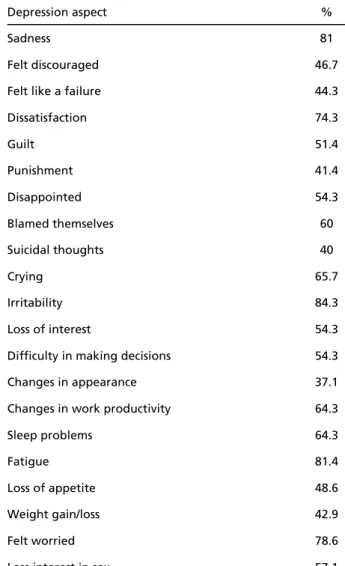
BDI ranged from 4 to 55, mean 21 ± 10.7. 58.7% had moderate and severe depression (Table 1). At least some degree of depression (mild to severe) appeared in 85.8% of patients. The BDI scores cor-related with perception of pain intensity (p = 0.02)
Table 1. Depression severity in chronic migraine patients accord -ing to Beck Depression Inventory.
Depression aspect %
Sadness 81
Felt discouraged 46.7
Felt like a failure 44.3
Dissatisfaction 74.3
Guilt 51.4
Punishment 41.4
Disappointed 54.3
Blamed themselves 60
Suicidal thoughts 40
Crying 65.7
Irritability 84.3
Loss of interest 54.3
Difficulty in making decisions 54.3
Changes in appearance 37.1
Changes in work productivity 64.3
Sleep problems 64.3
Fatigue 81.4
Loss of appetite 48.6
Weight gain/loss 42.9
Felt worried 78.6
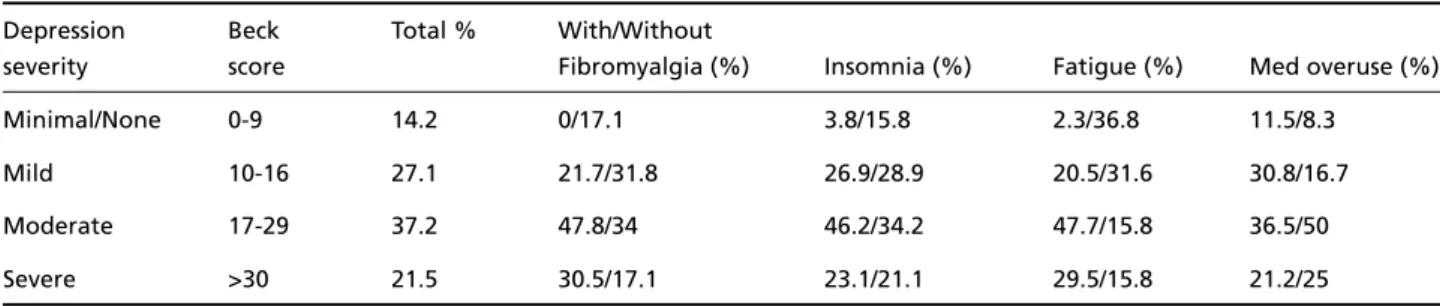
Table 2. Fibromyalgia, insomnia, fatigue and medication overuse and depression severity in chronic migraine patients.
Depression Beck Total % With/Without
severity score Fibromyalgia (%) Insomnia (%) Fatigue (%) Med overuse (%)
Minimal/None 0-9 14.2 0/17.1 3.8/15.8 2.3/36.8 11.5/8.3
Mild 10-16 27.1 21.7/31.8 26.9/28.9 20.5/31.6 30.8/16.7
Moderate 17-29 37.2 47.8/34 46.2/34.2 47.7/15.8 36.5/50
Severe >30 21.5 30.5/17.1 23.1/21.1 29.5/15.8 21.2/25
Arq Neuropsiquiatr 2005;63(2-A) 219
but not age, history of migraine, and acute medica-tion consumpmedica-tion. Severe depression was found in 30.5% of patients with fibromyalgia compared to 17.1% of patients without fibromyalgia, p<0.05. Patients with fatigue (defined as a FSS score high-er than 27) also reported sevhigh-ere depression signi-ficantly higher than those without fatigue (29.5 vs 15.8 respectively, p<0.05). No differences were found comparing patients with and without insom-nia, as in patients with and without acute medica-tion overuse (Table 2).
DISCUSSION
Depression is an important and frequent condi-tion in primary care, neurology, tertiary and hea-dache clinics settings6,7,16. It is estimated that de-pression may be responsible for as much as 25% of all visits to healthcare centers worldwide17. In primary care practices, 5-10% of adult patients experience major depression, making it one of the most common disorders seen by primary care physi-c i a n s1 8. Depression is associated with increased personal suffering, mortality, utilization of healthca-re services and dechealthca-reased functioning and quality of life19-21.
Recognizing and managing depression is a chal-lenging task. It is unknown how recognition, man-agement and outcomes of depression in headache, particularly chronic migraine patients, have been accessed in different settings, such as primary care, neurology or even headache centers. Headache patients are time consuming, and chronic daily headache, chronic migraine or refractory patients are complex with significant comorbidity with de-pression. The Beck Depression Inventory is a feasa-ble instrument for the detection and assessment of severity of depression in chronic migraine pati-ents. It is a self-applicable scale. It has an easy scor-ing and there is a correlation between DSM-IV diagnosis of major depression and the BDI scoring,
a cut-off of 16 suggesting a major depression diag-nosis22.
We found 21.5% of patients with severe depres-sion. Patients with fibromyalgia and fatigue were more prone to have severe depression than those without them. Suicide is the most common caus-es of death in major deprcaus-ession patients. In our pop-ulation 40% of patients reported suicidal ideation, 5% scoring the most severe item. Suicide risk and management has never been discussed in chronic migraine patients, future studies have to be car-ried out to address this important issue.
Certain symptoms including guilt, disappoint-ment, difficulty in making decisions, irritability, disatisfaction can be rapidly assessed, which may be an useful therapeutic tool for the cognitive be-havior approach. Sleep problems can also be screen-ed, but further evaluation are needed for a spe-cific diagnosis of sleep disorders. Work productiv-ity information also gives chronic migraine and depression impact in the patient.
Fibromyalgia and fatigue are particular condi-tions predisposing severe depression in chronic migraine. Their recognition may have important implications in the CM management.
220 Arq Neuropsiquiatr 2005;63(2-A)
REFERENCES
1. Silberstein SD, Lipton RB, Sliwinski M. Classification of daily and near-daily headaches: field trial of revised IHS criteria. Neuro l o g y 1996;47:871–875.
2. Castillo J, Munoz P, Guitera V, et al. Epidemiology of chronic daily headache in the general population. Headache 1998;39:190-196. 3. Mathew NT. Transformed migraine. Cephalalgia 1993;13:78-83. 4. O s t e rhaus JT, Gutterman DL, Plachetka JR. Healthcare re s o u rce and lost
labour costs of migraine headache in the US. Pharmacoeco nomics 1992;2:67-76.
5. Verri AP, Proietti CA, Galli C, et al. Psychiatric comorbidity in chron-ic daily headache. Cephalalgia 1998;18:45-49.
6. Mathew N. Chronic daily headache: clinical features and natural his-tory. In Nappi G (ed). Headache and depression: serotonin pathways as a common clue. New York: Raven Press, 1991:49-58.
7. Peres MF, Zukerman E, Young WB, Silberstein SD. Fatigue in chronic migraine patients. Cephalalgia. 2002;22:720-724.
8. P e res MF, Young WB, Kaup AO, Zukerman E, Silberstein SD. F i b romyalgia is common in patients with transformed migraine. Neurology 2001;57:1326-1328.
9. Merikangas KR,Angst J, Isler H. Migraine and psychopathology: re s u l t s of the Zurich cohort study of young adults. A rch Gen Psychiatry 1990;47:849-853.
10. Breslau N, Davis GC. Migraine, major depression and panic disorder: a prospective epidemiologic study of young adults. Cephalalgia 1992;12:85-90
11. Breslau N, Merikangas K, Bowden CL . Comorbidity of migraine and major affective disorders. Neurology 1994;44:17-S22
12. The International Classification of Headache Disorders. 2 Ed.Cephalalgia. 2004;24:1-160.
13. Wolfe F, Smythe HA, Yunus MB et al. The American College of Rheumatology 1990 Criteria for the Classification of Fibromyalgia. Re-port Multicenter Criteria Committee Arthritis Rheum 1990;33:160-172. 14. Brody, DS. Improving the management of depression in primary care: recent accomplishments and ongoing challenges. Disease Management & Health Outcomes. 2003; 11:21-31.
15. American Psychiatric Association. Diagnostic and statistical manual of mental disorders. 4 Ed., Washington DC:APA Press, 1994
16. Beck AT, Ward CH, Mendelson M, Mock J, Erbaugh J. An inventory for measuring depression. Arch Gen Psychiatry. 1961;4,561-571. 1 7 . Kleinman A, Cohen A. Psychiatry’s global challenge. Sci Am 1997;3:86-89 1 8 . Ballenger JC, Davidson JR, LecrubierY, et al. Consensus statement on the primary care management of depression from the International Consensus G roup on Depression and A n x i e t y. J Clin Psychiatry. 1999;60:54-61. 19. Rovner BW, German PS, Brant LJ, et al. Depression and mortality in
nursing homes. JAMA. 1991;265:993-996
20. Ormel J, VonKorff M, Ustun TB, et al. Common mental disorders and disability across cultures. JAMA. 1994; 272:1741-1748
2 1 . Simon GE, VonKorff M, Barlow W. Health care costs of primary carepatients with recognized depression. A rch Gen Psychiatry. 1995;52:850-856. 22. Lin EH, Katon WJ, Simon GE, et al. Achieving guidelines for the