ABSTRACT
BACKGROUND AND OBJECTIVES: Leukemias impair he-matopoietic stem-cells shunting and promote a proliferation of malignant cells without functional competence. Studies point that oral manifestations such as pain, hyperplasia and gum blee-ding may be one of the irst signs in leukemia patients. In light of the above, this study aimed at carrying out a systematic analysis of articles published in the last 15 years, with regard to chlorhe-xidine to treat and prevent mucositis in acute leukemia children under chemotherapy.
CONTENTS: A systematic search of articles published betwe-en January 2000 and January 2015 was carried out in Pubmed/ Medline, Science Direct and LILACS databases. After systematic search, 6 articles have fulilled all methodological inclusion cri-teria. Chlorhexidine is an important means of preventing and treating oral mucositis and studies refer that 0.12% chlorhexi-dine gluconate efectiveness is probably related to its bactericide action. Adequate oral hygiene is important to prevent mucositis and other therapeutic modalities have shown to be efective to treat and prevent oral mucositis.
CONCLUSION: Chlorhexidine gluconate does not totally eli-minate oral mucosa injuries, but is able to decrease their fre-quency and intensity without signiicant noxious efects. Howe-ver, other drugs compared to chlorhexidine in this study may present better results.
Keywords: Chemotherapy, Hematology, Oncology, Oral mani-festations, Mucositis.
Chlorhexidine to treat oral mucositis in patients with acute leukemia:
systematic review*
Uso da clorexidina no tratamento da mucosite oral em pacientes com leucemia aguda: revisão
sistemática
Rômulo Augusto de Paiva Macedo1, Everton Freitas de Morais2, Afonso Nóbrega Dantas1, Maria de Lourdes Silva de Arruda Morais3
*Received from Potiguar University, Natal, RN, Brazil.
1. Universidade Potiguar, Faculdade de Odontologia, Natal, RN, Brasil.
2. Universidade Potiguar, Faculdade de Odontologia, Bolsista de Iniciação a Pesquisa CNPq, Natal, RN, Brasil.
3. Universidade Federal do Rio Grande do Norte, Universidade Potiguar, Natal, RN, Brasil.
Submitted in May 01, 2015.
Accepted for publication in July 06, 2015.
Conlict of interests: none – Sponsoring sources: none.
Correspondence to: Everton Freitas de Morais
Avenida Senador Salgado Filho, 1610 – Lagoa Nova 59056-000 Natal, RN, Brasil.
E-mal: [email protected]
© Sociedade Brasileira para o Estudo da Dor
RESUMO
JUSTIFICATIVA E OBJETIVOS: As leucemias comprometem a derivação das células-tronco hematopoiéticas e promovem uma proliferação de células malignas sem competência funcional. Es-tudos apontam que manifestações orais como dor, hiperplasia e sangramento gengival podem ser um dos primeiros sinais em pacientes com leucemia. Diante do exposto, o objetivo deste es-tudo foi realizar uma análise sistemática de artigos publicados nos últimos 15 anos, no que diz respeito ao uso da clorexidina no tratamento e prevenção da mucosite em crianças com leucemia aguda em quimioterapia.
CONTEÚDO: Uma busca sistemática de artigos publicados entre janeiro de 2000 e janeiro de 2015 foi feita nas bases de dados Pubmed/Medline, Science Direct e LILACS. Após pesquisa sistemática 6 artigos preencheram todos os critérios de inclusão metodológica. A clorexidina é um importante meio de prevenção e tratamento da mucosite oral e estudos referem que a efetivi-dade do gluconato de clorexidina a 0,12% está provavelmente relacionada à sua ação bactericida. A correta higienização oral tem importante papel na prevenção da mucosite e outras formas terapêuticas demonstram ser eicazes no tratamento e prevenção da mucosite oral.
CONCLUSÃO: O gluconato de clorexidina não elimina total-mente as lesões de mucosa oral, mas é capaz de diminuir sua frequência e intensidade sem apresentar efeitos deletérios signi-icativos no paciente. Entretanto, outros fármacos comparados à clorexidina nesteestudo podem apresentar melhores resultados. Descritores: Hematologia, Manifestações bucais, Mucosite, On-cologia, Quimioterapia.
INTRODUCION
Leukemias impair hematopoietic stem-cells shunting and promote a proliferation of malignant cells without functional competence. here are diferent groups of lymphocytes, thus diferent types of leukemia, which are classiied according to involved cell, disease duration and character1-4. Its etiology is still uncertain and might be related to factors such exposure to radiation and genetics3.
Acute lymphoid leukemia (ALL) represents approximately 80% of all leukemias afecting children and young adults, and acute myeloid leukemia (AML) is responsible for
ximately 15% of cases5,6. In childhood, most afected age is four years of age, being approximately twice as common in Caucasian patients as compared to non-Caucasians7,8. Studies show that oral manifestations such as pain, hyperplasia and gingival bleeding may be the irst signs of leukemia patients4,9. Treatment of choice for this cancer is chemotherapy, which may be used together with other therapies10-12. In the last four decades, there has been major progress in the treatment of leukemia and approximately 80% of children and teenagers with early diagnosis may be cured8. However, several studies point to anticancer treatment as inducing oral mucositis1,2,4. Oral mucositis is characterized by erythema, followed by very painful ulcers in oral mucosa, which interfere with nutritional status and quality of life (QL), and may limit or even inter-rupt anticancer therapy in severe cases2.
Several studies indicate chlorhexidine gluconate, due to its antibacterial and antifungal activity and binding to tissue sur-faces, to prevent and treat oral manifestations of such patients, especially mucositis2,13. However, they caution that there may be sequelae for patients with long-term use of chlorhexidine, such as burning sensation, dysgeusia and dental pigmenta-tion13.
he understanding of oral injuries caused by acute leukemias (AL) and anticancer therapies is dentists’ duty, as well as the use of prophylactic and therapeutic measures to promote pa-tients’ oral health and help the return of their physical well-being.
In light of the above, this study aimed at carrying out a sys-tematic analysis of articles published in the last 15 years with regard to the use of chlorhexidine to treat and prevent muco-sitis in AL children submitted to chemotherapy.
CONTENTS
A systematic search of articles published between January 2000 and January 2015 was carried out in Pubmed/Medli-ne, Science Direct and LILACS databases, looking for studies evaluating the use of chlorhexidine to prevent and treat oral mucositis in AL patients.
he following terms were used for the search: Acute Leuke-mia, Oral Mucositis, Chlorhexidine, Treatment, Prevention, Oral Mucosa, as well as their synonyms and corresponding words in Portuguese and Spanish, in diferent combinations. Boolean operators AND, OR, NOT were used. Search strate-gies are shown in table 1.
After getting the abstracts, three independent investigators have selected relevant studies according to inclusion and exclusion criteria. Inclusion criteria were original articles in English, Portuguese or Spanish, aiming at evaluating chlorhe-xidine to prevent and treat oral mucositis in AL patients; and articles published as of January 2000. Exclusion criteria were clinical cases, review articles, population outside research standards, articles published before 2000 or in diferent lan-guages from those selected for the study.
he irst selection stage was to evaluate titles and abstracts. hen, all studies the titles or abstracts of which were consi-dered relevant to the subject where obtained in whole and completely analyzed. At the end, articles analyzed and selec-ted by evaluators after consensus meeting were included in this review.
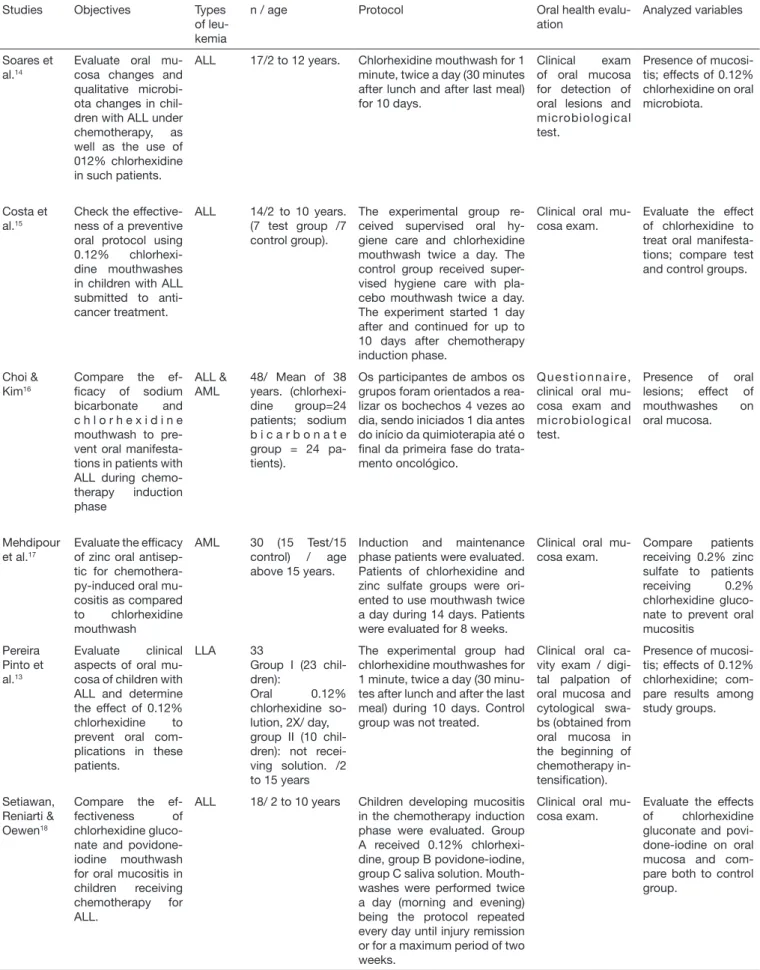
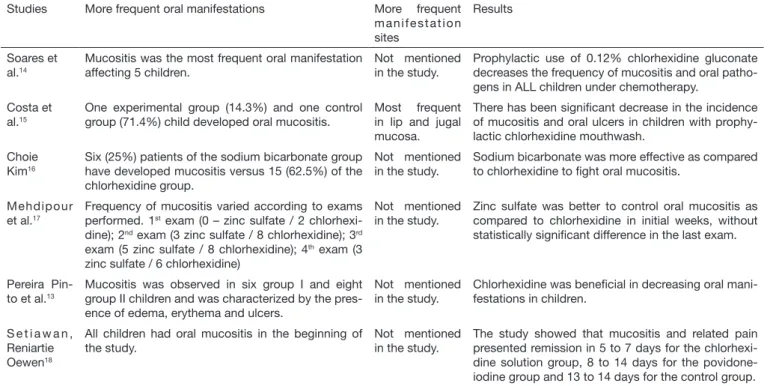
After initial search, 15 studies had potential to be included in this study, however after detailed and complete analysis, only 6 have met all methodological inclusion criteria13-18. Among selected studies, 5 were performed in developing countries13-15,17,18 and one in a developed country16. Methods and results of evaluated studies are shown in tables 2 and 3. Participants’ sample among selected studies has varied from 14 to 48 patients, in a total of 160 participants. Four studies were performed primarily in children between 2 and 15 ye-ars of age16,17. Most participants of the studies were above 15 years of age. Oral mucositis prevention and treatment with chlorhexidine gluconate were evaluated by 5 selected studies. Another study has evaluated chlorhexidine gluconate in chil-dren with ALL already with oral mucositis18.
Intraoral exam was used to evaluate patients of selected stu-dies. Studies14,16 have used microbiological tests. Pereira Pinto et al.13 also used cytological exam. Aiming at evaluating pain level of patients, authors16,18 have used questionnaires applied to participants.
Chlorhexidine gluconate concentration was 0.12%, except for the study by Mehdipour et al.17 the concentration of whi-ch was 0.2%. hree studies had control group without treat-ment13,15,17. Choi & Kim16 have compared chlorhexidine and sodium bicarbonate to treat oral mucositis and sodium bicar-bonate has shown better results.
In the study of Mehdipour et al.17, zinc sulfate was compared to chlorhexidine with better results in early evaluations of the study; however there has been no statistically signiicant dife-rence in the inal analysis of the experiment which has lasted 1 month. Setiawan, Reniarti & Oewen18, who analyzed the
ei-Table 1. Search strategies and number of articles found on databases
Strategies A B C
Chlorhexidine / oral mucositis 12 747 198
Chlorhexidine / oral mucositis / treatment / acute leukemia 0 727 184
Chlorhexidine / oral mucositis / (treatment OR prevention) / acute leukemia 0 733 185
Chlorhexidine / oral mucositis / (treatment OR prevention) / mucosa / acute leukemia 0 531 37
Chlorhexidine / oral mucositis / (treatment AND prevention) / oral mucosa/ acute leukemia 0 401 37
Table 2. Methods and objectives of selected studies
Studies Objectives Types
of leu-kemia
n / age Protocol Oral health
evalu-ation
Analyzed variables
Soares et al.14
Evaluate oral mu-cosa changes and qualitative microbi-ota changes in chil-dren with ALL under chemotherapy, as well as the use of 012% chlorhexidine in such patients.
ALL 17/2 to 12 years. Chlorhexidine mouthwash for 1 minute, twice a day (30 minutes after lunch and after last meal) for 10 days.
Clinical exam of oral mucosa for detection of oral lesions and microbiological test.
Presence of mucosi-tis; effects of 0.12% chlorhexidine on oral microbiota.
Costa et al.15
Check the effective-ness of a preventive oral protocol using 0.12% chlorhexi-dine mouthwashes in children with ALL submitted to anti-cancer treatment.
ALL 14/2 to 10 years. (7 test group /7 control group).
The experimental group re-ceived supervised oral hy-giene care and chlorhexidine mouthwash twice a day. The control group received super-vised hygiene care with pla-cebo mouthwash twice a day. The experiment started 1 day after and continued for up to 10 days after chemotherapy induction phase.
Clinical oral mu-cosa exam.
Evaluate the effect of chlorhexidine to treat oral manifesta-tions; compare test and control groups.
Choi & Kim16
Compare the ef-icacy of sodium bicarbonate and c h l o r h e x i d i n e mouthwash to pre-vent oral manifesta-tions in patients with ALL during chemo-therapy induction phase
ALL & AML
48/ Mean of 38 years. (chlorhexi-dine group=24 patients; sodium b i c a r b o n a t e group = 24 pa-tients).
Os participantes de ambos os grupos foram orientados a rea-lizar os bochechos 4 vezes ao dia, sendo iniciados 1 dia antes do início da quimioterapia até o inal da primeira fase do trata-mento oncológico.
Q u e s t i o n n a i re , clinical oral mu-cosa exam and microbiological test.
Presence of oral lesions; effect of mouthwashes on oral mucosa.
Mehdipour et al.17
Evaluate the eficacy of zinc oral antisep-tic for chemothera-py-induced oral mu-cositis as compared to chlorhexidine mouthwash
AML 30 (15 Test/15
control) / age above 15 years.
Induction and maintenance phase patients were evaluated. Patients of chlorhexidine and zinc sulfate groups were ori-ented to use mouthwash twice a day during 14 days. Patients were evaluated for 8 weeks.
Clinical oral mu-cosa exam.
Compare patients receiving 0.2% zinc sulfate to patients receiving 0.2% chlorhexidine gluco-nate to prevent oral mucositis
Pereira Pinto et al.13
Evaluate clinical aspects of oral mu-cosa of children with ALL and determine the effect of 0.12% chlorhexidine to prevent oral com-plications in these patients.
LLA 33
Group I (23 chil-dren):
Oral 0.12% chlorhexidine so-lution, 2X/ day, group II (10 chil-dren): not recei-ving solution. /2 to 15 years
The experimental group had chlorhexidine mouthwashes for 1 minute, twice a day (30 minu-tes after lunch and after the last meal) during 10 days. Control group was not treated.
Clinical oral ca-vity exam / digi-tal palpation of oral mucosa and cytological swa-bs (obtained from oral mucosa in the beginning of chemotherapy in-tensiication).
Presence of mucosi-tis; effects of 0.12% chlorhexidine; com-pare results among study groups.
Setiawan, Reniarti & Oewen18
Compare the ef-fectiveness of chlorhexidine gluco-nate and povidone-iodine mouthwash for oral mucositis in children receiving chemotherapy for ALL.
ALL 18/ 2 to 10 years Children developing mucositis in the chemotherapy induction phase were evaluated. Group A received 0.12% chlorhexi-dine, group B povidone-iochlorhexi-dine, group C saliva solution. Mouth-washes were performed twice a day (morning and evening) being the protocol repeated every day until injury remission or for a maximum period of two weeks.
Clinical oral mu-cosa exam.
Evaluate the effects of chlorhexidine gluconate and povi-done-iodine on oral mucosa and com-pare both to control group.
cacy of chlorhexidine and povidone-iodine to treat mucositis, have observed that the chlorhexidine group had faster lesion remission as compared to the second group.
With regard to oral mucosa site most afected by mucositis, only one study of Costa et al.15 has reported this frequency, being jugal mucosa and lip the sites reported by the authors. Chemotherapeutic drugs used during patients’ follow-up pe-riod are shown in table 4. Only the study by Soares et al.14 has not informed the chemotherapeutic scheme used for antican-cer therapy. Selected studies are unanimous in stating that the stage with most oral mucositis afections is during induction and that adequate oral hygiene is critical for preventing oral lesions.
DISCUSSION
Primary treatment of choice for acute leukemias is chemothe-rapy, with protocols lasting more than one year19,20. his treat-ment is divided in phases which are induction, consolidation and maintenance. Maintenance phase is the longest treatment period and in which children have better clinical stability19,21. Induction phase is considered by the literature the phase with highest incidence of oral mucositis.
hree of selected studies for this review have used metho-trexate in the induction phase13,15,18. Mucositis was more frequent between days 2 and 4 after beginning of treatment using intravenous methotrexate with mean remission times Table 3. Results of studies selected for the research
Studies More frequent oral manifestations More frequent m a n i f e s t a t i o n sites
Results
Soares et al.14
Mucositis was the most frequent oral manifestation affecting 5 children.
Not mentioned in the study.
Prophylactic use of 0.12% chlorhexidine gluconate decreases the frequency of mucositis and oral patho-gens in ALL children under chemotherapy.
Costa et al.15
One experimental group (14.3%) and one control group (71.4%) child developed oral mucositis.
Most frequent in lip and jugal mucosa.
There has been signiicant decrease in the incidence of mucositis and oral ulcers in children with prophy-lactic chlorhexidine mouthwash.
Choie Kim16
Six (25%) patients of the sodium bicarbonate group have developed mucositis versus 15 (62.5%) of the chlorhexidine group.
Not mentioned in the study.
Sodium bicarbonate was more effective as compared to chlorhexidine to ight oral mucositis.
Mehdipour et al.17
Frequency of mucositis varied according to exams performed. 1st exam (0 – zinc sulfate / 2
chlorhexi-dine); 2nd exam (3 zinc sulfate / 8 chlorhexidine); 3rd
exam (5 zinc sulfate / 8 chlorhexidine); 4th exam (3
zinc sulfate / 6 chlorhexidine)
Not mentioned in the study.
Zinc sulfate was better to control oral mucositis as compared to chlorhexidine in initial weeks, without statistically signiicant difference in the last exam.
Pereira Pin-to et al.13
Mucositis was observed in six group I and eight group II children and was characterized by the pres-ence of edema, erythema and ulcers.
Not mentioned in the study.
Chlorhexidine was beneicial in decreasing oral mani-festations in children.
S e t i a w a n , Reniartie Oewen18
All children had oral mucositis in the beginning of the study.
Not mentioned in the study.
The study showed that mucositis and related pain presented remission in 5 to 7 days for the chlorhexi-dine solution group, 8 to 14 days for the povidone-iodine group and 13 to 14 days for the control group.
ALL = acute lymphoid leukemia.
Table 4. Chemotherapeutic agents and chemotherapy phases
Studies Chemotherapic agents
Soares et al.14 Combinations for chemotherapeutic treatment were not mentioned.
Costa et al.15
Therapy consisted of 6-mercaptopurine (one 50/mg/m2/day oral dose during six weeks), methotrexate (one 2mg;m2 intravenous dose in continuous infusion during 24 h in days 1, 15, 30 and 45 of treatment, respectively), leucovorin (one 15mg/m2 oral dose four times a day in days 2, 3, 16, 17, 31, 32, 46 and 47) and spinal MADIT (combination of 12 mg methotrexate + 70mg cytosine-arabinoside + 2 mg/m2 dexamethasone) in days 1, 15, 30 and 45.
Choie Kim16 Under induction chemotherapy with idarubicin and enocitabine or LLA cyclophosphamide, vincristin and daunorubicin.
Mehdipour et al.17 Citarabine in the induction phase and novantrone in the consolidation phase.
Pereira Pinto et al.13
Protocol for acute leukemia treatment proposed by the Brazilian Society of Pediatric Oncology16. Methotrexate was a drug
used in this therapy. 0.12% chlorhexidine gluconate was administered for 10 consecutive days, after each methotrexate infusion during intensiication chemotherapy.
Setiawan, Reniar-tie
Oewen18
Methotrexate (one spinal dose in days 1, 14 and 42),
Dexamethasone (one 6mg/m2/day oral dose during 5 weeks), vincristin (one 1.5mg/m2 intravenous dose in continuous infusion in 5 minutes in days 7, 14, 21, 28, 35), and L-asparaginase (one 6000ug/m2 intravenous dose in weeks 4 and 5).
of 16 days, being the severity of oral lesions and their dura-tion in children receiving chlorhexidine mouthwashes shorter as compared to control group15. Similar results were found by other studies13,22,23. According to Setiawan, Reniarti & Oewen18, mucositis in general occurs between days 7 and 10 after beginning of treatment, especially in cases when metho-trexate is used. Studies refer that the efectiveness of 0.12% chlorhexidine gluconate is probably related to its bactericide action.
In the literature, mucositis is related to chemotherapy agents’ dose, administration type and interval, and such factors may vary according to the protocol used. So, it is understood that diferent protocols of the selected studies might have inluen-ced the higher or lower incidence of oral mucositis, as well as the severity of the process, which signiicantly impairs a more judicious analysis.
In this review, all studies showed signiicant decrease in oral mucositis, as well as less severity and time of the disease with chlorhexidine digluconate, being its use indicated for preven-tion and treatment.
However, previous studies show that only with accurate oral hygiene it would be possible to prevent oral mucositis in leu-kemia patients22,23. It is known that poor oral cavity hygiene is another factor favoring local infections and, in addition, it is the entry point for systemic infections, impairing patients’ general status and increasing their hospital stay. Adequate oral hygiene associated to prophylactic treatment of mucositis is pa-ramount for the prevention of such oral lesion. According to these studies, it is understood that a good oral hygiene associa-ted to chlorhexidine digluconate is able to decrease mucositis--induced pain in ALL children under anticancer treatment. Among selected studies, three have compared chlorhexidine to other therapies. Setiawan, Reniart & Oewen18 have com-pared povidone-iodine to chlorhexidine, being that the latter had better results to treat oral mucositis, with remission of 5 to 7 days versus 8 to 14 days for povidone-iodine. However, povidone-iodine had better results as compared to the con-trol group using saliva solutions, which is in line with other studies24,25. For the author, better chlorhexidine result may be related to the fact that it is absorbed by oral surfaces and released in mouth for a period of 24h, thus being in contact with the oral cavity for a longer time.
A study evaluating during four weeks chlorhexidine and zinc sulfate has observed better early results for zinc sulfate, ho-wever, in the fourth week, the diference between groups was not statistically signiicant. Zinc sulfate has positive efects on epithelization, is antioxidant and has antibacterial action, being efective for the maintenance of mucosal integrity and therapeutically acting during early mucositis stages17.
Choie & Kim16 had better results with sodium bicarbonate as compared to chlorhexidine; however, at microbiological analysis, the number of micro-organisms in the oral cavity of patients using sodium bicarbonate was higher than of tho-se using chlorhexidine, being this result similar to other stu-dies26,27. According to the literature, the origin of oral mucosa lesions is directly related to anticancer treatment, being
con-sequence of two major mechanisms: direct toxicity of the the-rapy on the mucosa and myelosuppression generated by the treatment20, and its course may be inluenced by infection. Alkaline solutions, water associated to sodium bicarbonate, change oral cavity pH, inhibiting saliva acidity thus elimi-nating an environment prone to bacterial and fungal proli-feration.
In the study by Soares et al.14, microbiological analysis has shown the presence of a small number of potentially patho-genic micro-organisms. Patients with oral mucositis had hi-gher frequency of coagulase-negative staphylococcus (80%) as compared to patients with normal oral mucosa (33.3%). Labarca et al.28 point that the micro-organism associated to severe neutropenia may favor the onset of oral mucositis. here are few studies in the literature aiming at evaluating the direct relationship between a speciic drug used in chemothe-rapy and the incidence of oral mucositis. It is known, howe-ver, that chemotherapy agents more commonly associated to the development of oral mucositis are 5-luoracil, methotre-xate29, cisplatin, bleomycin and doxorubicin30.
Selected studies for this review have not established correla-tion between chemotherapy schemes and frequency of oral mucositis among participants. he study by Mehdipour et al.17 has used cytarabine in the induction phase and novan-trone in the consolidation phase, which are drugs seldom mentioned with regard to oral mucositis; however, its high incidence infers the need for carrying out studies to more de-eply evaluate such correlation, as well as diferences between chemotherapy schemes, lymphoid and myeloid leukemias and the onset of oral mucositis.
CONCLUSION
Chlorhexidine gluconate does not totally eliminate oral mu-cosa lesions, but is able to decrease their frequency and in-tensity without signiicant adverse efects for patients, decrea-sing pain and discomfort. However, other drugs compared to chlorhexidine may have better results, being important that further studies are carried out to better explain such efects.
REFERENCES
1. Subramaniam P, Babu KL, Nagarathna J. Oral manifestations in acute lymphoblastic leukemic children under chemotherapy. J Clin Pediatr Dent. 2008;32(4):319-24. 2. Morais EF, Lira JA, Macedo RA, Santos KS, Elias CT, Morais Mde L. Oral
manifes-tations resulting from chemotherapy in children with acute lymphoblastic leukemia. Braz J Otorhinolaryngol. 2014;80(1):78-85.
3. Hamerschlak N. Leukemia: genetics and prognostic factors. J Pediatr. 2008;84(4):52-7. 4. Silva LC, Carneiro FM, Cruz RA. Manifestações bucais das leucemias agudas na
in-fância. Arq Bras Odontol. 2008;4(1):40-54.
5. Ziegler DS, Dalla Pozza L, Waters KD, Marshall GM. Advances in childhood leu-kemia: successful clinical-trials research leads to individualized therapy. Med J Aust. 2005;182(2):78-81.
6. Costa SS, Silva AM, Macedo IA. Conhecimento de manifestações orais da leu-cemia e protocolo de atendimento odontológico. Rev Odontol Univ São Paulo. 2011;23(1):70-8.
7. Galvão V, Castro CH, Consolaro A. Mucosite severa em paciente com leucemia: uma abordagem terapêutica. Rev Cir Traumatol Buco-Maxilo-Fac. 2006;6(2):35-40. 8. Pui CH, Robison LL, Look AT. Acute lymphoblastic leukaemia. Lancet.
2008;371(9617):1030-43.
10. Epstein JB, Tsang AH, Warkentin D, Ship JA. he role of salivary function in modu-lating chemotherapy-induced oropharyngeal mucositis: a review of the literature. Oral Surg Oral Med Oral Pathol Oral Radiol Endod. 2002;94(1):39-44.
11. Pels E, Mielnik-Błaszczak M. Oral hygiene in children sufering from acute lym-phoblastic leukemia living in rural and urban regions. Ann Agric Environ Med. 2012;19(3):529-33.
12. de Mendonça RM, de Araújo M, Levy CE, Morari J, Silva RA, Yunes JA, et al. Prospective evaluation of HSV, Candida spp., and oral bacteria on the severity of oral mucositis in pediatric acute lymphoblastic leukemia. Support Care Cancer. 2012;20(5):1101-7.
13. Pereira Pinto L, de Souza LB, Gordón-Núñez MA, Soares RC, de Brito Costa EM, de Aquino AR, et al. Prevention of oral lesions in children with acute lymphoblastic leukemia. Int J Pediatr Otorhinolaryngol. 2006;70(11):1847-51.
14. Soares AF, Aquino AR, Carvalho CH, Nonaka CF, Almeida D, Pinto, LP. Frequency of oral mucositis and microbiological analysis in children with acute lymphoblastic leuke-mia treated with 0.12% chlorhexidine gluconate. Braz Dent J. 2011;22(4):312-6. 15. Costa EM, Fernandes MZ, Quinder LB, de Souza LB, Pinto LP. Evaluation of an oral
preventive protocol in children with acute lymphoblastic leukemia. Pesqui Odontol Bras. 2003;17(2):147-50.
16. Choi SE, Kim HS. Sodium bicarbonate solution versus chlorhexidine mouthwash in oral care of acute leukemia patients undergoing induction chemotherapy: a randomi-zed controlled trial. Asian Nurs Res. 2012;6(2):60-6.
17. Mehdipour M, Taghavi Zenoz A, Asvadi Kermani I, Hosseinpour A. A comparison between zinc sulfate and chlorhexidine gluconate mouthwashes in the prevention of chemotherapy-induced oral mucositis. Daru. 2011;19(1):71-3.
18. Setiawan AS, Reniarti L, Oewen RR. Comparative efects of chlorhexidine gluconate and povidone iodine mouthwashes to chemotherapy induced oral mucositis in chil-dren with acute lymphoblastic leukemia. Int J of Oral Med Sci. 2006;5(1):1-5. 19. Macêdo TM, Campos TF, Mendes RE, França DC, Chaves GS, Mendonça KM.
Fun-ção pulmonar de crianças com leucemia aguda na fase de manutenFun-ção da quimiotera-pia. Rev Paul Pediatr. 2014;32(4):320-5.
20. Sonis ST, O’Donnell KE, Popat R, Bragdon C, Phelan S, Cocks D, et al. he
rela-tionship between mucosal cyclooxygenase-2 (COX-2) expression and experimental radiation-induced mucositis. Oral Oncol. 2004;40(2):170-6.
21. Sonis ST. Mucositis as a biological process: a new hypothesis for the development of chemotherapy-induced stomatotoxicity. Oral Oncol. 1998;34(1):39-43.
22. Dodd MJ, Larson PJ, Dibble SL, Miaskowski C, Greenspan D, MacPhail L, et al. Randomized clinical trial of chlorhexidine versus placebo for prevention of oral mu-cositis in patients receiving chemotherapy. Oncol Nurs Forum. 1996;23(6):921-7. 23. Epstein JB, Vickars L, Spinelli J, Reece D. Eicacy of chlorhexidine and nystatin
rin-ses in prevention of oral complications in leukemia and bone marrow transplantation. Oral Surg Oral Med Oral Pathol.1992;73(5):682-9.
24. Hasenau C, Clasen BP, Roettger D. [Use of standardized oral hygiene in prevention and therapy of mucositis in patients treated with radiochemotherapy of head and neck neoplasm]. Laryngol Rhinol Otol. 1988;67(11):576-9. German.
25. Rahn R, Adamietz IA, Boettcher HD, Schaefer V, Reimer K, Fleischer W. Povidone--iodine to prevent mucositis in patients during antineoplastic radiochemotherapy. Dermatology. 1997;195(Suppl 2):57-61.
26. Pitten FA, Kiefer T, Buth C, Doelken G, Kramer A. Do cancer patients with chemo-therapy-induced leukopenia beneit from an antiseptic chlorhexidine-based oral rinse? A double-blind, block-randomized, controlled study. J Hosp Infect. 2003;53(4):283-91. 27. Ferretti GA, Raybould TP, Brown AT, Macdonald JS, Greenwood M, Maruyama
Y, et al. Chlorhexidine prophylaxis for chemotherapy- and radiotherapy-induced stomatitis: a randomized double-blind trial. Oral Surg Oral Med Oral Pathol. 1990;69(3):331-8.
28. Labarca JA, Leber AL, Kern VL, Territo MC, Brankovic LE, Bruckner DA, et al. Outbreak of Stenotrophomonas maltophilia bacteremia in allogenic bone mar-row transplant patients: role of severe neutropenia and mucositis. Clin Infect Dis. 2000;30(1):195-7.
29. Köstler WJ, Hejna M, Wenzel C, Zielinski C. Oral mucositis complicating chemothe-rapy and/or radiothechemothe-rapy: options for prevention and treatment. CA Cancer J Clin. 2001;51(5):290-315.