ABSTRACT
BACKGROUND AND OBJECTIVES:his study aimed at identifying the impact of chronic pain on working activities of patients seen by the Chronic Pain Center of the Teaching Hospital, Federal University of Maranhão.
METHODS: his is a descriptive and transversal study with patients being treated for pain, using two questionnaires. A card-protocol was developed for clinical, sociodemographic, therapeutic and occupational data collection, with questions about gender, age, education, type of pain, interference of pain, proposed treatment and occupational status. Medical Outcomes Study 36-Item Short Form Health Survey (SF 36) was used to evaluate quality of life.
RESULTS: Participated in the study 74 patients, being 25 (34%) males and 49 (66%) females. Approximately 30% had some working activity, while 74.3% were inactive. More than 47% of active patients have stated that pain would always worsen during activities. Among inactive patients, this ratio was 80%. here has been statistically signiicant diference in “functional capacity”, “pain”, “vitality” and “social aspects” domains, being that the group of inactive patients had the worst scores.
CONCLUSION:Respondents were predominantly inactive. In addition, most patients have reported that working activi-ties would always worsen pain. It has been observed that the domain contributing the most for low SF36 questionnaire scores was that related to physical limitations to perform daily and working activities.
Keywords:Chronic pain, Quality of life, Working activity.
Relationship between chronic pain and working activities in patients with
painful syndromes*
Relação entre dor crônica e atividade laboral em pacientes portadores de síndromes dolorosas
Beatriz TavaresGarcia1, Erica Brandão Mores Vieira2, João Batista Santos Garcia3
*Received from Teaching Hospital, Federal University of Maranhão. São Luis, MA.
1. Federal University of Maranhão; School of Medicine. São Luis, MA, Brazil. 2. Federal University of Maranhão. São Luis, MA, Brazil.
3. Federal University of Maranhão; Teaching Hospital; Pain and Palliative Care Service, Maranhense Institute of Oncology. São Luis, MA, Brazil.
Submitted in June 01, 2013.
Accepted for publication in September 09, 2013. Conlict of interests: None.
Correspondence to: Beatriz Tavares Garcia
Rua Santa Luzia, Q 27, C 05 – Bairro Quintas do Calhau 65072-008 São Luís, MA.
E-mail: [email protected]
RESUMO
JUSTIFICATIVA E OBJETIVOS: O presente estudo obje-tivou identiicar a inluência da dor crônica no prejuízo da atividade laboral de pacientes atendidos no Serviço de Dor Crônica do Hospital Universitário da Universidade Federal do Maranhão.
MÉTODOS: Realizou-se um estudo descritivo e transver-sal, com pacientes em tratamento de dor, por meio de dois questionários. Para obtenção dos dados clínicos, sociodemo-gráicos, terapêuticos e ocupacionais foi elaborado uma icha-protocolo, com questões acerca do gênero, idade, escolari-dade, caracterização da dor, interferência da dor, tratamento proposto e status ocupacional. Para avaliação da qualidade de vida, foi utilizado o Medical Outcomes Study 36- Item Short-Form Health Survey (SF36).
RESULTADOS: Foram entrevistados 74 pacientes, dos quais 25 (34%) eram do gênero masculino e 49 (66%) do gênero feminino. Cerca de 30% realizavam atividades de trabalho, enquanto 74,3% estavam inativos. Mais de 47% dos pacien-tes em atividade airmaram que a dor sempre piorava durante a realização das atividades. Já no grupo de pacientes inati-vos, esta porcentagem foi de 80%. Houve diferença estatis-ticamente signiicante nos domínios “capacidade funcional”, “dor”, “vitalidade” e “aspectos sociais”, sendo que o grupo de pacientes inativos apresentou os piores valores.
CONCLUSÃO: Os pacientes entrevistados estavam pre-dominantemente afastados de suas atividades de trabalho. Além disso, a maioria relatou que a realização das atividades laborais piora sempre o quadro álgico. Observou-se que o domínio que mais contribuiu para baixos valores no ques-tionário SF36, foi aquele relacionado às limitações físicas no desempenho das atividades diárias e de trabalho.
Descritores: Atividade laboral, Dor crônica, Qualidade de vida.
INTRODUCTION
Complex chronic pain nature impairs the estimate of its prev-alence among general population because it requires a mul-tidimensional approach1 where, in addition to neurophysi-ologic phenomena, there are psychneurophysi-ological, cognitive and behavioral factors2.
their lives and in 10% to 40% of them pain lasts for more than one day3. In Brazil, studies have shown high incidence rates. A study has shown prevalence of 41.4%4 and another has found prevalence of 61.4%5. In São Luis, the prevalence is approximately 42%6.
Approximately 50% to 60% of patients become partially or totally disabled, in a transient of permanent manner, signii-cantly impairing quality of life (QL) with negative social and economic impacts. As a consequence, many working days may be lost by chronic pain individuals3.
Moderate to severe chronic pain afects 19% of adult Euro-peans, severely afecting their professional lives7. In Brazil, a study carried out with chronic pain patients has observed that 94.9% had their professional lives impaired8.
A recent study carried out in the city of São Luis to analyze pain intensity in active patients and patients in medical leave has shown severe pain in 48.6% and 60.9%, respectively. his minor diference evidences that pain intensity per se would not deine the incapacity of such individuals with regard to labor activities9.
Pain-related absenteeism brings consequences to country’s economy, because it predisposes to high expenditures with disability compensation and disability retirement. Accord-ing to the Statistical Bulletin of the Social Security, in 2012, total amount of benefits granted has reached more than 4.5 billion reals, and in 2013, from January to July, it exceeded 2.9 billion. In July 2013, total amount of benefits granted was 437 million, being that more than 44% of these were disability compensations and 3.9% represented disability retirements10.
At the Chronic Pain Service of the Teaching Hospital, Fed-eral University of Maranhão (HUUFMA), it is observed a large number of patients needing medical certificates to get medical leaves, arguing that chronic pain interferes with their labor activities. So, there is the need to develop stud-ies relating chronic pain to absenteeism. Results may con-tribute to reveal causes and factors influencing absenteeism allowing the development of preventive and therapeutic in-terventions.
his study aimed at identifying the inluence of chronic pain on labor activities of patients seen by the Chronic Pain Ser-vice, HUUFMA, by describing their occupational situation, worsening of pain during activities, working absence and leave, as well as at evaluating the impact of chronic pain in their QL.
METHODS
his was a descriptive and transversal study carried out from January to May 2013, with patients being treated in the Chronic Pain Service, HUUFMA. A convenience sample was used. Participated in the study patients with pain for more than six months and with minimum age to enter any profes-sional activity, deined by the Ministry of Labor as 16 years or above. Patients were selected through the treatment sched-ule of the Chronic Pain Outpatient Setting, which is weekly
prepared. Data were collected while patients were waiting for consultation.
All subjects were informed about the objectives of the study and the volunteer and conidential character of their partici-pation. heir agreement was recorded with the signature of the Free and Informed Consent Term, signed in two copies, of which one remained with the patient and the other with the investigator.
A tool speciically developed for this objective was used to collect clinical, sociodemographic, occupational and thera-peutic data. he card-protocol consisted of information on pain characterization and its interferences, proposed treat-ment and occupational status. Pain intensity was classiied through the verbal scale in mild, moderate and severe. Pain duration was recorded in months and diagnoses, when not reported by patients, were obtained from medical records. Medical Outcomes Study 36-Item Short Form Health Survey (SF-36), which is a generic and multidimensional tool validated to the Portuguese language by Ciconelli11 in 1997, was used to evaluate QL. It has 36 items grouped in 8 domains: functional capacity (daily life activities, such as care of oneself, get dressed, take bath and climb stairs); physical aspects (impact of physical fitness on daily and/ or professional activities); general health status (subjective perception of general health status); vitality (subjective per-ception of health status); social aspects (impact of physical health status on social activities); emotional aspects (impact of emotional status on daily and/or professional activities); mental health (mood and well-being scale). Scores vary from zero to 100, where zero means a more severe QL impairment and 100 a mild QL impairment.
A database was developed with the software Microsoft Oice Excel 2013. Stata 10.0 (Stata Corp., College Station, USA) was used for statistical analysis. Results of sociodemongraph-ic, clinical, therapeutic and occupational questions were ex-pressed by frequencies with percentages and means ± standard deviation. Student t test was used to compare numerical vari-ables and Chi-square test was used for categorical varivari-ables. Dependent variable of the study was occupational status. SF-36 answers were re-codiied according to SF-36 work group instructions. For each of the eight domains, mean scores were obtained with values varying from zero to 100. After data descriptive analysis, Student t test was used to com-pare means of each SF-36 domain with regard to occupational status, considering statistically signiicant p < 0.05.
his study was approved by the Ethics Committee for Re-search with Human Beings of the Teaching Hospital, Federal University of Maranhão, under opinion 275.495.
RESULTS
pre-dominance of male patients with lower income in the group of inactive patients, with statistically signiicant diference. Sociodemographic data are shown in table 1.
Table 1 – Comparison of sociodemographic characteristics of active and inactive patients.
Variables Active
n = 19 (25.7%)
Inactive n = 55 (74.3%)
p value
Age (years, mean ± SD) 46.3 ± 9.3 44.8 ±10.1 0.587
Gender (%) Male Female 10.6 89.4 58.2 41.8 0.013* Origin (%) Capital Interland 42.1 57.9 29.1 70.9 0.296
Marital status (%) Married Single Divorced Widower 31.5 57.8 0 10.5 52.7 41.8 3.6 1.8 0.141 Education (%) Illiterate Basic education High school College 0 26.3 47.3 26.3 5.4 40 43.6 10.9 0.255
Monthly income (%) No income Up to 1 MW Up to 3 MW Up to 5 MW
10.5 47.3 26.3 15.7 29.1 45.4 25.4 0 0.013*
MW = minimum wage(s); SD = standard deviation; *p<0.05.
More frequent diagnoses found in the group of active patients were low back pain and neuropathic pain, both with 26.3% of total, and the majority of inactive patients (49%) had low back pain as primary diagnosis.
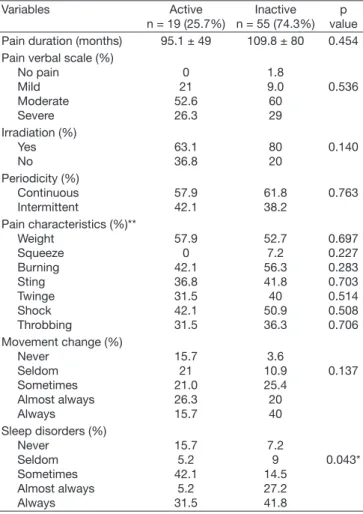
Considering separately patients with remunerated activities, corresponding to a total of 19 patients, mean pain duration was 95.1 ± 49 months. Most patients referred moderate pain (52.6%), with irradiation (63.1%) and continuous (57.9%). Major pain characteristic was “heavy” pain (57.9%). Approx-imately 26.3% have reported that almost always they had changes during movement and with regard to sleep, 42.1% have reported having sometimes diiculties to sleep.
In the group of inactive patients, corresponding to a total of 55 patients, mean pain duration was 109.8 months. More than half (60%) have reported moderate pain according to the verbal scale. Approximately 62% had continuous pain and 80% had pain with irradiation. Burning pain was men-tioned by approximately 56.3%, followed by “heavy” pain (52.7%). Movement and sleep were always impaired in 40% and 41.8%, respectively. here has been statistically signii-cant diference only in pain interfering with sleep, which was more signiicant among inactive patients (Table 2).
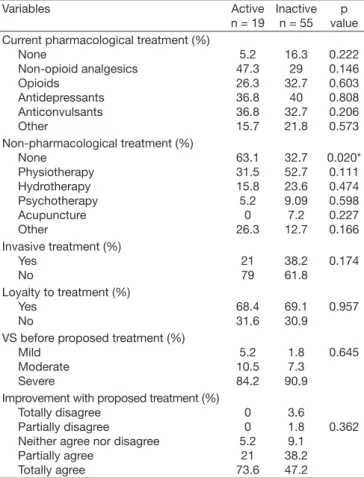
Only 5.2% of active patients did not use painkillers. With regard to those under pharmacological treatment, it was ob-served that most common drugs were non-opioid analgesics (47.3%), followed by anticonvulsants and antidepressants, both with 36.8%. Among patients under
non-pharmaco-logical treatment, physiotherapy was mentioned by 31.5%, followed by hydrotherapy (15.8%). Only 21% of this group had undergone some invasive procedure. Most patients were loyal to proposed treatment (68.4%) and have referred severe pain (84.2%) before starting the proposed treatment. In this group, approximately 73.6% totally agreed with the state-ment that the proposed treatstate-ment would improve their pain. Among inactive patients, 16.3% did not use drugs. Most common drugs were antidepressants (40%), followed by opi-oids and anticonvulsants, both with 32.7%. Approximately 33% would not perform any non-pharmacological treatment modality and among those performing it, physiotherapy was mentioned by more than half the patients (52.7%), and 38.2% had undergone some invasive treatment. Loyalty to treatment was 69%; and 90.9% have reported severe pain be-fore proposed treatment. Approximately 47.2% totally agreed with the statement that the proposed treatment would im-prove their pain. Active patients performed less non-pharma-cological treatments as compared to inactive patients, with statistically signiicant diference (Table 3).
Approximately 47.3% of active patients stated that pain
in-Table 2 – Comparison of pain characteristics and its interference with active and inactive patients.
Variables Active
n = 19 (25.7%)
Inactive n = 55 (74.3%)
p value
Pain duration (months) 95.1 ± 49 109.8 ± 80 0.454
Pain verbal scale (%) No pain Mild Moderate Severe 0 21 52.6 26.3 1.8 9.0 60 29 0.536 Irradiation (%) Yes No 63.1 36.8 80 20 0.140 Periodicity (%) Continuous Intermittent 57.9 42.1 61.8 38.2 0.763
Pain characteristics (%)** Weight Squeeze Burning Sting Twinge Shock Throbbing 57.9 0 42.1 36.8 31.5 42.1 31.5 52.7 7.2 56.3 41.8 40 50.9 36.3 0.697 0.227 0.283 0.703 0.514 0.508 0.706 Movement change (%)
Never Seldom Sometimes Almost always Always 15.7 21 21.0 26.3 15.7 3.6 10.9 25.4 20 40 0.137
Sleep disorders (%) Never Seldom Sometimes Almost always Always 15.7 5.2 42.1 5.2 31.5 7.2 9 14.5 27.2 41.8 0.043* *p<0.05
tensity would always worsen during professional activities, 47.3% have referred that sometimes they would miss work due to pain, and 31.5% have neither agreed nor disagreed when asked whether their pain was reason for retirement. he group of inactive patients, when asked about the frequency with which working activities would worsen pain, 80% have stated that always. Approximately 34.5% have referred that when they were active, they always missed work due to pain and the majority (31%) has totally agreed that their pain was reason for retirement. Inactive patients had expressive pain worsening when performing labor activities as well as would miss more work due to pain, with statistically signiicant dif-ference (Table 4).
Among inactive, 7 patients (12.7%) were already retired, 29 (52.7%) were in medical leave and 19 patients (34.6%) were inactive for other reasons, such as unemployment or not hav-ing any labor activity.
Mean medical leave time was 35.14 ± 27.61 months and, among patients under leave, 34.4% have referred that at some moment of the treatment they had their licenses suspended and when they returned to work, pain has returned or wors-ened for all of them (Table 5).
As to quality of life, mean values obtained have varied a lot among SF-36 domains. To better understand results, values of active and inactive patients were calculated separately.
Worst scores were observed in the domains “limitation by physical aspects”, “pain” and “general health status” for both groups. In the group of active patients, the best score was in the domain “limitation by emotional aspects” (68.4%). For the group of inactive patients, the best score was in the do-main “mental health” (56). here has been statistically signii-cant diference in domains “functional capacity”, “pain”, “vi-tality” and “social aspects” and the group of inactive patients has presented the worst values (Table 6).
Table 3 – Comparison of therapeutic characteristics of active and inactive patients.
Variables Active
n = 19
Inactive n = 55
p value Current pharmacological treatment (%)
None Non-opioid analgesics Opioids Antidepressants Anticonvulsants Other 5.2 47.3 26.3 36.8 36.8 15.7 16.3 29 32.7 40 32.7 21.8 0.222 0.146 0.603 0.808 0.206 0.573 Non-pharmacological treatment (%)
None Physiotherapy Hydrotherapy Psychotherapy Acupuncture Other 63.1 31.5 15.8 5.2 0 26.3 32.7 52.7 23.6 9.09 7.2 12.7 0.020* 0.111 0.474 0.598 0.227 0.166 Invasive treatment (%)
Yes No 21 79 38.2 61.8 0.174
Loyalty to treatment (%) Yes No 68.4 31.6 69.1 30.9 0.957
VS before proposed treatment (%) Mild Moderate Severe 5.2 10.5 84.2 1.8 7.3 90.9 0.645
Improvement with proposed treatment (%) Totally disagree
Partially disagree Neither agree nor disagree Partially agree Totally agree 0 0 5.2 21 73.6 3.6 1.8 9.1 38.2 47.2 0.362
VS = pain verbal scale; *p < 0.05.
Table 4 – Comparison of occupational characteristics of active and inactive patients.
Variables Active Inactive p value
Pain worsening with labor activities (%) Seldom Sometimes Almost always Always 15.8 26.3 10.5 47.3 1.8 3.6 7.2 80 0.002*
Absence from work (%) Never Seldom Sometimes Almost always Always 10.5 10.5 47.3 26.3 5.2 9 3.6 12.7 34.5 29.1 0.011*
Retirement due to pain (%) Totally disagree Partially disagree Neither agree nor disagree Partially agree Totally agree 21 15.8 31.5 15.8 5.2 14.5 9 18.2 16.3 31 0.429 *p<0.05.
Table 5 – Characteristics of patients on medical leave.
Patients on medical leave n = 29
Mean leave time 35.14 ± 27.61
Suspension of leave (%) Yes
No
34.4 65.6 Adaptation when returning to work (%)
Immediate pain return Pain intensiication No change in pain Had no pain
55.5 44.4 0 0
Table 6 – Comparison of values of each domain according to oc-cupational situation.
SF-36 Domain Active Inactive p value
Functional capacity 50.2 ± 31.06 35 ± 23.7 0.030*
Limitation by physical aspects
11.8 ± 25.5 7.2 ± 17.1 0.383
Pain 35 ± 13.1 26.4 ± 14.2 0.024*
General health status 39.5 ± 18.2 30 ± 18.1 0.052
Vitality 54.2 ± 23.8 39.8 ± 25.6 0.036*
Social aspects 61.8 ± 25.5 45.2 ± 29.9 0.034*
Limitation by emotional aspects
68.4 ± 45 55.7 ± 48.4 0.358
Mental health 63.5 ± 19.1 56 ± 25.7 0.248
DISCUSSION
As shown by this study, there is a strong interference of pain with the occupational life of chronic pain patients, since 74% of respondents were away from their working activities. A study carried out at a pain outpatient clinic in Bahia has also evidenced similar values, where 70% were inactive12.
Both active and inactive patients have reported that labor activities would worsen pain, but missing work was more predominant among inactive patients. his idea is shared by Saastamoinen et al.13 in a study carried out in an European city, where 20% of chronic pain patients have referred inca-pacity and moderate to severe limitation to perform activities. A diferent study carried out in Canada has evidenced even higher results, because more than 60% of respondents would often present such limitations14. Breivik et al.7, in an Euro-pean study, have found mean of 8.6 lost working days among chronic pain patients.
Mean age for both groups was the fourth decade of life. his result is very similar to that found in a study at the same pain service from 2006 to 2010, with active patients and inactive patients on medical leave, where mean was 46 and 45 years, respectively9. his age group is in productive age and chronic pain interference with occupational life of these patients gen-erates severe economic problems, such as high medical leave and disability retirement rates.
he highest prevalence of chronic pain was found among fe-males when considering total studied patients (66%). hese values are compatible with a study carried out at a chronic pain center in the city of São Paulo, which has found 62.4% prevalence of pain among females15, as well as a study carried out in the city of São Luis, with prevalence of 66.4%6. How-ever, in the inactive group, there has been higher prevalence of males (58.2%). his diference may be attributed to oc-cupational distribution among genders, since males are more frequently submitted to diferent labor exposures, especially with regard to physical strength.
Some authors report that pain among patients performing ac-tivities requiring hard physical work may be more pronounced than in those performing less demanding physical work13 and this fact is closely related to income and education; patients with low education levels in general resort to jobs requiring more physical efort. Our study has observed lower income among inactive patients, however there has been no diference in education.
Our study, similar to other authors9, could not establish that pain intensity was reason for withdrawing from work. Severe pain was observed in similar percentages for both active and inactive groups.
Low back pain was the most frequent diagnosis among inac-tive patients. his result is in line with a study carried out in Ireland by Raftery et al.16 where low back pain was present in 47.2% of chronic pain patients. Similarly, Ramage-Morin in Canada has found 33.6%. A study reports that low back pain is among major disease-induced absenteeism causes, together with depression and hypertension17. Meziat Filho and Silva
have concluded that back pain was the irst cause of disability and medical allowance in Brazil in 2007, causing an extreme-ly high economic loss for society18.
he percentage of patients not using painkillers was higher in the inactive group. hese values are lower than those found by a study carried out in he Netherlands, where the rate of patients receiving no treatment has varied from 24.8% to 43%19. It was expected that, because pain would impair their working activities, more analgesics would be used to control pain, what has not been observed in this study.
It was also observed that a large part of patients were not under non-pharmacological treatment, reaching more than 60% among active patients. his fact is in line with Dellaroza et al.20, who reported that although efective and safe, these therapies are seldom used by chronic pain individuals. It is known that pharmacological therapy is more efective and, in some situations, mandatory for pain control; however it has already been proven that the association of non-pharmacolog-ical therapies decreases the need for drugs, which may mini-mize the risk of adverse efects, as well as the dependence on analgesics, being able to improve quality of life of patients21. Invasive treatment rates were higher among inactive patients as compared to active patients, probably due to refractoriness to therapy. In the United States, costs with epidural injec-tions and steroids, opioids for back pain, lumbar magnetic resonance and spinal fusion surgery have grown, respectively, 629%, 423%, 307% and 220% in last decades. However, this increase in costs was not followed by lower labor incapacity rates among low back pain patients18.
In our study, some patients only returned to their labor ac-tivities when their leaves were suspended and all patients re-turning to work have reported worsen or immediate return of pain. Employees referred to the Brazilian Social Security (INSS) return to their jobs as a consequence of cancellation of their sickness allowance, being discharged even without conditions to work with health and dignity22. It would be interesting to reevaluate the granting of beneits by the So-cial Security9, to prevent unnecessary leaves as well as undue suspensions.
SF-36 questionnaire results have indicated that in domains addressing impact of pain, general health status and, espe-cially, the relex of physical status on daily and/or professional activities, are the most afected among chronic pain patients. Other studies have found very similar results, especially in the domains “pain” and “limitation by physical aspects”12,23. he lowest score for both groups was in the domain “physical aspects”, showing how chronic pain afects patients’ perfor-mance, expressively worsening their quality of life and labor activity. However, limitation by “emotional aspects” was high for both groups. Still in our study, although being recognized that chronic pain directly afects social life of patients short-ening their leisure moments6, the domain “social aspects” had also high values for both groups, indicating that, in spite of pain, patients maintain their social activities.
the relevant role of possible secondary gains with the mainte-nance of pain among inactive patients.
All SF-36 scores were better for the group of active patients; this result is in line with a study carried out with elderly pa-tients where respondents with some labor activity after retire-ment had higher scores in all domains evaluated by SF-3624. his is an uncommon study comparing labor activity and QL through SF-36.
It is interesting to observe that, similar to the study by Brasil et al.23, the domain “mental health”, which refers to mood and well-being scale, had the highest score (56) among in-active patients as compared to remaining domains and the second highest score among active patients (63.5) suggesting that, in spite of pain and its relexes, individuals are able to cope with the situation, once more supporting the possibility of secondary gains with pain.
his way, problems originated by chronic pain in the occu-pational level, imply decrease in productivity, increased ab-senteeism and inancial restrictions. For better control and prevention of pain-related absenteeism, in addition to ade-quate treatment and follow up, it is necessary to understand involved social, behavioral and labor factors.
CONCLUSION
Interviewed patients were predominantly away from their la-bor activities due to pain. In addition, most have reported that performing labor activities would always worsen pain, and absence from work was more signiicant in the inactive group. Only patients who had their leaves cancelled have re-turned to work and all those returning to their working ac-tivities have reported worsening or immediate return of pain. It has been observed that the domain contributing the most for low SF-36 questionnaire values was that related to physi-cal limitation to perform daily and working activities. his reinforces the idea that chronic pain impact on labor activities considerably afects QL.
So, we understand that this subject is very important for the academic society and the general population. he develop-ment of new studies in this area is needed, especially long term studies with patients’ follow up, treatment optimization, return to professional activities and measurement of quality of life indicators during diferent treatment moments.
REFERENCES
1. Verhaak PF, Kerssens JJ, Dekker J, et al. Prevalence of chronic benign pain disor-der among adults: a review of the literature. Pain. 1998;77(3):231-9.
2. Pereira MCR, Tramunt G, Dal Ponte ST, et al. Opioides no tratamento de dor crônica não oncológica: metadona como opção terapêutica. Rev Dor. 2007;8(2):1010-3.
3. Blyth F. Chronic pain--is it a public health problem? Pain. 2008;137(3):465-6. 4. Kreling MCGD, Cruz DALM, Pimenta CAM. Prevalência de dor crônica em
adultos. Rev Bras Enferm. 2006;59(4):509-13.
5. Sá K, Baptista AF, Matos MA, et al. Prevalência de dor crônica e fatores associados na população de Salvador, Bahia. Rev Saúde Públ. 2009;43(4):622-30. 6. De Moraes Vieira EB, Garcia JB, Da Silva AA, et al. Prevalence, characteristics,
and factors associated with chronic pain with and without neuropathic characte-ristics in São Luís, Brazil. J Pain Symptom Manage. 2012;44(2):239-51. 7. Breivik H, Collett B, Ventafridda V, et al. Survey of chronic pain in Europe:
pre-valence, impact on daily life, and treatment. Eur J Pain. 2006;10(4):287-333. 8. Teixeira MJ, Shiabata MK, Pimenta CAM, et al. Dor no Brasil: estado atual e
perspectivas. Dor: conceitos gerais. São Paulo (SP): Limay; 1995.
9. Garcia JBS, Torres Neto E. Atividade laboral em pacientes atendidos em um ser-viço ambulatorial de dor crônica. Rev Dor.2011;12(3):215-20.
10. Ministério da Previdência Social. Disponível em: <http://www.previdencia.gov. br/conteudoDinamico.php?id=423>. Acesso em: 4 set. 2013.
11. Ciconelli RM, Ferraz MB, Santos W, et al. Tradução para língua portuguesa e validação do questionário genérico de avaliação de qualidade de vida SF-36 (Brasil SF-36). Rev Bras Reumatol. 1999;39(3):143-50.
12. Castro MMC, Quarantini LC, Daltro C, et al. Comorbidade de sintomas ansiosos e depressivos em pacientes com dor crônica e o impacto sobre a qualidade de vida. Rev Psiq Clín. 2011;38(4):126-9.
13. Saastamoinen P, Leino-Arjas P, Laaksonen M, et al. Socio-economic diferences in the prevalence of acute, chronic and disabling chronic pain among ageing em-ployees. Pain. 2005;144(3):364-71.
14. Ramage-Morin PL, Gilmour H. Chronic pain at ages 12 to 44. Health Rep. 2010;21(4):53-61.
15. Ferreira KASL, De Siqueira SRDT, Teixeira MJ. Características demográicas, da dor e do tratamento dos pacientes atendidos em centro multidisciplinar de dor. Cad Saúde Colet. 2008;16(3):449-70.
16. Raftery MN, Sarma K, Murphy AW, et al. Chronic pain in the Republic of Ire-land—community prevalence, psychosocial proile and predictors of pain-related disability: results from the Prevalence, Impact and Cost of Chronic Pain (PRIME) study, part 1. Pain. 2011;152(5):1096-103.
17. Santos JPD, Mattos APD. Absentismo-doença na prefeitura municipal de Porto Alegre, Rio Grande do Sul, Brasil. Rev Bras Saúde Ocup. 2010;35(121):148-56. 18. Meziat Filho N, Silva GA. Invalidez por dor nas costas entre segurados da
Previ-dência Social do Brasil. Rev Saúde Públ 2011;45(3):494-502.
19. Bekkering GE, Bala MM, Reid K, et al. Epidemiology of chronic pain and its treatment in he Netherlands. Neth J Med. 2011;69(3):141-53.
20. Dellaroza MS, Furuya RK, Cabrera MA, et al. Characterization of chronic pain and analgesic approaches among community-dwelling elderly. Rev Assoc Med Bras. 2008;54(1):36-41.
21. Stefane T, Santos AM, Marinovic A, Hortense P. Dor lombar crônica: intensidade de dor, incapacidade e qualidade de vida. Acta Paul Enferm. 2013;26(1):14-20. 22. Oliveira AMR. Qualidade de vida no trabalho-trabalhadores que convivem com dor
crônica--o que eles esperam das empresas. Rev Bras Qual Vida 2011;3(2):33-42. 23. Brasil VV, ZattaII LT, Cordeiro JABL, et al. Qualidade de vida de
porta-dores de porta-dores crônicas em tratamento com acupuntura. Rev Eletr Enferm. 2008;10(2):383-94.