ABSTRACT
BACKGROUND AND OBJECTIVES: Chronic pain considera-bly worsens quality of life of the elderly, giving relevance to studies addressing it in such individuals, especially those long-lived. Re-cently, vitamin D deiciency, very prevalent among the elderly, has been correlated to chronic pain. his study aimed at estimating the prevalence of chronic pain among community long-lived elderly with functional independence, at evaluating its characteristics and at correlating this pain to serum vitamin D levels.
METHODS: Cross-sectional study of the “Long-Lived Project”, with elderly aged 80 years or above, of both genders, with func-tional independence. Socio-demographic data were collected, re-ferred chronic pains were measured and serum vitamin D levels were obtained.
RESULTS: We have evaluated 330 participants of the “Long-Li-ved Project” and pain prevalence was 20.9%, especially nocicepti-ve, continuous, moderate to severe and lumbar pain. Among pain intensity measurement tools, faces and verbal numeric scales were preferred. here has been high prevalence of vitamin D deiciency among long-lived elderly with chronic pain (87%); deiciency and insuiciency levels were 49 and 38%, respectively, however such levels were not signiicantly correlated to chronic pain.
CONCLUSION: here has been high prevalence of chronic pain among the elderly. Moderate to severe and low back pain were the most frequent. here has been high prevalence of vita-min D deiciency among studied long-lived elderly; however the-re has been no signiicant corthe-relation between low serum vitamin D levels and chronic pain.
Keywords: Chronic pain, Elderly, Measurement tool, Pain eva-luation, Vitamin D.
Chronic pain in long-lived elderly: prevalence, characteristics,
measurements and correlation with serum vitamin D level*
Dor crônica em idosos longevos: prevalência, características, mensurações e correlação com
nível sérico de vitamina D
Fania Cristina Santos1, Niele Silva de Moraes1, Adriana Pastore1, Maysa Seabra Cendoroglo1
*Received from the Discipline of Geriatrics and Gerontology, Federal University of São Paulo, Paulista School of Medicine, São Paulo, SP, Brazil.
1. Universidade Federal de São Paulo, Serviço de Dor e Doenças Osteoarticulares, Disciplina de Geriatria e Gerontologia, São Paulo, SP, Brasil.
Submitted in December 15, 2014. Accepted for publication in June 12, 2015.
Conlict of interests: none – Sponsoring sources: FAPESP.
Correspondence to: Fania Cristina Santos
Rua Francisco de Castro, 105 – Vila Clementino 04020-050 São Paulo, SP, Brasil.
E-mail: [email protected]
© Sociedade Brasileira para o Estudo da Dor
RESUMO
JUSTIFICATIVA E OBJETIVOS: A dor crônica diminui con-sideravelmente a qualidade de vida dos idosos, dando relevân-cia aos estudos que a abordam nesses indivíduos, sobretudo nos longevos. Recentemente, a hipovitaminose D, muito prevalente entre idosos, tem sido relacionada à dor crônica. O objetivo deste estudo foi estimar a prevalência de dor crônica entre os longe-vos da comunidade com independência funcional, avaliar suas características e correlacionar essa dor com os níveis séricos de vitamina D.
MÉTODOS: Estudo transversal do “Projeto Longevos”, com idosos de 80 anos ou mais, de ambos os gêneros, com indepen-dência funcional. Foram apurados os dados sócio-demográicos, avaliadas e mensuradas as dores crônicas apresentadas e obtidos os níveis séricos da vitamina D.
RESULTADOS: Foram avaliados 330 participantes do “Projeto Longevos”, e encontrada prevalência de 20,9% de dor crônica, sendo essa principalmente do tipo nociceptiva, contínua, de in-tensidade moderada a intensa, de localização lombar. Dentre os instrumentos de mensuração da intensidade dolorosa, os preferi-dos foram as escalas de faces e numérica verbal. Observou-se alta prevalência de hipovitaminose D nos longevos com dor crônica (87%); níveis de deiciência e insuiciência em 49 e 38%, respec-tivamente, porém tais níveis não se correlacionaram signiicativa-mente com a presença de dor crônica.
CONCLUSÃO: A prevalência de dor crônica entre os longevos foi alta. Intensidade moderada e intensa e localização lombar foram as mais frequentes. Houve alta prevalência de hipovita-minose D entre os longevos estudados, porém não se observou correlação signiicativa entre baixos níveis séricos de vitamina D e dor crônica.
Descritores: Avaliação da dor, Dor crônica, Idoso, Instrumento de mensuração, Vitamina D.
INTRODUCTION
Population aging is a worldwide phenomenon caused by low mortality and birth rates and increased life expectancy as re-sult of major scientiic and technological advances of recent decades1,2. With increased life expectancy there is increased prevalence of chronic (CD) and degenerative diseases. Many of such presentations are followed by CP, a major public
th problem which has been recently highlighted1,2.
Pain is a multifactorial phenomenon, involving physical, emotional, socio-cultural and environmental aspects, being deined by the International Association for the Study of Pain (IASP) as unpleasant sensory and emotional experience des-cribed in terms of real or potential tissue injuries. It is always subjective and related to previous experiences3,4.
CP is pain persisting beyond a reasonable period for injury healing or that associated with chronic pathological proces-ses which cause continuous or recurrent pain in intervals of months or years. CP afects not only individuals but also their families and society since it orients and limits patients’ conditions and behavior, increasing morbidity and burdening the health system5. his pain may be associated with depres-sion, physical and functional incapacity, social isolation, fa-mily dynamics changes and hopelessness. It may also induce fatigue, anorexia, sleep disorders, constipation and diicult concentration. he inability to control pain brings major physical and psychical distress variably afecting their daily activities6-9. Bio-psycho-social consequences of CP emphasize the magnitude of this problem, especially among the elderly where its prevalence is higher. Nevertheless, there are still few studies addressing its prevalence among the elderly, especially those considered long-lived elderly living in the community. he correlation between CP and vitamin D deiciency has been recently questioned, especially considering pain related to mus-culoskeletal syndromes7. Osteomalacia has already been propo-sed as the link between vitamin D deiciency and generalized and persistent musculoskeletal pain, but also decreased muscle strength and fatigue were suggested as being such link10. hese aspects are highly relevant for the planning of measures to control and manage CP in the elderly, especially long-lived elderly, because they could contribute to minimize morbidi-ty and functional dependence and to improve their QL. he scarcity of information about CP in long-lived elderly makes diicult the sensitization of health professionals to an emer-ging problem, since population is increasingly reaching hi-gher age groups.
his study aimed at estimating the prevalence of CP in com-munity long-lived elderly, at evaluating its peculiarities, even by observing measurement tools preferred by the elderly, and also at evaluating whether there is correlation between CP and vitamin D deiciency.
METHODS
his was a descriptive, analytical, cross-sectional study part of the “Long-lived Project”. his is a longitudinal epidemiologic study coordinated by a team of researchers of the Discipline of Geriatrics and Gerontology (DIGG) – Federal University of São Paulo (UNIFESP). Such project was started in April 2010 and is still ongoing; it includes elderly aged 80 years or above, of both genders and independent to walk. Exclusion criteria were elderly with diagnosis of dementia (by means of clinical evaluation together with the Mental State Mini Exam); severe acute or chronic uncompensated disease;
dialy-sis, chemotherapy or radiotherapy treatment; living in long--term care facilities; history of stroke or myocardial infarction with severe limitations; limiting visual or auditory deicit, not allowing them to answer the questionnaire; not walking inde-pendently outside home.
Patients were evaluated from February 2011 to December 2013 and have met the following inclusion criteria: pain las-ting for at least 6 months and intensity equal to or higher than 3 according to the pain verbal numeric scale (VerbalNS). Exclusion criteria were cancer pain.
Data related to socio-demographic conditions and pain, such as location, frequency, character, triggering and attenuating factors, nature according to physipatogeny (nociceptive, neu-ropathic, mixed or psychogenic) were collected. Pain inten-sity was measured using the following one-dimension tools: • Verbal description scale with 4 scores (VDS): four verbal descriptors indicate diferent perceived pain magnitudes. Zero means “no pain”, 1 means “mild pain”, 2 “moderate pain” and 3 “severe pain”11.
• Verbal numeric scale (VerbalNS): with numeric verbaliza-tion from zero to 10. Zero means “no pain” and 10 “the worst imaginable pain”11.
• Visual numeric scale (VNS): with scores from zero to 10 being zero “no pain” and 10 “the worst imaginable pain”11.
• Visual analog scale (VAS): represented by a 10-cm line with anchors on both edges with verbal descriptors “no pain” and “un-bearable pain”. A point is marked on the line indicating pain magnitude and the line is measured with a 0-100mm ruler11.
• Pain faces scale (PF) adapted for the elderly: initially used for children it was adapted and validated for the elderly. A series of faces are shown to patients, which progressively re-present the level of distress caused by pain and the face best expressing the pain is chosen (faces representing no, mild, moderate and severe pain)12.
hen, patients were asked which, in their opinion, the best tool to evaluate pain intensity was.
Peripheral blood samples were collected for vitamin D measu-rement and levels obtained were classiied in deiciency when <20ng/dL, insuiciency when between 20 and 30ng/dL, nor-mal when >30ng/dL, and above nornor-mal when >100ng/dL13.
Statistical analysis
he statistical program SPSS version 11.5 was used, and Chi--square and Two Proportions equality tests were performed and p value was calculated. Signiicance level was 5%. his study was approved by UNIFESP Ethics Committee un-der n. 493019/2010 and all participants have read and signed the Free and Informed Consent Term (FICT).
RESULTS
From 330 elderly participating in the “Long-lived Project”, 69 had CP, with prevalence of 20.9%.
mean education level of 4 years (Table 1). According to heal-th self-evaluation, most elderly have referred regular or good health, 44.3 and 43.6%, respectively (Table 1).
Table 1. Sample characterization according to socio-demographic data and health self-evaluation
n %
Gender
Male 11 15.9
Female 58 84.0
Race
Caucasian 48 69.0
African 2 2.89
Oriental 4 5.7
Mulatto 15 21.7
Marital status
Married 14 20.2
Divorced 3 4.3
Widow/er 40 57.9
Stable union 5 7.2
Single 7 10.4
Education (years)
Illiterate 11 15.9
1 to 4 33 47.8
5 to 8 8 11.5
9 to 11 11 15.9
>11 6 8.6
Health self-evaluation
Excellent 5 7.2
Good 28 40.5
Regular 29 42.0
Poor 7 10.1
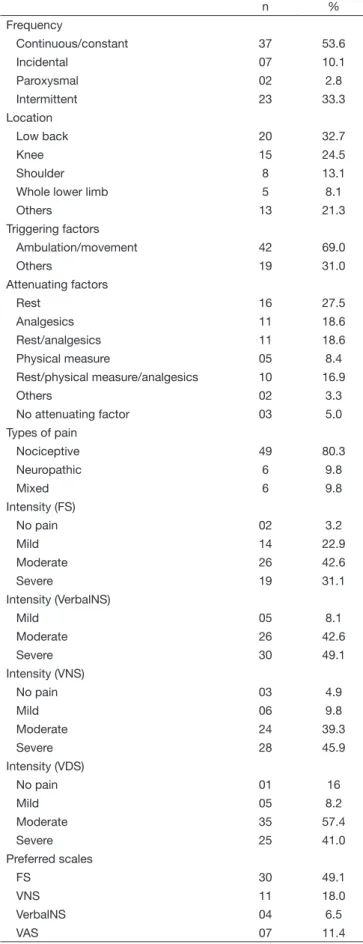
Pain was evaluated and measured in 61 individuals (8 of them have not stayed for pain evaluation/measurement). According to characteristics, most of them had continuous pain (59%), followed by intermittent (36%), incidental (9.8%) and pa-roxysmal (2%) (Table 2). With regard to location, most had low back pain (32.7%) and lower limbs pain (24.5%), espe-cially knees (32.6%) and shoulders (8.1%) (Table 2). Prima-ry triggering factors were ambulation and/or afected region movement (69%). And among pain attenuating factors, rest was the most prevalent (21%), followed by rest plus analgesics (16%), by analgesics alone (16%), rest associated to physical measures such as heat or ice (5%) and by physical measures alone (5%) (Table 2). As to nature, nociceptive pain was the most common (80%), followed by neuropathic (10%) and mixed (10%) pain (Table 2).
With regard to pain intensity, moderate to severe pain were the most common according to all applied scales (Table 2). No pain measures were obtained with VAS for most elderly because they had major diiculty to understand it. Preferred pain scales by the elderly were FS (49.1%) and VNS (18.0%) (Table 2).
Table 2. Chronic pain characterization and measurement in long-lived elderly
n %
Frequency
Continuous/constant 37 53.6
Incidental 07 10.1
Paroxysmal 02 2.8
Intermittent 23 33.3
Location
Low back 20 32.7
Knee 15 24.5
Shoulder 8 13.1
Whole lower limb 5 8.1
Others 13 21.3
Triggering factors
Ambulation/movement 42 69.0
Others 19 31.0
Attenuating factors
Rest 16 27.5
Analgesics 11 18.6
Rest/analgesics 11 18.6 Physical measure 05 8.4 Rest/physical measure/analgesics 10 16.9
Others 02 3.3
No attenuating factor 03 5.0 Types of pain
Nociceptive 49 80.3
Neuropathic 6 9.8
Mixed 6 9.8
Intensity (FS)
No pain 02 3.2
Mild 14 22.9
Moderate 26 42.6
Severe 19 31.1
Intensity (VerbalNS)
Mild 05 8.1
Moderate 26 42.6
Severe 30 49.1
Intensity (VNS)
No pain 03 4.9
Mild 06 9.8
Moderate 24 39.3
Severe 28 45.9
Intensity (VDS)
No pain 01 16
Mild 05 8.2
Moderate 35 57.4
Severe 25 41.0
Preferred scales
FS 30 49.1
VNS 11 18.0
VerbalNS 04 6.5
VAS 07 11.4
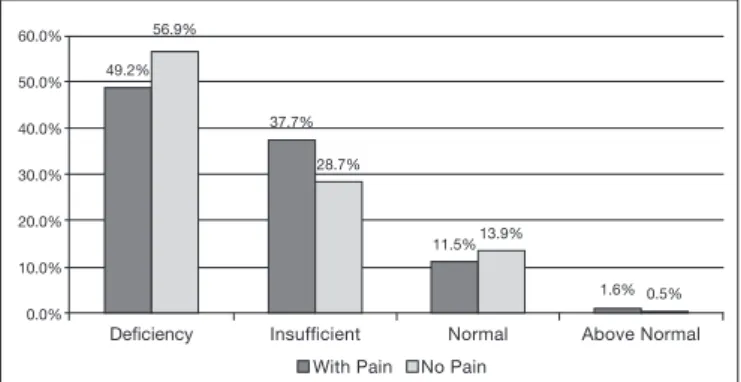
With regard to vitamin D levels, 49.2% of chronic pain el-derly had vitamin D deiciency, 37.7% insuiciency, 11.5% normal levels, and 1.8% excessive levels (Figure 1). here has been no statistically signiicant association between CP and vitamin D serum levels.
Deiciency
60.0%
50.0%
40.0%
30.0%
20.0%
10.0%
0.0%
Insuficient Normal Above Normal
49.2%
37.7%
11.5%
1.6% 56.9%
28.7%
13.9%
0.5%
With Pain No Pain
Figure 1. Correlation between chronic pain and vitamin D serum le-vels in the elderly
Deiciency (<20ng/mL) p=0.284, Insuficiency (20-30ng/mL) p=0.18, Normal (30-70ng/mL) p=0.628; above normal (>150ng/mL) p=0.352.
DISCUSSION
Our study has found high prevalence of CP among evalua-ted long-lived elderly (20.9%). According to the literature, its prevalence in the elderly varies between 28.9 and 85%14-20. his variation depends on several factors: established deini-tion to characterize CP, regional socio-demographic diferen-ces and pain evaluation method. here is higher CP prevalen-ce with increased age, with institutionalization or when the elderly are link to health services14-16.
CP prevalence might have been underestimated since most elderly were already being regularly followed up by the geria-trics ambulatory and so CP could already have been control-led or minimized at evaluation time.
Although the number of long-lived elderly addressed by this study was not very high, no other studies were found in Brazil about CP prevalence, characteristics and measurements in spe-ciically very old population and with functional independen-ce. his fact has prevented the establishment of comparisons between pain characteristics and pain intensity measurements. Higher prevalence of CP among elderly females is in line with the literature and may be related to the fact that females de-velop more musculoskeletal problems due to their anatomic and functional uniqueness, such as low stature, less muscle mass and bone density, more joint laxity and lower level of adaptation to physical efort as compared to males14. Accor-ding to Croft, Blyth and van der Windt21, the diference in pain prevalence between genders may be explained by three theories: gender, exposure and vulnerability theories. he irst states that it is more socially accepted for females to report pain, and that males have higher pain threshold as compared to females. he exposure theory states that females are more exposed to risk factors for musculoskeletal pain, such as do-mestic activities. And according to the vulnerability theory, females are more prone to develop musculoskeletal pain due
to psychological aspects related to sexual hormones. Global statistics involving elderly with CP have also observed higher frequency of pain among Caucasoids18,19.
For marital status, some authors have suggested that lone-liness feelings, such as in widowhood, could cause distress, vulnerability, loss of control and, consequently, could worse or perpetuate pain15,16,18. However, a study by Lacerda et al.19 has observed predominance of CP among married elderly or those living in the community. In our studied population the-re has been pthe-redominance of widowhood (57.9%).
As to education, some authors suggest that this might be an important factor for pain control, since the level of education could contribute for adequate understanding and adhesion to pain-related recommendations19. Our study has observed pain predominance among long-lived elderly with low educa-tion level (mean of 4 years), which could point to inadequate adhesion to analgesic therapies, maybe for not understanding pain control recommendations.
pain among the elderly (severe or worst possible in 54.6%)15. In a study carried out in Londrina, 16 (38.4%) of the elderly have reported moderate pain, and 10% severe pain, being that pain was measured by a scale from zero to 10, with scores 1 to 3 considered mild, 4 to 6 moderate and 7 to 10 severe. As to preferred pain evaluation tools, FS and NVS were pre-ferred by long-lived elderly in 49.1% and 18.0% of cases, res-pectively. Searching the literature for the best one-dimension tools for pain measurement in the elderly, it was found that VerbalNS was preferred by the elderly, including those with mild to moderate cognitive deicits who could have found some diiculties due to inadequate mastering of arithmetic properties26,28. According to Herr & Garand25, FS, originally developed for pediatrics, has shown to be a reliable alternative to measure pain in individuals with low education level and without cognitive changes or with mild changes. In our sam-ple, still with regard to pain measurement tools, most were unable to report pain intensity according to VAS, which is widely used worldwide. Gagliese & Melzack28 have also ob-served that approximately 30% of the elderly without cogni-tive deicits are unable to understand this pain measurement visual analog tool.
By analyzing vitamin D, we have found serum levels compa-tible with vitamin D deiciency in 87% of long-lived elderly and such vitamin deicit was not signiicantly correlated to chronic pain. A recent literature review on CP and vitamin D in the elderly has suggested association between vitamin D deicit and pain, however just considering musculoskeletal pain29. Turner et al.30, studying individuals looking for treat-ment for CP, have observed inadequate vitamin D levels in 26% of patients, in whom opioid analgesia needs were also signiicantly higher. In a study by Atherton et al.31 CP was more prevalent among middle-aged females with vitamin D deiciency, but the same was not observed with regard to ma-les. Similarly, a diferent study has found that vitamin D de-iciency was signiicantly associated to back pain in females, but not in males32.
It is not clear whether vitamin D deiciency is cause, efect or simply epiphenomenon in situations of pain, so more studies are needed on the subject, especially considering the elderly population, whose growth is associated to increased estimates of chronic pain and vitamin D deiciency. Studies addressing chronic pain and vitamin D serum levels in the elderly are still scarce.
CONCLUSION
here has been high prevalence of CP among long-lived el-derly living in the community, often of moderate to severe intensity, located on lumbar spine and lower limbs. Preferred tool by the elderly to measure pain was FS. here has been no signiicant correlation between CP and vitamin D serum levels among studied patients; however one should stress the need for further studies on this subject since vitamin D dei-ciency has been pointed by current literature as a factor asso-ciated to pain.
REFERENCES
1. Ferrell BA. Pain Management. Clin Geriatr Med. 2000;16(4):853-74.
2. Rabelo DF, Neri AL. Recursos psicológicos e ajustamento pessoal frente a incapacidade fun-cional na velhice. Psicol Estud. 2005;10(3):403-12.
3. International Association for the Study on Pain (IASP). Classiication of chronic pain. Des-criptions of chronic pain syndromes and deinitions of pain terms. he International Asso-ciation for the Study of pain, subcommittee on taxonomy. Pain. 1986;3:S1-226. 4. Merskey NB. Classiication of chronic pain: descriptions of chronic pain syndromes and
deinitions of pain terms prepared by the International Association for the Study of Pain. 2nd
ed. Seattle: IASP Press; 1994.
5. Yu HY, Tang FI, Kuo BI, Yu S. Prevalence, interference, and risk factors for chronic pain among Taiwanese community older people. Pain Manag Nurs. 2006;7(1):2-11. 6. Dellaroza MS, Furuya RK, Cabrera MA, Matsuo T, Trelha C, Yamada KN, et al.
[Characte-rization of chronic pain and analgesic approaches among community-dwelling elderly]. Rev Assoc Med Bras. 2008;54(1):36-41. Portuguese.
7. Carmaciu C, Ilife S, Kharicha K, Harari D, Swift C, Gillmann G, et al. Health risk appraisal in older people 3: prevalence, impact and context of pain and their implications for GPs. Br J Gen Pract. 2007;57(541):630-5.
8. Patil SK, Johnson AS, Lichtenberg PA. he relation of pain and depression with various he-alth- promoting behaviors in African-Americans elders. Rehabil Psychol. 2008;53(1):85-92. 9. Pereira LV, de Vasconcelos PP, Souza LA, Pereira Gde A, Nakatani AY, Bachion MM. Prevalence and intensity of chronic pain and self-perceived health among elderly people: a population--based study. Rev Lat Am Enfermagem. 2014;22(4):662-9. English, Portuguese, Spanish. 10. Boxer RS, Dauser RA, Walsh SJ, Hager WD, Kenny AM. he association between vitamin
D and inlammation with the 6-minute walk and frailty in patients with heart failure. J Am Geriatr Soc. 2008;56(3):454-61.
11. Carvalho DS, Kowacs PA. Avaliação da intensidade da dor. Migrâneas Cefaléias, 2006;9(4):164-8.
12. Bieri D, Reeve RA, Champion GD, Addicoat L, Ziegler JB. he faces pain scale for the self--assessment of the severity of pain experienced by children: development, initial validation, and preliminary investigation for ratio scale properties. Pain. 1990;41(2):139-50. 13. Bischof-Ferrari HA, Giovannucci E, Willett WC, Dietrich T, Dawson-Hughes B.
Estima-tion of optimal serum concentraEstima-tions of 25-hydroxyvitamin D for multiple health outcomes. Am J Clin Nutr. 2006;84(1):18-28. Erratum in: Am J Clin Nutr. 2006;84(5):1253. 14. Miranda VS, Decarvalho VB, Machado LA, Dias JM. Prevalence of chronic musculoskeletal
disorders in elderly Brazilians: a systematic review of the literature. BMC Musculoskelet Di-sord. 2012;13:82.
15. Bernfort L, Gerdle B, Rahmqvist M, Husberg M, Levin LA. Severity of chronic pain in an elderly population in Sweden--impact on costs and quality of life. Pain. 2015;156(3):521-7. 16. Panazzolo D, Trelha CS, Dellaroza MS, Cabrera M, Souza R. Chronic pain in older people
inhabitants of the Cabo Frio District of Londrina/PR. Rev Dor. 2007;8(3):1052-4. 17. Gibson SJ. IASP global year against pain in older persons: highlighting the current status and
future perspectivesin geriatric pain. Expert Rev Neurother. 2007;7(6):627-35.
18. Dellaroza MS, Pimenta CA, Matsuo T. [Prevalence and characterization of chronic pain among the elderly living in the community]. Cad Saude Publica. 2007;23(5):1151-60. Portuguese. 19. Lacerda PF, Godoy LF, Cobianchi MG, Bachion MM. Estudo da ocorrência de “dor crônica”
em idosos de uma comunidade atendida pelo programa de saúde da família em Goiânia. Rev Eletr Enferm. 2005;7:(1)29-40.
20. Martinez JE, Macedo AC, Pinheiro DF, Novato FC, Jorge CM, Teixeira DT. Peril clínico e demográico dos pacientes com dor musculoesquelética crônica acompanhados nos três níveis de atendimento de saúde de Sorocaba. Act Fisiátrica. 2004;11(2):67-71.
21. Croft P, Blyth FM, van der Windt D. Chronic pain epidemiology: from etiology to public health. Unites States: Oxford University; 2010.
22. Urwin M, Symmons D, Allison T, Brammah T, Busby H, Roxby M, et al. Estimating the burden of musculoskeletal disorders in the community: the comparative prevalence of symp-toms at diferent anatomical sites, and the relation to social deprivation. Ann Rheum Dis. 1998;57(11):649-55.
23. Teixeira MJ. Teixeira WG, Santos FP, Andrade DC, Bezerra SL, Figueiro JB, et al. Epidemio-logia clínica da dor músculo-esquelética. Rev Med. 2001;80(ed esp):1-21.
24. Jakobsson U. Pain management among older people in need of help with activities of daily living. Pain Manag Nurs. 2004;5(4):137-43.
25. Herr KA, Garand L. Assessment and measurement of pain in older adults. Clin Geriatr Med. 2001;17(3):457-78.
26. Andrade FA, Pereira LV, Sousa FA. [Pain measurement in the elderly: a review]. Rev Lat Am Enfermagem. 2006;14(2):271-6. Portuguese.
27. Ferrell BA, Stein WM, Beck JC. he Geriatric Pain Measure validity, reability and factor analysis. J Am Geriatr Soc. 2000;48(12):1669-73.
28. Gagliese L, Melzack R. Age diferences in the quality of chronic pain: a preliminary study. Pain Res Manag. 1997;2(1):157-62.
29. Oliveira WS, Moraes N, Santos FC. Vitamin D and chronic pain in the elderly. Rev Dor. 2013;14(3):223-5.
30. Turner MK, Hooten WM, Schmidt JE, Kerkvliet JL, Townsend CO, Bruce BK. Prevalence and clinical correlates of vitamin D inadequacy among patients with chronic pain. Pain Med. 2008;9(8):979-84.
31. Atherton K, Berry DJ, Parsons T, Macfarlane GJ, Power C, Hyppönen E. Vitamin D and chronic widespread pain in a white middle-aged British population: evidence from a cross--sectional population survey. Ann Rheum Dis. 2009;68(6):817-22.