ABSTRACT
BACKGROUND AND OBJECTIVES:A new challenge for pediatric cancer is pain control and it is believed that diferent professionals should be involved in this process, including the nursing team. So, there is the need for nursing care evaluation with regard to pain in cancer children. his study aimed at iden-tifying pain measurement scales and non-pharmacological meth-ods used by a pediatric nursing team.
METHODS:his is a descriptive, exploratory study carried out with 35 nursing professionals of the Children and Adolescents Cancer Hospital of Barretos, from June to September 2014. A questionnaire with 36 questions was used, added of 4 more for nursing professionals, related to the objective of the study. Data were analyzed by the SPSS v21.0 program.
RESULTS:here has been a small number of right answers with regard to the adequate use of scales for children from zero to 2 years of age. Only 3 (21.4%) nurses have chosen the Neonatal Infant Pain Scale. Most common non-pharmacological methods were: comfort measures (n=22), massage (n=18), environmental changes (n=16) and heat (n=16). Nevertheless, it was observed that among 15 sub-jects suggesting other methods, 10 have mentioned drugs. Only 4 (28.6%) nurses prepared nursing pain-related diagnoses and 7 (50%) believed that their care helped in pain management.
CONCLUSION:We have identiied the need for training on pain measurement scales according to age, possible non-pharma-cological methods used by the nursing team and their association with the nursing process.
Keywords: Child, Nursing team, Nursing team professional, Oncology, Pain management, Pediatrics.
Non-pharmacological approaches to control pediatric cancer pain:
nursing team view*
Métodos não farmacológicos no controle da dor oncológica pediátrica: visão da equipe de
enfermagem
Mayara Ruiz Chotolli1, Paula Batista Luize2
*Received from Cancer Hospital of Barretos, Barretos, SP, Brazil.
1. Children and Adolescents Cancer Hospital of Barretos, Pediatric Intensive herapy Unity, Barretos, SP, Brazil.
2. Cancer Hospital of Barretos, Surgical Center, Barretos, SP, Brazil.
Submitted in January 06, 2015. Accepted for publication in May 15, 2015. Conlict of interests: none – Sponsoring sources: none.
Correspondence to: Mayara Ruiz Chotolli
Rua Antenor Duarte Vilela, 1331 - Doutor Paulo Prata 14784-400 Barretos, SP, Brasil.
E-mail: [email protected]
© Sociedade Brasileira para o Estudo da Dor
RESUMO
JUSTIFICATIVA E OBJETIVOS: Um dos novos desaios para o câncer infantil é o controle da dor, e acredita-se que diversos proissionais devem estar envolvidos nesse manuseio, inclusive a enfermagem. Dessa forma, nota-se a necessidade de avaliações do cuidado de enfermagem em relação à dor de crianças em trata-mento oncológico. O objetivo deste estudo foi identiicar escalas de mensuração da dor e métodos não farmacológicos utilizados por uma equipe de enfermagem da pediatria.
MÉTODOS: Trata-se de um estudo descritivo exploratório, realizado com 35 proissionais de enfermagem no Hospital de Câncer Infanto-Juvenil de Barretos, de junho a setembro de 2014. Foi utilizado um questionário com 36 questões, acrescidas de 4 para o proissional enfermeiro, relacionadas ao objetivo da pesquisa. Os dados foram analisados com a ajuda do programa SPSS v21.0.
RESULTADOS: Obteve-se um número reduzido de acertos em relação ao uso correto de escalas para crianças de 0 a 2 anos; somente 3 (21,4%) enfermeiros escolheram a escala Neonatal In-fant Pain Scale. Os métodos não farmacológicos mais escolhidos foram: medidas de conforto (n=22), massagem (n=18), alter-ações no ambiente (n=16) e calor (n=16). Apesar disso, notou-se que entre os 15 sujeitos que sugeriram outros métodos, 10 citaram o fármaco. Veriicou-se que somente 4 (28,6%) enfer-meiros elaboravam diagnósticos de enfermagem relacionados à dor, mas que 7 (50%) acreditavam que seus cuidados auxiliavam no manuseio da dor.
CONCLUSÃO: Identiicou-se a necessidade de treinamentos sobre escalas de mensuração de dor conforme a idade, possíveis métodos não farmacológicos utilizados pela enfermagem e sua associação com o processo de enfermagem.
Descritores: Criança, Equipe de enfermagem, Manuseio da dor, Papel do proissional de enfermagem, Pediatria, Oncologia.
INTRODUCTION
he number of hospitalized cancer children is increasing every day and with this, new challenges involving the disease and its management are constantly arising1. Among them, one may mention cancer children pain management1. Percentages are alarming because pain in cancer children is approximately 78% at diagnosis, 25 to 58% during treatment, and up to
90% in later stages of the disease2.
Pain is currently described as the ifth vital sign, so it is be-lieved that nursing team is linked to potential interventions for children’s pain relief3. Pain management involves from its evaluation to measures to promote patients’ comfort and wellbeing and such actions lead to health promotion during treatment and hospital admission3. his way, it is critical for nurses to be knowledgeable about pain, its management and possible approaches for pain relief, to remain updated and as-sure quality and safety assistance1.
his study aimed at identifying non-pharmacological ap-proaches for pain control used by the nursing team for hospi-talized children and, at the same time, at evaluating most pop-ular pain scales to characterize pain and at evaluating nursing team views as contribution to other health professionals to manage pain as from non-pharmacological approaches.
METHODS
his is a descriptive, exploratory, quali-quantitative study, carried out in a Children and Adolescents Cancer Hospital from Barretos-SP, which has an Admission Unit with 18 beds and an Intensive Care Unit (ICU) with 6 beds. he study was carried out with 35 nurses acting on above-mentioned units, in the period from June to September 2014.
A questionnaire with 36 questions (open and closed) related to pain measurement and evaluation by the nursing team, in addition to questions identifying non-pharmacological ap-proaches was used for data collection. To these 36 questions, 11 items were included regarding variables: gender, age, time working with cancer children, function at the hospital, work-ing sector and specialization. When professionals answered the questionnaire, 4 questions were added, dealing with nurs-ing diagnosis and prescription.
Inclusion criteria were professionals working for three months or longer in the hospital, being them nurses, nursing techni-cians or assistants involved in nursing assistance to cancer children, in the admission unit and the pediatric ICU. hose on medical leave for 15 days or longer and those refusing to
participate in the research were excluded.
Data were described in terms of mean, standard deviation, minimum, maximum and quartiles for quantitative variables and by frequency tables for qualitative variables, being ana-lyzed by the program Statistical Package for the Social Sci-ences (SPSS) version 21.0.
In compliance with recommendations regarding research with human beings, approved by Resolution CNS 196/96, before data collection the project was submitted to appreciation by the Research Ethics Committee-CEP, in addition to having the consent of the institution and of participants. he project was approved by opinion 695390.
RESULTS
From 57 nursing professionals, 35 (67%) participated in the research, 9 (17%) were excluded for not meeting inclusion criteria, 3 (5,7%) refused to participate and 5 (9.6%) could not be interviewed during the data collection period.
Participated in the research 35 professionals, being 94.3% fe-males. From these, 21 (60%) were nursing technicians and 14 (40%) were nurses. From nurses, 5 (35.7%) had some type of specialization and just one female nurse was specialized in pediatrics, and one in oncology. Working places were: admis-sion unit with n=22 (62.9%) and ICU n=13 (37.1%). And working shifts were: morning with n=13 (37.1%), afternoon n=10 (28.6%) and evening n=12 (34.3%). Mean working time was 12 months (4-36).
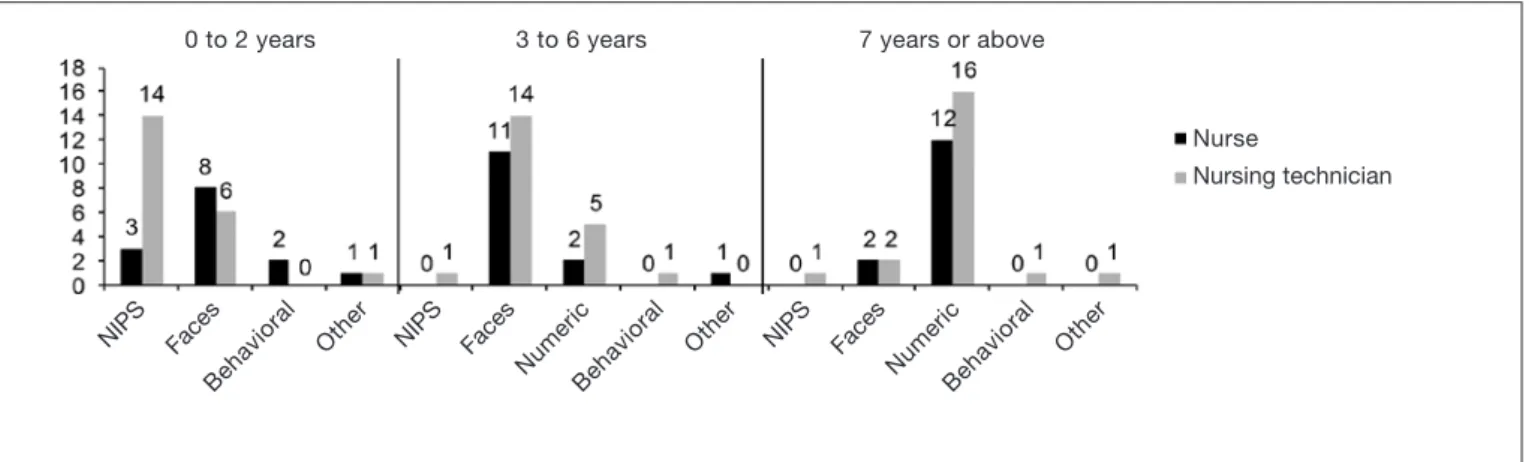
After the question: “How often have you cared of children with pain in the last week?”, 16 (47.1%) have answered “al-ways” and 14 (41.2%) have answered “almost al“al-ways”. It was observed that 29 (82.9%) respondents have answered that they “always” evaluate pain of a child during vital signs investigation. Figure 1 shows the choice of pain scale accord-ing to age group.
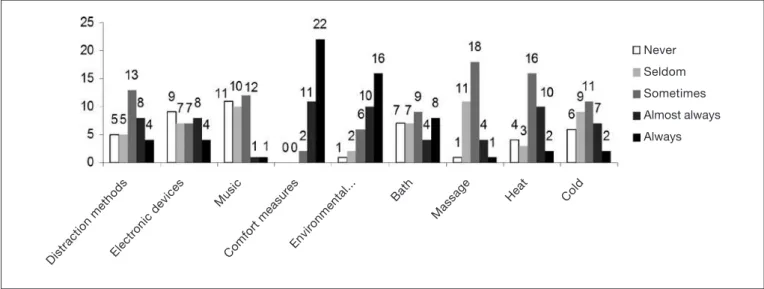
With regard to non-pharmacological approaches, there were nine possible approaches and a Likert Scale was developed for people to check the frequency with which they use each ap-proach. Results are shown in igure 2.
Figure 1. Pain measurement scales used by nurses and nursing technicians according to children’s age group. Children and Adolescents Cancer Hospital of Barretos, 2014
NIPS = Neonatal Infant Pain Scale; Faces = faces scale; Behavioral = behavioral scale; Numeric = numeric scale.
NIPS NIPS
NIPS Faces Faces Faces
Numeric Numeric
Behavioral Behavioral
Behavioral
Other Other
Other
0 to 2 years 3 to 6 years 7 years or above
Nurse
When asked: “hink about a child with pain; at the moment you see this child, can you think of a pain relief strategy dif-ferent from analgesics?”, 27 (77.1%) have answered yes. From these, 15 have suggested other approaches. he frequency of each approach was: 10 (38.4%) for drugs, 9 (34.2%) for dis-traction, 2 (7.6%) for lap, 2 (7.6%) for afection, 1 (3.8%) for decreasing noise and 1 (3.8%) for therapeutic touch. From respondents, 29 (82.9%) have mentioned more than one professional, diferent from physicians and nurses, who may contribute for children’s pain relief. Among profession-als, physiotherapist was mentioned 21 (33.8%) times, fol-lowed by psychologist with 12 (19.3%) and occupation thera-pist with 7 (11.2%).
With regard to nursing diagnosis and assistance prescribed by nurses, 4 (28.6%) have stated that “always” prepare pain-re-lated nursing diagnoses and 5 (35.7%) have stated “almost al-ways”. A total of 7 (50%) nurses believed that their prescribed assistance would help improving pain. Major approaches were: patients’ comfort n=9 (29.0%) and drugs n=5 (16.2%). Other approaches were: pain evaluation n=2 (6.4%), afection n=2 (6.4%), heat n=2 (6.4%), attention n=2 (6.4%), massage n=2 (6.4%), psychological support n=1 (3.2%), chatting n=1 (3.2%), lap n=1 (3.2%), singing n=1 (3.2%), clap hands n=1 (3.2%), placebo n=1 (3.2%) and environmental changes n=1 (3.2%).
DISCUSSION
Pain evaluation is the irst stage for correct decision-making and adequate therapy1. In pediatrics, pain should be measured according to age groups and this is the irst and probably the most important step to start any intervention2.
Pain is a subjective and individual experience so there is no single tool able to measure pain with extreme idelity; how-ever there are scales which allow nurses to measure pain, provided the professional complements this evaluation with
semiologic pain analysis3.
Children have diferent ways to express pain, so it is neces-sary to understand childhood developmental and behavioral stages4. A study has observed that a research has identiied dif-iculty to evaluate pain among infants and preschoolers who expressed themselves exclusively by crying5.
Our research has shown diiculty of the nursing team in choosing pain measurement scale, especially for children aged 0 to 2 years. his shows the need for training so that profes-sionals are skilled to use adequate scales for each child. A Finnish study has shown that 75% of nurses believe that pain scales are important to be used with neonates, however 60% considered possible to evaluate neonatal pain without scales6.
A second study has shown that nurses use more often neo-natal pain evaluation scales than physicians, who base their evaluation on behavior, body reactions, vital signs changes, stress and decreased oxygen saturation7.
Scales should be simple and facilitate the use by all profes-sionals. It is recommended that nurses evaluate which scale should be used for pain measurement in children and record such data, updating them daily8.
In the studied institution the use of pain scales according to children age group and conditions is standardized. Notwith-standing this being a standard, not all respondents answers were adequate and this might be related to the time work-ing with the institution, which was relatively short, approxi-mately 12 months, and to the low number of pediatrics and oncology specialization. A limitation of this study might have been the establishment of working time of “three months or longer”.
It was noted that the more qualiied is the pediatrics or neo-natology professional, there is signiicant increase in knowl-edge, especially about pain matters9. A UK study has shown that some professionals (1.5%) disagreed that a premature with less than 28 weeks would feel pain7. In a diferent study,
Figure 2. Frequency of approaches, according to a Likert Scale, checked by nurses and nursing technicians of the Children and Adoles-cents Cancer Hospital of Barretos, 2014
Never
Seldom
Sometimes
Almost always
Always
Distraction methodsElectr onic devices
Music
Comfort measur es
Envir onmental...
Bath
Massage
100% of respondents believed that neonates feel pain, being that 80 to 100% believed that they feel equal or more severe pain than adults9.
Training on the subject should be ongoing for children pain evaluation and control to be efective, thus assuring quality assistance10. Nurses have a major role in pain management, that is, monitoring and implementation of alternative mea-sures for its handling11. Inadequate treatment is largely as-sociated to the isolated work of a single professional, rather than a group11,12.
One respondent has evidenced the importance of nursing in controlling pain:
“Because nurses are responsible for most care and follow up dur-ing treatment, I have established an affective link of confidence and resolution, especially at the moment of pain or during un-comfortable procedures” [respondent 17].
It was observed that respondents have conirmed the help of numerous professionals for handling pain, showing that they know how to identify professionals who should be involved with pain therapy.
With regard to non-pharmacological pain relief approaches, there has been prevalence of the following: comfort measures, environmental changes, massage and heat. And it was noticed that when subjects answered that they used a diferent ap-proach10, they would mention a drug rather than a non-phar-macological approach.
Drugs were mentioned several times, including in one state-ment:
“Sometimes, nursing care may even improve children’s pain, but most of the times you need to medicate” [respondent 30]. One subject has considered that time available for using other methods diferent from drugs is short, as evidenced by the statement:
“(...) the profession requires a lot from us and we are not always able to give the attention they deserve” [respondent 1].
However, a diferent subject has mentioned that link is essen-tial to establish nursing care:
“When it is possible to establish a link, it is possible to identify strategies for pain relief according to each patient and sometimes in an early manner” [respondent 2].
It is necessary to advance with adjuvant therapies for pain relief, since a single therapeutic resource has not shown to be enough to control pain, especially chronic pain13.
For children and adolescents, studies have shown the impor-tance of associating drug therapy to arts, reading, music and recreational activities, in addition to health professional wel-coming and listening14. For neonates, according to the Min-istry of Health (MH), the following non-pharmacological measures are recommended: oral administration of sweet sub-stances, non-nutritional suction, breastfeeding, skin-to-skin contact and decreased tactile stimulation15.
he World Health Organization (WHO) has established stan-dards for the use of adjuvant therapies, that is, those added to drug therapy16. he document “Oncologic Palliative Care: Pain Control” (MH – Brazil. National Cancer Institute, 2001), has a series of complementary and alternative mea-sures, stressing physical, mechanical and cognitive methods16. Mentioned physical methods are: transcutaneous electric nerve stimulation, heat and cold manipulation16. Mechanical methods include massage and physical activity16. And cog-nitive methods mention relaxation and directed distraction, oriented imagination and deep breathing, biofeedback, edu-cational groups, modeling, positive reinforcement and behav-ioral essay16.
However, notwithstanding all these techniques, it is neces-sary that professionals applying such techniques understand them and be competent according to their exercise law, not to generate risks13.
For example, heat manipulation is a technique inducing in-creased blood flow, decreasing pain perception and generat-ing muscle relaxation, and joint stiffness, superficial inflam-mation and muscles spasm relief16. Professionals must know how to use this technique and understand that it becomes inadequate in cases of infection, active bleeding, vascular failure, tactile sensitivity changes and on sites with the pres-ence of tumor16. The professional in charge must be duly trained and understand that this method may have conse-quences such as edema, vascular failure, ischemia, burnings and necrosis16.
his attention is related to nursing diagnosis and prescrip-tion. Nurses, as from such tools, may use their knowledge to prescribe complementary therapies of their competence, based on scientiic arguments to protect patients and them-selves. In our study, only 4 (28.6%) nurses have stated that “always” perform pain-related nursing diagnosis.
A study with 118 premature infants assisted in a teaching hos-pital has shown percentages of nursing diagnoses performed by nurses of the unit, being that pain diagnosis was the 4th most frequent, with 65.3%17.
Nursing Assistance Systematization (NAS) allows care to gain theoretical and scientiic reference, and at the same time as-sures that individuals’ needs are met18. NAS language makes possible for nurses to speak the same language in diferent sites by diferent profesionals18.
According to NANDA, nursing diagnoses deining pain are: acute and chronic pain. Acute pain is related to noxious agents (biological, physical, chemical and psychological), and for chronic pain factors are chronic physical and psychosocial incapacity19.
pain the following interventions are mentioned: acupressure, analgesic administration, drug administration, application of heat or cold, pain control, drugs control, environmental con-trol or comfort, decreased anxiety, biofeedback, distraction, therapeutic game, simple massage, music therapy, guidance for image focusing, therapy with animals20.
Notwithstanding interventions and classifications, it seems that pain management is still difficult among professionals. The importance of professionals’ involvement with its man-agement is noted, however there is need for standardization of opinions, which could convey security for parents and children being assisted. In our study, no professional has recognized the importance of guidance about pain as nurs-ing care.
A study has mentioned this dilemma and has shown the im-portance of incorporating subjects related to pain manage-ment to university nursing courses21. Lack of knowledge is becoming increasingly sensitive to the situation and brings further pain handling diiculties21. Empathy with parents and simple information about pain may be ofered22. he lit-erature shows that conveying information seems to be im-portant for parents, who evaluate what is being reported by professionals and criticize when information difers from one professional to the other23.
CONCLUSION
Our study has observed that major diiculty of participants was pain measurement in children aged from 0 to 2 years and that drugs seem to be their irst choice for pain relief. he knowledge about non-pharmacological pain-relief ap-proaches and scales for measuring pain in children should be incorporated since Nursing Graduation because nurses are knowledge spreaders and major players during pain evaluation and integration of the multidisciplinary team to control pain. In spite of numerous available non-pharmacological ap-proaches and autonomy of nursing professionals to develop nursing prescriptions involving such approaches, compliance with NAS and pain involvement in the nursing process was low in our study, showing the need for further training and guidance for nursing professionals.
REFERENCES
1. Melo LR, Pettengill MA. Dor na infância: atualização quanto à avaliação e tratamento. Rev Soc Bras Enferm Ped. 2010;10(2):97-102.
2. Alves Neto O. Dor: princípios e prática. Porto Alegre: Artmed; 2009.
3. Bottega FH, Fontana RT. A dor como quinto sinal vital: utilização da escala de avalia-ção por enfermeiros de um hospital geral. Texto Contexto Enf. 2010;19(2):283-90. 4. Dias FM, Afonso M, Sá TS, Marcelino AL, Santos MJ, Morita AB. A criança vítima
de queimadura e sua dor no momento da realização de procedimentos diários: uma revisão bibliográica. Janus. 2008;5(8):33-43.
5. Bueno PC, Neves ET, Rigon AG. O manejo da dor em crianças com câncer: contri-buições para a enfermagem. Cogitare Enferm. 2011;16(2):226-31.
6. Pölkki T, Korhonen A, Laukkala H, Saarela T, Vehviläinen‐Julkunen K, Pietilä AM. Nurses’ attitudes and perceptions of pain assessment in neonatal intensive care. Scand J Caring Sci. 2010;24(1):49-55.
7. Akuma AO, Jordan S. Pain management in neonates: a survey of nurses and doctors. J Adv Nurs. 2012;68(6):1288-301.
8. Laleur KJ. Taking the ifth (vital sign). RN [periódico na Internet] 2004 Jul [acesso em 2015 Fev 20]; 67(7): [aproximadamente 3p.]. Disponível em: URL: http://www. modernmedicine.com/modern-medicine/content/taking-ifth-vital-sign.
9. Silva AP, Balda RC, Guinsburg R. Reconhecimento da dor no recém-nascido por alu-nos de medicina, residentes de pediatria e neonatologia. Rev Dor. 2012;13(1):35-44. 10. Silva MS, Pinto MA, Gomes LM, Barbosa TL. Dor na criança internada: a percepção
da equipe de enfermagem. Rev Dor. 2011;12(4):314-20.
11. Pimenta CA. Dor: ocorrência e evolução no pós-operatório da cirurgia cardíaca e ab-dominal Rev Paul Enferm. 1992;11(1):3-10.
12. Menossi MJ, Lima RA, Corrêa AK. Pain and the challenge of interdisciplinarity in child care. Rev Lat Am Enfermagem. 2008;16(3):489-94.
13. Silva MD, Leão E. Práticas complementares no alívio da dor. Dor: 5º sinal vital: re-lexões e intervenções de enfermagem Curitiba: Ed Maio; 2004. 121-33p. 14. Menossi MJ, Lima RA. A dor na criança e no adolescente com câncer: dimensões de
seu cuidar. Rev Bras Enferm. 2004;57(2):178-82.
15. Ministério da Saúde. Atenção à saúde do recém-nascido: guia para os proissionais de saúde. Brasília-DF Ministério da Saúde. 2011 [acesso em 13 de maio 2015]. Dis-ponível em: http://bvsms.saude.gov.br/bvs/publicacoes/atencao_recem_nascido_%20 guia_proissionais_saude_v2.pdf
16. Ministério da Saúde - Brasil. Instituto Nacional de Câncer. Cuidados paliativos on-cológicos: controle da dor. Recuperado em 25 de Agosto de 2010, de http://wwwin-cagovbr/estimativa/2010/indexasp?link=conteudo_viewasp&ID=2 2001:70-4. 17. Del’Angelo N, Góes FS, Dalri MC, Leite AM, Carvalho Furtado MC, Scochi CG.
Diagnósticos de enfermagem de prematuros sob cuidados intermediários. Rev Bras Enferm. 2010;63(5):755-61.
18. Laurent M, Dias V. A sistematização da assistência de enfermagem em pediatria. Pro-grama de Atualização em Enfermagem: saúde da criança e do adolescente: PROENF-ciclo. 2006;1.
19. Association NAND. Diagnósticos de enfermagem da NANDA: deinições e classiica-ção 2007-2008. Porto Alegre: Artmed; 2008. 548-9p.
20. Dochterman JM, Bulechek GM, Garcez RM. Classiicação das intervenções de enfer-magem (NIC). Porto Alegre, Artmed; 2008. 291-2p.
21. Nascimento LC, Strabelli BS, de Almeida FC, Rossato LM, Leite AM, de Lima RA. Mothers’ view on late postoperative pain management by the nursing team in children after cardiac surgery. Rev Lat Am Enfermagem. 2010;18(4):709-15.
22. Zisk RY, Grey M, Medof-Cooper B, Kain ZN. Accuracy of parental-global-impres-sion of children’s acute pain. Pain Manag Nurs. 2007;8(2):72-6.