ABSTRACT
BACKGROUND AND OBJECTIVES: Approximately 60%
of chronic pain individuals complain of sexual dysfunction, the prevalence of which varies from 20 to 88%. Among sexual com-plaints most reported by elderly females there are low interest, diicult vaginal lubrication and inability to reach orgasm. his study aimed at checking the prevalence of sexual dysfunction among long-lived females with chronic pain and at describing interfering factors.
METHODS:his was a descriptive, analytical and cross-section-al study with femcross-section-ales above 80 years of age. Data were collected on demographics, comorbidities and use of drugs, in addition to chronic pain evaluation and measurement and identiication of sexual dysfunctions by the Short Personal Experiences Question-naire.
RESULTS: Participated in the study 32 elderly females, with mean age of 87 years, most of them widows, with less than 4 years of education, good self-reported health, without sexual partner and with primarily osteoarthritis-induced nociceptive pain.he prevalenceof sexual dysfunctionwasfoundtobe 78% ofelderlywithchronicpainwith a mean score of7. Major reason for sexual inactivity was lack of a partner. In approximately 28.1% it was observed that chronic pain would interfere with sexuality. It was also observed that no elderly female had been previously addressed as to their sexuality, although 68.8% have stated that would have liked to be addressed.
CONCLUSION:Chronic pain was considered a factor interfer-ing with sexual practices of studied long-lived females,
suggest-Sexuality and chronic pain in long-lived females: description of
interferential factors*
Sexualidade e dor crônica em idosas longevas: descrição de fatores interferenciais
Alana Meneses Santos1, Fânia Cristina dos Santos2, Maysa Seabra Cendoroglo3
*Received from the Discipline of Geriatrics and Gerontology, Federal University of São Paulo, Paulista School of Medicine, São Paulo, SP, Brazil.
1. Federal University of São Paulo, Department of Geriatrics, São Paulo, SP, Brazil. 2. Federal University of São Paulo, Service of Pain and Musculoskeletal Diseases, São Paulo, SP, Brazil.
3. Federal University of São Paulo, Department of Geriatrics and Gerontology, São Paulo, SP, Brazil.
Submitted in October 08, 2014.
Accepted for publication in February 19, 2015. Conlict of interests: none – Sponsoring sources: none.
Correspondence to: Alana Meneses Santos
Rua Francisco de Castro, 105 – Vila Clementino 04020-050 São Paulo, SP.
E-mail: [email protected]
© Sociedade Brasileira para o Estudo da Dor
ing that this symptom may impair sexuality during aging. Keywords:Chronic pain, Geriatrics, Health of the elderly, Physi-ological sexual dysfunction, Sexuality.
RESUMO
JUSTIFICATIVA E OBJETIVOS: Cerca de 60% dos indivíduos com dor crônica queixam-se de disfunção sexual, cuja prevalência varia de 20 a 88%. Entre as queixas sexuais mais relatadas entre as idosas estão o baixo interesse, a diiculdade de lubriicação vaginal e a incapacidade de alcançar o orgasmo. O objetivo deste estudo foi apurar a prevalência de disfunção sexual entre as idosas longe-vas com dor crônica, e descrever os fatores de interferência. MÉTODOS: Foi realizado um estudo descritivo e analítico de corte-transversal, com indivíduos acima de 80 anos, do gênero feminino. Foram coletados dados sócio-demográicos, de comor-bidades e uso de fármacos, além da avaliação e mensuraçãoda dor crônica e apuraçãodas disfunções sexuais através do Short Person-alExperiencesQuestionnaire.
RESULTADOS: Participaram do estudo 32 idosas com média de idade de 87 anos, a maioria viúva, com menos de 4 anos de escolaridade, boa saúde autorreferida, sem parceiro sexual, e com dor crônica prevalentemente nociceptiva por osteoartrite. A pre-valência de disfunção sexual encontrada foi de 78% das idosas com dor crônica, com pontuação média de 7. A principal causa da inatividade sexual foi a ausência de um parceiro. Em cerca de 28,1% observou-se que a dor crônica interferia na sexualidade. Tambémse observou que nenhuma idosa fora abordada anteri-ormente quanto a sua sexualidade, apesar de 68,8% delas terem airmado que gostariam de já ter sido abordadas.
CONCLUSÃO: A dor crônica foi considerada um fator que inter-feria na prática sexual das idosas longevas estudadas, sugerindo que esse quadro possa comprometer a sexualidade no envelhecimento. Descritores: Disfunção sexual isiológica, Dor crônica, Geria-tria, Saúde do idoso, Sexualidade.
INTRODUCTION
Life expectation is increasing worldwide and with it, the prev-alence of chronic problems is also increasing among aging individuals, such as chronic pain presentations1.
of pain exacerbation, depression, relationship problems and conidences. Typical intercourse positions may compress or hyper-stretch a painful point, worsening pain intensity and making sex a pain triggering factor2.
Other chronic pain consequences, such as depression, anxiety, social isolation, sleep disorders, moving and walking diicul-ties and self-evaluation impairment also afect general patients’ health and sexual wellbeing3. Drugs used to control pain are also related to decreased libido and inability to reach orgasm4. Opioid analgesics and selective serotonin reuptake inhibitors antidepressants are commonly associated to decreased libido5. Previous surgical or radiotherapeutic procedures may also trigger pain processes during sexual intercourse6.
Sexual health is a key-element for general health and qual-ity of life (QL)7. Being sexually active may provide physical beneits, such as cardiovascular health8, improved physical ex-ercise, decreased pain sensitivity, and psychological beneits, such as decreased depression, general wellbeing and QL im-provement9 and increased longevity10. One third of Ameri-cans between 75 and 85 years of age report being sexually ac-tive and that physical health is more soundly related to sexual activity than age itself11. In addition to chronic pain, other medical and psychological causes, changes in body image, de-creased sensitivity, lack of partner and religious and cultural habits may decrease sexual activity of the elderly11. Advanced age and poor health are negatively associated to the inability of being sexually active12.
Sexual dysfunction is common among elderly females, with prevalence varying from 20 to 88%13,14. his could also sig-niicantly afect self-esteem and QL15,16. Most important complaint related to such dysfunction is low sexual interest, diicult vaginal lubrication and inability to reach orgasm11. Discomfort during sexual intercourse is a common meno-pausal problem. Anxiety may induce dyspareunia due to de-creased blood low to the vagina. Dede-creased vaginal lubrica-tion may cause more tissue irritalubrica-tion and friability, and may result in pain or abdominal discomfort5.
Notwithstanding the relative frequency of sexual dysfunc-tions, few males and females report such complaints to health professionals17. Just approximately 30% of physicians regu-larly ask about sexual activity of their patients, especially male patients. Major barrier reported by 53% of physicians is the fact of considering the subject embarrassing or fear of ofend-ing patients, in addition to lack of time durofend-ing consultations and especially lack of academic qualiication to treat sexual problems. he market of drugs and devices to treat sexual dys-function is increasing and this, in part, increases the demand for health services access. he subject sexuality is virtually in-existent in elderly basic attention18.
So, since determinants of sexual problems among elderly fe-males are multifactorial, studying their multiple factors would have scientiic merit and could help the orientations given by medical attention to elderly females.
his study aimed at identifying the prevalence of sexual dys-function among long-lived females with chronic pain and at describing factors interfering with that dysfunction,
suppos-ing that negative society attitudes about agsuppos-ing and sexuality, especially among long-lived females, would represent a major challenge.
METHODS
Observational, descriptive and cross-sectional study carried out as from the “Long-Lived Project” of the Discipline of Geriat-ric and Gerontology (DIGG), Federal University of São Paulo (UNIFESP). his is an observational longitudinal study in the city of São Paulo, started in 2011, with community long-lived people, with 80 or more years of age, of both genders, without cognitive impairment, able to walk without the help of third parties and with no diagnosis of potentially severe or fatal dis-ease. Elderly with limiting sensory deicits, cognitive deicit or debilitating clinical diseases were excluded.
Inclusion criteria were long-lived people with chronic pain lasting for 6 months or more, and intensity equal to or above 3 by the numerical scale. Evaluation period was from February 2010 to December 2012. All patients included in the study have signed the Free and Informed Consent Term (FICT). Interviews were carried out with questions regarding socio-demographic data (age, marital status, religion and education level), functionality proile for daily life activities19,20, and use of drugs to treat chronic pain that interfere with sexual func-tion, such as serotonin reuptake inhibitor antidepressants, opioids and anticonvulsants. We have also evaluated pain as to location, frequency, character, triggering and attenuating factors, nature according to physiopathogenesis (nociceptive, neuropathic, mixed or psychogenic). To measure pain inten-sity pain verbal description scale (VS) (mild, moderate and severe) and pain verbal numerical scale (VNS) (0-10) were used.
Questions regarding elderly general health self-perception and regarding pain interference with their sexual practice were asked, in addition to questions about reason for sexual decrease or inactivity. he Short Personal Experiences Ques-tionnaire (SPEQ) was applied. his is a tool validated for the Portuguese language21 and made up of nine questions ad-dressing libido (one question), sexual responsiveness (three questions), sexual activities frequency (one question), feelings regarding partner (two questions), partner sexual diiculty (one question) and pain during penetration (one question), making up a structured and concise questionnaire. his ques-tionnaire has been especially used in studies with menopausal females, allowing the evaluation of the presence of sexual dys-functions and associated factors, but it is also used for indi-viduals of diferent ages and menopausal states, regardless of the presence or not of sexual partner and regardless of the type of relation, whether heterosexual or homosexual22,23.
Statistical analysis
Quali-tative variables (categorized) were analyzed by absolute and relative frequencies calculation.
his study was approved by the Research Ethics Committee, UNIFESP/EPM - CEP 443.760.
RESULTS
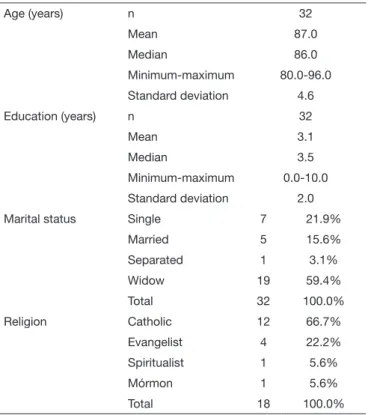
We have observed mean age of 87 years (standard deviation of 4.6 years), varying from 80 to 100 years, being most widows (59.4%), (21.9% single, 15.6% married and 3.1% separated), and with mean education level of 3.1 years. Only 18 elderly females have reported their religion, being 66.7% catholic, 22.2% evangelists, 5.6% spiritualists and 5.6% Mormons (Table 1).
Table 1.Sample characterization
Age (years) n 32
Mean 87.0
Median 86.0
Minimum-maximum 80.0-96.0
Standard deviation 4.6
Education (years) n 32
Mean 3.1
Median 3.5
Minimum-maximum 0.0-10.0
Standard deviation 2.0
Marital status Single 7 21.9%
Married 5 15.6%
Separated 1 3.1%
Widow 19 59.4%
Total 32 100.0%
Religion Catholic 12 66.7%
Evangelist 4 22.2%
Spiritualist 1 5.6%
Mórmon 1 5.6%
Total 18 100.0%
With regard to chronic pain, 87.5% had nociceptive pain, 3.1% neuropathic pain and 9.4% mixed pain and, accord-ing to its intensity a median of 8.0 was obtained with VNS. Considering pain etiology, 71.9% had osteoarthritis-related pain, 6.3% had myofascial syndrome and 21.9% other types of pain, such as headache, radiculopathy, ibromyalgia, bone fracture sequelae, post-herpetic neuralgia, post-trauma mus-cle injury sequelae and rotating cuf injury.
As to drugs interfering with sexual function, it was observed that 12.5% used opioid analgesics, 37.5% some type of an-tidepressant (duloxetine used by 6.3% of the elderly, sero-tonin reuptake inhibitor by 18.8% and tricyclic by 12.5%), 6.3% some anticonvulsant and 62.5% would use no such drugs. Approximately 28.1% of the elderly have reported that chronic pain interfered with sexual activity, and no elderly female in the sample referred having been asked before about
sexuality, although 68.8% would have liked to be approached at some moment of their lives about sexuality. As to general health self-perception, 3.1% of the elderly have evaluated their health as excellent, 50.0% as good, 37.5% as regular and 9.4% as poor (Table 2).
Table 2. Distribution of functionality, health self-evaluation and use of analgesic drugs, adjuvants or not
Basic daily life activities
Mean score 5.4
Median 5.0
Minimum-maximum 5.0-6.0
Standard deviation 0.5
Instrumental daily life activities
Mean score 24.1
Median 25.0
Minimum-maximum 17.0-27.0
Standard deviation 2.8
Health self-evaluation
Excellent 1 3.1%
Good 16 50.0%
Regular 12 37.5%
Poor 3 9.4%
Total 32 100.0%
Opioid analgesic No 28 87.5%
Yes 4 12.5%
Total 32 100.0%
Antidepressant Duloxetine 2 6.3%
Serotonin reuptake inhi-bitor
6 18.8%
Tricyclic 4 12.5%
No antidepressants 20 62.5%
Total 32 100.0%
Anticonvulsant No 30 93.8%
Yes 2 6.3%
Total 32 100.0%
Pain interference with sexual activity
No 23 71.9%
Yes 9 28.1%
Total 32 100.0%
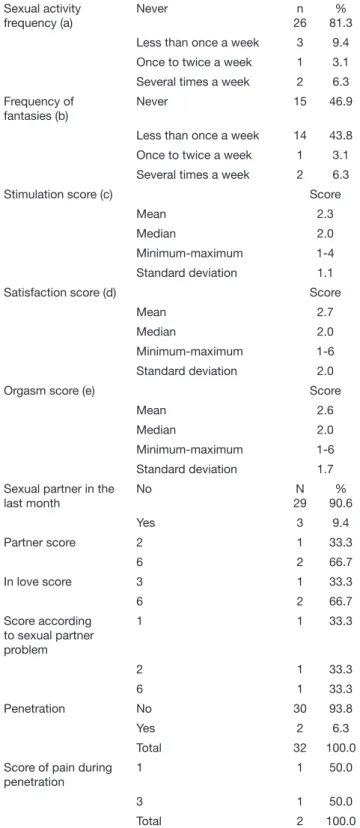
Table 3. Sexual dysfunctions according to Short Personal Experien-ces Questionnaire
Sexual activity frequency (a)
Never n
26 % 81.3
Less than once a week 3 9.4
Once to twice a week 1 3.1
Several times a week 2 6.3
Frequency of fantasies (b)
Never 15 46.9
Less than once a week 14 43.8
Once to twice a week 1 3.1
Several times a week 2 6.3
Stimulation score (c) Score
Mean 2.3
Median 2.0
Minimum-maximum 1-4
Standard deviation 1.1
Satisfaction score (d) Score
Mean 2.7
Median 2.0
Minimum-maximum 1-6
Standard deviation 2.0
Orgasm score (e) Score
Mean 2.6
Median 2.0
Minimum-maximum 1-6
Standard deviation 1.7
Sexual partner in the last month
No N
29 % 90.6
Yes 3 9.4
Partner score 2 1 33.3
6 2 66.7
In love score 3 1 33.3
6 2 66.7
Score according to sexual partner problem
1 1 33.3
2 1 33.3
6 1 33.3
Penetration No 30 93.8
Yes 2 6.3
Total 32 100.0
Score of pain during penetration
1 1 50.0
3 1 50.0
Total 2 100.0
(a) frequency the elderly had any sexual activity (masturba-tion, excitation and/or penetration), in the last month, (b) frequency the elderly had sexual fantasies and thoughts and/ or sexual desire in the last month, (c) score given to the fre-quency she felt stimulated or excited (with lubricated/moist vagina), (d) score given to sexual activity satisfaction, (e) score given to orgasm intensity during sexual activity.
Among those practicing some type of sexual activity (Table 2), we have asked the frequency of being stimulated or excited and 12 elderly gave scores varying from1 to 4 (mean 2.3). Sexual activity satisfaction score has varied from 1 to 6 (mean 2.7), and that attributed to orgasm frequency has varied from 1 to 6 (mean 2.6). Only 9.4% have reported having partner in the last month. All elderly females have reported heterosexual preference and 6.3% have reported sexual activity with penetration. According to SPEQ, 78% of elderly females had sexual dysfunction (mean score of 7).
DISCUSSION
here are few studies on elderly sexuality, especially those long-lived, with more than 80 years of age.
Our study, with participation of very old females (mean of 87 years), has observed that more than 70% were widows, single or separated, and had no sexual partner, so this could have been the major reason of observed sexual inactivity. Some authors have al-ready observed that widowhood was the primary cause of sexual inactivity among elderly females24. Goh et al.25 in a study with elderly people in Singapore have found signiicant sexual activity decrease with age.
With increased age, the presence of sexual partner may be a pro-tecting factor against sexual inactivity26,27. In a study with elderly females up to 79 years of age, it was observed that those sexually happier were those with sexual partner16.
In our sample, with regard to general health self-perception by chronic pain elderly females, 50% have considered their health as good, in spite of mean chronic pain intensity being severe (NS=7.8) and of infrequent sexual practice. Lindau and Gavrilo-va7, analyzing two large population studies, have stated that among long-lived people there is a positive correlation among health, presence of partner and sexual activity. Other studies have shown the relationship between being sexually active and general health status11,12,26.
With regard to chronic pain, 28% of the elderly have stated that the symptom could impair sexual life and such percentage is con-sidered signiicant. Some studies have shown the negative efect of pain on sexual function. A study involving young females with ankylosing spondylitis has observed high prevalence of sexual dysfunction, possibly due to high depression levels, decreased functionality, poor pain control and worsened QL28. A diferent study has shown that better sexual function could improve pain control29.
As to drugs potentially interfering with sexual function, it was observed that elderly females part of this study used them fre-quently (12.5% used opioid analgesics, 37.5% antidepressants and 6.3% anticonvulsants), and sexual dysfunction may be considered a common antidepressant adverse efect30. McCall-Hosenfeld et al.16 have observed that sexually happier elderly fe-males were those older, married and with partner, and also those emotionally healthy not under selective serotonin reuptake an-tidepressants.
the last month. With regard to sexual responsiveness, most have given low scores for stimulation/excitation, sexual satisfaction and orgasm frequency. Lindau et al.11 have observed that major sexual dysfunction among the elderly were inability to reach or-gasm, in addition to low sexual desire and diicult lubrication. Masturbation prevalence decreases with age, but according to some authors11, sexuality is not dramatically decreased with age. From total sample, only 6.3% had sexual activity with penetra-tion and it has already been observed that vaginal penetrapenetra-tion importance increases with aging31.
It has been observed that sexual dysfunction rate among the el-derly varies from 42 to 88%13. And partner availability is impor-tant factor for sexual function, especially for the elderly32. SPEQ questionnaire about sexuality has a score with cutof point equal to or below 7 to consider the presence of sexual dysfunction and here, using this tool, we had mean of 7 points, being that 78% of the sample were considered with sexual dysfunction. In the tran-sition from early to late menopause, the percentage of females with SPEQ with low sexual function increases a lot, varying from 42 to 88%33. According to international literature, sexual dys-function prevalence is high with aging, and in spite of this, sex-ual abstinence is not an unavoidable consequence of time, and a high proportion of males and females remains sexually active until the end of their lives34. Decreased sexual function in the elderly seems to be more a response to several stressors in other factors, which go from physical health to intimate relationship35. It is interesting in our study that no elderly female had been al-ready asked about sexuality, and we have also observed that most (68.8%) would have liked to be previously asked. his might have occurred because most physicians consider sexual dysfunc-tion “natural” to aging itself and not as a possibly changeable medical condition33.
Life expectation is increasing, especially in Brazil, so it would be necessary to maintain elderly people functional and happy until the end of their lives, in all functions, including sexuality, which may be considered an important QL aspect, thus it cannot be overlooked. Major limitations of this study were small sample size and the performance of just descriptive analyses of long-lived females of the community. However, our study may contribute with novel scientiic data in Brazil. Our data reinforce the issue that physi-cians should address sexuality during consultations, even with very old people, valuing chronic pain as interfering with indi-vidual’s sexual activity.
CONCLUSION
In our sample, most long-lived females with chronic pain pre-sented with sexual dysfunction, according to SPEQ tool, and major cause of reported sexual inactivity was the lack of a part-ner. Chronic pain was described and a factor interfering with sexual practice of studied elderly females, fact which ends up further impairing sexuality during aging.
In light of such indings, it is suggested that health professionals address sexuality during medical consultations involving elderly females, not forgetting to include in such approaches also long-lived females.
REFERENCES
1. Maruta T, Osborne D, Swanson DW, Halling JM. Chronic pain patients and spouses: marital and sexual adjustment. Mayo Clinic Proc.1981;56(5):307-10.
2. Ambler N, Williams AC, Hill P, Gunary R, Cratchley G. Sexual diiculties of chronic pain patients. Clin J Pain. 2001;17(2):138-45.
3. Santos FC, Souza PMR. Força-tarefa na dor em idoso. 1ª ed. Moreira Júnior; 2011. 4. Werneke U, Northey S, Bhugra D. Antidepressants and sexual dysfunction. Acta
Psychiatr Scand. 2006;114(6):384-97.
5. Ambler DR, Bieber EJ, Diamond MP. Sexual function in elderly women: a review of current literature. Rev Obstet Gynecol. 2012;5(1):16-27.
6. Hughes MKU. Disorders of sexuality and reproduction. In: Berger A, et al., editors. Principles and practices of palliative care and supportive oncology. Philadelphia: Lip-pincott Williams and Wilkins; 1998. 763-74p.
7. Lindau ST, Gavrilova N. Sex, health, and years of sexually active life gained due to good health: evidence from two US population based cross sectional surveys of ageing. BMJ. 2010;340(7746):c810.
8. Chen X, Zhang Q, Tan X. Cardiovascular efects of sexual activity. Indian J Med Res. 2009;130(6):681-8.
9. Brody S. he relative health beneits of diferent sexual activities. J Sex Med. 2010;7(4Pt1):1336-61.
10. Onder G, Penninx BW, Guralnik JM, Jones H, Fried LP, Pahor M, et al. Sexual satis-faction and risk of disability in older women. J Clin Psychiatry. 2003;64(10):1177-82. 11. Lindau ST, Schumm LP, Laumann EO, Levinson W, O’Muircheartaigh CA, Waite
LJ. A study of sexuality and Health among older adults in the United States. N Engl J Med. 2007;357(8):762-74.
12. Laumann EO, Nicolosi A, Glasser DB, Paik A, Gingell C, Moreira E, et al. Sexual pro-blems among women and men aged 40–80 y: prevalence and correlates identiied in the Global Study of Sexual Attitudes and Behaviors. Int J Impot Res. 2005;17(1):39-57. 13. Dennerstein L, Lehert P, Burger H, Guthrie J. Sexuality. Am J Med. 2005;118(Suppl
12B):59-63.
14. Kingsberg S, Althof SE. Evaluation and treatment of female sexual disorders. Int Uro-gynecol J Pelvic Floor Dysfunct. 2009;20(Suppl 1):33-4.
15. Nappi RE, Lachowsky M. Menopause and sexuality: prevalence of symptoms and impact on quality of life. Maturitas. 2009;63(2)138-41.
16. McCall-Hosenfeld JS, Jaramillo SA, Legault C, Freund KM, Cochrane BB, Manson JE, et al. Correlates of sexual satisfaction among sexually active postmenopausal women in the Women’s Health Initiative-Observational Study. J Gen Intern Med. 2008;23(12):2000-9. 17. Nicolosi A, Buvat J, Glasser DB, Hartmann U, Laumann EO, Gingell C. Sexual behaviour, sexual dysfunctions and related help seeking patternsn in middle-aged and elderly Europe-ans: the global study of sexual attitudes and behaviors. World J Urol. 2006;24(4):423-8. 18. Lindau ST. Sexuality, sexual function and the aging woman. In. Hazzard WR, et al,
edi-tors. Geriatric medicine and gerontology. 6th ed. New York: Mc Graw Hill; 2009. 567-82p.
19. Katz S, Stroud MW 3rd. Functional assessment in geriatrics. A review of progress and directions. J Am Geriatr Soc. 1989;37(3):267-71.
20. Lawton MP, Brody EM. Assessment of older people: self-maintaining and instrumen-tal activities of daily living. Gerontologist. 1969;9(3):179-86.
21. Valadares AL, Pinto-Neto AM, de Sousa MH, Osis MJ. [Sociocultural adaptation of the short personal experiences questionnaire (SPEQ) in Brazil]. Rev Bras Ginecol Obstet. 2010;32(2):72-6. Portuguese.
22. Dennerstein L, Lehert P, Dudley E. Short scale to measure female sexuality: adapted from McCoy Female Sexuality Questionnaire. J Sex Marital her. 2001;27(4):339-51. 23. Dennerstein L, Anderson-Hunt M, Dudley E. Evaluation of a short scale to assess
female sexual functioning. J Sex Marital her. 2002;28(5):389-97.
24. Karraker A, Delamater J, Schwartz CR. Sexual frequency decline from midlife to later life. J Gerontol B Psychol Sci Soc Sci. 2011;66(4):502-12.
25. Goh VH, Tain CF, Tong YY, Mok PP, Ng SC. Sex and aging in the city: Singapore. Aging Male. 2004;7(3):219-26.
26. Laumann EO, Paik A, Rosen RC. Sexual dysfunction in the United States: prevalence and predictors. JAMA. 1999;281(6):537-44. Erratum in: JAMA. 1999;281(13):1174. 27. Blümel JE, Castelo-Branco C, Cancelo MJ, Romero H, Aprikian D, Sarrá S. Impair-ment of sexual activity in middle-aged women in Chile. Menopause. 2004;11(1):78-81. 28. Demir SE, Rezvani A, Ok S. Assessment of sexual functions in female patients with an-kylosing spondylitis compared with healthy controls. Rheumatol Int. 2013;33(1):57-63. 29. Arabkheradmand J, Foroutan SK, Ranjbar S, Abbasi T, Hessami S, Gorji A. Improvement
of chronic pain by treatment of erectile dysfunction. J Sex Med. 2008;5(12):2911-6. 30. Basson R. Women’s sexual dysfunction: revised and expanded deinitions. CMAJ.
2005;172(10):1327-33.
31. Vares T, Potts A, Gavey N, Grace VM. Reconceptualizing cultural narratives of mature women’s sexuality in the Viagra era. J Aging Stud. 2007;21(2):153-64.
32. Delamater J, Karraker A.Sexual functioning in older adults. Curr Psychiatry Rep. 2009;11(1):6-11.
33. Yee L. Aging and sexuality. Aust Fam Physician. 2010;39(10):718-21.
34. Nicolosi A, Moreira ED Jr, Villa M, Glasser DB. A population study of the association between sexual function, sexual satisfaction and depressive symptoms in men. J Afect Disord. 2004;82(2):235-43.