Rev. CEFAC, São Paulo
TOTAL LARYNGECTOMY: SYSTEMATIC REVIEW
Reabilitação das funções do olfato e do paladar
em laringectomizados totais: revisão sistemática
Ada Salvetti Cavalcanti Caldas(1), Vera Lúcia Dutra Facundes(2), Hilton Justino da Silva (3)
ABSTRACT
Background: in total laryngectomy there occurs the transfer of the nasal airlow deinitely to the tracheostoma, which could cause a decrease in the perception of smell and taste. There have been recently developed methods of intervention in order to improve performance in laryngectomized smell and taste, although few studies have investigated this issue. Purpose: this study aimed to systematically review the evidence of how the techniques involved in the rehabilitation of the functions of smell and taste have an effect on individuals with total laryngectomy. Conclusion: in this review all the selected studies demonstrated effective use of rehabilitation techniques for the role of olfaction in laryngectomized. As for taste, there were no proposals in order to intervene directly in this function.
KEYWORDS: Laryngectomy; Smell; Taste; Olfaction Disorders; Taste Disorders; Rehabilitation
(1) Occupational Therapist; Mastering in Pathology at
Fede-ral University of Pernambuco, UFPE, Recife, PE – Brazil; Specialist in Public Health from University of Pernambuco – UPE.
(2) Occupational Therapist;, Assistant Professor of
Occupatio-nal Therapy course at the Federal University of Pernam-buco, UFPE, Recife, PE – Brazil; Doctor in Neuropsychiatry from Federal University of Pernambuco – UFPE.
(3) Speech Therapist; Assistant Professor II at the Federal
Uni-versity of Pernambuco – UFPE, Recife, PE – Brazil; Doctor in Nutrition from the Federal University of Pernambuco – UFPE.
Conlict of interest: non-existent
the improvement of the odor molecules arrival in the olfactory neuroepithelium4,5.
Given the few studies that address this issue, this article aims to systematically review the evidence of how the techniques involved in the rehabilitation of the smell and taste functions has effect on total laryngectomy individuals.
METHOD
A systematic literature review was performed from the PUBMED, MEDLINE (1997 – 2010), OLD MEDLINE (1966 – 1996), LILACS and SciELO data base, being the search of data held in 2010 october.
To search descriptors were used (DESCs) – keywords for retrieving subjects from scientiic literature – and free terms (TL) – terms not found in DESC and MESH, but with relevance to the research –, being done through: “laryngectomy” (DESCs) AND “smell” (DESCs); “laryngectomy” (DESCs) AND “taste” (DESCs); “laryngectomy” (DESCs) AND “olfaction disorders” (DESCs); “laryn-gectomy” (DESCs) AND “taste disorders” (DESCs); “laryngectomized” (TL) AND “smell” (DESCs); “laryngectomized” (TL) AND “taste” (DESCs) and its equivalent in Portuguese and Spanish.
INTRODUCTION
Total laryngectomy is a surgical procedure in which there is removal of structures that produce the laryngeal sound and neighbors muscles, with the transfer of the nasal airlow deinitely to the tracheostoma¹, compromising the arrival of odor molecules to the olfactory epithelium by nasal inha-lation, causing decreasing in smell perception and therefore taste function2,3.
Rev. CEFAC, São Paulo
LITERATURE REVIEW
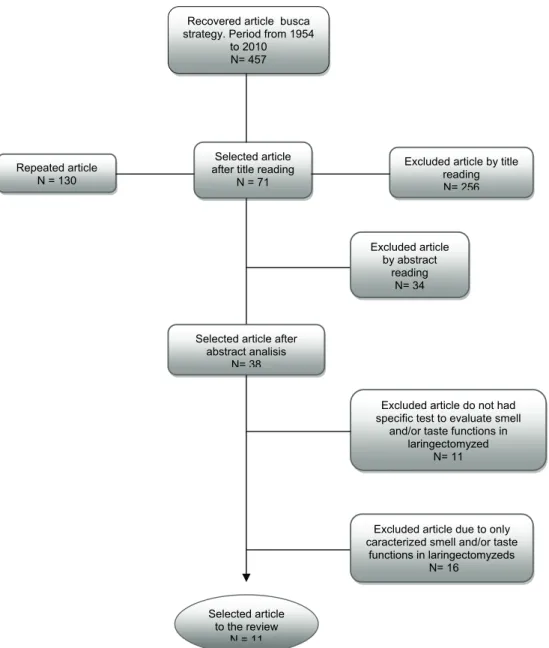
We found 457 articles from the research of descriptors and free terms, being 183 from the PUBMED, 153 from MEDLINE, 109 from MEDLINE OLD, seven from LILACS, three from SCIELO Brazil and two from SCIELO Colombia. Considering the inclusion and exclusion criteria, there were selected 11 articles for this review, as claimed in Figure 1.
The great diversity observed in the found studies did not allow statistical analysis (methanalysis). The heterogeneity is relected in the absence of criteria for randomization, sampling and variables diversii-cation considered in the population of each article. So for better presentation of results we chose to The research was conducted by three
researchers independently, following inclusion and exclusion criteria.
The inclusion criteria were original arti-cles (excluding editorials and case study) that approached the total laryngectomy and the smell and/or taste functions rehabilitation in this popu-lation with the use of speciic techniques, and the manuscripts were published in Portuguese, English and Spanish.
The literature review articles were excluded, as well as those who not speciically proposed interfere in the smell and/or taste functions and those who did not address the total laryngectomy population, such as animal studies.
FLOWCHART
Recovered article busca strategy. Period from 1954
to 2010 N= 457
Selected article after title reading
N = 71
Excluded article by title reading N= 256 Repeated article
N = 130
Selected article after abstract analisis
N= 38
Excluded article by abstract
reading N= 34
Excluded article do not had specific test to evaluate smell
and/or taste functions in laringectomyzed
N= 11
Selected article to the review
N = 11
Excluded article due to only caracterized smell and/or taste
functions in laringectomyzeds N= 16
Rev. CEFAC, São Paulo Another point that should be taken into account in analyzing the results presented in this review is the surgery time, and this time varied from 0 till 20 years, thereby increasing the heterogeneity of the selected studies.
The tests used to evaluate olfactory function in the majority were concerned to make a quantita-tive analysis using standardized instruments, which suggests a concern with the results presented, as is intended to demonstrate the effectiveness of an intervention technique.
A study with a sample about 44 individuals, was used as a method to evaluate the smell function, the Odor Detection Test (ODT) with presentation of 16 trials with bottles containing 250 mL of solvent odor-less dipropylene glycol and the others containing dipropylene glycol phenylethanol13. Later, in another
publication of the same author, also used this evaluate method in association to the evaluation Smell Disk Test (SDT) which is the submission of eight different odors on loppy disks, and the study conirmed that the SDT represents a test to be faster and simple application and reproducibility12.
The Snifin Sticks test battery is another stan-dardized test used in recent publications3,5,9, having
an evaluation as a method to use odors contained in 12 “pens”, with an objective test, showing a greater conidence in the presented results.
Subjective tests with questionnaires use, has been widely used to evaluate the smell and taste functions, particularly with respect to self-evaluation and satisfaction with the current situation experi-enced by the individual. The Olfaction question-naire, Taste and Appetite (QOTA) represents a subjective test with a study proposed evaluation through multiple-choice questions of the current and previous total laryngectomy surgery situation8,10,11,13.
It is understood that although the questionnaire has well-deined scores, it requires that their use is accompanied by objective tests for better results.
In the evaluation of taste function was noted that the studies used questionnaires and semi-structured interview with subjective approach and proposal self-assessment 4,8,10,11,13. It is understood
that changes in taste function can be considered as a consequence of the decline in olfactory function, which may explain the lack of analysis with stan-dardized tests for the taste function.
It is observed that even in articles that offer only the assessment of gustatory function, subjective tests are used, especially aqueous solutions, with non-standard instruments18, which demonstrates
the lack of more objective studies to analyse this function.
The found intervention techniques in the articles selected for this review primarily describes the use consider the following variables of selected articles:
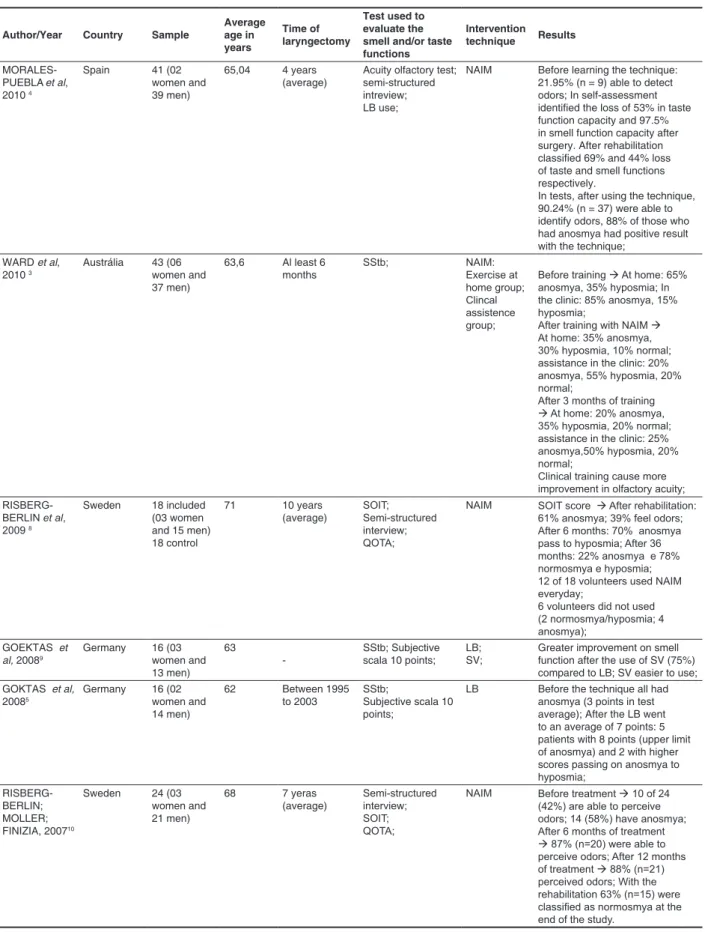
author, year, country, sample, average age, time after laryngectomy, test used to assess the smell and/or palate function, intervention technique and results, as can be seen in Table 1.
The rehabilitation of the smell and taste func-tions seems to have been evidenced by research from the 2000s. Although the knowledge that the total laryngectomy can cause a decrease in smell and taste acuity have been reported in studies since 19546, only in 19877 the irst publication describing
a intervention technique with the attempt to reverse these sensory losses were published.
It is believed that this may be related to tradition-ally be more emphasis on voice rehabilitation4, since
such changes are more evident in this population, with little perceived changes in the smell functions and taste consequently.
The discovery of the decrease in olfactory and gustatory function in total laryngectomized as well as the possible mechanisms and structures involved in these changes seems to have encour-aged research groups to investigate intervention strategies to improve these functions, mainly in the Netherlands, Sweden and Germany5,8-13.
It is assumed that the growth of larynx cancers and the number of total laryngectomy surgeries in Europe, has driven more and more researchers to investigate this population8. Associated with this
fact, research has used questionnaires and speciic tests to assess the smell and taste functions in order to verify the effectiveness of intervention tech-niques, verifying in these publications more concern about the quality of life of them.
Another relevant point is the absence of studies in Latin America, suggesting little emphasis on researching this topic. In Brazil, studies on the quality of life and oral communication are preferred by researchers in this region14,15, although it has
been found an article by Brazilian researchers outside of research strategies including the inclu-sion and excluinclu-sion criteria adopted in this review16.
The diversity of publications in this review may be evidenced by the number of sampling, and studies revealed the occurrence of between 12 and 44 indi-viduals, although it has identiied a prevalent varia-tion between 18 and 24 individuals. It is assumed that the small number of individuals surveyed may undermine the inference of these indings for the general population.
Table 1 – Studies that tested the evidence of rehabilitation techniques for smell and taste functions in total laryngectomyzed
Author/Year Country Sample Average age in years
Time of laryngectomy
Test used to evaluate the smell and/or taste functions
Intervention technique Results
MORALES-PUEBLAet al, 2010 4
Spain 41 (02 women and 39 men)
65,04 4 years
(average) Acuity olfactory test; semi-structured intreview;
LB use;
NAIM Before learning the technique: 21.95% (n = 9) able to detect odors; In self-assessment identiied the loss of 53% in taste function capacity and 97.5% in smell function capacity after surgery. After rehabilitation classiied 69% and 44% loss of taste and smell functions respectively.
In tests, after using the technique, 90.24% (n = 37) were able to identify odors, 88% of those who had anosmya had positive result with the technique;
WARD et al,
2010 3 Austrália 43 (06 women and
37 men)
63,6 Al least 6
months SStb; NAIM:Exercise at home group; Clincal assistence group;
Before training à At home: 65% anosmya, 35% hyposmia; In the clinic: 85% anosmya, 15% hyposmia;
After training with NAIM à
At home: 35% anosmya, 30% hyposmia, 10% normal; assistance in the clinic: 20% anosmya, 55% hyposmia, 20% normal;
After 3 months of training
à At home: 20% anosmya,
35% hyposmia, 20% normal; assistance in the clinic: 25% anosmya,50% hyposmia, 20% normal;
Clinical training cause more improvement in olfactory acuity;
RISBERG-BERLIN et al, 2009 8
Sweden 18 included (03 women and 15 men) 18 control
71 10 years
(average) SOIT;Semi-structured interview; QOTA;
NAIM SOIT score à After rehabilitation:
61% anosmya; 39% feel odors; After 6 months: 70% anosmya pass to hyposmia; After 36 months: 22% anosmya e 78% normosmya e hyposmia; 12 of 18 volunteers used NAIM everyday;
6 volunteers did not used (2 normosmya/hyposmia; 4 anosmya);
GOEKTAS et
al, 20089 Germany 16 (03 women and
13 men) 63
- SStb; Subjective scala 10 points; LB; SV; Greater improvement on smell function after the use of SV (75%) compared to LB; SV easier to use; GOKTAS et al,
20085 Germany 16 (02 women and
14 men)
62 Between 1995
to 2003 SStb;Subjective scala 10 points;
LB Before the technique all had anosmya (3 points in test average); After the LB went to an average of 7 points: 5 patients with 8 points (upper limit of anosmya) and 2 with higher scores passing on anosmya to hyposmia;
RISBERG-BERLIN; MOLLER; FINIZIA, 200710
Sweden 24 (03 women and 21 men)
68 7 yeras
(average) Semi-structured interview; SOIT;
QOTA;
NAIM Before treatment à 10 of 24
(42%) are able to perceive odors; 14 (58%) have anosmya; After 6 months of treatment
Rev. CEFAC, São Paulo
RISBERG-BERLIN; YLITALO; FINIZIA, 200611
Sweden 24 (03 Women and 21 men)
68 At least 5
months Semi-structured interview; SOIT; QOTA;
NAIM Before treatment à 42%
(normosmya [n=6]; hyposmia [n=4]) are able to perceive odors; 58% (n=14) has anosmya; 13(72%) of 18 patients with abnormal smell that used NAIM showed improvement; 7 of the 14 with anosmya started to perceived odors after a session of intervention;
HILGERS et
aL, 200212 Netherlands 41 (10 women and 31 men)
63 6,5 years ODT [POPS];
SDT; NAIM 46% (n =19) were considered with normosmya; It had statiscally signiicant with correct use of NAIM ;
HILGERS et aL, 200013
Netherlands 44 (10 women and 34 men)
64 6 years ODT;
QOTA [POPS]; NAIM Before treatment: 33 anosmya and 11 hyposmia/normosmya; After the treatment: 19 anosmya e 25 hyposmia/normosmya (success rate 46%) ARMENGOT
et aL, 199019 Spain 20 men Between 43 till 75
years
9 months to 20
years Elsberg method Phonatory prosthesis Without prosthesis: better perception limiar to the pure olfactory stimuli;
With prosthesis: pure limiar olfatory remain in normal values; SCHWARTZ
et aL, 19877
USA i 12 (2 women and 10 men); ii 30 (6 women and 24 men) 25 control
61,6 i
63 ii 2 months to 20 years Limiar detection odors test i; Odors identiication test with “odorant confusion matrix” ii;
LB ii Reversal of hyposmia by trigeminal nerve stimulation; Reversal of hyposmia is not complete without olfative nerve stimulation; The identiication test with the matrix was dependent on the inspiratory airlow with and without LB.
of devices to restore nasal airlow, reconnecting the upper to the inferior airway, as well as techniques whom works the orofacial muscles in order to recover this airlow. But in only one analyzed study observed the possibility of using the speech pros-thesis as a intervention technique, and certiied low eficiency of this method19.
Some studies have shown eficacy in the use of “Larynx Bypass” (LB), a lexible tube in order to connect the patient’s mouth and tracheostoma to restore the airlow, resulting from the smell improves air circulation in the nasal passage, requiring the patient to relax the palate does not obstruct the nasopharynx5,7,9.
Research conducted in Germany discusses the practicality of this method and proposes the tech-nique of Scent-Diffusing ventilator (SV), in which a small fan is attached to a mask, carrying the air directly to the nose, allowing the entry of odor mole-cules passively into nasal cavity9.
In both techniques there is evidence of improve-ment in olfaction, but we see a great improveimprove-ment through the use of the SV technique compared with the use of the LB technique, as well as being easier to use. In contrast, the cost of this technique is discussed, there is need greater technology, as
in LB technique uses only one lexible tube, which suggests less inancial support.
The Nasal Airlow-Inducing Maneuver (NAIM) is the most commonly used technique in studies that propose smell and taste functions rehabilita-tion 3,4,8,10-13. This device has a proposal to create a
negative pressure in the oral and oropharynx cavity to induce nasal airlow, allowing the arrival of odor molecules back to the olfactory neuroepithelium. This technique known as polite yawning, is a “yawn” extended with the simultaneous movement of retrac-tion of the mandible, the mouth loor, the tongue, the base tongue base and soft palate, keeping lips tightly closed13.
It was observed that this technique has proven effective in restoring olfactory function, converting individuals with anosmya to resume the ability to perceive odors, both short term and extended periods of use, besides being easy to learn by users.
In research conducted in Sweden with 24 indi-viduals, it was used the NAIM rehabilitation method, noting that half of patients who had anosmya started to perceive odors after being administered a single session of this technique¹¹.
CONCLUSION
In this review the tests used to evaluate olfactory function in the majority were concerned to make a quantitative analysis using standardized instru-ments, which suggests a concern with the results presented, as is intended to demonstrate the effec-tiveness of an intervention technique, but there are no tests to evaluate the taste function tests and speciic methods of rehabilitation.
All analyzed studies demonstrated effectiveness in use of rehabilitation techniques for the smell func-tion in total laryngectomized. Of the several tech-niques available, that who has been most commonly used is Nasal Airlow-Inducing Maneuver (NAIM), being a fast learning method, with obvious results in the reactivation of smell function and may have immediate effects after administration.
There is greater concern in the rehabilita-tion of olfactory funcrehabilita-tion due to the taste funcrehabilita-tion, considering that the taste function changes in total laryngectomized are a consequence of smell function changes, suggesting that the reactivation of smell function also resonate in taste function improvements.
in improvement in olfactory function and quality of life of these subjects. These results may provide incentives for researchers to invest in this area and propose new forms of intervention in clinical practice.
In this selected studies it is clear that the inten-tion of researching proposals for rehabilitainten-tion is not always relected in investments in clinical practice, and although there is a concern to encourage this practice4 only one study presents the analysis of
interventions in clinical and home care³. Given this, we suggest new studies who reported the appli-cability of these techniques in everyday of profes-sionals who provide care to this population.
We also observe that the various techniques available for the reactivation of smell function do not propose to intervene directly in the taste function. The absence of speciic methods to rehabilitate the taste function, such as the lack of standardized tests to assess this function, reiterates the hypothesis that the olfactory changes in total laryngectomyzeds can relect disorders in taste function and the reacti-vation of the olfactory function can also improve the taste function in this population.
RESUMO
Tema: na laringectomia total ocorre a transferência do luxo aéreo nasal deinitivamente ao traque-ostoma, podendo provocar diminuição na percepção do olfato e do paladar. Recentemente tem sido desenvolvidos métodos de intervenção a im de melhorar a performance olfativa e gustativa em laringectomizados, embora sejam escassos os estudos que abordam esse tema. Objetivo: rever de forma sistemática as evidências de como as técnicas envolvidas na reabilitação das funções do olfato e do paladar tem efeito em indivíduos laringectomizados totais. Conclusão: nesta revisão todos os estudos selecionados demonstraram eicácia na utilização de técnicas de reabilitação para a função do olfato em laringectomizados totais. Para o paladar não houve propostas para intervir diretamente nesta função.
DESCRITORES: Laringectomia; Olfato; Paladar; Transtornos do Olfato; Distúrbios do Paladar; Reabilitação
REFERENCE
1. Hannickel S, Zago MMF, Barbeira CBS, Sawada NO. O comportamento dos laringectomizados frente à imagem corporal. Revista Brasileira de Cancerologia. 2002 jul-ago-set; 48(3): 333-9. 2. Welge-luessen A, Kobal G, Wolfensberger M. Assessing olfactory function in laryngectomees using
the Snifin.sticks test battery and chemosensory evoked potentials. Laryngoscope. 2000; 110: 303-7. 3. Ward E, Coleman A, van As-Brooks C, Kerle S. Rehabilitation of olfaction post-laryngectomy:a randomized control trial comparing clinician assisted versus a home practice approach. Clin Otolaryngol. 2010 fev; 35(1):39-45.
Rev. CEFAC, São Paulo Chacón-Martínez J. Olfactory rehabilitation after
total laryngectomy. Acata Otorrinolaringol Esp. 2010 mar-abr; 61(2):128-34.
5. Goktas O, Fleiner F, Paschen C, Lammert I, Schrom T. Rehabilitation of the olfactory sense after laryngectomy: long-term use of the larynx bypass. Ear Nose Throat J. 2008 Set;87(9): 528-30.
6. Marco J, Gimenez JA, Morera H. Olfaction in laryngectomy. Rev Esp Otoneurooftalmol Neurocir. 1954 Nov-Dez; 13(76):380-94.
7. Schwartz DN, Mozell MM, Leopold DL, Youngentob SL, Sheehe PR. Improvement of olfaction in laryngectomized patients with the larynx bypass. Laryngoscope.1987 Nov; 97(11): 1280-6. 8. Risberg-Berlin B, Rydén A, Möller RY, Finizia C. Effects of total laryngectomy on olfactory function, health-related quality of life, and communication: a 3-year follow-up study. BMC Ear, Nose and Throat Disorders.[periódico na internet] 2009[acesso em 2010 out. 19]; 9 (8):[ 9 p.]. Disponível em: http:// www.biomedcentral.com/1472-6815/9/8.
9. Goektas O, Fleiner F, Frieler K, Scherer H, Paschen C. The scent-diffusing ventilator for rehabilitation of olfactory function after laryngectomy. Am J Rhinol. 2008 Set-Out;22(5):487-90.
10. Risberg-Berlin B, Moller RY, Finizia C. Effectiveness of Olfactory Rehabilitation With the Nasal Airlow-Inducing Maneuver After Total Laryngectomy: One-Year Follow-up Study. Arch otolaryngol head neck surg. 2007 Jul.; 133 (7):650-4. 11. Risberg-Berlin B, Ylitalo R, Finizia C. Screening and rehabilitation of olfaction after total laryngectomy in swedish patients: results from an intervention study using the nasal airlow-inducing maneuver. Arch Otolaryngol. Head Neck Surg. 2006 mar.; 132: 301-6.
RECEIVED IN: 01/07/2011 ACCEPTED IN: 04/27/2011 Mailing Address:
Ada Salvetti Cavalcanti Caldas
Rua Guedes Pereira, 180 – apto. 903 Parnamirim Recife – Pernambuco
CEP: 52060-150
E-mail: [email protected]
12. Hilgers FJM, Jansen HA, Van As CJ, Polak MF, Muller MJ, Van Dam FSAM. Long-term results of olfaction rehabilitation using the nasal airlow-inducing (“polite Yawning”) maneuver after total laryngectomy. Arch Otolaryngol. Head Neck Surg. 2002 jul.; 128: 648 –54.
13. Hilgers FJM, Van Dam FSAM, Keyzers S, Koster MN, Van As CJ, Muller MJ. Rehabilitation of olfaction after laryngectomy by means of a nasal airlow-inducing maneuver: The “polite yawning” technique. Arch Otolaryngol. Head Neck Surg. 2000 jun.; 126: 726 –32.
14. Oliveira IB de, Costa CC, Chagas JFS, Rochetti ECG, Oliveira LO de. Comunicação oral de laringectomizados com prótese traqueoesofágica: análise comparativa pré e pós-treino. Pró-Fono R. Atual. Cient. 2005 Aug.; 17(2): 165-74.
15. Paula FC, Gama RR. Avaliação de qualidade de vida em laringectomizados totais. Rev bras cir. cabeça pescoço. 2009 Jul-Set; 38(3):177-82. 16. Cleto ML, Pedalini LM, Junior JFM. Reativação do olfato em laringectomizados totais. Arquivos internacionais de otorrinolaringologia. 2005 Abr-Jun; 9(2):102-7.
17. Wünsch Filho I. The epidemiology of laryngeal cancer in Brazil. Sao Paulo Med J. 2004;122(5):188-94.
18. Kashima HK, Kalinowski B. Taste impairment following laryngectomy. Ear Nose Throat J. 1979 Fev;58(2):88-92.