www.reumatologia.com.br
REVISTA BRASILEIRA DE
REUMATOLOGIA
Original article
Detection of anti-nuclear antibodies by indirect
immunol uorescence on HEp-2 cells: setting the appropriate
screening dilution for the diagnosis of autoimmune
rheumatic diseases
Fabiano de Almeida Brito
a,b,*, Silvana Maria Elói Santos
b, Gilda Aparecida Ferreira
c,
William Pedrosa
a, Janaina Gradisse
a, Lara Cristina Costa
a, Suzane Pretti Figueiredo Neves
ba Instituto Hermes Pardini, Belo Horizonte, MG, Brazil
b Department of Complementary Assessment, Faculdade de Medicina, Universidade Federal de Minas Gerais (UFMG), Belo Horizonte, MG, Brazil c Department of Locomotor, Faculdade de Medicina, Universidade Federal de Minas Gerais (UFMG), Belo Horizonte, MG, Brazil
a r t i c l e i n f o
Article history:
Received on 5 March 2012 Accepted on 2 June 2013
Keywords:
Autoimmune rheumatic disease Antinuclear antibodies
Indirect immunol uorescence Reference value
a b s t r a c t
Objective: To establish the abnormal title and the appropriate screening dilution for ANA (antinuclear antibodies) test by indirect immunol uorescence on HEp-2 cells (ANA HEp-2).
Methods: An analysis of ANA Hep-2 in serum samples from 126 healthy individuals was performed. The samples were screened at a dilution of 1:80, and those positive were di-luted to the title of 1:5120. The abnormal title of ANA was dei ned as that corresponding to the 95th percentile of the test in this population. The sensitivity of the different titles of antinuclear antibodies was determined in a group of 136 patients with a diagnosis of auto-immune rheumatic disease, and the specii city was determined in a group of 118 patients with other rheumatic diseases. The optimal cutoff value of the test was determined by ROC curve analysis.
Results: The frequency of ANA positivity in healthy subjects was 13.2%. There was no dif-ference in the frequency of positive results according to gender or age. The abnormal title of ANA was dei ned as the dilution of 1:160. The 1:80 dilution had sensitivity of 87.7% and specii city of 67.8%, while the 1:160 dilution had sensitivity of 82% and specii city of 73.7%. By ROC curve analysis, a dilution of 1:160 corresponded to the optimal cutoff value.
Conclusion: The abnormal title and the optimal cutoff value of ANA HEp-2 in the population was 1:160. Therefore, the dilution of 1:160 is the optimal screening dilution, with better specii city but without signii cantly compromising the sensitivity of the diagnostic test.
© 2014 Elsevier Editora Ltda. All rights reserved.
* Corresponding author.
E-mail: [email protected] (F.A. Brito).
Detecção de anticorpos antinucleares por imunol uorescência indireta em células HEp-2: defi nindo a diluição de triagem adequada para o diagnóstico das doenças reumáticas autoimunes
Palavras-chave:
Doença reumática autoimune Anticorpos antinucleares Imunol uorescência indireta Valor de referência
r e s u m o
Objetivo: Dei nir o título anormal e a diluição de triagem adequada para o teste de FAN (fator antinúcleo) por imunol uorescência indireta em células HEp-2 (FAN HEp-2).
Métodos: Realizamos a pesquisa do FAN HEp-2 em amostras de soro de 126 indivíduos sau-dáveis. As amostras foram triadas na diluição de 1:80, e aquelas positivas diluídas até o títu-lo de 1:5120. O títutítu-lo anormal de FAN foi dei nido como aquele correspondente ao percentil 95 do teste nesta população. A sensibilidade dos diferentes títulos do FAN foi determinada em um grupo de 136 pacientes com diagnóstico de doença reumática autoimune, e a espe-cii cidade em um grupo de 118 pacientes com diagnóstico de outras doenças reumáticas. O valor de corte ótimo do teste foi determinado pelo estudo da curva ROC.
Resultados: A frequência de FAN positivo em indivíduos saudáveis foi de 13,2%. Não houve diferença na frequência de resultados positivos de acordo com o gênero ou a idade. O título anormal do FAN foi dei nido como a diluição de 1:160. A diluição dos soros de 1:80 tou sensibilidade de 87,7% e especii cidade de 67,8%, enquanto a diluição de 1:160 apresen-tou sensibilidade de 82% e especii cidade de 73,7%. Pela análise da curva ROC, a diluição de 1:160 correspondeu ao valor de corte ótimo.
Conclusão: O título anormal e o valor de corte ótimo do FAN HEp-2 na população avaliada foram de 1:160. A diluição de 1:160 é, portanto, a diluição de triagem ideal, com melhor espe-cii cidade, porém sem comprometimento signii cativo da sensibilidade diagnóstica do teste. © 2014 Elsevier Editora Ltda. Todos os direitos reservados.
Introduction
Antinuclear antibodies are important diagnostic markers of some autoimmune rheumatic diseases (AIRD), especially temic lupus erythematosus (SLE), Sjögren's syndrome (SS), sys-temic sclerosis (SSc), dermatomyositis/polymyositis (DM/PM) and mixed connective tissue disease (MCTD).1,2
Known as antinuclear antibody (ANA), the test for anti-nuclear antibodies by indirect immunol uorescence (IIF) is now called Research of Antibodies against Cellular Antigens (RACA-IIF), since it allows the detection of a range of anti-bodies that react with antigens not only of the nucleus, but of the nucleolus, cytoplasm and cellular mitotic apparatus.3
However, the term ANA continues to be widely used in clinical practice for historical reasons; so we will keep its use in this manuscript.
Thanks to its high diagnostic sensitivity, IIF using HEp-2 cells as substrate is considered the gold standard method for research of ANA (ANA HEp-2).4
However, a signii cant percentage of patients with various other autoimmune diseases, for which the test has no diag-nostic value, can provide positive results in the test.1,2 Positive
results can also occur in the context of infectious or neoplastic diseases, or even in individuals without clinical and laboratory evidence of autoimmune disease.5
The presence of ANA in an abnormal title is one of the cri-teria for classii cation of SLE of the American College of Rheu-matology (ACR).6 Recently, the Systemic Lupus International
Collaborating Clinics (SLICC) Group reviewed and validated the ACR classii cation criteria, dei ning as one of the immuno-logical criteria of SLE the presence of an ANA result above the laboratory reference value.7 However, neither ACR nor SLICC
published specii c recommendations about what procedures should be followed, for the establishment of ANA test abnor-mal title or reference value.
Different dilutions of serum screening, i.e., 1:40, 1:80 and 1:160, have often been suggested as a cutoff value for ANA HEp-2 test, without taking into account the recommendation of ACR with respect to the dei nition of ANA’s abnormal title.8-12
On the other hand, many manufacturers of commercial kits suggest that the test screening be made in the initial dilution of 1:40, usually based on studies on healthy European or Ameri-can populations.
In our country, a study showed that 12.9% of healthy indi-viduals may have positive ANA HEp-2 in the title of 1:80 – the screening dilution used by many clinical laboratories, and a fact that reinforces the importance of establishing an appro-priate screening dilution for the diagnosis of AIRD.13
The objective of this study is to determine, in a Brazilian population, the ANA test abnormal title, when performed by IIF on HEp-2 cells, by studying apparently healthy individuals; to determine the measures of test diagnostic accuracy, such as sensitivity, specii city, positive (LR+) and negative (LR-) likeli-hood ratio, by studying a group of patients with AIRD and an-other group with an-other rheumatic diseases, for which ANA has no diagnostic signii cance; and to establish the optimal cutoff value for the test with an analysis by ROC (Receiver Operating Characteristic) curve.
Materials and methods
Patients
Group 1: To determine the sensitivity of ANA HEp-2, 139 pa-tients with an established diagnosis of AIRD were evaluated, including 72 with SLE, 12 with SS, 31 with SSc (including lim-ited and diffuse cutaneous forms, MCTD and the patterns over-lapping with SLE, SS and PM), 10 with undifferentiated connec-tive tissue disease (UCTD) and 14 with DM/PM, according to specii c classii cation criteria.6,14-19
Group 2: To determine the specii city of ANA HEp-2, 118 pa-tients with an established diagnosis of other rheumatic diseas-es were evaluated, including 38 with rheumatoid arthritis (RA), 17 with spondyloarthritis, 26 with systemic vasculitis, 10 with osteoarthritis, 23 with i bromyalgia and 4 with gout, according to specii c classii cation criteria.20-24
For the determination of reference intervals in the clini-cal laboratory, the Cliniclini-cal and Laboratory Standards Institute (CLSI) recommends the assessment of at least 120 subjects considered healthy and the use of non-parametric statistical tests.25 Following the CLSI recommendations, 126 healthy
sub-jects living in the metropolitan region of Belo Horizonte, Minas Gerais, were evaluated, and matched according to gender and the following age groups: 18-30 years, 31-40 years, 41-50 years and 51-65 years.
Individuals aged between 18 and 65 years old, who were in full and regular practice of their work activities and did not present any physical or mental disabling condition, were con-sidered as healthy subjects, according to the model proposed by Tan et al.8 The abnormal ANA HEp-2 title was dei ned as that
corresponding to the 95th percentile of this population.26
All patients in groups 1 and 2 were recruited consecutively in the Service of Rheumatology, Hospital das Cl
í
nicas, Federal University of Minas Gerais, and Santa Casa de Belo Horizonte, Minas Gerais, Brazil, between September 2010 and September 2011. All the subjects signed an informed consent, and then a sample of blood for centrifugation was obtained. After that, the resultant serum was aliquoted and stored at -80°C. The study was approved by the Ethics in Research Committees of the Federal University of Minas Gerais and Santa Casa de Belo Horizonte.ANA HEp-2
Serum samples from all participants were analyzed for the presence of antibodies against cellular constituents by in-direct immunol uorescence method, using slides with HEp-2 cells, according to the manufacturer's recommendations (BION Enterprises, Des Plaines, IL, USA) and using 1:80 as screening dilution. The analyzes were performed by two ex-perienced observers (blinded to the patients' diagnosis and to the result issued by the other colleague) in an epil uores-cence microscope (Nikon Eclipse E400) at 400
×
magnii cation. The l uorescence patterns were classii ed according to recom-mendations of the 3rd Brazilian Consensus for Research on Autoantibodies against Cellular Constituents - ANA HEp-2.3The samples were classii ed as positive when they showed l uorescence intensity equal to or greater than the positive control of minimal reactivity (1+/4+) in any cellular compart-ment (nucleus, nucleolus, cytoplasm or mitotic apparatus). At the time of the screening, positive samples were succes-sively diluted in phosphate buffered saline (PBS) to the titer of 1:5120. The i nal title was the one in which it was still possible
to identify a well-dei ned morphological pattern, with mini-mal l uorescence intensity.
All cases with divergent results of title and/or l uorescence pattern were reviewed and ranked after consensus among ob-servers.
Statistical analysis
Continuous variables with normal distribution were expressed as mean
±
standard deviation, and those with non-parametric distribution were expressed as median and interquartile range. Categorical variables were presented as frequency and per-centage. For analysis of categorical variables, we used the chi-square (χ2) or Fisher's exact test. The level of statistical signii -cance was 5% (p <0.05). The study of interobserver agreement was conducted by kappa statistics. The sensitivity and speci-i cspeci-ity, wspeci-ith respectspeci-ive conspeci-i dence speci-intervals of 95%, were calcu-lated as the percentage of positive results in group 1 patients and as the percentage of negative results in group 2 patients, respectively. LRs were calculated by analysis of the results of group 1 patients, both in comparison with the results of group 2 and with those of healthy subjects. The discriminative abil-ity of ANA HEp-2 was evaluated by ROC curve analysis in two distinct ways: as the ability to discriminate between patients in group 1 and in group 2, as well as among group 1 patients and healthy subjects. Through the study of ROC curve, the screen-ing dilution of ANA HEp-2 with the best compromise between sensitivity and specii city (optimal cutoff value) was also estab-lished. Statistical analysis was performed by Medcalc for Win-dows, version 12.1.3 (Medcalc Software, Mariakerke, Belgium).Results
The mean age of group 1 was 42 years (± 11.7), the proportion of female patients 88.5%, and the median for disease duration was 6.7 years (3.2-12.7 ). The mean age in group 2 was 50 years (± 13.8), the proportion of female patients 71.2%, and the me-dian time after diagnosis was 5 years (2-10). The mean age of the healthy subjects was 39.7 years (± 10.8), and the proportion of female patients was 54%.
Initially, we evaluated the interobserver agreement for clas-sifying samples as positive or negative at the time of screen-ing, and observed that the concordance was good to very good (kappa = 0.783, CI95% 0.640-0.925). In a second step, we have studied the agreement with respect to the i nal title and the l uorescence pattern. The kappa statistics for the title was 0.762 (linear weighted kappa, CI95% 0.681-0.844), and for the pattern was 0.894 (quadratic weighted kappa, CI95% 0.780-1.000), indi-cating that the degree of agreement was good to very good.
Assuming a change in the dei nition of the title until ± 1 dilution, the absolute agreement was 95.7%. Disagreements of dei nition between nuclear homogeneous and nuclear dense i ne speckled patterns were the main cause of disagreement in the classii cation of l uorescence patterns.
Frequency of positive ANA in healthy population
fe-males and fe-males (16.1% and 10.3% respectively, p = 0.489) or according to age (p = 0.888).
The distribution of titers in healthy subjects revealed a predominance of low titers (1:80 and 1:160), although 29.5% of positive results occurred in titers ≥ 1:320, considered mod-erate to high (Table 1). The more prevalent l uorescence pat-terns were the nuclear i ne speckled, present in 11 individuals (64.7%), and nuclear dense i ne speckled, present in 3 subjects (17.6%) (Table 2).
Defi nition of abnormal ANA title
The 95th percentile of ANA HEp-2 in the healthy population corresponded to the dilution of 1:160.
Considering this dilution as the abnormal title and thus the reference value of ANA HEp-2, the frequency of posi-tive test results in the group of healthy subjects decreased to 6.3%.
Sensitivity and specifi city of ANA HEp-2
The sensitivity and specii city of ANA HEp-2, calculated for each dilution situated between 1:80 and 1:5120, are detailed in Table 3.
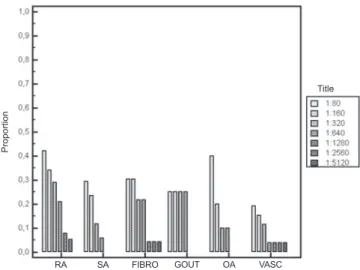
As the prevalence and diagnostic signii cance of ANA in the different AIRD are variable, the proportion of positive re-sults of ANA HEp-2 was determined for each disease repre-sented in groups 1 and 2 (Figs. 1 and 2).
Compared with the 1:80 dilution, the use of the dilution of 1:160 as reference value for the test was accompanied by a re-duction of sensitivity of ANA HEp-2, from 87.8% to 82.0%, and by an increase of specii city, from 67.8% to 73.8%.
The decrease in sensitivity was due mainly to a reduction in test positivity in patients with SLE and DM/PM. But in the patients with SSc, SS and DITC, the sensitivity remained prac-tically unchanged.
The sensitivity of ANA HEp-2 in patients with SLE was 87.5%, considering the dilution of 1:80 as the reference value. A decreased sensitivity to 81.9% was observed when only the test results in abnormal titer (> 1:160) were dei ned as positive.
In patients with DM/PM, the use of the reference value of 1:160 resulted in a decrease of diagnostic sensitivity, from 57.1% to 42.8%.
ROC curve analysis
The ROC curve analysis showed that the ANA HEp-2 test has a good performance to discriminate between group 1 and group 2 diseases. The area under the curve was 0.835 ( CI95% 0.787-0.884 , p < 0.0001 ) , and the dilution of 1:160 was the one with the best compromise between sensitivity and specii city .
The use of the healthy subject population for determin-ing the rate of false positive results of ANA HEp-2 resulted in better diagnostic performance of the test, with an area under the curve of 0.916 (CI95% 0.872-0.961, p < 0.0001). Also in this
Fig. 1 – Proportion of positive results of ANA HEp-2 by Group 1 disease, according to the title. Proportion calculated as the number of positive results considering the respective title as the cutoff value of the test, divided by the total number of patients with the disease. UCTD, undifferentiated connective tissue disease; DM/PM,
dermatomyositis/polymyositis; SSc, systemic sclerosis; SLE, systemic lupus erythematosus; SS, Sjögren syndrome.
Table 1 – Percentage of positive results of ANA Hep-2 in 126 healthy subjects, according to title.
Title
1:80 1:160 1:320 1:640
Number 17 8 5 2
Percentagea 13.5% 6.3% 4% 1.6%
a Number of positive results considering the title as the cutoff value
of the test, divided by the total number of healthy individuals.
Table 3 – Sensitivity and specifi city of ANA HEp-2, according to the title (CI95%).
Title Sensitivity Specii city
1:80 87.7% (81.1-92.7) 67.8% (58.6-76.1)
1:160 82.0% (74.6-88.0) 73.7% (64.8-81.4)
1:320 74.8% (66.8-81.8) 80.5% (72.2-87.2)
1:640 57.6% (48.9-65.9) 85.6% (77.9-91.4)
1:1280 46.8% (38.3- 55.4) 95.8% (90.4-98.6)
1:2560 27.3% (20.1-35.5) 96.6% (91.5-99.1)
1:5120 18.7% (12.6-26.2) 98.3% (94.0-99.8)
Sensitivity: calculated as the number of patients in group 1 with positive results, divided by the total number of patients in the group. Specii city: calculated as the number of patients in group 2 with negative results, divided by the total number of patients in the group.
Table 2 – Distribution of l uorescence patterns and ANA Hep-2 titles in 17 healthy subjects with a positive test.
Pattern Title Total
1:80 1:160 1:320 1:640
NFS 6 3 2 0 11 (64.7%)
NDFS 1 0 1 1 3 (17.6%)
Nucleolar 2 0 0 0 2 (11.8%)
Centromeric 0 0 0 1 1 (5.9%)
Total 9 (52.9%) 3 (17.6%) 3 (17.6%) 2 (11.9%) 17 (100%)
NFS, nuclear i ne speckled; NDFS, nuclear dense i ne speckled.
Pro
p
o
rt
io
n
Title
population, the dilution of 1:160 was the one with the best compromise between sensitivity and specii city.
As the titles of the ANA HEp-2 are an important param-eter for the interpretation of test results, and consider-ing that the high titers are more frequent in patients with AIRD, LRs specii c for the different titles of ANA HEp-2 were calculated (Table 4).
Discussion
The use of IIF HEp-2 as a method of choice for the investi-gation of ANA, the optimization of commercial kits for the detection of many autoantibodies of clinical importance, and the technological evolution of microscopes resulted in sig-nii cant increase in the sensitivity of this test. These factors, combined with the use of the test by many physicians with the objective of to exclude the diagnosis of AIRD in patients with nonspecii c signs and symptoms, had the effect of
re-ducing the specii city of ANA HEp-2, with the identii cation of positive results in a signii cant proportion of individuals without clinical evidence of AIRD.2,3,5
Several studies have investigated the frequency and dis-tribution of titles and l uorescence patterns of ANA Hep-2 in healthy subjects and in the general population.8,13,27-30 It is
im-portant to emphasize that different dei nitions were used in these studies to classify an individual as healthy or normal, besides different recruitment criteria.
Despite these conceptual disagreements, the frequency of ANA HEp-2 positivity in the healthy population was 13.5%, similar to that reported by studies conducted in Brazilian and in other populations, using different criteria of selection and dei nition of healthy individuals.8,13,27,28,29
In the study by Tan et al., the frequency of positive results of ANA Hep-2 in 125 healthy subjects, recruited by i fteen in-ternational reference centers in search of autoantibodies, was 31.7% in the title of 1:40, 13.3% in the title of 1:80, 5% in the title of 1:160 and 3.3% in the title of 1:320.8
In the other hand, Mariz et al. considered as healthy only individuals without previous or current evidence of AIRD, chronic infection and neoplastic disease, with negative serol-ogy for HIV, hepatitis B and C, and that were not under regular use of glucocorticoid, immunosuppressive, antimicrobial or anti-inl ammatory agents. Of the 918 individuals analyzed, 13.3% were positive at a dilution of 1:80, 7% at a dilution of 1:160, 6% at a dilution of 1:320, 4.4% at a dilution of 1:640 and 2,1% at dilutions ≥ 1:1280.13
Studying an ethnically heterogeneous population sample of 4,754 U.S. civilian non-institutionalized individuals aged from 12 years and without employing any specii c criteria of recruitment or exclusion, Satoh et al. found a frequency of ANA HEp-2 of 13.8% at a screening dilution of 1:80.27
Fernandez et al. investigated 500 Brazilian blood donors and found the following frequencies of positive results of ANA HEp-2: 22.6% at 1:40 dilution, 8% at 1:80 dilution, 3.4% at 1:160 dilution and 1.4% at dilutions ≥ 1:320.28
In contrast to the results described above, none of the 100 healthy blood donors from predominantly Caucasian ethnic-ity in Copple et al. study showed ANA HEp-2 positivethnic-ity in the screening dilution of 1:40.30
Such discrepancies in the prevalence of ANA may be a result of both genetic-environmental and sociodemographic
Fig. 2 – Proportion of positive results of ANA HEp-2 by Group 2 disease, according to the title. Proportion calculated as the number of positive results considering the respective title as the cutoff value of the test, divided by the total number of patients with the disease. RA, rheumatoid arthritis; SA, spondylarthritis; FIBRO, fi bromyalgia; OA, osteoarthritis; VASC, vasculitis.
Table 4 – Positive and negative likelihood ratios of different titles of ANA HEp-2, considering as “not ill” those patients in group 2 and the healthy population (CI95%).
Title GROUP 2 HEALTHY
LR+ LR- LR+
LR-1:80 2.73 (2.4-3.1) 0.18 (0.1-0.3) 6.5 (15.9-7.1) 0.14 (0.08-0.3)
1:160 3.12 (2.7-3.6) 0.24 (0.2-0.4) 20.67 (19.0-22.5) 0.19 (0.07-0.5)
1:320 3.84 (3.4-4.4) 0.31 (0.2-0.5) 18.85 (17.0-20.9) 0.26 (0.1-0.6)
1:640 3.99 (3.4-4.7) 0.5 (0.3-0.8) 36.26 (31.4-41.9) 0.43 (0.1-1.7)
1:1280 11.04 (9.2-13.2) 0.56 (0.2-1.3)
1:2560 8.06 (6.1-10.6) 0.75 (0.3-2.0)
1:5120 11.04 (7.8-15.6) 0.83 (0.2-3.3)
LR+: number of positive results in group 1 patients, divided by the number of false-positive results in patients from group 2 or in healthy individuals.
LR-: number of false-negative results in group 1, divided by the number of negative results in group 2 patients or in healthy subjects.
Pro
p
o
rt
io
n
Title
factors as technical ones. Differences between microscopes and commercial reagents, as well as the heterogeneity in the training of observers, confer high interlaboratory variability in the results of IIF HEp-2.31.32
Unlike other studies that showed a higher frequency of ANA HEp-2 positivity in females and older people, we found no differences in the frequency of ANA Hep-2 in healthy sub-jects by gender or age, dispensing thus the necessity of using specii c screening dilutions, according to these variables.26-28
It is possible that our i ndings may be explained by the small number of subjects with positive ANA in each gender and age extract, thus limiting the statistical power to detect signii cant differences between groups, as well as by the ab-sence of septuagenarian or octogenarian subjects. However, Mariz et al. also found no signii cant differences in the preva-lence of ANA according to gender or age.13
A small proportion of healthy subjects (18 subjects, 14.3%) consisted of health professionals such as physicians, lab technicians and nursing technicians. Despite some studies implying that this occupational proi le constitutes a risk fac-tor for presence of anti-dsDNA antibodies or ANA Hep-2 in high titers, especially for those handling blood samples from patients with SLE, only two individuals of that subgroup had a positive test, which makes it unlikely that the recruitment of healthy volunteers with this proi le did result in some sort of bias.8,29,33
The distribution of the l uorescence patterns and of the titles of ANA HEp-2 was similar to that described by Mariz et al.13 The only exception was the occurrence of a nuclear
centromeric speckled l uorescence pattern in a healthy indi-vidual. In the Mariz et al. study, this occurrence was observed exclusively in patients with AIRD.
Following the determination of ACR and SLIC, and adopting the CLSI guidelines for the dei nition of reference intervals in the clinical laboratory, the present study established a dilution of 1:160 as abnormal title or reference value of ANA HEp-2.6,25
Employing this dilution as a reference value for the test, the frequency of ANA in abnormal titers in SLE patients was 81.9%. Even lower frequencies of HEp-2 ANA in abnormal titles, i.e., 76.0%, can be observed in patients with established SLE.26
Besides not sacrii cing the diagnostic sensitivity of the test, the use of the 1:160 dilution for an initial screening of autoantibodies produced a 53.0% reduction in the number of positive results of ANA Hep-2 in the healthy population. As probable benei ts of increasing the specii city of the test, we can list: the reduction of the number of incorrect diagnoses and of therapeutic prescriptions potentially harmful to the patient, as well as the reduction of requests for additional ex-ams and unnecessary referrals to the rheumatologist.
The screening dilution of the test and how the patients are recruited are factors that may inl uence the frequency of ANA positivity.26,34 We did a cross-sectional evaluation of patients
with established SLE, comprising a heterogeneous group with respect to activity and duration of illness, ethnic composition and use of corticosteroids and immunosuppressants. There-fore, it is important to emphasize that in all SLE patients with a positive ANA HEp-2 test, the disease was in remission only at a dilution of 1:80. As such, it is important to emphasize that in all SLE patients with a positive ANA HEp-2 test, the disease was in remission only at a dilution of 1:80.
By studying the ROC curve, the optimal cutoff value of ANA HEp-2 for both comparison groups evaluated (group 2 and healthy subjects) was dei ned as the dilution of 1:160. Beck et al. analyzed by ROC curve the results from ANA HEp-2 of 47 patients with SLE and HEp-27 patients with other auto-immune diseases, and also found a dilution of 1:160 as the optimal cutoff value of the test.35 However, in that study the
use of dilution of 1:160 as the cutoff value was associated with a signii cant reduction in the diagnostic sensitivity of HEp-2 ANA for SLE.35 Moreover, in the study by Tan et al.,
only the dilution of 1:160 was able to adequately discrimi-nate among normal subjects and patients with SSc, SLE and SS, with sensitivities of 87.0%, 95.0% and 74.0%, respectively, and a specii city of 95%.
There is great variability in the literature as for what screening dilution to be used in the ANA HEp-2 test; some authors suggest the 1:40 dilution and others suggest dilutions of 1:160 and 1:80.8-12 However, universally they recommend
that only titers >1:160 should be considered positive or rele-vant from a diagnostic point of view, due to its higher positive predictive value for AIRD and to the presence of specii c au-toantibodies. The titles ≤ 1:80 are considered indeterminate, because they usually do not have diagnostic signii cance and are not associated with presence of specii c autoantibodies (anti-dsDNA and anti-ENA).8-12
Because this is a test for autoantibodies screening, posi-tive ANA HEp-2 results must be complemented by ordering of specii c autoantibodies. There is a well dei ned association between the titles of ANA HEp-2 and the probability of pres-ence of specii c autoantibodies.11,12 In this sense, González et
al. suggested 1:160 as the ideal screening dilution for ANA HEp-2, since this dilution has the highest positive predictive value for presence of anti-dsDNA and anti-ENA antibodies, when compared with the lower dilutions, and without com-promising the sensitivity of the test for the diagnosis of SLE.12
In the healthy population, the cutoff value of 1:80 was as-sociated with LR+ > 5, which situates a diagnostic test as very useful. However, only from the dilution of 1:160 a LR+ > 10 was obtained, considered as able to signii cantly modify the post-test probability of the disease. In the population of individuals with other rheumatic diseases, only the dilution of 1:1280 was associated to a LR+ > 5. In both populations, titles under 1:160 showed LR- < 0.2, considered as very useful to exclude the diagnosis of AIRD.
Our study has some limitations. We evaluated only pa-tients with an established diagnosis of AIRD. However, except in SLE, the immune proi le of most patients with SSc, DITC, MD/MP and SS tends to be stable over time.37-39
The results of our work were obtained with slides from the same manufacturer. Although the frequency of positive results in the healthy population was similar to studies that used slides from other manufacturers or in house, there are important qualitative differences among the commercial HEp-2 slides.8,13,27-29
serum on slides from different manufacturers (even with the use of a single microscope and the same observer).40
Finally, other factors of technical nature, such as the mi-croscope, the lamp power and the observer experience, also contribute to the great interlaboratory variability of ANA HEp-2 test.31,32 Thus, our i ndings cannot be extrapolated to other
laboratories; it is advisable that each laboratory establish its own ANA abnormal title, analyzing healthy individuals from the local population and using their own instruments.
In conclusion, the dilution of 1:160 was dei ned as the ab-normal title of ANA HEp-2 and as the optimal cutoff value of the test. Therefore, it is important to note that in situa-tions where ANA is required outside of the clinical setting, with the main objective to exclude the presence of AIRD in patients with nonspecii c clinical signs and symptoms, as has occurred in today's medical practice, and due to the high fre-quency of positive results in healthy subjects, the reference value of 1:160 would bring the benei t of a signii cant reduc-tion in the frequency of "false-positive" results without sig-nii cant loss of diagnostic sensitivity.
Conl icts of interest
The authors declare no conl icts of interest.
R E F E R E N C E S
1. Solomon DH, Kavanaugh AJ, Schur PH. Evidence-based guidelines for the use of immunologic tests: antinuclear antibody testing. Arthritis Rheum 2002;47:434-444. 2. Kavanaugh A, Tomar R, Reveille J, Solomon DH, Homburger
HA: Guidelines for clinical use of the antinuclear antibody test and tests for specii c autoantibodies to nuclear antigens. American College of Pathologists. Arch Pathol Lab Med 2000;124: 71-81.
3. Dellavance A, Júnior AG, Nuccitelli B, Taliberti BH, von Muhlen CA, Bichara CDA, et al. 3º Consenso Brasileiro para pesquisa de autoanticorpos em células HEp-2 (FAN). Recomendações para padronização do ensaio de pesquisa de autoanticorpos em células HEp-2, controle de qualidade e associações clínicas. Rev Bras Reumatol 2009;49:89-98.
4. Meroni PL, Schur PH. ANA screening: an old test with new recommendations. Ann Rheum Dis 2010;69(8):1420-2. 5. Dellavance A, Leser PG, Andrade LEC. Análise crítica do teste
de anticorpos antinúcleo (FAN) na prática clínica. Rev Bras Reumatol 2007;47:265-275.
6. Hochberg MC, for the Diagnostic and Therapeutic Criteria Committee of the American College of Rheumatology. Updating the American College of Rheumatology revised criteria for the classii cation of systemic lupus erythematosus [letter]. Arthritis Rheum 1997;40:1725. 7. Petri M, Orbai AM, Alarcón GS, Gordon C, Merrill JT, Fortin
PR, et al. Derivation and validation of the Systemic Lupus International Collaborating Clinics classii cation criteria for systemic lupus erythematosus. Arthritis Rheum 2012;64:2677-86.
8. Tan EM, Feltkamp TE, Smolen JS, Butcher B, Dawkins R, Fritzler MJ et al. Range of antinuclear antibodies in “healthy” individuals. Arthritis Rheum 1997;40:1601-11.
9. Tozzoli R, Bizzaro N, Tonutti E, Villalta D, Bassetti D, Manoni F et al. Italian Society of Laboratory Medicine Study Group on the Diagnosis of Autoimmune Diseases. Guidelines for
the laboratory use of autoantibody tests in the diagnosis and monitoring of autoimmune rheumatic diseases. Am J Clin Pathol 2002;117:316-24.
10. Sack U, Conrad K, Csernok E, Frank I, Hiepe F, Krieger T et al. Autoantibody detection using indirect immunol uorescence on HEp-2 cells. Ann N Y Acad Sci 2009; 1173:166-73. 11. Bonaguri C, Melegari A, Ballabio A, Parmeggiani M, Russo A,
Battistelli L et al. Italian multicentre study for application of a diagnostic algorithm in autoantibody testing for autoimmune rheumatic disease: Conclusive results. Autoimmun Rev 2011;11:1-5.
12. González DA, León AC, Varela AR, García MG, Rahola Mde S, Pérez Mdel C et al. Autoantibody detection with indirect immunol uorescence on HEp-2 cells: starting serum dilutions for systemic rheumatic diseases. Immunol Lett 2011;140:30-5. 13. Mariz HA, Sato EI, Barbosa SH, Rodrigues SH, Dellavance A,
Andrade LE. Pattern on the antinuclear antibody-HEp-2 test is a critical parameter for discriminating antinuclear antibody-positive healthy individuals and patients with autoimmune rheumatic diseases. Arthritis Rheum 2011;63:191-200. 14. Vitali C, Bombardieri S, Jonsson R, Moutsopoulos HM,
Alexander EL, Carsons SE et al. Classii cation criteria for Sjogren’s syndrome: a revised version of the European criteria proposed by the American-European Consensus Group. Ann Rheum Dis 2002;61:554-558.
15. Subcommittee for Scleroderma Criteria of the American Rheumatism Association Diagnostic and Therapeutic Criteria Committee. Preliminary criteria for the classii cation of systemic sclerosis (scleroderma). Arthritis Rheum 1980;23:581-590.
16. Bohan A, Peter JB. Polymyositis and dermatomyositis (i rst of two parts). N Engl J Med 1975;292:344-347.
17. Bohan A, Peter JB. Polymyositis and dermatomyositis (second of two parts). N Engl J Med 1975;292:403-407.
18. Amigues JM, Cantagrel A, Abbal M & Mazieres B. Comparative study of 4 diagnosis criteria sets for mixed connective tissue disease in patients with anti-RNP antibodies. Autoimmunity Group of the Hospitals of Toulouse. J Rheumatol 1996; 23: 2055-2062.
19. Mosca M, Neri R & Bombardieri S. Undifferentiated
connective tissue diseases (UCTD): a review of the literature and a proposal for preliminary classii cation criteria. Clin Exp Rheumatol 1999; 17: 615–620.
20. Arnett FC, Edworthy SM, Bloch DA, McShane DJ, Fries JF, Cooper NS et al. The American Rheumatism Association 1987 revised criteria for the classii cation of rheumatoid arthritis. Arthritis Rheum 1988;31:315-324.
21. Wolfe F, Smythe HA, Yunus MB, Bennett RM, Bombardier C, Goldenberg DL, et al. The American College of Rheumatology 1990 Criteria for the Classii cation of Fibromyalgia. Report of the Multicenter Criteria Committee. Arthritis Rheum 1990;33:160-72.
22. Dougados M, van der Linden S, Juhlin R, Huitfeldt B, Amor B, Calin A, et al. The European Spondyloarthropathy Study Group preliminary criteria for the classii cation of spondyloarthropathy. Arthritis Rheum 34:1218-1227, 1991. 23. Jennette JC, Falk RJ, Andrassy K, Bacon PA, Churg J, Gross WL,
et al. Nomenclature of systemic vasculitides: Proposal of an international consensus conference. Arthritis Rheum 1994; 37:187-192.
24. Rudwaleit M, van der Heijde D, Landewé R, Akkoc N, Brandt J, Chou CT, et al. The Assessment of SpondyloArthritis International Society classii cation criteria for peripheral spondyloarthritis and for spondyloarthritis in general. Ann Rheum Dis 2011;70:25–31.
26. Sjöwall C, Sturm M, Dahle C, Bengtsson AA, Jönsen A, Sturfelt G, et al. Abnormal antinuclear antibody titers are less common than generally assumed in established cases of systemic lupus erythematosus. J Rheumatol 2008;35:1994-2000.
27. Satoh M, Chan EK, Ho LA, Rose KM, Parks CG, Cohn RD, et al. Prevalence and sociodemographic correlates of antinuclear antibodies in the United States. Arthritis Rheum.
2012;64:2319-27.
28. Fernandez SA, Lobo AZ, Prado de Oliveira ZN, Fukumori LM, Perigo AM, Rivitti EA. Prevalence of antinuclear autoantibodies in the serum of normal blood donors. Rev Hosp Clin Fac Med Sao Paulo. 2003;58:315–9.
29. Marin GG, Cardiel MH, Cornejo H, Viveros ME. Prevalence of antinuclear antibodies in 3 groups of healthy individuals: blood donors, hospital personnel, and relatives of patients with autoimmune diseases. J Clin Rheumatol. 2009; 15:325-9. 30. Copple SS, Sawitzke AD, Wilson AM, Tebo AE, Hill HR.
Enzyme-linked immunosorbent assay screening then indirect immunol uorescence coni rmation of antinuclear antibodies: a statistical analysis. Am J Clin Pathol 2011;135:678-84.
31. Nossent H, Rekvig OP. Antinuclear antibody screening in this new millennium: farewell to the microscope? Scand J Rheumatol 2001;30:123-126.
32. Pham BN, Albarede S, Guyard A, Burg E, Maisonneuve P. Impact of external quality assessment on antinuclear antibody detection performance. Lupus 2005;14:113-9. 33. Zarmbinski MA, Messner RP, Mandel JS.
Anti-dsDNA antibodies in laboratory workers handling blood
from patients with systemic lupus erythematosus. J Rheumatol. 1992;19:1380-4.
34. Ippolito A, Wallace DJ, Gladman D, Fortin PR, Urowitz M, Werth V, et al. Autoantibodies in systemic lupus erythematosus: comparison of historical and current assessment of seropositivity. Lupus 2011;20:250-5. 35. Beck ST, Silva JCN, Schimit S, Fleck J, Santos RS. Taxa de
probabilidade como guia de interpretação do FAN-HEp-2 na pesquisa de autoanticorpos no lúpus eritematoso sistêmico. J Bras Patol Med Lab 2009;45:275-283.
36. American College of Rheumatology Ad Hoc Committee on Immunologic Testing Guidelines. Guidelines for immunologic laboratory testing in the rheumatic diseases: an introduction. Arthritis Care Res 2002;47:429–33.
37. Love LA, Leff RL, Fraser DD, Targoff IN, Dalakas M, Plotz PH, et al. A new approach to the classii cation of idiopathic inl ammatory myopathy: myositis-specii c autoantibodies dei ne useful homogeneous patient groups. Medicine (Baltimore) 1991; 70:360-74.
38. Mosca M, Tani C, Neri C, Baldini C, Bombardieri S. Undifferentiated connective tissue diseases (UCTD). Autoimmun Rev 2006;6:1-4.
39. Ramos-Casals M, Solans R, Rosas J, Camps MT, Gil A, Del Pino-Montes J, et al. GEMESS Study Group. Primary Sjögren syndrome in Spain: clinical and immunologic expression in 1010 patients. Medicine (Baltimore) 2008;87:210-9.