Melissa Araújo UlhôaI
Elaine Cristina MarquezeI
Lúcia Castro LemosI
Luna Gonçalves da SilvaI
Amanda Aparecida SilvaI
Patrícia NehmeI
Frida Marina FischerII
Claudia Roberta de Castro MorenoII
I Programa de Pós-Graduação em Saúde
Pública. Faculdade de Saúde Pública (FSP). Universidade de São Paulo (USP). São Paulo, SP, Brasil
II Departamento de Saúde Ambiental.
FSP-USP. São Paulo, SP, Brasil Correspondence:
Claudia Roberta de Castro Moreno Av. Dr. Arnaldo, 715 sala 314 Cerqueira Cesar
01246-904 São Paulo, SP, Brasil E-mail: [email protected] Received: 9/26/2009 Approved: 4/15/2010
Artigo disponível em português e inglês em: www.scielo.br/rsp
Minor psychiatric disorders and
working conditions in truck
drivers
ABSTRACT
OBJECTIVE: To estimate the prevalence of minor psychiatric disorders and to identify associated stressors among truck drivers.
METHODS: A cross-sectional study was conducted with 460 truck drivers from a cargo transportation company of the Southern and Southeastern regions of Brazil, in 2007. Workers completed a questionnaire about sociodemographic, lifestyle and working conditions data. Working conditions were the independent variables, including occupational stressors, job satisfaction and job demand-control. The outcome evaluated was the occurrence of minor psychiatric disorders. Multiple and univariate logistic regression analyses were performed.
RESULTS: The prevalence of minor psychiatric disorders was 6.1%. The most frequently reported stressors were traffi c congestion, tracking control and extended working hours. High job demand, low social support and extended daily working hours, as reported by drivers, were associated with minor psychiatric disorders.
CONCLUSIONS: Work involving extended working hours was associated with the occurrence of minor psychiatric disorders, both in the analysis of general working conditions and as a factor considered to be a stressor by drivers. Thus, regulation of working hours with focus on the limitation of the daily working hours is necessary to reduce the chance of developing minor psychiatric disorders in drivers.
DESCRIPTORS: Transportation. Mental Disorders, Working Conditions. Occupational Health.
INTRODUCTION
The interactions established between workers and working conditions can compromise their health. These interactions include the worker’s autonomy in their job, the level of satisfaction to perform work activities, the work perspec-tives and safety, and the human relationships established. In addition to these aspects, the rigidity of work division,9 the division itself and the content of work tasks are factors that contribute to worker’s mental suffering.13
In addition, working conditions that involve high demand, low control and lack of social support can have harmful effects on workers’ physical and mental health, such as cardiovascular diseases,15 metabolic disorders4 and psychological disorders.13
defi cit.8 Certain studies show an association between MPD and psychosocial work factors, such as high demand and low control in the job performed by nurses and nursing assistants1 and teachers.21 However, there are no data on MPD and specifi c working conditions of truck drivers in the literature.
Truck drivers are frequently subject to extended working hours, particularly irregular hours at night time, due to the urgency to deliver goods.11 The need to drive for many hours affects sleep, causes sleepiness at work and increases the risk of accidents.19 These workers are exposed to environmental stressors, such as road conditions and heavy traffi c, and to organizational stressors, such as the type of work shift and employ-ment relationship.18
These working conditions lead to the adoption of inad-equate life habits, such as alcohol consumption and smoking, in addition to sedentary lifestyle.18 Despite its relevance, this theme has hardly been approached by studies on such professionals. In this context, the present study aimed to estimate the prevalence of minor psychiatric disorders and identify stressors associated with it in truck drivers.
METHODS
A cross-sectional study was performed from March to July 2007, in which all 470 truck drivers of a cargo transportation company were invited to participate. This company has branches in the Southern and Southeastern regions of Brazil: Campinas (n=130 drivers), Rio de Janeiro (n=103), São Paulo (n=92), Belo Horizonte (n=89), Vitória (n=24), Americana (n=24) and Curitiba (n=8). A total of ten female drivers were excluded from the study. In all, 460 men, with a mean age of 39.8 years (SD=9.8), participated in this study.
Inadequate completion of certain questions of the ques-tionnaire resulted in loss. For this reason, the results showed variations in sample size.
Workers completed the questionnaire about sociodemo-graphic data, working conditions and information about alcohol consumption and smoking. Questions related to its completion were clarifi ed by a fi eld team, who were at the disposal of the drivers during the survey.
Body Mass Index (BMI) was calculated using the reported weight and height. Subsequently, this BMI was classifi ed according to reference values, established by the World Health Organization (WHO).
The following variables were analyzed: work shift (work in the day time, night time, and both), type of employment (hired or outsourced), work task (task of transference, whose function involves transferring goods to other cities; and task of collecting and delivery of goods, which involves short-haul drivers), seniority as
a professional truck driver (above and below the median – nine years), daily working hours (≤10 hours or >10 hours), having suffered occupational accidents in the last year and having more than one job. These variables were selected to characterize working conditions of truck drivers, based on the results of previous studies.12
Truck drivers reported factors that caused stress in their workplace, such as traffi c congestion, extensive working hours, confl icts with superiors and colleagues, working at night, and the impossibility of choosing the route and working hours, which comprised a group of variables analyzed separately.
The Self-Report Questionnaire (SRQ-20) was used to identify MPD, as this is an adequate screening instrument,6 developed by Harding et al8 (1980) and vali-dated to the Portuguese language by Mari & Williams16 (1986). A score with seven or more positive responses identifi es the presence of a minor psychiatric disorder.
Satisfaction in the workplace was investigated with the Portuguese version of the Occupational Stress Indicator (OSI), translated by Swan et al24 (1993). High and low satisfaction were classifi ed according to the median (87 points in the present study).
Demand, control and social support in the workplace were analyzed with the Job Stress Scale, adapted and validated to the Portuguese language by Alves et al2 (2004). This scale is widely used in the Brazilian1,5 and international scientifi c literature.13,25 A value above the median was used to categorize high control, high demand and high social support in the workplace (18, 16 and 20 points, respectively).
Data analysis included the description of the profi le of the population studied in terms of the main trend and dispersion measurements. Cronbach’s alpha of ques-tionnaires showed the following values: 0.71 (MPD); 0.70 (demand); 0.52 (control); 0.76 (social support) and 0.90 (OSI).
Simple and adjusted odds ratios were estimated, with 95% confi dence intervals (95%CI). Based on the results of univariate logistic regression, variables with p<0.20 entered the multiple regression model in a decreasing order of statistical significance (stepwise forward technique).
Multiple analysis following hierarchical levels was not performed, because the effect of each variable on the outcome of MPD in truck drivers is not known. In addition, the number of cases found was small, which restricted the number of variables in each model of the multiple logistic regression.
The present study was approved by the Research Ethics Committeeof the Faculdade de Saúde Pública da Universidade de São Paulo and conducted after participants signed an informed consent form (Protocol 1537, 2006).
RESULTS
The majority of truck drivers were married (80%), with an incomplete primary education level (60.3%), non-smokers (82.8%), social drinkers (65.5%) and overweight (62.4% with a BMI>25kg/m2). None of the drivers reported the use of psychotropic drugs.
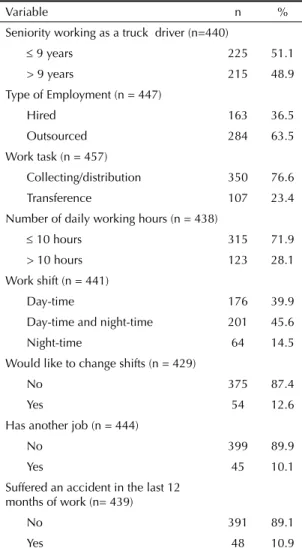
The prevalence of MPD in the population studied was 6.1%. To suffer an accident (50.7%) and being robbed (64.4%) were the most frequently reported aspects related to fear in the workplace. The self-reported factors that most often cause stress, tension or fatigue during work were: intense traffi c or congestion
(52.4%), strict control of the vehicle tracking system (36.5%) and extensive working hours (28.7%). More than 70% of drivers worked for ten hours a day or more (Table 1).
More than half (51.1%) of truck drivers reported low job satisfaction. The aspects showing the most dissatisfac-tion were as follows: salary according to experience and responsibility (52.5%), followed by the way in which confl icts are resolved (46.7%), communication and form of information fl ow in the company (46.4%), and level of participation in important decisions (46.4%). In contrast, the aspects showing the most satisfaction
Table 1. Distribution of truck drivers, according to working
condition variables. Southern and Southeastern Brazil, 2007.
Variable n %
Seniority working as a truck driver (n=440)
≤ 9 years 225 51.1 > 9 years 215 48.9
Type of Employment (n = 447)
Hired 163 36.5
Outsourced 284 63.5
Work task (n = 457)
Collecting/distribution 350 76.6
Transference 107 23.4
Number of daily working hours (n = 438)
≤ 10 hours 315 71.9 > 10 hours 123 28.1
Work shift (n = 441)
Day-time 176 39.9
Day-time and night-time 201 45.6
Night-time 64 14.5 Would like to change shifts (n = 429)
No 375 87.4
Yes 54 12.6
Has another job (n = 444)
No 399 89.9
Yes 45 10.1
Suffered an accident in the last 12 months of work (n= 439)
No 391 89.1
Yes 48 10.9
Table 2. Univariate logistic regression of minor psychiatric
disorders and factors associated with working conditions in truck drivers. Southern and Southeastern Brazil, 2007.
Variable OR 95% CI
Type of employment*(n = 447)
Hired 1
Outsourced 0.44 0.20;0.95
Work task* (n = 457)
Distribution and/or collecting 1
Transference 4.23 1.94;9.20
Work shift* * (n = 441)
Day-time 1
Day-time and night-time 1.67 0.65;4.28
Night-time 2.50 0.81;7.74 Has another job (n = 444)
No 1
Yes 1.07 0.31;3.69 Suffered an accident in the last 12 months* * (n = 439)
No 1
Yes 2.52 0.96;6.59 Seniority working as a truck driver* (n = 440)
≤ 9 years 1
> 9 years 3.95 1.56;9.99
* p < 0.05; * * p < 0.20
Table 3. Multiple logistic regression of minor psychiatric
disorders and factors associated with working conditions in truck drivers. Southern and Southeastern Brazil, 2007. (n=399).
Variable OR 95% CI
Work task*
Distribution and/or collecting 1
Transference 3.46 1.48;8.07
Seniority working as a truck Driver*
≤ 9 years 1
>9 years 3.46 1.23;9.66
were the following: relationship with other people in the company (90.1%), content of the work performed (88.2%) and the level on which the worker believes to be developing their abilities (84.6%).
Approximately one third (33%) of participants were classified as experiencing high demand; 54.9%, low control; and 60.8%, low social support in the workplace.
In the univariate analysis of factors associated with general working conditions, only work shift and having another job were not associated with MPD (Table 2).
In the multiple regression model, “to work in the area of transference”, i.e. the long haul-drivers, and “seniority as truck driver for more than nine years” remained associated with MPD (Table 3).
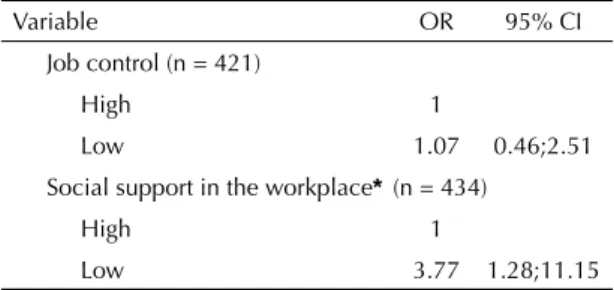
Table 4 shows the factors associated with MPD, among which the following stand out: low satisfaction, high demand, low social support in the workplace and number of working hours. In the multiple model, high psychological demand, low social support and extensive working hours remained associated with MPD (Table 5).
Table 4. Univariate logistic regression of minor psychiatric
disorders and work-related stressors reported by truck drivers and psychosocial work factors. Southern and Southeastern Brazil, 2007.
Variable OR 95% CI
Estressores
Fear of being robbed (n = 460)
No 1
Yes 0.85 0.39;1.86 Fear of dying while working* (n = 460)
No 1
Yes 3.13 1.41;6.96 Fear of falling ill due to work* (n = 460)
No 1
Yes 6.67 3.03;14.69 Fear of having an accident in the workplace (n = 460)
No 1
Yes 1.32 0.61;2.86 Intense traffi c/congestion* (n = 460)
No 1
Yes 0.41 0.18;0.92 Confl icts with superiors or colleagues* (n = 460)
No 1
Yes 3.02 1.38;6.61 Poor vehicle maintenance (n = 460)
No 1
Yes 1.22 0.50;2.95 Discomfort while driving* * (n = 460)
No 1
Yes 1.91 0.74;4.92
Working at night (n = 460)
No 1
Yes 1.40 0.58;3.41
Extensive working hours* (n = 460)
No 1
Yes 2.28 1.05;4.93
Impossibility of choosing routes (n = 460)
No 1
Yes 1.56 0.67;3.67
Strict control of the vehicle tracking system (n = 460)
No 1
Yes 1.58 0.72;3.34
Psychosocial work factors Job satisfaction* (n = 364)
High 1
Low 5.87 1.69;20.39 Job demand* (n = 424)
High 1
Low 3.54 1.56;8.01
To be continued
Table 4 continuation
Variable OR 95% CI
Job control (n = 421)
High 1
Low 1.07 0.46;2.51
Social support in the workplace* (n = 434)
High 1
Low 3.77 1.28;11.15
*p < 0.05; * *p < 0.20
Table 5. Multiple logistic regression of minor psychiatric
disorders and work-related stressors reported by truck drivers and psychosocial work factors. Southern and Southeastern Brazil, 2007. (n=356).
Variable OR 95% CI
Job demand*
Low 1
High 3.49 1.52;8.03
Apoio no trabalho*
High 1
Low 3.93 1.30;11.87
Extensive working hours reported as a stressor*
No 1
Yes 2.68 1.17;6.11
DISCUSSION
The prevalence of 6.1% of MPD in the population studied was lower than that observed in other profes-sional categories evaluated with the same instrument, such as that of public education teachers (55.9%),21 nursing professionals (33.3%)1 and cargo transportation drivers (33.0%).3 According to Gonçalves et al6 (2008), the instrument used here for the screening and
identi-fi cation of MPD (SQR-20) shows high sensitivity and specifi city and it is as effective as interviews conducted by professionals.
Data from other studies on the prevalence of MPD in truck drivers, estimated with the SQR-20 were not found in the literature. Using other instruments to investigate depression, Hilton et al10 (2009) reported a prevalence of 5.6% of mild depression and 4.4% of moderate depression in Australian drivers, while a study conducted by Silva-Júnior et al22 (2009) found a preva-lence of 13.6% in drivers of Northeastern Brazil.
The number of truck drivers on leave of absence at the time of this study was not made available to researchers by the company studied. Probably, the low prevalence found resulted from something called “healthy worker effect”. In other words, the study was conducted with healthy workers exclusively, in terms of the outcome studied, because those with a clinical diagnosis of psychiatric disorders had been on leave of absence.1 In addition, it is possible that an exclusively male popula-tion have a lower prevalence of mental disorders, once women show a prevalence of depression and anxiety two to three times higher than that found in men.14
Despite the low prevalence of MPD in the truck drivers studied, compared to other groups of workers,1,3,21 work-related factors associated with these disorders can be considered as relevant problems for these drivers. The extensive working hours reported by them as sources of stress were also associated with MPD. One of the causes of extensive working hours could be traffi c congestion, which leads to delays in deliveries and collections of goods and may consequently increase the level of stress in drivers. Perhaps, for this reason, traffi c congestion has been the factor most frequently
reported by drivers as cause of stress, in addition to its being associated with these disorders.
Truck drivers working in the area of transference drive long distances and frequently need to stay in a city other than their home city. Social and family deprivation resulting from such trips can harm their mental health13 and the exposure to acute and chronic stress increases the level of cortisol, which is also observed in depressed individuals.20 Drivers who drive many hours have high levels of cortisol.23 In terms of the type of employment, outsourcing work was a protective factor associated with psychiatric disorders. This same protective effect was observed by Silva-Júnior et al22 (2009) and it suggests that the greater autonomy that outsourced drivers have in the workplace may contribute to a reduc-tion in the occurrence of psychiatric disorders. Another explanation for this result is the possibility that hiring conditions can be worse than outsourcing conditions. A study conducted with drivers from two branches of the same company revealed a greater chance of hired drivers’ developing sleep apnea.12 The negative impact of hiring on the health of drivers is an indication that the employment contract alone is not necessarily better than outsourcing.
The present study did not fi nd an association between job control and minor psychiatric disorders, contrary to what has been observed in other professional categories, such as executives25 and civil servants.7 The relation-ship between job control and autonomy would lead to the assumption that this factor would be associated with MPD, also working as a protective factor against stress. Thus, the results obtained in the present study show the need to further research about the autonomy and control of outsourced work.
Workers’ job satisfaction depends on their own percep-tion of working condipercep-tions.17 Once the main causes of dissatisfaction are investigated, improvements must be proposed to change work environment conditions.
Due to the association between extensive working hours and the occurrence of MPD, regulation of the number of working hours is a necessary measure to reduce the chance of developing MPD in this population.
1. Araújo TM, Aquino E, Menezes G, Santos CO, Aguiar
L. Aspectos psicossociais do trabalho e distúrbios
psíquicos entre trabalhadoras de enfermagem. Rev
Saude Publica. 2003;37(4):424-33. DOI:10.1590/ S0034-89102003000400006
2. Alves MGM, Chor D, Faerstein E, Lopes CS, Werneck GL. Versão resumida da “job stress scale”: adaptação
para o português. Rev Saude Publica.
2004;38(2):164-71. DOI: 10.1590/S0034-89102004000200003
3. Cavagione LC, Pierin AMG, Batista KM, Bianch ERF, Costa ALS. A gravos à saúde, hipertensão arterial e predisposição ao estresse em motoristas de
caminhão. Rev Esc Enferm. 2009;43 n esp 2:1267-71.
DOI:10.1590/S0080-62342009000600021
4. Demiral Y, Soysal A, Can Bilgin A, Kiliç B, Unal B, Uçku R, et al. The association of job strain with Coronary heart disease and methabolic syndrome
in municipal workers in Turkey. J Occup Health.
2006;48(5):332-8. DOI:10.1539/joh.48.332
This research project was funded by the Conselho Nacional de Conhecimento Científi co e Tecnológico (CNPq), process 401165/07-8.
The authors declare that there are no confl icts of interest.
5. Fischer FM, Oliveira DC, Nagai R, Teixeira LR, Lombardi Júnior M, Latorre MRDO, et al. Job control, job demands, social support at work and
health among adolescent workers. Rev Saude
Publica. 2005;39(2):245-53. DOI:10.1590/S0034-89102005000200016
6. Gonçalves DM, Stein AT, Kapczinski F. Avaliação de
desempenho do Self-Reporting Questionnaire como
instrumento de rastreamento psiquiátrico: um estudo
comparativo com o Structured Clinical Interviewfor
DSM-IV-TR. Cad Saude Publica. 2008;24(2):380-90. DOI:10.1590/S0102-311X2008000200017
7. Gustafsson K, Lindfors P, Aronsson G, Lundberg U. Relationships between self-rating of recovery from
work and morning salivary cortisol. J Occup Health.
2008;50(1):24-30. DOI:10.1539/joh.50.24
8. Harding TW, de Arango MV, Baltazar J, Climent CE, Ibrahim HH, Ladrido-Ignacio L, et al. Mental disorders in primary health care: a study of their frequency and diagnosis in four developing countries.
Psychol Med. 1980;10(2):231-41. DOI:10.1017/ S0033291700043993
9. Härmä M, Kompier MA, Vahtera J. Work-related stress and health-risks, mechanisms and countermeasures.
Scand J Work Environ Health. 2006;32(6):413-9.
10. Hilton MF, Staddon Z, Sheridan J, Whiteford HA. The impact of mental health symptoms on heavy
good vehicle drivers´performance. Acc Anal Prev.
2009;41(3):453-61. DOI:10.1016/j.aap.2009.01.012 |
11. Horne J, Reyner L. Vehicle accidents related to sleep:
a review. Occup Environ Med. 1999;56(5):289-94.
DOI:10.1136/oem.56.5.289
12. Lemos LC, Marqueze EC, Sachi F, Lorenzi-Filho G, Moreno CRC. Síndrome da apnéia obstrutiva
do sono em motoristas de caminhão. J Bras
Pneumologia. 2009;35(6):500-6. DOI:10.1590/S1806-37132009000600002
13. Lindström M. Psychosocial work conditions,
unemployment and self-reported psychological health:
a population-based study. Occup Med(London).
2005;55(7):568-71. DOI:10.1093/occmed/kqi122
14. Ludermir AB. Desigualdades de classe e gênero e
saúde mental nas cidades. Physis. 2008;18(3):451-67.
DOI:10.1590/S0103-73312008000300005
15. Malinauskiene T, Theorell T, Grazuleviciene R, Malinauskas R, Azaraviciene A. Low job control and a myocardial infarction risk in the occupational
categories of Kaunas men, Lithuania. J Epidemiol
Community Health. 2004;58(2):131-5. DOI:10.1136/ jech.58.2.131
16. Mari JJ, Williams P. A validity study of a psychiatric screening questionnaire (SRQ-20) in primary
care in the city of São Paulo. Br J Psychiatry.
1986;148:23-6. DOI:10.1192/bjp.148.1.23
17. Marqueze EC, Moreno CRC. Satisfação no trabalho:
uma breve revisão. Rev Bras Saude Ocupacional.
2005;30(112):69-79.
18. Moreno CR, Carvalho FA, Lorenzi C, Matuzaki LS, Prezotti S, Bighetti P, et al. High risk for obstructive sleep apnea in truck drivers estimated by the Berlin questionnaire: prevalence and associated factors.
Chronobiol Int. 2004;21(6):871-9. DOI:10.1081/CBI-200036880
19. De Pinho RS, da Silva-Júnior FP, Bastos JPC, Maia WS, Mello MT, Bruin VMS, et al. Hypersomnolence and accidents in truck drivers: a cross-sectional
study. Chronobiol Int. 2006;3(5):963-71.
DOI:10.1080/07420520600920759
20. Pruessner M, Hellhammer DH, Pruessner JC, Sonia J. Lupien SJ. Self-reported depressive symptoms and stress levels in healthy young men: associations with
the cortisol response to awakening. Psychosomatic
Medicine. 2003;65(1):92-9. DOI:10.1097/01. PSY.0000040950.22044.10
21. Reis EJFB, Carvalho MF, Araújo TM, Porto LA, Silvany Neto AM. Trabalho e distúrbios psíquicos em professores da rede municipal de Vitória da Conquista, Bahia, Brasil. Cad Saude Publica. 2005;21(5):1480-90. DOI:10.1590/S0102-311X2005000500021
22. Silva-Júnior FP, de Pinho RS, de Mello MT, de Bruin VM, de Bruin PF. Risk factors for depression in truck drivers. Soc Psychiatry Psychiatr Epidemiol. 2009;44(2):125-9. DOI:10.1007/s00127-008-0412-3
23. Sluiter JK, van der Beek AJ, Frings-Dresen MH. Work stress and recovery measured by urinary catecholamines and cortisol excretion in long distance coach drivers. Occup Environ Med. 1998;55(6):407-13. DOI:10.1136/oem.55.6.407
24. Swan JA, Moraes LFR, Cooper CL. Developing the occupational stress indicator (OSI) for use in Brazil: A report on the reliability and validity of the translated OSI. Stress Med. 1993;9(4):247-53. DOI:10.1002/ smi.2460090407