Sônia Cristina Lima ChavesI
Sandra Garrido de BarrosI
Denise Nogueira CruzI
Andreia Cristina Leal FigueiredoI
Bárbara Laisa Alves MouraII
Maria Cristina Teixeira CangussuI
I Departamento de Odontologia Social e Pediátrica. Faculdade de Odontologia. Universidade Federal da Bahia (UFBA). Salvador, BA, Brasil
II Programa de Pós-Graduação em Saúde Comunitária. Instituto de Saúde Coletiva. UFBA. Salvador, BA, Brasil
Correspondence: Sônia Cristina Lima Chaves R. Araújo Pinho, 62 – Canela 40110-912 Salvador, BA, Brasil E-mail: [email protected] Received: 9/21/2009 Approved: 5/14/2010
Article available from: www.scielo.br/rsp
Brazilian Oral Health
Policy: factors associated
with comprehensiveness
in health care
ABSTRACT
OBJECTIVE: To analyze the factors associated with comprehensiveness in oral health care in Centers of Dental Specialists, according to the guiding principles of the Brazilian Oral Health Policy.
METHODS: An exploratory cross-sectional study, based on an interview with 611 users of four specialized dental care centers, was performed in the state of Bahia, Northeastern Brazil, in 2008. The dependent variable was described as “comprehensiveness in oral health care”, corresponding to having a primary dental care performed before specialized treatment or concomitantly with it. The main covariables referred to the level of coverage of the family health strategy in the city, users’ sociodemographic characteristics, and organizational and geographic accessibility to the service, in addition to the type of specialized care required.
RESULTS: Residents of the cities where the Family Healthcare Program had a coverage ≥50% were more likely to conclude their dental treatment (PR=2.03, 95% CI: 1.33;3.09), compared to those who lived in places with lower coverage. Individuals who sought endodontic treatment were more likely to receive comprehensive oral health care than users who were seeking other types of specialized care (PR=2.31, 95% CI: 1.67;3.19). Users with better geographic accessibility to specialized services (PR=1.22, 95% CI: 1.03;1.41), with a reference guide from primary care (PR=2.95, 95% CI: 1.82;4.78) and coming from primary health care services (PR=3.13, 95% CI: 1.70;5.77) were more likely to achieve comprehensiveness in oral health care than other users.
CONCLUSIONS: Users with better geographic accessibility, lower age and need of endodontic services were more likely to receive comprehensive health care. Implementation of Centers of Dental Specialists in cities where primary healthcare is not adequately structured is not recommended, because secondary health care would meet the free demand and perform basic procedures, thus not fulfi lling the expected principle of comprehensiveness.
DESCRIPTORS: Comprehensive Dental Care. Health Services Accessibility. Dental Health Services. Public Health Dentistry. Health Policy. Cross-Sectional Studies.
INTRODUCTION
The Brazilian Oral Health Policy(PNSB), formulated and launched in the Brazilian political agenda in 2004, intended to provide secondary dental care in Centers of Dental Specialists (CDS).10 The CDS are establishments
periodontics, minor oral surgeries of soft and hard tissues, endodontics and dental care for individuals with special needs.a
Studies on the formulation of the PNSB and the incorporation of oral health into the federal govern-ment’s political agenda indicate that the fact that this was a key issue in the federal government’s agenda between 2002 and 2006 was the result of the strategic action of a group of participants involved in the health movement.b,c Evaluation studies focusing on the
imple-mentation of policies are essential to make decisions aimed at their improvement and adjustments to their initial formulation.15
The PNSB directives seek universal access and compre-hensiveness in oral health care. According to Paim,15
the conceptual foundations of the Brazilian Health Reform originally included comprehensiveness in at least four perspectives: a) integration of health promo-tion, protecpromo-tion, recovery and rehabilitation actions; b) a type of professional performance that included the biological, psychological and social dimensions; c) guarantee of continuing care in the distinct levels of complexity of health services;12 d) integration of
several public policies associated with a set of projects of changes (urban and agrarian reforms, among other things), which dealt with living and health conditions through intersectoral action.
In addition, the coordination between primary and secondary care, here understood as “action or effort in common”,d also known as “interface” by certain
authors,14 has been the focus of attention in recent
reforms of European health systems with initiatives to strengthen the primary health system.e In these countries,
possible forms of interface with secondary care, in addi-tion to the tradiaddi-tional referral to perform procedures, range from “short or long-term” consulting and the common defi nition of case management protocols to the development of programs of health care shared between specialties and primary care professionals.7,d These paths
can also be constructed in local health systems. However, the expected comprehensiveness, understood as the integration between levels or between promotion and rehabilitation actions, requires good primary care coverage to enable the interface and adequate use of oral health services. This use, in its turn, can also be infl uenced by the accessibility to services, understood
a Ministério da Saúde. Secretaria de Atenção à Saúde. Coordenação Nacional de Saúde Bucal. Diretrizes da política nacional de saúde bucal. Brasília, 2004 [cited 2008 Oct 2]. Available from: http://portal.saude.gov.br/portal/arquivos/pdf/politica_nacional_brasil_sorridente.pdf. b Garcia DV. A construção da Política Nacional de Saúde Bucal: percorrendo os bastidores do processo de formulação [Master’s dissertation]. Rio de Janeiro: Instituto de Medicina Social da Universidade do Estado do Rio de Janeiro; 2006.
c Bartole MCS. Da boca cheia de dentes ao Brasil Sorridente: uma análise retórica da formulação da política nacional de saúde bucal formulação [Master’s dissertation]. Rio de Janeiro: Instituto de Medicina Social da Universidade do Estado do Rio de Janeiro; 2006. d Starfi eld B. Coordenação da atenção: juntando tudo. In: Starfi eld B. Atenção primária: equilíbrio entre necessidades de saúde, serviços e tecnologia. Brasília: UNESCO Brasil/ Ministério da Saúde; 2004. p.365-415.
e Organização mundial da saúde. Fundo das nações unidas para a Infância. Declaração de Alma Ata: saúde para todos no ano 2000. In: Conferência Internacional sobre Cuidados de Saúde Primários; 1978 set 12 [cited 2008 Dec 10]; Cazaquistão, URSS. 1978. Available from: http://saudepublica.web.pt/05-promocaosaude/dec_alma-ata.htm
as the relationship between the obstacles imposed by the services and the abilities of users to overcome such diffi culties.11 Among the service factors associated
with greater use are the adequate offer of procedures, according to the population needs, the geographic and organizational accessibility, and the defi nition of a health professional to follow each case, particularly specialized procedures.13
The implementation of the CDS can be a relevant strategy aimed at comprehensiveness in oral health care, especially associated with the fi rst and third perspec-tives indicated by Paim.15 A study by Figueiredo &
Góes9 identifi ed different CDS performances, according
to the population size and Human Development Index of the covered areas. However, no studies that analyzed the scope of comprehensiveness in oral health care, expected by the above mentioned policy, were found. Thus, the present study aimed to analyze the factors associated with comprehensiveness in oral health care in CDS, in the state of Bahia, Northeastern Brazil, according to the guiding principles of the PNSB.
METHODS
An exploratory cross-sectional study was conducted with a random sample of 611 users of four Centers of Dental Specialists of different cities in Bahia. The criteria of inclusion of CDS were as follows: a) a ministerial decree published at least one and a half year before; b) minimum number of procedures of average complexity in the Unifi ed Health System Outpatient Clinic Information System(SIA-SUS), in 2007 and 2008; c) municipal management. Even if the city had more than one CDS meeting these criteria, only one center per city was analyzed.
The study population to evaluate access was comprised of all CDS users, including those accompanying children, who required secondary care from May to August 2008. A simple random demand sample was calculated, with proportional allocation per CDS, using the N of outpatient clinic production in 2007 as basis of calculation.
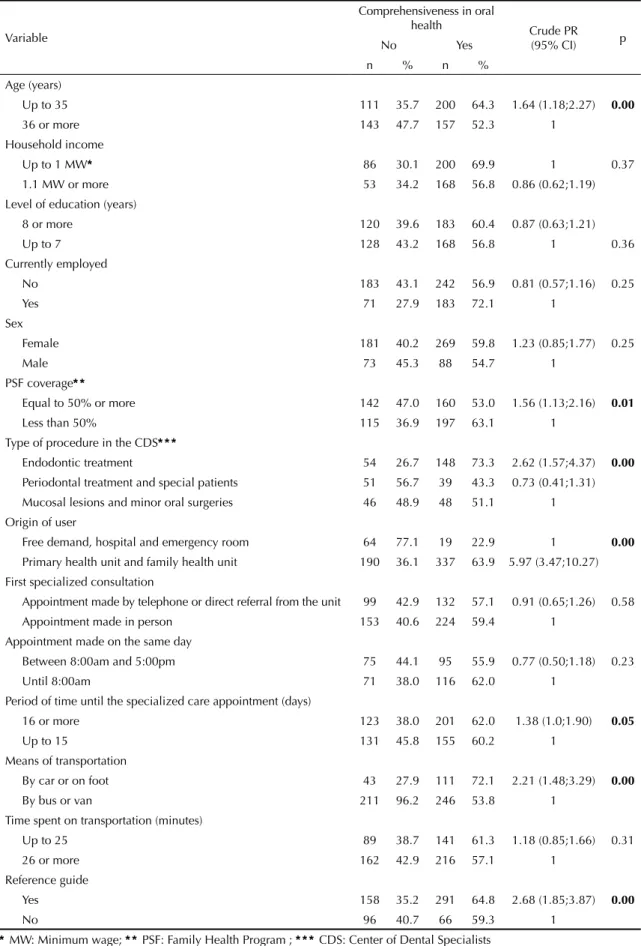
Table 1. Association between comprehensiveness in oral health and socioeconomic, demographic and access to specialized dental services variables. Bahia, Northeastern Brazil, 2008.
Variable
Comprehensiveness in oral
health Crude PR (95% CI) p
No Yes
n % n %
Age (years)
Up to 35 111 35.7 200 64.3 1.64 (1.18;2.27) 0.00
36 or more 143 47.7 157 52.3 1
Household income
Up to 1 MW* 86 30.1 200 69.9 1 0.37
1.1 MW or more 53 34.2 168 56.8 0.86 (0.62;1.19) Level of education (years)
8 or more 120 39.6 183 60.4 0.87 (0.63;1.21)
Up to 7 128 43.2 168 56.8 1 0.36
Currently employed
No 183 43.1 242 56.9 0.81 (0.57;1.16) 0.25
Yes 71 27.9 183 72.1 1
Sex
Female 181 40.2 269 59.8 1.23 (0.85;1.77) 0.25
Male 73 45.3 88 54.7 1
PSF coverage* *
Equal to 50% or more 142 47.0 160 53.0 1.56 (1.13;2.16) 0.01
Less than 50% 115 36.9 197 63.1 1
Type of procedure in the CDS* * *
Endodontic treatment 54 26.7 148 73.3 2.62 (1.57;4.37) 0.00
Periodontal treatment and special patients 51 56.7 39 43.3 0.73 (0.41;1.31) Mucosal lesions and minor oral surgeries 46 48.9 48 51.1 1 Origin of user
Free demand, hospital and emergency room 64 77.1 19 22.9 1 0.00
Primary health unit and family health unit 190 36.1 337 63.9 5.97 (3.47;10.27) First specialized consultation
Appointment made by telephone or direct referral from the unit 99 42.9 132 57.1 0.91 (0.65;1.26) 0.58 Appointment made in person 153 40.6 224 59.4 1
Appointment made on the same day
Between 8:00am and 5:00pm 75 44.1 95 55.9 0.77 (0.50;1.18) 0.23
Until 8:00am 71 38.0 116 62.0 1
Period of time until the specialized care appointment (days)
16 or more 123 38.0 201 62.0 1.38 (1.0;1.90) 0.05
Up to 15 131 45.8 155 60.2 1
Means of transportation
By car or on foot 43 27.9 111 72.1 2.21 (1.48;3.29) 0.00
By bus or van 211 96.2 246 53.8 1
Time spent on transportation (minutes)
Up to 25 89 38.7 141 61.3 1.18 (0.85;1.66) 0.31
26 or more 162 42.9 216 57.1 1
Reference guide
Yes 158 35.2 291 64.8 2.68 (1.85;3.87) 0.00
No 96 40.7 66 59.3 1
* MW: Minimum wage; * * PSF: Family Health Program ; * * * CDS: Center of Dental Specialists
Users with a previous appointment were approached and interviewed in the waiting room before this appoint-ment, in different days of the week, to prevent bias associated with the offer of specifi c procedures per day. The percentage of refusal was lower than 1%.
Accessibility refers to how accessible a service is, when compared to the ability of use by potential users, including the organizational and geographic dimensions that facilitate or hinder this use.5,6
Comprehensiveness in oral health care comprises the integration of oral health promotion, protection, recovery and rehabilitation actions, in addition to the guarantee of integration among the distinct levels of complexity of the health service system, according to Paim & Vieira-da-Silva.16
The interview guide included questions about the main factors associated with the use of health services, described in empirical7,9 and synthesis studies on this
theme13 (Attachment).
The dependent variable was described as “comprehen-siveness in oral health care”, when the user reported having primary dental care performed before special-ized care or concomitantly with it.
The following covariables, related with sociodemo-graphic and occupational characteristics of users, were also included in the analysis: age, household income, level of education, sex and employment. Continuous covariables were categorized by the median.
With regard to organizational access, the variables analyzed were as follows:
a. How the fi rst appointment was made (in person, by telephone, or direct referral from the unit); b. Origin of user (primary care or free demand,
including hospital, emergency room or private dentist);
c. Time the appointment was made (before 8:00am or between 8:00am and 5:00pm);
d. Period of time until the specialized care appoint-ment (number of days between the day when appointment was made and the day of fi rst consulta-tion/procedure in the CDS).
The following variables were considered for the geographic access:
a. Means of transportation used to go to the CDS (on foot or by bicycle, bus and other means);
b. Time spent to go to the CDS (lower or equal to 25 minutes or higher than 25 minutes).
With regard to the procedures performed, the following were analyzed:
a. Procedures required in the CDS (endodontic and periodontal treatments, treatment for patients with special needs, and mucosal lesion/minor oral surgery, in addition to primary care procedures and X-rays);
b. Procedures performed in primary care, which can be preventive (cleaning, supervised oral hygiene and application of fl uoride) or curative (dental extrac-tions and restoration).
Coverage of the Family Health Program/Oral Health Team (PSF/ESB) in the city was considered as a cova-riable of the health system that could infl uence the guarantee of comprehensiveness in oral health care. Data were input to the EpiInfo program, version 6.04, and analyzed in the Stata program, version
Table 2. Final model of logistic regression analysis of the
association between comprehensiveness in oral health care and socioeconomic, demographic and access to specialized dental services variables. Bahia, Northeastern Brazil, 2008.
Variable Adjusted PR (95% CI)
Age (years)
Up to 35 1.42 (1.01;2.01)
36 or more 1
PSF coverage*
Equal to 50% or more 2.03 (1.33;3.09)
More than 50% 1
Type of procedure in the CDS* *
Endodontic treatment 2.31 (1.67; 3.19)
Periodontal treatment
and special patients 0.70 (0.47;1.06) Mucosal lesions and
minor oral surgeries 1 Origin of user
Primary health units and
family health units 3.13 (1.70;5.77) Free demand, hospital
and emergency room 1 Period of time until the specialized
care appointment (days)
16 or more 1.81 (1.17;2.79)
Up to 15 1
Means of transportation
By car or on foot 1.22 (1.03;1.41)
By bus or van 1
Reference guide
Yes 2.95 (1.82;4.78)
No 1
* PSF: Family Health Program * * CDS: Center of Dental Specialists
7.0. Bivariate analysis was performed between the dependent variable and the independent variables with the application of the chi-square test, which resulted in the determination of the prevalence ratio (PR) and respective 95% confi dence interval for each characteristic of the study population. Next, multiple analysis was performed, using the Poisson regression method,2 only including the variables associated with
the outcome, with a signifi cance level lower than or equal to 0.2, aiming to control possible confounding factors. The variables associated with the outcome, with a signifi cance level lower than 0.05, remained in the model (age, PSF coverage in the city, origin of user, type of procedure in the CDS, period of time to make a specialized care appointment, means of transportation used and reference guide).
This research project was approved by the Research Ethics Committee of the Instituto de Saúde Coletiva da Universidade Federal da Bahia (UFBA) (Register CEP-ISC 005-07, approved on May 31, 2007). All participants signed an informed consent form, guaran-teeing anonymity and confi dentiality of information.
RESULTS
The majority of participants (73.6%) was female. Mean age was 36.7 years (SD=17.2) and 56.9% (n=286) of individuals had a household income of up to one minimum wage. The most frequent level of education was primary education (46.4%). Among individuals who sought the CDS, 58.4% (n=357) stated that they were having or had already had a certain primary dental care procedure performed. Between 32.4% and 79.5% of users of the four CDS analyzed had primary dental care performed before specialized care or concomi-tantly with it, thus characterizing comprehensiveness in oral health. Among the primary care procedures already performed, there were few reports of supervised oral hygiene (8.9%). Previous dental cleaning and applica-tion of fl uoride were reported by 52.3% and 22.5% of participants, respectively. The majority (73.6%, n=449) stated that they arrived at a secondary care service with a reference guide. A total of 61.7% (n=377) of users made an appointment in person, at the reception, to access a specialized care service. However, the majority reported that they did not have to stand in line (64.7%) and that the most frequent time to make an appointment was between 8:00am and 5:00pm (68.6%). The majority of participants arrived at a specialized care service as the result of a referral from primary care (86.9%), although many had done this due to the free demand or other recommendations, such as those from private dentists (13.1%). There was a considerable number of users (n=59) who were in a specialized care service to have a primary care procedure performed (14.9%). The period of time until the specialized care appointment was lower than 15 days in 47.5% of users (n=286).
In the bivariate analysis between the “comprehensive-ness in oral health care” variable and the socioeco-nomic, demographic and access to specialized dental services variables (Table 1), individuals aged up to 35 years (PR=1.64, 95% CI: 1.18;2.27) and those living in cities with a PSF coverage equal to or higher than 50% (PR=1.56, 95% CI: 1.13;2.16) had a greater chance to complete the treatment.
Users who needed endodontic treatment were 2.62 times more likely to complete their treatment than those who sought specialized services to have mucosal lesions treated or minor oral surgeries performed (PR=2.62, 95% CI: 1.57;4.37).
With regard to access to specialized care services, individuals referred by Primary Health Units (UBS) and Family Health Units(USF) of the primary care system were 5.97 times more likely to conclude their primary care treatment than those who arrived due to free demand or a referral from an emergency room or hospital (PR=5.97, 95% CI: 3.47;10.27).
After being referred to a CDS, users who could easily reach this center (on foot or by car) (PR=2.21, 95% CI: 1.48;3.29), who had made an appointment for 16 days later or more (PR=1.38, 95% CI: 1.0;1.90), and who had a reference guide (PR=2.68, 95% CI: 1.85;3.87) had a higher chance to achieve comprehensiveness in oral health care, compared to those who arrived by bus, who had made an appointment for up to 15 days later and who did not have a reference guide (p=0.05) (Table 1).
Table 2 showed the Poisson regression model. In the
fi nal model, it was observed that individuals with a greater chance of completing their dental treatment were those who lived in cities with a PSF coverage equal to or higher than 50% (PR=2.03, 95% CI: 1.33;3.09), when compared to others who lived in places where such coverage was lower. In addition, users seeking endodontic treatment were more likely to obtain comprehensiveness in oral health care than those seeking other specialties in the CDS (PR=2.31, 95% CI: 1.67;3.19). Users with easier geographic access to specialized services (PR=1.22, 95% CI: 1.03;1.41), with a reference guide (PR=2.95, 95% CI: 1.82;4.78), who came from primary care services (PR=3.13, 95% CI: 1.70;5.77) and who had made an appointment for 16 days later or more (PR=1.81, 95% CI: 1.17;2.79) continued to have a greater chance of obtaining comprehensiveness in oral health care, compared to other users.
DISCUSSION
in oral health care in the CDS. The main factor refers to the greater primary care coverage in areas where specialized care services are situated, in addition to lower user age and type of need of service required. In this case, endodontics showed a greater chance of guaranteeing this continuity than the remaining special-ties provided in the CDS.
Systematic review studies that discuss factors associated with health service use and, as a result, the possibility of comprehensiveness in oral health care, reveal that the patient’s attribution of responsibility to a primary care health professional facilitates access13 to secondary
care. In addition, by taking on such responsibility, this professional begins to be acknowledged as one who defends the patient.7,14,d
In a system based on primary care, this works as an entry into the remaining health care levels, also contributing to resource rationalization and improving the use of medical technologies that are more costly and complex.7
Morris & Burke14 describe the ideal interface between
primary and secondary oral health care using four characteristics: a) free indiscriminate access to special-ized care after referral; b) reference system, where all services that are not available in primary care are provided in secondary care; c) fast and adequate referral, with counter-reference for primary care at the end of the specialized treatment; d) facilitated return to secondary care, whenever necessary.
The analysis of factors relevant to comprehensive-ness in oral health care in the CDS studied point to better results where the Family Health Strategy is the way the municipal health system is organized, with an emphasis on an integrated and structured service network, capable of making user reference and counter-reference operational. However, as regards the commu-nication between primary and secondary care, 73.6% of users reported having a reference guide, although this does not guarantee that a certain procedure will be performed in primary care, nor that the quality of this referral will be analyzed. This is considered to be a relevant gap in studies on the coordination of health care or interface.12
In view of this situation, the implementation of centers of dental specialists in cities where primary care is not adequately structured is not recommended. The secondary care services would be exposed to the pressures of the free demand and typical primary care procedures would be performed in them, thus changing their main objective, according to the current national policy,10 which guarantees comprehensiveness
in oral health care, providing procedures of higher
technological complexity.
A study based on secondary outpatient clinic produc-tion data (SIA-SUS) observed that cities with a PSF coverage higher than 50% had worse performance in terms of meeting the goals in general.9 Based on the
results observed, the authors suggest that the higher PSF coverage be reviewed as a selection criterion for CDS implementation. The limitation of use of the SIA-SUS databases as the only source should be analyzed for such inference.3 There are countless factors that could
interfere with the recording of procedures, including the existence of pre-established goals.d In addition, the
goals proposed by the ministerial decrees are question-able, once they are not based on the potential offer of procedures per specialty, only considering the type of CDS to achieve this. Such discussion is a relevant gap in the sense of investigating the relationship between the offer and use of these services.
The user makes an investment to have the procedure performed, when the time and transport expenses are taken into consideration. Proximity to the specialized service is important, in terms of its central location, when compared to primary health units. This is a relevant aspect to guarantee comprehensiveness in oral health care found in the present study. It was observed that only 25.2% of users reported ease of access to the CDS (on foot, by bicycle or car). Ferreira & Loureiro8 suggest a
reduction in the barrier of access with the increase in the time of consultation, implying a lower number of visits, so that the cost for the patient is reduced.
The present study pointed out that the actions proposed by the PNSB must be integrated to primary care and that their implementation can only have an effect on the guarantee of comprehensiveness with the adequate offer of procedures and reduction in the obstacles to oral health services, including a good rate of utilization by users. A great defi ciency in primary care was observed, when it comes to the performance of the essential practice of supervised oral hygiene in the dental chair, because only 8.9% of users reported having had this type of practice performed on this level of health care. Such evidence could have a negative repercussion for the achievement of the expected comprehensiveness. The main limitation to this study was the use of a demand sample, instead of a population-based sample. In other words, the present study did not identify indi-viduals who did not go to the CDS, only those who did, something that could indicate biased access, as observed by Assis et al.1 It is suggested that specifi c studies per
1. Assis MMA, Villa TCS, Nascimento MAA. Acesso aos serviços de saúde: uma possibilidade a ser construída na prática. Cienc Saude Coletiva. 2003;8(3):815-23. DOI:10.1590/S1413-81232003000300016 2. Barros AJ, Hirakata VN. Alternatives for logistic
regression in cross-sectional studies: an empirical comparison of models that directly estimate the prevalence ratio. BMC Med Res Methodol. 2003;3:21. DOI:10.1186/1471-2288-3-21
3. Barros SG, Chaves SCL. Utilização do Sistema de informações Ambulatoriais (SIA-SUS) com instrumento para caracterização das ações de saúde bucal. Epidemiol Serv Saude. 2003;12:41-51.
4. Bolfarine H, Bussab WO. Elementos de amostragem. São Paulo: Edgard Blücher, 2005.
5. Donabedian A. The quality care. How can it be assessed? JAMA. 1988;260(12):1743-8.
6. Donabedian A. Formulating Criteria and Standards. In: Donabedian A. An introduction to quality assurance in health care. Oxford: Oxford University Press, 2003. p 59-76.
7. Faulkner A, Mills N, Bainton D, Baxter K, Kinnersley P, Peters TJ, et al. A systematic rewiew of the effect of primary care-based service innovations on quality and patterns of referral to specialist secondary care. Br J Gen Pract. 2003;53(496):872-84.
8. Ferreira CA, Loureiro CA. Custos para implantação e operação de serviço de saúde bucal na perspectiva do serviço e da sociedade. Cad Saude Publica. 2008;24(9):2071-80. DOI:10.1590/S0102-311X2008000900013
9. Figueiredo N, Goes PSA. Construção da atenção secundária em saúde bucal: um estudo sobre os Centros de Especialidades Odontológicas
em Pernambuco, Brasil. Cad Saude Publica. 2009;25(2):259-67. DOI:10.1590/S0102-311X2009000200004
10. Frazão P, Narvai PC. Saúde bucal no Sistema Único de Saúde: 20 anos de lutas por uma política pública. Saude Debate. 2009;33(81):64-71.
11. Frenk JM. El concepto y la medición de accesibilidad. In: White KL, editor. Investigaciones sobre servicios de salud: una antología. Washington, DC: OPS; 1992. p. 929-43.
12. Giovanella L, Lobato LVC, Carvalho AI, Conill EM, Cunha EM. Sistemas municipais de saúde e a diretriz para integralidade: critérios para avaliação. Saude Debate. 2002;26(60):37-61.
13. Mendoza-Sassi R, Beria JU. Utilización de los servicios de salud: una revisión sistemática sobre los factores relacionados. Cad Saude Publica. 2001;17(4):819-32. DOI:10.1590/S0102-311X2001000400016
14. Morris AJ, Burke FJT. Primary and secondary dental care: how ideal is the interface? British Dental J. 2001;191(12):666-70. DOI:10.1038/sj.bdj.4801263a 15. Paim JS. Bases conceituais da reforma sanitária
brasileira. In: Fleury S, organizador. A luta do Cebes. São Paulo: Lemos; 1997.
16. Paim JS, Vieira-da-Silva LM. Desafi os e possibilidades de práticas avaliativas de sistemas universais e integrais de saúde. In: Pinheiro R, Mattos RA, organizadores. Gestão em redes práticas de avaliação, formação e participação na saúde. Rio de Janeiro: Cepesc/IMS/ UERJ/Abrasco; 2006. p 91-111.
17. Solla JJSP, Reis AAC, Soter APM, Fernandes AS, Palma JJL. Mudanças recentes no fi nanciamento federal do Sistema Único de Saúde: atenção básica à saúde. Rev Bras Saude Matern Infant. 2007;7(4):495-502. DOI:10.1590/S1519-38292007000400018 REFERENCES
Research funded by Fundação de Amparo à Pesquisa do Estado da Bahia/Conselho Nacional de Desenvolvimento Científi co e Tecnológico/Programa de Pesquisa e Desenvolvimento Científi co e Tecnológico Prioritário para o Sistema Único de Saúde (Process Nº 0037/2007; PPSUS Announcement).
Attachment. Questionnaire for users of the Centers of Dental Specialists with an appointment made on the same day. I. User profi le
Name: ___________________________________ How old are you? ______ years old 1. Sex:
1. Male 2. Female
2. How many years of school did you complete? _______complete years of education 3. Are you currently working?
1.Yes 2.No 4. If so, what is your job?
____________________________________________________ 5. If not, what was your last job?
______________________________ II. Use and Access
6. What procedure do you have an appointment for in the Center of Dental Specialists?
1. Endodontic treatment 2. Periodontal treatment 3. Special patient 4. Mucosal lesion 5. Minor oral surgery 6. Other 7. Primary care 8. Prosthesis 9. X-ray
7. Are you undergoing or have you undergone primary dental care before coming to this Center? 1.Yes 2.No
8. If so, what procedures have you undergone? (not excluding)
1. Simple restoration 2. lDental cleaning 3. Supervised oral hygiene
4. Tooth extraction(s) 5. Application of fl uoride 6. Other What? ________________ 7.Does not apply 9. Were you referred to the CDS with a reference guide?
1.Yes 2.No
10. How did you come to this CDS?
1. Free demand 2. Referred by a health clinic 3. Referred by a USF 4.Private clinic 5. Hospital 6. Emergency room 7. Other How? ________________
11. How did you get this fi rst consultation to be cared for here?
1. Obtained the appointment slip today 2. Made an appointment in person at the reception 3. The primary health unit made the appointment 5. Waiting list in the CDS
6. An acquainted health network professional made the appointment 7. Someone else (friend/family member) made the appointment
8. Made the appointment by telephone 9. Other. What? ______________________ Considering that the appointment was made in person:
12. Was there a line to make the appointment? 1.Yes 2.No 3. Does not apply
13. What time did you arrive to make the appointment (him/her or someone else)? ___hour ___minutes Does not apply
14. How long before was the appointment made (period of time between the day the appointment was made and the day of consultation in days)?
____days Does not apply 15. Means of transportation used:
1. On foot 2. Bus 3. Bicycle 4. Car 5. Other __________________________ 16. How long did it take you to come to the CDS?
_____minutes
17. What is your household income (in minimum wages)?
1. Without income 2. Up to 1 MW 3. More than 1 to 2 MW 4. More than 2 to 3 MW