Rev Saúde Pública 2005;39(2)
www.fsp.usp.br/rsp
Prevalence of noise-induced hearing loss in
metallurgical company
M aximiliano Ribeiro Guerrab, Paulo M aurício Campanha Lourençoa, M aria Teresa Bustamante-Teixeirab and M árcio José M artins Alvesb
aDepartamento de Epidemiologia. Instituto de Medicina Social. Universidade do Estado do Rio de
Janeiro. Rio de Janeiro, RJ, Brasil. bNúcleo de Assessoria, Treinamento e Estudos em Saúde (NATES).
Universidade Federal de Juiz de Fora. Juiz de Fora, MG, Brasil
*Ministério da Previdência e Assistência Social. Norma Técnica para Avaliação da Incapacidade – PAIR, de 5 de agosto de 1998. Aprova Norma Técnica sobre perda auditiva neurossensorial por exposição continuada a níveis elevados de pressão sonora. Ordem de Serviço INSS/DSS nº 608, Brasília (DF); 1998.
Part of a master’s degree dissertation presented to the Departamento de Epidemiologia, Instituto de Medicina Social, Universidade do Estado do Rio de Janeiro (IMS/UERJ), in 2002.
Work carried out at the company Cetest Rio Ltda, with its main premises in Benfica, RJ, Brazil. Received on 13/10/2003. Reviewed on 21/6/2004. Approved on 14/7/2004.
Correspondence to: Maximiliano Ribeiro Guerra
NATES - Universidade Federal de Juiz de Fora Campus Universitário Martelos
36036-330 Juiz de Fora, MG, Brasil E-mail: [email protected]
Keywords
Hearing loss, noise-induced, epidemiology. Workers. Occupational exposure. Noise, occupational. Occupational health. Cross-sectional studies. Prevalence.
Abstract
Objective
To analyze the prevalence of cases suggestive of noise-induced hearing loss (NIHL) among metalworkers who were potentially exposed to occupational noise (from 83 to 102 dB).
Methods
A cross-sectional study was carried out in a metalworking company providing services in Rio de Janeiro, Brazil. Clinical and occupational data on 182 workers who were active between November 2001 and March 2002 were obtained from the company’s Hearing Conservation Program and analyzed. In order to characterize the noise exposure status within the work environment, the acoustic classifications from the operating units of the client companies were used, due to difficulty in quantification at an individual level. Associations between these cases and variables such as age, length of service in the company, length of exposure to occupational noise and degree of use of individual protection equipment were tested by means of prevalence ratios and logistic regression analysis. Results
The prevalence of cases suggestive of NIHL was 15.9% and significant associations (p<0.05) were identified from multivariate analysis between these cases and the variables of age and degree of use of individual protection equipment.
Conclusions
The results found contribute towards better understanding of the behavior of some of the main characteristics of NIHL, in a particular situation of the organizing of work that is relatively common in the Brazilian industrial context.
Even though the existence of noise in the work-ing environment is considered to be one of the main risk factors in the genesis of occupational hearing loss, other agents of diverse nature may cause hear-ing def icits, through interaction with noise, thereby increasing the effect of noise on hearing.3 A variety of factors are often related to the occur-rence of hearing losses, such as age, cranial trauma, exposure to noise outside of the workplace, smok-ing, systemic diseases, family history of hearing def icits and exposure to chemical agents in the workplace.1,2,6,11,13
INTRODUCTION
Rev Saúde Pública 2005;39(2)
www.fsp.usp.br/rsp Hearing loss in metalworking company
Guerra MR et al
ment. Thus, all the workers studied were classified as potentially exposed to occupational noise, since they performed their activities in production sectors with sound pressure levels above the legal tolerance limit for eight hours per day (>85 dB),* according to the assessment for the Environmental Risk Prevention Program that was carried out in the company in 2001. These sound pressure levels varied not only from sec-tor to secsec-tor, but also within secsec-tors, ranging from 83 to 102 dB, according to the activity performed: sched-uled preventive maintenance and/or unschedsched-uled cor-rective maintenance (measurements made using the Minipa MSL 1350 digital decibel meter with inter-nal calibrator).
A self-administered questionnaire drawn up through the company’s own Hearing Conservation Program was utilized. This was based on present knowledge of the natural history of NIHL, so that a data collection instrument could be constructed that would enable investigation of the main factors associated with this illness. In accordance with the priorities of the pre-ventive program, which was destined solely for the population exposed to occupational noise, the ques-tionnaire was initially applied to the workers dis-persed around the various client companies. This stage of the data collection was performed as an integral part of the Hearing Conservation Program, and was conducted together with talks on auditory health-care for the workers, with clarifications about NIHL, the issuing of Work Accident Communications (CAT) when necessary, and the distribution of individual protection equipment.
A databank was set up, containing all the information available from the questionnaire and also from the records of the company’s specialized service for safety engineering and occupational medicine (SESMT). These records consisted of audiometry results, other clinical data and administrative information. All the audiomet-ric examinations were performed by service providers of recognized technical quality, in accordance with the norms recommended in Brazil.*
The variables analyzed were the following:
Dependent variable (outcome)
The dependent variable was hearing loss sugges-tive of NIHL, which was characterized from evidence of neurosensory hearing deficit suggestive of NIHL in the audiometric examinations, according to the criteria established by Ordinance no. 19 of the Min-istry of Labor and Employment (1998).8
*Ministério da Previdência e Assistência Social. Norma Técnica para Avaliação da Incapacidade – PAIR, de 5 de agosto de 1998. Aprova Norma Técnica sobre perda auditiva neurossensorial por exposição continuada a níveis elevados de pressão sonora. Ordem de Serviço INSS/DSS nº 608, Brasília (DF); 1998.
The diagnosis of NIHL of occupational origin de-pends on the typical representation seen on audio-grams and the proving of the existence of exposure to noise within the working environment, while always considering the intensity and characteristics of the agent, as well as the type of exposure.*
In most cases, NIHL does not cause incapacity for work.* This leads to notification difficulties regard-ing this hazard to workers’ health in Brazil. Thus, the estimates of the prevalence of this illness among the different categories of workers in Brazil are basically made by means of epidemiological studies.1,7,9,10,12,14,15
Although NIHL has practically reached endemic proportions within the industrial environment, scien-tific studies on its natural history among Brazilian workers are still scarce.4 The great imprecision in quan-tifying the level of individual exposure to noise ob-served in Brazilian industry should also be noted. Sus-tained scientific exploration of the behavior of NIHL among these workers therefore becomes necessary.
The present study had the objective of analyzing the prevalence of hearing loss that was suggestive of NIHL among the workers at a metalworking company, whose exposure to occupational noise at the indi-vidual level was difficult to characterize.
M ETH O D S
This was a study with cross-section delineation, carried out from November 2001 to March 2002, in a private metalworking company that provides techni-cal services of preventive and corrective mechanitechni-cal maintenance for medium to large-sized refrigeration equipment, located in the city of Rio de Janeiro, Bra-zil. Metalworkers who provided services within cli-ent companies that were included within the scope of the Hearing Conservation Program during the period of the research were analyzed. Thus, 194 workers filled out questionnaires, of whom 12 (6.2%) were excluded because there were no audiometric results for these workers. The study was therefore conducted on 182 workers, who represented around 74% of the total number of workers who were providing services within these companies.
environ-!
Rev Saúde Pública 2005;39(2)
www.fsp.usp.br/rsp
Hearing loss in metalworking company Guerra MR et al
Independent variables (exposure)
The independent variables were age, length of serv-ice in the company, total length of exposure to occu-pational noise (estimated from the workers’ reported individual perception of exposure to the physical agents over the course of their whole working lives), degree of use of individual protection equipment (char-acterized by reports of utilization of ear defenders by workers whenever they were performing activities in noisy environments), exposure to noise outside of the workplace (habit of using firearms, going to noisy par-ties, or letting off fireworks or mortars), occupational exposure to chemical products (solvents, reducing agents, oils and greases), family history of hearing defi-cits, present and/or previous history of smoking, per-sonal history of hypertension and diabetes mellitus, and previous history of cranial trauma. The distribu-tion of frequent complaints of buzzing sounds and hearing difficulties in noisy environments among the study population were also analyzed.
The data analysis observed the following steps: • Univariate analysis with a description of the
distribution of the dependent and independent variables in the study population;
• Bivariate analysis, done by crossing the dichotomous dependent variable with each of the independent variables, in accordance with their nature, by means of contingency tables (chi-squared test and, when necessary, the Fisher exact test). In the 2x2 tables, prevalence ratios (PR) and odds ratios (OR) were calculated, with their respective 95% confidence intervals 95% (95% CI). To test differences between means, the Student t test was utilized;
• Multivariate analysis for controlling for confound-ing factors, by means of multiple logistic regression using the manual backward-forward stepwise strategy.5 For the multivariate analysis, the most significant variables (p≤0.2) from the bivariate analysis and/or most relevant variables in the context of NIHL were selected. The criteria for variables to be kept in the final model also took into account the signif icance level and the relevance of these variables, in addition to the quality of model adjustment. The presence of interaction between age and length of exposure to occupational noise was also investigated.
The values of the likelihood ratio and the Hosmer-Lemeshow test, respectively, were utilized to assess significance and the quality of model adjustment, at all stages. The statistical software utilized was Epi Info (version 6.04b), for data entry and analysis, and SPSS 8.0 for Windows, for the multivariate analyses.
The present research was approved by the research ethics committee of the University Hospital of the Federal University of Juiz de Fora (CEP/HU-UFJF).
RESU LTS
The study population was made up solely of male workers, with ages ranging from 19 to 70 years (me-dian: 35.5; 25th percentile: 25.0; 75th percentile: 46.0), and 61.5% aged no more than 40 years. The mean length of service in the company was 7.6 years (me-dian: 5.0; 25th percentile: 2.0; 75th percentile: 12.1). The mean length of exposure to noise in the working environment was 9.9 years (median: 6.0; 25th percen-tile: 2.0; 75th percentile: 16.0). The prevalence of cases suggestive of NIHL was 15.9%, with a confidence interval of 10.9% to 22.1%.
In the bivariate analysis, the distribution of cases sug-gestive of NIHL presented significantly increasing preva-lence (p<0.05) that was directly proportional to increas-ing age, length of service in the company and length of exposure to occupational noise. The PR for length of exposure to occupational noise greater than or equal to 20 years was 4.65 (95% CI: 2.01-10.72). The prevalence of cases suggestive of NIHL was lower among the work-ers who reported that they regularly used individual protection equipment (p=0.09) and higher among those who reported occupational exposure to chemical prod-ucts (p=0.3), in relation to the workers who did not re-port these facts (Table 1).
The workers with audiometry results suggestive of NIHL presented mean age, mean length of service in the company and mean length of exposure to occu-pational noise of 50.2 years, 14.1 years and 16.6 years, respectively. These figures were greater than those observed for the other workers (p<0.05) (Table 2).
" Rev Saúde Pública 2005;39(2)
www.fsp.usp.br/rsp Hearing loss in metalworking company
Guerra MR et al
sounds and hearing difficulties in noisy environments, respectively (Table 3).
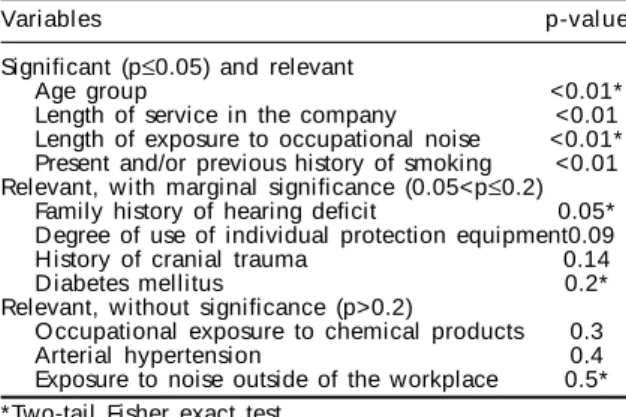
Eleven variables were selected for the modeling process (logistic regression), in accordance with their statistical significance and/or relevance (Table 4).
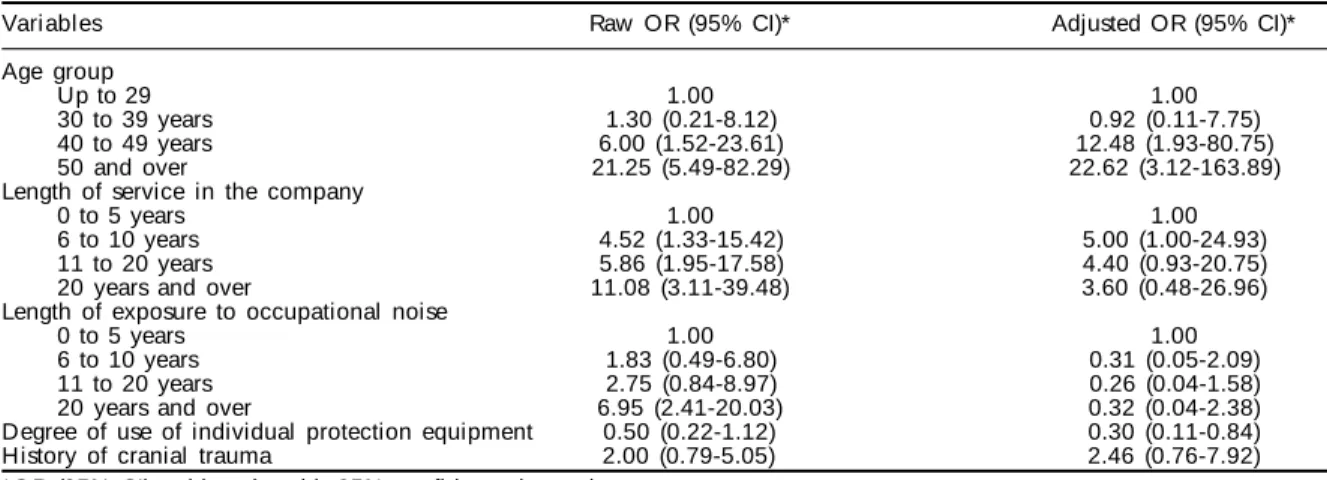
The interaction term that was evaluated (age and length of exposure to occupational noise) was not significant, thus indicating that the effects of these factors were independent. The final model identified the variables of age and degree of use of individual protection equipment as significantly associated with cases suggestive of NIHL (p<0.05), after controlling for potential confounding factors (Table 5). Accord-ing to the value of the likelihood ratio, the model was shown to be significant as a whole (p<0.01), and presented good adjustment quality, as assessed by the Hosmer-Lemeshow test (p=0.65).
D ISCU SSIO N
The present study was conducted together with the company’s Hearing Conservation Program, and a large proportion of the information was obtained by means
of a questionnaire drawn up for this program. Thus, the survey had the burden of some limitations relat-ing to the decision to work with data comrelat-ing from a scheduled activity that was in progress. The priori-ties adopted for the program, with the aim of verify-ing the need for immediate assistance for the client companies, always gave consideration to the client companies to which the greatest contingents of work-ers were allocated. Since the data collection was re-stricted to a period of around five months, the pro-gram did not achieve 100% coverage over the period considered in its proposal for performing evaluations on all workers with potential exposure to noise in the working environment. At first sight, doubts could be raised regarding the representativeness of the study population. However, according to technical assess-ments by the SESMT, the workers who were not as-sisted through the Hearing Conservation Program during this period did not present conditions of ex-posure to occupational agents that differed from those of the other workers. Thus, it is believed that no sig-nificant selection bias occurred.
According to the bibliographic survey carried out, the prevalence of cases suggestive of NIHL found
Table 1 - Percentage distribution of the population studied (%), prevalence of cases suggestive of NIHL and prevalence ratio, according to age group and occupational data.
Variables % Preval ence PR (95% IC)* p-val ue
Age group
Up to 29 39.0 4.2% 1.00
30 to 39 years 20.3 5.4% 1.28 (0.22-7.32) 1.00**
40 to 49 years 23.6 20.9% 4.95 (1.42-17.30) <0.01**
50 and over 17.0 48.4% 11.45 (3.57-36.73) <0.01**
Length of service in the company
0 to 5 years 55.5 5.9% 1.00
6 to 10 years 14.8 22.2% 3.74 (1.31-10.68) <0.01
11 to 20 years 20.3 27.0% 4.55 (1.78-11.64) <0.01
20 years and over 9.3 41.2% 6.93 (2.65-18.14) <0.01
Length of exposure to occupational noise
0 to 5 years 48.6 8.3% 1.00
6 to 10 years 16.2 14.3% 1.71 (0.54-5.42) 0.46**
11 to 20 years 17.3 20.0% 2.40 (0.88-6.57) 0.08
20 years and over 17.9 38.7% 4.65 (2.01-10.72) <0.01
Degree of use of individual protection equipment
Not used regularly 44.2 21.3% 1.00
U sed regularly 55.8 11.9% 0.56 (0.28-1.10) 0.09
Occupational exposure to chemical products
N o 53.6 13.4% 1.00
Yes 46.4 19.0% 1.42 (0.73-2.78) 0.3
Data relate only to the workers who gave information (rate of withholding information was less than 10%) *PR (95% CI): prevalence ratio with 95% confidence interval
**Two-tail Fisher exact test
Table 2 - Mean and standard deviation (SD), in years, of workers’ ages and length of service in the company and their total length of exposure to occupational noise, according to the classification of the audiometric tracing.
Variables Case suggestive of NIHL p-val ue* *
Yes N o
M ean (SD ) M ean (SD )
Age 50.2 (±12.3) 34.1 (±10.7) <0.01
Length of service in the company 14.1 (±8.3) 6.4 (±6.5) <0.01 Length of exposure to occupational noise* 16.6 (±11.2) 8.6 (±9.0) <0.01
SD : Standard deviation
NIHL: Noise-induced hearing loss
#
Rev Saúde Pública 2005;39(2)
www.fsp.usp.br/rsp
Hearing loss in metalworking company Guerra MR et al
in the present study (15.9%) was less than was found in all the other studies analyzed. These other stud-ies presented a range of prevalences from 28.5 to 46.2%.1,7,9,10,12,14,15 This observation needs to take into account the fact that these other studies were per-formed on different categories of Brazilian workers. In addition to this, the lower prevalence of cases suggestive of NIHL observed in the present study may also be related to the level of exposure to occu-pational noise that the workers studied were sub-jected to. This noise presented quantification diffi-culties at the individual level, due mainly to the nature of the activity performed: preventive main-tenance (scheduled) and corrective mainmain-tenance (unpredictable).
The association between the cases suggestive of NIHL and age deserves highlighting, given that the prevalence of such cases rose as the age group in-creased (p<0.01). This occurred in an independent manner, and was around 11.45 times greater among workers aged over 50 years, in relation to workers aged under 30 years (95% CI: 3.57 to 36.73). This finding is consistent with the data in the literature.1,2 The degree of use of individual protection equip-ment also presented a statistical association with cases suggestive of NIHL (p=0.02), after controlling for possible confounding variables. Thus, it was shown that there was a lower prevalence of cases suggestive of NIHL among workers who reported that they regu-larly used protection, in relation to those who said
they used protection occasionally or not at all (PR: 0.56; 95% CI: 0.28-1.10). This emphasizes the need for individual protection equipment use to be indi-cated, made to fit and followed up when the collec-tive protection measures are unsatisfactory.*
Even though length of service in the company (p=0.18) and positive history of cranial trauma (p=0.13) only presented marginal significance (0.05<p<0.2), they merit consideration because they are very rel-evant in the context of this illness and presented raw OR within the limits of the 95% confidence interval of the adjusted OR.
It was observed that the prevalence of cases sug-gestive of NIHL was greater for workers with more
Table 3 - Percentage distribution of the population studied, prevalence of cases suggestive of noise-induced hearing loss and prevalence ratios, according to data on exposure to noise outside of the workplace, history of cranial trauma, morbidity in the worker and his family, auditory symptoms and smoking.
Variables % Preval ence PR (95% CI)* p-val ue
Exposure to noise outside of the workplace
N o 97.8 15.7% 1.00
Yes 2.2 25.0% 1.59 (0.28-8.97) 0.5**
History of cranial trauma
N o 81.5 13.8% 1.00
Yes 18.5 24.2% 1.76 (0.85-3.64) 0.14
Arterial hypertension
N o 87.6 15.5% 1.00
Yes 12.4 22.7% 1.47 (0.62-3.45) 0.4
Diabetes mellitus
N o 94.4 15.6% 1.00
Yes 5.6 30.0% 1.93 (0.70-5.29) 0.2**
Family history of hearing deficit
N o 82.1 18.3% 1.00
Yes 17.9 3.2% 0.18 (0.02-1.25) 0.05**
History of smoking
N o 70.9 9.4% 1.00
Yes 29.1 32.7% 3.46 (1.78-6.73) <0.01
Buzzing sounds
N ever/ sometimes 98.3 15.3% 1.00
Al w ays 1.7 33.3% 2.17 (0.42-11.17) 0.4**
H earing difficulties
N ever/someti mes 95.6 13.9% 1.00
Al w ays 4.4 62.5% 4.48 (2.33-8.60) <0.01**
Data relate only to the workers who gave information (rate of withholding information was less than 10%) *PR (95% CI): prevalence ratio with 95% confidence interval
**Two-tail Fisher exact test
Table 4 - Variables introduced during the modeling process, according to the respective selection criteria.
Variables p-val ue
Significant (p≤0.05) and relevant
Age group <0.01*
Length of service in the company <0.01 Length of exposure to occupational noise <0.01* Present and/or previous history of smoking <0.01 Relevant, with marginal significance (0.05<p≤0.2)
Family history of hearing deficit 0.05* Degree of use of individual protection equipment0.09 History of cranial trauma 0.14
Diabetes mellitus 0.2*
Relevant, without significance (p>0.2)
Occupational exposure to chemical products 0.3
Arterial hypertension 0.4
Exposure to noise outside of the workplace 0.5* *Two-tail Fisher exact test
$ Rev Saúde Pública 2005;39(2)
www.fsp.usp.br/rsp Hearing loss in metalworking company
Guerra MR et al
than six years of service in the company than for those with shorter service. This finding may indi-cate that various working environments within the production sectors of the client companies may be contributing towards the occurrence of this hazard to workers’ health. The prevalence of cases sugges-tive of NIHL was around 1.8 times greater among workers with a positive history of cranial trauma than for those who were negative for such trauma. This is in accordance with the need to investigate this fac-tor when there are workers with a hearing deficit suggestive of NIHL, so as to gain a better etiologi-cal understanding.2,*
The length of exposure to noise in the working en-vironment was shown to be not significant in the ad-justed model (p=0.48), thereby indicating the influ-ence of the other variables on the raw measurement. This finding may be explained by the fact that this variable, which was reported by the workers, is very subject to information bias. It may be overestimated or underestimated due to a variety of interests, such as the obtaining of some legal assistance. It is worth commenting that the average length of exposure to occupational noise that was reported (9.9 years) was greater than the average length of service in the com-pany in question (7.6 years), which may suggest prior exposure to noise in previous activities.
Although the statistical results indicated indepen-dence between age and length of exposure to occu-pational noise, the possibility of collinearity can only be eliminated by pairing the study participants by age, under different exposure conditions, which was not done in this case. It also needs to be taken into consideration that, even though the association be-tween exposure to chemical products and NIHL was not significant in the present study (p>0.05), the lack of exposure measurement results and lack of detailed exposure history do not allow such an association to be dismissed.
Even with all the limitations already discussed, the present study has enabled better comprehension of the behavior of some of the principal characteristics that are related to NIHL, in a particular situation of the organizing of work that is relatively common in the industrial environment. Similar studies under-taken in the future will certainly enable an ever-closer interpretation of the real situation of Brazilian work-ers. Every approach undertaken must always be placed within its context, because of the diversity of occu-pational health questions in Brazil and the difficul-ties in researching this field in this country. Such investigations not only involve various problems of a technical nature, but also financial interests and significant legal implications.
*Ministério da Previdência e Assistência Social. Norma Técnica para Avaliação da Incapacidade – PAIR, de 5 de agosto de 1998. Aprova Norma Técnica sobre perda auditiva neurossensorial por exposição continuada a níveis elevados de pressão sonora. Ordem de Serviço INSS/DSS nº 608, Brasília (DF); 1998.
REFEREN CES
1. Barbosa ASM . Ruído urbano e perda auditiva: o caso da exposição ocupacional em atividades ligadas à coordenação do tráfego de veículos no município de São Paulo [dissertação de mestrado]. São Paulo: Faculdade de Saúde Pública da U niversidade de São Paulo; 2001.
Table 5 - Raw and adjusted odds ratios (final logistic regression model) and the respective 95% confidence intervals.
*OR (95% CI): odds ratio with 95% confidence interval
Variables Raw OR (95% CI)* Adjusted OR (95% CI)*
Age group
Up to 29 1.00 1.00
30 to 39 years 1.30 (0.21-8.12) 0.92 (0.11-7.75)
40 to 49 years 6.00 (1.52-23.61) 12.48 (1.93-80.75)
50 and over 21.25 (5.49-82.29) 22.62 (3.12-163.89)
Length of service in the company
0 to 5 years 1.00 1.00
6 to 10 years 4.52 (1.33-15.42) 5.00 (1.00-24.93)
11 to 20 years 5.86 (1.95-17.58) 4.40 (0.93-20.75)
20 years and over 11.08 (3.11-39.48) 3.60 (0.48-26.96)
Length of exposure to occupational noise
0 to 5 years 1.00 1.00
6 to 10 years 1.83 (0.49-6.80) 0.31 (0.05-2.09)
11 to 20 years 2.75 (0.84-8.97) 0.26 (0.04-1.58)
20 years and over 6.95 (2.41-20.03) 0.32 (0.04-2.38)
Degree of use of individual protection equipment 0.50 (0.22-1.12) 0.30 (0.11-0.84) History of cranial trauma 2.00 (0.79-5.05) 2.46 (0.76-7.92)
%
Rev Saúde Pública 2005;39(2)
www.fsp.usp.br/rsp
Hearing loss in metalworking company Guerra MR et al
10. Miranda CR, Dias CR. Perda auditiva induzida pelo ruído em trabalhadores em bandas e em trios elétricos de Salvador, Bahia. Rev Bras Saude Ocup 1998;25(93/94):99-118.
11. Morata TC, Lemasters GK. Considerações epidemioló-gicas para o estudo de perdas auditivas ocupacionais. In: Nudelmann AA, Costa EA, Seligman J, Ibagñez RN. PAIR: perda auditiva induzida pelo ruído. Rio de Janeiro: Revinter; 2001. v. 2, cap. 1, p. 1-16.
12. Oliveira TMT, Reis ABF, Bossi C, Pagnossim DF, Pereira LF, Mello MC et al. Implantação de um programa de conservação auditiva em uma indústria de bebidas. Rev Bras Saude Ocup 1997;24(89/90):31-6.
13. Phaneuf R, Hetu R. An epidemiological perspective of the causes of hearing loss among industrial workers. J Otolaryngol 1990;19(1):31-40.
14. Ruggieri M, Cattan S, Giardini LDL, Oliveira KAS. Deficiência auditiva induzida por ruído em 472 trabalhadores da região do ABC Paulista. Arq Med ABC 1991;14(1):19-23.
15. Santos LF, Shiraishi NY, Silva JS, Prioste SV, Koishi SM, Lima CJ et al. Estudo de prevalência da perda auditiva induzida por ruído em trabalhadores de uma indústria gráfica. Disturb Comun 1998;10(1):45-58. 3. Da Costa EA, Kitamura S. Órgãos dos sentidos:
audição. In: Mendes R. Patologia do trabalho. Belo Horizonte: Atheneu; 1997. p. 365-87.
4. De Almeida SIC, Albernaz PLM, Zaia PA, Xavier OG, Karazaw a EH I. H istória natural da perda auditiva ocupacional provocada por ruído. Rev Assoc Med Bras 2000;46(2):143-58.
5. Hosmer DW, Lemeshow S. Applied logistic regression. USA: Wiley-Interscience Publication; 1989.
6. Kwitko A, Ferreira PG, França MT, Zanzini C, Steggiorin S. Perdas auditivas ocupacionais: análise de variáveis e diagnóstico. Rev Bras Méd
Otorrinolaringol 1996;3(3):151-64.
7. Martins AL, Alvarenga KF, Bevilacqua MC, Costa Filho OA. Perda auditiva em motoristas e cobradores de ônibus. Rev Bras Otorrinolaringol 2001;67(4):467-73.
8. Ministério do Trabalho e Emprego. Portaria nº 19, de 9 de abril de 1998. Estabelece diretrizes e parâmetros mínimos para avaliação e acompanhamento da audição em trabalhadores expostos a níveis de pressão sonora elevados. Diário Oficial da União, Brasília (DF), 22 abr. 1998.