Health self-assessment by hemodialysis
patients in the Brazilian Unified Health
System
Tiago Ricardo MoreiraI, Luana GiattiII, Cibele Comini CesarIII, Eli Iola Gurgel AndradeIV, Francisco
de Assis AcurcioV, Mariângela Leal CherchigliaIV
I Departamento de Medicina e Enfermagem. Universidade Federal de Viçosa. Viçosa, MG, Brasil
II Departamento de Nutrição Clínica e Social. Escola de Nutrição. Universidade Federal de Ouro Preto. Ouro
Preto, MG, Brasil
III Departamento de Estatística. Instituto de Ciências Exatas. Universidade Federal de Minas Gerais. Belo
Horizonte, MG, Brasil
IV Departamento de Medicina Preventiva e Social. Faculdade de Medicina. Universidade Federal de Minas
Gerais. Belo Horizonte, MG, Brasil
V Departamento de Farmácia Social. Faculdade de Farmácia. Universidade Federal de Minas Gerais. Belo
Horizonte, MG, Brasil
ABSTRACT
OBJECTIVE: To examine whether the level of complexity of the services structure and sociodemographic and clinical characteristics of patients in hemodialysis are associated with the prevalence of poor health self-assessment.
METHODS: In this cross-sectional study, we evaluated 1,621 patients with chronic terminal kidney disease on hemodialysis accompanied in 81 dialysis services in the Brazilian Uniied Health System in 2007. Sampling was performed by conglomerate in two stages and a structured questionnaire was applied to participants. Multilevel multiple logistic regression was used for data analysis.
RESULTS: he prevalence of poor health self-assessment was of 54.5%, and in multivariable analysis it was associated with the following variables: increasing age (OR = 1.02; 95%CI 1.01–1.02), separated or divorced marital status (OR = 0.62; 95%CI 0.34–0.88), having 12 years or more of study (OR = 0.51; 95%CI 0.37–0.71), spending more than 60 minutes in commuting between home and the dialysis service (OR = 1.80; 95%CI 1.29–2.51), having three or more self-referred diseases (OR = 2.20; 95%CI 1.33–3.62), and reporting some (OR = 2.17; 95%CI 1.66–2.84) or a lot of (OR = 2.74; 95%CI 2.04–3.68) trouble falling asleep. Individuals in treatment in dialysis services with the highest level of complexity in the structure presented less chance of performing a self-assessment of their health as bad (OR = 0.59; 95%CI 0.42–0.84).
CONCLUSIONS: We showed poor health self-assessment is associated with age, years of formal education, marital status, home commuting time to the dialysis service, number of self-referred diseases, report of trouble sleeping, and also with the level of complexity of the structure of health services. Acknowledging these factors can contribute to the development of strategies to improve the health of patients in hemodialysis in the Brazilian Uniied Health System.
DESCRIPTORS: Renal Insuiciency, Chronic, psychology. Renal Dialysis. Self-Assessment. Sickness Impact Proile. Attitude to Health. Outcome and Process Assessment (Health Care). Uniied Health System. Cross-Sectional Studies.
Correspondence: Tiago Ricardo Moreira Departamento de Medicina e Enfermagem
Universidade Federal de Viçosa Av. Peter Henry Rolfs, s/n Sala 401 Campus Universitário
36570-900 Viçosa, MG, Brasil E-mail: [email protected]
Received: 30 Sep 2014 Approved: 9 Jun 2015
How to cite: Moreira TR, Giatti L, Cesar CC, Andrade EIG, Acurcio FA, Cherchiglia ML. Health self-assessment by hemodialysis patients in the Brazilian Unified Health System (SUS). Rev Saude Publica. 2016;50:10.
Copyright: This is an open-access article distributed under the terms of the Creative Commons Attribution License, which permits unrestricted use, distribution, and reproduction in any medium, provided that the original author and source are credited.
INTRODUCTION
Health self-assessment is a comprehensive and solid subjective measure of health, besides being considered a strong predictor of disability9, usage of health services14, and mortality7. he context in which the individual lives can inluence the health self-assessment, which, in turn, can aggregate
and summarize the biological, psychosocial, and social dimensions of health5.
Among the factors associated with the worse health self-assessment are sociodemographic characteristics, such as female gender4, advanced age4,19, and lower levels of education3,4 and
income3, as well as unhealthy behaviors5, presence of objective health conditions19, functional
incapacity3,4,20, and psychosocial aspects, such as social isolation5. he presence of chronic diseases directly inluences health self-assessment, and the presence of bad self-assessment
grows as the number of referred diseases increases4.
Few studies have assessed the association between health self-assessment and chronic kidney disease21,25. Chronic kidney disease is a public health problem characterized by high
morbidity and mortality, impacting economic, social, and personal aspects, as well as the health system. Patients with chronic kidney disease who develop end-stage renal disease
require dialysis (hemodialysis or peritoneal dialysis) for the rest of their lives or require kidney
transplant, carried out in speciic health services21. he quality and the performance of the
dialysis services are fundamental to maintaining the best clinical condition of the patients27.
he characteristics of dialysis services inluence the quality of life of patients in treatment2
and its results, as the reduction in the rate of urea after the hemodialysis session23, the control
of anemia8 and the survival time6.
Studies have also shown that the prevalence of poor health self-assessment in hemodialysis patients with end-stage chronic kidney disease is high when compared to the prevalence observed in the total population21,25. In that case, similarities with the prevalence found in
patients with other chronic diseases, such as coronary heart disease and cancer are pointed
out25. his study aimed to assess whether the level of complexity of the structure of services
and sociodemographic and clinical characteristics of patients in hemodialysis are associated with the prevalence of poor health self-assessment.
METHODS
In this cross-sectional study, survey data were used by the Project TRS – Epidemiological and Economic Evaluation of Substitute Renal herapy Modalities in Brazil, led by the Research Group in Health Economics at the Universidade Federal de Minas Gerais in 2007.
he TRS project participants were recruited in dialysis units (n = 81) and transplant centers (n = 17) registered at the Brazilian Society of Nephrology. he criteria for inclusion
of participants were: being over 18 years old, being diagnosed with late-stage chronic kidney disease and being in dialysis for at least three months, or having performed a kidney transplant at least six months before. Patients who did multiple transplants were excluded. A representative sample was obtained at the services of dialysis and transplant centers
contracted with the Brazilian Uniied Health System (SUS). Sampling by conglomerate was used in two stages: in the irst one, dialysis services and transplant centers were sampled;
in the second, patients in treatment at dialysis centers and transplant services sampled in
the irst stage were selected. he random selection of patients was made using the records of patients of dialysis services and transplant centers. We selected 3,036 patients, of which
1,621 were in hemodialysis, 788 in peritoneal dialysis, and 627 who had performed kidney
transplant. Each sample is representative of the respective treatment modality.
Data collection was carried out from January to May 2007. Trained interviewers applied
a previously tested structured questionnaire containing socioeconomic, demographic,
to follow during the implementation of the interview. Only patients who were undergoing hemodialysis treatment were assessed, which corresponded to 1,621 individuals allocated
in 81 dialysis services in the Country. he average number of patients by dialysis service was of 20 (minimum of 13 and a maximum of 31 patients).
Dialysis services data analyzed were obtained in the National Registry of Health
Establishments (CNES)a, made available through DATASUS, Ministry of Health. he data
obtained concern the same period of data collection from patients.
he dependent variable was the health self-assessment. he answers to the question
“how would you say your health is in general?” were categorized as “good” (which included
individuals who answered excellent, very good or good), and “bad” (which included respondents who answered regular or bad).
Explanatory variables were included to the individual (level 1) and dialysis services (level 2). he sociodemographic characteristics investigated were: sex, age (continuous and grouped into age groups), color or race, full years of education, marital status, and commuting time between home and the dialysis service. he clinical characteristics were: time on dialysis,
number of self-referred diseases (constructed from the responses to the questions that investigated medical diagnosis of hypertension, diabetes, cancer, depression, pulmonary
disease, cirrhosis, arthritis, HIV, bone disease, stroke, ulcers, and hepatitis), inscription on the transplant list, trouble sleeping, extra medical consultation (out of the dialysis service)
in the last 12 months, and hospitalization in the last 12 months.
Contextual characteristics related to dialysis service were: type of service (outpatient; inpatient), educational activity (yes; no), number of hemodialysis machines (2-20; 21-30; 31 or more), working shifts (morning and afternoon; morning, afternoon, and night; 24-hour), existence of transplant service in the unit (yes; no), existence of vascular surgery service (yes; no), and dialysis treatments ofered (hemodialysis; hemodialysis and peritoneal dialysis). hese variables were grouped into an indicator that characterized the level of complexity of dialysis service structure through the analysis of the main component (AMC) from the
polychoric matrix correlationb. his analysis reduced the number of variables assessed, generating a new set of p components, with the irst component being the one that presents
the greatest variance possible among all possible linear combinations of the original variables.
he extracted component is a continuous variable categorized according to tertiles, deining the level of complexity of the dialysis services in high, medium, and low. he component obtained explained 72.0% of the total variance of the seven variables used in characterizing
the structure of the dialysis services.
The initial analysis included description of study population by means of frequency
distribution, mean, and standard deviation. he prevalence of poor health self-assessment
was estimated, and its association with characteristics of the individual and the service was
investigated using Pearson’s Chi-square test with a signiicance level of 5%. he strength of
the association between health and self-assessment explanatory variables was evaluated by
odds ratio (OR) and their respective 95% conidence intervals using bivariate and multivariate
multilevel logistic regression.
Mean odds ratio (MOR) was used to estimate the contextual efect. MOR quantiies the
variation among the dialysis services, comparing two people with the same covariables in two services picked randomly13. MOR is the median chances ratio between the individual that
is more likely and the one that is less likely to report poor health self-assessment. As MOR
quantiies the variance of the contextual level in the odds ratio, it is comparable to the ixed efects odds ratio. hus, MOR measures heterogeneity in scale familiar to researchers who
worked with the logistics regression model13.
he association between each variable of level 1 and the self-perception of health was tested (bivariate analysis). he following multilevel modeling was started with the setting of a null model (without explanatory variables) to verify the signiicance of variance of the poor health a Ministério da Saúde. Cadastro
Nacional de Estabelecimentos de Saúde – CNESNet. Brasília (DF); 2007 [cited 2007 Jan 15]. Available from: http://cnes2. datasus.gov.br/Listar_Unidade_ Dialise.asp
b Kolenikov S, Angeles G.
self-assessment among dialysis services (model I). he subsequent model (model II) was
adjusted with the inclusion of explanatory variables of individual level that presented value of
p < 0.20 in bivariate analysis. he ones with p-value < 0.05 were kept. he inal model (model III)
included the contextual level variable, complexity of dialysis service structure to the previous
model, with the variables that showed statistical signiicance at the level of 5% remaining. We used Akaike Information Criterion (AIC) and likelihood ratio test to compare the models. he Stata software version 11.0 was used for statistical analysis.
he TRS Project was approved by the Research Ethics Committee of the Universidade Federal de Minas Gerais (Opinion ETIC 397-04). All participants signed an informed consent form.
RESULTS
Of the 1,621 participants, more than half were male, married, and with up to seven years
of study. he average age was 48.9 years old (SD = 14.5) and approximately 76.0% were less than 59 years old. More than a third was white or yellow and about 33.0% reported spending
less than 20 minutes on the way home to the dialysis service. Other features of interest are found in Table 1.
Table 1. Sociodemographic characteristics, clinics and dialysis services to patients on hemodialysis.
Brazil, 2007.
Variable n %
Health Self-assessment
Good 738 45.5
Poor 883 54.5
Sociodemographic features Sex
Female 707 43.6
Male 914 56.4
Age group (years old)
18-39 446 27.5
40-59 781 48.2
60 or more 394 24.3
Color or race
White and yellow 671 41.9
Black 230 14.3
Brown 588 36.7
Others 114 7.1
Marital status
Married 921 56.8
Single 385 23.8
Separated/Divorced 182 11.2
Widower 130 8.0
No information 3 0.2
Completed education in years
0-3 337 20.8
4-7 567 35.0
8-11 248 15.3
12 or more 465 28.7
Among the participants, 54.5% reported poor health self-assessment (Table 1). In bivariate
analysis, the chance of poor health self-assessment increased with age, and was highest among those who spent more than 60 min on the way home to the dialysis service than those who spent
less than 20 min. he prevalence was lowest among single, separated, and divorced patients
than married ones, and lowest among those who studied eight years or more compared to those who reported up to three years of study. With the exception of time on dialysis treatment, all
clinical characteristics were associated with poor health self-assessment (p < 0.05). In addition,
the chance of poor health self-assessment was lower in patients attended in services of high
complexity level (OR = 0.67; 95%CI 0.53–0.86) (Table 2).
Table 1. Sociodemographic characteristics, clinics and dialysis services to patients on hemodialysis.
Brazil, 2007. Continuation
No information 4 0.2
Time spent between home and the dialysis service
< 20 min 543 33.5
20-40 min 464 28.6
41-60 min 313 19.3
> 60 min 301 18.6
Clinical features Time in dialysis
< 6 months 141 10.3
7-12 months 192 14.0
13-24 months 283 20.7
< 24 months 752 55.0
Registry in the transplant waiting list
Yes 903 55.7
No 656 40.5
Additional medical consultation
No 740 45.7
Yes 880 54.3
No information 1 0.1
Hospitalization in the last 12 months
No 869 53.6
Yes 747 46.1
No information 5 0.3
Trouble falling asleep
None or a little amount of time 856 52.8 Some or a good amount of time 401 24.7
Most of the time 364 22.5
Self-referred diseases
None 100 6.2
One 541 33.4
Two 492 30.4
Three or more 455 28.1
No information 33 2.0
Characteristics of the dialysis services
Complexity level of the dialysis service structure
Low 553 34.1
Average 535 33.0
High 533 32.9
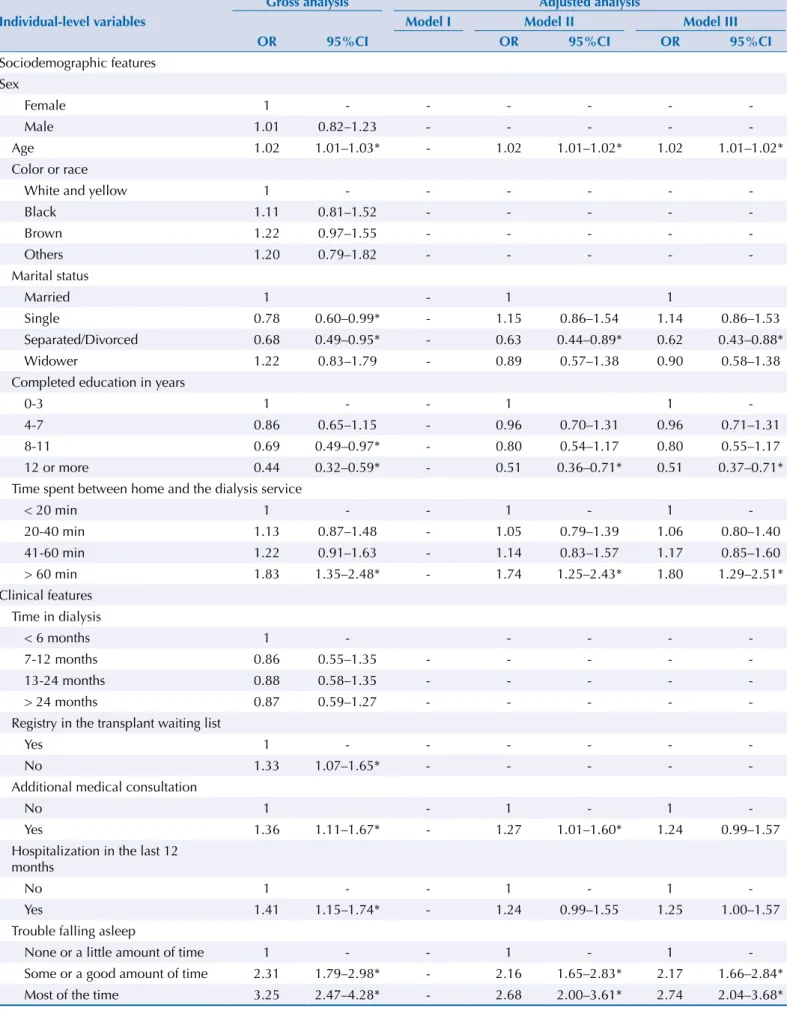
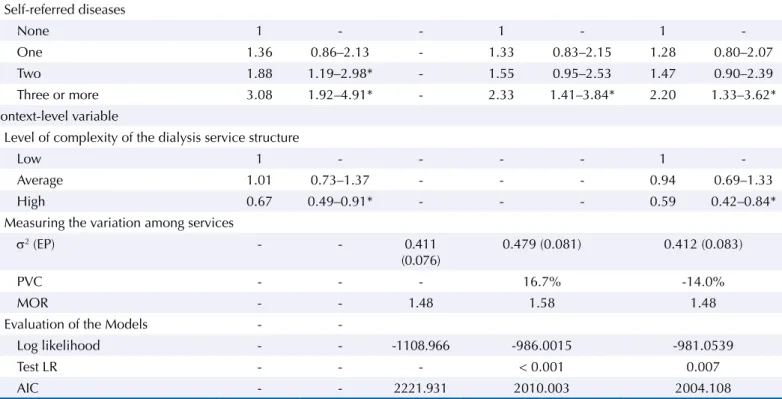
Table 2. Gross and adjusted analysis of multilevel logistic regression for factors associated with poor health self-assessment of hemodialysis patients. Brazil, 2007.
Gross analysis Adjusted analysis
Individual-level variables Model I Model II Model III
OR 95%CI OR 95%CI OR 95%CI
Sociodemographic features Sex
Female 1 - - -
-Male 1.01 0.82–1.23 - - - -
-Age 1.02 1.01–1.03* - 1.02 1.01–1.02* 1.02 1.01–1.02* Color or race
White and yellow 1 - - -
-Black 1.11 0.81–1.52 - - - -
-Brown 1.22 0.97–1.55 - - - -
-Others 1.20 0.79–1.82 - - - -
-Marital status
Married 1 - 1 1
Single 0.78 0.60–0.99* - 1.15 0.86–1.54 1.14 0.86–1.53 Separated/Divorced 0.68 0.49–0.95* - 0.63 0.44–0.89* 0.62 0.43–0.88* Widower 1.22 0.83–1.79 - 0.89 0.57–1.38 0.90 0.58–1.38 Completed education in years
0-3 1 - - 1 1
-4-7 0.86 0.65–1.15 - 0.96 0.70–1.31 0.96 0.71–1.31 8-11 0.69 0.49–0.97* - 0.80 0.54–1.17 0.80 0.55–1.17 12 or more 0.44 0.32–0.59* - 0.51 0.36–0.71* 0.51 0.37–0.71* Time spent between home and the dialysis service
< 20 min 1 - - 1 - 1
-20-40 min 1.13 0.87–1.48 - 1.05 0.79–1.39 1.06 0.80–1.40 41-60 min 1.22 0.91–1.63 - 1.14 0.83–1.57 1.17 0.85–1.60 > 60 min 1.83 1.35–2.48* - 1.74 1.25–2.43* 1.80 1.29–2.51* Clinical features
Time in dialysis
< 6 months 1 - - - -
-7-12 months 0.86 0.55–1.35 - - - -
-13-24 months 0.88 0.58–1.35 - - - -
-> 24 months 0.87 0.59–1.27 - - - -
-Registry in the transplant waiting list
Yes 1 - - -
-No 1.33 1.07–1.65* - - - -
-Additional medical consultation
No 1 - 1 - 1
-Yes 1.36 1.11–1.67* - 1.27 1.01–1.60* 1.24 0.99–1.57 Hospitalization in the last 12
months
No 1 - - 1 - 1
-Yes 1.41 1.15–1.74* - 1.24 0.99–1.55 1.25 1.00–1.57 Trouble falling asleep
None or a little amount of time 1 - - 1 - 1 -Some or a good amount of time 2.31 1.79–2.98* - 2.16 1.65–2.83* 2.17 1.66–2.84* Most of the time 3.25 2.47–4.28* - 2.68 2.00–3.61* 2.74 2.04–3.68*
he adjusted multilevel analysis is presented in Table 2. Model I presents a statistically signiicant
variance in self-assessment of poor health among dialysis services (σ2 = 0.411; 95%CI 0.285–0.591). MOR was equal to 1.48, indicating that diferences between dialysis services may increase in 48.0% the odds of poor health self-assessment. For instance, if the patient can transfer to a
dialysis service with more inadequate service conditions, the risk of self-evaluating his health
as bad could increase, being the median of such increase equal to 48.0%.
In model II, the following individual variables remained independently associated with increased chance of poor health self-assessment: being older, spending 60 minutes or more on the way home to the dialysis service, having three or more of the diseases referred, and having trouble sleeping. Separated or divorced marital status, and having 12 years or more of study were associated with less chance of poor health self-assessment.
As to the contextual level (level 2), the chance to assess health as poor was lower among
those who were under treatment in dialysis services with the highest level of complexity
(OR = 0.59; 95%CI 0.42-0.84) (model III). he inclusion of context variable did not cause
major changes in the magnitude of the association between poor health self-assessment and
individual variables. Only the variable “extra medical consultation” (out of dialysis service) lost its signiicance. he variance of poor health self-assessment among dialysis services was reduced from 0.479 (model II) to 0.412 (model III) after the inclusion of the context variable, indicating that the variation of 14.0% of poor health self-assessment in the contextual level
might be explained by the inclusion of the level of complexity of the dialysis service structure
in the model. A reduction of AIC between models II and III occurred, and the likelihood ratio test showed to be signiicant (p < 0.05), indicating better adaptation of model III.
DISCUSSION
he results of this study show that more than half of the patients in hemodialysis assessed
their health as poor. Patients who presented a higher chance to assess their health negatively
Table 2. Gross and adjusted analysis of multilevel logistic regression for factors associated with poor health self-assessment of hemodialysis
patients. Brazil, 2007. Continuation
Self-referred diseases
None 1 - - 1 - 1
-One 1.36 0.86–2.13 - 1.33 0.83–2.15 1.28 0.80–2.07 Two 1.88 1.19–2.98* - 1.55 0.95–2.53 1.47 0.90–2.39 Three or more 3.08 1.92–4.91* - 2.33 1.41–3.84* 2.20 1.33–3.62* Context-level variable
Level of complexity of the dialysis service structure
Low 1 - - - - 1
-Average 1.01 0.73–1.37 - - - 0.94 0.69–1.33 High 0.67 0.49–0.91* - - - 0.59 0.42–0.84* Measuring the variation among services
σ2 (EP) - - 0.411
(0.076) 0.479 (0.081) 0.412 (0.083)
PVC - - - 16.7% -14.0%
MOR - - 1.48 1.58 1.48
Evaluation of the Models -
-Log likelihood - - -1108.966 -986.0015 -981.0539
Test LR - - - < 0.001 0.007
AIC - - 2221.931 2010.003 2004.108
OR: odds ratio; σ2: variance in the context level; EP: standard error; PCV: proportional variance change; MOR: median odds ratio; LR test:
were the older, less-educated ones, who spent more time on the way home to the dialysis
service, which reported the largest number of self-referred diseases, and diiculty sleeping.
Separated or divorced patients had less chance of poor health self-assessment. Our results showed that those who were on hemodialysis services characterized by increased complexity of structure presented a chance to assess their own health negatively.
he prevalence of self-assessment of poor health is extremely high compared to the one observed in the adult population that resided in households covered by the ixed phone network in the Brazilian state capitals and the Federal District in 2012, which was of 5.0%c. However, it is similar to that found among patients on dialysis in Denmark21 and Holland25, respectively 51.0% and 54.0%. It is also similar to the percentages of adults who reported having any long-term disease or disability in Brazil in 2003, 55.9%24, and in the elderly from diferent Brazilian cities
in 2009, approximately 50.0%20. However, the population of this study is younger than the
population of the studies cited. Such high prevalence of poor health self-assessment found in hemodialysis patients draws attention, since many authors have noted the high predictive power of morbidity and mortality resulting from a poor assessment of their own health7.
he results were consistent with population-based studies with adults4 and older adults20
being inluenced by age, education, and the number of referred diseases in the health self-assessment. An association between self-assessment of poor health and sex was not identiied,
unlike other studies in adults10 and older adults3,4. he chance to assess health as bad was
higher among individuals with lower education levels, regardless of other characteristics
investigated. Education determines several advantages for health, because individuals with
higher educational level are less likely to expose themselves to risk factors for diseases and, in general, have greater access to economic and social resources that promote better health18. he association between the presence of diseases and poor health self-assessment conirms
the account of other authors who have evaluated that relationship in surveys with adults in Brazil4,c. Nonetheless, in this population under the impact of a more severe chronic disease,
which evolves with complications and restrictions in daily activities, only the account of three or more diseases were associated with poor health self-assessment. Other studies also
identiied the association between multiple morbidities and worse health assessment17. Other
frequent disorders among these patients, such as changes in sleep, are related to the poor health self-assessment, as shown by our results. Similar association was also reported in hemodialysis patients in Italy16. Sleep disorders are associated with increased cardiovascular
morbidity and mortality in the general population. As the incidence of these disorders is
considerably higher among patients in end-stage chronic kidney disease, the potential efects
could also be higher in this population26.
In this study, separated or divorced marital status was associated with less chance of reporting poor health self-assessment. A research carried out in Italy with hemodialysis patients showed that living alone or with other people has no association with poor health self-assessment16. However, studies in adults and older adults in Sweden11 and Japan10 showed
that poor health self-assessment was associated with, respectively, being single and being divorced. In fact, the social support promoted by a partner or by family members is one of the most important factors to face the disease and treatment, since it contributes to a reduction in the incidence of depression and mortality, and to improve the quality of life of patient undergoing hemodialysis1.
he use of dialysis service is part of the weekly routine of these patients. he commuting time to the dialysis service can afect the health self-assessment of the patient, since it adds to
the time that patients spend on dialysis. In this study, spending a longer time getting to the dialysis facility was associated with poor health self-assessment. A study performed with a representative sample of patients in hemodialysis of 12 countries found a higher risk of death
and signiicantly lower quality of life in patients with longer commuting times to the dialysis
service facility15. he longest time spent in the way to the service decreases the time available
for other activities, also infuencing patients’ sleep and satisfaction with the received care19. c Ministério da Saúde,
his is the irst national-level study to investigate the prevalence of self-assessment of poor
health in hemodialysis patients and its association with individual characteristics and dialysis
services. It was possible to identify signiicant variance in poor health self-assessment among
dialysis services after the control by sociodemographic and clinical variables. An increase in variance of poor health self-assessment was noticed among dialysis services in model II.
his can happen when individual-level variables are negatively correlated with variation in the contextual level. he variance in poor health self-assessment among dialysis services in
model II indicates the true variance between the services, after adjusting according to the
diferences in the proile of patients assisted in each unit.
he level of complexity of the service structure can explain 14.0% of variability in prevalence
of poor health self-assessment among hemodialysis services, pointing to the importance of the structure of services for the maintenance of better health condition of these patients. Individuals attended in dialysis services with better structure presented a lower chance to
assess their health as poor. he highest level of complexity of dialysis service structure was
characterized by location in hospitals, having a teaching activity, having the highest number of
dialysis machines, working in three daily shifts or 24h, having its own vascular surgery service,
performing kidney transplant, and performing peritoneal dialysis and hemodialysis. It is possible that the patients in services with more complex structure have greater probability of access to alternative treatment in the same service, such as implementation of arteriovenous
istula, peritoneal dialysis, and transplant, which may inluence the perception of security
and better care from patients.
Other studies also identiied a signiicant association between the structure of dialysis services and some results on patients’ health. Carvalho et al.6found better results on survival
of patients attended in dialysis services with the highest number of dialysis machines. In the same study, patients submitted to hemodialysis in services where cyclical peritoneal dialysis was the only treatment option had lower survival compared to those where there was no peritoneal dialysis service. Machado et al.12 noted that the access to kidney transplant was
greater in dialysis services with less complex structure12. New studies may delve into aspects of how the structure of the services inluence the self-assessment of health of patients in
hemodialysis treatment.
Another possible explanation for the variability of poor health self-assessment among dialysis
services can be attributed to diferences in care practices. A study performed on 54 dialysis
services in Italy showed that the greater social support performed by health professionals in dialysis services was associated with better health self-assessment16. Spiegel et al22 identiied
lower rates of mortality in dialysis services in which there were interpersonal relationships, more communication with the doctor, and earlier multidisciplinary meetings to discuss strategies for treatment after hospital discharge. In that case, the nutritionists addressed cultural aspects relevant to the patients’ care plan, better quality continuing education
programs, and there was more engagement and discipline from the patients. Such diferences have explained 31.0% of the variation of rates of mortality among the 90 dialysis services in
the United States participating in the study in 200722.
Among the limitations of this study, we can cite the indicator used. Although there are many advantages in the use of health self-assessment as an indicator of health, limitations are described in literature about the lack of knowledge of the mechanisms and ways with which each individual evaluates their own health7. Another limitation refers to the use of the administrative registries of the CNES to characterize dialysis services. he use of such
data, whose record does not aim to be used in research activities, can have the occurrence of incompleteness and inconsistencies as a limitation. Other variables that characterized the service, such as number of rooms and number of dialysis professionals were not included
in the analysis due to the great loss of information. he last limitation is inherent to the
In conclusion, the high prevalence of poor health self-assessment found among hemodialysis patients in the SUS system was associated with age, years of education, marital status, commuting time from home to the dialysis service, number of self-referred diseases, and
reports on diiculty of sleeping. Health self-assessment in this population does not involve
only individual factors, but it is also related to the level of complexity of the structure of
health services, conirming the multidimensional nature of this health indicator.
The acknowledgment of the effects of dialysis services in poor health self-assessment draws attention to the importance of the structure of the facilities, as an additional dimension of the strategy to improve the health of patients in hemodialysis in SUS. It is necessary that health professionals are alert to the aspects linked to worse health self-assessment and that public policies are implemented to prevent or delay undesirable forecasts in this population.
REFERENCES
1. Aghakhani N, Sharif F, Molazem Z, Habibzadeh H. Content analysis and qualitative study of hemodialysis patients, family experience and perceived social support. Iran Red Crescent Med J. 2014;16(3):e13748. DOI:10.5812/ircmj.13748
2. Álvares J, Cesar CC, Acurcio FA, Andrade EIG, Cherchiglia ML. Quality of life of patients in renal replacement therapy in Brazil: comparison of treatment modalities. Qual Life Res. 2012;21(6):983-91. DOI:10.1007/s11136-011-0013-6
3. Alves LC, Rodrigues RN. Determinantes da autopercepção de saúde entre idosos do Município de São Paulo, Brasil. Rev Panam Salud Publica. 2005;17(5/6):333-41. DOI:10.1590/S1020-49892005000500005
4. Barros MBA, Zanchetta LM, Moura EC, Malta DC. Auto-avaliação da saúde e fatores associados, Brasil, 2006. Rev Saude Publica. 2009;43 Supl 2:s27-37. DOI:10.1590/S0034-89102009000900005
5. Berglund E, Lytsy P, Westerling R. The influence of locus of control on self-rated health in context of chronic disease: a structural equation modeling approach in a cross sectional study. BMC Public Health. 2014;14:492. DOI:10.1186/1471-2458-14-492
6. Carvalho MS, Henderson R, Shimakura S, Sousa IPSC. Survival of hemodialysis patients: modeling differences in risk of dialysis centers. Int J Qual Health Care. 2003;15(3):189-96. DOI:10.1093/intqhc/mzg035 189-196
7. DeSalvo KB, Muntner P. Discordance between physician and patient self-rated health and all-cause mortality. Ochsner J. 2011;11(3): 232-40.
8. Fink JC, Hsu VD, Zhan M, Walker LD, Mullins CD, Jones-Burton C et al. Center effects in anemia management of dialysis patients. J Am Soc Nephrol. 2007;18(2):646-53. DOI:10.1681/ASN.2006050433
9. Idler EL, Russell LB, Davis D. Survival, functional limitations, and self-rated health in the NHANES I Epidemiologic Follow-up Study, 1992. First National Health and Nutrition Examination Survey. Am J Epidemiol. 2000;152(9):874-83. DOI:10.1093/aje/152.9.874
10. Kawada T, Suzuki S. Marital status and self-rated health in rural inhabitants in Japan: a cross-sectional study. J Divorce Remarriage. 2012;52(1):48-54. DOI:10.1080/10502556.2011.534395
11. Lindström M. Marital status, social capital, material conditions and self-rated health:a population-based study. Health Policy. 2009;93(2-3):172-9. DOI:10.1016/j.healthpol.2009.05.010
12. Machado EL, Caiaffa WT, César CC, Gomes IC, Andrade EIG, Acúrcio FA et al. Iniquities in the access to renal transplant for patients with end-stage chronic renal disease in Brazil. Cad Saude Publica. 2011;27 Supl 2:s284-97. DOI:10.1590/S0102-311X2011001400015
13. Merlo J, Chaix B, Ohlsson H, Beckman A, Johnell K, Hjerpe P et al. A brief conceptual tutorial of multilevel analysis in social epidemiology: using measures of clustering in multilevel logistic regression to investigate contextual phenomena. J Epidemiol Community Health. 2006;60(4):290-7. DOI:10.1136/jech.2004.029454
and on mortality in the working-age population. J Clin Epidemiol. 1997;50(5):517-28. DOI:10.1016/S0895-4356(97)00045-0
15. Moist LM, Bragg-Gresham JL, Pisoni RL, Saran R, Akiba T, Jacobson SH et al. Travel time to dialysis as a predictor of health-related quality of life, adherence, and mortality: the Dialysis Outcomes and Practice Patterns Study (DOPPS). Am J Kidney Dis. 2008;51(4):641-50. DOI:10.1053/j.ajkd.2007.12.021
16. Neri L, Brancaccio D, Rocca Rey LA, Rossa F, Martini A, Andreucci VE. Social support from health care providers is associated with reduced illness intrusiveness in hemodialysis patients. Clin Nephrol. 2011;75(2):125-34. DOI:10.5414/CNP75125
17. Perruccio AV, Katz JN, Losina E. Health burden in chronic disease: multimorbidity is associated with self-rated health more than medical comorbidity alone. J Clin Epidemiol. 2012;65(1):100-6. DOI:10.1016/j.jclinepi.2011.04.013
18. Pimenta FAP, Bicalho MAC, Romano-Silva MA, Moraes EN, Rezende NA. Doenças crônicas, cognição, declínio funcional e Índice de Charlson em idosos com demência. Rev Assoc Med Bras. 2013;59(4):326-34. DOI:10.1016/j.ramb.2013.02.002
19. Silva GM, Gomes IC, Machado EM, Rocha FH, Andrade EIG, Acurcio FA et al. Uma avaliação da satisfação de pacientes em hemodiálise crônica com o tratamento em serviços de diálise no Brasil. Physis. 2011;21(2):581-600. DOI:10.1590/S0103-73312011000200013
20. Silva RJS, Smith-Menezes A, Tribess S, Rómo-Perez V, Virtuoso Júnior JS. Prevalência e fatores associados à percepção negativa da saúde em pessoas idosas no Brasil. Rev Bras Epidemiol. 2012;15(1):49-62. DOI:10.1590/S1415-790X2012000100005
21. Sondergaard H, Juul S. Self-rated and functioning in patients with chronic renal disease. Dan Med Bul. 2010;57(12):A4220.
22. Spiegel B, Bolus R, Desai AA, Zagar P, Parker T, Moran J et al. Dialysis practices that distinguish facilities with below- versus above-expected mortality. Clin J Am Soc Nephrol. 2010;5(11):2024-33. DOI:10.2215/CJN.01620210
23. Tangri N, Tighiouart H, Meyer KB, Miskulin DC. Both patient and facility contribute to achieving the Centers for Medicare and Medicaid Services’ pay-for-performance target for dialysis
adequacy. J Am Soc Nephrol. 2011;22(12):2296-302. DOI:10.1681/ASN.2010111137 24. Theme Filha MM, Szwarcwald CL, Souza-Junior PRB. Medidas de morbidade referida
e inter-relações com dimensões de saúde. Rev Saude Publica. 2008;42(1):73-81. DOI:10.1590/S0034-89102008000100010
25. Thong MS, Kaptein AA, Benyamini Y, Krediet RT, Boeschoten EW, Dekker FW. Association between a self-rated health question and mortality in young and old dialysis patients: a cohort study. Am J Kidney Dis. 2008;52(1):111-7. DOI:10.1053/j.ajkd.2008.04.001
26. Trojan DA, Kaminska M, Bar-Or A, Benedetti A, Lapierre Y, Da Costa D et al. Polysomnographic measures of disturbed sleep are associated with reduced quality of life in multiple sclerosis. J Neurol Sci. 2012;316(1-2):158-63. DOI:10.1016/j.jns.2011.12.013
27. Zuilen AD, Blankestijn PJ, Buren M, Dam MA, Kaasjager KA, Ligtenberg G et al. Quality of care in patients with chronic kidney disease is determined by hospital specific factors. Nephrol Dial Transplant. 2010;25(11):3647-54. DOI:10.1093/ndt/gfq184
Funding: Fundo Nacional de Saúde/Ministério da Saúde (Process 4864/2005) and Conselho Nacional de
Desenvolvimento Cientíico e Tecnológico (CNPq – Process 409729/2006-0).
Authors’ Contribution: Conception, planning, analysis, and interpretation of the data: TRM, MLC, CCC, and
LG. Drafting of the manuscript: TRM, MLC, and LG. Review and approval of the inal version of the manuscript: FAA, EIGA, MLC, CCC, and LG.