THE ROLE OF SOCIAL FACTORS IN THE USE OF LICIT DRUGS AMONG
UNIVERSITY STUDENTS FROM ONE UNIVERSITY IN KINGSTON,
JAMAICA
Rashalee Mitchell1, Samuel Noh2, Hayley Hamilton3, Bruna Brands4, Maria da Glória Miotto Wright5, Francisco Cumsille6, Akwatu Khenti7
1 M.Sc. Assistante Professor, Psychology Department, University of West Indies, Mona Campus. Kingston, Jamaica. E-mail:
2 Ph.D. Investigator, Centre for Addiction and Mental Health, CAMH, University of Toronto. Toronto, Canada. E-mail: samuel.
3 Ph.D. Investigator, CAMH, University of Toronto. Toronto, Canada. E-mail: [email protected]
4 Ph.D. Senior Scientist. Ofice of Research and Surveillance, Drug Strategy and Controlled Substances Programme, Health Canada and Public Health and Regulatory Policies, CAMH, University of Toronto. Toronto, Canada. E-mail: [email protected] 5 Ph.D. Former Coordinator Educational Development Program Inter-American Drug Abuse Control Commission (CICAD),
Secretariat for Multidimensional Security. Washington, USA. E-mail: [email protected]
6 Ph.D. Director Interamerican Drug Observatory, CICAD, Secretariat for Multidimensional Security at Organization of American
States. Washington, USA. E-mail: [email protected]
7 Doctoral Student. Director, Ofice of Transformative Global Health, CAMH. Toronto, Canada. E-mail: [email protected]
ABSTRACT: A quantitative, descriptive and exploratory study, with a cross-sectional design aimed at examining whether social factors are related to licit drug use among university students in one university in Kingston, Jamaica. The non-probabilistic sample was composed of 335 students from a speciic university in Kingston, Jamaica. A questionnaire was developed with ive validated scales that interrogated about the inluence of the peer group, the family relationships, the entertainment, the spirituality, and drug consumption. The data indicated that respondents with one or more friend who engaged in drug use were 9.5 times more likely to smoke tobacco and twice as likely to consume alcohol. Notably, respondents who had low spirituality were twice as likely to smoke tobacco and 1.3 times more likely to consume alcohol. These results suggest that having friends who use drugs may be a risk factor for alcohol and tobacco use, whereas greater spirituality may serve as a protective factor.
DESCRIPTORS: Narcotics. University. Students.
EL PAPEL DE FATORES SOCIALES EN EL USO DE DROGAS LICITAS
EN ESTUDIANTES UNIVERSITARIOS DE UNA UNIVERSIDAD DE
KINGSTON, JAMAICA
RESUMEN: Investigación cuantitativa de tipo descriptiva-exploratoria, con diseño transversal que examinó el efecto moderador de ciertos factores socio-culturales en el consumo de drogas licitas entre estudiantes universitarios de una universidad en Kingston, Jamaica. La muestra non probabilistica fue conformada por 335 estudiantes de una universidad especiica de Kingston, Jamaica. Fue elaborado un cuestionario con cinco escalas ya validadas, que interrogaba sobre la inluencia del grupo de pares, las relaciones familiares, el entretenimiento, la espiritualidad y el consumo de drogas. Se utilizó el programa SPSS versión 18 para el análisis estadística. Los datos indicaran que los respondientes con uno o mas anmigos que estaban involucrados con el uso de drogas eran 9.5 veces mas disponibles para fumar y dos veces mas para consumir alcole. Los respondientes que tinian baja espiritualidad eran dos veces mas proponientes para fumar y 1.3 veces mas proponientes de consumir alcole. Los datos indicaran haber asociacion signiicante entre los factores sociales y el consume de drogas licitas.
DESCRIPTORES: Narcóticos. Universidad. Estudiantes.
O PAPEL DE FATORES SOCIAIS NO USO DE DROGAS LÍCITAS EM
ESTUDANTES DE UMA UNIVERSIDADE EM KINGSTON, JAMAICA
RESUMO: Pesquisa quantitativa, descritiva e exploratória, com desenho transversal, que examinou o efeito moderador de certos fatores demográicos e socioculturais no consumo de drogas lícitas entre estudantes universitários em uma universidade de Kingston, Jamaica. A amostra não probabilística foi composta por 335 estudantes de uma universidade na cidade de Kingston, Jamaica. Foi elaborado um questionário com cinco escalas validadas que questionavam sobre a inluência dos pares, as relações familiares, o entretenimento, a espiritualidade e o consumo de drogas. Se utilizou o programa SPSS versão 18 para a análise estatística. Veriicou-se que os estudantes da amostra que tinham pelo menos um amigo envolvido com drogas eram 9.5 vezes mais disponíveis para fumar e duas vezes mais para consumir álcool. Os estudantes que responderam que tinham baixa espiritualidade eram duas vezes mais proponentes a fumar e 1.3 vezes mais proponentes a consumir álcool. Os dados indicaram uma associação signiicativa entre os fatores sociais e o consumo de drogas líicitas. DESCRITORES: Entorpecentes. Universidades. Estudantes.
INTRODUCTION
Drug use is problematic for various popu -lations, including youth, in certain parts of the world. Young people are critical to the devel-opment of a nation, and contemporary society
provides both positive and negative avenues
for them to express themselves. Whether they express themselves positively or negatively will have important effects on social order and the
overall stability of a society. Jamaica, a developing country, has developed a plan called Vision 2030,
which is intended to ensure its emergence as a
developed country by the year 2030.1 Youth are a vital component of this plan because increasing drug use and/or abuse among youth may not only threaten the health of the population but also the
country’s development.
In a global environment where commodities are easily and quickly accessible to individuals, alcohol and tobacco are both increasingly being
used in various social spaces and among youths. This is due in part to the well organised nature of the legal drug industry which has highly
sophis-ticated marketing strategies. In other words it is
now typically seen as a consumer good that has to remain competitive.2 As a major threat to health and overall individual and societal wellbeing, licit drugs, such as tobacco and alcohol, have the capac
-ity to derail sustainable development.
The Caribbean is one region where young
people initiate use and misuse of licit and illicit
drugs at very vulnerable ages. According to the Inter-American Drug Abuse Commission (CICAD), the average age of irst drugs use is approximately
ten, and in some instances as low as age seven. It also reported that there is widespread social ac-ceptance of drug use among young people in the
Caribbean.3 It found that that drug abuse is signii
-cantly more common among males than females,
that alcohol, ganja (cannabis), and crack cocaine are the most frequently abused drugs, and that tobacco is frequently consumed by the adolescent and youth
population.4 Tobacco is one of the main addictive substances in the world and also one of the leading
causes of death. Statistics from the World Health
Organization (WHO) indicate that tobacco smoking
causes nearly six million deaths per year.3
In 2010, the United Nations (UN) Ofice on Drug and Crime conducted a study on the link between drug use and HIV/AIDS among young people in Grenada. It found that alcohol is widely
used among youth, mainly as a means of
socialis-ing at parties and other public events. Youth also
reported using alcohol for reasons such as stress relief, peer pressure, increased sexual pleasure, out of curiosity, and to improve academic per-formance. The study also found that alcohol was
generally easily accessible in the home.5
In Jamaica, there is growing concern
regard-ing excessive licit drug use among youth. Rapid social changes driven by larger local and global
factors may predispose young people to use licit
drugs such as alcohol and tobacco. While there is no single reason for smoking and alcohol use among teens in Jamaica, a survey from the Na -tional Drug Council revealed experimentation is one important factor.6 Some young people engage in drinking and smoking because they see others
(friends, parents, other adults) doing the same.
According to the 1997 National Adolescent Stu -dents’ Drug Survey in Jamaica, 70.9% of students reported having ever consumed alcohol, and ap-proximately one in four (28.8%) had used alcohol in the previous month.6 Together, these data
sug-gest a worrisome and progressing trend in drug
use among youth in the Caribbean. Appropriately
addressing these concerns is imperative within
developing countries like Jamaica, because the popularity and overuse of alcohol and tobacco,
although licit drugs, pose a threat to the overall health and productivity of the next generation
of leaders. A concerted effort among stakehold
-ers will be required to address this problem.
This study was conducted to provide empirical
evidence to clarify the relationships between so -cial factors and licit drug use among university
students, with the objective of informing policy.
METHODOLOGY
A cross-sectional survey was used to collect data from 335 students at one university in Kings-ton, Jamaica. The survey targeted undergraduate students ages 18 to 24 within the faculties of social science, medical sciences, and pure and applied sciences. A purposive sampling method was used. The study was advertised using recruitment
post-ers, campus intranet, bulletin and notice boards,
campus newspapers, and hand outs.
The dependent variable of the study is past year (12 month) use of the licit drugs tobacco and alcohol. The independent variable of the study is the level of peer inluence. The moderating vari
-ables are: quality of family relations, engagement in interactive and non-interactive screen-based entertainment, party-based entertainment, and
A self-report questionnaire was used to col-lect the data. The questionnaire consisted of six sections, with a total of 86 questions pertaining to socio-demographic information (10 questions),
peer inluence (six questions), family relations
(25 questions) entertainment (nine questions) spirituality (26 questions) and drug
consump-tion (10 quesconsump-tions). It took approximately 20 to
30 minutes to complete. Pre-existing scales and instruments within the questionnaire included
The Peer Inluence Scale,7 The Index of Family Relations,8 The Spirituality Involvement and
Beliefs Scale,9 Screen-based entertainment,10 The Alcohol, Smoking and Substance Involvement
Screen Test.11 The data were analyzed using The Statistical Package for Social Sciences (SPSS), version 18. Bivariate analyses and crostabulations
were done, and then multivariate and logistic regression were used.
The research study received ethics approval from the Centre for Addiction and Mental Health (CAMH) in Canada as well as the participating university in Jamaica in 2012.
RESULTS
Gender and Peer Inluence were both signii
-cant factors for the licit drugs; alcohol and tobacco but entertainment variables were signiicant for only three of the six relationships, two for tobacco
and only one for alcohol.
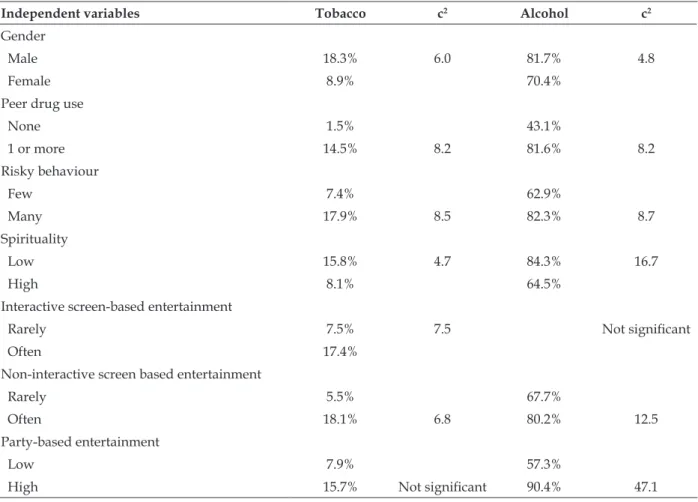
Table 1 examines the bivariate relation
-ships between the selected independent variables and tobacco and alcohol use in the past year (12 months). Only the signiicant results will be dis -cussed in this section.
Males were twice as likely to have smoked tobacco during the last 12 months, at a rate of
18.3 percent, compared to females at a rate of 8.9
percent (χ2(1)=6.0, p<.05). Furthermore, males were 1.2 times as likely to have consumed alcohol
during the last 12 months, at a rate of 81.7 percent,
compared to females at a rate of 70.4 percent (χ2
(1)=4.8, p<.05).
Participants with one or more friend who
engaged in drug use were 9.5 times more likely to smoke tobacco within the past year, compared
to those whose friends did not use drugs (14.5
percent versus 1.5 percent; χ2(1)=8.2, p<.01).
Furthermore, those with one or more friend who
used drugs were nearly twice as likely to have
consumed alcohol during the past year, compared
to those whose friends did not engage in drug use
(81.6 percent versus 43.1 percent; χ2 (1)=8.2, p <.01). Participants with peers who engaged in risky behaviour were more than twice as likely to have smoke tobacco during the past year, compared to those with peers who engaged in few risky behav
-iours (17.9 percent versus 7.4 percent; χ2(1)=8.5,
p<.01). Additionally, participants with peers who
engaged in many risky behaviors were more likely
to have consumed alcohol within the past year, compared to those with peers who engaged in few
risky behaviors (82.3 percent versus 67.9 percent; χ2(1)=8.7, p<.01).
Participants with reportedly low
spiritual-ity were nearly twice as likely to have consumed tobacco during the past year, compared to those
who were high in spirituality (15.8 percent versus
8.1 percent; χ2(1)=4.7, p<.05). Further, students
who were low in spirituality were 1.3 times as
likely to have consumed alcohol within the past
year, compared to those who were reportedly high
in spirituality (84.3 percent versus 64.5 percent; χ2
(1)=16.7, p<.01).
Participants who often engaged in
interac-tive screen- based entertainment were 2.3 times more likely to have used tobacco during the past
year, compared to those who reported rare use
(17.4 percent versus 7.5 percent; χ2 (1)=7.5, p<.01).
Students who reported frequent use of
non-interactive screen-based entertainment were 3.3 times more likely to have used tobacco within the
past year, compared to those who reported rare
use (18.1 percent versus 5.5 percent; χ2(1)=6.8,
p<.01). Further, participants who often used
non-interactive based entertainment were 1.2 times more likely to have used alcohol within the
past year, compared to those who reported rare
use (80.2 percent versus 67.7 percent; χ2(1)=12.5,
p<.01).
Participants who reportedly engaged in
party-based entertainment, at which licit or il
-licit substances were present, were 1.5 times more likely to have consumed alcohol within the past
year, compared to those who did not participate
in party-based entertainment (90.4 percent versus 57.3 percent; χ2=47.1, p<.01).
Gender, peer drug use, risky behaviour, spirituality, interactive screen based entertain
Table 1 - Bivariate relationships between selected Independent variables Alcohol and Tobacco use in the past 12 months. Kingston, Jamaica, 2012
Independent variables Tobacco c2 Alcohol c2
Gender
Male 18.3% 6.0 81.7% 4.8
Female 8.9% 70.4%
Peer drug use
None 1.5% 43.1%
1 or more 14.5% 8.2 81.6% 8.2
Risky behaviour
Few 7.4% 62.9%
Many 17.9% 8.5 82.3% 8.7
Spirituality
Low 15.8% 4.7 84.3% 16.7
High 8.1% 64.5%
Interactive screen-based entertainment
Rarely 7.5% 7.5 Not signiicant
Often 17.4%
Non-interactive screen based entertainment
Rarely 5.5% 67.7%
Often 18.1% 6.8 80.2% 12.5
Party-based entertainment
Low 7.9% 57.3%
High 15.7% Not signiicant 90.4% 47.1
Table 2 denotes the results of a series of hier -archical multiple logistic regression analyses that were conducted to determine the extent to which
past year (12 month) drug use was inluenced by peers, marital status, family relations, enter
-tainment use, and spirituality. Notably, tobacco and alcohol were combined into one variable, as both constitute licit drug use. At the irst stage of
analysis, age and gender were entered as control
variables. At the second stage, the main variables of interest−friends who use drugs, peer inluence, spirituality, interactive screen-based entertain
-ment, non-interactive screen-based entertain-ment, party-based entertainment and family relations−
were entered into the regression equation. At the
inal stage of analysis, the interactions of peer
influence with spirituality, interactive
screen-based entertainment, non-interactive screen-screen-based entertainment, party-based entertainment, and
family relations were entered into the regression equation to explore if these factors moderated licit
drug use. Statistical signiicance was determined
using an alpha level of .05.
Table 2-Logistic regression examining factors associated with licit drug use (12 Months). Kingston, Jamaica, 2012
Variables
Past year Licit drug use O.R.
Conidence
Limit Marital status 1.148 0.560 2.353 Friends who use drugs 5.441 2.659 11.132
Peer inluence 1.107 0.897 1.153
Family relationship 1.002 0.984 1.021 Spirituality 0.958 0.932 0.984 Drug present parties 2.078 1.477 2.925
Interactive screen-based
entertainment
1.115 0.945 1.315
Non-interactive screen-based
entertainment
1.108 0.948 1.295
Results of the regression analyses, control -ling for the associations of gender and age, indicat-ed that peer drug use, spirituality, and attending
parties where drugs were signiicantly associated
Stu-dents who attended a party at which drugs were
used were 2.07 times more likely to use licit drugs
within the past year, compared to those who did not attend such parties. However, each one-point
increase in spirituality scores reduced the prob
-ability of licit drug use within the past year. In the inal step of the analysis, the interac
-tions between peer inluence and family rela-tions,
spirituality, and types of entertainments were
entered after controlling for the other variables in the model (Table 2). None of the interactions were found to be statistically signiicant. As such,
it appears that these factors did not moderate the
association between peer inluence and the use of
licit drugs during the past year.
DISCUSSION
Overall, three factors were found to inluence
past year (12 month) drug use among participants: spirituality, attending parties at which drugs were present, and peer drug use. Thus, religious and social
factors had signiicant effects on student drug use.
Because associating with peers who engaged in drug use and attending parties at which drugs
were present increased the likelihood of using tobacco and alcohol, peer pressure appears to be an important inluence on licit drug use. In other words, it can be viewed as a risk factor, as it relates
to the increasing use of licit drugs among Jamaican
university students. Notably, peer inluence can
also act as a protective factor if students associate
with peers who abstain from drug use.
Despite the arguably diminishing role of
organised religion in society (due in part to in-creased secularisation), the results of the current study demonstrate that spirituality stills plays an important protective role in a young adult’s deci-sion to use licit drugs.
The results points to the need for stakehold -ers to pursue a more aggressive and sustained
agenda to implement effective and eficient mecha -nisms within Jamaica’s development mandate.
Speciically, these should facilitate positive peer inluences and other protective factors to counter
the negative effects of the increasing licit drug use among university students.
Interventions by the National Council on Drug Abuse (NCDA), such as training workshops
held within communities, may encourage some
behavioural changes. These training workshops currently take place in a number of communities. They involve various stakeholders who identify
substance misuse challenges, primarily among
youth, and assess which community assets and resources may promote change.12 For example, a UNICEF-funded two-year project operated through the NCDA in Jamaica encourages com -munity action projects aimed at protecting youths
from the harmful effects of substance misuse.12 It
is important that more communities, and schools
including universities, can beneit from this kind of project. However, the lack of resources presents some challenges in terms of the sustainability of
these intervention programmes. For example, the
UNICEF-funded project is currently available in
only 20 communities (primarily rural), and is only funded for two years. Securing funding for longer
periods would help ensure continuity and build on the gains made. The NCDA also collaborates with the National Health Fund (NHF) on a proj
-ect called Resistance Education Against Drugs (READ), which has been launched in 25 schools in
Jamaica. This in-school programme is intended to empower children from a young age to recognise the negative consequences that drug misuse can have.13 Implementing this programme in many
more schools island-wide would increase its reach
and could be very effective.
The misuse of licit and illicit drugs involves tremendous costs to Jamaican society, especially
inancial resources that could be better spent on
human resources and other areas that could help
Jamaica become a developed country. According
to the Economic and Social Survey of Jamaica, the
guidelines of the Vision 2030 National Develop -ment Plan require the Ministry of Health to assess the needs of human resources and to provide the necessary training for their development. The Min-istry of Health currently has 14,606 employees, and
has projected that 16,100 will be needed to effec -tively manage the needs of the healthcare system
by 2013/14.14 The need for more healthcare staff, as well as funding to address HIV/AIDS and the massive chikungunya outbreak,15 may affect the vi-ability of the READ programme. However, it may be more effective to fund this kind of preventative
programme and more research to identify
appro-priate preventative approaches to the signiicant
threat of licit drug use among Jamaican youth.16
CONCLUSIONS
Social factors appear to have less of an
of various forms of entertainment. Encouraging spirituality and spiritual practices among youth
may be a one way to moderate the increasing use of tobacco and alcohol (and arguably other behav
-iours) that may place youths at risk for negative
social outcomes.
To date, limited research has explored how social factors affect licit drug use among university students in Jamaica. The current study addressed
this research gap by focusing on university students, who appear to be using licit drugs in increasing numbers. This, and other studies, can
help inform policy and programme interventions
to aid at-risk populations.
The results of this study point to a disturbing trend that seems to be developing among most young people in the global society. Although alco
-hol and tobacco are licit drugs, their popularity and overuse among young people is troubling, because they will be responsible for future governance. This trend is particularly problematic in developing
countries such as Jamaica, which are attempting to move into a state of development. Strategies must
be put in place to mitigate this trend.
Limitations
This study was not a random sample, so the
results may not be generalizable to all university
students or young people in Jamaica.
Recommendations
Reduce the use of licit drugs by appealing to students’ beliefs in a higher power in order
to encourage more socially conscious decisions. While not necessarily advocating for organised
religion, spirituality may be an effective protective factor for at-risk youth. Participants who scored high for spirituality were less likely to engage in
licit drug use.
More funding should be sought to bolster the NCDA’s intervention programmes in rural and urban communities. Additionally, interven
-tion programmes should have a more sustainable timeline to ensure maximum effect on behavioural
change.
Acknowledgements
The Government of Canada/DFATD, the Organization of American States (OAS), the Inter-American Drug Abuse Control Commission (CI -CAD), and the Centre for Addiction and Mental
Health (CAMH) in Toronto, Canada provided
technical and inancial support. The study could not have been completed without the participant
university’s support, as well as the advisors,
col-laborators, and students who participated in the
research.
REFERENCES
1. Planning Institute of Jamaica (PIOJ). Vision 2030
Jamaica National development plan. Kingston: PIOJ; 2009.
2. Mazibuko F. Drugs and young people: prevention
and therapeutic models of intervention within the context of social development. In: 29th International
Conference on Social Welfare [online]. 2000 Oct 23-27; Cape Townm, South Africa, 2000 [cited 2013 Sep 13]. Available at: http://www.icsw.org/global-conferences/mazibuko.htm
3. Inter-American Drug Abuse Control Commission.
Comparative analysis of student drug use in the Caribbean [online]. Washington: CICAD, OEA; 2010 [cited 2013 Sep 13]. Available at: http:// www.cicad.oas.org/Main/pubs/StudentDrugUse-Caribbean2011.pdf
4. Caribbean Community Secretariat. Caribbean
Research crucial to tackling regional drug abuse [online]. 2005 [cited 2012 Nov 28]. Available at: http://www.caricom.org/jsp/pressreleases/ pres178_05.jsp
5. United Nations Council on Drugs and Crime. The
link between drug use and HIV/AIDS among young people in Grenada. Barbados: UNODC Regional Ofice; 2010.
6. Reid T. Young drunks. The Sunday Gleaner, 2010
Apr 18 [cited 2014 May 15]. Available at: http:// jamaicagleaner.com/gleaner/20100418/lead/ lead4.html
7. Mayberry ML, Espelage DL, Koenig B. Multilevel
modeling of direct effects and interactions of peers, parents, school, and community influences on adolescent substance use. J Youth Adolesc. 2009 Sep; 38(8):1038-49.
8. Hudson WW. The Walmyr Assessment Scales Scoring Manual. Tempe, AZ: Walmyr Publishing Co.; 1992.
9. Hatch RL, Burg MA, Naberhaus DS, Hellmich
LK. The Spiritual Involvement and Beliefs Scale: development and testing of a new instrument. J Fam Pract. 1998 Jun; 46(6):476-86.
10. Padilla-Walker LM, Nelson LJ, Carroll JS, Jensen AC. More than a just a game: video game and internet use during emerging adulthood. J Youth Adolesc. 2010 Feb; 39(2):103-13.
11. World Health Organisation. The Alcohol, Smoking
Manual for use in primary care. [cited 2013 Mar 20] Available at: http://whqlibdoc.who.int/ publications/2010/9789241599382_eng.pdf 12. Smith P. Do we have a drug problem? National
Council On Drug Abuse [online], 2014 May 1 [cited 2014 May 15]. Available at: http:/ncda.org.
jm/index.php?option=com_content&view=ar
-ticle&id=131:do-we-have-a-drug-problem&
-catid=10:surveys&itemid=40
13. Gomes AY. The anti-drug offensive. The Jamaica
Observer [online], 2012 Nov 28 [cited 2013 Sep 13]. Available at: http://www.jamaicaobserver.com/ columns/The-anti-drug-offensive_13099145#ix-zz2DW6Dwg7f
14. Planning Institute of Jamaica (PIOJ), Economic and Social Survey of Jamaica. Kingston:, PIOJ; 2011
15. US Warns of Continued Progression of Chikungunya
Outbreak in the Caribbean. The Gleaner [online], 2014 Nov 98 [cited 2014 Nov 9]. Available at: http:// jamaica-gleaner.com/latest/article.php?id=56507 16. Mitchell C, Simich L, Strike C, Brands B, Giesbrecht
N, Khenti A. Exploration of simultaneous polydrug use: risk and protective factors in undergraduate students in one university, Kingston - Jamaica. Texto Contexto Enferm [online]. 2012 [cited 2015 Jan 21]; 21(spe):68-73. Available at: http://www. scielo.br/scielo.php?script=sci_arttext&pid=S0104-07072012000500009&lng=en
Correspondence: Rashalee Mitchell The University of West Indies Mona Campus.
St. Andrew, Jamaica