Direct cost of reprocessing cotton-woven surgical drapes: a case study
1 Master’s in Science, School of Nursing, Universidade de São Paulo, São Paulo, SP, Brazil. 2 Doctorate Professor, Department of Professional Guidance, School of Nursing, Universidade de São Paulo. São Paulo, SP, Brazil.
AbstrAct
Objective: Identify the direct cost of reprocessing double and single cotton-woven drapes of the surgical LAP package. Method: A quantitative, exploratory and descriptive case study, performed at a teaching hospital. he direct cost of reprocessing cotton-woven surgical drapes was calculated by multiplying the time spent by professionals involved in reprocessing the unit with the direct cost of labor, adding to the cost of materials. he Brazilian currency (R$) originally used for the calculations was converted to US currency at the rate of US$0.42/R$. Results: he average total cost for surgical LAP package was US$9.72, with the predominance being in the cost of materials (US$8.70 or 89.65%). It is noteworthy that the average total cost of materials was mostly impacted by the cost of the cotton-woven drapes (US$7.99 or 91.90%). Conclusion: he knowledge gained will subsidize discussions about replacing reusable cotton-woven surgical drapes for disposable ones, favoring arguments regarding the advantages and disadvantages of this possibility considering human resources, materials, as well as structural, environmental and inancial resources.
descriPtors
Protective Clothing; Product Packaging; Costs and Cost Analysis; Nursing.
Direct cost of reprocessing cotton-woven
surgical drapes: a case study
Custo direto do reprocessamento de campos cirúrgicos de tecido de algodão: um estudo de caso
Costo directo del reprocesamiento de campos quirúrgicos de tela de algodón: un estudio de caso
Mariana Fexina Tomé1, Antônio Fernandes Costa Lima2
Received: 07/27/2014 Approved: 03/02/2015
originAl Article DOI: 10.1590/S0080-623420150000300018
Corresponding author:
Antônio Fernandes Costa Lima Av. Dr. Enéas de Carvalho Aguiar, 419 - Cerqueira Cesar
INTRODUCTION
Among the components of the surgical apparatus, surgi-cal drapes constitute a barrier against micro-organism inva-sion at surgical sites, as well as protection for health profes-sionals from exposure to body luids. A standard package of reusable textiles named surgical LAP is generally used for these purposes.he LAP packageis composed of six double woven cotton drapes, one single cotton linen and a double woven cotton linen for packaging, and all can be reprocessed.
A study examining the cumulative efect of cotton fabric made of 2x1serge bonding, used in the manufacture of dou-ble cotton surgical drapes for packaging of medical items as an efective microbial barrier, and the multiple laundering and steam sterilization process efect on the barrier eicacy, correlating to the failure of microbial barrier due to physical changes of fabric characteristics which demonstrated from microbiological results that the efectiveness of the microbi-al barrier for equipment packaging only lasted a maximum of 65 reprocessing procedures. According to the authors, the reprocessing of these fabrics is a traditional practice which is supposed/inferred as low cost(1).
Another study(2) assessed the weight and the microbial
barrier of single 100% cotton surgical drapes of 2x1serge bonding, according to the Brazilian Association of Tech-nical Standards (ABNT)(3). he study indicated that the
efectiveness of the microbial barrier lasted until the ifth reprocessing cycle, when the fabrics lost an average of 6 to 15% of their initial weight. he researchers found more than ive colony-forming units after the sixth cycle, demonstrat-ing the barrier breakdown(2).
Clinical practice recognizes that standard surgical LAP
packages do not completely attend the speciicities of each surgery, thus its use varies depending on the size and the de-mand of the procedures performed. Depending on the sur-gical specialization, it is not unusual that up to four pack-ages are used, or that a package is opened but only one of the seven drapes are used, causing waste and consequently increasing the cost of procedures.
In healthcare, waste is characterized by the unnecessary expense of resources, processes, products or procedures relat-ed to patient care. Its occurrence aggravates the diiculties already existing due to scarce human and material resources, including purchasing materials of questionable quality(4).
Several companies sell basic or universal disposable kits that satisfy the majority of the surgical specializations due to the diversity of sizes and options, disposable kits with speciic anatomical shapes and details for diferent surger-ies (stickers that promote better adherence to the surgical site, presence of fenestrae and collection bags). Disposable drapes intended to cover the Mayo and instrument tables can integrate these kits or be sold individually. herefore, the use of disposable materials could minimize waste.
A literature review seeking scientiic evidence on the use of surgical gowns according to their composition (woven or non-woven fabric) included intervention studies inves-tigating the contamination and/or infection of the surgical
site with use of reusable or disposable surgical gowns. he authors reported diiculty inding studies on this issue of examining the efectiveness of single-use cotton surgical gowns, as only two of the studies revealed scientiic evi-dence that there was no diference in contamination and/ or infection of surgical sites between woven and non-woven materials(5).
Due to the complexity of dental-medical hospital ap-paratus reprocessing (AOMH in Portuguese), currently designated as health products by the Board Resolution - RDC 15/2012(6), in most institutions it is very diicult to
determine the main processes to monitor and how to track their results. herefore, planning and work adaptations are required in Central Sterile Services Department (CSSD), along with the use of indicators to evaluate their quality(7).
It is the CSSD nurse’s responsibility to consider the use of cleaning, disinfection and sterilization products, opting for technologies/products that save water and energy; and the use of reprocessed or recyclable packaging, also consid-ering the environmental impact of certain products used(8).
It would be possible to estimate the expenses a hospital organization would incur with the purchase of basic and speciic surgical kits, but the lack of knowledge on the cost of reprocessing and reusing surgical cotton drapes prevents evaluating the economic impact that such changes would entail.
Although reducing health costs is a diicult task be-cause of their nature, health decisions combined with eco-nomic principles are increasingly gaining strength, when considering the disproportion between available resources and the growing demands of society(9-11). his is because
cost management is an important aspect to be considered in achieving inancial balance, and increasing accessibility without harming the quality of health services(12).
In some public and private hospitals, nurses have deci-sion-making power in allocating resources, assessing needs related to material, physical, human and inancial resources; performing critical monthly analysis of unit costs, compar-ing budgeted and actual costs; and participatcompar-ing in budget forecasts for following years(13).
It is noteworthy that nurses can improve health institu-tions performance by understanding costs, identifying and monitoring elements and processes steps that increase costs and those which can be eliminated without jeopardizing the quality and without compromising care demands(14).
here-fore, we developed this study in order to identify the direct costs of reprocessing the double and single surgical cotton drapes contained in LAP surgical package.
METHOD
his is a quantitative, exploratory and descriptive case study(15), conducted at Hospital Santa Lucinda (HSL), after
approval by the Research Ethics Committee of the appli-cant institution - CAAE: 23028113.0.0000.5392, number: 464.023 and under authorization of the Superintendent and the Academic Hospital Coordinator.
Direct cost of reprocessing cotton-woven surgical drapes: a case study
countryside of São Paulo state. It has a surgical proile and serves approximately 50 municipalities in the region, total-ing 2.2 million inhabitants. Of its 146 beds, 93 (63.7%) are for patients from the Uniied Brazilian Healthcare System (SUS), mostly occupied by clients in pre- and post-oper-ative periods.
It performs an average of 700 surgeries/month in vari-ous specializations such as Orthopedics, general surgery, Cardiology, Plastic surgery, ENT, Ophthalmology, and Urology. Its physical structure is comprised of Primary Outpatient Clinics, Central Sterile Services Department - CSSD, Cardiology Center and Interventional Radiology, Adult Intensive Care Unit (ICU), Neonatal ICU, Surgical Center (SC), Obstetric and Gynaecology Center (OGC), Pediatrics, Dialysis Center and Renal Transplantation, Cor-onary Care Unit, Lithotripsy, Medical and Surgical Clinics. All units/services that require LAP packages for surgi-cal demands are supplied by CSSD of the referred hospi-tal, which assembles and sterilizes 40 to 60 packages/day. Drapes and packaging drapes are discarded after use into collecting bags and stored at the hospital’s purge unit, to be collected later by the Linen Service staf (LS). An out-sourced laundry service is responsible for the pickup, pro-cessing and return of the drapes to the LS. At the time of this research, the price of processed clothing was US$0.83/ kilogram.
he LS works around the clock to control the input and output of hospital clothes/apparel, collecting used ones, re-ceiving the processed material from the outsourced laundry and resupplying all units/services. It has one supervisor and eight maids.
Once a day the outsourced laundry collects used apparel and delivers clean material to the LS. Maids receive the processed material; they control the entry, count apparel by category (gowns, drapes, sheets, blankets/covers, cami-soles, towels) and store them. Garments to be sterilized are forwarded to CSSD in the morning, in the afternoon and at night.
he CSSD, which is adjacent to the Surgical Center, also works 24/7 developing cleaning procedures, disinfec-tion, sterilization and supplying HSL’s units/services. Its physical structure consists of: the dressing room, the ad-ministrative room, the preparation area, the purging room, the sterilization room and the sterile material storage area. It has two ultrasonic washers, one heat-washing-disinfector, three pre-vacuum autoclaves and one low temperature hy-drogen peroxide plasma sterilizer.
he professional staf is composed of a Nursing Coor-dinator, present at CSSD from 07:00a.m. to 4:00p.m., one nurse working from 3:00p.m. to 9:00p.m., 18 Technicians and three Nursing Assistants distributed throughout morn-ings, afternoons and nights to ensure proper functioning.
he steps and activities of the reprocessing process were mapped by observation actors not involved in LS and CSSD. Experienced professionals active in the study scenarios designed and validated the instrument. he in-strument documented the consumption of materials (type and quantity) and time (timed with a stopwatch) spent by
Maids, Nursing Assistants (NA) and Nursing Technicians (NT) in order to calculate the direct costs.
Direct costs can be applied directly to products by mea-suring consumption. It is clearly quantiiable and identii-able with a product, service or Department/Unit/Section(16).
In hospitals, it consists of labor, materials and equipment directly used in the care process(14).
Direct Labor Costs (DLC) are the costs of staf in-volved in product management, provided it is possible to identify who carried out the work and the amount of time spent for performing the task. herefore, DLC constitutes wages, social security contributions, holiday provisions and 13th salary(16).
he calculation of unit cost of DLC was based on aver-age waver-ages (salary, beneits and social charges), provided un-der the supervision of the Department of Human Resourc-es of HSL in the frame of LS and CSSD profResourc-essionals. We obtained US$ 1,017.39 for maids, US$2,629.57 for NA, and US$1,704.22 for NT, for a contract workload of 144 hours/month. he salary category of NA was just justiied to be greater than the NT category due to the irst group of professionals having spent more time working in the Hos-pital. Since there is no distinction between NA and NT in carrying out steps/components activities of the process, we calculated the weighted average of the two categories (US$ 1,836.41). So, time compensation per hour, minute, and sec-ond were: maids US$ 7.07; US$ 0.12; US$ 0.002 and NA/ NT US$12.75; US$0.21 and US$0.0035.
We clarify that we did not count the DLC of profession-als involved in buying and receiving new drapes because it does not carry out a direct action on the object of study. Also, for the DLC of LS workers who collect used linens, it was not possible to estimate the amount of surgical drape com-ponents in the collection bags for the outsourced laundry along with other items of clothing used in Units/Services.
he cost of materials for making the LAP packages based on the last three purchases were provided by the Co-ordination of Supply Inventory Sector, the Purchasing De-partment and the Coordination of Consultations.
We used the weight of clean fabric drapes to calculate the direct cost, because the weight after use varies according to each surgical procedure. here was no consensus obtained from the experienced professionals working in the LS on the estimate of the maximum number of reprocessing for these drapes, we considered 65 reuses for double drapes(1)
and ive for single drapes(2). he cost of reprocessing
out-sourced laundry increased according to the dry weight of the surgical drape.
we found a monthly average of 1,139 surgeries/procedures, with 639 surgeries, 243 deliveries (normal and caesarean sections) and 257 hemodynamic examinations.
he SC and CSSD helped in estimating the number of LAP packages the Nursing Coordinators needed by spe-cialization, and established the type and the amount of dis-posable surgical drape kits, individual disdis-posable drapes and table drapes needed to replace them. In order to estimate the values for these materials, they consulted the nine most well-known suppliers in the market, and received 5 responses.
he direct cost of reprocessing the cotton fabric com-ponents of LAP package surgical drapes was calculated by multiplying the (clocked) time spent by Maids, NA and NT with the unit cost of the DLC, adding to the cost of materials.
All values of the Brazilian currency (R$) originally used in this study were converted to American currency (US$) based on the conversion rate of R$1.00 = US$0.42 (02.10.2014).
RESULTS
Table 1 shows the average time spent by Maids in sec-onds in conducting the component activities of the steps for receiving clothing in the LS; assembling and sterilizing the surgical LAP packet; LAP surgical package storage and its respective cost, considering the manufacturing cost of a surgical LAP package.
he reception of clothes step in the LS activity that spent the most time (104 seconds) and with the highest cost for Maid DLC (US$ 0.21) was the removal of the drapes from plastic bags, the input control and storage.
With regard to assembly and sterilization of a LAP
package, the activity that took the longest for the NA/ NT was the reviewing the folds and integrity of the eight drapes, and introduction of the chemical integra-tor (104 seconds) which represented the highest cost (US$0.36).
he storage for the LAP package corresponded to the step with the smallest time spent, due to the fact that a fully loaded autoclave containing ten packages is very quick to unload and their packaging is in the storage side of the sterilization room.
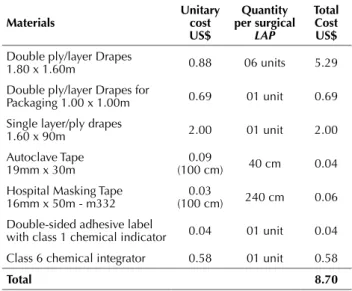
he data in Table 2 indicate the cost and amount of materials used for assembling and sterilizing a surgical
LAP package. he unit cost of surgical drapes added to the estimated cost of 65 reuses for double drapes, and ive reuses for single drapes, added to the cost of reprocessing done by outsourced laundry (US$0.83/1000g) according to their weight (double drapes 1.80 x 1.60m - 800g; double drapes for packaging 1.00 x 1.00m - 580g and single drapes 1.60 x 90 - 400g).
As expected, the unit and the total costs of surgical drapes (double, double packing and single) were most im-pacted in the total cost of materials for end LAP package (US$ 7.98), especially the double drapes because they need-ed six units and single drapes due to the limiting number of only six reuses.
In relation to consumables, the chemical integrator had the highest cost (US$ 0.58/unit) and the cost of using of biological indicator was not accounted for in the Bowie Dick test for routine serum procedures in the CSSD.
Table 1 – Distribution of the time and cost of DLC for Maids and NA/NT, according to the steps/activities for making a surgical LAP package - São Paulo, SP, Brazil, 2014.
steps/Activities Average time spent per surgical lAP (seconds) labor cost per person Us$
Gowns and Drapes reception at LS: removing items out of plastic sealed bags; controlling
stock; storing items by category; assembling the dressing carts and transporting items to CSSD. 148 0.30
DLC of Maids
Assembly and sterilization of surgical LAP package: receiving items from LS; separating drapes for LAP package assembly; review/checking folds and drapes integrity (eight units) and introducing a chemical integrator; packing drapes with autoclave tape and masking tape to identify the packages; establishing autoclave loads; listing all materials inserted into autoclave on Sterilization Control and labeling all LAP packages (tracking); introducing load into the autoclave, programing and initiating the sterilization cycle.
198 0.69
Storage of surgical LAP packages: unloading of autoclave onto dressing carts and storing LAP packages
DLC of NA/NT
09 0.03
total dlc for maids and nA/nt 355 1.02
DLC: maid/second: US$ 0.002; DLC NA/NT/second: US$ 0.0035
Table 2 – Distribution of the cost and quantity of materials used in the assembly and sterilization of surgical LAP package - São Paulo, SP, Brazil, 2014.
Materials
Unitary cost Us$
Quantity per surgical
LAP
total cost Us$
Double ply/layer Drapes
1.80 x 1.60m 0.88 06 units 5.29 Double ply/layer Drapes for
Packaging 1.00 x 1.00m 0.69 01 unit 0.69
Single layer/ply drapes
1.60 x 90m 2.00 01 unit 2.00
Autoclave Tape 19mm x 30m
0.09
(100 cm) 40 cm 0.04
Hospital Masking Tape
16mm x 50m - m332 (100 cm)0.03 240 cm 0.06
Double-sided adhesive label
with class 1 chemical indicator 0.04 01 unit 0.04
Class 6 chemical integrator 0.58 01 unit 0.58
Direct cost of reprocessing cotton-woven surgical drapes: a case study
Table 3 shows that the average total cost, with the DLC for Maids and NA/NT and material for making a surgical
LAP package totaled US$9.72 (100%).
In the composition of the average total cost, the assem-bly and sterilization step of the surgical LAP package was the most representative to US$9.39, with the cost of the materials having the most impact at (US$8.70) 89.51%.
Monthly average consumption was estimated at 1,439 surgical LAP packages in surgeries/procedures for 14 spe-cializations performed at HSL, totaling US$13,987.08. he Hemodynamics, Orthopedics and Obstetrics accounted for the biggest average monthly consumption of LAP packages (753), with the largest impact on representing an estimated average monthly cost of 52.32%.
Table 1 depicts the variation in prices of surgical kits, disposable surgical drapes and individual disposable drapes for auxiliary tables available from ive companies. he av-erage cost according to the type of kit/individual drapes required was taken from this information if there was a pro-posal to replace surgical LAP packages being used in HSL.
drapes, to meet the various specializations, amounting to US$29,127.15 (100.00%).
DISCUSSION
In the CSSD, a nurse’s managerial performance is es-sential to the work process eiciency and to establish the measures necessary for forecasting and the provision of human, material and structural resources, in order to as-sure the quality of customer support(17). he managerial role
requires the nurse to have knowledge on the principles of cost accounting to support rational decision-making and the arguments for negotiating with the hospital administra-tors, in addition to having speciic technical and scientiic knowledge.
he average cost of US$8.70 (89.51%) for the materials integrated in the surgical LAP package, mainly related to the double and single drapes, was the most impactful in the composition of the direct processing cost (US$9.72), similar to what was found in studies that demonstrated the pre-dominance of material costs in relation to DLC involving staf(18-20).
According to RDC 15(6), the reuse of repaired drapes
with patches or mended cotton, presence of holes, tears, fabric wear or any impaired barrier function are not allowed when they are used as packaging. Although this resolution refers to the double drapes for packaging, all cotton drapes in HSL are discarded regardless of how many times they have been reprocessed when characteristics that compro-mise the microbial barrier function are present. Given that the actual number of times that these drapes are used in the hospital is still unknown, it appears that the limit number of reuses may be diferent, or even less, than what is recom-mended in the literature(1-2).
he estimated unit cost of the surgical drapes was cal-culated by adopting their weight before use (clean), but the amount charged by outsourced laundry next to the HSL is based on the weight after use, which is quite variable con-sidering the speciics of each surgical procedure in relation to the volume of luids, secretions and liquids.
Some surgical procedures performed in Urology, Gy-necology and Orthopedics such as Transurethral Resection (TUR) surgery, Hysteroscopy and Arthroscopy, require continuous irrigation luid and generate large volumes of luids which are absorbed by tissue drapes, as well as large sized surgeries that have heavy bleeding. hus, the drapes
Table 4 – Distribution of the total estimated average monthly consumption of surgical kits, surgical drapes and individual dis-posable auxiliary table drapes, and their cost according to the average of surgeries performed in HSL from September to No-vember 2013 - São Paulo, SP, Brazil, 2014.
disposable Materials
Average consumption
(units)
total cost Us$ %
Surgical Kits 1,167 27,937.98 95,92
Individual table drapes 169 1,127.23 3,87
Individual surgical drapes 19 61.94 0,21
total 1,355 29,127.15 100,00
Table 3 – Distribution of the DLC for Maids, Nursing Assistants/ Technicians and materials needed, according to the steps for manufacturing a surgical LAP package - São Paulo, SP, Brazil, 2014.
steps
dlc per person
Us$
Material cost
Us$
total cost Us$
%
Clothing reception at LS 0.30 - 0.30 3.09
Assembly and sterilization
of surgical LAP package 0.69 8.70 9.39 96.60
Storage of surgical LAP
package 0.03 - 0.03 0.31
total 1.02 8.70 9.72 100.0
Chart 1 – Distribution of minimum, maximum and average cost of surgical kits, surgical drapes and individual disposable drapes for auxiliary tables, according to the five suppliers - São Paulo, SP, Brazil, 2014.
Kit/individual drapes Minimum cost Us$ Maximum cost Us$ cost Us$Average
Individual surgical drapes 2.86 4.00 3.26
Individual table drapes 1.81 9.11 6.67
Hemodynamics/Angiography 14.28 25.20 20.57
Hands and extremities 21.00 30.24 26.16
Ophthamology 4.70 10.75 7.96
Orthopedics 25.20 31.98 28.37
ENT 23.10 25.96 24.99
C-section Delivery 20.92 29.40 25.26
Normal Delivery 17.42 26.04 23.13
Universal 20.75 30.72 26.18
Urology/Proctology/
Gynecology 25.20 30.66 27.10
used in these procedures have increased weight and there-fore a higher amount to be paid by the HSL to the out-sourced laundry service.
he Hemodynamics, Orthopedics, Obstetrics and Plas-tic Surgery specializations which had the highest average monthly consumption of LAP packages and the higher cost, also represent the greatest inancial impact if there was the replacement of LAP packages for disposable surgical kits.
In HSL, standard surgical LAP packages also do not meet the speciicity of all surgical specializations, generat-ing waste arisgenerat-ing from usgenerat-ing them in proceedgenerat-ings in which seven drapes would not be needed during it. herefore, the use of disposable kits speciic for each type of surgery, table drapes and individual disposable surgical drapes could be an alternative to minimize the occurrence of waste. Some types of disposable kits have drapes for collecting bags for storage of luid volume generated during certain surgical procedures, which facilitates their disposal.
Regardless of the nature of the health organization be-ing public or private, waste aggravates existbe-ing diiculties due to scarce resources, and so it is imperative to adopt measures/strategies for minimizing waste(4).
It should be noted that the calculation of consumption costs of surgical kits and disposable drapes was based on the average of the values obtained from ive suppliers without any kind of economic negotiation, which would occur from establishing a provision to be gained if the HSL opted for adopting them.
he study was not focused on comparing the costs at-tributed to reprocessing the fabric of surgical drapes in rela-tion to the cost of their replacement by disposable surgical kits, as we could not identify the total cost of this process due to lack of information that would enable the measuring the indirect costs.
Until a few years ago, estimating the indirect cost or lack of it did not compromise the cost of products and services, as there was already a predominance of labor cost and ma-terials directly allocated to a particular product or service. However, with technological advances indirect costs tend to have higher a share in total spending, thereby declining the direct costs within an organization. hus, the lack of knowledge on indirect costs is a problem for organizations because there is no security of their ownership to costing objects and their behavior towards them(21).
A study(22) with the overall objective to apply the
meth-od of Costing Based on Activities in CSSD of a teaching hospital presented the total direct and indirect cost of each type of cycle / load and product groups for sterilization and disinfection as part of the results, having obtained the unit cost of the type of cycle / load for the objects of study. he total cost for the Saturated Vapor Pressure (SVP) steriliza-tion amounted to US$413,743.64, with the direct cost being US$17,270.43 (4%) and the indirect cost US$396,473.20 (96%). In addition to costing per cycle / charge, our data allowed for the identiication of the unit cost per prod-uct group. he total cost identiied for the sterilization of clothes by SVP was US$78,745.30, of which US$15,740.90 (20%) represented the direct costs and US$63,004.06 (80%) represented indirect. his research showed the importance of indirect costing in the composition of the total cost of a CSSD.
From this perspective, the systematization of informa-tion that subsidizes the calculainforma-tion of the indirect costs of reprocessing surgical LAP packages would be crucial in the context of HSL to enable the comparison of the total cost compared to the costs of buying disposables.
However, in addition to the inancial aspects involved in the choice of clothing for the surgical garment, in this case, surgical drapes, it is essential to consider the envi-ronmental impact of waste generated by an increase of disposables, since its use would increase the amount of Group A infectious waste production (material which came in contact with biological luid)(23), and consequently,
the costs for their treatment (disinfection, sterilization or incineration).
CONCLUSION
he achievement of this single case study enabled the direct cost of the steps and their related activities to the reprocessing process of double and single cotton drapes, pieces of the surgical LAP packages used in a teaching hos-pital, amounting to a total of US$9.72.
he knowledge gained will subsidize preliminary dis-cussions on the economic feasibility of replacing reusable cloth drapes with disposable drapes, favoring to sustain ar-guments regarding the advantages and disadvantages of this possibility, considering the eiciency of human, material, structural, environmental and inancial resources.
resUMo
Objetivo: Identiicar o custo direto do reprocessamento de campos de tecido de algodão, duplos e simples, integrantes do pacote de LAP cirúrgico. Método: Estudo de caso quantitativo, exploratório-descritivo, realizado em um hospital de ensino. Calculou-se o custo direto multiplicando-se o tempo despendido por proissionais envolvidos no reprocessamento pelo custo unitário da mão de obra direta, somando-se ao custo dos materiais. A moeda brasileira (R$) utilizada originalmente para os cálculos foi convertida para a moeda norte-americana pela taxa de US$ 0.42/R$. Resultados: O custo total médio, por pacote de LAP cirúrgico, foi de US$ 9.72, com predominância do custo com materiais (US$ 8.70) 89.65%. Destaca-se que o custo total médio dos materiais recebeu forte impacto dos custos dos campos de tecido de algodão (US$ 7.99) 91.90%. Conclusão: O conhecimento obtido subsidiará discussões sobre a substituição de campos de tecido reutilizáveis por campos descartáveis, favorecendo argumentações relativas às vantagens e desvantagens dessa possibilidade considerando os recursos humanos, materiais, estruturais, ambientais e inanceiros.
descritores
Direct cost of reprocessing cotton-woven surgical drapes: a case study resUMen
Objetivo: Identiicar el costo directo del reprocesamiento de campos de tela de algodón, dobles y sencillos, integrantes del paquete de LAP quirúrgico. Método: Estudio de caso cuantitativo, exploratorio-descriptivo, llevado a cabo en un hospital de enseñanza. Se calculó el costo directo multiplicándose el tiempo empleado por los profesionales involucrados en el reprocesamiento por el costo unitario de la mano de obra directa, sumándose al costo de los materiales. La moneda brasileña (R$) utilizada originalmente para los cálculos se convirtió en moneda estadounidense a la tasa de US$ 0.42/R$. Resultados: El costo total medio, por paquete de LAP quirúrgico, fue US$ 9.72, con predominancia del costo con materiales (US$ 8.70), el 89.65%. Se destaca que el costo total medio de los materiales recibió fuerte impacto de los costos de los campos de tela de algodón (US$ 7.99), el 91.90%. Conclusión: El conocimiento obtenido subsidiará discusiones acerca del reemplazo de campos de tela reutilizables por campos desechables, favoreciendo argumentaciones relativas a las ventajas y desventajas de dicha posibilidad al considerarse los recursos humanos, materiales, estructurales, ambientales y inancieros.
descriPtores
Ropa de Protección; Embalaje de Productos; Costos y Análisis de Costo; Enfermería.
REFERERENCES
1. Rodrigues E, Levin AS, Sinto SI, CF Mendes, Barbosa B, Graziano KU. Evaluation of the use and re-use of cotton fabrics as medical and hospital wraps. Braz J Microbiol. 2006;37(2):113-16.
2. Burgatti JC, Possari JF, Moderno AMB. Avaliação da barreira microbiana do campo cirúrgico de algodão. Rev SOBECC. 2004;9(1):24-32.
3. Associação Brasileira de Normas Técnicas. ABNT NBR 14028/1997. Roupa hospitalar - confecção de campo duplo. Rio de Janeiro: ABNT; 1997.
4. Castilho V, Castro LC, Couto AT, Maia FOM, Sasaki NY, Nomura FH, et al. Survey of the major sources of waste in the health care units of a teaching hospital. Rev Esc Enferm USP. 2011;45(n.esp):1613-20.
5. Burgatti JC, Lacerda RA. Systematic review of surgical gowns in the control of contamination/surgical site infection. Rev Esc Enferm USP. 2009;43(1):237-44.
6. Brasil. Ministério da Saúde; Agência Nacional de Vigilância Sanitária. Resolução da Diretoria Colegiada - RDC n. 15, de 15 de março de 2012. Dispõe sobre requisitos de boas práticas para o processamento de produtos para a saúde e dá outras providências [Internet]. Brasília; 2012 [citado 2014 out. 12]. Disponível em: http://bvsms.saude.gov.br/bvs/saudelegis/anvisa/2012/rdc0015_15_03_2012.html
7. Calicchio LG, Santos FP, Silva CPR. Indicadores de monitoramento em Centro de Material e Esterilização. In: Leão ER, Silva CPR, Alva-renga DC, Mendonça SHF. Qualidade em saúde e indicadores como ferramenta de gestão. São Caetano do Sul: Yendis; 2008. p.281-93.
8. Psaltikidis EM. Desaios atuais e futuros para a Central de Materiais e Esterilização [Internet]. São Paulo; 2013 [citado 2014 out. 04]. Dis -ponível em: http://www.nascecme.com.br/artigos/Desaios%20atuais%20e%20futuros%20para%20a%20CME%20-%20inal.pdf
9. Raschka S, Dempster L, Bryce E. Health economic evaluation of an infection prevention and control program: are quality and patient safety programs worth the investment? Am J Infect Control. 2013;41(9):773-7.
10. McDermott K. Lowering the cost of health care: the West Health initiative. Am J Prev Med. 2013;44(1 Suppl 1):S51-3.
11. Jha AK, Orav EJ, Epstein AM. Public reporting of discharge planning and rates of readmissions. N Engl J Med. 2009;361(27):2637-45.
12. Castilho V, Mendes KGL, Jericó MC, Lima AFC. Gestão de custos em Serviços de Enfermagem. Programa de Atualização em Enfermagem. Rev Gestão. 2012;2(1)1:51-73.
13. Zunta RSB, Castilho V. Billing of nursing procedures at an intensive care unit. Rev Latino Am Enfermagem. 2011;19(3):573-80.
14. Castilho V, Fugulin FMT, Gaidzinski RR. Gerenciamiento de costos en los servicios de enfermería. In: Kurcgant P, organizadora. Geren-ciamiento en enfermería. 2ª ed. Rio de Janeiro: Guanabara Koogan; 2010. p. 169-80.
15. Yin RK. Estudo de caso: planejamento e método. 4ª ed. Porto Alegre: Bookman; 2010.
16. Martins E. Contabilidade de custos. 10ª ed. São Paulo: Atlas; 2010.
17. Silva AC, Aguiar BGC. O enfermeiro na central de material e esterilização: uma visão das unidades consumidoras. Rev Enferm UERJ [Internet]. 2008 [citado 2014 out. 12];16(3):377-81. Disponível em: http://www.facenf.uerj.br/v16n3/v16n3a13.pdf
18. Psaltikidis EM, Graziano KU, Frezatti F. Cost analysis of reprocessing disposable forceps used in video-assisted surgery. Rev Latino Am Enfermagem. 2006;14(4):593-600.
19. Lima AFC, Castilho V, Fugulin FMT, Silva B, Ramin NS, Melo TO. Costs of most frequent nursing activities in highly dependent hospitalized patients. Rev Latino Am Enfermagem. 2012;20(5):880-7.
20. Secco LMD, Castilho V. Expenditure survey on continued veno-venous hemodialysis procedure in the intensive care unit. Rev Latino Am Enfermagem. 2007;15(6):1138-43.
21. Gonçalves MA, Zac JI, Amorim CA. Gestão estratégica hospitalar: aplicação de custos na saúde. R Adm FACES J. 2009;8(4):161-79.
22. Jericó MC, Castilho V. Cost management: the implementation of the activity-based costing method in central sterilizing services. Rev Esc Enferm USP [Internet]. 2010 [cited 2014 Oct 12];44(3):745-52. Available from: http://www.scielo.br/pdf/reeusp/v44n3/en_28.pdf
23. Brasil. Ministério do Meio Ambiente; Conselho Nacional do Meio Ambiente (CONAMA). Resolução n. 358, de 29 de abril de 2005. Dispõe
sobre o tratamento e a disposição inal dos resíduos dos Serviços de Saúde e dá outras providências [Internet]. Brasília; 2005 [citado 2013