Photodegradation of UHMWPE Filled with Iron Ore Fine
Frederick Louis Dias de Moraisa, Felipe da Silva Medeirosb, Glaura Goulart Silvab, Marcelo Silveira Rabelloc, Alexandre Rangel de Sousaa*
Received: April 23, 2016; Revised: September 24, 2016; Accepted: December 27, 2016.
Ultra high molecular weight polyethylene (UHMWPE) is one of the most important engineering materials owing to outstanding properties like impact strength and abrasion resistance. However, the
relatively low Young´s modulus restricts some application and the use of illers may be a suitable way to overcome this. The illers can inluence the photo stabilization of the compound, as it occurs to other polymers. Neat UHMWPE and its composites with 1 and 10% of iron ore ine were exposed
to ultraviolet radiation for up to 33 days and then tested for mechanical properties. The stress-strain behaviour changed with degradation, with an evident necking and strain hardening region that was
not observed before exposure, due to a reduction in entanglements density. From the tensile results, the iller may have a protection action against UV, particularly when a loading of 10% was present. Complementary analyses were performed, including X-ray difraction, DSC and SEM.
Keywords: Iron ore ine, Photodegradation, UHMWPE
* e-mail: [email protected]
1. Introduction
Ultra high molecular weight polyethylene (UHMWPE) is rather similar to high-density polyethylene (HDPE) based on the chemical structure and molecular architecture1,2. Such as HDPE, it can be synthetized as an homopolymer, being
predominantly linear, or as a copolymer of ethylene and
other oleins, having some small side branches3. However, because of the very high molar mass that results on special properties like high impact strength and abrasion resistance,
UHMWPE is classiied as an engineering polymer4, whereas HDPE is considered a commodity5. UHMWPE is applied, among others, as internal human body prosthesis, which prompted several studies on the gamma radiation and electron
beam efects on its properties6,7,8. These radiations are used for sterilization and to promote crosslinking, improving the
wear strength9,10,4. As an engineering plastic, UHMWPE is also widely used outdoors and, hence, the chemical stability
under UV radiation is very important. Although not many
studies were conducted on this issue, it was shown that the degradation behaviour of UHMWPE is similar to HDPE,
except for mobility diferences of free radicals due the diference in molecular sizes of these two polymers11,12.
One of the disadvantages of UHMWPE in comparison with other engineering polymers is the relatively low
modulus, and this can be overcome by adding illers. The use of natural or synthetic illers, however, can also change the polymer stability against UV radiation and temperature
damage, which have been reported in many studies13,14,15,16. For example, Dintcheva et al.17,18 evaluated the anti UV action of a functionalized carbon nanotube (CNT) with a hindered amine light stabilizer and silsesquioxane on an UHMWPE matrix. A signiicant improvement in UV stabilization was noted when the iller was present.
In this study the inluence of iron ore ine on UV stability of UHMWPE was investigated. Although the iron ore ine can
be a high value material and, therefore, could be considered
inappropriate to be used as a iller, the wastes generated from
the mining and ore processing are usually discarded, being a
possible industrial iller to UHMWPE. The neat polymer and the compound with 1% and 10% of iller were submitted to UV irradiation for up to 33 days and tested for mechanical
and physicochemical changes. To the best of our knowledge,
this is the irst study using a residue from the mining industry as iller to improve UV stability of UHMWPE.
2. Experimental
The UHMWPE was supplied by Braskem (Brazil) in
a powder form, with molar mass 3×10⁶ g/mol and density 0.925 g/cm3. The iron ore ine was supplied by Vale do Rio
aDepartamento de Engenharia de Materiais, Campus I, Centro Federal de Educação Tecnológica de
Minas Gerais, Avenida Amazonas, 5253, Belo Horizonte, MG, Brazil
bDepartamento de Química, Instituto de Ciências Exatas, Universidade Federal de Minas Gerais, Avenida Antônio Carlos, 6627, Belo Horizonte, MG, Brazil
cUnidade Acadêmica de Engenharia de Materiais, Universidade Federal de Campina Grande, Avenida
Doce Company (Brazil) and it was sifted through an ASTM
100 mesh sieve, with aperture of 0.154mm, to remove coarse
particles before mixing with the polymer.
The polymer and iron ore ine were poured in a closed plastic bag for an intense mixing up to homogenization.
Besides the neat UHMWPE, two compounds were prepared,
containing 1% and 10% of iron ore ine. Plates with sizes
of 150mm × 100mm × 1 and 3mm were produced by compression moulding in a Solab hydraulic press at 220°C during 35 minutes under a pressure of 2.7MPa with periodic degassing during the cycle. The cooling of the plates was
done at irst by leaving them under pressure for 60 minutes after switching of the heat, followed by 40 minutes at room
temperature. Test bars were machined from the plates, for
characterization.
The X-ray difraction analysis (XRD) of iller was performed in a Shimadzu XRD-7000 model at 40 KV, 30
mA and using a copper target. The scanning range was from
5 to 80° (2θ) with a rate of 2°/min. The data analysis was
performed with the software OriginLab version 7.0 and powder X software, version 2004.04.70 PRO to identify the
pattern of difraction peaks generated. The determination of iller chemical composition was done by energy dispersive X-ray in a Shimadzu EDX-720 equipment using a scanning
rate of 0.02°/min, enabling the determination of elements
from Ti to U. The image of the UHMWPE powder illed with 10% of iron ore ine was obtained using a SED-X Shimadzu
scanning electron microscope.
Type IV tensile bars (ASTM D-638), thickness of 1mm,
and impact Charpy specimens (120×12×3mm) were machined from compression-moulded plates. The impact specimens were notched with an angle of 30° and 2mm of depth.
The specimens were exposed to ultraviolet radiation at room temperature using LightTech 80W luorescent tubes, which are used to artiicial sunbath, following a similar
procedure used in a previous study19. The exposure times were deined as 11, 22 and 33 days.
Tensile tests before and after UV irradiation were conducted in a Shimadzu tensile test machine using a crosshead
speed of 50 mm/min at 23°C with at least 6 specimens for each condition. The impact Charpy was done on a XJ25-Z
equipment using a 25J hammer.
FTIR spectra from UV exposed surfaces were obtained using a Shimadzu Prestige 21 spectrophotometer with a horizontal ATR accessory. Carbonyl index (CI) was determined through the equation (1):
Where A1731 and A1370 are the band areas of carbonyl and methyl groups, respectively. The last one was used as internal standard band.
Diferential scanning calorimetry (DSC) was used to
evaluate the crystallinity degree of neat polymer and their
compounds with iron ore ine after UV irradiation. The
measurements were performed in a TA Instruments 2920 calorimeter. The samples were removed from a micrometric
layer from exposed surface and the data were obtained from the irst heating using a heating rate of 10°C/min. For
selected compositions the tests were performed in duplicate,
indicating diferences between data of crystallinity degree
from the measurements inferior to 2%.
The morphology in cryogenic fractured specimens
before and after UV exposure was inspected by scanning
electron microscopy (SEM). The images were obtained
with an electron microscope gun of ield emission scanning (FEI QUANTA 200) and acquired using the Backscattered
Electrons mode (BSE). In the BSE method, the backscattered electrons are originated from the interaction of the emitted beam by the electronic microscope with the nuclei of atoms in the samples. As the intensity of this interaction depends largely on the nuclear charge (Rutherford scattering type), chemical contrast is most evident in these images, enabling
a better assessment to the dispersion of iron ore ine in the
composite. Through these analyses, the evaluation of particles
morphology size distribution is possible.
3. Results
3.1 Iron ore ine characterization
The XRD difractogram of the iron ore ine (Figure 1) shows that it is composed primarily of hematite (Fe2O3) and quartz (SiO2). The high content of hematite in this material was also observed by Costa et al.20, who argued as typical of Brazilian ores composition.
( )
CI A A
1
1370 1731
=
Figure 1. XRD difractogram of iron ore ine.
The chemical composition is given in Table 1, as obtained
by EDX. Even though this technique gives only a low accuracy
evaluation of atom content, it is useful for a general idea of the material composition. The analysis detected the presence
which is consistent with the results of XRD. Mn is the lowest percentage element (<1%) and it was not observed in the
XRD difractogram. The presence of Mn might be due to the
occurrence of substitution manganese hematite structures as a result of environmental weathering21.
Table 1: Chemical composition of iron ore ine obtained from EDX analysis.
Chemical element Composition (%)
Fe 88,6
Si 10,5
Mn 0,8
The morphology of the iller particles was assessed
by the SEM analysis of the composite fracture surface, as
shown in Figure 2. The quartz particles have a more compact
morphology whereas hematite is more granular. The average
area of the particles is approximately 0.2 mm2, as given in the histogram. Although they have an irregular format, if
we consider the disc form the average diameter equivalent
is 0.5mm, that is higher than 0.154mm, the aperture of the
sieve. This can be explained for some agglomeration during
the moulding process or the elongated format of the particles.
Figure 2. SEM and BSE images of the fractured surface of composite with 10% of ine iron ore, and histogram of the average size of the particles.
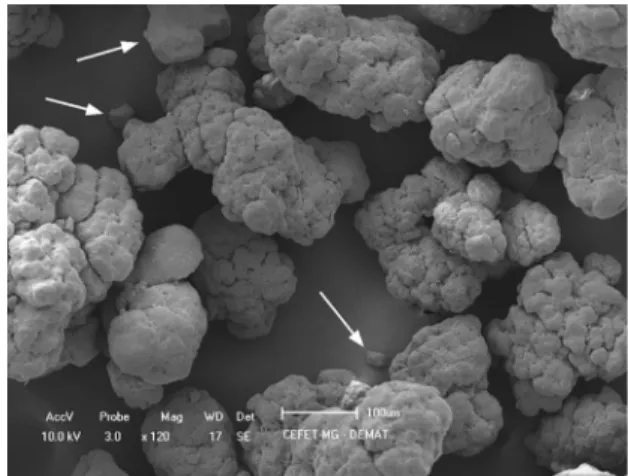
The Figure 3 shows the SEM image obtained from the composition of the polymer with 10% of iron ore ine before moulding where we can see that the iron ore ine particles, indicated by white arrows, barely have the size
higher than 0.1mm.
3.2 Mechanical properties
Tensile tests, crystallinity and oxidation
The results for ultimate strain of neat UHMWPE and
their compounds with iron ore ine before and after UV exposure are shown in Figure 4. For the unexposed samples, the maximum elongation is reduced by about 20% when 10% iller is present. Even so, the value obtained (about 400%)
is still higher than the minimum accepted to this grade that is 350%, according to the polymer manufacturer22. It is well known that the presence of particulate illers in a ductile matrix reduces the elongation because the illers act as a
Figure 3. SEM image of the UHMWPE powder illed with 10% of iron ore ine.
stress raiser15. Li et al.23 studied the mechanical strength of UHMWPE compounded with 70% charcoal, and observed a reduction on rupture strain of composites. The neat polymer strained 323% and the composites 31%.
Figure 4. Rupture strain with the UV time exposure of UHMWPE and their compounds with 1 and 10% of iron ore ine. Surigo usar nas abcissas “Filler content (%)”.
Figure 4 also shows that after UV exposure, the rupture strain of neat UHMWPE changed signiicantly, rising 27% at irst up to 22 days exposure, then an abrupt drop was
observed. A similar behavior was observed to the polymer
compounded with 1% of iron ore ine in which the rupture strain raised 34% up to 22 days exposure then a reduction
was observed, though far less in comparison to neat polymer.
The polymer containing 10% of iron ore ine showed the lowest variation of maximum elongation with UV exposure time, indicating the stabilizing action of the iller. A high
dispersion on rupture strain results was noted for the neat
polymer after 33 days UV exposure since some specimens fractured during necking while some of them stabilized
rupture. There are some studies showing that mineral illers can protect the polymeric matrix against the UV radiation but, in some cases, the iller may contain active metal that
act as a catalyst to polymer degradation5,14. Grigoriadou et al.24 observed that Cu-nanoiber protected HDPE against UV radiation by reducing the oxygen difusion through
the sample. In other work, Grigoriadou et al.25 showed that some nanoparticles added to HDPE promoted stabilization whereas others accelerated the photo-oxidation process.
It could be expected that the changes that occurred on rupture strain by UV action were towards the reduction on
this property, not the increase as noted in some conditions
(Figure 4). Actually, one of the most common evidences of
polymer deterioration by photodegradation is the reduction in elongation26, which is explained by the molecular scission and entanglement density reduction that can also cause an increase in crystallinity in semi-crystalline polymers26,27,28. The results showed in Figure 4, specially to neat polymer and to the compound with 1% iron ore ine, up to 22 days exposure are surprising at irst sight because an increase
on rupture strain was clearly noted. We believe that the high entanglement density of UHMWPE may be the key to understand this behaviour. The stress strain curves presented
by the degraded neat polymer and the compound with 1% iller (to be discussed in detail further in this text) are somewhat
similar to the HDPE behaviour, which has a higher elongation in comparison to UHMWPE. It is believed that the very high entanglement density of UHMWPE restricts the elongation. In this way, we suppose that the molecular scissions that
take place during exposure reduce the entanglement density
and, hence, allow a higher elongation, similar to HDPE.
However, it is important to highlight that there is a proile
of degradation on thick samples like those used here. This
is because of oxygen access vary through the thickness, making degradation more intense near the exposed surface29. Despite the heterogeneous proile, the resultant behaviour
on stress strain test of degraded samples was much similar to that presented by HDPE, including the necking on yield point and the cold drawing region that are not normally presented during UHMWPE tests4,30. These diferences are assigned to the higher entanglement density on the last one31. It is important to emphasize that HDPE is also more crystalline than UHMWPE30. Another aspect that should be considered to explain those results is the possibility of crosslinking of polyethylene, particularly if the oxygen is absent, for example, in internal regions of the specimen11.
Figures 5 shows that the elastic modulus and yielding stress increased with increasing UV exposure time. For the neat polymer after 11 and 22 days exposure, the properties
increased more in comparison to polymer containing 1%
iller. However, between 22 and 33 days exposure the increase
was much less, indicating that a steady condition in these properties is reached. This is a similar behaviour to the one observed with the crystallinity of polypropylene by Rabello and White27, although in this study this steady condition
was achieved after more than 25 weeks of UV exposure. The authors observed that the carboxyl index continued to increase after the crystallinity plateau of equilibrium
showing that the degradation process continued even though
the crystallinity not changed any more. For the polymer containing 1% of iron ore ine, elastic modulus and yielding
stress achieved about the same values of the neat polymer
after 33 days exposure. For the compound with 10% iller,
the changes in elastic modulus and yielding stress are rather
small, indicating that iron ore ine may have a stabilizing
action. The elastic modulus increased almost 70% for the
neat polymer and the compound with 1% iller, whereas the composite with 10% iller showed an increase of 29% after 33 days of UV exposure. The yielding stress increased 23
and 26% to neat polymer and the compound with 1% of
iron ore ine, respectively, while the increase was only 9% when 10% iller was added.
Figure 5. Elastic modulus (a) and yielding stress (b) results of neat UHMWPE and their compounds with iron ore ine after UV irradiation.
Elastic modulus and yielding stress of semi-crystalline polymers like polyethylene have a close relation with the crystallinity degree. Higher crystallinity leads to higher values of modulus and strength5,32. Since the degradation caused by UV exposure results on molecular scission on amorphous
region, the released segments can rearrange, increasing the crystallinity degree. This phenomenon is known as
chemi-crystallization27,28. UHMWPE is a crystallizable polymer owing to the linear molecular structure, but crystallization is more diicult when compared to HDPE due to the extremely
high molar mass that cause too much entanglements. The molecular scission on interlamellar regions, due the degradation, allows the increase of crystallinity degree.
According to Figure 6, the changes in crystallinity were
more pronounced in the neat polymer, that increased 34.3%
after 33 days of UV exposure; followed by the polymer containing 1% of iron ore ine where the crystallinity increased 28.6%, but the composite with higher iller content
also showed a considerable increase, of 26.4% after 33 days
of UV exposure. For this experiment, the specimens were removed from the bar exposed surface, whereas the results for the other tests relected the bulk of the samples. It is possible that interior of the samples with 10% iller was more protected due to the screening efect ofered by the
when the yielding point is reached, which would be due to the necking of the sample bar30. Actually, no necking was visually observed during the test. After the yielding point, the curve presents a steady increases on stress up to fracture without the development of a cold drawing region. These two aspects, absence of necking after yielding point and hardening strain, are assigned to a high density of entanglements36,37,38,39 because of the high molecular weight of UHMWPE. With the
increase of UV exposure, a signiicant stress drop is noted
after the yielding point, which caused necking of the samples,
followed by a cold drawing region that is more extensive for longer exposures. The strain hardening is still observed for samples exposed for 11 and 22 days. The behaviour of these
samples is similar to the one observed for HDPE38, probably due to the reduction of entanglements density as considered
previously. For 33 days of UV exposure, the majority of the
samples fractured close to the yielding region.
The stress-strain curves for the 1% illed polymer (Figure 7-b) were similar to ones for the neat polymer, like
the occurrence of necking on yielding point, a cold drawing
region and the hardening strain at the end of the test. For 33 days of UV exposure, about 85% of the samples dit not
fractured on yielding point, developing cold drawing. This percentange was higher in comparison to neat polymer
exposed to UV radiation by the same time, indicating some stabilization promoted by the iller.
The behaviour described above for the neat polymer and
composite with 1% iller occurred also with the 10% illed compound, though in a subtle way (Figure 7-c). There was no rupture on yielding point for samples exposed to 33 days,
probably due to the protection against photodegradation this
iller promoted to the polymer.
From the plastic region of stress-strain curves three
important data were obtained: (i) the drop on stress value after the yield point, (ii) the slope between 100 and 200% elongation and (iii) the slope between 300 and 400%
elongation, and the results are given in Figure 8. Figure 8-a
shows that stress drop is higher for the neat polymer and a minor change was observed for the polymer containing 10%
iller; the compound with 1% of iller showed an intermediate
behaviour. The increase in stress drop after yielding with
exposure is a consequence of the reduction in entanglement
density and a crystallinity increase, as discussed previously. Figure 6. Crystallinity degree of neat UHMWPE and their compounds
with iron ore ine after UV irradiation. The accuracy of the data was obtained for selected samples and is ± 2%.
Although the photodegradation of polyoleins like UHMWPE is followed by the increase of carbonyl index,
in this study this wasn’t observed, as shown in the Table 2.
Studies of measures of carbonyl index through FTIR in polyoleins indicates an interval before the detection of the increase of oxidation, wich one increases if a stabilizer is
used34. Fernando et al.35 after comparing two diferent ways of measuring the oxidation of polyethylene and propylene
concluded that while it is necessary more than one hundred
hours of UV exposure to get a measurable concentration of
carbonyl groups in a conventional test only a few minutes are necessary to detect the CO2 evolved in gas tests.
Table 2: Carbonyl index.
Sample CI
unexposed 33 days
0% ine 0.067 0.028
1% ine 0.033 0.028
10% ine 0.097 0.037
Plastic region of stress strain curves
Figure 7-a shows representative curves for unexposed and UV irradiated neat UHMWPE. For the unexposed
polymer the curve does not have a visible drop on stress
Figure 8. Data obtained from stress strain curves: (a) drop on stress after the yielding; (b) slope of curve between 100 and 200% of strain; and (c) slope between 300 and 400% of strain.
The reduction of slope between 100 and 200% of strain
(Figure 8-b) is also a consequence of a change of entanglement
network, with the appearance of a cold drawing region as the degradation increases. It results that the deformation becomes easier when less entanglements are present. The
slope between 300 and 400% (Figure 8-c) is related to the extension of cold drawing, following the same trend shown in Figure 8-b.
Impact Tests Results
The impact results reported here must be seen only as a
qualitative test, but the results obtained are consistent with
the others in which we observed that the sample with 10%
of iron ore ine showed higher UV radiation resistance. From Figure 9, it is observed that only the neat polymer after exposure showed a total fracture, i.e., both parts of
the sample bars were physically separated after testing.
The illed samples, even after UV exposure, maintained a
conection between the two halves of the sample (separated by the notch). Moreover, the more preserved samples were
the ones with the highest iller content.
Figure 9. Specimens after the impact test: unexposed (a) and after 33 days UV irradiation (b).
Fracture surfaces after impact testing
The SEM images of impact-fractured surfaces after 33
days exposure to UV radiation are shown in Figure 10. The
fracture surface of the neat UHMWPE has lower roughness, indicating a less ductile behaviour than the other specimens tested9, which is consistent to the results of maximum elongation after 33 days exposure (Figure 4).
Figure 10. SEM images of fractured surfaces of neat UHMWPE and their compounds with iron ore ine in two magniications after 33 days of UV exposure.
3.3 Filler Distribution in the UHMWPE Polymer
Matrix
polymer presents a very clear image due to the absence of
the iller. With the increasing addition of iron ore ine in the polymer matrix, there is an increase of the light spots on the
images. These bright spots correspond to the dispersed iron
ore ines over the polymer bulk. It is important to note the good distribution of the iller on the matrix in both images (Figure 11-b and 11-c) but there is a poor dirpersion which
is typical of this processing procedure.
Figure 11. SEM and BSE images of fractured surfaces of composites before UV exposure.
EDS mapping in Figure 12 also conirmed that iron ore ines were well distributed in the polymeric matrix. A
colour map of EDS is assigned for each element, having
the colours red, green, blue and yellow for C, O, Si and Fe,
respectively. The EDS maps show more intense red colour (C) in regions of polymer domain, and increased distribution of green colour (O) is present in regions with hematite and
quartz particles.
4. Conclusion
In this work the inluence of iron ore ine in the
photodegradation behaviour of UHMWPE was evaluated.
The presence of the 10% iller improved the UV resistance
of the polymer, as observed by a lower variation in tensile properties and the maintenance of toughness in impact tests, in comparison to neat polymer and the one compounded
with 1% iller. A detailed investigation of stress strain
curves indicated a reduction of entanglement density with
UV exposure, including the developing of necking after the
Figure 12. EDS spectra and mapping (elements C, Fe, O, Si) for the fractured surface of composite with 10% of ine iron ore, after 33 days exposure to UV radiation.
yield point. Complementary tests showed that the iller was uniformly distributed through the polymer matrix and that
an increase in crystallinity with degradation was observed.
5. Acknowledgements
The authors thank the Braskem and Vale do Rio Doce Company for the UHMWPE and iron ore ine samples
kindly supplied.
6. References
1. Gnanou Y, Fontanille M. Linear (monodimensional) Synthetic Polymers. In: Gnanou Y, Fontanille M. Organic and Physical Chemistry of Polymers. Hoboken: John Wiley & Sons; 2008.
2. Carraher Jr CE. Introduction to Polymer Chemistry. Boca Raton: CRC Press; 2010.
3. Rojas G, Berda EB, Wagener KB. Precision polyolein structure: Modeling polyethylene containing alkyl branches. Polymer. 2008;49(13-14):2985-2995. DOI: 10.1016/j.polymer.2008.03.029 4. Villaraga ML, Cripton PA. The Clinical Performance of UHMWPE
in the Spine. In: Kurtz SM, ed. The UHMWPE handbook: Ultra-high Molecular Weight Polyethylene in Total Joint Replacement. San Diego: Elsevier Academic Press; 2004. p. 219-243.
5. Brydson J. Polyethylene. In: Brydson J. Plastic Materials. 7th ed.
London: Butterworth Heinemann; 1999. p. 205-246. 6. Takahashi Y, Shishido T, Yamamoto K, Masaoka T, Kubo K,
Tateiwa T, et al. Mechanisms of plastic deformation in highly cross-linked UHMWPE for total hip components–the molecular physics viewpoint. Journal of the Mechanical Behaviour
of Biomedical Materials. 2015;42:43-53. DOI: 10.1016/j. jmbbm.2014.11.002
8. George A, Ngo HD, Bellare A. Inluence of crystallization conditions on the tensile properties of radiation crosslinked, vitamin E stabilized UHMWPE. Journal of the Mechanical Behaviour of Biomedical Materials.2014;40:406-412. DOI: 10.1016/j.jmbbm.2014.09.011
9. McKeen LW. Plastics Used in Medical Devices. In: Modjarrad K, Ebnesajjad S. Handbook of Polymer Applications in Medicine and Medical Devices. Oxford: Elsevier; 2014. p. 21-53. 10. Lu S, Buchanan FJ, Orr JF. Analysis of variables inluencing the
accelerated ageing behaviour of ultra-high molecular weight polyethylene (UHMWPE). Polymer Testing. 2002;21(6):623-631. DOI: 10.1016/S0142-9418(01)00134-9
11. Costa L, Bracco P. Mechanisms of Crosslinking and Oxidative Degradation of UHMWPE. In: Kurtz SM, ed. The UHMWPE Handbook: Ultra-High Molecular Weight Polyethylene in total joint replacement. San Diego: Elsevier Academic Press; 2004. p. 245-261.
12. Costa L, Luda MP, Trossarelli L. Ultra high molecular weight polyethylene–II. Thermal- and photo-oxidation. Polymer Degradation and Stability. 1997;58(1-2):41-54. DOI: 10.1016/ S0141-3910(97)00010-4
13. Butylina S, Martikka O, Karki T. Weathering properties of coextruded polypropylene-based composites containing inorganic pigments. Polymer Degradation and Stability. 2015;120:10-16. DOI: 10.1016/j.polymdegradstab.2015.06.004
14. Yang R, Yu J, Liu Y, Wang K. Efects of inorganic illers on the natural photo-oxidation of high-density polyethylene. Polymer Degradation and Stability. 2005;88(2):333-340. DOI: 10.1016/j. polymdegradstab.2004.11.011
15. Trotignon JP, Demdoum L, Verdu J. Efect of mineral illers in low concentration on the mechanical properties of polymeric materials. Part 1: Static and fatigue fracture of polypropylene, qualitative aspects. Composites. 1992;23(5):313-318. DOI: 10.1016/0010-4361(92)90330-W. DOI:10.1016/0010-4361(92)90330-W
16. Sharma N, Chang LP, Chu YL, Ismail H, Ishiaku US, Mohd Ishak ZA. A study on the efect of pro-oxidant on the thermo-oxidative degradation behaviour of sago starch illed polyethylene.
Polymer Degradation and Stability. 2001;71(3):381-393. DOI: 10.1016/S0141-3910(00)00189-0
17. Dintcheva NTz, Arrigo R, Morici E, Gambarotti C, Carroccio S, Cicogna F, et al. Multi-functional hindered amine light stabilizers-functionalized carbon nanotubes for advanced ultra-high molecular weight polyethylene-based nanocomposites.
Composites Part B: Engineering. 2015;82:196-204. DOI: 10.1016/j.compositesb.2015.07.017
18. Dintcheva NTz, Arrigo R, Carroccio S, Curcuruto G, Guenzi M, Gambarotti C, et al. Multi-functional polyhedral oligomeric silsesquioxane-functionalized carbon nanotubes for photo-oxidative stable Ultra-High Molecular Weight Polyethylene-based nanocomposites. European Polymer Journal. 2016;75:525-537. DOI: 10.1016/j.eurpolymj.2016.01.002
19. Sousa AR, Amorim KLE, Medeiros ES, Mélo TJA, Rabello MS. The combined efect of photodegradation and stress cracking in
polystyrene. Polymer Degradation and Stability. 2006;91(7):1504-1512. DOI: 10.1016/j.polymdegradstab.2005.10.002 20. da Costa GM, Barrón V, Ferreira CM, Torrent J. The use of
difusive relectance spectroscopy for the characterization of iron ores. Minerals Engineering. 2009;22(14):1245-1250. DOI: 10.1016/j.mineng.2009.07.003
21. da Costa MI, Kunrath JI, Cunha JBM, Moro JT, de Araújo JH. Mösbauer efect characterization of Brazilian iron ores for mining industrial purposes. Nuclear Instruments and Methods in Physics
Research Section B: Beam Interactions with Materials and Atoms. 1993;76(1-4):244-245. DOI: 10.1016/0168-583X(93)95196-C
22. Braskem. Utec. Ultra high molecular weight; 2015. Available from: < http://www.braskem.com.br/Portal/Principal/Arquivos/ Download/Upload/Bras2011_UTEC_ING_20042011.pdf >. Access in: 10/15/2015.
23. Li S, Li X, Deng Q, Li D. Three kinds of charcoal powder reinforced ultra-high molecular weight polyethylene composites with excellent mechanical and electrical properties. Materials and Design. 2015;85:54-59. DOI: 10.1016/j.matdes.2015.06.163
24. Grigoriadou I, Paraskevopoulos KM, Karavasili M, Karagiannis G, Vasileiou A, Bikiaris D. HDPE/Cu-nanoiber nanocomposites with enhanced mechanical and UV stability properties.
Composites Part B: Engineering. 2013;55:407-420. DOI: 10.1016/j.compositesb.2013.07.002
25. Grigoriadou I, Paraskevopoulos KM, Chrissais K, Pavlidou E, Stamkopoulos TG, Bikiaris D. Efect of diferent nanoparticles on HDPE UV stability. Polymer Degradation and Stability. 2011;96(1):151-163. DOI: 10.1016/j.polymdegradstab.2010.10.001
26. Rabek JF. Experimental methods in polymer degradation. In: Rabek JF. Polymer Photodegradation. Mechanisms and experimental methods. London: Chapman & Hall; 1995. p. 433-597. 27. Rabello MS, White JR. Crystallization and melting behaviour
of photodegraded polypropylene – I. Chemi-crystallization.
Polymer. 1997;38(26):6379-6387. DOI:
10.1016/S0032-3861(97)00213-9
28. Craig IH, White JR, Kin PC. Crystallization and chemi-crystallization photodegraded polypropylene. Polymer. 2005;46(2):505-512. DOI:10.1016/j.polymer.2004.11.019
29. Schoolenberg GE, Vink P. Ultra-violet degradation of polypropylene: 1. Degradation proile and thickness of the embrittled surface layer. Polymer. 1991;32(3):432-437. DOI: 10.1016/0032-3861(91)90446-Pdoi:10.1016/0032-3861(91)90446-P doi:10.1016/0032-3861(91)90446-P
30. Mohagheghian I, McShane GJ, Stronge WJ. Impact perforation of monolithic polyethylene plates: Projectile nose shape dependence.
International Journal of Impact Engineering.2015;80:162-176. DOI: 10.1016/j.ijimpeng.2015.02.002
31. Bartczak Z. Efect of the molecular network on high-strain compression of cross-linked polyethylene. European
Polymer Journal. 2012;48(12):2019-2030. DOI: 10.1016/j. eurpolymj.2012.09.006
33. Rabello MS, White JR. Photodegradation of talc-filled polypropylene. Polymer Composites. 1996;17(5):691-704. DOI: 10.1002/pc.10661
34. Gugumus F. Re-evaluation of the stabilization mechanisms of various light stabilizer classes. Polymer Degradation and Stability. 1993;39(1):117-135. DOI: 10.1016/0141-3910(93)90131-2
35. Fernando SS, Christensen PA, Egerton TA, White JR. Carbon dioxide evolution and carbonyl group development during photodegradation polyethylene and polypropylene. Polymer
Degradation and Stability. 2007;92(12):2163-2172. DOI: 10.1016/j.polymdegradstab.2007.01.032
36. Antsupov YA, Volodin VP, Kuvshinskii EV. Analysis of the cold drawing of polyoleins based on stress-strain diagrams. Polymer Mechanics. 1968;4(3):402-405. DOI: 10.1007/BF00859536
37. Haward RN, Thackray G. The Use of a Mathematical Model to Describe Isothermal Stress-Strain Curves in Glassy Thermoplastics.
Proceedings of the Royal Society A. Mathematical, Physical and Engineering Sciences. 1968;302(1471):453-472. DOI: 10.1098/rspa.1968.0029
38. Schrauwen BAG. Deformation and failure in semi-crystalline
polymer systems: inluence of micro and molecular structure. [Thesis]. Eindhoven: Technische Universiteit Eindhoven; 2003.