ISSN 1517-7076 artigo 11532, pp.33-39, 2014
Autor: Santos, L Data de envio: 30 /11/ 2013 Data de aceite: 30/06/2014
Elastic modulus evaluation of
Titania nanotubes obtained by anodic
oxidation
Luciane S. Santos 1, Nilson T. C. Oliveira2, Carlos M. Lepienski1, Cláudia E. B. Marino1, Neide K Kuromoto1,3
1
Graduate Program in Engineering and Materials Science - PIPE - UFPR CP: 19011 - 81531-990, Curitiba, PR e-mail: [email protected]
2
Department of Materials Engineering - DEMa – UFSCAR CEP: 13565-905, São Carlos, SP e-mail: [email protected]
3
Physics Department – UFPR – CP: 19044 - 81531-990 Curitiba, PR e-mail: [email protected]
ABSTRACT
The use of titania (TiO2) nanotubes is becoming one of the most attractive techniques as surface treatment for implants due its combination of morphology (that accelerates osteoblast adhesion and proliferation), bioactiv-ity and possibilbioactiv-ity of being use as a drug vehicle. Anodic oxidation is one of the cheapest and simplest ap-proaches to obtain highly ordered nanotubes. Parameters such as applied potential, reaction time and fluoride containing in the electrolyte define the nanotubes morphology. However, the mechanical properties of the nanotubes layer do not have been completely elucidated and they play a crucial role in the implant long term stability. The objective of this research was to obtain TiO2 nanotubes using anodic oxidation and to determine their elastic modulus and hardness. The TiO2 nanotubes layer was obtained in a fluoride containing electro-lyte for 1 hour, one group at 15 V and another one at 25 V. The TiO2 nanotubes morphology was character-ized by scanning electron microscopy (SEM) and atomic force microscopy (AFM). The elastic modulus and hardness were evaluated by nanoindentation experiments using a spherical tip. SEM images showed highly ordered nanotubes on all titanium surfaces and it was observed that the nanotubes diameters are directly re-lated with the applied potential. Nanotubes diameters are 66 ± 9 nm and 131 ± 22 nm for nanotubes obtained at 15 V and 25 V, respectively. Nanoindentation test results showed a decrease in the elastic modulus comparing with titanium reference and these values approach to cortical bone elastic modulus. These re-sults demonstrate that it was possible to obtain a homogeneous TiO2 nanotubes layer that has mechan-ical properties adequate to improve implant long-term stability.
Keywords: Titania nanotubes, anodic oxidation, indentation, elastic modulus.
1. INTRODUCTION
Titanium and titanium alloys are the materials most used as endosseous implants. Their characteristics as mechanical properties, low density, good corrosion resistance, make them more attractive than other used as implants, as stainless steel 316 L and Cr-Co alloy [1], [2]. Elastic modulus (E) is a property that affects di-rectly the implant stability. It is desirable that the metal elastic modulus be as close as possible from that of the bone (around 30 GPa to the cortical bone), because lower differences between the E values result in better transfer of stress, avoiding stress-shielding effect [3]. Being a valve metal, titanium has a self-formed sponta-neous oxide layer that prevents the release of ions when implanted, leading to biocompatibility. However this thin oxide layer does not promote chemical bonds with live tissue, so it’s necessary a surface treatment to improve their surface properties looking for a optimized osseointegration [4].
34
Elastic modulus of TiO2 nanotubes layer is not well established until now and it plays an important role on the long term stability of the implant, although few researches have investigate it. Instrumented indentation is the most suitable technique to determine the elastic modulus of thin films, however the initial roughness and the probe geometry can impose some limitations. Crawford [13] has examined the deformation behavior of a nanotube layer using nanoindentation tests with a Berkovich probe, what led to a indentation penetration higher than the thickness of the nanotube layer and wear marks on indentation.
In this study it is reported the nanotube obtainment under two different potentials, to observe their morpho-logical properties and investigate the elastic modulus of TiO2 nanotubes layers using a spherical probe .
2. MATERIALS AND METHODS
Prior to anodic oxidation, commercially pure titanium samples (~5×18×2) mm, grade 2 were grounded and polished with SiC paper and silical coloidal suspension to mirror image. They were then degreased by soni-cating in acetone, isopropyl alcohol and deionized water, for 15 min in each bath . To remove the air-formed oxide layer the samples were chemically etched by immersion in a solution of nitric acid and hydrofluoric acid for 15 sec. A two-electrode electrochemical cell was used with the sample as anode and a platinum wire as counter electrode. The applied potential was computer-controlled using a Agilent DC power supply. Ano-dization was conducted at constant voltage of 15 V or 25 V for 1 h at room temperature. A 1 mol.L-1 H3PO4 electrolyte with an addition of 0.3 wt % HF was used. A magnetic stirrer was employed during the anodiza-tion to avoid formaanodiza-tion of bubbles on the electrode surface. After the anodizaanodiza-tion the samples were rinsed in deinonized water and dried with a heat gun.
The TiO2 nanotubes morphology was analyzed by scanning electron microscopy (SEM) and atomic force microscopy (AFM) in contact mode. The average diameter was calculated after the image acquisition using ImageJ software measuring 50 nanotubes in three regions of each sample. Structure was evaluated by Raman spectroscopy, using a 532 nm laser. The elastic modulus was obtained from the Oliver and Pharr method us-ing instrumented indentation tests. A spherical tip (100 μm diameter) was used and the applied loads ranged from 0.10 mN to 100 mN in 8 loading/unloading cycles or 20 mN in one cycle. A Ti polished sample was used as reference to the nanoindentation test.
3. RESULTS AND DISCUSSIONS
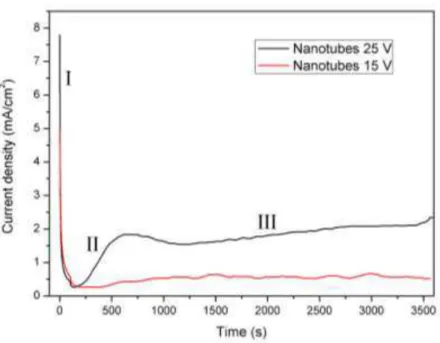
3.1. Chronoamperometric curve of obtainment
35
Figure 1: Current densities as function of time during anodization of TiO2 nanotubes obtained at 15 V and 25 V.
3.2. Morphological features
Figure 2 shows an AFM image of the nanotubes anodized at 25 V. It’s possible to observe that the nanotubes tops were not on the same level, probably due to the initial roughness. AFM analyses prove to be adequate to observe the topography, but it was not possible to measure diameter and roughness due to the tip convolution, consequence of tip geometry. As a consequence, this image provides just a qualitative view of the nanotopog-raphy.
Morphology analysis of TiO2 nanotubes shows that anodization processes lead to a highly ordered nanotube layer, self-organized and perpendicularly disposed over the substrate. SEM images show the top-view of TiO2 nanotubes obtained under 25 V (Figure 3) and under 15 V (Figure 4). TiO2 nanotubes diameter is af-fected by the applied potential. Samples anodized under 15 V and 25 V showed inner diameters of 66 ± 9 nm and 131 ± 22 nm respectively. Since only the applied potential was changed during the anodization tests, it is possible to conclude, in accordance with literature, that the average diameter depends on the applied poten-tial.
36
Figure 3: SEM top view images of TiO2 nanotubes grown at 25 V.
Figure 4: SEM top view images of TiO2 nanotubesgrown at 15 V.
3.3. Crystallinity
37
according to RRUFF project. Nanotubes obtained at 15 V exhibit a broad band instead of well defined peaks. Previous data in literature reported the absence of Raman peaks in porous titanium layers obtained at 20 V due to the low layer thickness [15].
3.4. Elastic modulus
The dotted blue line on Figure 6a corresponds to the elastic modulus of untreated Ti sample. After the ano-dization process it was repeated the indentation tests and the results are the black and red dots, to nanotubes obtained under 15 V and 25 V, respectively. On this test it was performed 8 loading/unloading cycles of in-dentation, where the maximum load applied was 100 mN. As even the small irregularities influence on inden-tation test, resulting in large deviations, the graphs presented here are useful for comparison but are not quan-titative results. Both nanotubes layers show an increase on elastic modulus as the contact depth becomes higher. This behavior is caused by the substrate influence. No difference is observed between the values measured for both nanotubes layers and the amount of anatase phase seems not to be significant to the nano-tube elastic modulus.
Literature reports show that the indentation could lead to densification, caused by the collapse of nanotubes under pressure, resulting in results variation [16]. Therefore, other tests were performed using just one load-ing/unloading cycle and a lower load, 20mN. The results are presented in Figure 6(b), where it is possible to observe that both nanotubes elastic modulus values are lower than that of untreated Ti.
38
Figure 5: (a) Elastic modulus profile of TiO2 nanotubes anodized at 15V (black points) and anodized at 25V (red points) in comparison with titanium reference (blue dotted lines), It’s was used 8 loading/unloading cycles with maximum load of 100mN (b) Elastic modulus for one loading/unloading cycle with load of 20mN.
4. CONCLUSIONS
It was possible to obtain nanotubes by anodic oxidation using a 1 mol.L-1 H3PO4 +0.3 wt % HF electrolyte and the nanotube diameter was defined by the applied potential. The nanotubes elastic modulus does not ex-hibited difference between nanotubes obtained at 15 V and 25 V, but both values are lower than that of un-treated Ti. These results demonstrated that it was possible to obtain an improved surface due to a homogene-ous TiO2 nanotubes layer that has elastic modulus values adequate to improve osseointegration.
5. ACKNOWLEDGEMENT
The present study was supported by Brazilian agencies Capes, CNPq and Fundação Araucária. The authors would like to thank the Centro de Microscopia Eletrônica/UFPR for the SEM facilities.
6. REFERENCES
[1] a. W. Miles and S. Gheduzzi, “Basic biomechanics and biomaterials,” Surg., vol. 30, no. 2, pp. 86– 91, Feb. 2012.
[2] R. Van-Noort, “Review Titanium : the implant material of today,” J. Mater. Sci., vol. 22, pp. 3801– 3811, 1987.
[3] M. Niinomi and M. Nakai, “Titanium-Based Biomaterials for Preventing Stress Shielding between Implant Devices and Bone.,” Int. J. Biomater., vol. 2011, p. 836587, Jan. 2011.
[4] S. Izman, M. R. Abdul-kadir, M. Anwar, E. M. Nazim, R. Rosliza, A. Shah, and M. A. Hassan,
“Surface Modification Techniques for Biomedical Grade of Titanium Alloys : Oxidation ,
Carburization and Ion Implantation Processes,” 2006.
[5] S. Oh, C. Daraio, L. Chen, T. R. Pisanic, R. R. Fin, and S. Jin, “Significantly accelerated osteoblast
cell growth on aligned TiO 2 nanotubes,” 2006.
[6] J. Kunze, L. Müller, J. M. Macak, P. Greil, P. Schmuki, and F. A. Müller, “Time-dependent growth
of biomimetic apatite on anodic TiO2 nanotubes,” Electrochim. Acta, vol. 53, no. 23, pp. 6995–7003, Oct. 2008.
[7] M. Li, X. Xiao, and R. Liu, “Synthesis and bioactivity of highly ordered TiO2 nanotube arrays,” Appl. Surf. Sci., vol. 255, no. 2, pp. 365–367, Nov. 2008.
[8] L. M. Bjursten, L. Rasmusson, S. Oh, G. C. Smith, K. S. Brammer, and S. Jin, “Titanium dioxide
nanotubes enhance bone bonding in vivo.,” J. Biomed. Mater. Res. A, vol. 92, no. 3, pp. 1218–24, Mar. 2010.
[9] W. Yu, J. Qiu, and F. Zhang, “In vitro corrosion study of different TiO2 nanotube layers on titanium
in solution with serum proteins.,” Colloids Surf. B. Biointerfaces, vol. 84, no. 2, pp. 400–5, Jun. 2011.
[10] K. C. Popat, M. Eltgroth, T. J. Latempa, C. a Grimes, and T. a Desai, “Decreased Staphylococcus epidermis adhesion and increased osteoblast functionality on antibiotic-loaded titania nanotubes.,” Biomaterials, vol. 28, no. 32, pp. 4880–8, Nov. 2007.
[11] a. W. Tan, B. Pingguan-Murphy, R. Ahmad, and S. a. Akbar, “Review of titania nanotubes:
39
[12] J. M. Macak, H. Tsuchiya, A. Ghicov, K. Yasuda, R. Hahn, S. Bauer, and P. Schmuki, “TiO2 nanotubes: Self-organized electrochemical formation, properties and applications,” Curr. Opin. Solid State Mater. Sci., vol. 11, no. 1–2, pp. 3–18, Feb. 2007.
[13] G. a Crawford, N. Chawla, K. Das, S. Bose, and a Bandyopadhyay, “Microstructure and deformation
behavior of biocompatible TiO2 nanotubes on titanium substrate.,” Acta Biomater., vol. 3, no. 3, pp. 359–67, May 2007.
[14] L. Sun, S. Zhang, X. W. Sun, and X. He, “Effect of electric field strength on the length of anodized titania nanotube arrays,” J. Electroanal. Chem., vol. 637, no. 1–2, pp. 6–12, Dec. 2009.
[15] H.-Y. Si, Z.-H. Sun, X. Kang, W.-W. Zi, and H.-L. Zhang, “Voltage-dependent morphology,
wettability and photocurrent response of anodic porous titanium dioxide films,” Microporous Mesoporous Mater., vol. 119, no. 1–3, pp. 75–81, Mar. 2009.
[16] G. a Crawford, N. Chawla, K. Das, S. Bose, and A. Bandyopadhyay, “Microstructure and