*e-mail: [email protected]
1. Introduction
Al2O3-ZrO2 eutectic ceramics have a good combination of physical, thermal and mechanical properties, such as ultra-high hardness, excellent oxidation resistance and strength retention at elevated temperatures1-3. These excellent properties make Al2O3-ZrO2 eutectic ceramics potential for a wide range of applications. Generally, eutectic ceramics were mostly prepared by Bridgman method3, laser heated loating zone method4,5, micro pulling down method6,7, combustion synthesis method8,9, thermal explosion spraying10-12 and so on. In addition, the mechanical properties of the Al2O3-ZrO2 eutectic ceramics are mainly decided by microstructure which is inluenced signiicantly by the cooling rate of the melt.
Rapid solidiication technique was usually used to prepare metal, alloy and metallic eutectic because it has the high cooling rate greater than 105~106K/s[13-15]. However, this method was rarely to prepare eutectic ceramics due to the high melting points of the ceramics. In this paper, thermal explosion spraying was used to realize rapid solidiication for eutectic ceramics, which was a new kind of method for high‑eficient heating process. By utilizing the highly exothermic reaction between reactants, the thermal explosion spraying can generates a large amount of heat and gas, and the reaction product can melt easily and be sprayed rapidly under high gas pressure. Once encounter the cool substrates, the high‑temperature melt can be solidiied quickly. Compared to the traditional rapid quenching method16, it has the advantages of simplifying process and saving cost and energy17,18. Moreover, this method can reach super high temperatures to realize rapid solidiication of the system without any special crucible or extra heating device.
In this paper, Al2O3-ZrO2 hypoeutectic coating was prepared by thermal explosion spraying to realize rapid solidiication. The heat transfer mechanism of the solidiication process was simulated by Finite Element Analysis. The microstructure evolution of the coating under different cooling rates was studied.
2. Experimental Procedure
Aluminum (5μm, ≥ 99% in purity) and zirconium nitrate (Zr(NO3)4, A.R. ≥ 99% in purity) powders were used as raw materials in this experiment. The reactant powders were thoroughly dried and mixed by ball milling for 12~24 hours using alumina milling-media, and then the mixed powders were encased into the explosive spraying reaction equipment. The reaction in this study was expected to take place as follows:
Al+Zr(NO3)4→Al2O3+ZrO2+N2↑ (1)
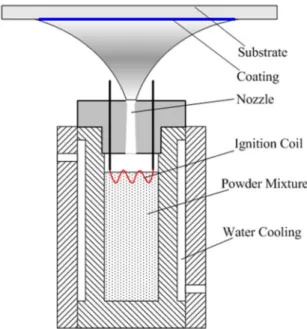
In Addition, certain amount of Al2O3 and ZrO2 were added to control the reaction temperature of the system. The reactants were ignited by the heat released by the Ni-Cr resistance wire with an 10A electrical current. Once ignited, the reaction instantly generated a large amount of heat, and the system was rapidly heated to a temperature above the melting point of each substance. Meanwhile large quantities of nitrogen produced by the reaction generated a high pressure in the apparatus, so that the melt can spray from the nozzle to the Cu-plate, and the Al2O3/ZrO2 hypoeutectic coating was obtained by at rapid cooling rates, as shown in Figure 1.
Microstructure Evolution and Model Analysis of Al
2O
3/ZrO
2Hypoeutectic Ceramic During Rapid Solidiication
Zhonghai Xua, Yongting Zhenga*, Yangyang Guoa, Wei Yea, Pan Yanga
aCenter for Composite Materials and Structures, Harbin Institute of Technology, Harbin, PR China
Received: November 24, 2014; Revised: October 12, 2015
Rapid solidiication of the super high‑temperature Al2O3/ZrO2 melt was studied by a novel method. The melt was prepared by explosion reaction using Al and Zr(NO3)4 as raw materials and then sprayed to Cu‑plate. The heat transfer during the solidiication process was analyzed by one-dimensional Finite Element Analysis. The cooling rate of the melt decreased with the increasing distance from the Cu-plate. According to the microstructure evolution, the coating can be divided into four areas: amorphous, nano-crystalline, cellular and dendrite crystal layer. The amorphous and nano-crystalline (50~100 nm) layers can be obtained at the cooling rate of about 1.68~7.76 × 10⁵K/s and 0.48~1.68 × 10⁵K/s, respectively, while the cooling rate of the cellular and dendrite crystal layers were about 0.26~0.48 × 10⁵K/s and 0.14~0.26 × 10⁵K/s, respectively. The microstructure of the hypoeutectic ceramics shows that the nano-crystalline, cellular and dendritic crystals of the Al2O3 phases were embedded in the Al2O3/ZrO2 eutectic matrix.
2015; 18(Suppl. 1) 147 Microstructure Evolution and Model Analysis of Al2O3/ZrO2
Hypoeutectic Ceramic During Rapid Solidiication
The phase composition of the as-sprayed coating was identiied by X‑ray diffraction (D/MAX‑rB, Rigaku, Japan). The cross-sectional microstructure of the coating was investigated by SEM (FE‑SEM, S‑4700, Hitachi, Japan), EDS (EDAX, USA) and TEM (JEM 2010, Jeol, Japan).
3. Results and Discussion
3.1. Phase composition of the coating
The X‑ray diffraction pattern of the as‑sprayed coating was shown in Figure 2. It showed that the Reaction 1 proceeded as expected and the reactant was transformed to Al2O3 and ZrO2 completely. The reaction between Al and Zr(NO3)4 generated a large amount of heat and nitrogen. As a result, the reaction temperature could reach about 3000-4000K. Due to the higher oxidizability of oxygen than nitrogen and suficient oxygen supply, Al was oxidized to form Al2O3 and no aluminum nitride was observed in the product. Because
of the high cooling rate of the coating, most of the ZrO2 reserved the tetragonal structure, and the residual showed monoclinic structure. The existence of t-ZrO2 was beneicial to improve the mechanical properties through transformation toughening of t-ZrO2 to m- ZrO2[19,20].
3.2. Microstructure of the coating
The back scattering electron micrograph of the cross-section of the Al2O3/ZrO2 hypoeutectic coating was shown in Figure 3. The white particles in the igure were Fe, which was formed by the erosion of the nozzle caused by molten Al2O3/ZrO2 during the spraying.
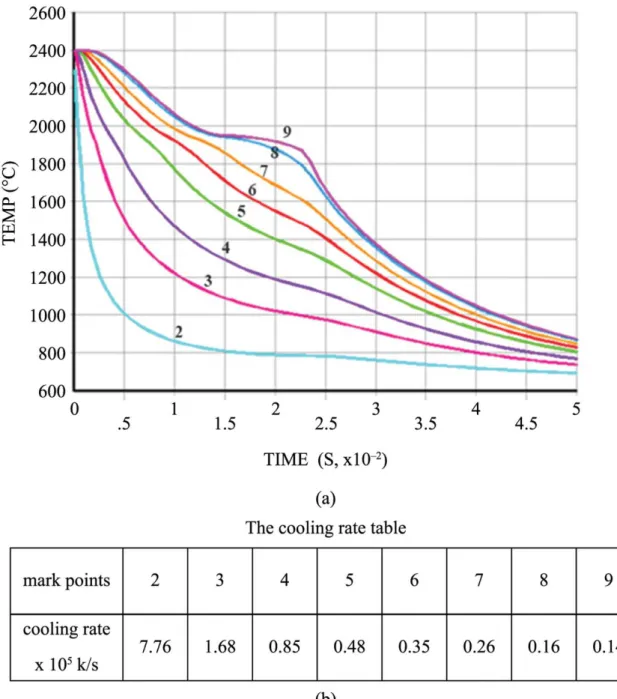
According to the microstructure evolution along the growth direction, Al2O3/ZrO2 hypoeutectic coating could be divided into four areas: amorphous structure area, nano-crystalline area, cellular crystal area and dendrite crystal area. The boundaries and the center points of the four areas were marked by numbers 1~9, as shown in Figure 3. The changes of the temperature over time as well as the cooling rate of the marked points were shown in Figure 4a, b, respectively. With the increase of the distance to the surface of Cu-plate, the cooling rate decreased rapidly. Because of the different cooling rates, the crystallization morphologies of Al2O3/ZrO2 coating in different areas were varied signiicantly.
The amorphous structure, which is shown in Figure 3, occurred in the interface contacted with the Cu-plate. In this area, the maximum cooling rate of 1.68~7.76 × 10⁵K/s was appeared, as shown in curve 2, 3 in Figure 4a. The temperature of the Cu-plate was much lower than that of the Al2O3/ZrO2 melt so that the heat was transferred to Cu-plate rapidly. As a result, the temperature of the melt dropped suddenly to much lower than the glass transition temperature (Tg), and then the amorphous structure formed when the atoms were frozen at the place where they were in the liquid.
The cooling rate decreased with the thickness increasing of the Al2O3/ZrO2 eutectic coating. When the cooling rate reached about 0.48~1.68 × 10⁵K/s, as shown in curve 4, 5 in Figure 4a, there has a certain period of time to allow the atomic diffusion over a short distance, and therefore crystal
Figure 1. The device of fabricating theAl2O3/ZrO2 hypoeutectic coating by thermal explosion spraying.
Figure 2. XRD pattern of the Al2O3-ZrO2 coating.
Figure 4. The temperature over time (a) and the cooling rate at solidiication temperature (b) of mark points during Al2O3/ZrO2 melt
solidiication.
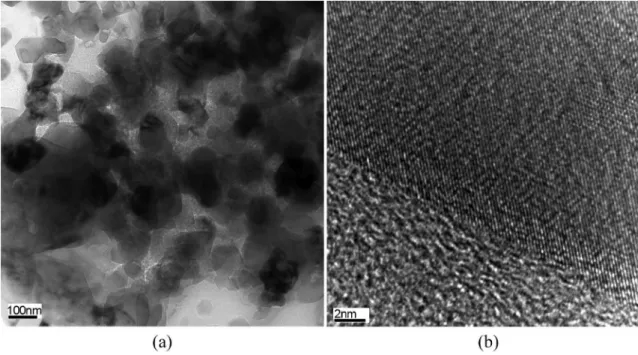
nucleation process was promoted and Al2O3 nano-crystalline formed inally. Nano‑scale Al2O3 particles, as shown in Figure 5a, were observed through TEM in crystalline area b in Figure 3. The particle diameters were about 50-100 nm. The microstructure of the nano-crystalline area showed that Al2O3 phases were embedded in the Al2O3/ZrO2 hypoeutectic structure matrix. Figure 5b showed the strong boundary combination between the crystal and amorphous area in the coating.
As the thickness increasing of the Al2O3/ZrO2 coating, the cooling rate further reduced, and the material diffusion became easier. The nano-sized Al2O3 phase gradually grew up
to form cellular crystal. The cooling rate of cellular crystal area (c area in Figure 3) was about 0.26~0.48 × 10⁵K/s (as shown as curve 6, 7 in Figure 4). X. Mao et al.21 pointed out that the higher cooling rate decreased the local solidiication time and hindered the nucleus grow fully to dendrites, therefore only cellular crystal could be formed, as shown in Figure 6a. The phase formation of Al2O3 precipitated ZrO2 to solid‑liquid interface during the process of nucleation. When the Al2O3 and ZrO2 proportion in the solid‑liquid interface was closed to the eutectic composition, hypoeutectic structure was formed.
2015; 18(Suppl. 1) 149 Microstructure Evolution and Model Analysis of Al2O3/ZrO2
Hypoeutectic Ceramic During Rapid Solidiication
Al2O3 with diameter of about 1~2μm were embedded in Al2O3/ZrO2 hypoeutectic matrix.
When the last part of the melt was sprayed, the cooling rate slowed down to the minimum value of 0.14~0.26 × 10⁵K/s (as shown in curve 8, 9 in Figure 4). The latent heat of the crystallization helped the fully grown Al2O3 cellular crystal to form the secondary dendrite arm and the dendrites. The dendrite region of crystal structure showed that Al2O3 dendrites were embedded in the Al2O3/ZrO2 hypoeutectic structure matrix.
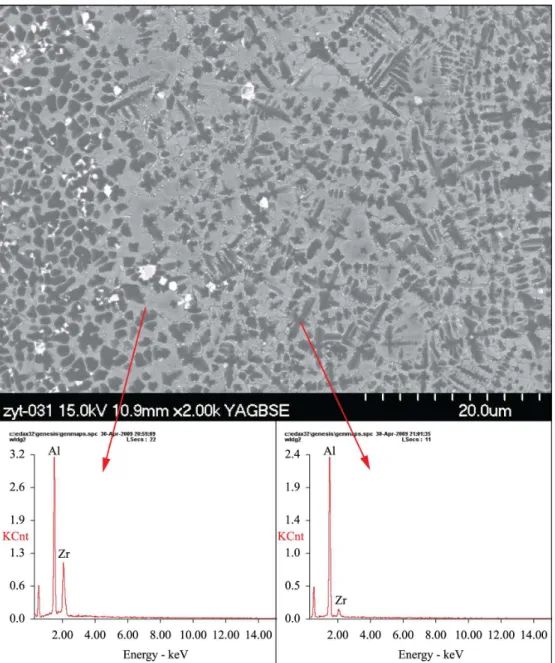
Dendrite Al2O3 crystal structure was shown in Figures 7 and 8, respectively. Figure 7 showed the early stage of the dendrite formation. In this stage pseudo-eutectics formed and dendrite became less due to the high cooling rate. Al2O3 dendrite was
embedded in the light gray Al2O3/ZrO2 eutectic matrix, which was demonstrated by EDS shown in Figure 7. When platform of the cooling curve appeared, the low cooling rate and the usual law of solidiication conducted the dendrite to form the inal morphology. Hypoeutectic products of Al2O3 and ZrO2 were greatly deviated from the eutectic composition, so that a large area of alumina dendrites was formed as shown in Figure 8.
Owing to the characteristics of thermal spraying technique, pores can readily form and deteriorated the properties of the coating. However, the Al2O3/ZrO2 hypoeutectic coating prepared by thermal explosion spraying showed a high relative density and no pores were observed. High relative density of the coating prepared in this experiment was
Figure 6. Back scattering electron images of (a) cellular structure and (b) nano and cellular structure of the Al2O3/ZrO2 coating.
Figure 8. Back scattering electron image of the dendrite crystal.
Figure 7. Back scattering electron image and EDS of the dendrite crystal.
attributed to the strong impact on the coating bring from the explosion spraying, which is favorable for the densiication of the coating.
4. Conclusions
2015; 18(Suppl. 1) 151 Microstructure Evolution and Model Analysis of Al2O3/ZrO2
Hypoeutectic Ceramic During Rapid Solidiication
Reference
1. Waku Y, Nakagawa N, Wakamoto T, Ohtsubo H, Shimizu K and Kohtoku Y. A ductile ceramic eutectic composite with high strength at 1873. Nature. 1997; 389(6646):49-52. http://dx.doi. org/10.1038/37937.
2. LLorca JL, Pastor JY, Poza P, Pena JI, Francisco I, Larrea
A, et al. Influence of the Y2O3 content and temperature on the mechanical properties of melt-grown Al2O3-ZrO2 eutectics.
Journal of the American Ceramic Society. 2004; 87(4):633-639. http://dx.doi.org/10.1111/j.1551-2916.2004.00633.x.
3. Lee JH, Yoshikawa A, Kaiden H, Lebbou K, Fukuda T, Yoon
DH, et al. Microstructure of Y2O3 doped Al2O3 /ZrO2 eutectic fibers grown by the micro-pulling-down method. Journal of Crystal Growth. 2001; 231(1-2):179-185. http://dx.doi. org/10.1016/S0022-0248(01)01451-8.
4. Mesa MC, Oliete PB, Pastor JY, Martín A and LLorca J.
Mechanical properties up to 1900 K of Al2O3/Er3Al5O12/ZrO2 eutectic ceramics grown by the laser floating zone method.
Journal of the European Ceramic Society. 2014; 34(9):2081-2087. http://dx.doi.org/10.1016/j.jeurceramsoc.2013.11.013.
5. Larrea A, de la Fuente GF, Merino RI and Orera VM. ZrO2 -Al2O3 eutectic plates produced by laser zone melting. Journal of the European Ceramic Society. 2002; 22(2):191-198. http:// dx.doi.org/10.1016/S0955-2219(01)00279-5.
6. Su HJ, Zhang J, Cui CJ, Liu L and Fu HZ. Rapid solidification
of Al2O3-Y3Al5O12-ZrO2 eutectic in situ composites by laser zone remelting. Journal of Crystal Growth. 2007; 30(2):448-456. http://dx.doi.org/10.1016/j.jcrysgro.2007.06.029.
7. Lee JH, Yoshikawa A, Kaiden H, Lebbou K, Fukuda T, Yoon
DH, et al. Microstructure of Y2O3 doped Al2O3/ZrO2 eutectic fibers grown by the micro-pulling-down method. Journal of Crystal Growth. 2001; 231(1-2):179-185. http://dx.doi. org/10.1016/S0022-0248(01)01451-8.
8. LLorca J, Pastor JY, Poza P, Peña JI, Francisco I and Larrea A.
Influence of the Y2O3 content and temperature on the mechanical properties of melt-grown Al2O3-ZrO2 eutectics. Journal of the American Ceramic Society. 2004; 87(4):633-639. http://dx.doi. org/10.1111/j.1551-2916.2004.00633.x.
9. Zhao ZM, Zhang L, Zheng J, Bai H, Zhang S and Xu B.
Microstructure and mechanical properties of Al2O3/ZrO2 composite produced by combustion synthesis. Scripta Materialia. 2005; 53(8):995-1000. http://dx.doi.org/10.1016/j. scriptamat.2005.06.016.
10. Zhao ZM, Zhang L, Song YG and Wang W. Al2O3/ZrO2(Y2O3) self-growing composite prepared by combustion synthesis under high gravity. Scripta Materialia. 2008; 58(3):207-211. http:// dx.doi.org/10.1016/j.scriptamat.2007.09.051.
11. Zheng YT, Li HB and Zhou T. Microstructure and mechanism of Al2O3/ZrO2 eutectic coating prepared by combustion-assisted thermal explosion spraying. Applied Surface Science. 2011; 258(4):1531-1534. http://dx.doi.org/10.1016/j.apsusc.2011.09.125.
12. Zheng YT, Li HB, Zhou T, Zhao J and Yang P. Microstructure
and mechanical properties of Al2O3/ZrO2 eutectic ceramic composites prepared by explosion synthesis. Journal of Alloys and Compounds. 2013; 551:475-480. http://dx.doi.org/10.1016/j. jallcom.2012.11.064.
13. Li Y, Liu HY, Davies HA and Jones H. Easy glass formation
in Mg64Ni21Nd15 by bridgman solidification. Materials Science and Engineering A. 1994; 179-180:628-631. http://dx.doi.
org/10.1016/0921‑5093(94)90281‑X.
14. Jones H. Enhancement of properties and performance of
materials by rapid solidification processing. Key Engineering Materials. 1995; 97-98:1-12. http://dx.doi.org/10.4028/www. scientific.net/KEM.97-98.1.
15. Guan SK and Wang LG. Research and development trend of rapidly solidified alloy. Modern Casting. 2004; 4:22-26.
16. Han YH, Yun J, Harada Y, Makino T and Kakegawa K. Eutectic
structure from amorphous Al2O3-ZrO2-Y2O3 system by rapid
quenching technique for potential hybrid solar cell application. Advances in Applied Ceramics. 2010; 109(2):101-103. http://
dx.doi.org/10.1179/174367509X12554402490949.
17. Wei MX, Wang SQ, Wang F and Cui XH. A thermal explosion
process to fabricate an intermetallic matrix composite coating on a steel. Materials & Design. 2009; 30(8):3041-3047. http:// dx.doi.org/10.1016/j.matdes.2008.12.013.
18. Klinger L, Gotman I and Horvitz D. In situ processing of TiB2/ TiC ceramic composites by thermal explosion under pressure: experimental study and modeling. Materials Science and Engineering A. 2001; 302(1):92-99. http://dx.doi.org/10.1016/ S0921-5093(00)01359-9.
19. Tuan WH, Chen RZ, Wang TC, Cheng CH and Kuo PS.
Mechanical properties of Al2O3/ZrO2 composites. Journal of
the European Ceramic Society. 2002; 22(16):2827-2833. http:// dx.doi.org/10.1016/S0955-2219(02)00043-2.
20. Hannink RHJ, Kelly PM and Muddle BC. Transformation
toughening in zirconia-containing ceramics. Journal of the American Ceramic Society. 2000; 83(3):461-487. http://dx.doi. org/10.1111/j.1151-2916.2000.tb01221.x.
21. Mao XM, Li JG and Fu HZ. Effect of local solidification time