ISSN 0104-6632 Printed in Brazil
www.abeq.org.br/bjche
Vol. 33, No. 04, pp. 713 - 721, October - December, 2016 dx.doi.org/10.1590/0104-6632.20160334s20150291
Brazilian Journal
of Chemical
Engineering
STRIPPING AND DISSIPATION TECHNIQUES FOR
THE REMOVAL OF DISSOLVED GASES FROM
ANAEROBIC EFFLUENTS
R. M. Glória, T. M. Motta, P. V. O. Silva, P. da Costa, E. M. F. Brandt,
C. L. Souza
*and C. A. L. Chernicharo
Federal University of Minas Gerais, Belo Horizonte - MG, Brazil. E-mail: [email protected]
(Submitted: May 8, 2015 ; Revised: July 29, 2015 ; Accepted: July 30, 2015)
Abstract - UASB reactors are a common technology for wastewater treatment. However, certain
disadvantages must be considered. One of the disadvantages relates to the presence of dissolved gases, hydrogen sulfide and methane, in the effluent, which can potentially be released into the atmosphere. This can cause malodours and contribute to the greenhouse effect. In this perspective, this work investigated alternative techniques to minimize these disadvantages: air stripping inside the settling compartment; and a dissipation chamber immediately after the reactor outlet. Results achieved with the air stripping technique showed low removal efficiencies for methane, around 30%, and in the range of 40 to 60% for hydrogen sulfide. On the other hand, the removal efficiencies obtained with the dissipation chamber technique were much higher, consistently reaching 60% or more for both gases, plus a relatively lower exhaust flow. For the best operational condition tested, median removal efficiencies of 73 and 97% were observed for dissolved methane and dissolved sulfide, respectively.
Keywords: Dissipation chamber; Stripping; Dissolved methane; Hydrogen sulphide; Gaseous emissions; UASB reactor.
INTRODUCTION
When anaerobic UASB-type reactors are em-ployed for the treatment of domestic sewage, the generation of gaseous by-products, notably methane and hydrogen sulfide, is unavoidable. The former is a greenhouse gas and the latter causes bad odours and corrosion. In addition, methane losses mean less energy potential to be exploited. In this sense, a higher dissolved methane concentration in the reac-tor effluent leads to a decrease in the CH4 recovery efficiency, which stands for the percentage of the total CH4 produced (biogas + losses with the efflu-ent) that is actually recovered with the biogas, inside the three-phase separator. This parameter is another
important issue of concern when CH4 is intended to be used as energy source (Giménez, 2012).
hanging sponge (DHS) reactor (Hatamoto et al., 2010; Matsuura et al., 2010; Hatamoto et al., 2011).
In relation to dissolved sulfide, various tech-niques have been applied to attempt its removal from anaerobic reactor effluents, notably from UASB reactors. Some studies have been carried out in this direction, including: aeration of the effluent, with removal efficiency of approximately 86% (Khan et al., 2011); electrochemical technique, with removal efficiency of approximately 82% (Dutta et al., 2010); micro aeration technique, with removal efficiency of around 16% (Krayzelova et al., 2014) and biochemi-cal technique (photosynthetic bacteria), with removal efficiencies ranging between 81 and 95% (Kobayashi, 1983).
Other alternatives, such as stripping and dissipa-tion techniques (this study), which present low cost and operational simplicity for the removal of dis-solved gases, are based on aeration and gas transfer conditions. Since gas transfer occurs through the gas-liquid interface (according to the two-film theory), this operation has to be carried out as to maximize the opportunity of interfacial contact between the two phases. In order to have the bulk solution also take part in the transfer, continuous renewal of these interfaces is essential (Popel, 1979). In this sense, the dissipation chamber technique, by exhaustion of the confined atmosphere, promotes the gas phase reno-vation. In addition, the turbulence caused by the free drop height increases the mass transfer for the liquid phase. Thereby two conditions are optimized: i) the oxygen diffusion in the liquid effluent, due to its high concentration in the gas phase; and ii) the re-lease of dissolved gases (like hydrogen sulfide and methane) into the confined atmosphere, which is under low partial pressure due to its constant renova-tion, enabling gas recuperation. For the stripping technique, the gas transfer occurs as the bubble emerges from the orifice of diffusers and rises through the liquid. Besides oxygen diffusion into the liquid phase, hydrogen sulfide and methane transfer-ences from the liquid phase are expected to occur, through the formed bubbles.
Therefore, this study aimed to test the effective-ness of the stripping and dissipation techniques for the removal of methane and hydrogen sulfide dis-solved in the effluent of anaerobic reactors.
MATERIAL AND METHODS
Two pilot-scale UASB reactors of identical con-figuration (V=360 L), both fed with real domestic wastewater and operated with a hydraulic detention time of 7 h were used in the experiments. Two alter-natives to remove the gases dissolved in the anaero-bic effluent were tested:
i. Stripping device, located inside the settling compartment of one of the UASB reactors;
ii. Dissipation unit, located outside the other reactor, with the purpose to create hydraulic energy dissipation through a controlled free-fall.
The stripping device, which consisted of 4 air in-jection points, located 15 cm below the liquid sur-face of the settling compartment of the reactor, was operated under 3 different rates of air injection (213, 160 and 107 L.m-3.min-1), comprising three opera-tional phases. The volume used to calculate the rates of air injection was the volume of the settling com-partment, above the stripping point (0.03 m3).
The dissipation unit, which consisted of a 10 cm diameter cylindrical chamber, was operated at two different drop heights (0.5 and 1.0 m) and controlled air exhaustion rates, comprising 4 operational phases, as shown in Table 1.
The experiments with both techniques were car-ried out at ambient temperature (around 22 °C) and atmospheric pressure of around 91.9 kPa.
Analyses of sulfide in the liquid samples were performed according to the protocol adapted by Plas et al. (1992), whereas sampling and analysis of dis-solved methane followed the protocol described in Souza et al. (2011). The quantification of methane and hydrogen sulfide in the waste gas were per-formed, respectively, via gas chromatography and a portable analyzer (Odalog®, range 1 to 2000 ppm).
Table 1: Operational phases of the experiments with the dissipation chamber.
Operational phases
Exhaustion rate (L.min-1)
Exhaustion time (min)
Number of air renovations*
(renews.h-1)
Free drop height
(m)
Chamber volume
(L)
Hydraulic loading rate (m3.m-2.min-1)
1 1.6 5 12 1.0 8 0.132
2 1.6 2.5 24 0.5 4 0.132
3 1.2 3.3 18 0.5 4 0.132
4 0.8 5 12 0.5 4 0.132
RESULTS
Stripping Device
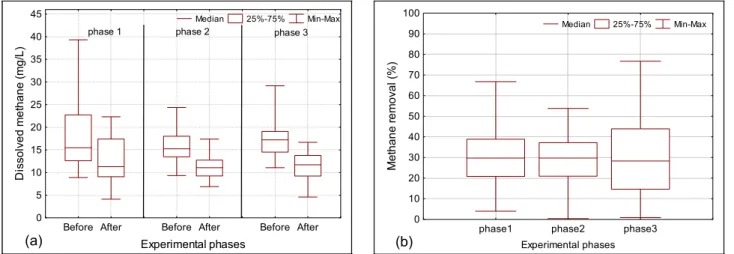
Figures 1(a) and 1(b) present, respectively, the concentrations of dissolved methane (before and after the stripping device) and the respective removal efficiencies. For all three operational phases, statisti-cally different concentrations were observed before and after the stripping device (Figure 1(a)), confirm-ing the removal of dissolved methane, from around 15 to approximately 10 mg.L-1 (median values). In relation to the removal efficiencies (Figure 1(b)), the results showed an enormous dispersion, but the median removal was about the same for all phases (around 30%).These removal efficiencies are about three times lower than results obtained by Luo (2014) using membranes; however, other factors should be taken into account when comparing both techniques, in particular the costs. No statistical dif-ferences between phases were observed
(non-para-metric method, Kruskal-Wallis, independent sam-ples, with significance level of 5%), meaning that the higher air injection rates tested during phases 1 and 2 (213 and 160 L.m-3.min-1, respectively) did not affect the dissolved methane removal efficiency. Indeed, some phenomena could be occurring and this should be better explained. New experiments have been planned, testing other operational pa-rameters, aiming at the establishment of a proper relationship between air injection rate and methane removal.
The lower air injection rate practiced during phase 3 (107 L.m-3.min-1) resulted in a lower methane dilu-tion measured in the headspace above the liquid surface of the settler compartment (Figure 2). In the headspace, the median methane concentrations were around 1% for phase 3, against 0.5% for phases 1 and 2 (Figure 2). However, no statistical differences be-tween phases were observed (non-parametric method, Kruskal-Wallis, independent samples, with signifi-cance level of 5%).
Before After Before After Before After
Experimental phases
0 5 10 15 20 25 30 35 40 45
D
is
s
o
lv
ed m
et
han
e (
m
g/
L)
Median 25%-75% Min-Max
phase 1 phase 2 phase 3
(a)
phase1 phase2 phase3 Experimental phases 0
10 20 30 40 50 60 70 80 90 100
M
et
hane r
em
ov
al
(
%
)
Median 25%-75% Min-Max
(b)
Figure 1: Results obtained with the stripping unit: (a) dissolved methane concentrations before and after the stripping device, (b) methane removal efficiencies.
phase1 phase2 phase3 Experimental phases 0.0
0.5 1.0 1.5 2.0 2.5 3.0 3.5 4.0 4.5
CH
4
w
a
st
e
g
a
s (
%
)
Median 25%-75% Min-Max
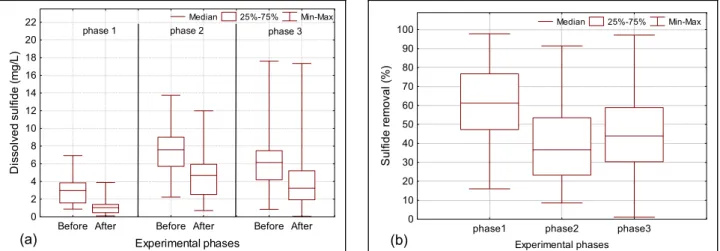
Figures 3(a) and 3(b) present, respectively, the concentrations of dissolved sulfide (before and after the stripping device) and the respective removal efficiencies. As for methane, statistically different concentrations were observed before and after the stripping device, for all three phases (Figure 3(a)), confirming the removal of dissolved sulfide. In rela-tion to the removal efficiencies (Figure 3 (b)), the median values were 61, 37 and 44%, for phases 1, 2 and 3, respectively. These removal efficiencies fall below the ones reported by Khan et al. (2011), who applied similar techniques, like aeration of the efflu-ent, and obtained a removal efficiency of approxi-mately 86%. Non-parametric tests showed statistical differences between the removal efficiencies of phase 1 in relation to phases 2 and 3 (Kruskal-Wallis method, independent samples, with significance level
of 5%).The higher efficiencies observed in phase 1 were related to the higher air injection rate applied (213 L.m-3.min-1), but it is possible that factors other than physical stripping took part in the sulfide re-moval process (such as chemical oxidation due to oxygen diffusion in the liquid), since the emission of hydrogen sulfide in the headspace above the liquid surface of the settler compartment was not propor-tional to the air injection rates.
The waste gas of the settler compartment pre-sented the following median concentrations (Figure 4): 87 ppm (phase 1), 175 ppm (phase 2) and 190 ppm (phase 3). Such concentrations determined release rates higher for phase 2. Statistical differences were observed between all tested phases (by using non-parametric method, Kruskal-Wallis, independent sam-ples, with significance level of 5%).
Before After Before After Before After
Experimental phases
0 2 4 6 8 10 12 14 16 18 20 22
D
iss
o
lve
d su
lf
id
e
(
m
g/
L
)
Median 25%-75% Min-Max
phase 1 phase 2 phase 3
(a) phase1 Experimental phasesphase2 phase3
0 10 20 30 40 50 60 70 80 90 100
S
u
lf
id
e
r
e
m
o
v
a
l (
%
)
Median 25%-75% Min-Max
(b)
Figure 3: Results obtained with the stripping unit: (a) dissolved sulfide concentrations before and after the stripping device, (b) dissolved sulfide removal efficiencies.
phase1 phase2 phase3 Experimental phases 0
100 200 300 400 500 600
H2
S
w
as
te ga
s
(
ppm
)
Median 25%-75% Min-Max
Dissipation Chamber (DC)
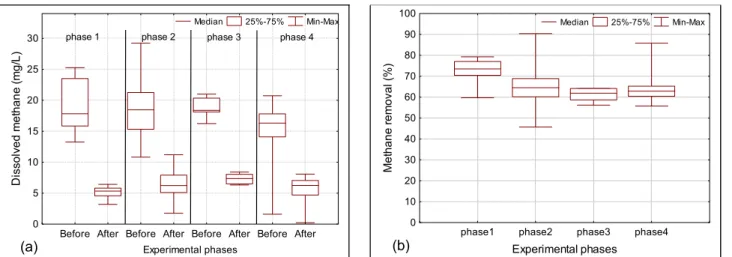
Figures 5(a) and 5(b) present, respectively, the concentrations of dissolved methane (before and after the DC) and the respective removal efficiencies. For this technique, high removals were noted in all operational phases, in general from 17-19 mg.L-1 to around 6 mg.L-1, as confirmed by statistical analyses. From Figure 5(b), it can be noted that the highest methane removal efficiency was achieved in phase 1 (median of 73%), against 62-63% observed in the other phases, therefore indicating that the physical and operational conditions adopted in phase 1 (higher free drop height) favoured a greater release of dissolved methane. It can also be noticed that, for the specific free drop height adopted in phases 2, 3 and 4 (0.5 m), the different exhaustion rates applied did not affect the methane removal efficiencies, indicating that the turbulence caused by the drop inside the chamber was the governing factor. However, no statistical differ-ences between all tested phases were found, with re-spect to methane removal efficiencies (non-parametric
method, Kruskal-Wallis, independent samples, with significance level of 5%).
In previous studies carried out by Souza and Chernicharo (2011), also using the dissipation cham-ber technique, lower methane removal efficiencies were reported, in the range of 33 to 39%, but the authors tested lower hydraulic loading rates (0.048 to 0.060 m3.m-2.min-1) and also a lower air renovation rate (11 h-1). The free drop height was basically the same used in phases 2, 3 and 4 of the present study (0.45 m). These efficiencies are lower than the ones obtained in the present study, which were consist-ently above 60%, possibly due to the higher hydrau-lic loading rates (0.132 m3.m-2.min-1) and number of air renovation rates (12 to 24 h-1) applied.
As expected, the concentrations of methane in the waste gas (headspace of the DC) were higher in phases with lower exhaustion rates, phases 1 and 4 (Figure 6). However, no statistical differences between the tested phases were found with respect to the methane in the waste gas (non-parametric method, Kruskal-Wallis, independent samples, with significance level of 5%).
Before After Before After Before After Before After Experimental phases
0 5 10 15 20 25 30
D
iss
ol
v
ed m
e
th
an
e
(m
g/
L
)
Median 25%-75% Min-Max
phase 1
(a)
phase 2 phase 3 phase 4
phase1 phase2 phase3 phase4
Experimental phases
0 10 20 30 40 50 60 70 80 90 100
M
e
than
e r
e
m
o
val
(
%
)
Median 25%-75% Min-Max
(b)
Figure 5: Results obtained with the dissipation chamber technique: (a) dissolved methane concentrations before and after the dissipation chamber, (b) methane removal efficiencies.
phase1 phase2 phase3 phase4 Experimental phases
0 1 2 3 4 5 6 7
CH
4
w
a
s
te gas (
%
)
Median 25%-75% Min-Max
Figures 7(a) and 7(b) present, respectively, the concentrations of dissolved sulfide (before and after the DC) and the respective removal efficiencies. The median concentrations after the DC were lower than 5 mg.L-1, however with well-scattered results, nota-bly in phase 4, possinota-bly associated with the big varia-tions also detected before the DC. In relation to the removal efficiencies (Figure 7(b)), it can be noted that the highest sulfide removal efficiency was achieved in phase 1 (median of 97%), again indicating that the higher free drop height adopted in phase 1 (1.10 m) favoured the H2S release and sulfide oxidation pro-cesses. Very high efficiencies were also observed in phases 2 and 3 (median values of 77 and 80%, re-spectively), while the lowest efficiency was detected in phase 4 (median value of 57%). In this last phase, the lower drop height (0.5 m), associated with lowest exhaustion rate (12 renews.h-1), minimized the ef-fects of release and oxidation of sulfides. Statistical analyses support the efficiency differences detected between phases 1 and 2 and phases 1 and 4 (non-parametric method, Kruskal-Wallis, independent samples, with significance level of 5%). The higher
efficiencies obtained with the DC technique in the present research (around 80%) are comparable to the ones reported by Kobayashi (1983), which ranged between 81 and 95%, using however the biochemical technique (photosynthetic bacteria) for dissolved sulfide removal. The efficiencies of the present study are also much higher than the ones obtained by Krayzelova et al. (2014), with the micro aeration technique, of around 16%, and by Souza (2010), with the dissipation chamber technique, of around 40%, using however different operational conditions: free drop height = 0.45 m; number of renovations = 11 h-1; and hydraulic loading rates varying between 0.048-0.060 m3.m-2.min-1.
In addition, analyses of H2S in the waste gas indi-cated concentrations varying from 100 to 500 ppm (Figure 8), confirming the release of part of the dissolved sulfide to the headspace of the DC. Re-garding statistical analysis for hydrogen sulfide con-centration in the waste gas, differences were detected only for phase 1 in relation to the other phases (non-parametric method, Kruskal-Wallis, independent sam-ples, with significance level of 5%).
Before After Before After Before After Before After
Experimental phases
0 5 10 15 20 25 30 35 40
D
iss
o
lve
d
su
lf
id
e
(
m
g
/L
)
Median 25%-75% Min-Max
phase 1
(a)
phase 2 phase 3 phase 4
phase1 phase2 phase3 phase4
Experimental phases
0 10 20 30 40 50 60 70 80 90 100
Su
lf
id
e
r
e
m
o
v
a
l (
%
)
Median 25%-75% Min-Max
(b)
Figure 7: Results obtained with the dissipation chamber technique: (a) sulfide concentrations before and after the dissipation chamber, (b) sulfide removal efficiencies.
phase1 phase2 phase3 phase4 Experimental phases
0 100 200 300 400 500 600 700 800 900
H2
S
w
a
s
te
gas (
p
p
m
)
Median 25%-75% Min-Max
Management of the Waste Gases
In both tested techniques, the management of the waste gases is necessary after their generation. From the point of view of odour control, the physical, chemi-cal and biologichemi-cal treatment methods have been ex-tensively used for H2S removal from waste gases emitted in wastewater treatment plants (Allen and Yang, 1992; Yang and Allen, 1994; Kohl and Nielsen, 1997; Kennes and Veiga, 2001; WEF, 2004). Nota-bly, biological techniques such as biofilters and bio-trickling filters have been shown to be very appropri-ate alternatives for the reduction of odorous com-pounds from waste gases generated in anaerobic reactors treating domestic wastewater, since the main odorant compound of concern, H2S, is usually pre-sent in low concentrations (0-500 ppm), which is the ideal range for good biofiltration performance (Cher-nicharo, 2010).
Nevertheless, since the supersaturation of me-thane in the effluent of anaerobic reactors is an emerg-ing issue, techniques for the proper management and control of waste gases containing methane are still under development. The studies so far have basically focused on improving the post-treatment of the anaerobic effluents, aiming to promote the biological oxidation of dissolved methane (Hatamoto et al., 2010; Matsuura et al., 2010; Hatamoto et al., 2011). Flaring, incineration and energy recovery could be considered, but only if the waste gases are concen-trated, for example, by membrane separation pro-cesses (Bandara et al., 2011), dissipation chamber (this article) or by mixing gas streams rich in CH4 (eg: biogas). However, these treatment techniques can only be economically viable when the amount of gas stream to be treated exceeds 10–15 m3 h–1, and if the stream CH4 concentration remains greater than 20%v/v (Nikiema et al., 2007). If data obtained in this study (including biogas production - data not shown) are used, the mixture of biogas with the residual gas flow obtained with the dissipation technique would result in a dilution of 10 to 20-fold. Thus, while the content of hydrogen sulfide would have an important reduction, to around 500 ppm, the methane content would drop to values as low as 6% in the mixture of biogas and waste gas, posing serious difficulties and technical problems, including risks of an explosive atmosphere within the range of 5 to 15% CH4 (Noy-ola et al. 2006). On the other hand, in research re-lated to landfills, coal mining and piggery, there are many studies on biofiltration of CH4 at low concen-trations (250-50,000 ppmv), since in these fields problems related to greenhouse gas emissions are well known (Sly et al., 1993; Melse and Vander Werf,
2005; Gebert and Gröngröft, 2006; Nikiema et al., 2007; Park et al., 2009). However, we did not find in the literature any study regarding the removal of CH4 from waste gases generated in anaerobic reactors used for the treatment of domestic wastewater, possi-bly because of the different requirements for the biofiltration of CH4 in relation to odorant compound biofiltration and because of CH4 mass-transfer limi-tatios in biofilms, which often reduce the abatement potential or lead to an empty bed residence time (EBRT) extremely high. In this sense, a deeper knowledge on biofiltration of CH4 at low concentra-tions is required, in order to identify the condiconcentra-tions that allow the combined biofiltration with H2S.
CONCLUSIONS
Only low or intermediate removal efficiencies of dissolved methane and sulfide were accomplished with the stripping technique: around 30% for me-thane and in the range of 40 to 60% for hydrogen sulfide, depending on the air injection rate applied.
Very promising results were obtained with the dissipation chamber technique, with removal effi-ciencies consistently above 60% being observed for dissolved methane and dissolved sulfide, even at low exhaustion rates. For the best operation condition (free drop height of 1.0 m and 12 renews.h-1), me-dian removal efficiencies of 73 and 97% were ob-served for dissolved methane and dissolved sulfide, respectively.
Based on the characteristics of the waste gas produced by the dissipation technique, mixing with the biogas stream could result in a high dilution, not allowing flaring, incineration and energy recovery from the mixture of biogas and waste gas, unless a very low exhaustion rate is applied in the dissipa-tion chamber. If a waste gas with low methane con-centration (below 20%v/v) is produced, its treatment using biofilters or biotrickling filters should be considered.
ACKNOWLEDGMENTS
The authors wish to acknowledge the support ob-tained from the following institutions: Fundação de
Amparo à Pesquisa do Estado de Minas Gerais –
FAPEMIG; Centro Federal de Educação Tecnológica
de Minas Gerais – CEFET-MG; Companhia de
Sane-amento de Minas Gerais – COPASA; Conselho
Coordenação de Aperfeiçoamento de Pessoal de Nível Superior – CAPES.
REFERENCES
Allen, E. R., Yang, Y., Biofiltration: An air pollution control technology for hydrogen sulfide emis-sions. In: (Ed.). Industrial Environmental Chemis-try, Springer, p. 273-287 (1992).
Bandara, W. M., Satoh, H., Sasakawa, M., Nakahara, Y., Takahashi, M., Okabe, S., Removal of residual dissolved methane gas in an upflow anaerobic sludge blanket reactor treating low-strength waste-water at low temperature with degassing mem-brane. Water Research, 45(11), 3533-3540 (2011). Chernicharo, C. A. L., Stuets, R. M., Souza, C. L., Melo, G. C. B., Alternativas para o controle de emissões odorantes em reatores anaeróbios tratan-do esgoto tratan-doméstico. Engenharia Sanitária e Ambi-ental, 15(3), 229-236, (2010). (In Portuguese). Cookney, J., McAdam, E. J., Cartmell, E., and
Jeffer-son, B., Recovery of methane from anaerobic pro-cess effluent using poly-di-methyl-siloxanemem-brane contactors. In: Proc. 12th Specialized Con-ference on Anaerobic Digestion. IWA Specialist Conference, Mexico, (2010).
Dutta, P. K., Rabaey, K., Yuan, Z., Rozendal, R. A. and Keller, J., Electrochemical sulfide removal and recovery from paper mill anaerobic treatment effluent. Water Research, 44, 2563-2571 (2010). Gebert, J., Gröngröft, A., Performance of a passively
vented field-scale biofilter for the microbial oxidation of landfill methane. Waste Management, 26(4), 399-407 (2006).
Giménez, J. B., Martí, N., Ferrer, J. and Seco, A., Methane recovery efficiency in a submerged an-aerobic membrane bioreactor (SAnMBR) treating sulphate-rich urban wastewater: Evaluation of me-thane losses with the effluent. Bioresource Tech-nology, 118, 67-72 (2012).
Hartley, K., Lant, P., Eliminating non-renewable CO2 emissions from sewage treatment: An anaerobic migrating bed reactor pilot plant study. Bio-technology and Bioengineering, 95(3), 384-398 (2006).
Hatamoto, M., Miyauchi, T., Kindaichi, T., Ozaki, N., Ohashi, A., Dissolved methane oxidation and competition for oxygen in down-flow hanging sponge reactor for post-treatment of anaerobic wastewater treatment. Bioresour Technol., 102 (22), 10299-10304 (2011).
Hatamoto, M., Yamamoto, H., Kindaichi, T., Ozaki, N., Ohashi, A., Biological oxidation of dissolved
methane in effluents from anaerobic reactors using a down-flow hanging sponge reactor. Water Research, 44(5), 1409-1418 (2010).
Kennes, C., Veiga, M. C., Bioreactors for Waste Gas Treatment. Dordrecht: Kluwer Academic Publish-ers, p. 312 (2001).
Khan, A. A., Gaur, R. Z., Lew, B., Mehrotra, I. and Kazmi, A. A., Effect of aeration on the quality of effluent from UASB reactor treating sewage. Jour-nal of Environmental Engineering, 137, 464-471 (2011).
Kobayashi, H. A., Stenstrom, M. and Mah, R. A., Use of photosynthetic bacteria for hydrogen sul-fide removal from anaerobic waste-treatment ef-fluent. Water Research, 17(5), 579-587 (1983). Kohl, A., Nielsen, R., Gas Purification. 5th Ed.
Houston, Gulf Publishing Company (1997). Krayzelova, L., Bartacek, J., Kolesarova, N. and
Jenicek, P., Microaeration for hydrogen sulfide removal in UASB reactor. Bioresource Technol-ogy, 172, 297-302 (2014).
Luo, G., Wang, W. and Angelidaki, I., A new degas-sing membrane coupled upflow anaerobic sludge blanket (UASB) reactor to achieve in-situ biogas upgrading and recovery of dissolved CH4 from the anaerobic effluent. Applied Energy, 132, 536-542 (2014).
Matsuura, N., Hatamoto, M., Sumino, H., Syutsubo, K., Yamaguchi, T., Ohashi, A., Closed DHS sys-tem to prevent dissolved methane emissions as greenhouse gas in anaerobic wastewater treatment by its recovery and biological oxidation. Water Sci Technol., 61(9), 2407-2415 (2010).
Matsuura, N., Hatamoto, M., Sumino, H., Syutsubo, K., Yamaguchi, T., Ohashi, A., Recovery and bio-logical oxidation of dissolved methane in effluent from UASB tratment of municipal sewage using a two-stage closed downflow hanging sponge sys-tem. Journal of Environmental Manegement, 151, 200-209 (2015).
Melse, R. W., Van Der Werf, A. W., Biofiltration for mitigation of methane emission from animal husbandry.Environmental Science & Technology, 39(14), 5460-5468 (2005).
Nikiema, J., Brzezinski, R., Heitz, M., Elimination of methane generated from landfills by biofiltration: A review. Reviews in Environmental Science and Bio/Technology, 6(4), 261-284 (2007).
Park, S., Lee, C.-H., Ryu, C.-R., Sung, K., Biofiltra-tion for reducing methane emissions from modern sanitary landfills at the low methane generation stage. Water, Air, and Soil Pollution, 196(1-4), 19-27 (2009).
Plas, C., Harant, H., Danner, H., Jelinek, E., Wim-mer, K., Holubar, P. and Braun, R., Ratio of bio-logical and chemical oxidation during the aerobic elimination of sulfide by colourless sulphurbacte-ria. Applied Microbiology and Biotechnology, 36(6), 817-822 (1992).
Popel, H. J., Aeration and Gas Transfer. 2nd Ed. Delft, Delft University of Technomic Publishing Co, Lancaster, EUA (1979).
Sly, L. I., Bryant, L. J., Cox, J. M., Anderson, J. M., Development of a biofilter for the removal of me-thane from a coal mine ventilation atmospheres. Applied Microbiology and Biotechnology, 39, 400-404 (1993).
Souza, C. L., Estudo das rotas de formação, trans-porte e consumo dos gases metano e sulfeto de hi-drogênio resultantes do tratamento de esgoto do-méstico em reatores UASB (Pathways of for-mation, transportation and consumption of me-thane and hydrogen sulfide resulted from
domes-tic wastewater treatment in UASB reactors). Ph.D. Thesis, Programa de Pós-Graduação em Saneamento, Meio Ambiente e Recursos Hídri-cos, Escola de Engenharia, Universidade Federal de Minas Gerais, p. 147 (2010). (In Portuguese). Souza, C. L., Chernicharo, C. A. L., Methane losses
in UASB reactors treating domestic wastewater: mass balance and possible improvements. In: 10th Specialized Conference on Small Water and Wastewater Systems & 4th Conference on Decen-tralized Water and Wastewater International Net-work & 3th Specialized Conference on Resources Oriented, Venice-Italy (2011).
Souza, C. L., Chernicharo, C. A. L. and Aquino, S. F., Quantification of dissolved methane in UASB reactors treating domestic wastewater under dif-ferent operating conditions. Water Science and Technology, 64(11), 2259-2264 (2011).
Yang, Y., Allen, E. R., Biofiltration control of hydro-gen sulfide 1. Design and operational parameters. Air & Waste, 44(7), 863-868 (1994).