SY
STEMA
TIC REVIEW
Mailing address: Samyra Said de Lima – Post-Graduate Program in Theory and Research of Behavior, Federal University of Pará (UFPA) – Rua Augusto Corrêa, 1, Guamá – Belém (PA), Brazil – CEP: 66075-110 – Email: [email protected] – Funding source: Nothing to declare – Conlict of interest: Nothing to declare – Presentation: Nov. 2015 – Accepted for publication: Oct. 2016.
1Physiotherapist, Master’s Student of the Post-Graduate Program in Theory and Research of Behavior, Federal University of Pará
(UFPA) – Belém (PA), Brazil.
2Professor of the Post-Graduate Program in Theory and Research of Behavior, Federal University of Pará (UFPA) – Belém (PA), Brazil.
3Occupational Therapist, Doctoral Student of the Post-Graduate Program in Theory and Research of Behavior, Federal University of
Pará (UFPA) – Belém (PA), Brazil.
ABSTRACT | The assessment of child development
through screening has been a frequent topic in research. However, little is known about the achievements and outcomes generated by such studies at the national level. With the purpose of analyzing studies that evaluated the neuropsychomotor development of Brazilian children through the Denver Development Screening Test II, a systematic review of the literature in accordance with the PRISMA recommendations was performed with search in the Medline, Lilacs, Scielo, PubMed, Scopus and Web of Science databases, including original articles that evaluated typical and atypical Brazilian children through the Denver Test II, published between 2005 and 2015 in English and Portuguese. Results: 1,016 studies were found and 67 were selected to be fully read, resulting in 31 articles that met the criteria for inclusion. Most of the studies evaluated the development of typical children in outpatient settings, who live in the Southeastern region of the country and with ages up to 3 years old, using cross-sectional research approaches. The percentage of suspected delay or delay in development for typical children ranged from none to 46.3% and from 14.2% to 100% for atypical children. Several risk factors and high percentages of suspicions of and delays in the neuropsychomotor development of children can be noted,
336
suggesting the need for standardized screening services that are better nationally distributed. The resulting data may imply preventive actions to the risks and delays in the development of Brazilian children.
Keywords | Child Development; Screening.
RESUMO | A avaliação do desenvolvimento infantil por meio de triagem tem sido temática frequente em pesquisas. Entretanto, pouco se sabe sobre a realização e os desfechos desses estudos em nível nacional. Com objetivo de analisar estudos que avaliaram o desenvolvimento neuropsicomotor de crianças brasileiras mediante o Teste de Triagem de Desenvolvimento Denver II, foi realizada revisão sistemática de literatura adequada às recomendações PRISMA, com buscas nas bases de dados MEDLINE, LILACS, SciELO, Scopus, PubMed e Web of Science. A revisão inclui artigos originais que avaliaram crianças brasileiras típicas e atípicas por meio do teste Denver II, publicados nos idiomas nglês e português, entre 2005 e 2015. Foram encontrados 1.016 estudos, e após a leitura dos seus títulos e resumos, foram selecionados 67, dos quais 31 artigos atendiam aos critérios de inclusão. A maior parte dos estudos avaliou o desenvolvimento de crianças típicas em contextos ambulatoriais, residentes na região Sudeste e com até 3 anos de idade, utilizando
Neuropsychomotor development screening of
Brazilian children: a systematic review
of the literature
Triagem do desenvolvimento neuropsicomotor de crianças brasileiras:
uma revisão sistemática da literatura
Valoración del desarrollo neuropsicomotor de niños brasileños:
revisión sistemática de literatura
abordagens de pesquisa transversais. O percentual de suspeitas de atraso ou atrasos de desenvolvimento em crianças típicas variou de 0 a 46,3%, e em crianças atípicas de 14,2%a 100%. Notam-se diversos fatores de risco e altos percentuais de suspeitas e atrasos do desenvolvimento neuropsicomotor infantil, sugerindo a necessidade de serviços de triagem padronizados e mais bem distribuídos nacionalmente. Os dados apontados neste estudo podem apoiar ações preventivas aos riscos e atrasos de desenvolvimento de crianças brasileiras. Descritores | Desenvolvimento infantil; Triagem.
RESUMEN | Es constante en investigaciones el tema sobre la evaluación del desarrollo infantil a través del cribado. Pero poco se sabe respeto de la realización y de los resultados generados en estos estudios en ámbito local. Para evaluar las investigaciones que estudiaron el desarrollo neuropsicomotor de niños brasileños por intermedio de la Prueba de Tamizaje del Desarrollo de Denver II, se llevó a cabo una revisión sistemática de literatura desde las recomendaciones PRISMA, en las bases de datos MEDLINE, LILACS, SciELO, Scopus, PubMed y Web
of Science, en la cual se incluyeron artículos de investigación originales que evaluaron a los niños brasileños típicos y atípicos a través de la prueba de Denver II, publicados entre 2005 y 2015 en lengua inglesa y en portugués brasileño. De los 1.016 estudios hallados y tras la lectura de sus resúmenes y títulos, se eligieron 67 estudios de los cuales resultaron en 31, por estar bajo los criterios de inclusión. La mayoría de los trabajos evaluó el desarrollo de niños típicos en ambulatorios, moradores en la región Sudeste de Brasil y que tenían hasta 3 años de edad, y empleó abordajes de investigación transversal. El porcentaje de sospechas de retraso o retrasos en el desarrollo de niños típicos osciló entre 0 y 46,3%, y de los niños atípicos de 14,2 a 100%. Se observó que hay distintos factores de riesgo y elevados porcentuales de sospecha y retrasos en el desarrollo neuropsicomotor infantil, lo que muestra la necesidad de servicios de cribado estandarizados y distribuidos en la mayor parte del país. Los datos mencionados en este trabajo pueden proponer acciones de prevención a riesgos y retrasos en el desarrollo de niños brasileños.
Palabras clave |Desarrollo Infantil; Triaje.
INTRODUCTION
he screening of the neuropsychomotor development (NPMD) of children refers to the process of applying tests to a large population of children, in order to identify practical and standardized
risks or delays in development1-3. Regarding the
factors associated with delays, aspects ranging from conception, pregnancy and birth, to neurological causes, malnutrition, environmental, socioeconomic and family factors, causing permanent or transitional delay conditions, are some of the most prominent, assuming an adequate and periodical monitoring
of the child3-7. Despite their importance, there are
few studies with national approaches, in particular those that make a systematic review of the literature and address issues related to the surveillance of the development of children, both typical and atypical, as well as its outcomes2,3,8,9.
One of the main instruments of the NPMD used in national studies is the Denver Development Screening Test II (DDST II), due to its practicality, low cost and quick implementation in relation to other existing instruments2,5,7-12.DDST II assesses the personal and
social area, ine and gross motricity and language, and can be applied for children from zero to six years old, classifying them as normal or suspected of being delayed in development.
his study consists of a systematic review of the literature based on the Population, Intervention
Comparison, Outcome (PICO) model13, with the
objective of verifying studies concerning the NPMD assessment of Brazilian children through DDST II, with the intention of proposing preventive actions to the risks and delays in development based on the analysis of empirical studies that have already been conducted. his study stands out for providing an unprecedented overview of the national literature on the analysis of the development of typical and atypical Brazilian children through screenings that have already been performed.
METHODOLOGY
his review is in accordance with the PRISMA
model13, which includes the choice of data sources,
descriptors, search for articles, analysis of titles and abstracts, reading of the full texts, adopting inclusion and exclusion criteria, data extraction and assessment of selected publications.
Articles belonging to the Medline, Lilacs, Scielo, Pubmed, Scopus and Web of Science databases published between January 2005 and July 2015 were included, that is, studies conducted in the past ten years, as it was intended to analyze current NPMD-related aspects in Brazilian children. he terms used were those present in Health Sciences Descriptors (DeCS) and some free terms: (neuropsychomotor development OR
child development OR soreening) AND (Denver II OR
Denver test II OR Denver Development Screening Test II) AND (Brazil) and their equivalents in Portuguese, with all possible intersections of descriptors.
he downloaded articles were added to the software Mendley Desktop for veriication of duplicity. After this procedure, titles and abstracts were read and the integral reading of the articles was subsequently made for the application of the inclusion and exclusion criteria, always by two researchers and independently.
he inclusion criteria used were: original empirical studies in Portuguese or English, full text available for free download, and studies that used DDST II to evaluate Brazilian healthy-typical children or those with any pathological and atypical condition. Studies with non-Brazilian children or with children evaluated through another screening test and validation of instruments were excluded.
After this stage, information from the following variables were extracted: region and context of study; methodological aspects; use of complementary instruments and outcome observed through the DDST II, which were then inserted into a spreadsheet in Excel, also by the same two researchers. Subsequently, the studies were assessed through a Test of Relevance (TR) by three external judges, in order to assess their methodological quality and the existence of possible biases of research, deciding whether they would be included or not.
Finally, the formula to calculate the Reliability Index (RI) proposed by Polit et al.14 was applied: RI= [(number of
agreements)×100] ÷ [(number of agreements) + (number of disagreements)], with RI≥80% being considered
acceptable. In this study, an RI of 93.33% was obtained, thus being considered credible.
RESULTS
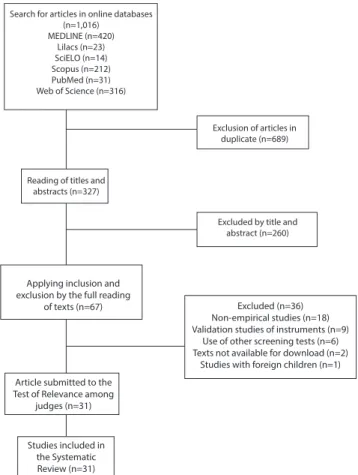
We found 1,016 studies. After reading the titles and abstracts, 67 studies were left, in which the inclusion and exclusion criteria for the reading of the texts in full were applied, resulting in a total of 31 articles subjected to the TR. he judges decided for the inclusion of 31 studies in the review (Figure 1).
Figure 1. Flowchart of the articles selected according to PRISMA recommendations
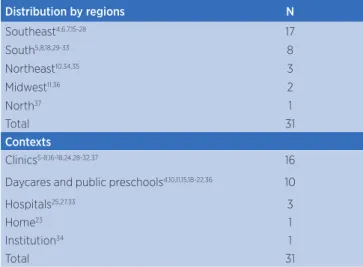
here was a predominance of studies in the Southeast region and in outpatient settings (Table 1). Most used cross-sectional approaches with small samples of typical children up to 3 years old (Table 2). Regarding the use of other instruments, the use of socioeconomic surveys prevailed (Table 3).
he outcomes of the DDST II revealed percentage
of suspicion of or delays to the NPMD between zero15
and 46.3% for typical children and from 14.216 to
100%6,17,18 for atypical children.
Search for articles in online databases (n=1,016)
MEDLINE (n=420) Lilacs (n=23) SciELO (n=14) Scopus (n=212) PubMed (n=31) Web of Science (n=316)
Exclusion of articles in duplicate (n=689)
Reading of titles and abstracts (n=327)
Excluded by title and abstract (n=260)
Applying inclusion and exclusion by the full reading
of texts (n=67) Excluded (n=36)
Non-empirical studies (n=18) Validation studies of instruments (n=9)
Use of other screening tests (n=6) Texts not available for download (n=2)
Studies with foreign children (n=1)
Article submitted to the Test of Relevance among
judges (n=31)
Table 1. Geographical distribution and contexts of the studies that evaluated Brazilian children through DDST IIa, 2005-2015
Distribution by regions N
Southeast4,6,7,15-28 17
South5,8,18,29-33 8
Northeast10,34,35 3
Midwest11,36 2
North37 1
Total 31
Contexts
Clinics5-8,16-18,24,28-32,37 16
Daycares and public preschools4,10,11,15,18-22,36 10
Hospitals25,27,33 3
Home23 1
Institution34 1
Total 31
aDenver Development Screening Test II
Table 2. Methodological aspects of the studies that evaluated Brazilian children through DDST IIa, 2005-2015
Approach/sample N
Cross-sectional with typical children4,10,11,18-20,22,23,26,32-34,37 13
Cross-sectional with atypical children16,25,30 3
Case-control cross-sectional study5,6,17,18,31 5
Longitudinal with typical children8,15,21,28,36 5
Longitudinal with atypical children7,24,29,35 4
Case-control longitudinal study27 1
Total 31
Sample Size
<20 children16,25,28 03
Between 20 and 40 children5,6,15,17-18,20,21,24,26,27,30,34,36 14
>40 children4,7,8,10,11,19,22,23,29,31-33,35,37 14
Total 31
Children age
Newborns33 1
0 to 12 months old8,20,27,29,32,35,37 7
0 to 3 years old7,16,18,19,22,24,28,31,36 9
3 to 6 years old6,10,11 3
Other ages4,5,15,17,18,21,23,25,26,30,34 11
Total 31
aDenver Development Screening Test II
Table 3. Use of complementary Instruments
Instruments N
Socio-economic surveys10,11,15,21,22,23,25,35,36 9
Instrument of evaluation of the child’s habits
and behavior17,18,20,23,25,27,31,32 8
Nutritional and anthropometric measurements
of the child4,5,16,19,32,33,36 7
Maternal, gestational and neonatal variables7,10,24,28,29,35 6
Questionnaires or imaging tests for tracing health problems or diagnostic conirmation6,28,30,35
4
Instruments of context assessment22-24 3
Evaluation of maternal risk factors27 1
Typical children all over the country who were assessed in daycare and preschool contexts showed percentages of suspicion of delay ranging from zero to 46.3%4,10,11,19,21-24. he area of language had the
highest percentages of suspicion or delay4,10,15,19,23,24,
and the ones with the lowest values were the personal-social11,10,15,23 and gross motor skills22 areas. Moreover,
male preschoolers aged above the median of the other students evaluated obtained slightly inferior NPMD11.
Similar results were found in institutionalized Brazilian children25, with greater impairment of language (18.1%
suspicions and 59.1% delays) and less impairment of gross motor skills (18.1% suspicions and 18.1% delays).
In the home environment, 33% of children were suspected of having delayed NPMD, language being the most afected area (35% and 4% of delay) and ine Motricity (19%)26 the least afected. In typical children
assessed in clinics, 12.8% were suspected of being delayed, especially in the gross motor skill area27.
Atypical conditions of children in clinics or hospitals7,28,16,29-33 such as low weight at birth and
prematurity were correlated with suspicion of delayed
NPMD7,32, particularly in the gross motor skill and
language areas. Neurological changes and changes in the transfontanelar ultrasound, respiratory failure and hospitalization in ICU, have also contributed to a worse performance of the DDST II in all areas30,33.
Exposure to HIV/AIDS and the implementation of antiretroviral therapy in the intrauterine and/or neonatal period was one of the factors for suspicion of delayed NPMD (50% of children), particularly in the areas of language (50% suspicion) and to a lesser extent gross motricity (8.3% suspicion)29. In addition,
children with heart conditions contributed to suspicion of delayed NPMD, being the gross motor skill area the most afected (50% suspicions)16. Epilepsy, seizures and
altered electroencephalogram exams also contributed to suspicion of delay31,18.
Children with malnutrition or starvation risk had more suspicions and delays according to the DDST II in relation to children who were eutrophic in the gross motor skill (25% versus 12.5%), ine motor skill (80% versus 68.75%) and language (85% vs. 75%) areas5. Phenylketonuria was a factor for suspicion of
factor for suspicion of delayed NPMD in all areas if compared to children without hearing deicits (100% suspicions against 6.3%)17.
Main factors associated with delayed NPMD of typical or atypical children in Brazil were the poor socioeconomic conditions, including low education level of the parents26, poor nutrition and low weight8,34,35,
pathological conditions, poor conditions of birth and exposure to certain therapies. Children of mothers with less than six consultations of prenatal, birth order, having no access to running water, incomplete vaccination schedule and ignorance of the family on
child development can also inluence NPMD35. In
contrast, depression and postpartum maternal anxiety, high blood pressure and gestational diabetes and the use of hypoglycaemic medications seem to not have signiicantly contributed in many of the children for
suspicion of or delayed NPMD36-38 according to the
DDST II.
DISCUSSION
Several studies point out the inluence of biological, nutritional, socioeconomic, family factors and the availability of access to services on the NPMD reinforcing its multifactorial potential4,5,7,8,25-28,30,34-36. However, it is
observed that such conditions, in particular those that induce an atypical NPMD in children and that need more rigorous screening throughout childhood, are scarcely studied. he need to perform screenings that may involve all children or most of them is reairmed, regardless of them having or not special health needs2,
since even in those considered typical evidence was found suspicion of or delayed NPMD.
Conditions of the institutions and early childhood education as well as the educator/child ratio, qualiication of educators, child’s age, quality and structure of the place and the length of stay of the
child24 are correlated with suspicions of delayed
NPMD23,24,26. Such aspects determine the performance
of interpersonal relationships between child and educator, patterns of activities and stimuli1 and stability
and emotional attachment of the child23. hus, they
may also have contributed to the signiicant language delays, due to the decrease in the linguistic repertoire and low speech stimulation and the prioritization of the care focused on basic needs of the child (hygiene and food)24. he lack of attention given to the measurement
of environmental features and their impact on the development of children should be noted as well.
Regarding institutions for children, the age of
admission of the child1 and the socioeconomic
characteristics of the original families also stand out25.
Furthermore, although the clinic is the primary context for evaluating child development, the knowledge on the social context of the child, information about his/ her family, pregnancy, primary caregiver, his/her routine and possible risk factors are also important2.
Moreover, there was a predominance of children between zero and three years old, which implies a greater interest of researchers in evaluating them at this age for it being considered a critical period from the neural point of view, which is particularly susceptible to the inluence of external factors, making them more vulnerable to severe risks to the NPMD.
Although a considerable amount of studies that evaluated the NPMD of Brazilian children through screening tests was found, it should be noted that in Brazil there are no parameters for assessment of children through norm-referenced tests2,3,8,25. his may
contribute to the fact that changes in the NPMD often pass by unnoticed, only becoming evident when the child is at school age, justifying the need for early and systematic evaluation in diferent contexts and regions of the country, minimizing further health problems or delays. It should be also noted the need for analysis of studies that used other screening instruments to achieve broader results and discussions concerning the Brazilian child population.
CONCLUSIONS
REFERENCES
1. Bronfenbrenner U. A ecologia do desenvolvimento humano: experimentos naturais e planejados. Porto Alegre: Artes Médicas; 1996.
2. Zeppone SC, Volpon LC, Ciampo LAD. Monitoramento do desenvolvimento infantil realizado no Brasil. Rev Paul Pediatr. 2012;30(4):594-9.
3. Dornelas LF, Duarte NMC, Magalhães LC. Atraso do desenvolvimento neuropsicomotor: mapaconceitual, deinições, usos e limitações do termo. Rev Paul Pediatr. 2015;33(1):88-103.
4. Biscegli TS, Polis LB, Santos LM, Vicentin M. Avaliação do estado nutricional e do desenvolvimento neuropsicomotor em crianças frequentadoras de creche. Rev Paul Pediatr. 2007;25(4):337-42.
5. Saccani R, Brizola E, Giordani AP, Bach S, Resende TL, Almeida CS. Avaliação do desenvolvimento neuropsicomotor em crianças de um bairro da periferia de Porto Alegre. Sci Med (Porto Alegre). 2007;17(3):130-7.
6. Silva GK, Lamônica DAC. Desempenho de crianças com fenilcetonúria no Teste de Screening de Desenvolvimento Denver – II. Pro Fono. 2010;22(1):345-50.
7. Magalhães LC, Fonseca KL, Martins LDTB, Dornelas LF. Desempenho de crianças pré-termo com muito baixo peso e extremo baixo peso segundo o teste Denver-II. Rev Bras Saúde Matern Infant (Recife). 2011;11(4):445-53.
8. Halpern R, Barros AJD, Matijasevich A, Santos IS, Victora CG, Barros FC. Developmental status at age 12 months according to birth weight and family income: a comparison of two Brazilian birth cohorts. Cad Saúde Pública. 2008;24(3):444-50.
9. Custódio ZAO, Crepaldi MA, Cruz RM. Desenvolvimento de Crianças Nascidas Pré-Termo Avaliado pelo Teste de Denver-II: Revisão da Produção Cientíica Brasileira. Psicol Relex Crit (Porto Alegre). 2012;25(2):400-6.
10. Brito CML, Vieira GO, Costa COM, Oliveira NF. Desenvolvimento neuropsicomotor: o teste de Denver na triagem dos atrasos cognitivos e neuromotores de pré-escolares. Cad Saúde Pública (Rio de Janeiro). 2011;27(7):1403-14.
11. Souza SC, Leone C, Takano AO, Moratelli HB. Desenvolvimento de pré-escolares na educação infantil em Cuiabá, Mato Grosso, Brasil. Cad Saúde Pública. 2008;24(8):1917-26. 12. Frankenburg WK, Dodds J, Archer P, Shapiro H, Bresnick
B. The Denver II: a major revision and restandardization of the Denver Developmental Screening Test. Pediatrics. 1992;89(1):91-7.
13. Moher D, Liberati A, Tetzlaf J, Altman DG, PRISMA Group. Preferred reporting items for systematic reviews and meta-analyses: the PRISMA statement. Ann Intern Med. 2009;151(4):264-9.
14. Polit DF, Beck CT, Hungler BP. Fundamentos de pesquisa em enfermagem: métodos, avaliação e utilização. 5ª ed. Porto Alegre: Artmed; 2004.
15. Rezende MA, Beteli VC, Santos JLF. Avaliação de habilidades de linguagem e pessoal-sociais pelo Teste de Denver II em instituições de educação infantil. Acta Paul Enferm. 2005;18(1):56-63.
16. Sabates AL, David ETM. Avaliação do crescimento e desenvolvimento de lactentes portadores de cardiopatias congênitas – um estudo descritivo. Online Braz J Nurs. 2006;5(2):113-8.
17. Quintas TA, Curti LM, Goulart BNG, Chiari BM. Caracterização do jogo simbólico em deicientes auditivos: estudo de casos e controles. Pro Fono. 2009;21(4):303-8.
18. Carneiro JM, Brito APB, Santos MEA. Avaliação do desenvolvimento de crianças de uma creche através da escala de Denver II. REME. 2011;15(2):174-80.
19. Sabatés AL, Mendes LCO. Peril do crescimento e desenvolvimento de crianças entre 12 e 36 meses de idade que frequentam uma creche municipal da cidade de Guarulhos. Cienc Cuid Saude. 2007;6(2):164-70.
20. Sigolo ARL, Aiello ALR. Análise de instrumentos para triagem do desenvolvimento infantil. Paidéia. 2011;21(48):51-60. 21. Rezende MA, Beteli VC, Santos JLS. Acompanhamento das
habilidades motoras de crianças que frequentam creches e pré-escolas. Rev Lat Am Enfermagem. 2005;13(5):619-25. 22. Rezende MA, Costa PS, Pontes PB. Triagem de
desenvolvimento neuropsicomotor em instituições de educação infantil segundo o teste de Denver II. Rev Enferm. 2005;9(3):348-55.
23. Mengel MRSM, Linhares MBM. Fatores de risco para problemas de desenvolvimento infantil. Rev Lat Am Enferm. 2007;15:146-52.
24. Nobre FDA, Carvalho AEV, Martinez PE, Linhares MBM. Estudo longitudinal do desenvolvimento de crianças nascidas pré-termo no primeiro ano pós-natal. Psicol Relex Crit. 2009;22(3):362-9.
25.Ramos AD, Morais RLS. Vigilância do desenvolvimento neuropsicomotor de crianças de um programa DST/AIDS. Fisioter Pesqui. 2011;18(4):371-6.
26. Moraes MW, Weber APR, Santos MCO, Almeida FA. Denver II: evaluation of the development of children treated in the outpatient clinic of Project Einstein in the Community of Paraisópolis. Einstein. 2010;8(21):149-53.
27. Fraga DA, Linhares MBM, Carvalho AEV, Martinez FE. Desenvolvimento de bebês nascidos pré-termo e indicadores emocionais maternos. Psicol Relex Crit. 2008;21(1):33-41. 28. Dias BR, Piovesana AMSG, Montenegro MA, Guerreiro MM.
Desenvolvimento neuropsicomotor de lactentes ilhos de mães que apresentaram hipertensão arterial na gestação. Arq Neuropsiquiatr. 2005;63(3-A):632-6.
29. Kreling KCA, Brito ASJ, Matsuo T. Fatores perinatais associados ao desenvolvimento neuropsicomotor de recém-nascidos de muito baixo peso. Pediatria. 2006;28(2):98-108. 30. Winckler DC, Jeremias VW, Geib LTC, Migott AMB, Giacomini
FL, Nunes ML. O valor do eletroencefalograma na avaliação de suspeitas de atraso no desenvolvimento neuropsicomotor em crianças com epilepsia. J Human Growth Dev. 2010;20(2):263-9.
31. Schirmer CR, Portuguez MW, Nunes ML. Clinical assessment of language development in children at age 3 years that were born preterm. Arq Neuropsiquiatr. 2006;64(4):926-31. 32. Veleda AA, Soares MCF, César-Vaz MR. Fatores associados
33. Silva JC, Weinfurther C, Medeiros C, Fossari M, Agertt F. Impactos dos hipoglicemiantes orais no desenvolvimento neuropsicomotor e pondero-estatural em recém-nascidos. Arq Catarin Med. 2012;41(3):38-43.
34.Lima AKP, Lima AO. Peril do desenvolvimento neuropsicomotor e aspectos familiares de crianças institucionalizadas na cidade do Recife. Rev CES Psicol.
2012;5(1):11-25.
35. Cunha RDS, Filho FL, Silva AAM, Lamy ZC. Valor de predição da ultrassonograia cerebral em recém-nascidos pré-termo para alteração de desenvolvimento neuropsicomotor aos 12 meses de idade corrigida. J Human Growth Dev. 2010;20(3):699-710.
36. Braga AKP, Rodovalho JC, Formiga CKMR. Evolução do crescimento e desenvolvimento neuropsicomotor de crianças pré-escolares de zero a dois anos do município de Goiânia (GO). J Human Growth Dev. 2011;21(2):230-9.
37. Andrade JL, Negreiros MM. Suspeita de atraso no desenvolvimento neuropsicomotor em crianças menores de um ano atendidas em uma Unidade de Saúde da Família de Rio Branco (Acre). Rev APS. 2013;16(1):60-5.