Dragan P. Gačić Milorad Danilović Goran Zubić Predrag Ćirović
BARK STRIPPING DAMAGE BY RED DEER (
Cervus elaphus
L.)
IN THE FENCED REARING CENTRE “LOMNIČKA REKA“
Abstract: Bark stripping damage is a serious problem in some forest hunting grounds in Serbia. This study aimed at assessing the incidence and intensity of bark stripping by red deer in the fenced rearing centre “Lomnička Reka“ (Mt. Ve -liki Jastrebac, central Serbia). The data were collected by detailed surveying of the entire rearing centre over spring and autumn 2008, 2009 and 2010. Our results show that, in spring and summer, it is exclusively broadleaf tree species that are bark stripped by red deer, mainly beech (86.3% or 536 trees) and hornbeam (10.1% or 63 trees). The incidence and intensity of bark stripping were the highest in the diameter class of 20-39.9 cm. Damaged trees were identiied in all parts of the rear -ing centre, at all aspects and at different slopes. Beech bark was stripped over the period May-August, with the focus in June or July.
Key words: red deer, beech, bark stripping, reintroduction, Serbia
ШТЕТА ЗБОГ ГУЉЕЊА КОРЕ КОЈУ НАНОСИ ЈЕЛЕН (Cervus ela-phus L.) У ОГРАЂЕНОМ УЗГАЈАЛИШТУ „ЛОМНИЧКА РЕКА“
Извод: Штета због гуљења коре је озбиљан проблем у неким шумским лови-штима Србије. Циљ истраживања је био да се утврди опсег и интензитет гу-љења коре које узрокује јеленска дивљач у ограђеном узгајалишту ,,Лом ничка река“ (планина Велики Јастребац, централна Србија). Подаци су колектирани
BIBLID: 0353-4537, (2012), 105, p 35-50
UDK: 630*156.5+630*451.2(497.11)(23.02 Jastrebac)=111 Оригинални научни рад
DOI: 10.2298/GSF1205035G
др Драган П. Гачић, ванредни професор, Универзитет у Београду - Шумарски факултет, Београд (e-mail: [email protected])
др Милорад Даниловић, ванредни професор, Универзитет у Београду - Шумарски факул-тет, Београд
мр Горан Зубић, виши асистент, Универзитет у Бањој Луци - Шумарски факултет, Бања Лука
Предраг Ћировић, дипл. инж., мастер студент, Универзитет у Београду - Шумарски фа-кул тет, Београд
детаљним прегледом целог узгајалишта у пролеће и јесен 2008., 2009. и 2010. године. Ови резултати показују да јеленска дивљач у пролеће и лето ис-кључиво гули кору лишћарских врста дрвећа, углавном букве (86,3% или 536 стабала) и граба (10,1% или 63 стабла). Опсег и интензитет гуљења коре су највећи у дебљинској класи од 20-39,9 cm. Оштећена стабла су утврђена у свим деловима узгајалишта, на свим експозицијама и различитом нагибу терена. Кора букве је гуљена у периоду мај-август, са тежиштем гуљења у јуну или јулу.
Кључне речи: јелен, буква, гуљење коре, реинтродукција, Србија
1. INTRODUCTION
Red deer (Cervus elaphus L.) regularly strips bark of forest trees in many parts of Europe, e.g. Slovenia (Je r i na et al., 2008), Austria (Vospe r n i k , 2006), Czech Repub -lic (Če r má k et al., 2004), Slovakia (R ajsk ý et al., 2008), Great Britain (G il l et al., 2000), Germany (K if f ne r et al., 2007) and France (Sai nt-A nd r ieu x et al., 2009). Bark stripping damage caused by red deer was identiied also in some forest hunting grounds in Serbia, mainly in small fenced areas (game rearing centres) and in fenced parts of hunting grounds (Ga čić et al., 2006, 2008, Ga čić, Da n ilov ić, 2009).
Many hypotheses have been proposed aiming at the explanation of the reasons why ungulates remove the tree bark, e.g. the demand for high quantities of mineral sub -stances contained in the bark, the difference in nutritive value between the twigs and the bark, as well as the lack of high-quality food (McIntyre, 1972 cit. after M iquel le, Va n Bal lenbe rg he, 1989). Generally, there are two basic hypotheses which try to explain the bark stripping damage (G il l, 1992, Ve rheyden et al., 2006, Sai nt-A nd r ieu x et al., 2009): 1) the value of bark as food; and 2) the use of bark for digestion improve -ment, to establish the balance in the rumen (maintenance of pH level), or to provide pro -tection from parasites.
By the end of the nineties of the 20th century, by the action of PE “Srbijašume“,
red deer was reintroduced to the forest complexes in Serbia, south of the Sava and the Danube, to the following localities: “Lomnička Reka“ on Mt. Veliki Jastrebac (1997), “Miloševa Voda“ on Mt. Sokolovica (1997), “Kumovac“ on Mt. Cer (1998), “Valmište“ on the fringe of the Vlasina plateau (2000), and also “Bukovik“ near Sokobanja (2005).
are: harmonisation of the Special Forest Management Plan with the Hunting Plan; estab -lishment of areas under green forage (pastures and meadows), which should be protected (fenced) against wild boar; and the improvement of the existing pasture quality (Ga čić, Da n ilov ić, 2009, Tom ić et al., 2009, 2010). The eficiency of the above measures was veriied and conirmed in spring and summer 2009, when there was a signiicantly lower number of damaged trees (n=41) compared to spring and summer 2008 (n=481) (Ga čić et al., 2011).
This study aimed at assessing the incidence and intensity of bark stripping by red deer in the fenced rearing centre “Lomnička Reka“.
2. MATERIAL AND METHOD
The study area is the game rearing centre “Lomnička Reka“ (Figure 2), in the cen -tral part of Mt. Veliki Jastrebac (MU “Lomnička Reka“), at the altitude of 530-890 m. The area of the fenced rearing centre is 381 ha, of which the greatest part is under forest cover (364 ha or 95.5%), and meadows occupy 2.5 ha (0.7%). It was established in 1996 by fencing the initial area (≈8.0 ha), which was populated by the initial stock of 20 calves (14 ♂ and 6 ♀) (in 1997), followed by three red deer males and a pregnant hind (in 1998). The relief of the rearing centre is broken by frequent alteration of streams, so the slopes are the main terrain features. The bedrock consists of granite. Terrain aspects are pre -dominantly north-west, west and south-west. Mean annual air temperature is 11.5°C, and mean annual precipitation is 650 mm.
Regular forest inventory in MU “Lomnička Reka“ was performed during 2005, and the information on the forest state was taken from the Special Forest Management Plan. High stands account for 64.6% of the total forest area in the rearing centre, and ar -tiicial coniferous stands occupy 35.4%. Well-preserved forests occupy 97.3% of the area, and mixed forests 71.7%. The number of tree species identiied in the rearing centre is more than 20 tree species, among which beech (Fagus moesiaca) is the most dominant in the total volume, followed by spruce (Picea abies), Scots pine and Austrian pine (Pinus sylvestris and Pinus nigra), sessile oak (Quercus petraea), birch (Betula pendula), Doug -las ir (Pseudotsuga menziesii), European ir (Abies alba), Weymouth pine (Pinus stro-bus), and aspen (Populus tremula). The dominant forest categories are high even-aged forests of beech (143 ha) and beech and sessile oak (70 ha), then high all-aged forests of ir and beech (20 ha), and artiicially established stands of spruce and Scots pine with naturally regenerated beech (60 ha, and 26 ha respectively).
diet was analysed based on the data obtained from the professional service of FE “Ra -sina“ - Kruševac (data on production, purchase and consumption of food and medication). The data were collected by detailed surveying of the entire rearing centre during spring and autumn 2008, 2009 and 2010 (between June 26th and July 2nd, i.e. between
November 3rd and 15th). In the subsequent analyses, the data from the irst period were
marked as spring stripping (April -June), and the data from the second period were de -noted as summer stripping (July-Sept). It was only the trees with new wounds (removed bark) on the stems that were recorded and measured each year. The incidence and dura -tion of spring and summer bark stripping were recorded over ive subsequent years: 2007 (Feb 20th, April 21st, July 9th and Dec 10th), 2008 (Feb 26th, May 30th, July 7th, Nov 3rd and Dec 8th), 2009 (April 18th, May 7th, May 21st, June 29th and July 9th), 2010 (May 31st) and 2011 (June 25th and Aug 17th).
Bark stripping incidence is presented by the number of damaged trees in the entire rearing centre area. Bark stripping intensity is presented by the size of wounds on indi -vidual trees. It is grouped into four categories based on the data reported by Mou nt ford (1997, 2006) and Ku it e r s et al. (2006): 1=limited damage (bark removed at the root swelling); 2=moderate (10-50% of the bark removed); 3=severe (bark removed on >50% of the stem); 4=very severe (ring-barked). The terrain slopes on which the damaged trees occurred were measured by the instrument Vertex 3 (ultrasonic altimeter). Based on the diameter at breast height (DBH), damaged trees were grouped into the following diameter classes: ≤19.9; 20-39.9; 40-59.9; 60-79.9 and ≥80 cm. The damaged trees spatial position within the game rearing centre was assessed by the device Magellan Mobile Mapper 6. Statistical analysis was performed using software package Statistica 8. The impact of tree diameter (DBH) and terrain slope on bark stripping intensity was tested using the one-way analysis of variance. The correlation of tree species and bark stripping intensity was tested by Chi-square test.
3. RESULTS
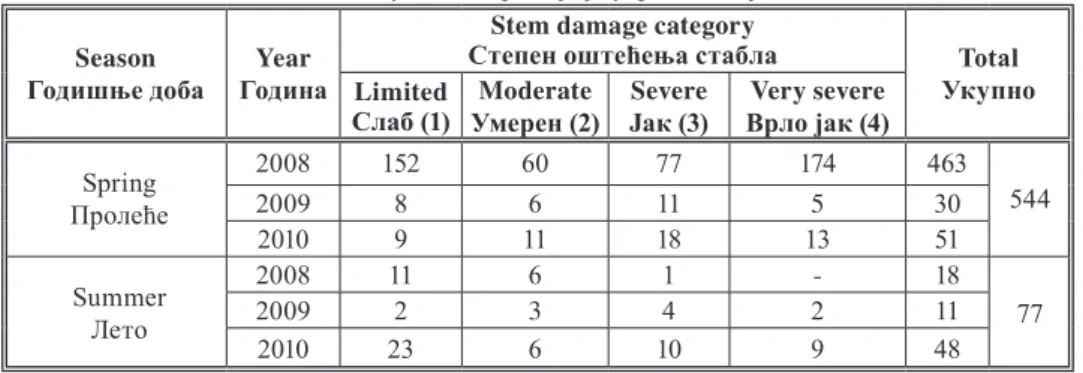
Bark stripping incidence in the fenced rearing centre “Lomnička Reka“ is presented in Table 1. The greatest number of damaged trees was detected in spring 2008 (n=463), and the smallest in summer 2009 (n=11). Bark stripping intensity, which is expressed by wound sizes on individual trees, was signiicantly higher in spring, when there were 192 ring-barked trees (x¯=32.0 cm, min-max=5.0-60.0 cm), which accounts for 30.9% of the total number of stem damaged trees. Bark stripping wounds on the trees in the severe and very severe categories (3 and 4) range from the ground level (x¯=4.0 cm) to the height of 2.6 m (x¯=178.0 cm). Red deer very often remove tree bark over several years (several times). It was found that 10.8% of new wounds were inlicted on the trees already dam -aged in the severe and very severe categories.
the highest in the category of medium-diameter trees (20-39.9 cm). This diameter class accounts for 48.8% of the total number of stem damaged trees, of which 137 trees are ring-barked, which is 67.5% of the total number of trees in the very severe stem damage category.
Тable 2 presents the incidence of bark stripping per tree species. Red deer in spring and summer exclusively remove the bark of broadleaf tree species, primarily beech, and also hornbeam. Beech accounts for 86.3% of the total number of damaged trees, i.e. 536 trees, and hornbeam accounts for 10.1%, i.e. 63 trees. Chi-square test (χ2) shows that there is a correlation between damage category and tree species (p<0.001), and based on the
Тable 1. Incidence and intensity of bark stripping by red deer
Tабела 1. Опсег и интензитет гуљења коре које је узроковала јеленска дивљач
Season
Годишње доба ГодинаYear
Stem damage category
Степен оштећења стабла Total
Укупно Limited
Слаб (1) Умерен (2)Moderate SevereЈак (3) Врло јак (4)Very severe Spring
Пролеће
2008 152 60 77 174 463
544
2009 8 6 11 5 30
2010 9 11 18 13 51
Summer Лето
2008 11 6 1 - 18
77
2009 2 3 4 2 11
2010 23 6 10 9 48
Number of trees / Број ст
аба ла 0 250 50 100 150 200 0 100 20 40 60 80
≤19,9 20-39,9 40-59,9 60-79,9 ≥80 DBH class / Дебљинска класа
%
2008.
2009.
2010.
≤19,9 20-39,9 40-59,9 60-79,9 ≥80 DBH class / Дебљинска класа 1 2 3 4 1 2 3 4 1 2 3 4 1 2 3 4 1
value of the coeficient of contingency (0.212), it can be concluded that the cor -relation is not strong.
Beech bark stripping intensi -ty depends on the tree sizes. One-way analysis of variance of beech diameter at breast height (DBH) and the factor “damage category“ shows that there are signiicant differences in the in -tensity of bark stripping, i.e. that red deer selectively remove beech bark (p<0.001). Mean diameter of beech trees (x¯=SE) in very severe damage category (33.5±0.7 cm; n=186) and lim -ited damage category (36.5±1.2 cm; n=187) is signiicantly higher than that of the trees in moderate (28.2±1.8 cm; n=68) and severe damage categories (28.4±1.3 cm; n=95). During the study period (2007-2010), bark stripping of Table 2. Species composition and number of damaged trees in the fenced rearing centre Табела 2. Састав врста и број оштећених стабала у ограђеном узгајалишту
Тree species Врста дрвећа
Year / Година
2008 2009 2010
Spring
Пролеће SummerЛето ПролећеSpring SummerЛето ПролећеSpring SummerЛето Deciduous species / Лишћарске врсте
Fagus moesiaca (K.
Maly) Czecz 417 18 25 9 25 42
Carpinus betulus L. 25 - 4 2 26 6
Acer pseudoplatanus L. 2 - - - -
-Quercus petraea (Matt.) Liebl. 1 - - - -
-Quercus cerris L. 1 - - - -
-Prunus avium L. - - 1 - -
-Corylus colurna L. 1 - - - -
-OML (Other species) 13 - - - -
-Coniferous species / Четинарске врсте
Picea abies (L.) Karst 1 - - -
-Abies alba Mill. 1 - - - -
-Pinus nigra Arnold 1 - - - -
-Total / Укупно 463 18 30 11 51 48
Figure 2. Spatial distribution of damaged trees in
the fenced rearing centre “Lomnička
reka”
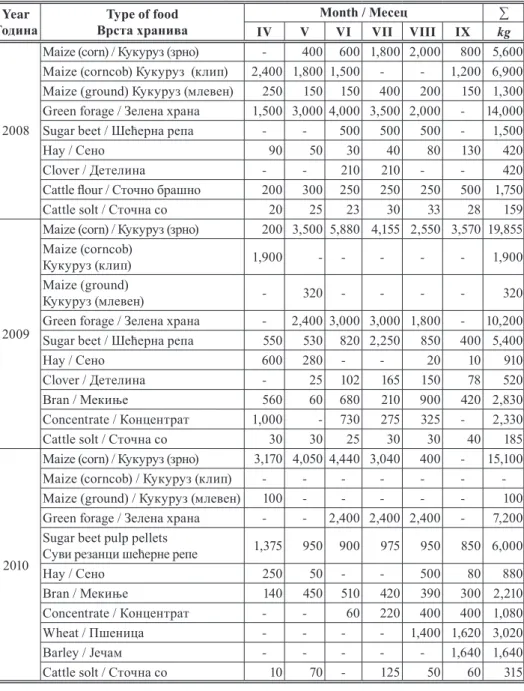
Table 3. Type and quantity of food consumed in the fenced rearing centre (Evidence Forest es -tate “Rasina“ - Kruševac)
Табела 3. Врста и количина утрошенe хранe у ограђеном узгајалишту (eвиденција шум-ског газдинства „Расина“ - Крушевац)
Year
Година Врста храниваType of food IV V Month / МесецVI VII VIII IX kg∑
2008
Maize (corn) / Кукуруз (зрно) - 400 600 1,800 2,000 800 5,600 Maize (corncob) Кукуруз (клип) 2,400 1,800 1,500 - - 1,200 6,900 Maize (ground) Кукуруз (млевен) 250 150 150 400 200 150 1,300 Green forage / Зелена храна 1,500 3,000 4,000 3,500 2,000 - 14,000
Sugar beet / Шећерна репа - - 500 500 500 - 1,500
Hay / Сено 90 50 30 40 80 130 420
Clover / Детелина - - 210 210 - - 420
Cattle lour / Сточно брашно 200 300 250 250 250 500 1,750
Cattle solt / Сточна со 20 25 23 30 33 28 159
2009
Maize (corn) / Кукуруз (зрно) 200 3,500 5,880 4,155 2,550 3,570 19,855 Maize (corncob)
Кукуруз (клип) 1,900 - - - 1,900
Maize (ground)
Кукуруз (млевен) - 320 - - - - 320
Green forage / Зелена храна - 2,400 3,000 3,000 1,800 - 10,200 Sugar beet / Шећерна репа 550 530 820 2,250 850 400 5,400
Hay / Сено 600 280 - - 20 10 910
Clover / Детелина - 25 102 165 150 78 520
Bran / Мекиње 560 60 680 210 900 420 2,830
Concentrate / Концентрат 1,000 - 730 275 325 - 2,330
Cattle solt / Сточна со 30 30 25 30 30 40 185
2010
Maize (corn) / Кукуруз (зрно) 3,170 4,050 4,440 3,040 400 - 15,100
Maize (corncob) / Кукуруз (клип) - - -
-Maize (ground) / Кукуруз (млевен) 100 - - - 100
Green forage / Зелена храна - - 2,400 2,400 2,400 - 7,200 Sugar beet pulp pellets
Суви резанци шећерне репе 1,375 950 900 975 950 850 6,000
Hay / Сено 250 50 - - 500 80 880
Bran / Мекиње 140 450 510 420 390 300 2,210
Concentrate / Концентрат - - 60 220 400 400 1,080
Wheat / Пшеница - - - - 1,400 1,620 3,020
Barley / Јечам - - - 1,640 1,640
beech trees started by the end of May, and reached the maximum already in June or July. The irst beech trees with new stem wounds (removed bark) were detected on June 9th
2007, May 30th 2008, May 21st 2009 and May 31st 2010. There were no beech trees with new stem wounds during the period November-April.
Figure 2 presents the spatial distribution of damaged trees in the fenced rearing centre. The damage caused by bark stripping is non-uniformly distributed throughout the rearing centre area (mainly by groups), on all aspects and different terrain slopes. There were no signiicant differences (p=0.388) between the terrain slopes and the damage cat -egories. Damaged trees occur, inter alia, on the ridge, near the feeding places, salt lick places and near the meadow, as well as along forest roads and streams.
The data on spring and summer nutrition in the fenced rearing centre are presented in Table 3. Maize and green forage are dominant in the total quantity of consumed food, followed by sugar beet (whole or pulp pellets), bran, concentrate, wheat and barley. The highest quantity of maize was consumed in 2009 (altogether 9,700 kg in May and June), which coincides with the lowest incidence of bark stripping damage (30 trees in spring). Conversely, the lowest amount of maize was consumed in 2008 (altogether 4,600 kg in May and June), when the largest incidence of damage was recorded (463 trees in spring). The presented data point to the dependence between the consumed food and the incidence of bark stripping damage. This dependence is not readily determined, because the cut -ting of damaged beech trees in the fenced rearing centre started in 2008 (74d, 76a, g, 77a, i, j, k), and clear cutting of Weymouth pine was performed at two sites (74c, 95k - total 3.60 ha), which caused signiicant changes in nutrition conditions in the fenced rearing centre.
4. DISCUSSION
Selective bark stripping is a widely distributed and well known phenomenon, char -acterising numerous species of ungulates and rodents. The species in the deer family (Cervidae) selectively strip the bark of forest trees, and the tolerance of each tree species to bark removal is different, causing the reduction in the percentage of species whose bark is frequently removed and which is not resistant to bark removal, and vice versa (Ando et al., 2004).
Birch, Sessile oak and Turkey oak. However, it was found that coniferous bark is mainly damaged during winter and autumn, and that bark stripping incidence and intensity de -pend greatly on the stand age.
The animals that strip bark of beech trees are: Red deer Cervus elaphus (Üe ck -e r ma n n , 1960, R h-ei nb-e rg-e r, Sut -e r, 2006, Ga čić et al., 2006, 2008, Sai nt-A n -d r ieu x et al., 2009), horse Equus caballus (Ku it e r s et al., 2006) and American grey squirrel Sciurus carolinensis (Mou nt ford , 1997, 2006). Our results show that in the rearing centre “Lomnička Reka“ during spring and summer, Red deer exclusively re -moved the bark from broadleaf species, primarily beech and hornbeam (86.3% i.e. 10.1% respectively of the total number of damaged trees). Similarly, in the National Park “Velu -wezoom“ (the Netherlands), it was found that horses most frequently removed bark from broadleaf species, irst of all beech, Mountain ash, Sweet chestnut and Hornbeam (Ku it -e r s et al., 2006).
The beech bark stripping incidence and intensity depends on the tree sizes. Our results show that Red deer in the rearing centre “Lomnička Reka“ most often removed bark from medium-diameter trees (20-39.9 cm), wherefore 48.8% of the total number of damaged trees belong to this diameter class, of which 137 trees were ring-barked. Also, according to Ku it e r s et al. (2006), horses show preference to smaller diameter classes (<40 cm), especially the trees with smooth bark. This is explained by the fact that bark structure changes with the increased tree age, as in most tree species bark becomes thick -er and much more dificult to detach (G il l, 1992).
Beech is at risk of bark stripping during a long time interval, between the ages of 15 and 50 years, and even later on (Üe cke r ma n n , 1960). This author reports that beech, as opposed to other tree species is at risk exclusively in spring and summer (between May 20th and Aug 31st, with the focus in July). Sai nt-A nd r ieu x et al. (2009) report that red deer removed beech bark during May-August, with the focus in June or July. Also, our results show that red deer in the rearing centre “Lomnička Reka“ started beech bark strip -ping by the end of May, with the maximum in June or July. Also, previous investigations in this rearing centre (Ga čić et al., 2006, 2008, Ga čić, Da n ilov ić, 2009), as well as our study results (Figure 1), conirmed that beech trees in the small fenced areas, even at higher ages (>70 years), could be greatly endangered and damaged by bark stripping.
the favourable ratio of digestible nutrients in summer and/or to achieve the adequate ratio of mineral elements.
The factors that affect beech bark stripping by red deer were studied in detail in France (Sai nt-A nd r ieu x et al., 2009). These authors report that beech bark contains more water and carbohydrates, and less macro-elements in late spring and summer than during autumn and winter. Bark is more easily detached in summer than during the dor -mancy period (autumn and winter), which is in correlation with the stripping frequency. It is also reported that both damaged and undamaged beech trees have evidently similar bark chemical composition, which indicates that the trees for bark stripping are randomly selected. Also, the results of our study in the rearing centre “Lomnička Reka“ (Figure 2) show that the bark stripping damage was non-uniformly distributed throughout the rear -ing centre (mainly by groups), at all exposures and at different slope angles.
The fact that horse Equus caballus prefers the bark of beech and several other species (Mountain ash and Sweet chestnut) is not explained by the bark mineral compo -sition (Ku it e r s et al., 2006). These authors report that the content of mineral elements in beech bark does not differ signiicantly from that in other tree species (Mountain ash, Sweet chestnut, Aspen, Common oak and Scots pine). Also, the content of mineral ele -ments in beech bark is almost independent on diameter classes. Therefore, if we want to explain why horses prefer beech bark stripping and select the thinner diameter classes, it can be concluded that, regarding stripping capacity, the bark physical characteristics (di -ameter and hardness) are much more important than the bark chemical composition. This is conirmed by the results reported by other authors (Sai nt-A nd r ieu x et al., 2009), which report that mechanical properties of bark, especially as it is easily detachable, can stimulate red deer to remove beech bark in summer. In contrast, selective bark stripping of juvenile trees caused by voles (species in the family Cricetidae) is explained by the sig -niicant differences in the bark chemical composition (He roldová et al., 2009). It is re -ported that broadleaf bark (Mountain ash and beech) is much more attractive to the voles than coniferous bark (spruce), thanks to the higher content of nutrients (fats and crude proteins) and a low content of ibres.
Based on the chemical analysis of meadow and pasture plants, and the chemical analysis of beech and hornbeam bark (Ga čić et al., 2008), it was found that the plants had almost two times higher energetic value than beech bark (4.51 MJ·kg–1 ME) and horn -beam bark (4.72 MJ·kg–1 ME). As all animals as a rule show preference to the nutrients which are more digestible and richer in energy, these authors conclude that red deer in the rearing centre “Lomnička Reka“ should by all means prefer to consume pasturage than the tree bark, if it was available. In this rearing centre, there is only one meadow (92nd Compartment, Clearing 1) of relatively small area (1.71 ha), so the grass is com
Festuca vallesiacae L., Poa pratensis L., Festuca pratensis Huds. and Cynodon dacty-lon L. Leguminous species of high quality are Medicago lupulina L., Trifolium repens L. and Trifolium pratense L. In other families, there are 4 useful species, 3 conditionally useful species, 10 poor and valueless species, and two species are harmful and slightly poisonous (Rubus cesius L. and Mentha longifolia L.). For this reason, it was proposed to improve the quality of this meadow and the few forest clearings, i.e. to establish new ar -eas under green forage, which could satisfy the nutrient requirements of Red deer, which would most likely prevent (or signiicantly reduce) the bark stripping of beech trees. Also, fertilization was proposed as the main measure for meadow improvement, i.e. the mini -mal rates of NPK 15:15:15, 300 kg·ha–1 in spring, which would be favourable for the good quality leguminous species.
The analysis of game nutrition in the rearing centre “Lomnička Reka“, also shows that the lowest quantities of maize were consumed in 2008 (4,600 kg in May and June), while almost two times higher quantities were consumed in 2009 (9,700 kg), and 2010 (8,490 kg). When these data are compared to the number of damaged trees (463, 30 and 51 respectively), it is evident that the higher quantities of consumed food result in the smaller incidence of bark stripping damage. Also, in the meadow of the 92nd Compartment, as
well as in some of the existing and new forest clearings (e.g. 74c), the hunting ground user performed the proposed agro-engineering measures - mineral fertilization and seed sowing of suitable species and varieties for hay production and pasturage (Ga čić et al., 2008, Tom ić et al., 2009, 2010). Additionally, large-scale felling over several past years (2008-2010), primarily of damaged beech trees, provided considerable amounts of twigs and foliage in the spring, but also opened the canopy in many stands and stimulated the development of shrubs and ground lora. Accordingly, the results of our study conirm the hypothesis that forest tree bark stripping was caused by the deiciency in natural food supply.
5. CONCLUSIONS
The following conclusions were made based on the study in the fenced rearing centre “Lomnička Reka“:
– Red deer in spring and summer exclusively remove bark of broadleaf tree spe -cies, irst of all beech (86.3% or 536 trees), followed by hornbeam (10.1% or 63 trees);
– Bark stripping incidence and intensity are the highest in diameter class of 20-39.9 cm, which accounts for 48.8% of the total number of damaged trees. Bark damage of 137 trees is in very severe category (ring-barked);
– Damaged trees are non-uniformly distributed throughout the rearing centre area (mainly by groups), at all aspects and at different slopes;
– Beech trees can at bark stripping risk over a very long time interval (>70 years), especially in smaller fenced areas;
– Our results conirm the hypothesis that forest tree bark stripping is caused by the shortage of natural food;
– In the following period, new areas under green forage (pastures and meadows) should be established and the quality of the existing pasture areas should be improved.
Acknowledgement: This study was inanced by the Ministry of Education and Science of the Republic of Serbia (Project Number: TR-31041) and the Ministry of Agricul -ture, Forestry and Water Management (Forest Directorate). We are especially grateful to FE “Rasina“ - Kruševac.
REFERENCES
A k a sh i N., Te r a z awa K. (2005): Bark stripping damage to conifer plantations in relation to the abundance of sika deer in Hokkaido, Japan, Forest Ecology and Management 208 (77-83)
A ndo M., Yokot a H., Sh ibat a E. (2003): Bark stripping preference of sika deer (Cervus nippon) in terms of bark chemical contents, Forest Ecology & Management 177 (323-331) A ndo M., Yokot a H., Sh ibat a E. (2004): Why do sika deer (Cervus nippon) debark trees in
summer on Mt. Ohdaigahara (central Japan), Mammal Study 29 (73-83)
Če r m á k P., Gloga r J., Ja n kovsk ý L. (2004): Damage by deer barking and browsing and subsequent rots in Norway spruce stands of Forest Range Mořkov, Forest Dis-trict Frenštát (the Beskids Protected Landscape Area), Journal of Forest Science 50 (24-30)
G a čić D., K r st ić M., M ijat ov ić J. (2006): Oštećivanje sastojina od naseljene jelenske divljači u ograđenom uzgajalištu „Lomnička reka“, Šumarstvo 4, UŠITS, Beograd (25-36) G a čić D.P., Vi lot ić D., K a r a d ž ić D., K r st ić M., Da n i lov ić M., Tom ić Z., Ne šić Z.
(2008): Istraživanje šteta od krupne divljači i njihov uticaj na šumske ekosis-teme Republike Srbije, pilot projekat - završni izveštaj, Univerzitet u Beogradu - Šumarski fakultet, Beograd (1-157)
G a čić D.P., Da n i lov ić M. (2009): Damage caused by red deer (Cervus elaphus) and wild boar (Sus scrofa) in forest hunting grounds in Serbia, Glasnik Šumarskog fakulteta 99, University of Belgrade - Faculty of Forestry, Belgrade (15-32) DOI:10.2298/ GSF0999015G
G a čić D.P., Da n i lov ić M., Ći rov ić P. (2011): Selective bark stripping by red deer (Cervus elaphus) in forest stands on the mountain Veliki Jastrebac (Serbia), Biennial Inter -national Symposium “Forest and sustainable development“, Proceedings, Braşov (313-318)
G i l l R. (1992): A review of damage by mammals in North temperate forests: 1. Deer, Forestry 65 (145-169)
He roldová M., Já nová E., Suchomel J., P u rch a r t L., Homol k a M. (2009): Bark chemical analysis explains selective bark damage by rodents, Beskydy 2 (137-140)
Je r i n a K., Dajč m a n M., Ad a m ič M. (2008): Red deer (Cervus elaphus) bark stripping on spruce with regard to spatial distribution of supplemental feeding places, Zbornik gozdarstva in lesarstva 86 (33-43)
K i f f ne r C., Rößige r E., Tr isl O., Schu l z R., Rü he F. (2008): Probability of recent bark stripping damage by red deer (Cervus elaphus) on Norway spruce (Picea abies) in a low mountain range in Germany - a preliminary analysis, Silva Fennica 42 (125-134)
Ku it e r s A.T., Va n de r Slu ijs L.A.M., Wy t e m a G.A. (2006): Selective bark-stripping of beech Fagus sylvatica by free-ranging horses, Forest Ecology and Management 222 (1-8)
M iquel le D.G., Va n Bal le nbe rg he V. (1989): Impact of bark stripping by moose on aspen-spruce communities, Journal of Wildlife Management 53 (577-586)
Mou nt ford E.P. (1997): A decade of grey squirrel bark-stripping damage to beech in Lady Park Wood, UK, Forestry 70 (17-29)
Mou nt ford E.P. (2006): Long-term patterns and impacts of grrey squirrel debarking in La-dy Park Wood young-growth stands (UK), Forest Ecology and Management 232 (100-113)
R ajsk ý M., Vod ň a n sk ý M., Hel l P., Sla me čk a J., K ropi l R., R ajsk ý D. (2008): Inluence supplementary feeding on bark browsing by red deer (Cervus elaphus) under ex-perimental conditions, European Journal of Wildlife Research 54 (701-708) R hei nb e rge r C., Sut e r W. (2006): Schälungen durch den Rothirsch: eine Fallstudie in den
Nor-dostschweizer Voralpen, Schweizerische Zeitschrift für Forstwesen 157 (147-156) Sai nt-A nd r ieu x C., Bone n fa nt C., Toïgo C., Ba si l le M., K lei n F. (2009): Factors
affect-ing beech Fagus sylvatica bark strippaffect-ing by red deer Cervus elaphus in a mixed forest, Wildlife Biology 15, (187-196)
Tom ić Z., Ne šić Z., Vi lot ić D., G a čić D., Žujov ić M. (2009): Production and quality of meadow associations in forest hunting grounds in Serbia, Biotechnology in Ani -mal Husbandry 25, Belgrade (251-260)
Tom ić Z., Bije d ić Z., Vi lot ić D., G a čić D.P. (2010): Phytocenological research into the meadow associations on forest hunting grounds of Serbia, Archives of Biological Sciences 62, Belgrade (363-372)
Üe cke r m a n n E. (1960): Wildstandsbewirtschaftung und Wildschadenverhütung beim Rotwild, Hamburg und Berlin: Paul Parey.
Ve rheyde n H., Bal lon P., Be r n a rd V., Sai nt-A nd r ieu x C. (2006): Variations in bark-strip-ping by red deer Cervus elaphus across Europe, Mammal Review 36 (217-234) Vosp e r n i k S. (2006): Probability of bark stripping damage by red deer (Cervus elaphus) in
Драган П. Гачић Милорад Даниловић Горан Зубић Предраг Ћировић
ШТЕТА ЗБОГ ГУЉЕЊА КОРЕ КОЈУ НАНОСИ ЈЕЛЕН (Cervus elaphus L.) У ОГ
РАЂЕНОМ УЗГАЈАЛИШТУ „ЛОМНИЧКА РЕКА“
Ре зи ме
Подаци су колектирани детаљним прегледом целог узгајалишта у пролеће и јесен 2008., 2009. и 2010. године (између 26. јуна и 2. јула односно између 3. и 15. новембра). У ка-снијим анализама, подаци из првог периода су означени као пролећно гуљење (април-јун), а подаци из другог периода као летње гуљење (јул-септембар). Сваке године су мерена једино стабла са новим ранама на деблу (уклоњеном кором). Опсег гуљења коре је исказан бројем оштећених стабала на целој површини. Интензитет гуљења коре је исказан величином рана на поједином стаблу и груписан у четири степена (Mountford, 1997, 2006, Kuiters et al., 2006): 1 = слаб (кора је гуљена на жилишту); 2 = умерен (10-50% коре уклоњено); 3 = јак (кора је гуљена на >50% дебла); 4 = врло јак (кора је прстенована). Нагиб терена на којем се налазе ош тећена стабла мерен је инструментом Vertex 3. У односу на прсни пречник (DBH) оштећена ста бла су груписана у следеће дебљинске класе: ≤19,9; 20-39,9; 40-59,9; 60-79,9 и ≥80 cm. По-ложај оштећених стабала утврђен је помоћу уређаја Magellan Mobile Mapper 6. Статистичка анализа је спроведена у софтверском пакету Statistica 8. Утицај пречника стабла (DBH) и на-гиба терена на интензитет гуљења коре тестиран је једнофакторском анализом варијансе. По-везаност врсте дрвећа и интензитета гуљења коре тестирана је χ2-тестом.
Површина узгајалишта „Ломничка река“ је 381 ha (530-890 m надморскe висинe), од чега је највећи део под шумом (364 ha или 95,5%), док ливаде заузимају 2,5 ha (0,7%). Oсновни подаци су детаљно дати у претходним истраживањима (нпр. Gačić, Danilović, 2009, Gačić et al., 2011). Гајене врсте дивљачи су јелен и дивља свиња (13 односно 26 јединки на 100 ha). Исхрана гајене дивљачи анализирана је на основу података добијених од корисника ловишта (Евиденција ШГ „Расина“ - Крушевац).
Највећи број оштећених стабала утврђен је у пролеће 2008. год. (n=463), а најмањи у лето 2009. год. (n=11). Интензитет гуљења коре значајно је већи у пролеће него у лето (табе-ла 1). Опсег и интензитет гуљења коре су највећи у дебљинској к(табе-ласи од 20-39,9 cm (слика 1). Ране од гуљења коре на стаблима оштећеним у јаком и врло јаком степену (категорија 3 и 4) крећу се од површине земљишта (x¯=4,0 cm) до висине 2,6 m (x¯=178,0 cm).
Интензитет гуљења коре букве зависи од величине стабла. Једнофакторска анализа варијансе пречника на прсној виcини (DBH) стабала букве са фактором „степен оштећења“ показала је да постоје значајне разлике у интензитету гуљења коре, односно да јеленска дивљач селективно гули кору букве (p<0,001). Средњи пречник стабала букве (x¯±SЕ) оштећених у врло јаком (33,5±0,7 cm; n=186) и слабом степену (36,5±1,2 cm; n=187) значајно је већи од стабала оштећених у умереном (28,2±1,8 cm; n=68) и јаком степену (28,4±1,3 cm; n=95). Ниједно стабло букве са новим ранама на деблу није утврђено у периоду новембар-април. Између нагиба терена при разним степенима оштећења стабла није утврђена значајна разлика (p=0,388).