Eliane Santos Cavalcante
I, João Mário Pessoa Júnior
II, Izaura Luzia Silvério Freire
I,
Cleonice Andréa Alves Cavalcante
I, Francisco Arnoldo Nunes de Miranda
IIII Universidade Federal do Rio Grande do Norte, Health Science Center, Health School. Natal, Rio Grande do Norte, Brazil. II Universidade Federal do Rio de Janeiro, Nursing and Obstetrics School. Macaé, Rio de Janeiro, Brazil.
III Universidade Federal do Rio Grande do Norte, Nursing Department,
Postgraduate Program in Nursing. Natal, Rio Grande do Norte, Brazil.
How to cite this article:
Cavalcante ES, Pessoa Jr JM, Freire ILS, Cavalcante CAA, Miranda FAN. Social representations of fishermen with spinal cord injury: impacts and life trajectory. Rev Bras Enferm [Internet]. 2017;70(1):132-8.
DOI: http://dx.doi.org/10.1590/0034-7167-2016-0436
Submission: 06-12-2016 Approval: 09-02-2016 ABSTRACT
Objective: analyze social representations in the life trajectory of artisanal fi shermen with spinal cord injury caused by diving on the north coast of Rio Grande do Norte. Method: a descriptive, qualitative study was conducted with 31 fi shermen between October 2013 and August 2014, using a semi-structured interview. A lexicographic analysis and descending hierarchical classifi cation of texts were performed (with software ALCESTE), in the perspective of the social representations. Results: social representations of fi shermen with spinal cord injury presented experiences with physical limitations and expectations regarding retirement, which appeared as a distant reality from the requirements in Brazilian labor laws. Conclusion: measures are required for the promotion, prevention and rehabilitation of the health of fi shermen with spinal cord injury, as well as safe and decent fi shing conditions, with the commitment of health authorities.
Descriptors: Diving; Spinal Cord Injuries; Mental Health; Men’s Health; Nursing. RESUMO
Objetivo: analisar as representações sociais da trajetória de vida dos pescadores artesanais com lesão medular vítimas de acidente por mergulho nas praias do litoral Norte do Rio Grande do Norte. Método: estudo descritivo, de natureza qualitativa, desenvolvido com 31 pescadores entre outubro de 2013 e agosto de 2014, mediante entrevista semiestruturada. Empregou-se a análise lexicográfi ca e classifi cação hierárquica descendente dos textos (software ALCESTE), sob a ótica das Representações Sociais. Resultados: as representações sociais dos pescadores com lesão medular apresentaram as experiências com as limitações físicas e expectativas de aposentadoria, estas últimas confi gurando-se como uma realidade distante das exigências impostas por nossas leis trabalhistas. Conclusão: exigem-se medidas de promoção, prevenção e reabilitação da saúde do pescador vítima de lesão medular, além de condições seguras e dignas de trabalho como compromisso das políticas de saúde.
Descritores: Mergulho; Traumatismos da Medula Espinhal; Saúde Mental; Saúde do Homem; Enfermagem.
RESUMEN
Objetivos: analizar las representaciones sociales de la historia de vida de pescadores artesanales con lesión medular víctimas de accidente de buceo en las playas del litoral Norte de Rio Grande do Norte. Método: estudio descriptivo, de naturaleza cuantitativa, desarrollado con 31 pescadores entre octubre de 2013 y agosto de 2014, mediante entrevista semiestructurada. Se empleó análisis lexicográfi co y clasifi cación jerárquica descendiente en los textos (soft ware ALCESTE), en la visión de las Representaciones Sociales.
Resultados: las representaciones sociales de los pescadores con lesión medular expresaron las experiencias de las limitaciones físicas y expectativas de jubilación, confi gurándose éstas como realidad distante de las exigencias impuestas por la legislación
Social representations of fi shermen with spinal cord injury:
impacts and life trajectory
INTRODUCTION
In the world, the annual incidence of spinal cord injury (SCI) varies; for example, in Portugal, high rates are reported (57.8/000), followed by Brazil, also with high rates (50/000). In China, a lower incidence is observed (8.4/000 inhabitants), without however considering people who have died of this cause(1). Acute and chronic health problems associated with SCI
consequences usually involve multiple organic systems, such as the genitourinary, gastrointestinal, respiratory, epithelial, car-diovascular, autonomic nervous, neuromuscular, and psychoso-cial(2). Given the considerations above, this study highlights the
occurrence of temporary or permanent SCI in artisanal fisher-men affecting predominantly male young adults worldwide(1,3).
One strategy to support the male population exposed to dif-ferent risks and other health issues and vulnerabilities was cre-ated by the Ministry of Health in 2008 – the National Policy for Men’s Health – to promote healthcare actions that help under-stand sociocultural and political-economic contexts of the male population, aiming to extend their life expectancy and reduce morbimortality of preventable causes in this population(3).
The state of Rio Grande do Norte has an important role in the scenario of fishing activities in Brazil. Artisanal fishing, charac-terized by the practice of diving, accounts for about 70% of the total production, showing the socioeconomic importance of this activity of food production and income, performed essentially by men(4-5). Fishing activities, accidents and their consequences
represent a challenge to public health on the coast.
These fishermen work in precarious and dangerous situa-tions, with frequent risks of accidents and death, either due to diving-related diseases, such as drowning and shipwreck, or decompression illnesses(5). The state of Rio Grande do Norte
has fishing zones located on its south and north coasts, and the latter was selected for the development of this study.
Social representations show a portrait of the evolution of the empirical and practical reflexive investigation about rep-resentative phenomena analyzed according to several views: epistemological aspects, social life, analysis of social and cog-nitive processes, social relevance in understanding symbolic processes, application and examination of issues related to memory, urbanity, health, body, sex, and environment. In ad-dition, it proposes themes for future investigations(6).
In a recent study about which areas of knowledge use the theory of social representations in studies in Brazil, a bibliometric study showed five national journals with most published studies, of which three publish nursing articles, predominantly in the fields of collective health and public health(6). In this sense, the contributions of the theory of social
representations are highlighted for the production and dis-semination of scientific knowledge.
Given the above, our questions were: What was the fisher-man’s life like before the spinal cord injury? How does he feel today after the accident? Based on these considerations, the aim of this study was to analyze the social representations of the life trajectory of artisanal fishermen with spinal cord injury caused by diving on the north coast of Rio Grande do Norte.
METHOD
Ethical aspects
In compliance with Resolution 466/12 of the National Re-search Ethics Commission of the National Health Council, this study was approved by the Research Ethics Committee of the Federal University of Rio Grande do Norte.
Study design
This is a descriptive qualitative study.
Theoretical and methodological framework
The theory of social representations (TSR)(7) and the central
core theory(CCT)(8) were the theoretical and methodological
framework used. The TSR is understood as “a particular type of knowledge whose function is to create behaviors and commu-nication among individuals”, in which behaviors are produced and determined, defining the nature of stimuli that surround us and provoke us, and the meaning of answers to be provided(6).
The CCT, proposed by Jean Claude Abric(8) in 1976,
com-plementing the initial formulation of the TSR, is based on the concept of representational field, as a dimension proposed by Moscovici(7). Every social representation is organized around a
central core and a peripheral system. The central core is relat-ed to collective memory, ensuring signification, consistency and permanence to the representation; therefore, it is stable and resistant to changes. It includes the constitutive dimen-sions of a social representation, that is, information, represen-tational field, and attitude towards an object, and represented phenomenon(8-9).
Methodological procedures
Study setting
The study site was the north coast of the state of Rio Grande do Norte, which includes ten beaches: Caiçara do Norte, Rio do Fogo, Zumbi, Pitangui, Touros, Maracajaú, Barra de Maxa-ranguape, São Miguel do Gostoso, Barra do Rio, and Pititinga.
Data source
Data were collected between October 2013 and August 2014 using semi-structured interviews. In total, 31 artisanal fishermen were selected through the following inclusion criteria: performing
Eliane Santos Cavalcante E-mail: [email protected] CORRESPONDING AUTHOR
laboral vigente. Conclusión: se requieren medidas de promoción, prevención y rehabilitación de la salud del pescador víctima de lesión medular, además de condiciones laborales seguras y dignas, con compromiso de las políticas de salud.
fishing activities, being over 18 years old, male, having had a diving accident, and being diagnosed with spinal cord injury. In addition, data were obtained from the associations of fishermen belonging to several Municipal Health Departments linked to the North Sanitary District. The associations of fishermen, the state federations and the National Fishermen Confederation were rec-ognized by Law no. 11.699 of 2008 as trade associations for arti-sanal fishing workers(5).
Data collection and organization
The answers provided in the interviews were processed in the software Analyse Lexicale par Contexte d’un Ensemble de Seg-ment de Texte (ALCESTE), which is considered the first content analysis application, created in France in the 1970s(10). After a
lexi-cal vocabulary analysis, ALCESTE cuts the text and generates el-ementary context units (ECU) and the descending and ascending hierarchical classification expressed in each class. The parameters for the standard analysis are predefined by ALCESTE, which con-secutively performs two classifications to keep the most stable one and continue the analysis, while, regarding the classes, in a para-metric analysis, the software defines its own parameters for the type of classification (ascending and descending), and one word is analyzed when present in at least 4 ECUs(10).
Data analysis
Microsoft Excel 2007 was used in the analysis of sociodemo-graphic data from fishermen. Data submitted to text analysis in ALCESTE, based on statistical crossings, generated seven classes, which were submitted to extenuating thorough reading of the entire corpus and separated for each class, supported by Bar-din’s thematic content analysis(11). After an exhaustive process of
reading and reflection on the obtained material, seven analysis categories were developed: Category 1: Treatment – limitations and expectations; Category 2: Spinal cord injury – before and after; Category 3: Retirement – a very distant reality; Category 4: Deficiency – dependence, disability and vulnerability; Category 5: Faith: overcoming and autonomy; Category 6: Feelings of the self: physical losses and restart; and Category 7: Life and work – obstacles, plans and changes (Chart 1).
RESULTS
The demographic profile of fishermen was characterized predominantly by male workers, aged 41 to 50 years (53.6%), with a mean age of 50.2 years, who completed elementary school (68.2%), married (77.3%). After the spinal cord injury, most of them remained as self-employed workers in fishing ac-tivities or artisans (52.3%), with family income up to one min-imum wage (70.5%). The highest injury level was the thoracic spine (41.8%), with paraplegia as the main outcome (50.0%). The corpus processed and generated by ALCESTE obtained effective use of 95.1%, producing seven classes that are defined according to word occurrence and co-occurrence and textual function. Each class corresponds to a list of grammar categories according to its Khi2 (chi square) and efficacy in the class, where:
Khi2 > 0 means relative presence in the class and category; Khi2
< 0 means relative absence of one category; Khi2 = 0 means
the presence of a subclass in the class is not significant (Figure 1).
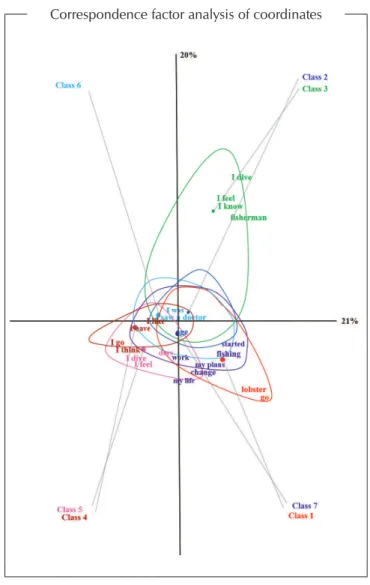
The correspondence factor analysis shows the creation of a representational field of fishermen with spinal cord injury caused by diving on the north coast of the state of Rio Grande do Norte. Comprising axes X and Y, horizontal and vertical, it generated four equal parts of the same image and a spatial distribution of catego-ries in their respective quadrants: right upper quadrant and left up-per quadrant (RUQ and LUQ), right lower quadrant and left lower quadrant (RLQ and LLQ), related to the changes in the life of these fishermen after the event (SCI) caused by a diving accident and frustrated healing, with physical dependence. Its semantic group is located in the ECUs (Figure 2).
The organization of one or more social representations pres-ents a singular characteristic: it is organized around a central core, with two or more elements that ensure the meaning to social rep-resentation, in the perspective of the structural approach of the represented fact(8). Chart 1 shows the composition of classes, the
correspondence factor analysis, the creation of categories and the core, the peripheral elements and the intermediate elements of social representations for fishermen with spinal cord injury caused by a diving accident. The central core and the peripheral elements produce an “X” with the intermediate elements(12). From
the central core, the peripheral elements and two groups of inter-mediate elements were analyzed.
Based on the central core theory, the results obtained with axes X and Y were analyzed, with indication in the LUQ of the ele-ments that comprise the central core of social representations, that is, class 6, such as: Category 1: treatment – limitations and expec-tations. It has the semantic roots related to experiences with spinal cord injury after the diving accident and memories from the past (“I used to”, showing the current situation of paraplegia and dis-satisfaction with the medical follow-up support received from the basic healthcare unit; the rehabilitation treatment, experiences, expectations and limitations, besides emphasizing self-care and self-medication as a strategic tool in the current treatment.
The RLQ includes classes 7 and 1, respectively named egory 7: life and work – obstacles, plans and changes and Cat-egory 3: retirement – a very distant reality. This quadrant refers to peripheral elements of social representations(13), recording the
way fishermen deal with the situation, observed in the following statements: “I can”, “I know, “I do”, “thank God”; or in situations that occurred, union and presence of family members in the treat-ment, observed in the emblematic statement: “we do”.
The RUQ includes classes 2 and 3, named Category 2: spinal cord injury – before and after and Category 4: deficiency – de-pendence, disability and vulnerability. This quadrant indicates intermediate elements and it comprises the most significant se-mantic units, distributed by ALCESTE.
The LLQ has classes 5 and 4 named Category 6: feelings of the self – physical losses and restart and Category 5: faith: overcom-ing and autonomy. Like the prior quadrant, this one also refers to peripheral elements of social representations(8). It predominantly
Chart 1 – Correspondence factor analysis, quadrants, analysis categories and excerpts of the speech of fishermen with spinal cord injury, Natal, Rio Grande do Norte, 2014
Correspondence
factor analysis Axis Analysis category
Excerpts of the speech of fishermen identified in the lexical analysis by ALCESTE
Central core LUQ
Category 1: treatment – limitations and expectations
[...] today, the treatment is more difficult, be-cause I can’t have physical therapy sessions anymore because I have anemia, I’d like to have it, but I can’t have my treatments like I used to. (Fisherman 9)
[...] I used to say to the doctor, “Look at me, see my situation [...] I can’t work, I’m physically disabled” [...] I used to work with diving, it’s a complicated job [...] I’m telling this story here, and sometimes I feel like crying, because I won [...] because I see other people, I see other people that did my work too, you know, they are in a wheelchair. (Fisherman 1)
Peripheral elements
RUQ
Category 2: spinal cord injury – before
and after
Category 4: deficiency – dependence, disability and vulnerability
[...] see my situation, I don’t feel my right leg and I feel “tingling” also in my arms, I can’t work, I’m disabled, I used to work with diving [...] I can’t be unemployed [...] I have to work twice as much. (Fisherman 4)
[...] I used to work all the time, go fishing, take care of my girls, my wife, [...] then, go to work, come back home, go to the sea, come back home [...] that was my life, just work. (Fisherman 4)
[...] I used to fish, I stopped fishing because I couldn’t stand fishing [...] it was getting heavy for me, then I stopped fishing [...], and now I buy fish from different people and I resell, that’s how I survive. (Fisherman 28)
LLQ
Category 6: feelings of the self – physical losses and restart
Category 5: faith: overcoming and
autonomy
[...] I got sick and I kept fishing, do you understand? [...] but today I don’t dive anymore, I only work with a net. (Fisherman 7)
[...] you have to see to understand, it’s a weak boat, people leave their home and go to an old and weak boat [...], old mattress [...] risking their life when it rains, isn’t that true? (Fisherman 6)
[...] today, thank God, I feel better than my period as a fisher [...] because I come home more often, I spend more time with my children and wife; in the past, I used to go to many places around the world, like a gypsy. A fisherman is like a gypsy, going to places [...] we fished from Recife to Fortaleza [...] we went every-where in this area. (Fisherman 30)
[...] thank God, I can survive... we don’t live very well... but I can survive. (Fisherman 28)
Intermediate
elements RLQ
Category 7: life and work – obstacles, plans and changes
Category 3: retirement – a very
distant reality
[...] I stopped fishing, now I sell crafted items, thank God, I suffer a little, but that’s normal. (Fisherman 6)
[...] I feel good, thank God, although I have a disabil-ity, I can’t lift weight, there are some things I can’t do, you know. (Fisherman 10)
[...] when I got sick I started walking and diving again [...] I went diving for a while, but I had felt it was dif-ficult for me, but anyway I produced a lot, even after I got sick, I caught many lobsters, but I felt my legs, they didn’t have that vigor anymore like before, but I need to work while I wait for my retirement. (Fisherman 10)
DISCUSSION
Based on this analysis, the fishermen structure their so-cial representation according to their need and hope to have changes in their rehabilitation treatment to recover their au-tonomy and return to the fishing activities they performed be-fore the accident. The presence of family members and friends is constantly mentioned, observed in their position and be-havior full of hope, faith in God and in the future, mixed with some moments of hopelessness and sadness, translated into facies of suffering/pain and easy crying.
They also recognize it is necessary to “change”, “fight” and “mobilize” options and actions for the continuity of fishing activities and overcoming limitations and obstacles detected, for example, ensure continuity in related activities, acting like self-employed workers in fishing or artisanal activities to remain
Correspondence factor analysis of coordinates
Source: ALCESTE report.
Note: Semantic and lexical root of the word defi ned by Khi2: eu_mergulh = eu mergulho (I dive); aposent = aposentadoria, aposenta, aposentado (retire/ retirement/retired), among others.
Figure 2 – Correspondence factor analysis that generated the quadrants of social representations for fishermen with spinal cord injury caused by diving
Class 2
Class 4
Class 5
Class 6 Class 7
Class 3
Class 1
Class 1: 26 words analyzed
Class 2: 14 words analyzed
Class 3: 15 words analyzed
Class 4: 31 words analyzed
Class 5: 14 words analyzed
Class 6: 19 words analyzed
Class 7: 29 words analyzed
Distribution of ECU by class Words analyzed
Classes
1 2 3 4 5 6 7
26
14 14
19 15
31
29
Class 1: 33 ECU, 21,0%
Class 2: 19 ECU, 11,0%
Class 3: 17 ECU, 10,0%
Class 4: 32 ECU, 19,0%
Class 5: 18 ECU, 11,0%
Class 6: 20 ECU, 12,0%
Class 7: 26 ECU, 16,0%
Number of words analyzed by class
Source: ALCESTE report.
inserted in the labor market and generating income to support their families. They show a desire for political adjustments in services of medium complexity offered in these municipalities besides the prevention, with stronger therapeutic activities that can mobilize these users (fishermen), family members, technicians and the community. These changes aim to high-light and promote stable improvements in the life and health conditions currently experienced through the treatment(2).
Regarding the representational field expressed, the fol-lowing is suggested: an expectation of improvement and success in the medical treatment, concrete hope for the fu-ture, better life and health conditions with their suffering and coping towards “total” rehabilitation. In general speeches of fishermen that cannot dive due to physical limitations, cuts of their speeches illustrate the functions established by the representational system(8). Understanding and explanation
of the reality are observed in these excerpts of interviews. This theory could provide an understanding of social rep-resentation of fishermen with innumerous biopsychosocial losses after the spinal cord injury. In this sense, they may provide support for reflection and guidance for the prac-tice of health professionals, especially nursing professionals working in basic healthcare units, which are considered the front door of these fishermen after the accident(14).
The social representation produced by fishermen who had a diving accident gathers different experiences, vocab-ularies, concepts and cuts of their lives, illustrating the ex-perience with their disorder, the contact with their spouses and family members, lifestyle and decisions affected, treat-ment requiretreat-ments, dealing with being disabled – before and after the spinal cord injury with deformed perceptions of the self, self-medication experienced and diffused as criti-cal for the life of these men and hope that there is still much to be done, changed, improved in the activities proposed by the Brazilian Unified Health System(15).
The fishermen who participated in this study reported a process of personal, social and economic-financial transfor-mation they experienced due to physical changes in body and psychic disorder, with friends becoming distant, and di-rect reliance on family members for survival. The social pro-cess is characterized by a propro-cess of familiarization through which the objects and psychosocial subject are understood and distinguished on the basis of prior models. The pre-dominance of past over present, answer over stimulus, im-age over reality, with the only purpose to provide nothing new under the sun. Familiarity is, at the same time, a state of group relations and a judgment standard for everything that happens(3,5).
In turn, the LLQ intermediates the representational field through more flexible semantic contents that interact with the central and peripheral systems, originating the interme-diate elements. The social representations, used to think and interpret the daily reality, allowed the fishermen of this study, who had a diving accident, to recreate their under-standing of life and themselves, adapting to their new bio-psychosocial context(7).
The social and individual representation of disability be-comes a lens through which individuals are seen and see their world. These perceptions may be full of stereotypes and prejudices of both sides, considering an individual is a social being who participates in the construction and main-tenance of concepts, statuses and values of the society(16).
Returning to reality after a SCI shows other feelings re-lated to the fragility and emotional shock, along the days experienced with the loss of motor, sensory and autonomic functions, configuring the reaction of denial to these impair-ments(3,5,14). These factors interfere in the identity and
self-esteem of people, as they did not have a chance to gradually prepare to the changes, leading to gloomy feelings. These negative emotional answers, when uncontrolled, may lead these people to depression.
Study limitations
The main study limitations refer to its operational and logistic aspects, considering the distance between the coast and the state capital, weather conditions and technical problems for handling the recorder, which had an impact of excessive wind and successive recording, requiring suc-cessive visits to perform the interviews again, as well as dif-ficult access and new approaches to the fishermen.
Contributions to nursing, public health and public policies
Nursing, acting in the political scenario of healthcare, when recognizing the social representations and trajecto-ries of fishermen with spinal cord injury, provides impor-tant contributions, clarifications and information to improve the quality of life of this specific group. The interrelation of specialties in the nosographic group of fishermen, among them, traumato-orthopedics, neurology, clinical and men-tal health, provides a significant amount of information and situations/problems in which nursing can act and provide answers to users, aiming to ensure access to the principles of the Brazilian Unified Health System.
CONCLUSION
The social representations originated from the speeches reported in this study present the experiences from physical limitations and retirement expectations, the latter constituted a distant reality from the labor law requirements. The debate on spinal cord injury among artisanal fishermen, based on life experiences of this group, is in the current agenda of national public policies, indicating the implementation and strengthening of health promotion strategies for men work-ing in fishwork-ing activities.
REFERENCES
1. Silva GA, Schoeller SD, Gelbcker FL, Carvalho ZMF, Silva EMJP. Epidemiologia da paraplegia traumática em um centro de reabilitação em Fortaleza, Ceará, Brasil. EfDeportes Rev Digital [Internet]. 2012 [cited 2014 Nov 24];17(171). Available from: http://www.efdeportes.com/efd171/epidemiologia-da-p araplegia-traumatica.htm
2. Schoeller SD, Bitencourt RN, Leopardi MT, Pires DP, Za-nini MTB. Changes in the life of people with acquired spinal cord injury. Rev Eletr Enferm [Internet]. 2012[cited 2016 Jul 30];14(1):95-103. Available from: https://www. fen.ufg.br/fen_revista/v14/n1/pdf/v14n1a11.pdf
3. Cavalcante ES, Miranda FAN, Gomes ATL, Freire ILS, Faro ACM. Men with spinal cord injury in rehabilitation: a contextual analysis. Rev Enferm UFPE [Internet]. 2015[cited 2016 Jul 30];9(10):9601-7. Available from: http://www.revista.ufpe.br/re vistaenfermagem/index.php/revista/article/view/7824/pdf_8756
4. Oliveira MR, Carvalho MM, Souza AL, Molina WF, Chel-lappa MEYS. Caracterização da produção do peixe-voador, Hi run dichthys affinis em Caiçara do Norte. Biota Amazônia [Internet]. 2013[cited 2014 Nov 24];3(2)23-32. Available from: http://periodicos.unifap.br/index.php/biota/issue/view/53/ showToc
5. Saldanha, MCW, Carvalho RJM, Oliveira, LP, Celestino JEM, Veloso ITBM. Ergonomia e sustentabilidade na atividade jangadeira: construam das demandas ergonômicas na praia de Ponta Negra/RN. Rev Bras Ergonomia [Internet]. 2012[cit-ed 2014 Nov 24];7(1):101-21. Available from: http://www. abergo.org.br/revista/index.php/ae/article/view/133
6. Marcolino ABL, Amaral AKFJ, Alves KL, Costa SMG, Bit-tencourt GKGD, Nogueira JA, et al. The theory of social representations in brazilian health researches: a biblio-metric profile. Int Arch Med. 2016; 9(82):1-9.
7. Moscovici S. Representações sociais: investigações em psicologia social. Petrópolis; 2011.
8. Abric JC. A abordagem estrutural das representações sociais. In: Moreira ASP, Oliveira DC, organizadores. Estudos interdis-ciplinares de representação social. 2ª ed. Goiânia: AB Ed; 2000.
9. Machado LBI, Aniceto RA. Núcleo central e periferia das representações sociais de ciclos de aprendizagem entre professores. Ensaio Aval Pol Públ Educ [Internet]. 2010[cited 2014 Nov 10];18(67):345-64. Available from: http://www.scielo.br/pdf/ensaio/v18n67/a09v1867.pdf
10. Azevedo DM, Costa RKS, Miranda FAN. Use of the AL-CESTE in the analysis of qualitative data: contributions to researches in nursing. Rev Enferm UFPE [Internet]. 2013[cited 2014 Nov 24];7(esp):5015-22. Available from: http://www.revista.ufpe.br/revistaenfermagem/index.php/ revista/article/view/3297/pdf_3089
11. Bardin L. Análise de Conteúdo. Lisboa: Edições 70; 2009
12. Ferreira MA. Theory of social representations and con-tributions to the research of health care and nursing. Esc Anna Nery Rev Enferm [Internet]. 2016[cited 2014 Nov 24];20(2):214-9. Available from: http://www.scielo.br/ pdf/ean/v20n2/en_1414-8145-ean-20-02-0214.pdf
13. Polli GM, Wachelke J. Confirmação de centralidade das rep-resentações sociais pela análise gráfica do questionário de caracterização. Temas em Psicologia. 2013;21(1):97-104.
14. França ISX, Enders BC, Coura AS, Cruz GKP, Aragão JS, Oliveira DRC. Lifestyle and health conditions of adults with spinal cord injury. Invest Educ Enferm [Internet]. 201 [cited 2014 Oct 18];32(2):244-51. Available from: http://www.sci-elo.org.co/pdf/iee/v32n2/v32n2a07.pdf
15. Landeiro MJL, Martins TV, Peres HHC. Nurses’ perception on the difficulties and information needs of family members caring for a dependent person. Texto Contexto Enferm [In-ternet]. 2016[cited 2016 Ago 17]; 25(1):e0430015. Available from: http:// http://www.scielo.br/pdf/tce/v25n1/0104-0707-t ce-25-01-0430015.pdf