The Schistosome Vectors in the Americas
W Lobato Paraense
Departamento de Malacologia, Instituto Oswaldo Cruz-Fiocruz, Av. Brasil 4365, 21045-900 Rio de Janeiro, RJ, Brasil
OPENING ADDRESS
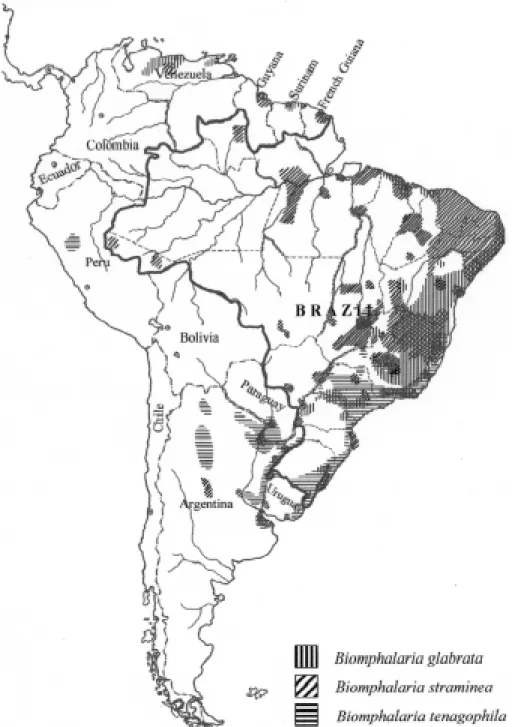
With few exceptions, the nomenclature of planorbid molluscs has been a confusing subject. Consequently, whoever intends to investigate a group of those molluscs may first have to over-come a nomenclatural problem. Otherwise it would be impossible to recognize the species to be men-tioned in this address. The present distribution of the three vectors is shown in Figs 1 and 2.
Biomphalaria glabrata
B. glabrata, the most important vector of Schis-tosoma mansoni in the Americas, had a doubtful
birth certificate. It was originally described by Tho-mas Say (1818), based on a shell given to the Acad-emy of Natural Sciences of Philadelphia by the French naturalist Felix Louis L’Herminier, who as-sured Say that he had collected it “near Charles-ton”, in South Carolina, where he lived for some years. Several subsequent authors did not succeed in finding in South Carolina specimens answering to Say’s description, and it is known today that the large planorbids occurring there belong to the ge-nus Helisoma. Based on the fact that, before living
in Charleston, L’Herminier had spent 20 years in the island of Guadeloupe, from where he had brought to Charleston an extensive collection of specimens, Pilsbry (1934) concluded: “It seems quite likely therefore that the type of Planorbis glabratus was one of the specimens L’Herminier
brought from Guadeloupe, and which he subse-quently thought (or Say inferred) that he had picked up around Charleston. ... I have no doubt that P. glabratus Say is identical with P. guadaloupensis
Sowerby. The name is prior to Sowerby’s”. In the mentioned paper, Pilsbry proposed the new genus
Australorbis for the species glabratus.
The occurrence of B. glabrata in the American
continent was first recorded during the celebrated Spix-Martius expedition to Brazil from 1817 to 1820. Spix, responsible for the zoological part of the ex-pedition, collected at Ilhéus and Almada, state of
Bahia, a batch of shells considered by him as a group of species, naming them P. olivaceus, P. ferrugineus, P. nigricans, P. albescens and P. viridis,
evidently according to the color of the shells. Since until about a century ago the study of shelled mol-luscs was based almost exclusively on shell char-acters, it was convenient to collect empty shells during a long expedition. In a sample of field col-lected specimens the color may vary depending on environment and time. In natural environments the shell of living B. glabrata is usually olivaceous,
and remains so for a variable time after death and decomposition of the animal (P. olivaceus). In
re-gions of lateritic soil a rusty color may be imparted to shells (P.ferrugineus), which get darker in the
course of time (P. nigricans). If the calcareous layer
becomes perceptible through a worn periostracum the shell exhibits a whitish shade (P. albescens),
which may become greenish by the action of green algae (P. viridis).
Spix traveled through the region of Ilhéus and Almada from December 13, 1818 to January 6, 1819, coinciding with Say’s description of P. glabratus
in 1818. He died in 1827, leaving midway the study of his specimens to be completed by JA Wagner (1827), who introduced substantial changes, main-taining the name olivaceus for the largest
speci-men and considerig ferrugineus a smaller-shelled
synonym. Moreover, he introduced a sixth speci-men, not selected by Spix, naming it P. lugubris as
senior synonym of the three remaining Spix’s spe-cies. Afterdescribing such P. lugubris he states
that it is found together with P. olivaceus and
re-fers the reader to Fig. 1118and the original descrip-tion of the former in the 1786 edidescrip-tion of Martini-Chemnitz’s Conchylien-Cabinet (rejected by the
International Commission on Zoological Nomen-clature). But Fig. 1118 of that work refers to a planorbid of the West Indies.
Besides Sowerby’s P. guadaloupensis and Spix’s P. olivaceus, B. glabrata was recorded throughout
the West Indies and South America (Figs 1-2): Do-minican Republic (Dunker 1853a, as P. refulgens);
Puerto Rico (Shuttleworth 1854, as P. gua-dalupensis); Surinam and French Guiana (Drouët
1859, as P. xerampelinus); Venezuela (Martens 1873,
as P. guadelupensis and P. lugubris); Martinique
(Mazé 1874, as P. guadeloupensis); Antigua
(Sowerby 1877, as P. antiguensis); Vieques (Germain
1921, as P. blauneri); St. Martin (Jones 1923, as P. antiguensis); St. Kitts (Pilsbry 1934, as A. glabratus christopherensis); St. Lucia (FC Baker 1945, as A. glabratus); Curaçao (Kuyp 1949, as A. glabratus lugubris); Dominica (Smithsonian Institute
Biologi-cal Survey 1964, cited by Prentice 1980); and Montserrat (Pointier 1975).
Only about a century from its finding by Spix in Bahia was B. glabrata recorded in Brazil by F
Baker (1913), as P. guadeloupensis, from the lakes
Extremoz and Papari, state of Rio Grande do Norte. Lutz (1918) studied specimens from the states of Sergipe (as P. olivaceus) and Maranhão (as P. guadaloupensis). Since 1916 he asserted that
schistosomiasis did not occur from Rio de Janeiro southwards for want of a molluscan vector, so much that for his studies he resorted to feces of pupils
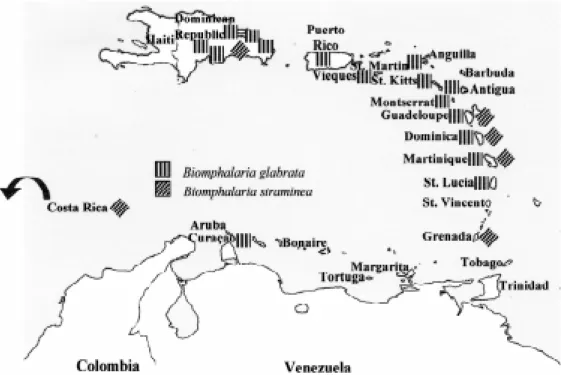
Fig. 2: present distribution of Biomphalaria glabrata and B. straminea in the Caribbean.
from northeastern states in the Naval School of Rio and to “P. olivaceus” from the state of Sergipe. In
the last-mentioned paper he describes his proce-dure for concentration of schistosome eggs, now often referred to as the Hoffman-Pons-Janer’s (1934) method, proposed 18 years later.
It can not be assured that Lutz was right in af-firming that there was no schistosomiasis from Rio de Janeiro southwards. Probably there was no di-agnosis. Nowadays it is known that there is B. glabrata transmitting S. mansoni in southern São
Paulo and northern Paraná. In Lutz’s collection there are four specimens labeled P. confusus (but
certainly B. glabrata)collected on May 5th, 1919
in Jatahy (now Jataizinho, a town in northern Paraná) by Souza-Araujo (1919), during an exten-sive helminthologic survey, from Sept. 1918 to Aug. 1919, which did not reveal any case of schistoso-miasis. It seems certain that spread of the disease to northern Paraná is relatively recent. Up to the end of last century that region was covered by pri-mary forest, a condition unfavorable for coloniza-tion by Biomphalaria. About 1867 it began to be
settled by emigrants from São Paulo and Minas Gerais, occupation being completed in the 1920’s with high-scale coffee plantation. There followed new immigratory waves, now from northeastern states, the seat of the oldest foci of schistosomia-sis. The association of three factors – devastation of the natural environment by intensive
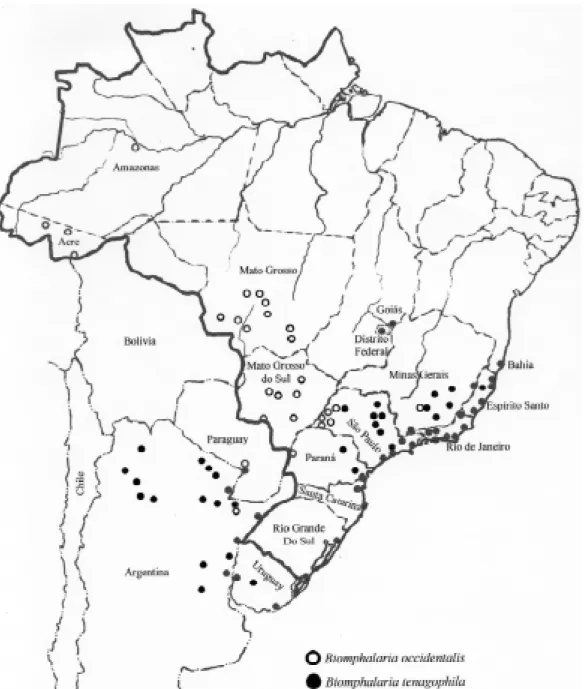
agricul-tural exploitation, land occupation by immigrants of low socioeconomic status, and eutrophication of the bodies of water – would certainly stimulate proliferation of the preexistent molluscan vector. Fig. 3 shows the progression of B. glabrata in the
state of Paraná toward the Paraguayan frontier; records of successive surveys show that schisto-somiasis did not preexist in the spotted localities.
In Jan. 1997 a population of B. glabrata was
found in Esteio, a locality of Rio Grande do Sul near Porto Alegre (Carvalho et al. 1998).
Biomphalaria tenagophila
This species was described by Orbigny (1835) as P. tenagophilus, based on specimens from the
Argentine province of Corrientes. He found it again in Rio de Janeiro, calling it P. ferrugineus Spix, which
as seen above is a synonym of B. glabrata. He
stated further (Orbigny 1841) that he had collected it from marshes at São Cristóvão district, Rio de Janeiro city, “where it is very rare”. I searched for this planorbid in São Cristóvão, finding specimens that agree with Orbigny’s description, but are in-distinguishable from B. tenagophila in anatomy
and crossing tests (Paraense 1961b).
In 1856 Dunker described the species P. bahiensis, based on specimens collected in Bahia
and Rio de Janeiro. As shown elsewhere (Paraense 1961a, b), Dunker was really dealing with two spe-cies: B. glabrata from Bahia and B. tenagophila
Lutz (1918) admitted that Spix’s P. nigricans
(from Bahia) was identical to the planorbid usually found by him in Rio de Janeiro. His opinion was reinforced by the fact that he had received speci-mens, considered typical by him, from the town of Caravelas, in Bahia. For some years several au-thors (including myself) adopted Lutz’s nomencla-ture, treating as nigricans the tenagophila from
Rio de Janeiro southwards. Only in 1960 did I no-tice that the snail from Caravelas is really
tenagophila. In 1994 I collected it in Ibirapuã and
Itamaraju, the latter, about 100 km north of Caravelas, being the northernmost limit of its distribution.
The above-mentioned planorbid from São Cristóvão was found by Lutz (1918) “in the same place as D’ORBIGNY”, and named P. confusus by
him. Lutz reasoned as follows: “The observations of D’ORBIGNY on the Planorbis, referred by him
to ferrugineus SPIX, can not apply to olivaceus
SPIX, as the dimensions would suggest. Not only is olivaceus never found in Rio (where Schistosomum is unknown) but the species still
existing in São Christovão is our confusus (unable
to transmit the parasite). Its largest specimens, but rarely found in Manguinhos, are very like
olivaceus, but do not exceed 25 mm”. Realizing
later that the name confusus had been given by
Rochebrune (1882) to an Oriental planorbid, he changed it to immunis (Lutz 1923) for obvious
rea-son. Now it is known that P. immunis is a synonym
of B. tenagophila (see Paraense 1961b), which
ceased being immune to transmit at least a race of the schistosome (Paraense & Corrêa 1963, 1981).
Since we are dealing with adaptation of the schistosome to a previously refractory host, it would be worthwhile to remember the circum-stances. In 1956, Corrêa et al. detected five autochtonous cases of schistosomiasis in Pindamonhangaba, a town on the Paraíba valley, a region of the state of São Paulo till then free from the disease. They examined 408 “A. nigricans” (=B. tenagophila) from local draining ditches, finding a
single one infected with S. mansoni. Subsequent
investigation showed that in the next six years
tenagophila-transmitted schistosomiasis had
ledo 1959, Piza et al. 1959, Piza & Ramos 1960, Piza et al. 1960a, b, Corrêa et al. 1962).
Investigating the schistosome from the Paraíba valley (infective to tenagophila, as seen above) in
comparison with the schistosome from Minas Gerais (infective to glabrata), we observed that
the former was uninfective to glabrata and the
lat-ter was uninfective to tenagophila of the valley
(Paraense & Corrêa 1963). Further investigation (Paraense & Corrêa 1978) showed that 15 out of 20 populations of B. tenagophila from the species
range were susceptible to S. mansoni from the
Paraíba valley (sample SJ, from São José dos Cam-pos). Comparing the relatively lower infection rate of those populations to those observed in B. glabrata exposed to the BH schistosome (from Belo
Horizonte, state of Minas Gerais), we concluded that it might be understood “in the context of an ongoing process of adaptation of the tenagophila
-infecting schistosome by selection through sucessive passages by the snail host”.
Finally, additional experiments (Paraense & Corrêa 1981) led to the conclusions that the SJ schistosome is less adapted to its vector snail than the BH parasite to its own; that they are interfertile, producing hybrids infective to BH and SJ snails at lower rates than in the sympatric combinations; and that they are to be considered biological races rather than mere strains. Now hybridization of the two races is surely taking place in nature as a result of human migration.
To prevent expansion of schistosomiasis from the Paraíba valley a special office was created that, in spite of adopting all the currently recommended strategy for snail control, did not accomplish that purpose. After many years of arduous effort it was noticed that new cases did not occur westwardly, notwithstanding the presence of the vector. Till then the consensus of the specialists was that B. tenagophila ranged westward from São Paulo to
Paraguay through the state of Mato Grosso do Sul. Coincidentally I was then collecting snails in Mato Grosso do Sul, verifying that the so-called
tenagophila was really a new species – B. occidentalis – reproductively isolated from B. tenagophila (Paraense 1981) and insusceptible to
infection with the SJ race of S. mansoni (Paraense
& Corrêa 1982). I extended the survey to the westernmost area of São Paulo, identifying B. occidentalis in five localities. A subsequent review
of that area by the state agency for control of en-demic diseases (Vaz et al. 1983) found B. occidentalis in a great majority of 252 biotopes,
and B. tenagophila in a single one. Thus it was
understood that the westward expansion of schis-tosomiasis in São Paulo was being stopped by na-ture and not by control measures (Fig. 4).
A planorbid of Santos, on the coast of São Paulo, gave rise to great nomenclatural confusion. Arantes (1923) identified the first two cases of au-tochthonous schistosomiasis in the city, also in the state. He sent specimens of the planorbid vec-tor to Pirajá da Silva, who regarded it as probably P. centimetralis Lutz (now B. straminea). Moura
(1945) and Pinto (1945) identified it as A. glabratus.
According to Coutinho (1949a, b) there would be another unidentified species besides A. glabratus.
Bequaert and Lucena (1951) considered it identical with the African B. alexandrina pfeifferi (Krauss),
which they believed to have been introduced dur-ing the slave trade. Afterwards Lucena (1953), fol-lowing Jaeckel’s opinion, considered that snail iden-tical with A. camerunensis Boettger from Cameroon.
Such identification was firstly denied by Boettger himself, who assured that the snail was Wagner’s
P. lugubris, but agreed later (Lucena 1956) that it
really was his A. camerunensis. Ruiz and Carvalho
(1953) identified two species in Santos: A. immunis
(Lutz) and A. nigricans (Spix), the former being much
more frequent and the only one infected with S. mansoni. Examining samples from 10 populations
of that planorbid (Paraense & Deslandes 1956) we proved them to belong to a single species, indistin-guishable morphologically (shell and anatomy) and genetically (crossing experiments) from A. nigricans (now B. tenagophila).
A surprising find of B. tenagophila was at the
Valle de Condebamba (2,500 m above sea level), in the sierra Department of Cajamarca, Peru (Paraense et al. 1964). They were morphologically identical with the Brazilian tenagophila but reproductively
isolated from three strains of the latter, including the SJ snail from the Paraíba valley. Exposed to the BH schistosome they showed an infection rate of 43.3%, with retarded development of the parasite, which did not reach the cercarial stage. Contrari-wise, 72.7% became heavily infected with the SJ schistosome, cercarial shedding beginning 30 to 60 days after exposure to miracidia.
Besides Brazil, Argentina and Peru, B. tenagophila also occurs in Bolivia (Orbigny 1835),
Paraguay (Paravicini 1894) and Uruguay (Marshall 1930, as P. paysanduensis). Its distribution is shown
in Fig. 1. So far it was not found outside South America.
Biomphalaria straminea
This snail from Cuming’s collection in the Natural History Museum, London, is labeled as proceeding from South America. It was described (not figured) by Dunker (1848) as P. stramineus. A subsequent
montanus Orbigny from lake Titicaca but does by no
means adjust to Orbigny’s description of that spe-cies. He also refers to another specimen of Cuming’s collection, from Aconcagua, Chile, having doubts about considering it a variety of P. stramineus or a
separate species. As to P. montanus, Pilsbry (1924)
and Hubendick (1955) showed that it is a form of P. andecolus Orbigny, 1835, also from lake Titicaca,
ana-tomically (Paraense & Deslandes 1957) quite different from what is now known as B. straminea. Concerning
the specimen from Aconcagua, it is quite probably the snail from that province described by Biese (1951) as Tropicorbis schmiererianus. The likeness between
the shells of those nominal species hinders the solu-tion of this problem.
Martens (1859), studying Venezuelan material from the coastal region of lake Maracaibo and the environs of Mérida, restricted the type locality of
P. stramineus to Lagunilla. In reality there is a town
called Lagunillas (not Lagunilla) in either region, and Martens did not clearly indicate the place of his “Lagunilla”. About P. stramineus he only says
(translation): “Lagunilla (see above Ampullaria) associated with leaves of water plants”. By “Ampullaria” he means A. eximia Dunker and A. puncticulata Reeve, both from “Laguna von
Lagunilla”, “of warm, little wavy, saline water”. End-ing his description of A. eximia, Dunker (1853b)
states that “according to information of Mr. consul Gruner, from Bremen, the locality of this snail is the province of Coro, on the lake of Maracaibo”. As a matter of fact, Coro is the capital of Falcón state, and lies about 250 km to the northeast of that lake. In May 1974 I collected in the other Lagunillas, situated 30 km west of Mérida city, a snail described as P. meridaensis by Preston (1907). Its shell
re-sembles that of what is now called B. straminea,
but anatomically it is indistinguishable from B. prona (see Paraense 1992), described by Martens
himself (1873) from lake Valencia, and whose shell is notably modified outside the lake (Paraense et al. 1992).
Summing up, almost certainly Martens’ Lagunilla is the Venezuelan village on lake Maracaibo, whose saline water, derived from the Caribbean sea through the gulf of Venezuela, com-municates its salinity to the “Laguna von Lagunilla” mentioned by him. By the way, in northeastern Bra-zil B. straminea has been found thriving in saline
waters, 1-2 g NaCl/liter (Lucena 1946).
It can be affirmed, however, that Cuming had never been to Venezuela. His shell collecting in the Americas was restricted to the Pacific coast, from the island of Chiloé in Chile to Conchagua, in Hon-duras (see Dance 1986: 114).
Martens (1873) refers to specimens of Planor-bis stramineus in the Museum of Berlin: from
Lagunilla, collected by Engel; from Caracas, by Ernst; and from the Brazilian state of Ceará, by Zietz. Lutz (1928) considered P. stramineus a snail found
by him near Maracay, asserting that it coincided with the species so determined by Martens. Of those localities the only one where B. straminea (as now
defined) surely occurs is Ceará, where it is wide-spread. Since its presence in the other localities has not been confirmed, the name straminea is
currently applied to the planorbid morphologically identical with the form occurring in Ceará.
The next record of B. straminea is F Baker’s
(1913), who collected it in lake Papari (Brazilian state of Rio Grande do Norte) and Ceará, referring to it as follows: “There are about half a dozen very similar forms of Planorbis described from South America,
not figured or imperfectly figured, quite possibly reducible to one or two species. Planorbis stramineus Dunker seems to be the first of these to
be described”. Moreover, he records the occur-rence of B. peregrina (Orbigny, 1835) in the coastal
region of Ceará, which has never been confirmed: its northern limit is 15°S (Paraense 1966), whereas the southern limit of Ceará is 8°S.
Baker’s doubts mentioned above were also felt by Lutz (1918): “In the State of Pernambuco ... the
largest species of Planorbis are unknown, but a
smaller one is widely spread, as well in rivers as in ponds. Trying to determine it, I found consider-able difficulty. It looks somewhat like peregrinus
D’ORB. of which F. BAKER mentions a specimen from Ceará which may belong to our species; the true peregrinus, however, which I obtained in
Montevideo, is larger and differs by the form of the last whorl. BAKER also mentions stramineus
DUNKER as a species of Ceará, but its size and form do not agree, if the drawing of REEVE-SOWERBY be correct. Without denying that this species may have been collected before, I do not think that it has been well defined, which obliges me to give it a name. I call it centimetralis to
indi-cate the size which, in this case, helps very much to recognize it”. (In the semiarid region of Brazil-ian Northeast I found specimens measuring 15 mm).
As mentioned above, Lutz (1928) identified as
P. stramineus a planorbid collected by him near
Maracay. Since he had erected the species
centimetralis ten years before, differentiating it
from straminea, a doubt remains about the true
identity of those Venezuelan specimens. Such confusion about B. straminea and many species of
planorbids and other molluscs results from the fact of their descriptions having been based exclusively on shell characters.
Still regarding Venezuela, in December 1956 (Paraense 1963) I collected B. straminea in San
Joaquín, state of Carabobo (some specimens shed-ding cercariae of S. mansoni), from a creek at
Haci-enda Cura, where members of a family were infected with the parasite. Malek (1969) mentions its pres-ence in Guatire and Guaraymito, states of Miranda and Aragua, respectively.
B. straminea is also present in Uruguay (Olazarri
1984), Argentina (Paraense 1970) and Paraguay (Paraense 1970).
Outside South America (Figs 1, 2) B. straminea
has been recorded in Martinique (Paraense 1970), Grenada (Richards 1973), Costa Rica (Paraense et al. 1981), Dominican Republic (Sodeman Jr et al. 1985), Dominica (Noblet & Damian 1991) and Guadeloupe (Pointier et al. 1993).
In the Neotropical region there is a planorbid –
B. kuhniana (Clessin, 1883) – very similar to B. straminea, which so far has proved refractory to
infection with S. mansoni. Originally described from
Suriname, I collected it in Paramaribo and in locali-ties on the Tocantins river basin, northern Brazil (Paraense 1988), and also in Panama (Paraense 1999), where it was named P. isthmicus by Pilsbry
(1920). Samples labeled “B. straminea” from
REFERENCES
Arantes A 1923. Sôbre dois casos de schistosomose autoctones em Santos. An Paulistas Med Cir 11:
95-96.
Baker F 1913. The land and fresh-water mollusks of the Stanford Expedition to Brazil. Proc Acad Nat Sci Phila 66: 618-672 [1914].
Baker FC 1945. The Molluscan Family Planorbidae,
University of Illinois Press, Urbana, 530 pp. Beck H 1837. Index molluscorum praesentis aevi Musei
Principis Augustissimi Christiani Frederici. Mol-lusca Gastraeopoda Pulmonata, Fasc 2: 101-124.
Bequaert JC, Lucena DT 1951. Introdução no Brasil de duas espécies africanas de caramujos transmis-sores da esquistossomose. Rev Brasil Med 8:
167-170.
Biese WA 1951. Revisión de los moluscos terrestres y de agua dulce provistos de concha de Chile. Bol Mus Nacl Hist Nat 25: 115-137.
Carvalho OS, Nunes IM, Caldeira RL 1998. First re-port of Biomphalaria glabrata in the State of Rio
Grande do Sul, Brazil. Mem Inst Oswaldo Cruz 93: 39-40.
Clessin S 1883-1886. Die Familie der Limnaeiden enthaltend die Genera Planorbis, Limnaeus, Physa
und Amphipeplea. In Martini & Chemnitz,
Systematisches Conchylien-Cabinet, ed. 2, Bauer &
Raspe, Nürnberg, p. 29-430.
Corrêa RR, Coda D, Oliveira UA 1956. Um foco autóctone de esquistossomose no Vale do Paraíba.
Folia Clin Biol 26: 85-90.
Corrêa RR, Piza JT, Ramos AS, Camargo LV 1962. Planorbídeos do Estado de São Paulo. Sua relação com a esquistossomose. Arq Hig Saúde Públ 27:
139-159.
Coutinho JO 1949a. Moluscos do gênero Australorbis
Pilsbry, 1934 – (Mollusca Planorbidae). Rev Clin São Paulo 25: 1-6.
Coutinho JO 1949b. Contribuição para o estudo do hospedador intermediário do Schistosoma mansoni
em Santos – São Paulo. Rev Clin São Paulo 25: 11-18.
Crosse H 1891. Faune malacologique terrestre et fluvia-tile de l’île de Saint-Domingue. J Conchyliol 39: 69-211.
Dance SP 1986. The Cumingian era, p. 110-131.In SP Dance, A History of Shell Collecting, EJ Brill-W Backhuys, Leiden, 265 pp.
Drouët H 1859. Essai sur les mollusques terrestres et d’eau douce de la Guyane Française. Mém Soc Agr Sci Arts Belles Lettres Dept Aube 23: 303-405. Dunker W 1848. Diagnoses specierum novarum generis
Planorbis collectionis Cumingianae. Proc Zool Soc London 16: 40-43.
Dunker W 1850. Die Familie der Limnaeidae enthaltend die Genera Planorbis, Limnaeus, Physa und
Amphipeplea. In Martini & Chemnitz, Systematisches Conchylien-Cabinet, ed. 2, vol 1, pt. 17, Bauer & Raspe, Nürnberg.
Dunker W 1853a. Limnaeacea nova collectionis Cumingianae. Proc Zool Soc London 21: 53-54.
Dunker W 1853b. Ampullaria eximia. Zeitschr Malakol 10: 93-95.
Dunker W 1856. Die Familie der Limnaeiden, etc. In
Martini & Chemnitz, Systematisches Conchylien-Cabinet, Bauer & Raspe, Nürnberg.
Germain L 1921-24. Catalogue of the Planorbidae in the Indian Museum (Natural History), Calcutta. Rec Indian Museum 21: 1-210.
Hoffman WA, Pons JA, Janer JL 1934. The sedimenta-tion-concentration method in schistosomiasis mansoni. Puerto Rico J Public Health Trop Med 9:
283-291.
Hubendick B 1955. The Percy Sladen Trust Expedition to Lake Titicaca in 1937. XVIII. The anatomy of the Gastropoda. Trans Linnean Soc London 1: 309-327.
Jones SB 1923. Intestinal bilharziasis in the West Indies: intermediate host. J Trop Med Hyg 26: 253-254.
Kuyp E v d 1949. Planorbidae records of the Nether-lands Antilles. Am J Trop Med 29: 259-261.
Lucena DT 1946. Esboço ecológico do A. (N.) tarsimaculatus Goeldi, 1905, no Nordeste Brasileiro. Folha Méd 27:1-46.
Lucena DT 1953. Sôbre um planorbídeo da África ocidental introduzido na América do Sul. Rev Zool Botan Afr 48: 176-178.
Lucena DT 1956. Resenha Sistemática dos Planorbídeos Brasileiros. Gráfica Editora do Recife, 104 pp.
Lutz A 1916. Observações sobre a evolução do
Schistosomum mansoni. Nota prévia. Brazil-Méd 30: 385-387.
Lutz A 1918. On Brasilian fresh-water shells of the ge-nus Planorbis. Mem Inst Oswaldo Cruz 10: 45-61.
Lutz A 1923. Planorbis immunis n. n. Nautilus 37: 36.
Lutz A 1928. Estudios de zoología y parasitología venezolanas. Rio de Janeiro.
Malek EA 1969. Studies on “tropicorbid” snails (Biomphalaria: Planorbidae) from the Caribbean and
Gulf of Mexico areas, including the southern United States. Malacologia 7: 183-209.
Marshall WB 1930. New land and fresh-water mollusks from South America. Proc US Natl Museum 77: 1-7.
Martens E 1859. Ueber einige Land- und Süsswasser-Schnecken aus Venezuela. Malakozool Blätter 6:
59-66 [1860].
Martens E 1873. Die Binnenmollusken Venezuela’s.
Festschrift zur Feier des hundertjährigen Bestehens der Gesellschaft Naturforschender Freunde zu Ber-lin: 157-225. Ferd. Dümmlers Verlagsbuchhandlung,
Harrwitz und Gossmann, Berlin.
Mazé H 1874. Catalogue des coquilles terrestres et fluviatiles recueillies, à la Martinique, en 1873. J Conchyliol 22: 158-173.
Moura SAL 1945. Schistosomose mansoni autóctone em Santos. Rev Inst Adolfo Lutz 5 : 279-311.
Noblet GP, Damian RT 1991. On the status of
Biomphalaria and Thiara snails and the threat of
schistosomiasis and paragonimiasis on Dominica, West Indies. J Med Appl Malacol 3: 1-6.
Olazarri J 1984. Biomphalaria straminea (Dunker, 1848)
(Mollusca: Gasteropoda) en la cuenca del río Uru-guay. Hist Nat (Corrientes) 4: 285-288.
molluscorum, in suo per Americam meridionalem iti-nere collectorum. Mag Zool 5, Classe 5 (662):
1-44.
Orbigny A 1841. Voyage dans l’Amérique Méridionale, 1826-1833. Mollusques, P. Bertrand, Strasbourg,
758 pp.
Paraense WL 1961a. The nomenclature of Brazilian planorbids. I. Australorbis glabratus (Say, 1818). Rev Brasil Biol 21: 287-296.
Paraense WL 1961b. The nomenclature of Brazilian planorbids. II. Australorbis tenagophilus (Orbigny,
1835). Rev Brasil Biol 21: 343-349.
Paraense WL 1963. The nomenclature of Brazilian planorbids. III. Australorbis stramineus (Dunker,
1848). Rev Brasil Biol 23: 1-7.
Paraense WL 1966. The synonymy and distribution of
Biomphalaria peregrina in the Neotropical region. Rev Brasil Biol 26: 269-296.
Paraense WL 1970. Planorbídeos hospedeiros inter-mediários do Schistosoma mansoni. In AS Cunha, Esquistossomose Mansoni, Sarvier & Universidade
de São Paulo, São Paulo, p. 13-30.
Paraense WL 1975. The distribution of the molluscan vectors of schistosomiasis in the Americas. Brasilia Med 11: 11-14.
Paraense WL 1981.Biomphalaria occidentalis sp.n.
from South America (Mollusca Basommatophora Pulmonata). Mem Inst Oswaldo Cruz 76: 199-211.
Paraense WL 1988. Biomphalaria kuhniana (Clessin,
1883), planorbid mollusc from South America. Mem Inst Oswaldo Cruz 83: 1-12.
Paraense WL 1992. Planorbis meridaensis Preston,
1907 (Gastropoda: Planorbidae), a synonym of
Biomphalaria prona (Martens, 1873). Mem Inst Oswaldo Cruz 87: 545-548.
Paraense WL 1999. A bird’s eye survey of Central American planorbid molluscs. Malacol Rev 32 (in
press).
Paraense WL, Corrêa LR 1963. Susceptibility of
Australorbis tenagophilus to infection with Schis-tosomamansoni. Rev Inst Med Trop S Paulo 5:
23-29.
Paraense WL, Corrêa LR 1978. Differential susceptibil-ity of Biomphalaria tenagophila populations to
in-fection with a strain of Schistosoma mansoni. J Parasitol 64: 822-826.
Paraense WL, Corrêa LR 1981. Observations on two biological races of Schistosoma mansoni. Mem Inst Oswaldo Cruz76: 287-291.
Paraense WL, Corrêa LR 1982. Unsusceptibility of
Biomphalaria occidentalis to infection with a strain
of Schistosoma mansoni. Mem Inst Oswaldo Cruz 77: 55-58.
Paraense WL, Deslandes N 1956. Australorbis nigricans
as the transmitter of schistosomiasis in Santos, state of São Paulo. Rev Brasil Biol 8: 235-245.
Paraense WL, Deslandes N 1957. A redescription of
Taphius andecolus (Orbigny,1835) (Pulmonata,
Planorbidae). Rev Brasil Biol 17: 235-243.
Paraense WL, Ibañez N, Miranda H 1964. Australorbis tenagophilus in Peru, and its susceptibility to Schis-tosoma mansoni. Am J Trop Med Hyg 13:534-540.
Paraense WL, Pointier JP, Delay B, Pernot AF, Incani RN, Balzan C, Chrosciechowski P 1992. Biom-phalaria prona (Gastropoda: Planorbidae): a
mor-phological and biochemical study. Mem Inst Oswaldo Cruz 87: 171-179.
Paraense WL, Zeledón R, Rojas G 1981. Biomphalaria straminea and other planorbid molluscs in Costa
Rica. J Parasitol 67: 282-283.
Paravicini G 1894. Viaggio del dottor Alfredo Borelli nella Repubblica Argentina e nel Paraguay. Boll Musei Zool Anat Comp Univ Torino 9: 1-10.
Pilsbry HA 1920. Some Auriculidae and Planorbidae from Panama. Nautilus 30: 76-79.
Pilsbry HA 1924. South American land and fresh-water mollusks: notes and descriptions. Proc Acad Nat Sci Phila 76: 49-66.
Pilsbry HA 1934. Review of the Planorbidae of Florida, with notes on other members of the family. Proc Acad Nat Sci Phila86: 29-66.
Pinto C 1945. Sôbre um foco de esquistosomíase mansoni em culturas de agrião (Nasturtium officinale) na cidade
de Santos. Rev Brasil Med 2: 820-823.
Piza JT, Ramos AS 1960. Os focos autóctones de es-quistossomose no Estado de São Paulo. Arq Hig Saúde Públ 25: 261-271.
Piza JT, Ramos AS, Brandão CSH, Figueiredo CG 1959. A esquistossomose no vale do Paraíba (Estado de São Paulo, Brasil). Observações sobre a doença em alguns dos seus municípios e a fauna planorbídica da região. Rev Inst Adolfo Lutz 19: 97-143.
Piza JT, Ramos AS, Brandão CSH, Camargo LSV, Gonçalves JR 1960a. Descoberta de um foco autóctone de esquistossomose em Caçapava (Estado de São Paulo – Brasil). Arq Hig Saúde Públ 25:
181-184.
Piza JT, Ramos AS, Brandão CSH, Figueiredo CG, Camargo LSV 1960b. Vale do Paraíba, foco endêmico de esquistossomose. Arq Hig Saúde Públ 25: 35-40.
Pointier JP 1975. Sur la presence de Biomphalaria glabrata (Say, 1818) et de Physa cubensis Pfeiffer,
1839 dans l’île de Montserrat (Petites Antilles). Nouv Agr Antilles-Guyane 1: 242-245.
Pointier JP 1976. Répartition locale et biogéographie des mollusques dulçaquicoles de la Guadeloupe (Antilles françaises). Malacol Rev 9: 85-103.
Pointier JP, Paraense WL, Mazille V 1993. Introduction and spreading of Biomphalaria straminea (Dunker,
1848) (Mollusca: Pulmonata: Planorbidae) in Guadeloupe, French West Indies. Mem Inst Oswaldo Cruz 88: 449-455.
Prentice MA 1980. Schistosomiasis and its intermedi-ate hosts in the Lesser Antillean islands of the Caribbean. Bull PAHO 14: 258-268.
Preston HB 1907. Descriptions of new species of land and freshwater shells from Central and South America. Ann Mag Nat Hist (series7) 20: 490-498.
Richards CS 1973. A potential intermediate host of Schis-tosoma mansoni in Grenada. J Parasitol 59: 111.
Rochebrune AT 1882. Documents sur la faune malacologique de la Cochinchine et du Cambodge.
Bull Soc Philomat 6: 35-74.
(Lutz, 1918) hospedeiro intermediário de Schisto-soma mansoni na cidade de Santos, Estado de São
Paulo. Mem Inst Butantan 25: 175-176.
Say T 1818. Account of two new genera, and several new species, of fresh water and land shells. J Acad Nat Sci Phila 1 : 276-284.
Shuttleworth RJ 1854. Beiträge zur näheren Kenntniss der Land- und Süsswasser-Mollusken der Insel Portorico. Mitth Naturf Ges Bern 321-322 : 89-103.
Sodeman Jr. WA, Rodrick GE, Paraense WL, Vargas de Gomez M. 1985. Biomphalaria straminea and other
planorbids in the Dominican Republic. Mem Inst Oswaldo Cruz 80: 453-456.
Souza-Araujo HC 1919. A profilaxia rural no Estado
do Paraná. In Esboço de Geografia Medica, Livraria
Economica, Curitiba, p. 305-309.
Sowerby GB 1877. Monograph of the genus Planorbis.
In Reeve: Conchologia Iconica, Vol. 20, L Reeve&
Co., London.
Toledo OM 1959. Casos autóctones de esquistossomose mansônica em São José dos Campos. Quoted by Piza et al. (1960a).
Vaz JF, Elmôr MRD, Gonçalves LMC, Ishihata GK 1983. Resultados do levantamento planorbídico da área de Presidente Prudente – Estado de São Paulo.
Rev Inst Med Trop São Paulo 25: 120-126.
Wagner JA 1827. Testacea fluviatilia brasiliensia. C