Defense-related proteins involved in sugarcane responses to biotic stress
Thais P. Souza
1*, Renata O. Dias
1* and Marcio C. Silva-Filho
11
Departamento de Genética, Escola Superior de Agricultura Luiz de Queiroz, Universidade de São Paulo,
Piracicaba, SP, Brazil.
Abstract
Sugarcane is one of the most important agricultural crops in the world. However, pathogen infection and herbivore at-tack cause constant losses in yield. Plants respond to pathogen infection by inducing the expression of several pro-tein types, such as glucanases, chitinases, thaumatins, peptidase inhibitors, defensins, catalases and glycopropro-teins. Proteins induced by pathogenesis are directly or indirectly involved in plant defense, leading to pathogen death or in-ducing other plant defense responses. Several of these proteins are induced in sugarcane by different pathogens or insects and have antifungal or insecticidal activity. In this review,defense-related proteins in sugarcane are de-scribed, with their putative mechanisms of action, pathogen targets and biotechnological perspectives.
Keywords: Defense-related protein, PR-protein, biotic stress,Saccharumspp.
Received: March 09, 2016; Accepted: September 27, 2016.
Introduction
Sugarcane (Saccharum spp. hybrids) is the primary
source of sugar and renewable biofuel energy worldwide. With high carbohydrate content, favorable energy in-put/output ratio and high biomass production capacity, sug-arcane is one of the best options to generate biofuel (Hoang
et al., 2015). The growing global demand for energy has led to increased interest in the development of new sugarcane cultivars with high productivity for use as bioenergy feed-stock (Hoanget al., 2015).
Sugarcane production is constantly challenged by dif-ferent abiotic and biotic stresses (Long and Hensley, 1972; Azevedoet al., 2011). Biotic stresses include, among
oth-ers, fungal infection by species such as Colletotrichum
falcatum(red rot disease),Sporisorium scitamineum
(sug-arcane smut), Fusarium spp. and Ceratocystis paradoxa
(pineapple disease), bacterial diseases such as red stripe (Acidovorax avenae), leaf scald (Xanthomonas Albileneans) and sugarcane grassy shoot disease (Phyto-plasma), virus infection by species such as sugarcane mo-saic virus (ScMV) and yellow leaf virus (ScYLV), and insect attack by species such asDiatraea saccharalis
(sug-arcane stem borer),Eldana saccharina(African sugarcane
stalkborer) andSphenophorus levis(sugarcane weevil). Plants respond to biotic stress by constitutive or in-ducible defense mechanisms. Many defense related (DR)
proteins have been identified in different plants after infec-tion by fungi, oomycetes, bacteria and viruses or attack by
insects and nematodes (Van Loon, 1999; Van Loonet al.,
2006).
Plant microbe-induced proteins and their homologs are usually collectively called as “pathogenesis-related” (PR) proteins. However, this concept has been revised to include only proteins induced by pathogens and which are mostly not detectable in their absence (Van Loon et al., 2006). In plant defense responses, PRs affect pathogen or herbivore development (Ryan, 1990; Bohlmann and Broekaert, 1994; Broekaertet al., 1995) or stimulate plant defensive barriers (Van Loonet al., 2006).
Other proteins are also involved in plant defense, such as NBS-LRR proteins, which recognize a wide variety of pathogens and insects (Li et al., 2015), glycoproteins (MMMGs and HMMGs), which are produced after patho-gen infection and modify some physiological functions of the invader (Legazet al., 1998), catalases, which are anti-oxidant enzymes that detoxify reactive oxygen species
(ROS) (Sharmaet al., 2012) and WRKY proteins, which
comprise a large family of transcription factors that recog-nize the W box (TTGACC/T) type DNA sequence, which is found in the promoters of many plant defense genes (Rushtonet al., 1996).
This review describes defense-related proteins of sugarcane and addresses their putative mechanisms of ac-tion, pathogen targets and biotechnological perspectives.
Send correspondence to Marcio C. Silva-Filho. Departamento de Genética, Escola Superior de Agricultura Luiz de Queiroz, Univer-sidade de São Paulo, Av. Pádua Dias, 11, 13400-918 Piracicaba, SP, Brazil. E-mail: [email protected]
*The first two authors contributed equally to this work.
PR families and their sugarcane homologs
PR proteins were first reported in a tobacco variety hypersensitive to tobacco mosaic virus (TMV) infection (Van Loon and Van Kammen, 1970). PRs are classified into 17 different families, PR-1 to PR-17, based on their primary structure and biological activity (Van Loonet al.,
1994; van Loonet al., 2006). New PR families have been
proposed, such as the PR-18, which was first purified from sunflower (Custerset al., 2004) and the PR-19, which was identified in Scots pine (Sooriyaarachchiet al., 2011).
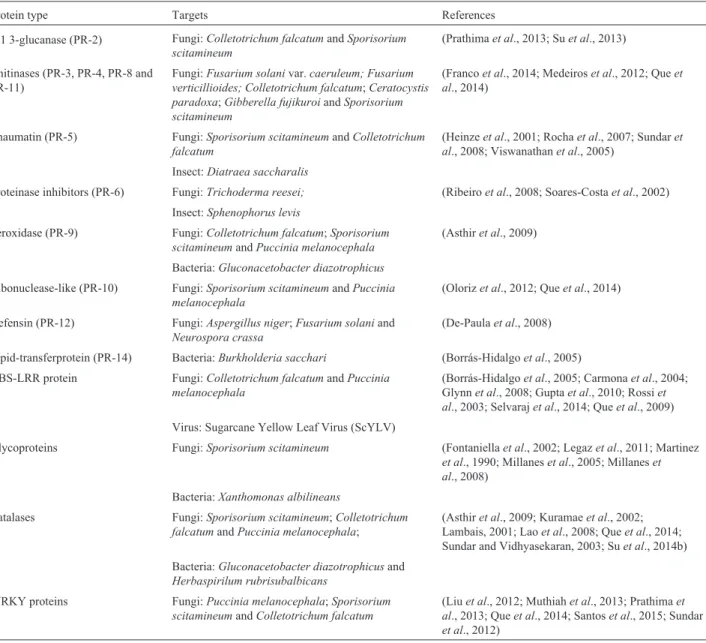
Several sugarcane proteins presenting homology to different PR families were already described. PR proteins in sugarcane are induced by fungi, bacteria, oomycetes, vi-ruses and insects (Table 1). These PR proteins showed anti-microbial or insecticidal activity (Table 1).
PR-1 family
The most abundant PR inNicotiana tabacumis in the PR-1 family, with a high level of induction (~10,000-fold) in response to pathogen infection (Alexanderet al., 1993). PR-1 induction increased the tolerance of different plants, such as tomato, tobacco and Arabidopsis, to pathogens, af-fecting fungal development (Nidermanet al, 1995; Segarra
et al., 2013). In transgenic tobacco plants that overexpress the PR-1a gene, tolerance to infection by two oomycetes,
Peronospora tabacina and Phytophthora parasitica var.
nicotianae, was improved (Alexanderet al., 1993). Pro-teins in the PR-1 family from tobacco and tomato have dif-ferent levels of fungicidal activity and affect the germina-tion ofPhytophthora infestanszoospores (Nidermanet al., 1995). PR-1 gene expression was increased in Arabidopsis
Table 1- Defense related proteins identified in sugarcane in response to biotic stress.
Protein type Targets References
b-1 3-glucanase (PR-2) Fungi:Colletotrichum falcatumandSporisorium scitamineum
(Prathimaet al., 2013; Suet al., 2013)
Chitinases (PR-3, PR-4, PR-8 and PR-11)
Fungi:Fusarium solanivar.caeruleum; Fusarium verticillioides; Colletotrichum falcatum;Ceratocystis paradoxa;Gibberella fujikuroiandSporisorium scitamineum
(Francoet al., 2014; Medeiroset al., 2012; Queet al., 2014)
Thaumatin (PR-5) Fungi:Sporisorium scitamineumandColletotrichum falcatum
(Heinzeet al., 2001; Rochaet al., 2007; Sundaret al., 2008; Viswanathanet al., 2005)
Insect:Diatraea saccharalis
Proteinase inhibitors (PR-6) Fungi:Trichoderma reesei; (Ribeiroet al., 2008; Soares-Costaet al., 2002)
Insect:Sphenophorus levis
Peroxidase (PR-9) Fungi:Colletotrichum falcatum;Sporisorium scitamineumandPuccinia melanocephala
(Asthiret al., 2009)
Bacteria:Gluconacetobacter diazotrophicus Ribonuclease-like (PR-10) Fungi:Sporisorium scitamineumandPuccinia
melanocephala
(Olorizet al., 2012; Queet al., 2014)
Defensin (PR-12) Fungi:Aspergillus niger;Fusarium solaniand Neurospora crassa
(De-Paulaet al., 2008)
Lipid-transferprotein (PR-14) Bacteria:Burkholderia sacchari (Borrás-Hidalgoet al., 2005) NBS-LRR protein Fungi:Colletotrichum falcatumandPuccinia
melanocephala
(Borrás-Hidalgoet al., 2005; Carmonaet al., 2004; Glynnet al., 2008; Guptaet al., 2010; Rossiet al., 2003; Selvarajet al., 2014; Queet al., 2009)
Virus: Sugarcane Yellow Leaf Virus (ScYLV)
Glycoproteins Fungi:Sporisorium scitamineum (Fontaniellaet al., 2002; Legazet al., 2011; Martinez et al., 1990; Millaneset al., 2005; Millaneset al., 2008)
Bacteria:Xanthomonas albilineans
Catalases Fungi:Sporisorium scitamineum;Colletotrichum falcatumandPuccinia melanocephala;
(Asthiret al., 2009; Kuramaeet al., 2002; Lambais, 2001; Laoet al., 2008; Queet al., 2014; Sundar and Vidhyasekaran, 2003; Suet al., 2014b)
Bacteria:Gluconacetobacter diazotrophicusand Herbaspirilum rubrisubalbicans
WRKY proteins Fungi:Puccinia melanocephala;Sporisorium scitamineumandColletotrichum falcatum
after the inoculation withBotrytis cinereafungi (Segarraet al., 2013).
For sugarcane, a putative PR-1-encoding gene was observed in the SUCEST database (Sugarcane EST
Ge-nome Project) (Kuramae et al., 2002). Based on the
in-creased activity of other members of the PR-1 family,
showed in tobacco and tomato, againstPhytophthora
spe-cies (Alexanderet al., 1993; Nidermanet al., 1995), PR-1 proteins are relevant targets for future studies against the oomycete species that also affect sugarcane.
b-1,3-glucanases (PR-2 family)
The PR-2 family includes b-1,3-glucanases, which
are enzymes that catalyze the endo-type hydrolytic cleav-age of 1,3-b-D-glucosidic linkages inb-1,3-glucans (Leub-ner-Metzger and Meins Jr, 1999). These enzymes are involved in several physiological and developmental
pro-cesses in non infected plants (Romero et al., 1998;
Leubner-Metzger, 2003; Balasubramanianet al., 2012) and in responses to abiotic (Hinchaet al., 1997) and biotic
fac-tors (Kempet al., 1999; Leubner-Metzger and Meins Jr,
1999).b-1,3-Glucanases releaseb-glucans from fungal cell walls, which in turn can act as elicitors in plant defense, in-ducing accumulation of the antibiotic phytoalexin (Sharpet al., 1984; Okinakaet al., 1995).
In sugarcane,b-1,3-glucanase genes are differentially expressed afterC.falcatum(Prathimaet al., 2013) andS.
scitamineum(Suet al., 2013) infection, with different ex-pression profiles. In response to bothS. scitamineum
infec-tion and abiotic stresses, ScGluA1 (KC848050) was
up-regulated, whereas ScGluD1 (KC848051) was slightly
down-regulated (Suet al., 2013). The activity was variable for b-1,3-glucanase in genotypes with different levels of susceptibility to S. scitamineum. For example, following infection withS. scitamineum, glucanase activity increases more rapidly and last longer in a variety of sugarcane resis-tant to smut than in a susceptible one (Suet al., 2013).
Chitinases (PR-3, PR-4, PR-8 and PR-11 families)
Chitinases are enzymes that hydrolyze theb
-1,4-lin-kage between N-acetylglucosamine residues of chitin,
which is a structural polysaccharide that is the primary component of cell walls of several types of fungi and exoskeletons of invertebrates (Datta et al., 1999). In the molecular defense of plants, chitinases degrade the chitin in fungal cell walls, with a consequent inhibition of pathogen
growth (Schlumbaum et al., 1986). These proteins are
grouped in several classes based on sequence similarity and are distributed in four PR families: PR-3, PR-4, PR-8 and PR-11 (Neuhaus, 1999).
Chitinase proteins in sugarcane are associated with responses to biotic and abiotic stresses (Suet al., 2014a,
2015).TheScChiVII1gene showed differential expression
pattern in sugarcane genotypes resistant and susceptible to
smut (Wang et al., 2014). Transcript levels of chitinase genes were differentially expressed after infection by the fungiC.falcatum(Sundaret al., 2008; Rahulet al., 2013),
S.scitamineum(Suet al., 2014a, 2015; Queet al., 2014) andGiberella fujikuroi(Linet al., 2010). Additionally, the constitutive chitinase activity was higher in sugarcane vari-eties resistant to red rot disease than in susceptible geno-types (Viswanathan, 2012).
The sugarcane chitinase ScChi, an acidic class III chitinase (PR-8 family), has antifungal activity and inhibits
the hyphal growth ofFusarium solanivar.coeruleum(Que
et al., 2014). Moreover, sugarcane chitinases showed ac-tion againstC. falcatumand are also associated with Pseu-domonas-mediated induced resistance (Viswanathanet al., 2003) and with sugarcane response toD.saccharalisattack (Medeiroset al., 2012).
Sugarcane has two homologs (SUGARWIN1 and SUGARWIN2) of the antifungal barley wound-inducible protein BARWIN, a class II chitinase (PR-4 family) (Me-deiroset al., 2012). BARWIN is a basic protein composed of 125 residues, with the tridimensional structure stabilized by three disulfide bonds (Ludvigsen and Poulsen, 1992; Svenssonet al., 1992). Proteins with a domain similar to BARWIN are observed in several different plants, with (Broekaert et al., 1990) or without an associated chitin-binding domain (Friedrichet al., 1991; Linthorst et al., 1991; Carusoet al., 1999), includingHevea brasiliensis,
Solanum lycopersicum, Nicotiana tabacum and Triticum aestivum. These proteins have antimicrobial activities to-ward fungi (Hejgaardet al., 1992; Carusoet al., 1999; Zhu
et al., 2006) or both fungi and bacteria (Kibaet al., 2003).
Transcript levels of genes encoding SUGARWINs were up-regulated in response to mechanical wounding, sugarcane borer (D. saccharalis) attack and methyl jasmo-nate treatment (Medeiroset al., 2012). Although induced byD. saccharalisdamage, SUGARWIN2 proteins have no insecticidal activity; however, these proteins have an
anti-microbial role against the opportunistic fungi Fusarium
verticillioides (Medeiros et al., 2012) and C. falcatum
(Francoet al., 2014), which typically develop after sugar-cane borer attacks. Based on these results, SUGARWIN2 proteins are likely involved in a finely regulated defense mechanism in which insect damage induces plant defenses
against imminent opportunistic fungi (Medeiros et al.,
2012; Francoet al., 2014). Moreover, the sugarcane
patho-genic fungusC.paradoxawas affected by SUGARWIN2,
but the nonpathogenic fungi Aspergillus nidulans and
Thaumatin-like proteins (PR-5 family)
Thaumatin-like proteins (TLPs) have a sequence sim-ilar to that of thaumatin, a protein extracted from
Thaumatococcus daniellii(a west African shrub). Thau-matin is a monomeric protein composed of 207 residues and stabilized by eight disulfide bonds (Kimet al., 1988). TLPs are induced by biotic and abiotic stresses (Velazhahanet al., 1999; Rajamet al., 2007). Inin vitro as-says, the plasma membranes (PL) of fungi were disrupted by the antifungal activity of TLPs (Vigerset al., 1992).The mechanisms responsible for the fungal plasma membrane rupture are the direct insertion of TLP in its membrane (for-mation of pores), causing changes in membrane permeabil-ity (Roberts and Selitrennikoff, 1990), or by the hydrolysis of b-1,3-glucans from fungal cell walls (Grenier et al., 1999).
TLP was induced in sugarcane afterS.scitamineum
(smut) inoculation (Heinzeet al., 2001),C.falcatum glyco-protein elicitor treatment (Sundaret al., 2008) and in re-sponse toD.saccharalisattack (Rochaet al., 2007). PR-5 genes were differentially expressed after sugarcane chal-lenge withC.falcatum(Sathyabhamaet al., 2015).
Peptidase inhibitors (PR-6 family)
Peptidase inhibitors (PIs) in plants are important in the control of endogenous and exogenous peptidase activ-ity. The activity of PIs in plant defense is primarily to in-hibit the peptidases secreted by insects and pathogenic microorganisms with the digestion of these proteins (Habib and Fazili, 2007).
Plant cystatins, or phytocystatins (PhyCys), are one of the most studied plant protease inhibitors (Benchabane
et al., 2010). They are competitive and reversible inhibitors of cysteine proteases (Martínez and Díaz, 2008). The genes of the cystatin family have been identified and character-ized in some plant species, demonstrating functions in de-fense against pathogens (Bobek and Levine, 1992; Gutierrez-Camposet al., 1999; Belenghiet al., 2003), in re-sponse to insect attack (Gouletet al., 2008; Konradet al., 2008; Lianget al., 2015), in programmed cell death (Solo-monet al., 1999; Zhaoet al., 2013), in seed germination (Hwanget al., 2009, Zhaoet al., 2014), and in responses to abiotic environmental stresses (Hwanget al., 2010). Fur-thermore, the genes in the cystatin family were differen-tially expressed in response to different abiotic/biotic stresses, with essential roles in plant defense and hypersen-sitive cell death (Koiwaet al. 2000; Belenghiet al. 2003; van der Lindeet al., 2012, Wanget al., 2015).
Canecystatin, a sugarcane phytocystatin, is composed of 106 amino acid residues and typically seems to occur as a domain-swapped dimer in solution (Valadareset al., 2013). The canecystatin dimerization mechanism turns this inhibi-tor inactive, avoiding the inhibition of nontarget endoge-nous cysteine peptidases (Valadareset al., 2013).
The Sugarcane Genome Project SUCEST was the first to characterize canecystatin (Soares-Costa et al., 2002). Following recombinant expression and purification, the antifungal activity of canecystatin was demonstrated againstTrichoderma reeseiby reducing germination of the filamentous fungus (Soares-Costaet al., 2002). The cane-cystatin provided inhibitory effect against thiol peptidases, showing that may provide protection for sugarcane against fungi and insects (Olivaet al., 2004). Purified from trans-genic sugarcane, His-tagged CaneCPI-1 affects the cata-lytic activity of cysteine peptidases partially purified from the midgut of the coleopteranS.levis (sugarcane weevil;
Ribeiro et al., 2008). Furthermore, some sugarcane
cys-tatins present high homology with the mir 1 gene from
maize, which inhibits the growth of a wide range of lepi-dopteran species (Pechanet al., 2000). These results cor-roborate that cystatins have potential roles in the defense of sugarcane against insect pests.
In addition to the well-described cysteine peptidase inhibitors, sugarcane also has serine peptidase inhibitors of the Bowman-Birk type (BBI) (Melloet al., 2003). BBIs are small double-headed serine peptidase inhibitors that are highly stabilized by several disulfide bonds (Birk, 1985). Sugarcane likely has at least 14 BBI genes, with highly variable compositions of the amino acid sequences (Mello
et al., 2003). The introduction of soybean Bowman-Birk and Kunitz-type serine peptidase inhibitors into sugarcane transgenic lines significantly retards the development ofD. saccharalis, although the damage caused by this herbivore was not prevented (Falco and Silva-Filho, 2003).
Endoproteinases (PR-7 family)
The proteins in the PR-7 family are similar to potato alkaline endoproteinase p-69, which is the primary PR in tomato involved in the response to citrus exocortis viroid (CEV) infection (Vera and Conejero, 1988), and to the subtilisin serine protease family (Tornero et al., 1997). Endoproteinases are essential in hydrolyzing peptide bonds in the process of protein degradation. The role of these pro-teins in biotic defense is unclear, but these propro-teins may contribute to the dissolution of microbial cell walls (van Loonet al., 2006) or to the posttranslational modification of proteins involved in plant defense (Torneroet al., 1996).
The genesP69BandP69Cfrom tomato inserted into
trans-genic Arabidopsis are induced by salicylic acid and by
plant interaction withPseudomonas syringae (Jordá and
Vera, 2000).
Endoproteinase genes with diverse substrate specific-ity are reported in sugarcane, but their involvement in plant defense remains to be explored (Correaet al., 2001; Ramos and Selistre-de-Araujo, 2001; Santos-Silvaet al., 2012).
Peroxidases (PR-9 family)
and are involved in a wide variety of physiological and plant defense processes (Chittooret al., 1999). Peroxidases respond to biotic stress by affecting cell wall cross-linking and by creating an unfavorable environment for pathogen growth in plants with the generation of reactive oxygen species (ROS) (Passardiet al., 2005). The role of peroxi-dases in plant cell walls is associated with the biosynthesis of lignin, which is a phenolic biopolymer synthesized for mechanical support and in response to pathogen attack in vascular plants (Østergaardet al., 2000). For example, ATP
A2 peroxidase in Arabidopsis thaliana is a
lignin-asso-ciated peroxidase that was potentially used in defense against pathogens (Østergaardet al., 2000).
In sugarcane, peroxidase activity increases after inoc-ulation with the pathogenC. falcatum(red rot) (Sundaret al., 2006), with a greater increase in activity in a resistant genotype than in a susceptible one (Asthiret al., 2009). Ad-ditionally, an elicitor isolated from C. falcatum induces peroxidase activity in sugarcane leaves and in suspension-cultured cells (Sundaret al., 2002). For sugarcane varieties with different levels of susceptibility toS. scitamineum, en-zyme activity levels were also variable, with higher in-creases in activity in a resistant genotype than in a suscepti-ble one after inoculation with the pathogen (Esh et al., 2014). Transcripts encoding peroxidase genes were also
in-duced in sugarcane tissues infected byGluconacetobacter
diazotrophicus (Lambais, 2001) and during interaction withPuccinia melanocephala(Carmonaet al., 2004).
Ribonuclease-like proteins (PR-10 family)
The PR-10 family includes intracellular proteins with ribonuclease activity (Van Loonet al., 1994). PR-10 pro-teins are induced by pathogens in several plants and shown to possess antifungal, antibacterial, antiviral and anti-nematode activity (Fernandeset al., 2013; Parket al., 2004; McGeeet al., 2001).
In sugarcane, PR-10 homologs were induced after treatment with the defense-regulator methyl jasmonate
(MJ) (Bower et al., 2005) and inoculation of sugarcane
buds withS.scitamineum(Queet al., 2014) and in response toP.melanocephalainfection (Olorizet al. 2012).
Defensins (PR-12 family)
Plant defensins are small, cysteine-rich antimicrobial peptides found in several organisms, typically with a char-acteristicb-fold (Stotzet al., 2009). These cationic pep-tides, likely act as antimicrobial molecules that induce the formation of pores in pathogen membranes or modify membrane permeability by a mechanism based on electro-static charge (Thommaet al., 2002).
Sugarcane has at least three putative functional defensins: Sd1, Sd3 and Sd5 (De-Paulaet al., 2008). Sd1, Sd3 and Sd5 have antifungal activity against the fungi
Aspergillus niger, F.solaniandNeurospora crassa; how-ever, these proteins have no antibacterial activity against
Kocuria rhizophila,Bacillus subtilis,Escherichia coliand
Staphylococcus aureus(De-Paulaet al., 2008).
Lipid-transferproteins (PR-14 family)
Lipid-transfer proteins (LTPs) are small, basic and cysteine-rich lipid-binding proteins in plants that transport
lipids between membranesin vitro(Rueckert and Schmidt,
1990). These proteins are observed in plant cell walls, with putative roles in cutin biosynthesis and in response to biotic and abiotic stresses (Kader, 1997). Genes encoding the PR-14 type-member, barley LTP4, are differentially in-duced after fungal and bacterial inoculation (Molina and García-Olmedo, 1993; Molinaet al., 1996).
After pathogen inoculation, putative homologs of LTPs are differentially induced in a sugarcane genotype re-sistant to eyespot (Biopolaris sacchari; Borrás-Hidalgoet al., 2005).
Other defense-related proteins in sugarcane
NBS-LRR proteins
Plant NBS-LRR proteins are used to recognize a wide variety of pathogens and insects (Liet al. 2015). These pro-teins encoded by plant resistance genes contain two typical domains: a nucleotide binding site (NBS) and a leucine-rich repeat (LRR). Plant NBS-LRR proteins detect the effector molecules of pathogens that are responsible for vir-ulence. The NBS-LRR class of R genes is categorized into TIR and non-TIR classes based on sequence similarity in the region that precedes the NBS domain. The plant NBS-LRR proteins in the TIR class transport the TOLL/inter-leukin-1 receptor (TIR) and are called TNL proteins (Joshi and Navak, 2011). The TIR class was found in most dicots but is rare or absent in monocots (Baiet al., 2002; Meyerset al., 2003). The proteins in the non-TIR class are typically called CNL proteins, with most members containing a coiled-coil (CC) N-terminal domain or zinc finger and
RPW8 domains (Meyerset al., 2002, DeYoung and Innes,
2006). The CNL class was found in both dicots and mono-cots (Panet al., 2000).
Red-rot-related NBS-LRR genes were found in
sug-arcane EST databases (Gupta et al., 2010); these genes
were up-regulated in response to C. falcatum challenge,
suggesting a possible role in systemic acquired resistance, SAR (Selvarajet al., 2014). These genes were also induced in sugarcane somaclonal variants during interaction withP.
melanocephala(Carmonaet al., 2004). An NBS-LRR class resistance-gene, non-TIR-NBS-LRR-type, was induced in sugarcane in response to infection byS.scitamineum, the causal agent of smut (Borrás-Hidalgoet al., 2005;Que et al., 2009).
Resistance-associated genes that encode an NBS do-main have been identified in plants using disease resistance
gene analog (RGA) markers (Sekhwalet al., 2015). RGA
genes with conserved domains. The NBS domain was used to amplify RGA fragments from various plant species
(Wanget al., 2001). For example, NBS-RGA analogs from
wheat and soybean were used to amplify NBS-LRR DNA in sugarcane; the genes identified were associated with re-sistance against yellow leaf virus (SCYLV) and moderate resistance against rust caused byP. melanocephala(Glynn
et al., 2008). Non-TIR-NBS-LRR resistance genes (Xa1
andRPS2) and TIR-NBS-LRR resistance genes (L6andN)
were also identified in sequences of RGAs from smut-resistant sugarcane (Queet al., 2009). Eighteen other sug-arcane NBS-LRR gene homologs were found in the SUCEST database with homology to maize and rice variet-ies resistant to rust (Rossiet al., 2003). Analyses of these genes may enhance the understanding of stress-responsive pathways in sugarcane and lead to the development of markers for disease.
Glycoproteins
The production of glycoproteins is likely the primary response of sugarcane to infection by pathogens
(Fonta-niella et al., 2002). These macromolecules are found in
plant cell walls (Martínezet al. 1990) and are of two types, mid molecular mass glycoproteins (MMMGs) or high mo-lecular mass glycoproteins (HMMGs) (Legazet al., 1998).
In response to the entry of a pathogen, sugarcane glycoproteins (MMMGs and HMMGs) are produced that modify some physiological functions of the invader. These glycoproteins were first isolated from sugarcane juice
pro-duced in response to mechanical injuries (Legaz et al.,
1998).
The inoculation of sugarcane with smut teliospores of
S.scitamineuminduces a significant increase in concentra-tion of HMMGs, the polymers from which MMMGs are derived (Martínezet al. 1990). In other studies on smut dis-ease, both types of glycoproteins act against the fungus by increasing cytoagglutination and decreasing the germina-tion of teliospores by 50% (Fontaniellaet al., 2002) or by preventing cell polarization with inhibition of germination
tube protrusion and spore germination (Millanes et al.,
2005). Furthermore, HMMGs and MMMGs produced by healthy sugarcane cause a complete inhibition of smut my-celium growth (Millaneset al., 2008).
Xanthomonas albilineansis the causal agent of leaf scald, a bacterial-vascular disease in sugarcane. Sugarcane HMMGs and MMMGs act as cell-to-bacterial signals in-ducing the production of xanthan, an exocellular poly-saccharide, byX. albilineans. The production of xanthan is likely caused by inhibition of bacterial proteases by these glycoproteins, which consequently protects the enzymes responsible for xanthan biosynthesis from proteolytic deg-radation (Legazet al., 2011).
Catalases
Catalase was the first antioxidant enzyme discovered and characterized. In plants, these enzymes detoxify reac-tive oxygen species (ROS). Catalases are hemeproteins that have high specificity for H2O2and catalyze the dismutation of two molecules of H2O2into water and oxygen (Sharmaet
al., 2012).
A search in the SUCEST database found catalases with similarities to the three maize isoforms (CAT 1, CAT 2 and CAT 3) (Soares Netto, 2001). The level of gene ex-pression for a catalase isoform (CAT3) increases after in-fection withG.diazotrophicus(2.5-fold),Herbaspirillum rubrisubalbicans (5-fold) (Lambais, 2001) and S. scitamineum(Laoet al., 2008). CAT 1 and CAT 3 were also found in sugarcane leaves inoculated with the patho-genP. melanocephala, the causal agent of sugarcane rust disease (Kuramaeet al., 2002).
The elicitor ofC.falcatuminduces variable levels of catalase in suspension-cultured sugarcane cells (Sundar and Vidhyasekaran, 2003). Moreover, high catalase activ-ity was found in two cultivars with varying sensitivactiv-ity toC.
falcatum after inoculation with conidia of red rot fungus (Asthiret al., 2009).
After inoculation withS.scitamineum, the expression of the catalase gene (ScCAT1) in sugarcane increases sig-nificantly, which suggests thatScCAT1protects plants a-gainst reactive oxidant-related fungal stimuli. Based on this study, a positive correlation between activity of catalase and smut resistance in sugarcane was also confirmed (Suet al., 2014b). Furthermore, the transcription and expression of the catalase gene were also induced by this interaction (Queet al., 2014).
WRKY proteins
WRKY proteins are a large family of transcription factors. These proteins are named because of a highly con-served 60 amino acid-long WRKY domain, which is com-posed of the highly conserved motif WRKYGQK at the N-terminus and a novel metal-chelating zinc finger signa-ture at the C-terminus (Agarwalet al., 2011). WRKY pro-teins recognize the W box (TTGACC/T) type DNA se-quence, which was found in the promoters of many plant
defense genes (Rushtonet al., 1996). WRKY proteins are
may have played a key role in the expansion of the WRKY family (Ulker and Somssich, 2004; Agarwalet al., 2011).
Data analyses of sugarcane defense-related genes from many projects worldwide identified WRKY genes
(Lambais, 2001; Liuet al., 2012; Wanderley-Nogueiraet
al., 2012; Queet al., 2014; Santoset al., 2015). The expres-sion ofb-1,3-glucanases, chitinases, peroxidases and cata-lases was co-regulated with WRKY-like genes in sugar-cane (Dellagiet al., 2000; Haraet al., 2000). Furthermore, specific isoforms of sugarcane WRKY-like transcription factor are associated with PR regulons (Lambais, 2001). The expression analysis of WRKY genes indicates strong inductions after sugarcane interaction withU.scitaminea
(Liuet al., 2012),C.falcatum(Sundaret al., 2012; Muthiah
et al., 2013; Prathimaet al., 2013),S.scitamineum(Queet al., 2014) andP.melanocephala(Santoset al., 2015).
Biotechnology potential of defense-related
proteins in sugarcane
Induced systemic resistance (ISR) is one strategy that has been described as a potential weapon to improve sugar-cane resistance to biotic stresses. Rhizobacterial strains of
Pseudomonas (nonpathogenic bacteria) were associated with increased resistance in sugarcane toC.falcatumby in-ducing PR proteins in stalk tissues (Viswanathan et al., 2003) and by increasing chitinases with antifungal activity
(Viswanathan and Samiyappan, 2001; Viswanathanet al.,
2005).
PR proteins from the families PR-13, PR-15, PR-16, PR-17, PR-18 and PR-19, with homologs not yet found in sugarcane, can also be potential targets for RGA markers for enhanced resistance to pathogens. PR-13 (thionins) de-stroy fungal and bacterial membranes (Bohlmann and
Broekaert, 1994) and in barley andArabidopsisinhibited
the growth of the sugarcane phytopathogenic fungi
Thielaviopsis paradoxa(Reimann-Philippet al., 1989) and
Fusarium oxysporum (Epple et al., 1997), respectively. Oxalate oxidases (PR-15 family) and oxalate-oxidase-like proteins (PR-16 family) are correlated with the generation of hydrogen peroxide, which produces a toxic environment to the pathogen or stimulates directly or indirectly plant
de-fense responses (Van Loonet al., 2006). Members of the
newly described PR-17 family (Nt PRp27 like) were
ob-served in response to Blumeria graminis in barley
(Christensenet al., 2002), induced by the synthetic benzo (1,2,3) thiadiazole-7-carbothioic acid S-methyl ester (BTH) in wheat (Görlachet al., 1996) and upon mosaic vi-rus infection in tobacco. PR-18 (fungus- and SA-inducible carbohydrate oxydases) enhanced resistance to infection by bacteria in tobacco transgenic plants (Custerset al., 2004). Recently, a new PR protein with antimicrobial effect was
identified in Pinus sylvestris and named PR-19
(Sooriyaarachchiet al., 2011). This protein binds to fungal cell wall glucans altering cell wall structure which leads to
morphological distortion of hyphae (Sooriyaarachchiet al., 2011).
Recently, RNA interference also has been used for control of sugarcane diseases. RNAi of endochitinases in
the sugarcane endophyteTrichoderma virens223 was used
as a form of biocontrol forC.paradoxa(Romão-Dumaresq
et al., 2012). RNAi has been used for development of viral resistant plants (Kimet al., 2013; Ntuiet al., 2013). Gene silencing has proven to be effective to obtain multistrain re-sistant sugarcane plants for mosaic disease (Potyvirus sugarcane mosaic virus ScMV and/or Sorghum mosaic virus -SrMV)(Guoet al., 2015).
Studies have reported that microRNA-guided gene regulation was essential for tolerance to biotic stresses (Guptaet al., 2014). Thiebautet al. (2012) identified sev-eral microRNAs in sugarcane after inoculation with
Acidovorax avenaesubspavenae. These new microRNAs have a potential use for genetic engineering of stress-resistant plants and can contribute to an improved under-standing of regulatory pathways for defense-related pro-teins.
The development of transgenic plants is another strat-egy proposed to increase resistance to pathogens. For ex-ample, the insertion of single genes encoding PR proteins,
such as b-1,3-glucanase (Sundaresha et al., 2010) or
thaumatin-like proteins (Chen et al., 1999; Datta et al., 1999; Velazhahan and Muthukrishnan, 2003; Schestibra-tov and Dolgov, 2005), in transgenic plants increases host resistance against fungi. Additionally, transgenic plants that express more than one PR-encoding gene have also been considered as a strategy to improve plant resistance to pathogens (Anandet al., 2003; Amianet al., 2011).
Concluding remarks
Sugarcane is one of the most important commodities worldwide, primarily for sugar and biofuel production. However, despite the significant agronomical relevance, little is known about the role of proteins in sugarcane de-fense when compared with other plant species. Improving our knowledge of sugarcane defense mechanisms against pathogens is still a great challenge to be achieved.
Acknowledgments
References
Agarwal P, Reddy MP and Chikara J (2011) WRKY: Its structure, evolutionary relationship, DNA-binding selectivity, role in stress tolerance and development of plants. Mol Biol Rep 38:3883-3896.
Alexander D, Goodman RM, Gut-Rella M, Glascock C, Weymann K, Friedrich L, Maddox D, Ahl-Goy P, Luntz T, Ward E,et al.(1993) Increased tolerance to two oomycete pathogens in transgenic tobacco expressing pathogenesis-related protein 1a. Proc Natl Acad Sci U S A 90:7327-7331. Amian AA, Papenbrock J, Jacobsen H-J and Hassan F (2011)
En-hancing transgenic pea (Pisum sativum L.) resistance against fungal diseases through stacking of two antifungal genes (chitinase and glucanase). GM Crops 2:104-109.
Anand A, Zhou T, Trick HN, Gill BS, Bockus WW and Mu-thukrishnan S (2003) Greenhouse and field testing of trans-genic wheat plants stably expressing genes for thaumatin-like protein, chitinase and glucanase against Fusarium graminearum. J Exp Bot 54:1101-1111.
Asthir B, Preet K, Batta SK and Sharma B (2009) Role of anti-oxidative enzymes in red rot resistance in sugarcane. Sugar Tech 11:282-287.
Azevedo RA, Carvalho RF, Cia MC and Gratão PL (2011) Sugar-cane under pressure: An overview of biochemical and physi-ological studies of abiotic stress. Trop Plant Biol 4:42-51. Bai JF, Pennill LA, Ning JC, Lee SW, Ramalingam J, Webb CA,
Zhao BY, Sun Q, Nelson JC, Leach JE,et al.(2002) Diver-sity in nucleotide binding site-leucine-rich repeat genes in cereals. Genome Res 12:1871-1884.
Balasubramanian V, Vashisht D, Cletus J and Sakthivel N (2012) Plant b-1, 3-glucanases: Their biological functions and transgenic expression against phytopathogenic fungi. Bio-technol Lett 34:1983-1990.
Belenghi B, Acconcia F, Trovato M, Perazzolli M, Bocedi A, Polticelli F, Ascenzi P and Delledonne M (2003) AtCYS1, a cystatin fromArabidopsis thaliana, suppresses hypersensi-tive cell death. Eur J Biochem 270:2593-2604.
Benchabane M, Schluter U, Vorster J, Goulet MC and Michaud D (2010) Plant cystatins. Biochimie 92:1657-1666.
Birk Y (1985) The Bowman-Birk inhibitor. Trypsin- and chy-motrypsin-inhibitor from soybeans. Int J Pept Protein Res 25:113-131.
Bobek LA and Levine MJ (1992) Cystatins-inhibitors of cysteine proteinases. Crit Rev Oral Biol Med 3:307-332.
Bohlmann H and Broekaert W (1994) The role of thionins in plant protection. CRC Crit Rev Plant Sci 13:1-16.
Borrás-Hidalgo O, Thomma BP, Carmona E, Borroto CJ, Pujol M, Arencibia A and Lopez J (2005) Identification of sugar-cane genes induced in disease-resistant somaclones upon in-oculation with Ustilago scitamineaorBipolaris sacchari. Plant Physiol Biochem 43:1115-1121.
Bower NI, Casu RE, Maclean DJ, Reverter A, Chapman SC and Manners JM (2005) Transcriptional response of sugarcane roots to methyl jasmonate. Plant Sci 168:761-772.
Broekaert I, Lee HI, Kush A, Chua NH and Raikhel N (1990) Wound-induced accumulation of mRNA containing a hevein sequence in laticifers of rubber tree (Hevea brasiliensis). Proc Natl Acad Sci U S A 87:7633-7637.
Broekaert WF, Terras F, Cammue B and Osborn RW (1995) Plant defensins: Novel antimicrobial peptides as components of the host defense system. Plant Physiol 108:1353.
Carmona E, Vargas D, Borroto C, Lopez J, Fernández A, Aren-cibia A and Borrás-Hidalgo O (2004) cDNA-AFLP analysis of differential gene expression during the interaction be-tween sugarcane and Puccinia melanocephala. Plant Breeding 123:499-501.
Caruso C, Bertini L, Tucci M, Caporale C, Leonardi L, Saccardo F, Bressan RA, Veronese P and Buonocore V (1999) Isola-tion and characterisaIsola-tion of wheat cDNA clones encoding PR4 proteins. DNA Seq 10:301-307.
Chen W, Chen P, Liu D, Kynast R, Friebe B, Velazhahan R, Muthukrishnan S and Gill B (1999) Development of wheat scab symptoms is delayed in transgenic wheat plants that constitutively express a rice thaumatin-like protein gene. Theor Appl Genet 99:755-760.
Chittoor JM, Leach JE and White FF (1999) Induction of pero-xidase during defense against pathogens. In: Datta SK and Muthukrishnan S (eds) Pathogenesis-Related Proteins in Plants. CRC Press, Boca Raton, pp 171-193.
Christensen AB, Cho BH, Naesby M, Gregersen PL, Brandt J, Madriz-Ordenana K, Collinge DB and Thordal-Christensen H (2002) The molecular characterization of two barley pro-teins establishes the novel PR-17 family of pathogenesis-related proteins. Mol Plant Pathol 3:135-144.
Correa GC, Margis-Pinheiro M and Margis R (2001) Identifica-tion, classification and expression pattern analysis of sugar-cane cysteine proteinases. Genet Mol Biol 24:275-283. Custers J, Harrison SJ, Sela-Buurlage MB, van Deventer E,
Lage-weg W, Howe PW, van der Meijs PJ, Ponstein AS, Simons BH, Melchers LS,et al.(2004) Isolation and characterisa-tion of a class of carbohydrate oxidases from higher plants, with a role in active defence. Plant J 39:147-160.
Datta K, Velazhahan R, Oliva N, Ona I, Mew T, Khush G, Muthukrishnan S and Datta S (1999) Over-expression of the cloned rice thaumatin-like protein (PR-5) gene in transgenic rice plants enhances environmental friendly resistance to
Rhizoctonia solani causing sheath blight disease. Theor Appl Genet 98:1138-1145.
De-Paula V, Razzera G, Medeiros L, Miyamoto C, Almeida M, Kurtenbach E, Almeida F and Valente A (2008) Evolution-ary relationship between defensins in the Poaceae family strengthened by the characterization of new sugarcane defensins. Plant Mol Biol 68:321-335.
Dellagi A, Helibronn J, Avrova AO, Montesano M, Palva ET, Stewart HE, Toth IK, Cooke DE, Lyon GD and Birch PR (2000) A potato gene encoding a WRKY-like transcription factor is induced in interactions with Erwinia carotovora
subsp. atroseptica and Phytophthora infestans and is coregulated with class I endochitinase expression. Mol Plant Microbe Interact 13:1092-1101.
DeYoung BJ and Innes RW (2006) Plant NBS-LRR proteins in pathogen sensing and host defense. Nat Immunol 7:1243-1249.
Dong J, Chen C and Chen Z (2003) Expression profiles of the Arabidopsis WRKY gene superfamily during plant defense response. Plant Mol Biol 51:21-37.
Esh AMH, Guirgis AA, El-Kholi MMA, El-Absawy EA, Nasr MI and Hassanien EH (2014) The activity of pathogenesis re-lated proteins in smut resistant and susceptible sugarcane (GT54-9) mutants induced by gamma radiation. Adv Plants Agric Res 1:1-12.
Eulgem T, Rushton PJ, Robatzek S and Somssich IE (2000) The WRKY superfamily of plant transcription factors. Trends Plant Sci 5:199-206.
Falco MC and Silva-Filho MC (2003) Expression of soybean proteinase inhibitors in transgenic sugarcane plants: Effects on natural defense against Diatraea saccharalis. Plant Physiol Biochem 41:761-766.
Fernandes H, Michalska K, Sikorski M and Jaskolski M (2013) Structural and functional aspects of PR-10 proteins. FEBS J 280:1169-1199.
Fontaniella B, Márquez A, Rodríguez CW, Piñón D, Solas MT, Vicente C and Legaz ME (2002) A role for sugarcane glyco-proteins in the resistance of sugarcane to Ustilago scitaminea. Plant Physiol Biochem 40:881-889.
Franco FP, Santiago AC, Henrique-Silva F, de Castro PA, Goldman GH, Moura DS and Silva-Filho MC (2014) The sugarcane defense protein SUGARWIN2 causes cell death inColletotrichum falcatumbut not in non-pathogenic fungi. PloS ONE 9:e91159.
Friedrich L, Moyer M, Ward E and Ryals J (1991) Pathogenesis-related protein 4 is structurally homologous to the carboxy-terminal domains of hevein, Win-1 and Win-2. Mol Gen Genet 230:113-119.
Glynn NC, Comstock JC, Sood SG, Dang PM and Chaparro JX (2008) Isolation of nucleotide binding site-leucine rich re-peat and kinase resistance gene analogues from sugarcane (Saccharum spp.). Pest Manag Sci 64:48-56.
Goulet MC, Dallaire C, Vaillancourt LP, Khalf M, Badri AM, Preradov A, Duceppe MO, Goulet C, Cloutier C and Mi-chaud D (2008) Tailoring the specificity of a plant cystatin toward herbivorous insect digestive cysteine proteases by single mutations at positively selected amino acid sites. Plant Physiol 146:1010-1019.
Grenier J, Potvin C, Trudel J and Asselin A (1999) Some thau-matin-like proteins hydrolyse polymeric b-1, 3-glucans. Plant J 19:473-480.
Guo JL, Gao SW, Lin QL, Wang HB, Que YX and Xu LP (2015) Transgenic sugarcane resistant to Sorghum mosaic virus based on coat protein gene silencing by RNA interference. Biomed Res Int 2015:1-9.
Gupta OP, Sharma P, Gupta RK and Sharma I (2014) Current sta-tus on role of miRNAs during plant-fungus interaction. Physiol Mol Plant Pathol 85:1-7.
Gupta V, Raghuvanshi S, Gupta A, Saini N, Gaur A, Khan MS, Gupta RS, Singh J, Duttamajumder SK, Srivastava S,et al.
(2010) The water-deficit stress- and red-rot-related genes in sugarcane. Funct Integr Genomics 10:207-214.
Gutierrez-Campos R, Torres-Acosta JA, Saucedo-Arias LJ and Gomez-Lim MA (1999) The use of cysteine proteinase in-hibitors to engineer resistance against potyviruses in trans-genic tobacco plants. Nat Biotechnol 17:1223-1226. Görlach J, Volrath S, Knauf-Beiter G, Hengy G, Beckhove U,
Kogel K-H, Oostendorp M, Staub T, Ward E and Kessmann H (1996) Benzothiadiazole, a novel class of inducers of sys-temic acquired resistance, activates gene expression and dis-ease resistance in wheat. Plant Cell 8:629-643.
Habib H and Fazili KM (2007) Plant protease inhibitors: A de-fense strategy in plants. Biotechnol Mol Biol Rev 2:68-85. Hara K, Yagi M, Kusano T and Sano H (2000) Rapid systemic
ac-cumulation of transcripts encoding a tobacco WRKY tran-scription factor upon wounding. Mol Gen Genet 263:30-37. Heinze B, Thokoane L, Williams N, Barnes J and Rutherford R
(2001) The smut-sugarcane interaction as a model system for the integration of marker discovery and gene isolation. Proc S Afr Sug Technol Ass Citeseer, pp 88-93.
Hejgaard J, Jacobsen S, Bjorn SE and Kragh KM (1992) Anti-fungal activity of chitin-binding PR-4 type proteins from barley grain and stressed leaf. FEBS Lett 307:389-392. Hincha DK, Meins Jr F and Schmitt JM (1997) [beta]-1,
3-Glu-canase is cryoprotective in vitro and is accumulated in lea-ves during cold acclimation. Plant Physiol 114:1077-1083. Hoang NV, Furtado A, Botha FC, Simmons BA and Henry RJ
(2015) Potential for genetic improvement of sugarcane as a source of biomass for biofuels. Front Bioeng Biotechnol 3:1-15.
Hwang JE, Hong JK, Je JH, Lee KO, Kim DY, Lee SY and Lim CO (2009) Regulation of seed germination and seedling growth by an Arabidopsis phytocystatin isoform, AtCYS6. Plant Cell Rep 28:1623-1632.
Hwang JE, Hong JK, Lim CJ, Chen H, Je J, Yang KA, Kim DY, Choi YJ, Lee SY and Lim CO (2010) Distinct expression patterns of two Arabidopsis phytocystatin genes, AtCYS1 and AtCYS2, during development and abiotic stresses. Plant Cell Rep 29:905-915.
Jones JDG and Dangl JL (2006) The plant immune system. Nature 444:323-329.
Jordá L and Vera P (2000) Local and systemic induction of two defense-related subtilisin-like protease promoters in trans-genic Arabidopsis plants. Luciferin induction of PR gene ex-pression. Plant Physiol 124:1049-1058.
Joshi RK and Nayak S (2011) Functional characterization and sig-nal transduction ability of nucleotide-binding site-leucine-rich repeat resistance genes in plants. Genet Mol Res 10:2637-2652.
Journot-Catalino N, Somssich IE, Roby D and Kroj T (2006) The transcription factors WRKY11 and WRKY17 act as nega-tive regulators of basal resistance inArabidopsis thaliana. Plant Cell 18:3289-3302.
Kader J-C (1997) Lipid-transfer proteins: A puzzling family of plant proteins. Trends Plant Sci 2:66-70.
Kemp G, Botha A-M, Kloppers F and Pretorius Z (1999) Disease development andb-1, 3-glucanase expression following leaf rust infection in resistant and susceptible near-isogenic wheat seedlings. Physiol Mol Plant Pathol 55:45-52. Kiba A, Saitoh H, Nishihara M, Omiya K and Yamamura S (2003)
C-terminal domain of a hevein-like protein fromWasabia japonica has potent antimicrobial activity. Plant Cell Physiol 44:296-303.
Kim HJ, Kim MJ, Pak JH, Jung HW, Choi HK, Lee YH, Baek IY, Ko JM, Jeong SC, Pack IS,et al.(2013) Characterization of SMV resistance of soybean produced by genetic transforma-tion of SMV-CP gene in RNAi. Plant Biotechnol Rep 7:425-433.
Kim S-H, de Vos A and Ogata C (1988) Crystal structures of two intensely sweet proteins. Trends Biochem Sci 13:13-15. Koiwa H, Shade RE, Zhu-Salzman K, D’Urzo MP, Murdock LL,
cystatin (soyacystatin) targets cathepsin L-like digestive cysteine proteinases (DvCALs) in the larval midgut of west-ern corn rootworm (Diabrotica virgifera virgifera). FEBS Lett 471:67-70.
Konrad R, Ferry N, Gatehouse AM and Babendreier D (2008) Po-tential effects of oilseed rape expressing oryzacystatin-1 (OC-1) and of purified insecticidal proteins on larvae of the solitary beeOsmia bicornis. PLoS ONE 3:e2664.
Kuramae EE, Fenille RC, Rosa VE, Dias DR, Monteiro JP, Gi-menes MA, Palmieri DA, Lima MM and Fávaro RD (2002) Mining of sugarcane ESTs involved in the mechanisms against plant pathogen and environmental stress. Summa phytopatológica 4:315-324.
Lambais MR (2001) In silico differential display of defense-related expressed sequence tags from sugarcane tissues in-fected with diazotrophic endophytes. Genet Mol Biol 24:103-111.
Lao M, Arencibia AD, Carmona ER, Acevedo R, Rodriguez E, Leon O and Santana I (2008) Differential expression analy-sis by cDNA-AFLP of Saccharum spp. after inoculation with the host pathogenSporisorium scitamineum. Plant Cell Rep 27:1103-1111.
Legaz M-E, Blanch M, Piñón D, Santiago R, Fontaniella B, Blanco Y, Solas M-T and Vicente C (2011) Sugarcane glycoproteins may act as signals for the production of xan-than in the plant-associated bacterium Xanthomonas albilineans. Plant Signal Behav 6:1132-1139.
Legaz ME, de Armas R, Pinon D and Vicente C (1998) Relation-ships between phenolics-conjugated polyamines and sensi-tivity of sugarcane to smut (Ustilago scitaminea). J Exp Bot 49:1723-1728.
Leubner-Metzger G (2003) Functions and regulation of b-1, 3-glucanases during seed germination, dormancy release and after-ripening. Seed Sci Res 13:17-34.
Leubner-Metzger G and Meins Jr F (1999) Functions and regula-tion of plant b-1,3-glucanes (PR-2). Datta SK and Muthukrishnan S (eds) Pathogenesis-Related Proteins in Plants. CRC Press, Boca Raton, pp 49-76.
Li X, Kapos P and Zhang Y (2015) NLRs in plants. Curr Opin Immunol 32:114-121.
Liang J, Wang Y, Ding G, Li W, Yang G and He N (2015) Biotic stress-induced expression of mulberry cystatins and identifi-cation of cystatin exhibiting stability to silkworm gut pro-teinases. Planta 242:1139-1151.
Lin S, Zhou Y, Chen G, Zhang Y, Zhang Y, Ning W and Pan D (2010) Molecular responses to the fungal pathogen
Gibberella fujikuroi in the leaves of chewing cane
(Saccharum officinarumL.). Sugar Tech 12:36-46. Linthorst HJ, Danhash N, Brederode FT, Van Kan JA, De Wit PJ
and Bol JF (1991) Tobacco and tomato PR proteins homolo-gous to win and pro-hevein lack the “hevein” domain. Mol Plant Microbe Interact 4:586-592.
Liu J, Que Y, Guo J, Xu L, Wu J and Chen R (2012) Molecular cloning and expression analysis of a WRKY transcription factor in sugarcane. Afr J Biotechnol 11:6434.
Long W and Hensley S (1972) Insect pests of sugar cane. Annu Rev Entomol 17:149-176.
Ludvigsen S and Poulsen FM (1992) Three-dimensional structure in solution of barwin, a protein from barley seed. Biochem-istry 31:8783-8789.
Martinez M and Diaz I (2008) The origin and evolution of plant cystatins and their target cysteine proteinases indicate a complex functional relationship. BMC Evol Biol 8:198. Martinez M, Legaz ME, Paneque M, Dearmas R, Pedrosa MM,
Medina I, Rodriguez C and Vicente C (1990) The origin of soluble fructans in sugar-cane juice. Int Sugar J 92:155-159. McGee JD, Hamer JE and Hodges TK (2001) Characterization of
a PR-10 pathogenesis-related gene family induced in rice during infection withMagnaporthe grisea. Mol Plant Mi-crobe Interact 14:877-886.
Medeiros AH, Franco FP, Matos JL, de Castro PA, Santos-Silva LK, Henrique-Silva F, Goldman GH, Moura DS and Silva-Filho MC (2012) Sugarwin: A sugarcane insect-induced gene with antipathogenic activity. Mol Plant Microbe Inter-act 25:613-624.
Mello MO, Tanaka AS and Silva-Filho MC (2003) Molecular evolution of Bowman-Birk type proteinase inhibitors in flowering plants. Mol Phylogenet Evol 27:103-112. Meyers BC, Morgante M and Michelmore RW (2002) TIR-X and
TIR-NBS proteins: Two new families related to disease re-sistance TIR-NBS-LRR proteins encoded in Arabidopsis and other plant genomes. Plant J 32:77-92.
Meyers BC, Kozik A, Griego A, Kuang HH and Michelmore RW (2003) Genome-wide analysis of NBS-LRR-encoding genes in Arabidopsis. Plant Cell 15:809-834.
Millanes A-M, Fontaniella B, Legaz M-E and Vicente C (2005) Glycoproteins from sugarcane plants regulate cell polarity of Ustilago scitaminea teliospores. J Plant Physiol 162:253-265.
Millanes A-M, Vicente C and Legaz M-E (2008) Sugarcane glycoproteins bind to surface, specific ligands and modify cytoskeleton arrangement of Ustilago scitaminea telio-spores. J Plant Interact 3:95-110.
Molina A and García-Olmedo F (1993) Developmental and pathogen-induced expression of three barley genes encoding lipid transfer proteins. Plant J 4:983-991.
Molina A, Diaz I, Carbonero P, García-Olmedo F and Vasil IK (1996) Two cold-inducible genes encoding lipid transfer protein LTP4 from barley show differential responses to bacterial pathogens. Mol Gen Genet 252:162-168.
Muthiah M, Ramadass A, Amalraj RS, Palaniyandi M and Rasappa V (2013) Expression profiling of transcription fac-tors (TFs) in sugarcane XColletotrichum falcatum interac-tion. J Plant Biochem Biotechnol 22:286-294.
Neuhaus JM (1999) Plant chitinases (PR-3, PR-4, PR-8, PR-11). In: Datta SK and Muthukrishnan S (eds) Pathogenesis-Related Proteins in Plants. CRC Press, Boca Raton, pp 77-105.
Niderman T, Genetet I, Bruyere T, Gees R, Stintzi A, Legrand M, Fritig B and Mosinger E (1995) Pathogenesis-related PR-1 proteins are antifungal. Isolation and characterization of three 14-kilodalton proteins of tomato and of a basic PR-1 of tobacco with inhibitory activity against Phytophthora infestans. Plant Physiol 108:17-27.
Ntui VO, Kynet K, Azadi P, Khan RS, Chin DP, Nakamura I and Mii M (2013) Transgenic accumulation of a defective cu-cumber mosaic virus (CMV) replicase derived double stranded RNA modulates plant defence against CMV strains O and Y in potato. Transgenic Res 22:1191-1205.
for the mechanisms of elicitor release from fungal cell walls by plant [beta]-1, 3-endoglucanase. Plant Physiol 109:839-845.
Oliva ML, Carmona AK, Andrade SS, Cotrin SS, Soares-Costa A and Henrique-Silva F (2004) Inhibitory selectivity of cane-cystatin: A recombinant cysteine peptidase inhibitor from sugarcane. Biochem Biophys Res Commun 320:1082-1086. Oloriz MI, Gil V, Rojas L, Portal O, Izquierdo Y, Jimenez E and
Hofte M (2012) Sugarcane genes differentially expressed in response toPuccinia melanocephalainfection: Identifica-tion and transcript profiling. Plant Cell Rep 31:955-969. Østergaard L, Teilum K, Mirza O, Mattsson O, Petersen M,
Welinder KG, Mundy J, Gajhede M and Henriksen A (2000) Arabidopsis ATP A2 peroxidase. Expression and high-resolution structure of a plant peroxidase with implications for lignification. Plant Mol Biol 44:231-243.
Pan QL, Wendel J and Fluhr R (2000) Divergent evolution of plant NBS-LRR resistance gene homologues in dicot and cereal genomes. J Mol Evol 50:203-213.
Park CJ, Kim KJ, Shin R, Park JM, Shin YC and Paek KH (2004) Pathogenesis-related protein 10 isolated from hot pepper functions as a ribonuclease in an antiviral pathway. Plant J 37:186-198.
Passardi F, Cosio C, Penel C and Dunand C (2005) Peroxidases have more functions than a Swiss army knife. Plant Cell Rep 24:255-265.
Pechan T, Ye L, Chang Y-M, Mitra A, Lin L, Davis FM, Williams WP and Luthe DS (2000) A unique 33-kD cysteine pro-teinase accumulates in response to larval feeding in maize genotypes resistant to fall armyworm and other Lepidoptera. Plant Cell 12:1031-1040.
Prathima P, Raveendran M, Kumar K, Rahul P, Kumar VG, Viswanathan R, Sundar AR, Malathi P, Sudhakar D and Balasubramaniam P (2013) Differential regulation of de-fense-related gene expression in response to red rot patho-gen Colletotrichum falcatuminfection in sugarcane. Appl Biochem Biotechnol 171:488-503.
Que Y, Su Y, Guo J, Wu Q and Xu L (2014) A global view of transcriptome dynamics during Sporisorium scitamineum
challenge in sugarcane by RNA-Seq. PLoS ONE 9:e106476. Que YX, Xu LP, Lin JW and Chen RK (2009) Isolation and char-acterization of NBS-LRR resistance gene analogs from sug-arcane. Acta Agron Sin 35:631-639.
Rahul P, Kumar VG, Sathyabhama M, Viswanathan R, Sundar AR and Malathi P (2013) Characterization and 3D structure prediction of chitinase induced in sugarcane during patho-genesis ofColletotrichum falcatum. J Plant Biochem Bio-technol 24:1-8.
Rajam M, Chandola N, Goud PS, Singh D, Kashyap V, Choudha-ry M and Sihachakr D (2007) Thaumatin gene confers resis-tance to fungal pathogens as well as tolerance to abiotic stresses in transgenic tobacco plants. Biol Plant 51:135-141. Ramos O and Selistre-de-Araujo H (2001) Identification of
metal-loprotease gene families in sugarcane. Genet Mol Biol 24:285-290.
Reimann-Philipp U, Schrader G, Martinoia E, Barkholt V and Apel K (1989) Intracellular thionins of barley. A second group of leaf thionins closely related to but distinct from cell wall-bound thionins. J Biol Chem 264:8978-8984. Ribeiro CW, Soares-Costa A, Falco MC, Chabregas SM, Ulian
EC, Cotrin SS, Carmona AK, Santana LA, Oliva ML and
Henrique-Silva F (2008) Production of a His-tagged cane-cystatin in transgenic sugarcane and subsequent purification. Biotechnol Prog 24:1060-1066.
Roberts WK and Selitrennikoff CP (1990) Zeamatin, an anti-fungal protein from maize with membrane-permeabilizing activity. Microbiology 136:1771-1778.
Rocha FR, Papini-Terzi FS, Nishiyama MY, Vêncio RZ, Vicen-tini R, Duarte RD, de Rosa VE, Vinagre F, Barsalobres C and Medeiros AH (2007) Signal transduction-related re-sponses to phytohormones and environmental challenges in sugarcane. BMC Genomics 8:71.
Romao-Dumaresq AS, de Araujo WL, Talbot NJ and Thornton CR (2012) RNA interference of endochitinases in the sugar-cane endophyteTrichoderma virens223 reduces its fitness as a biocontrol agent of pineapple disease. PLoS ONE 7:e47888.
Romero GO, Simmons C, Yaneshita M, Doan M, Thomas BR and Rodriguez RL (1998) Characterization of rice endo-beta-glucanase genes (Gns2-Gns14) defines a new subgroup within the gene family. Gene 223:311-320.
Rossi M, Araujo PG, Paulet F, Garsmeur O, Dias VM, Chen H, Van Sluys MA and D’Hont A (2003) Genomic distribution and characterization of EST-derived resistance gene analogs (RGAs) in sugarcane. Mol Genet Genomics 269:406-419. Rueckert DG and Schmidt K (1990) Lipid transfer proteins. Chem
Phys Lipids 56:1-20.
Rushton PJ, Torres JT, Parniske M, Wernert P, Hahlbrock K and Somssich IE (1996) Interaction of elicitor-induced DNA-binding proteins with elicitor response elements in the pro-moters of parsley PR1 genes. EMBO J 15:5690-5700. Ryan CA (1990) Protease inhibitors in plants: Genes for
improv-ing defenses against insects and pathogens. Annu Rev Phytopathol 28:425-449.
Santos FRC, Pinto LR, Carlini-Garcia LA, Gazaffi R, Mancini MC, Goncalves BS, Medeiros CNF, Perecin D, Garcia AAF, Souza AP,et al.(2015) Marker-trait association and epis-tasis for brown rust resistance in sugarcane. Euphytica 203:533-547.
Santos-Silva LK, Soares-Costa A, Gerald LT, Meneghin SP and Henrique-Silva F (2012) Recombinant expression and bio-chemical characterization of sugarcane legumain. Plant Physiol Biochem 57:181-192.
Sathyabhama M, Viswanathan R, Malathi P and Sundar AR (2015) Identification of differentially expressed genes in sugarcane during pathogenesis ofColletotrichum falcatum
by suppression subtractive hybridization (SSH). Sugar Tech 18:176-183.
Schestibratov K and Dolgov S (2005) Transgenic strawberry plants expressing a thaumatin II gene demonstrate enhanced resistance toBotrytis cinerea. Sci Hortic 106:177-189. Schlumbaum A, Mauch F, Vögeli U and Boller T (1986) Plant
chitinases are potent inhibitors of fungal growth. Nature 324:365-367.
Segarra G, Santpere G, Elena G and Trillas I (2013) Enhanced Bo-trytis cinerea resistance of Arabidopsis plants grown in compost may be explained by increased expression of de-fense-related genes, as revealed by microarray analysis. PLoS ONE 8:e56075.
Selvaraj N, Ramadass A, Amalraj RS, Palaniyandi M and Rasappa V (2014) Molecular profiling of systemic acquired resistance (SAR)-responsive transcripts in sugarcane chal-lenged withColletotrichum falcatum. Appl Biochem Bio-technol 174:2839-2850.
Sharma P, Jha AB, Dubey RS and Pessarakli M (2012) Reactive oxygen species, oxidative damage, and antioxidative de-fense mechanism in plants under stressful conditions. J Bot 2012:1-26.
Sharp JK, Valent B and Albersheim P (1984) Purification and par-tial characterization of a beta-glucan fragment that elicits phytoalexin accumulation in soybean. J Biol Chem 259:11312-11320.
Soares Netto LE (2001) Oxidative stress response in sugarcane. Genet Mol Biol 24:93-102.
Soares-Costa A, Beltramini LM, Thiemann OH and Henrique-Silva F (2002) A sugarcane cystatin: Recombinant expres-sion, purification, and antifungal activity. Biochem Biophys Res Commun 296:1194-1199.
Solomon M, Belenghi B, Delledonne M, Menachem E and Levine A (1999) The involvement of cysteine proteases and prote-ase inhibitor genes in the regulation of programmed cell death in plants. Plant Cell 11:431-444.
Sooriyaarachchi S, Jaber E, Covarrubias AS, Ubhayasekera W, Asiegbu FO and Mowbray SL (2011) Expression and beta-glucan binding properties of Scots pine (Pinus sylvestrisL.) antimicrobial protein (Sp-AMP). Plant Mol Biol 77:33-45. Stotz HU, Thomson JG and Wang Y (2009) Plant defensins:
De-fense, development and application. Plant Signal Behav 4:1010-1012.
Su Y, Xu L, Fu Z, Yang Y, Guo J, Wang S and Que Y (2014a) ScChi, encoding an acidic class III chitinase of sugarcane, confers positive responses to biotic and abiotic stresses in sugarcane. Int J Mol Sci 15:2738-2760.
Su Y, Guo J, Ling H, Chen S, Wang S, Xu L, Allan AC and Que Y (2014b) Isolation of a novel peroxisomal catalase gene from sugarcane, which is responsive to biotic and abiotic stresses. PLoS ONE 9:e84426.
Su Y, Xu L, Wang S, Wang Z, Yang Y, Chen Y and Que Y (2015) Identification, phylogeny, and transcript of chitinase family genes in sugarcane. Sci Rep 5:10708.
Su YC, Xu LP, Xue BT, Wu QB, Guo JL, Wu LG and Que YX (2013) Molecular cloning and characterization of two patho-genesis-related beta-1,3-glucanase genes ScGluA1 and ScGluD1 from sugarcane infected by Sporisorium scitamineum. Plant Cell Rep 32:1503-1519.
Sundar AR, Velazhahan R, Viswanathan R and Vidhyasekaran P (2002) Induction of active oxygen species (AOS), lipoxygenase and lipid peroxidation in suspension-cultured sugarcane cells by a glycoprotein elicitor isolated from
Colletotrichum falcatum. J Plant Dis Protect 109:441-451. Sundar AR and Vidhyasekaran P (2003) Differential induction of
phenylpropanoid metabolites in suspension-cultured cells of sugarcane by fungal elicitors. Acta Phytopathol Entomol Hung 38:29-42.
Sundar AR, Viswanathan R, Malathi P and Padmanaban P (2006) Mechanism of resistance induced by plant activators against
Colletotrichum falcatum in sugarcane. Arch Phytopathol Plant Protect 39:259-272.
Sundar AR, Velazhahan R, Nagarathinam S and Vidhyasekaran P (2008) Induction of pathogenesis-related proteins in
sugar-cane leaves and cell-cultures by a glycoprotein elicitor iso-lated fromColletotrichum falcatum. Biol Plant 52:321-328. Sundar AR, Selvaraj N, Muthiah M, Ramadass A, Malathi P and
Viswanathan R (2012) Induced resistance-a potential sup-plementary strategy for the management of red rot in sugar-cane. Funct Plant Sci Biotechnol 6:63-72.
Sundaresha S, Kumar AM, Rohini S, Math S, Keshamma E, Chandrashekar S and Udayakumar M (2010) Enhanced pro-tection against two major fungal pathogens of groundnut,
Cercospora arachidicolaandAspergillus flavusin transgen-ic groundnut over-expressing a tobaccob1-3 glucanase. Eur J Plant Pathol 126:497-508.
Svensson B, Svendsen I, Hoejrup P, Roepstorff P, Ludvigsen S and Poulsen FM (1992) Primary structure of barwin: A bar-ley seed protein closely related to the C-terminal domain of proteins encoded by wound-induced plant genes. Biochem-istry 31:8767-8770.
Thiebaut F, Grativol C, Carnavale-Bottino M, Rojas CA, Tanur-dzic M, Farinelli L, Martienssen RA, Hemerly AS and Ferreira PCG (2012) Computational identification and anal-ysis of novel sugarcane microRNAs. BMC Genomics 13:290.
Thomma BP, Cammue BP and Thevissen K (2002) Plant defen-sins. Planta 216:193-202.
Tornero P, Conejero V and Vera P (1996) Primary structure and expression of a pathogen-induced protease (PR-P69) in to-mato plants: Similarity of functional domains to subtilisin-like endoproteases. Proc Natl Acad Sci U S A 93:6332-6337.
Tornero P, Conejero V and Vera P (1997) Identification of a new pathogen-induced member of the subtilisin-like processing protease family from plants. J Biol Chem 272:14412-14419. Ulker B and Somssich IE (2004) WRKY transcription factors:
From DNA binding towards biological function. Curr Opin Plant Biol 7:491-498.
Valadares NF, de Oliveira-Silva R, Cavini IA, Marques I de A, Pereira HD, Soares-Costa A, Henrique-Silva F, Kalbitzer HR, Munte CE and Garratt RC (2013) X-ray crystallography and NMR studies of domain-swapped canecystatin-1. FEBS J 280:1028-1038.
van der Linde K, Hemetsberger C, Kastner C, Kaschani F, van der Hoorn RA, Kumlehn J and Doehlemann G (2012) A maize cystatin suppresses host immunity by inhibiting apoplastic cysteine proteases. Plant Cell 24:1285-1300.
Van Loon LC (1999) Occurrence and properties of plant patho-genesis-related proteins. In: Datta SK and Muthukrishnan S (eds) Pathogenesis-Related Proteins in Plants. CRC Press LLC, Boca Raton, pp 1-19.
Van Loon L and Van Kammen A (1970) Polyacrylamide disc electrophoresis of the soluble leaf proteins fromNicotiana tabacum var.`Samsun’and `Samsun NN’: II. Changes in protein constitution after infection with tobacco mosaic vi-rus. Virology 40:199-211.
Van Loon L, Pierpoint W, Boller T and Conejero V (1994) Rec-ommendations for naming plant pathogenesis-related pro-teins. Plant Mol Biol Report 12:245-264.
Van Loon LC, Rep M and Pieterse CM (2006) Significance of in-ducible defense-related proteins in infected plants. Annu Rev Phytopathol 44:135-162.
protein (PR-5) show enhanced resistance to Alternaria alternata. Biol Plant 47:347-354.
Velazhahan R, Datta SK and Muthukrishnan S (1999) The PR-5 family: Thaumatin-like proteins. In: Datta SK and Muthu-krishnan S (eds) Pathogenesis-Related Proteins in Plants. CRC Press LLC, Boca Raton, pp 107-129.
Vera P and Conejero V (1988) Pathogenesis-related proteins of tomato: p-69 as an alkaline endoproteinase. Plant Physiol 87:58-63.
Vigers AJ, Wiedemann S, Roberts WK, Legrand M, Selitren-nikoff CP and Fritig B (1992) Thaumatin-like pathogene-sis-related proteins are antifungal. Plant Sci 83:155-161.
Viswanathan R (2012) Molecular basis of red rot resistance in sugarcane. Funct Plant Sci Biotechnol 6:40-50.
Viswanathan R and Samiyappan R (2001) Role of chitinases in
Pseudomonas spp. induced systemic resistance against
Colletotrichum falcatumin sugarcane. Indian Phytopathol 54:418-423.
Viswanathan R, Nandakumar R and Samiyappan R (2003) Role of pathogenesis-related proteins in rhizobacteria-mediated induced systemic resistance against Colletotrichum falcatumin sugarcane. J Plant Dis Protect 110:524-534.
Viswanathan R, Malathi P, Sundar AR, Aarthi S, Premkumari S and Padmanaban P (2005) Differential induction of chiti-nases and thaumatin-like proteins in sugarcane in response to infection byColletotrichum falcatumcausing red rot dis-ease. J Plant Dis Protect112:417-425.
Wanderley-Nogueira AC, Kido EA, Soares-Cavalcanti NDMBL and Bezerra-Neto J (2012) Insight on pathogen defense
mechanisms in the sugarcane transcriptome. Funct Plant Sci Biotechnol 6:134-148.
Wang SS, Su YC, Yang YT, Guo JL and Xu LP (2014) Molecular cloning and expression analysis of chitinase gene ScChiVII1 in sugarcane. Chin J Trop Crop 35:289-298.
Wang W, Zhao P, Zhou XM, Xiong HX and Sun MX (2015) Ge-nome-wide identification and characterization of cystatin family genes in rice (Oryza sativa L.). Plant Cell Rep 34:1579-1592.
Wang Z, Taramino G, Yang D, Liu G, Tingey SV, Miao GH and Wang GL (2001) Rice ESTs with disease-resistance gene-or defense-response gene-like sequences mapped to regions containing major resistance genes or QTLs. Mol Genet Genomics 265:302-310.
Zhao P, Zhou XM, Zhang LY, Wang W, Ma LG, Yang LB, Peng XB, Bozhkov PV and Sun MX (2013) A bipartite molecular module controls cell death activation in the Basal cell lin-eage of plant embryos. PLoS Biol 11:e1001655.
Zhao P, Zhou XM, Zou J, Wang W, Wang L, Peng XB and Sun MX (2014) Comprehensive analysis of cystatin family genes suggests their putative functions in sexual reproduc-tion, embryogenesis, and seed formation. J Exp Bot 65:5093-5107.
Zhu T, Song F and Zheng Z (2006) Molecular characterization of the rice pathogenesis-related protein, OsPR-4b, and its anti-fungal activity against Rhizoctonia solani. J Phytopathol 154 378-384.
Associate Editor: Nelson Saibo