online | memorias.ioc.fiocruz.br
Achievement of constitutive fluorescent pLEXSY-egfp
Leishmania braziliensis
and its application as an alternative method
for drug screening in vitro
Matheus Silva e Bastos1, Luciana Ângelo de Souza1, Thiago Souza Onofre1, Abelardo Silva-Júnior2, Márcia Rogéria de Almeida1, Gustavo Costa Bressan1, Juliana Lopes Rangel Fietto1/+
1Universidade Federal de Viçosa, Departamento de Bioquímica e Biologia Molecular, Viçosa, MG, Brasil 2Universidade Federal de Viçosa, Departamento de Veterinária, Viçosa, MG, Brasil
BACKGROUND Gene reporter-fluorescent cells have emerged as alternative method for drug screening.
OBJECTIVE Achievement of constitutive expression of fluorescent protein GFP by Leishmania braziliensis as alternative method for drug screening.
METHODS L. braziliensis-GFP was generated using Leishmaniatarentolae pLEXSY-egfp for constitutive expression of GFP. Fluorescent cells were selected and subjected to standardisation tests of anti-promastigote and anti-intracellular amastigote assays.
FINDINGS Our results showed that L. braziliensis-GFP method is faster and more sensitive than Allamar Blue-resazurin.
MAIN CONCLUSION Transfected parasites maintained stable fluorescence after successive in vitro passages and pLEXSY system can be used to achieve non-L. tarentolae fluorescent cells.
Key words: Leishmania braziliensis - green fluorescent protein - drug screening
Leishmaniasis is a vector-borne disease caused by more than 20 different species of protozoan parasites of the genus Leishmania (Herwaldt 1999). The World Health Organization has reported that approximately 1.3 million new cases of leishmaniasis occur each year and that 20,000 to 30,000 deaths occur during the same period as a consequence of the disease (WHO 2016).
Leishmania braziliensis is the main species responsible for cutaneous leishmaniasis in the New World, and Bra-zil is one of the ten countries with the highest numbers of estimated cases (Alvar et al. 2012). Leishmania parasites have two main evolutionary forms: promastigotes, the flagellated form found in the sandfly vector, and amasti-gotes, the non-flagellated form present inside the mam-malian host phagocytes. The control of leishmaniasis depends especially on chemotherapy because there is no effective and licensed human vaccine against the dis-ease. In addition, there is a limited number of drugs that can be used in its treatment. Pentavalent antimony has long been used as the first line of treatment. Amphoteri-cin B and other alternative drugs such as pentamidine, paromomycin and allopurinol are also employed. How-ever, their use is limited due to different reasons, such as
doi: 10.1590/0074-02760160237
Financial support: European Union’s Seventh Framework Program for research, technological development and demonstration (Grant no. 602080), CAPES, CNPq, FAPEMIG.
+ Corresponding author: [email protected] Received 29 May 2016
Accepted 20 October 2016
high cost, toxicity and parasite resistance, which has led to the search for new drugs for treating Leishmaniasis (Singh et al. 2012, Pace 2014).
The detection of cell viability has been used in the drug screening of antiparasitic and anticancer drugs (Bopp & Lettieri 2008).There are many colorimetric assays for screening of drugs against Leishmania, such as: lactate dehydrogenase assay (LDH), trypanothione reductase assay (TryR), ornithine decarboxylase assay (ODC), and those related to intracellular metabolising salts, like 3-(4,5-dimethyl thiazol-2-yl)-2,5-diphenyl tetrazolium bromide assay (MTT); 3-(4,5-dimethyl- thiazol-2-yl)-5-(3-carboxymethoxyphenyl)-2-(4-sul-fophenyl)-2H-tetrazolium (MTS), and even those that employ resazurin (Ganguly et al. 2006, Gould et al. 2008, Rampersad 2012, Kulshrestha 2013, van den Bogaart et al. 2014, Xu et al. 2015). Resazurin, known as Alamar Blue, are widely used in the screening of compounds with leishmanicidal potential because they are inexpen-sive and reproducible with good sensitivity and linear-ity (Gould et al. 2008, Rampersad 2012). Resazurin is a sodium salt, and in its oxidised form is a blue dye. In the presence of cellular metabolic activity, it is reduced to resofurin that has a pink colour, which can be measured by a colorimetric or fluorometric reading (O’Brien et al. 2000). Despite the advantages of this methodology, some factors can influence its effectiveness, which must be carefully evaluated and standardised for each cell type. In this context, the temperature and time of incubation can influence the metabolism of resazurin as shown for
L. major promastigotes that metabolise resazurin more
dur-ing the drug screendur-ing, the compound itself may be able to reduce resazurin, leading to false-positive results. Moreover, using the resazurin method it is difficult to evaluate if the action of a drug led to cell death or simply led to cell growth arrest because killed cells may pro-duce strong fluorescent signals, which is indicative of living cells (Gould et al. 2008). Finally, the screening of a large number of compounds by the resazurin method that assesses the action of these compounds at different times is laborious and requires a longer time. Thus, the search for faster alternative methodologies that are more direct and have higher performance has increased to re-duce the limitations of the tests with resazurin (Rocha et al. 2013). Among these methods, the use of engineered cells expressing the green fluorescent protein (GFP) has emerged as a good alternative.
The green fluorescent protein is a reporter gene that has been extensively studied for protozoan parasites, and among its advantages are its low toxicity and easy quan-tification (Bolhassani et al. 2011). In Leishmania, the use of GFP has been shown for L. major, L. donovani, L. infantum, L. mexicana,and L. amazonensis (Rocha et al. 2013). A new heterologous expression system LEXSY using L. tarentolae was developed and allowed many different plasmids to be used for expression under the control of genome integration or the episomal way (Bre-itling et al. 2002).
In this work, we used one pLExsy construction to achieve L. braziliensis expressing GFP and then used it to evaluate its usefulness for the screening of leishmani-cidal compounds against forms of the parasite including axenic promastigotes and intracellular amastigotes.
Mammalian cells and parasite strain - L. braziliensis
MHOM/BR/75/M2904 and M2904-GFP promastigotes were maintained in Grace’s medium at 25ºC, and RAW 264.7 macrophages were kept in RPMI medium (RPMI-1640, Sigma, MO, USA) at 37ºC in a humid atmosphere containing 5% CO2. Both mediums were supplemented with 10% inactivated fetal calf serum (LGC Biotecnolo-gia, SP, Brazil), L-glutamine (2 mM) (Serva Electropho-resis & Life Science Products, NY, USA) and penicillin (100 µg/ml) (USB Corporation, OH, USA).
Transfection and growth - L. braziliensis MHOM/
BR/75/M2904 parasites were transfected with the pLExsy-EGFP-sat2 vector (Jena Bioscience,Thuringia, Germany) using 5 µg of SwaI digested vector following the manufacturer’s recommendations. The purification of digested plasmid was done using the PureLinkTM Quick Gel Extraction kit (Invitrogen, CA, USA). The selection of transfected cells was done using 100 µg/mL nourseothricin. Cells were incubated for 20 days at 25ºC. The recovery of the cells was daily checked by evaluat-ing the GFP fluorescence under an EVOS fluorescence microscope (Life Technologies). After 20 days, cells were suspended in fresh supplemented Grace’s medium with nourseothricin. For the selection of single clones, we made a limiting dilution of transfected polyclonal cells previously selected with antibiotic. In a 96-well plate, 1 x 10⁵ cells were added to well A1, and then a serial dilution was made in all of the other remaining
wells, which were considered clone isolated cells that were grown in wells where dilution generated cell num-bers equal to 1 or 0. Following cell recovery and clonal selection, the cells were frozen. The polyclonal pool se-lected with antibiotic was subsequently used in drug tri-als. M2904 and M2904-GFP promastigotes of L. brazil-iensis were growth in three independent bottles with 10 mL of Grace’s medium each one. The bottles were keep at 25ºC. All six samples were counted using Neubauer chamber every day by eight days.
Drug assay using L. braziliensis M2904 and
M2904-GFP promastigotes - Assays on promastigotes were
made in 96-well plates and assessed after 24 and 48 h. Initially, a culture of 300 mL of L. braziliensis (wild type) was transferred to 50 mL sterile conical bottom tubes and centrifuged at 1,200 x g at 4ºC for 10 min. The obtained pellet was suspended in 5 mL of supple-mented Grace’s medium. Subsequently, the cells were counted in a Neubauer chamber, and the volume was adjusted to achieve a concentration of 4 x 10⁶
Leishma-nia/well. Then, DMSO was added into control wells at a final concentration of 0.1%, and Amphotericin B diluted in DMSO 0.1% (Sigma-Aldrich) was added to the test wells at a final concentration of 3.125 µg/mL (3.4 µM). Subsequently, the plates were incubated at 25ºC for 23 and 47 h; then, 20 µL of resazurin (Sigma-Aldrich) was added, followed by incubation for 1 h. After 24 or 48 h, the plates were read on a microplate reader (Spectramax M5) at 570 nm and 600 nm at 1 h intervals for 3 h. For L. braziliensis GFP promastigotes, a culture of 30 mL was used. The cell culture was centrifuged and suspended as cited above. Subsequently, the cells were counted in the Neubauer chamber, and the volume was adjusted to 0.25 x 10⁶ cells/well. Then, DMSO and Amphotericin B were added at the same concentrations for L. braziliensis
M2904(wild type). Plates were then incubated at 25ºC for 24 and 48 h, and after these times, they were read on a microplate reader (Spectramax M5) with excitation at 490 nm and emission at 520 nm.
Macrophage infection drug assay - Infection was
temperature to achieve 90% lysis of the macrophages. Then, we added 150 µL of supplemented Grace’s me-dium, and the plate was sealed with parafilm followed by incubation at 25ºC for up to six days. Leishmania
survival rates were estimated in relation to the controls and determined based on the fluorescence intensity af-ter being read using a microplate reader (Spectramax M5) at 490 nm (excitation) and 520 nm (emission). In infection assays by the resazurin method using L. brazil-iensis M2904 (wild type), the assays were performed in the same manner cited above for L. braziliensis M2904-GFP. However, for up to the sixth day after incubation (which is sufficient time to have promastigotes forms), 20 µL of resazurin/well (Sigma-Aldrich) was added, and the plates were incubated for 1 h. After this, the plates were read on a microplate reader (Spectramax M5) at 570 nm and 600 nm at 1 h intervals for 3 h.
IC50 and IC90 of amphotericin B - Assay to determine the amphotericin B IC50 and IC90 (the concentration to inhibit parasite infection in 50% and 90%) of M2904 and M2904-GFP of L. braziliensis in in vitro infection were made using the same protocol described to the Macro-phage infection drug assay. Time evaluated was 48 h. Amphotericin B was diluted from the stock-solution of
250 μg/mL and tested at the following concentrations: 1.25 μg/mL; 0.625 μg/mL; 0.3125 μg/mL; 0.15625 μg/ mL; 0.078125 μg/mL; 0.0078125 μg/mL and 0.00078125 μg/mL. The positive control was the absence of ampho -tericin. The IC50 and IC90 were calculated using Graph-Pad Prism Version 7.0.
L. braziliensis GFP achievement, selection and growth - After achievement of transfected cells expressing the green fluorescent protein, four passages were made to ensure that all non-transfected cells were eliminated. Then, the clonal selection was performed by limiting dilution. We obtained nine isolated clones of L. braziliensis GFP, and one repre-sentative expanded clone is shown in Fig. 1A-B, where we can observe the GFP fluorescence of groups of promasti-gotes. In addition the insertion of GFP expression cassette do not influence the growth of promastigotes (Fig. 1C).
Standardisation of the drug screening test using L. braziliensis GFP promastigotes - In the standardisation
Fig. 1: Leishmania braziliensis GFP promastigotes and growth curve comparison with wild type. All promastigotes were cultivated in Grace’s medium supplemented with the selective antibiotic. (A) poly-clonal promastigotes; (B) zoom of promastigote pool showing the classical form of promastigotes; and (C) growth curve comparison between wild type and GFP L. braziliensis promastigotes. Photos were taken using a green filter on an EVOS fluorescence microscope with magnifications of 60x (A). Scale bar: (A) 200 µM.
TABLE I
Comparison of the Leishmanicidal effect of Amphotericin B in promastigotes using the direct GFP fluorescence assay and indirect resazurin assay
Condition GFP Fluorescent assay Resazurin assay
# cell/well 1 x 10⁶ 0.5 x 10
6
0.25 x 10
6
0.125 x 10⁶ 4 x 10⁶ % live cells-24 h 53.44 ± 0.72 38.46 ± 0.87 28.14 ± 1.27 26.58 ± 14.29 27.84 ± 3.89
% live cells-48 h 50.11 ± 1.47 33.09 ± 0.95 17.94 ± 1.20 11.19 ± 2.00 31.40 ± 5.53
The assays were done using different number of Leishmania per well, as described in #cell/well. The data indicate that GFP fluo-rescence assay is more sensible than Resazurin because similar % of live cells were achieved using lower number of cells/well in GFP assay (highlighted in bold letters). The GFP is the assay using L. braziliensis M2904 expressing GFP; and Resazurin is the assay using non fluorescent L. braziliensis M2904 wild type strain. The data represent the Median and Standard Deviation of at least ten assays with internal quadruplicates for each of them. Percentage of live cells were estimated in comparison with data from the control (without Amphotericin).
previously standardised. These results are shown in Ta-ble I and are evidence that the GFP fluorescence assay is more sensible than the resazurin assay. The GFP assay is able to detect the same level of action of the Amphoteri-cin effect using an 8-16 times lower number of cells than the resazurin method (0.25 x 10⁶ cells for the GFP assay in contrast with 4 x 10⁶ cells for the resazurin assay after 24 h as well as 0.5 x 10⁶ cells compared to 4 x 10⁶ cells after 48 h, see Table I bolded numbers).
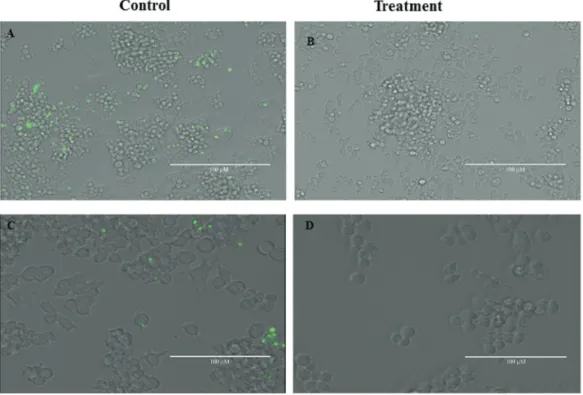
Drug assay for macrophage infection using L. brazil-iensis GFP - In the infection assay using transfected para-sites, L. braziliensis GFP promastigotes from the stationary phase containing infectious metacyclic forms were used to infect cultures of macrophages. After infection and the ac-tion of the control drug Amphotericin B, it was possible to observe the presence of fluorescent amastigotes within
macrophages in the control sample as well as the absence or undetectable levels of intracellular forms in samples treated with Amphotericin B (Fig. 2). Similar results were observed after the measurement of the fluorescence of sur-viving parasites after the lyses of macrophages and prolif-eration of extra-cellular promastigotes derived from sur-viving intracellular amastigotes (Table II).
Amphotericin B IC50 and IC90 - We get dose-response curves of amphotericin B and calculated the IC50 and IC90 values using resazurin colorimetric assay and GFP-flu-orescence assay of in vitro infection (promastigotes de-rived from intracellular amastigotes) after 48 h of ampho-tericin action. To the resazurin method IC50 was 0.77 µg/ mL (0.84 µM) and IC90 was 6.93 µg/mL (7.56 µM). To the GFP-fluorescence method the IC50 was 0.34 µg/mL (0.37 µM) and IC90 was 3.06 µg/mL (3.33 µM) (Table II). Fig. 2: visual evaluation of the macrophage infection assay using Leishmania braziliensis GFP. The images are the merge image from light micros-copy image, showing the macrophages and immunofluorescence image from L. braziliensis-GFP intracellular amastigotes (green fluorescence). (A, C): visualisation of fluorescent intracellular amastigotes in the control sample (without Amphotericin B); (B, D): visualisation of the absence of fluorescent intracellular amastigotes in the treated sample (after treatment with Amphotericin B). Scale bar: 200 µM (A, B); 100 µM (C, D).
TABLE II
Amphotericin B Leishmanicidal effect in intracellular amastigotes using the direct GFP fluorescence assay
Treatment % live cells IC50 IC90
Amphotericin B 0 ± 2.8 0.34 µg/mL (0.37 µM) 3.06 µg/mL (3.33 µM) The range of Amphotericin B concentration using in these assays were: 1.25 μg/mL; 0.625 μg/mL; 0.3125 μg/mL; 0.15625 μg/ mL; 0.078125 μg/mL; 0.0078125 μg/mL and 0.00078125 μg/mL. The IC50 and IC90 were calculated using GraphPad Prism Version
Development of new drugs for the treatment of leish-maniasis has required new methods for optimising the in vitro screening of compounds with leishmanicidal poten-tial, and reporter genes such as GFP are promising tools for this purpose (Pulido et al. 2012). Herein, we report the generation of L. braziliensis expressing GFP, revealing that the fluorescent assay is more sensible and direct than the resazurin method. The compound screening assay in
Leishmania promastigotes using the resazurin method re-quires mounting over a plaque to evaluate different times of action, as the resazurin is readily reduced by viable cells. Furthermore, long periods of resazurin incubation can make it toxic to cells and cause it to be carried to a second reduction stage, yielding hidroresofurin, a non-fluorescent and colorless product (O’Brien et al. 2000, Pace & Burg 2015), which makes it an infeasible test on a single plate for different time periods. However, when the screening is performed in promastigotes expressing GFP, the same plate can be used for all time analyses. In ad-dition, the fluorescence measurement is predicted by the efficiency of compounds directly against the parasites and is not an indirect result as in the resazurin assay. The am-photericin B IC50 andIC90 determined to in vitro infection using resazurin method or GFP-fluorescence method em-phasise the better usability of GFP in the optimisation of in vitro drug testing, since the value determined by GFP-fluorescence method was lower than that from resazurin method. This result could be explained by the needed of higher number of cells and by the presence of traces of lysed macrophages that could contribute to reduction of resazurin and may interfere in this method.
Thus, the GFP fluorescence assay was also adapted to be applied in an in vitro infection assay. The infection assay using the resazurin method has many problems, such as the difficultly of reproducibility, because the ly-sis of macrophages does not occur homogeneously, and the remaining cells not lysed on the plate can reduce re-sazurin and thus interfere with its reading. When the test is performed with parasite GFP, the macrophage lysis efficiency will not influence the fluorescence measure-ment. In addition, a control is used to subtract the intrin-sic fluorescence of macrophages.
In conclusion, our results showed that the use of
L. braziliensis GFP for screening drugs with potential against leishmaniasis is an affordable alternative, and it is more sensitive and faster in comparison to the resa-zurin method. In addition, the pLExsy plasmids can be used to produce stable L. braziliensis GFP parasites and may be useful for use in other non-L. tarentolae cells.
AUTHORS’ CONTRIBUTION
MSB - Planning of assays, standardisation of biochemi-cal assays, produced Leishmania braziliensis GFP strain, co-orientation of students, discussion and interpretation of results and paper write; LAS - done part of the biochemical assays and IC50 assay, discussion and interpretation of results and paper write; TSO - done growth curves, done part of biochemical as-says, discussion and interpretation of results and paper write; ASJ - co-orientation of students, discussion and interpretation of results and paper write; MRA - co-orientation of students, discussion and interpretation of results and paper write; GCB - co-orientation of students, discussion and interpretation of
results and paper write; JLRF - coordinator of work, planning of assays, orientation of students, discussion and interpreta-tion of results and paper write.
REFERENCES
Alvar J, Vélez ID, Bern C, Herrero M, Desjeux P, Cano J, et al. WHO Leishmaniasis Control Team. Leishmaniasis worldwide and global estimates of its incidence. PLoS ONE. 2012; 7(5): 35671.
Bolhassani A, Taheri T, Taslimi Y, Zamanilui S, Zahedifard F, Seyed N, et al. Fluorescent Leishmania species: development of stable GFP expression and its application for in vitro and in vivo stud-ies. Exp Parasitol. 2011; 127(3): 637-45.
Bopp SK, Lettieri T. Comparison of four different colorimetric and fluorometric cytotoxicity assays in a zebrafish liver cell line. BMC Pharmacol. 2008; 8: 8.
Breitling R, Klingner S, Callewaert N, Pietrucha R, Geyer A, Eh-rlich G, et al. Non-pathogenic trypanosomatid protozoa as a platform for protein research and production. Protein Expr Pu-rif. 2002; 25(2): 209-18.
Ganguly S, Bandyopadhyay S, Sarkar A, Chatterjee M. Development of a semi-automated colorimetric assay for screening anti-leish-manial agents. J Microbiol Methods. 2006; 66: 79-6.
Gould MK, Vu XL, Seebeck T, Koning HP. Propidium iodide-based methods for monitoring drug actionin the kinetoplastidae: compar-ison with the Alamar Blue assay. Anal Biochem. 2008; 382: 87-93.
Herwaldt BL. Leishmaniasis. Lancet. 1999; 354(9185): 1191-9.
Kulshrestha A, Bhandari V, Mukhopadhyay R, Ramesh V, Sundar S, Maes L, et al. Validation of a simple resazurin-based promastigote assay for the routine monitoring of miltefosine susceptibility in clini-cal isolates of Leishmania donovani. Parasitol Res. 2013; 112: 825-8.
Mikus J, Steverding D. A simple colorimetric method to screen drug cytotoxicity against Leishmania using the dye Alamar Blue. Par-asitol Int. 2000; 48(3): 265-9.
O’Brien J, Wilson I, Orton T, Pognan F. Investigation of the Alamar Blue (resazurin) fluorescent dye for the assessment of mamma-lian cell cytotoxicity. Eur J Biochem. 2000; 267(17): 5421-6.
Pace D. Leishmaniasis. J Infect. 2014; 69(1): 10-18.
Pace RT, Burg KJ. Toxic effects of resazurin on cell cultures. Cyto-technology. 2015; 67(1): 13-7.
Pulido SA, Munõz DL, Restrepo AM, Mesa CV, Alzate JF, Vélez ID, et al. Improvement of the green fluorescent protein reporter sys-tem in Leishmania spp. for the in vitro and in vivo screening of antileishmanial drugs. Acta trop. 2012; 122(1): 36-45.
Rampersad SN. Multiple applications of Alamar Blue as an indicator of metabolic function and cellular health in cell viability bioas-says. Sensors (Basel). 2012; 12(9): 12347-60.
Rocha MN, Corrêa CM, Melo MN, Beverley SM, Martins-Filho AO, Madureira AP, et al. An alternative in vitro drug screening test using Leishmaniaamazonensis transfected with red fluorescent protein. Diagn Microbiol Infect Dis. 2013; 75(3): 282-91.
Singh N, Kumar M, Singh RK. Leishmaniasis: current status of avail-able drugs and new potential drug targets. Asian Pac J Trop Med. 2012; 5(6): 485-97.
van den Bogaart E, Schoone GJ, England P, Faber D, Orrling KM, Dujardin JC, et al. Simple colorimetric trypanothione reduc-tase-based assay for high-throughput screening of drugs against
Leishmania intracellular amastigotes. Antimicrob Agents Che-mother. 2014; 58(1): 527-35.
WHO - World Health Organization [homepage on the Internet]. Media-centre. Fact sheets 375 [Updated Sept 2016; cited 2016 Oct 20]. Avail-able from: http://www.who.int/mediacentre/factsheets/fs375/en/.